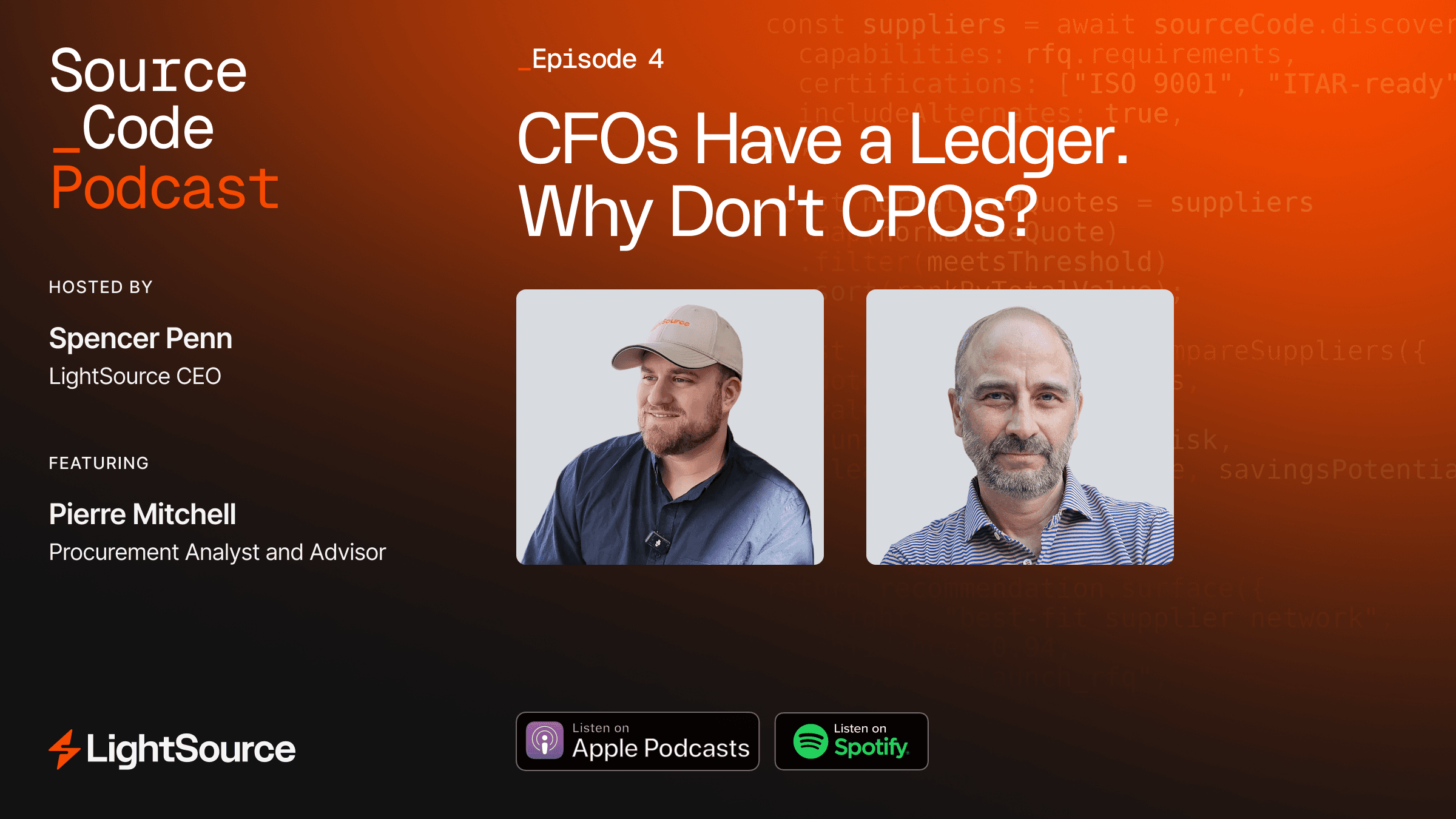
Episode 4: CFOs Have a Ledger. Why Don't CPOs?
Guest: Pierre Mitchell, Procurement Analyst & Advisor
Listen on Spotify | Listen on Apple Podcast | Listen on Amazon Music
A new chief procurement officer at a Fortune 500 company recently started her role with one question: what's being bought and where? It seems like an obvious place to start. Yet the answer wasn't sitting in a dashboard somewhere. There was no spend cube, no analytics layer, no visibility rollup. She had to go find it.
That scenario opened a recent conversation on the LightSource podcast with Pierre Mitchell, a procurement analyst who has spent over 25 years studying how companies buy and how well they manage it. The exchange covered spend analytics, agentic AI, the real limits of RPA, and why the direct vs. indirect framing may be getting in the way of smarter automation decisions.
The Spend Visibility Problem Is 25 Years Old and Still Not Solved
Pierre draws a direct comparison to financial reporting: you wouldn't expect a CFO to come in and find no general ledger. But CPOs encounter the equivalent regularly. Some companies treat the inability to track spend as a material finding. Most don't.
The old adage in procurement, Pierre notes, is that spend visibility is job one. You cannot manage what you cannot see. And yet the same problem persists across enterprise organizations that should, by any reasonable standard, have solved it by now.
Part of the reason is how these investments get evaluated. Spend analytics gets put through the same ROI filter as every other budget line. But the ROI question is the wrong one to ask. Spend analytics doesn't generate savings directly; it shows you where savings are possible. It's the treasure finder, not the treasure. Putting it on the same scorecard as a sourcing initiative misses the point entirely.
The other reason: data entropy. Companies acquire other companies. Spend taxonomies multiply. IT teams promise that the data warehouse will eventually surface the insights procurement needs. It rarely does, or not fast enough to act on. The result is that what should be running water in every procurement organization is instead a recurring project that never quite gets finished.
KPI callout: A team of seven procurement professionals managing $1.4 to $2 billion in spend is not an unusual ratio at the enterprise level. That's a ratio where the right answer is not fewer people but better-equipped people with higher-fidelity data.
AI in Procurement: Real, Not a Hype Cycle
Pierre is not AI-skeptical, but he draws a careful distinction between what AI is good at and what it isn't.
His framing centers on two worlds: neural (probabilistic, language-driven, LLM-based) and symbolic (deterministic, structured, rules-based). SaaS applications and structured data models live on the symbolic side. LLMs live on the neural side. The mistake many make is treating these as a competition. Pierre argues the value is in connecting them.
"AI doesn't replace SaaS," he said. "AI is SaaS." The point is that AI raises the demands on enterprise architectures rather than replacing them. Agentic systems still need data persistence, structured models, and reliable integrations underneath. An agent without a data model to write to is a concept, not a capability.
This is also why blockchain serves as an instructive counterexample. Blockchain was a technology in search of a problem for most enterprise use cases. AI, and particularly LLMs, are demonstrably useful in specific domains. The hype is real, but so is the underlying shift.
Where AI Has the Most Impact in Procurement: Contracts and Complexity
The area where AI has delivered the most concrete value in procurement so far is contract management. Legal documents are written in a form of structured language, what Pierre calls "legal ease," that varies by jurisdiction and organization. Extracting metadata from contracts, surfacing risk clauses, and normalizing language across large repositories is exactly the kind of complex, language-heavy work that LLMs handle well.
The same logic applies wherever there is scale and linguistic complexity: supplier communications, RFP interpretation, market intelligence synthesis. These are areas where human capacity is the real constraint, not willingness.
On the other side, the transactional work that was always a candidate for RPA will increasingly get automated. The reason RPA underperformed for so long was fragility. Every time a software vendor changed a screen layout, the automation broke. AI-assisted integration at higher levels of abstraction makes those connections more durable. The goal is to express a business intent, such as converting a PR to a PO, at a conversational level and let the AI handle the translation across multiple underlying systems.
The Workforce Replacement Question
The replacement question is real but often framed in a way that obscures the actual economics of procurement.
Pierre points to customer service as an analog. Shared service centers managing procurement help desks, FAQ handling, and intake triage are already being restructured around AI-assisted knowledge management. Productivity goes up; headcount growth slows or declines. That pattern will apply to procurement operations.
But procurement is not a labor-intensive function relative to the spend it manages. A team generating 5x to 10x ROI on their cost is not the place to optimize for headcount. The better question is how to get that ratio to 20x.
KPI callout: Procurement benchmarking research suggests ROI in the range of 5x to 7x to 10x is achievable for well-run teams. Even a conservative 2x to 3x payback positions procurement investment as a high-return allocation relative to cost of capital.
Pierre also observed that many organizations spend roughly 60% of their procurement budget on low-impact transactional activity. That's not investment; it's expense. Shifting that ratio toward strategic work is where the real leverage sits.
Direct vs. Indirect Is the Wrong Axis
The conventional procurement taxonomy draws a hard line between direct (COGS) and indirect (SG&A). Pierre largely sets it aside.
The more useful axis is complexity. Tail spend is simple regardless of whether it's direct or indirect. Three bids and a buy, automated as much as possible, is the right answer. The cost of the procurement process should not exceed the value of what's being bought. Spending $50 of procurement labor to buy a $5 stapler was the original Ariba problem, and it remains an unsolved one in many organizations.
But complexity exists on both ends. Some of the most sophisticated sourcing events are large-scale indirect categories: logistics, packaging, energy, renewables. And some direct material is highly strategic in ways that resist automation, while other direct categories are essentially interchangeable and can be sourced algorithmically.
The procurement organizations best positioned for AI-assisted automation are those that have already mapped their categories by complexity and prize size, not just by the accounting classification of where spend lands on the income statement.
Combinatorial Auctions and the Limits of Reverse Auctions
The e-auction conversation surfaces a persistent tension in procurement between simplicity and value capture.
Reverse auctions were popular during the dot-com era for obvious reasons. Watching prices drop in real time is a compelling boardroom presentation. The problem is that the format collapses the market into a single variable. You lock in the lot structure, hold everything constant, and compete only on price. That approach destroys the information value of what suppliers could actually tell you about their own cost structures and capabilities.
Pierre's argument for combinatorial auctions is that you start by opening up the market basket. Let suppliers bid on whatever combinations of items optimize their own economics. Then use combinatorial optimization to identify the allocations that best satisfy your constraints across total cost, service levels, risk tolerance, and any other objective. Run scenario planning on the constraints before you commit.
Pierre conducted research on this approach and found that combinatorial auctions outperformed straight reverse auctions across transportation and some direct categories.
The format also changes the supplier dynamic. In a reverse auction, suppliers often overbid to win the business and plan to recover margin later. In a combinatorial structure, they can bid only on what they can genuinely fulfill well. It reduces the winner's curse and surfaces the real market.
KPI callout: Pierre's own research found combinatorial auctions outperformed straight reverse auctions by a material margin across transportation and direct categories, though he noted the comparison was limited in scope.
The Technology Architecture That Actually Matters
When asked what technology category excites him most right now, Pierre points to ontologies, knowledge graphs, and data modeling.
The reason comes back to the neural-symbolic framework. The missing layer between LLMs and enterprise applications is semantic structure: a way to give the AI enough context about what things mean, how they relate, and what constraints apply. Ontologies and knowledge graphs provide that layer. They make it possible to bridge the gap between conversational, probabilistic AI and the deterministic systems that actually run procurement operations.
Palantir's platform architecture is the reference point he cites. Whatever you think of the company, their approach to modeling ontologies and building tooling around structured knowledge is the pattern worth studying for anyone building in this space.
The next generation of enterprise applications, in his view, will not be defined by which LLM is most capable. That gap is narrowing fast and will effectively disappear as a differentiator. The differentiation will come from how well a platform models the knowledge domain underneath, and how effectively it connects that model to both the language layer above and the data systems below.
Pierre Mitchell is a procurement analyst and advisor. This post is drawn from a recorded conversation on the LightSource podcast. Watch the full episode here.
Episode 4: CFOs Have a Ledger. Why Don't CPOs?
Guest: Pierre Mitchell, Procurement Analyst & Advisor
Listen on Spotify | Listen on Apple Podcast | Listen on Amazon Music
A new chief procurement officer at a Fortune 500 company recently started her role with one question: what's being bought and where? It seems like an obvious place to start. Yet the answer wasn't sitting in a dashboard somewhere. There was no spend cube, no analytics layer, no visibility rollup. She had to go find it.
That scenario opened a recent conversation on the LightSource podcast with Pierre Mitchell, a procurement analyst who has spent over 25 years studying how companies buy and how well they manage it. The exchange covered spend analytics, agentic AI, the real limits of RPA, and why the direct vs. indirect framing may be getting in the way of smarter automation decisions.
The Spend Visibility Problem Is 25 Years Old and Still Not Solved
Pierre draws a direct comparison to financial reporting: you wouldn't expect a CFO to come in and find no general ledger. But CPOs encounter the equivalent regularly. Some companies treat the inability to track spend as a material finding. Most don't.
The old adage in procurement, Pierre notes, is that spend visibility is job one. You cannot manage what you cannot see. And yet the same problem persists across enterprise organizations that should, by any reasonable standard, have solved it by now.
Part of the reason is how these investments get evaluated. Spend analytics gets put through the same ROI filter as every other budget line. But the ROI question is the wrong one to ask. Spend analytics doesn't generate savings directly; it shows you where savings are possible. It's the treasure finder, not the treasure. Putting it on the same scorecard as a sourcing initiative misses the point entirely.
The other reason: data entropy. Companies acquire other companies. Spend taxonomies multiply. IT teams promise that the data warehouse will eventually surface the insights procurement needs. It rarely does, or not fast enough to act on. The result is that what should be running water in every procurement organization is instead a recurring project that never quite gets finished.
KPI callout: A team of seven procurement professionals managing $1.4 to $2 billion in spend is not an unusual ratio at the enterprise level. That's a ratio where the right answer is not fewer people but better-equipped people with higher-fidelity data.
AI in Procurement: Real, Not a Hype Cycle
Pierre is not AI-skeptical, but he draws a careful distinction between what AI is good at and what it isn't.
His framing centers on two worlds: neural (probabilistic, language-driven, LLM-based) and symbolic (deterministic, structured, rules-based). SaaS applications and structured data models live on the symbolic side. LLMs live on the neural side. The mistake many make is treating these as a competition. Pierre argues the value is in connecting them.
"AI doesn't replace SaaS," he said. "AI is SaaS." The point is that AI raises the demands on enterprise architectures rather than replacing them. Agentic systems still need data persistence, structured models, and reliable integrations underneath. An agent without a data model to write to is a concept, not a capability.
This is also why blockchain serves as an instructive counterexample. Blockchain was a technology in search of a problem for most enterprise use cases. AI, and particularly LLMs, are demonstrably useful in specific domains. The hype is real, but so is the underlying shift.
Where AI Has the Most Impact in Procurement: Contracts and Complexity
The area where AI has delivered the most concrete value in procurement so far is contract management. Legal documents are written in a form of structured language, what Pierre calls "legal ease," that varies by jurisdiction and organization. Extracting metadata from contracts, surfacing risk clauses, and normalizing language across large repositories is exactly the kind of complex, language-heavy work that LLMs handle well.
The same logic applies wherever there is scale and linguistic complexity: supplier communications, RFP interpretation, market intelligence synthesis. These are areas where human capacity is the real constraint, not willingness.
On the other side, the transactional work that was always a candidate for RPA will increasingly get automated. The reason RPA underperformed for so long was fragility. Every time a software vendor changed a screen layout, the automation broke. AI-assisted integration at higher levels of abstraction makes those connections more durable. The goal is to express a business intent, such as converting a PR to a PO, at a conversational level and let the AI handle the translation across multiple underlying systems.
The Workforce Replacement Question
The replacement question is real but often framed in a way that obscures the actual economics of procurement.
Pierre points to customer service as an analog. Shared service centers managing procurement help desks, FAQ handling, and intake triage are already being restructured around AI-assisted knowledge management. Productivity goes up; headcount growth slows or declines. That pattern will apply to procurement operations.
But procurement is not a labor-intensive function relative to the spend it manages. A team generating 5x to 10x ROI on their cost is not the place to optimize for headcount. The better question is how to get that ratio to 20x.
KPI callout: Procurement benchmarking research suggests ROI in the range of 5x to 7x to 10x is achievable for well-run teams. Even a conservative 2x to 3x payback positions procurement investment as a high-return allocation relative to cost of capital.
Pierre also observed that many organizations spend roughly 60% of their procurement budget on low-impact transactional activity. That's not investment; it's expense. Shifting that ratio toward strategic work is where the real leverage sits.
Direct vs. Indirect Is the Wrong Axis
The conventional procurement taxonomy draws a hard line between direct (COGS) and indirect (SG&A). Pierre largely sets it aside.
The more useful axis is complexity. Tail spend is simple regardless of whether it's direct or indirect. Three bids and a buy, automated as much as possible, is the right answer. The cost of the procurement process should not exceed the value of what's being bought. Spending $50 of procurement labor to buy a $5 stapler was the original Ariba problem, and it remains an unsolved one in many organizations.
But complexity exists on both ends. Some of the most sophisticated sourcing events are large-scale indirect categories: logistics, packaging, energy, renewables. And some direct material is highly strategic in ways that resist automation, while other direct categories are essentially interchangeable and can be sourced algorithmically.
The procurement organizations best positioned for AI-assisted automation are those that have already mapped their categories by complexity and prize size, not just by the accounting classification of where spend lands on the income statement.
Combinatorial Auctions and the Limits of Reverse Auctions
The e-auction conversation surfaces a persistent tension in procurement between simplicity and value capture.
Reverse auctions were popular during the dot-com era for obvious reasons. Watching prices drop in real time is a compelling boardroom presentation. The problem is that the format collapses the market into a single variable. You lock in the lot structure, hold everything constant, and compete only on price. That approach destroys the information value of what suppliers could actually tell you about their own cost structures and capabilities.
Pierre's argument for combinatorial auctions is that you start by opening up the market basket. Let suppliers bid on whatever combinations of items optimize their own economics. Then use combinatorial optimization to identify the allocations that best satisfy your constraints across total cost, service levels, risk tolerance, and any other objective. Run scenario planning on the constraints before you commit.
Pierre conducted research on this approach and found that combinatorial auctions outperformed straight reverse auctions across transportation and some direct categories.
The format also changes the supplier dynamic. In a reverse auction, suppliers often overbid to win the business and plan to recover margin later. In a combinatorial structure, they can bid only on what they can genuinely fulfill well. It reduces the winner's curse and surfaces the real market.
KPI callout: Pierre's own research found combinatorial auctions outperformed straight reverse auctions by a material margin across transportation and direct categories, though he noted the comparison was limited in scope.
The Technology Architecture That Actually Matters
When asked what technology category excites him most right now, Pierre points to ontologies, knowledge graphs, and data modeling.
The reason comes back to the neural-symbolic framework. The missing layer between LLMs and enterprise applications is semantic structure: a way to give the AI enough context about what things mean, how they relate, and what constraints apply. Ontologies and knowledge graphs provide that layer. They make it possible to bridge the gap between conversational, probabilistic AI and the deterministic systems that actually run procurement operations.
Palantir's platform architecture is the reference point he cites. Whatever you think of the company, their approach to modeling ontologies and building tooling around structured knowledge is the pattern worth studying for anyone building in this space.
The next generation of enterprise applications, in his view, will not be defined by which LLM is most capable. That gap is narrowing fast and will effectively disappear as a differentiator. The differentiation will come from how well a platform models the knowledge domain underneath, and how effectively it connects that model to both the language layer above and the data systems below.
Pierre Mitchell is a procurement analyst and advisor. This post is drawn from a recorded conversation on the LightSource podcast. Watch the full episode here.
Episode 4: CFOs Have a Ledger. Why Don't CPOs?
Guest: Pierre Mitchell, Procurement Analyst & Advisor
Listen on Spotify | Listen on Apple Podcast | Listen on Amazon Music
A new chief procurement officer at a Fortune 500 company recently started her role with one question: what's being bought and where? It seems like an obvious place to start. Yet the answer wasn't sitting in a dashboard somewhere. There was no spend cube, no analytics layer, no visibility rollup. She had to go find it.
That scenario opened a recent conversation on the LightSource podcast with Pierre Mitchell, a procurement analyst who has spent over 25 years studying how companies buy and how well they manage it. The exchange covered spend analytics, agentic AI, the real limits of RPA, and why the direct vs. indirect framing may be getting in the way of smarter automation decisions.
The Spend Visibility Problem Is 25 Years Old and Still Not Solved
Pierre draws a direct comparison to financial reporting: you wouldn't expect a CFO to come in and find no general ledger. But CPOs encounter the equivalent regularly. Some companies treat the inability to track spend as a material finding. Most don't.
The old adage in procurement, Pierre notes, is that spend visibility is job one. You cannot manage what you cannot see. And yet the same problem persists across enterprise organizations that should, by any reasonable standard, have solved it by now.
Part of the reason is how these investments get evaluated. Spend analytics gets put through the same ROI filter as every other budget line. But the ROI question is the wrong one to ask. Spend analytics doesn't generate savings directly; it shows you where savings are possible. It's the treasure finder, not the treasure. Putting it on the same scorecard as a sourcing initiative misses the point entirely.
The other reason: data entropy. Companies acquire other companies. Spend taxonomies multiply. IT teams promise that the data warehouse will eventually surface the insights procurement needs. It rarely does, or not fast enough to act on. The result is that what should be running water in every procurement organization is instead a recurring project that never quite gets finished.
KPI callout: A team of seven procurement professionals managing $1.4 to $2 billion in spend is not an unusual ratio at the enterprise level. That's a ratio where the right answer is not fewer people but better-equipped people with higher-fidelity data.
AI in Procurement: Real, Not a Hype Cycle
Pierre is not AI-skeptical, but he draws a careful distinction between what AI is good at and what it isn't.
His framing centers on two worlds: neural (probabilistic, language-driven, LLM-based) and symbolic (deterministic, structured, rules-based). SaaS applications and structured data models live on the symbolic side. LLMs live on the neural side. The mistake many make is treating these as a competition. Pierre argues the value is in connecting them.
"AI doesn't replace SaaS," he said. "AI is SaaS." The point is that AI raises the demands on enterprise architectures rather than replacing them. Agentic systems still need data persistence, structured models, and reliable integrations underneath. An agent without a data model to write to is a concept, not a capability.
This is also why blockchain serves as an instructive counterexample. Blockchain was a technology in search of a problem for most enterprise use cases. AI, and particularly LLMs, are demonstrably useful in specific domains. The hype is real, but so is the underlying shift.
Where AI Has the Most Impact in Procurement: Contracts and Complexity
The area where AI has delivered the most concrete value in procurement so far is contract management. Legal documents are written in a form of structured language, what Pierre calls "legal ease," that varies by jurisdiction and organization. Extracting metadata from contracts, surfacing risk clauses, and normalizing language across large repositories is exactly the kind of complex, language-heavy work that LLMs handle well.
The same logic applies wherever there is scale and linguistic complexity: supplier communications, RFP interpretation, market intelligence synthesis. These are areas where human capacity is the real constraint, not willingness.
On the other side, the transactional work that was always a candidate for RPA will increasingly get automated. The reason RPA underperformed for so long was fragility. Every time a software vendor changed a screen layout, the automation broke. AI-assisted integration at higher levels of abstraction makes those connections more durable. The goal is to express a business intent, such as converting a PR to a PO, at a conversational level and let the AI handle the translation across multiple underlying systems.
The Workforce Replacement Question
The replacement question is real but often framed in a way that obscures the actual economics of procurement.
Pierre points to customer service as an analog. Shared service centers managing procurement help desks, FAQ handling, and intake triage are already being restructured around AI-assisted knowledge management. Productivity goes up; headcount growth slows or declines. That pattern will apply to procurement operations.
But procurement is not a labor-intensive function relative to the spend it manages. A team generating 5x to 10x ROI on their cost is not the place to optimize for headcount. The better question is how to get that ratio to 20x.
KPI callout: Procurement benchmarking research suggests ROI in the range of 5x to 7x to 10x is achievable for well-run teams. Even a conservative 2x to 3x payback positions procurement investment as a high-return allocation relative to cost of capital.
Pierre also observed that many organizations spend roughly 60% of their procurement budget on low-impact transactional activity. That's not investment; it's expense. Shifting that ratio toward strategic work is where the real leverage sits.
Direct vs. Indirect Is the Wrong Axis
The conventional procurement taxonomy draws a hard line between direct (COGS) and indirect (SG&A). Pierre largely sets it aside.
The more useful axis is complexity. Tail spend is simple regardless of whether it's direct or indirect. Three bids and a buy, automated as much as possible, is the right answer. The cost of the procurement process should not exceed the value of what's being bought. Spending $50 of procurement labor to buy a $5 stapler was the original Ariba problem, and it remains an unsolved one in many organizations.
But complexity exists on both ends. Some of the most sophisticated sourcing events are large-scale indirect categories: logistics, packaging, energy, renewables. And some direct material is highly strategic in ways that resist automation, while other direct categories are essentially interchangeable and can be sourced algorithmically.
The procurement organizations best positioned for AI-assisted automation are those that have already mapped their categories by complexity and prize size, not just by the accounting classification of where spend lands on the income statement.
Combinatorial Auctions and the Limits of Reverse Auctions
The e-auction conversation surfaces a persistent tension in procurement between simplicity and value capture.
Reverse auctions were popular during the dot-com era for obvious reasons. Watching prices drop in real time is a compelling boardroom presentation. The problem is that the format collapses the market into a single variable. You lock in the lot structure, hold everything constant, and compete only on price. That approach destroys the information value of what suppliers could actually tell you about their own cost structures and capabilities.
Pierre's argument for combinatorial auctions is that you start by opening up the market basket. Let suppliers bid on whatever combinations of items optimize their own economics. Then use combinatorial optimization to identify the allocations that best satisfy your constraints across total cost, service levels, risk tolerance, and any other objective. Run scenario planning on the constraints before you commit.
Pierre conducted research on this approach and found that combinatorial auctions outperformed straight reverse auctions across transportation and some direct categories.
The format also changes the supplier dynamic. In a reverse auction, suppliers often overbid to win the business and plan to recover margin later. In a combinatorial structure, they can bid only on what they can genuinely fulfill well. It reduces the winner's curse and surfaces the real market.
KPI callout: Pierre's own research found combinatorial auctions outperformed straight reverse auctions by a material margin across transportation and direct categories, though he noted the comparison was limited in scope.
The Technology Architecture That Actually Matters
When asked what technology category excites him most right now, Pierre points to ontologies, knowledge graphs, and data modeling.
The reason comes back to the neural-symbolic framework. The missing layer between LLMs and enterprise applications is semantic structure: a way to give the AI enough context about what things mean, how they relate, and what constraints apply. Ontologies and knowledge graphs provide that layer. They make it possible to bridge the gap between conversational, probabilistic AI and the deterministic systems that actually run procurement operations.
Palantir's platform architecture is the reference point he cites. Whatever you think of the company, their approach to modeling ontologies and building tooling around structured knowledge is the pattern worth studying for anyone building in this space.
The next generation of enterprise applications, in his view, will not be defined by which LLM is most capable. That gap is narrowing fast and will effectively disappear as a differentiator. The differentiation will come from how well a platform models the knowledge domain underneath, and how effectively it connects that model to both the language layer above and the data systems below.
Pierre Mitchell is a procurement analyst and advisor. This post is drawn from a recorded conversation on the LightSource podcast. Watch the full episode here.
Read more

Source Code Episode 9: Source Code: Shashi Mandapaty, Former Chief Procurement Officer at Johnson & Johnson, on Why One Throne Isn't Enough

Source Code Episode 8: Running on Paper: Rick McDonald, Chief Supply Chain Officer at Clorox, on Why Supplier Trust Is the Real Business Continuity Plan

The IEEPA Ruling Wasn't a Win. Here's What Procurement Leaders Are Missing.
Read more
Source Code Episode 9: Source Code: Shashi Mandapaty, Former Chief Procurement Officer at Johnson & Johnson, on Why One Throne Isn't Enough
Source Code Episode 8: Running on Paper: Rick McDonald, Chief Supply Chain Officer at Clorox, on Why Supplier Trust Is the Real Business Continuity Plan
The IEEPA Ruling Wasn't a Win. Here's What Procurement Leaders Are Missing.
Read more
Source Code Episode 9: Source Code: Shashi Mandapaty, Former Chief Procurement Officer at Johnson & Johnson, on Why One Throne Isn't Enough
Source Code Episode 8: Running on Paper: Rick McDonald, Chief Supply Chain Officer at Clorox, on Why Supplier Trust Is the Real Business Continuity Plan
The IEEPA Ruling Wasn't a Win. Here's What Procurement Leaders Are Missing.
Faster sourcing. Lower cost. Less chaos.
See how LightSource connects engineering, procurement, and suppliers in one operating system to help you launch faster at lower cost.
SOC 2
Kearney #1 2024
Gartner Cool Vendor
Procuretech 100
G2 Top Rated
Faster sourcing. Lower cost. Less chaos.
See how LightSource connects engineering, procurement, and suppliers in one operating system to help you launch faster at lower cost.
SOC 2
Kearney #1 2024
Gartner Cool Vendor
Procuretech 100
G2 Top Rated
Faster sourcing. Lower cost. Less chaos.
See how LightSource connects engineering, procurement, and suppliers in one operating system to help you launch faster at lower cost.
SOC 2
Kearney #1 2024
Gartner Cool Vendor
Procuretech 100
G2 Top Rated
Trusted by:
Trusted by:
Trusted by:
*GARTNER is a registered trademark and service mark of Gartner, Inc. and/or its affiliates in the U.S. and internationally, and COOL VENDORS is a registered trademark of Gartner, Inc. and/or its affiliates and are used herein with permission. All rights reserved. Gartner does not endorse any vendor, product or service depicted in its research publications, and does not advise technology users to select only those vendors with the highest ratings or other designation. Gartner research publications consist of the opinions of Gartner’s research organization and should not be construed as statements of fact. Gartner disclaims all warranties, expressed or implied, with respect to this research, including any warranties of merchantability or fitness for a particular purpose.