

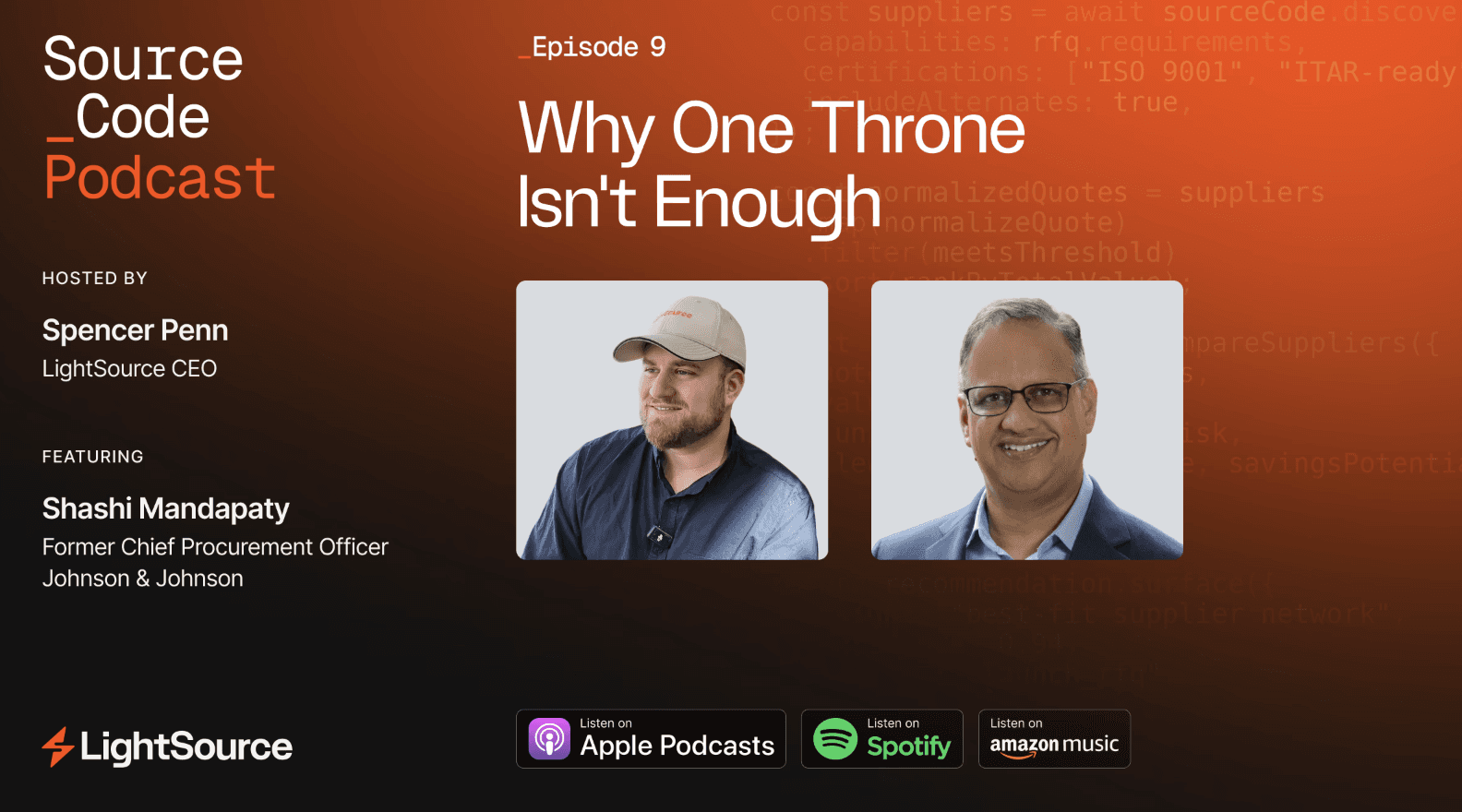
Guest: Shashi Mandapaty, Former Chief Procurement Officer, Johnson & Johnson; Advisor to the National Cancer Institute in India
Listen on Spotify | Listen on Apple Podcasts | Listen on Amazon Music
Most executives reach the top of one function and stay there until retirement. Shashi Parekh reached the top of procurement at a $400 billion pharmaceutical giant, looked around, and decided the job wasn’t big enough for what he actually wanted to do. He cut his time at Johnson & Johnson in half and spent the other half building the world’s largest cancer biorepository in India, a research initiative born from his experience as a stage four cancer survivor and shaped entirely by the procurement muscles he’d built over thirty years. “I don’t think there’s any giving back,” he tells Spencer, “because what I realize is that I do only those things where I get something out of it. I get a lot of satisfaction, and that’s the reason why I’m doing it.” It’s a clarifying move in a career that’s been defined by calculated risks that nobody would predict: an electrical engineer who became a procurement executive, a global operator who learned the job in the chaos of post-Soviet Russia, a CPO who decided the real work wasn’t buying better, it was building institutions in countries where cancer outcomes are three times worse than they need to be.
Guest: Shashi Parekh, Former Chief Procurement Officer, Johnson & Johnson; Advisor to the National Cancer Institute in India; Founder of multiple healthcare advisory boards
In the span of 30+ years, Parekh moved from an electrical engineering background to running procurement at Procter & Gamble, through the volatility of Eastern Europe, and into the Chief Procurement Officer role at Johnson & Johnson, where he oversaw over $10 billion in annual spend. He’s now pursuing what he calls a “plural career,” splitting time between advisory roles at major pharma companies and building a dedicated research division at the National Cancer Institute in India. In this episode, he and Spencer trace that arc: how an engineer becomes a global procurement leader, why the skills that save money also save lives, and what it means to design a career around the problems you actually care about solving.
Why India Has a Cancer Problem the World Doesn’t Understand
The gap between cancer outcomes in India and the United States doesn’t sound like an engineering problem, but it is. Shashi walks through the numbers like a sourcing manager reviewing a supplier scorecard. India is number three in the world in absolute cancer incidence, behind only the US and China. But India is number two in absolute deaths. And when you calculate the mortality-to-incidence ratio, India sits at the top of the list among high-incidence countries. “If someone is detected with cancer in India, odds are they will succumb to the disease in 65% of cases, whereas it is 25% in the US,” he says. That’s a three-times-higher death rate. But there’s a catch in the data: only 10% of cancer cases in India are even reported. Most of them are urban. Rural cancer is invisible, which means the real numbers are almost certainly worse.
The disease profile is completely different, too. American cancer is mostly a disease of the elderly—prostate cancer alone accounts for nearly a third of male cancer incidence. Indian cancer is a disease of the young, and most of it is avoidable. A third of male cancers in India come from tobacco, oral consumption or smoking. Another major category comes from infectious causes: cervical cancer from HPV, other cancers from preventable infections. “If you were to add rural data, those numbers will only get worse,” Shashi says. Even where the disease overlaps, the presentation is different. Breast cancer is the leading cancer in women in both countries, but in the US it’s mostly postmenopausal women. In India, it shows up almost a decade earlier, in late thirties and early forties. Something in the epidemiology is fundamentally different, and nobody knows what it is because the research hasn’t been done.
From an Electrical Engineer to a $4 Billion Procurement Function
Shashi never planned to work in procurement. He studied electrical engineering and took the first job he could find—unpaid work at a boiler-manufacturing plant building thermic fluid heaters, the kind of equipment that heats industrial processes by circulating high-temperature fluid instead of steam. He stayed because he liked the immediate feedback loop: you change something, you see the output move. That instinct carried him through ten years at Thermax and then Frito-Lay, running manufacturing plants and learning supervision the old way: on the floor, watching production, understanding every constraint.
Procter & Gamble recruited him into supply chain and procurement, the division managing raw materials and packaging for brands across Asia. It was early days for strategic sourcing as a discipline, and Shashi volunteered for an internal pilot, a small $13 million spend in charcoal and related materials for Kingsford. He sourced new raw materials that ultimately solved a problem that had failed before: how to get sawdust to absorb properly so that Kingsford charcoal briquettes could make smoke smell better. That small sourcing project returned $4 million in savings and created a product claim. “The idea itself had failed five or ten years earlier because nobody had figured out the technical problem. A new engineer solved that, and a shelved idea became a product claim.”
That pattern, of bringing technical rigor and process discipline to problems that seemed intractable, defined his entire career. In 2004, P&G sent him to Moscow to set up the procurement organization for all of Eastern Europe—a territory running from Israel to Pakistan, a region everyone called “the CNN countries” because they were always on CNN for the wrong reasons. It was chaotic, high-stakes, and exactly what he needed. “We had to get the currencies right. We had to make sure suppliers were as localized as possible. We had to build local talent.” He spent four years there and learned how to operate in markets where the rules are written every week.
Clorox brought him in eventually, and by the time he became Chief Procurement Officer, his remit stretched across the full organization. He managed $10 billion in annual spend and a global procurement organization of hundreds. He moved through COVID, the inflation spike that followed, and then August 2023, when systems stopped working entirely.
Building the World’s Largest Cancer Biorepository with Procurement Skills
The shift into cancer research came from both necessity and belief. Shashi is a stage four cancer survivor who has spent the last three years building a research division at the National Cancer Institute in India, modeling it on the comprehensive cancer center framework that works in the United States—patient care, education, and research, all operating at the highest level under one roof.
The centerpiece is a biorepository: not just a frozen storage vault, but an annotated, genomically catalogued, multiomically tagged collection of tissue samples linked to patient records, all of it standardized to global ethical and technical standards. The idea is that a researcher looking for a specific cancer type—say, pediatric head and neck cancer in patients with a particular genetic marker—can get that sample in weeks instead of waiting two to four years for the right patient to come through their own hospital. “The sooner a researcher can get access to such samples, the faster would be the research. Many times you have researchers stuck because they want a specific sample and there are not enough patients or the sample is not being stored or they don’t have access to it.”
Building this required the exact same skill set that made him effective in procurement. Identify what’s needed. Find the capabilities that exist inside and outside your organization. Assemble them sustainably. “My role here is to establish a strategy that will help identify capabilities—some we may build inhouse, some we will build, some we will tie in with wherever that capability exists—to meet the needs of patients in South Asia.”
The business case, as he calls it (though it’s a nonprofit), required the same rigor. You need capital investment upfront. You need a plan for sustainability. You need buy-in from the board and the leadership. He spent six months building that case and presented it to the chief minister of Maharashtra. It was unanimous, with a commitment to fund the initial phase.
The Plural Career: When One Thing Isn’t Enough
What makes Shashi’s move unusual isn’t the transition—plenty of executives move from corporate to nonprofit. It’s the structure. He didn’t retire from J&J and then move to India. Instead, he carved out a portfolio: 50% dedicated to the National Cancer Institute India initiative, the other 50% still on procurement, working with multiple companies in advisory capacity and private equity firms. “I don’t want to take on another CPO role, but I want to grow. I want to grow not just from a financial perspective, but also from areas I can learn and have ability to work on things very close to my heart.”
It’s a deliberate hedge against the singular-focus career model. One company, one revenue stream, one source of growth. “Now I have multiple sources of revenue, multiple sources of growth. I’m not saying this is the right thing for everyone, but for someone like me, I felt like this was the right time to make the transition to a plural career.”
The math works because, as he frames it, he’s not actually giving anything up. The same procurement instincts apply to a biorepository build. The same relationship-management skills that kept a $10 billion spend flowing now keep a capital-intensive research initiative aligned with stakeholders. And the work itself pays better in satisfaction than any title ever could.
Why Relationships Matter More Than Systems
If there’s a single thread that runs through Shashi’s career, it’s that relationships are the infrastructure that systems run on top of. He saw this most clearly during a crisis at a company he advised, not dissimilar to the Clorox cyberattack but with a different impact: a major supplier’s facility went down, and the company faced potential disruption. The supplier, facing their own cash crunch from the outage, didn’t walk away. “We had built relationships over years, and they stuck with us even when it would have been rational for them not to.”
In the cancer institute work, the same principle applies. He needed institutional partnerships. He needed researchers willing to lend credibility to a new initiative in a market they didn’t know. He needed board members and advisors who would open doors. “The connections are going to be very important. There are two big things that go hand in hand: knowledge and money. And access. The access is really invaluable in any direction.”
His advice to procurement leaders is almost heretical in a function that tends to view suppliers as adversaries to extract value from: understand what your supplier needs. Build relationships before you need them. Don’t treat the 100-day payment stretch as a favor you’re asking for—it’s what happens when you’ve actually invested in the relationship over time.
The #1 Skill That Actually Gets You to CPO
Asked what it takes to become a Chief Procurement Officer, Shashi doesn’t say “master negotiation” or “understand global supply chain.” He says: get close to the business. “I think understanding the business that you are part of. You are not supporting the business, you are part of the business.”
This isn’t abstract. In Eastern Europe, the wrong currency decision could blow up the whole region’s P&L. In pharma, managing the CRO relationship for drug trials is the difference between a drug that launches on time and one that slips. “When you’re working in a cross-functional team, if you as a procurement person know the industries that you buy from really well, and you understand the business inside, you can communicate the way any other function can. You become indispensable.”
The pattern that got him promoted repeatedly was the same: volunteer for the uncomfortable role. Move into marketing despite having no training. Take a job in Moscow during unstable times. Build something that hasn’t been built before. “I was continuously going out of my comfort zone. I didn’t see it as risk—I thought it was the right thing to do. I’d have fun. So I just did it.”
That willingness to take the risk is what created the opportunities that a typical procurement track would never offer. And those opportunities created the perspective that made him useful beyond procurement entirely.
When the Good Idea Gets Shelved, Keep It Anyway
Shashi’s last insight is about timing, which might be the most important variable nobody controls. The Kingsford charcoal idea—charcoal briquettes made with super-saturated sawdust—failed once before. It sat on the shelf for years. Then a different engineer tried a different approach, solved the problem, and the idea worked. “Sometimes the idea, its time is not there. You put it on the shelf, but you got to come back to it, because good ideas, there’ll be a time for them at some point.”
He sees the same arc in cancer research. India needs this research now. But he’s also building it with the assumption that some of the ideas won’t work immediately. Some will need to wait. Some will need a different approach next time someone picks them up. The point is to build the institution that allows you to keep working on the hard problems, through the times when they seem impossible, until the moment when they’re not.
It’s not a message that fits neatly on a motivational poster, which might be why it matters. Build the relationships. Take the uncomfortable roles. Keep the good ideas alive even after they fail. Structure your life so you can work on the things that matter, not just the things that pay. And understand that getting to the top of one function is often just the opportunity to do something bigger with what you’ve learned.
Guest: Shashi Mandapaty, Former Chief Procurement Officer, Johnson & Johnson; Advisor to the National Cancer Institute in India
Listen on Spotify | Listen on Apple Podcasts | Listen on Amazon Music
Most executives reach the top of one function and stay there until retirement. Shashi Parekh reached the top of procurement at a $400 billion pharmaceutical giant, looked around, and decided the job wasn’t big enough for what he actually wanted to do. He cut his time at Johnson & Johnson in half and spent the other half building the world’s largest cancer biorepository in India, a research initiative born from his experience as a stage four cancer survivor and shaped entirely by the procurement muscles he’d built over thirty years. “I don’t think there’s any giving back,” he tells Spencer, “because what I realize is that I do only those things where I get something out of it. I get a lot of satisfaction, and that’s the reason why I’m doing it.” It’s a clarifying move in a career that’s been defined by calculated risks that nobody would predict: an electrical engineer who became a procurement executive, a global operator who learned the job in the chaos of post-Soviet Russia, a CPO who decided the real work wasn’t buying better, it was building institutions in countries where cancer outcomes are three times worse than they need to be.
Guest: Shashi Parekh, Former Chief Procurement Officer, Johnson & Johnson; Advisor to the National Cancer Institute in India; Founder of multiple healthcare advisory boards
In the span of 30+ years, Parekh moved from an electrical engineering background to running procurement at Procter & Gamble, through the volatility of Eastern Europe, and into the Chief Procurement Officer role at Johnson & Johnson, where he oversaw over $10 billion in annual spend. He’s now pursuing what he calls a “plural career,” splitting time between advisory roles at major pharma companies and building a dedicated research division at the National Cancer Institute in India. In this episode, he and Spencer trace that arc: how an engineer becomes a global procurement leader, why the skills that save money also save lives, and what it means to design a career around the problems you actually care about solving.
Why India Has a Cancer Problem the World Doesn’t Understand
The gap between cancer outcomes in India and the United States doesn’t sound like an engineering problem, but it is. Shashi walks through the numbers like a sourcing manager reviewing a supplier scorecard. India is number three in the world in absolute cancer incidence, behind only the US and China. But India is number two in absolute deaths. And when you calculate the mortality-to-incidence ratio, India sits at the top of the list among high-incidence countries. “If someone is detected with cancer in India, odds are they will succumb to the disease in 65% of cases, whereas it is 25% in the US,” he says. That’s a three-times-higher death rate. But there’s a catch in the data: only 10% of cancer cases in India are even reported. Most of them are urban. Rural cancer is invisible, which means the real numbers are almost certainly worse.
The disease profile is completely different, too. American cancer is mostly a disease of the elderly—prostate cancer alone accounts for nearly a third of male cancer incidence. Indian cancer is a disease of the young, and most of it is avoidable. A third of male cancers in India come from tobacco, oral consumption or smoking. Another major category comes from infectious causes: cervical cancer from HPV, other cancers from preventable infections. “If you were to add rural data, those numbers will only get worse,” Shashi says. Even where the disease overlaps, the presentation is different. Breast cancer is the leading cancer in women in both countries, but in the US it’s mostly postmenopausal women. In India, it shows up almost a decade earlier, in late thirties and early forties. Something in the epidemiology is fundamentally different, and nobody knows what it is because the research hasn’t been done.
From an Electrical Engineer to a $4 Billion Procurement Function
Shashi never planned to work in procurement. He studied electrical engineering and took the first job he could find—unpaid work at a boiler-manufacturing plant building thermic fluid heaters, the kind of equipment that heats industrial processes by circulating high-temperature fluid instead of steam. He stayed because he liked the immediate feedback loop: you change something, you see the output move. That instinct carried him through ten years at Thermax and then Frito-Lay, running manufacturing plants and learning supervision the old way: on the floor, watching production, understanding every constraint.
Procter & Gamble recruited him into supply chain and procurement, the division managing raw materials and packaging for brands across Asia. It was early days for strategic sourcing as a discipline, and Shashi volunteered for an internal pilot, a small $13 million spend in charcoal and related materials for Kingsford. He sourced new raw materials that ultimately solved a problem that had failed before: how to get sawdust to absorb properly so that Kingsford charcoal briquettes could make smoke smell better. That small sourcing project returned $4 million in savings and created a product claim. “The idea itself had failed five or ten years earlier because nobody had figured out the technical problem. A new engineer solved that, and a shelved idea became a product claim.”
That pattern, of bringing technical rigor and process discipline to problems that seemed intractable, defined his entire career. In 2004, P&G sent him to Moscow to set up the procurement organization for all of Eastern Europe—a territory running from Israel to Pakistan, a region everyone called “the CNN countries” because they were always on CNN for the wrong reasons. It was chaotic, high-stakes, and exactly what he needed. “We had to get the currencies right. We had to make sure suppliers were as localized as possible. We had to build local talent.” He spent four years there and learned how to operate in markets where the rules are written every week.
Clorox brought him in eventually, and by the time he became Chief Procurement Officer, his remit stretched across the full organization. He managed $10 billion in annual spend and a global procurement organization of hundreds. He moved through COVID, the inflation spike that followed, and then August 2023, when systems stopped working entirely.
Building the World’s Largest Cancer Biorepository with Procurement Skills
The shift into cancer research came from both necessity and belief. Shashi is a stage four cancer survivor who has spent the last three years building a research division at the National Cancer Institute in India, modeling it on the comprehensive cancer center framework that works in the United States—patient care, education, and research, all operating at the highest level under one roof.
The centerpiece is a biorepository: not just a frozen storage vault, but an annotated, genomically catalogued, multiomically tagged collection of tissue samples linked to patient records, all of it standardized to global ethical and technical standards. The idea is that a researcher looking for a specific cancer type—say, pediatric head and neck cancer in patients with a particular genetic marker—can get that sample in weeks instead of waiting two to four years for the right patient to come through their own hospital. “The sooner a researcher can get access to such samples, the faster would be the research. Many times you have researchers stuck because they want a specific sample and there are not enough patients or the sample is not being stored or they don’t have access to it.”
Building this required the exact same skill set that made him effective in procurement. Identify what’s needed. Find the capabilities that exist inside and outside your organization. Assemble them sustainably. “My role here is to establish a strategy that will help identify capabilities—some we may build inhouse, some we will build, some we will tie in with wherever that capability exists—to meet the needs of patients in South Asia.”
The business case, as he calls it (though it’s a nonprofit), required the same rigor. You need capital investment upfront. You need a plan for sustainability. You need buy-in from the board and the leadership. He spent six months building that case and presented it to the chief minister of Maharashtra. It was unanimous, with a commitment to fund the initial phase.
The Plural Career: When One Thing Isn’t Enough
What makes Shashi’s move unusual isn’t the transition—plenty of executives move from corporate to nonprofit. It’s the structure. He didn’t retire from J&J and then move to India. Instead, he carved out a portfolio: 50% dedicated to the National Cancer Institute India initiative, the other 50% still on procurement, working with multiple companies in advisory capacity and private equity firms. “I don’t want to take on another CPO role, but I want to grow. I want to grow not just from a financial perspective, but also from areas I can learn and have ability to work on things very close to my heart.”
It’s a deliberate hedge against the singular-focus career model. One company, one revenue stream, one source of growth. “Now I have multiple sources of revenue, multiple sources of growth. I’m not saying this is the right thing for everyone, but for someone like me, I felt like this was the right time to make the transition to a plural career.”
The math works because, as he frames it, he’s not actually giving anything up. The same procurement instincts apply to a biorepository build. The same relationship-management skills that kept a $10 billion spend flowing now keep a capital-intensive research initiative aligned with stakeholders. And the work itself pays better in satisfaction than any title ever could.
Why Relationships Matter More Than Systems
If there’s a single thread that runs through Shashi’s career, it’s that relationships are the infrastructure that systems run on top of. He saw this most clearly during a crisis at a company he advised, not dissimilar to the Clorox cyberattack but with a different impact: a major supplier’s facility went down, and the company faced potential disruption. The supplier, facing their own cash crunch from the outage, didn’t walk away. “We had built relationships over years, and they stuck with us even when it would have been rational for them not to.”
In the cancer institute work, the same principle applies. He needed institutional partnerships. He needed researchers willing to lend credibility to a new initiative in a market they didn’t know. He needed board members and advisors who would open doors. “The connections are going to be very important. There are two big things that go hand in hand: knowledge and money. And access. The access is really invaluable in any direction.”
His advice to procurement leaders is almost heretical in a function that tends to view suppliers as adversaries to extract value from: understand what your supplier needs. Build relationships before you need them. Don’t treat the 100-day payment stretch as a favor you’re asking for—it’s what happens when you’ve actually invested in the relationship over time.
The #1 Skill That Actually Gets You to CPO
Asked what it takes to become a Chief Procurement Officer, Shashi doesn’t say “master negotiation” or “understand global supply chain.” He says: get close to the business. “I think understanding the business that you are part of. You are not supporting the business, you are part of the business.”
This isn’t abstract. In Eastern Europe, the wrong currency decision could blow up the whole region’s P&L. In pharma, managing the CRO relationship for drug trials is the difference between a drug that launches on time and one that slips. “When you’re working in a cross-functional team, if you as a procurement person know the industries that you buy from really well, and you understand the business inside, you can communicate the way any other function can. You become indispensable.”
The pattern that got him promoted repeatedly was the same: volunteer for the uncomfortable role. Move into marketing despite having no training. Take a job in Moscow during unstable times. Build something that hasn’t been built before. “I was continuously going out of my comfort zone. I didn’t see it as risk—I thought it was the right thing to do. I’d have fun. So I just did it.”
That willingness to take the risk is what created the opportunities that a typical procurement track would never offer. And those opportunities created the perspective that made him useful beyond procurement entirely.
When the Good Idea Gets Shelved, Keep It Anyway
Shashi’s last insight is about timing, which might be the most important variable nobody controls. The Kingsford charcoal idea—charcoal briquettes made with super-saturated sawdust—failed once before. It sat on the shelf for years. Then a different engineer tried a different approach, solved the problem, and the idea worked. “Sometimes the idea, its time is not there. You put it on the shelf, but you got to come back to it, because good ideas, there’ll be a time for them at some point.”
He sees the same arc in cancer research. India needs this research now. But he’s also building it with the assumption that some of the ideas won’t work immediately. Some will need to wait. Some will need a different approach next time someone picks them up. The point is to build the institution that allows you to keep working on the hard problems, through the times when they seem impossible, until the moment when they’re not.
It’s not a message that fits neatly on a motivational poster, which might be why it matters. Build the relationships. Take the uncomfortable roles. Keep the good ideas alive even after they fail. Structure your life so you can work on the things that matter, not just the things that pay. And understand that getting to the top of one function is often just the opportunity to do something bigger with what you’ve learned.
Guest: Shashi Mandapaty, Former Chief Procurement Officer, Johnson & Johnson; Advisor to the National Cancer Institute in India
Listen on Spotify | Listen on Apple Podcasts | Listen on Amazon Music
Most executives reach the top of one function and stay there until retirement. Shashi Parekh reached the top of procurement at a $400 billion pharmaceutical giant, looked around, and decided the job wasn’t big enough for what he actually wanted to do. He cut his time at Johnson & Johnson in half and spent the other half building the world’s largest cancer biorepository in India, a research initiative born from his experience as a stage four cancer survivor and shaped entirely by the procurement muscles he’d built over thirty years. “I don’t think there’s any giving back,” he tells Spencer, “because what I realize is that I do only those things where I get something out of it. I get a lot of satisfaction, and that’s the reason why I’m doing it.” It’s a clarifying move in a career that’s been defined by calculated risks that nobody would predict: an electrical engineer who became a procurement executive, a global operator who learned the job in the chaos of post-Soviet Russia, a CPO who decided the real work wasn’t buying better, it was building institutions in countries where cancer outcomes are three times worse than they need to be.
Guest: Shashi Parekh, Former Chief Procurement Officer, Johnson & Johnson; Advisor to the National Cancer Institute in India; Founder of multiple healthcare advisory boards
In the span of 30+ years, Parekh moved from an electrical engineering background to running procurement at Procter & Gamble, through the volatility of Eastern Europe, and into the Chief Procurement Officer role at Johnson & Johnson, where he oversaw over $10 billion in annual spend. He’s now pursuing what he calls a “plural career,” splitting time between advisory roles at major pharma companies and building a dedicated research division at the National Cancer Institute in India. In this episode, he and Spencer trace that arc: how an engineer becomes a global procurement leader, why the skills that save money also save lives, and what it means to design a career around the problems you actually care about solving.
Why India Has a Cancer Problem the World Doesn’t Understand
The gap between cancer outcomes in India and the United States doesn’t sound like an engineering problem, but it is. Shashi walks through the numbers like a sourcing manager reviewing a supplier scorecard. India is number three in the world in absolute cancer incidence, behind only the US and China. But India is number two in absolute deaths. And when you calculate the mortality-to-incidence ratio, India sits at the top of the list among high-incidence countries. “If someone is detected with cancer in India, odds are they will succumb to the disease in 65% of cases, whereas it is 25% in the US,” he says. That’s a three-times-higher death rate. But there’s a catch in the data: only 10% of cancer cases in India are even reported. Most of them are urban. Rural cancer is invisible, which means the real numbers are almost certainly worse.
The disease profile is completely different, too. American cancer is mostly a disease of the elderly—prostate cancer alone accounts for nearly a third of male cancer incidence. Indian cancer is a disease of the young, and most of it is avoidable. A third of male cancers in India come from tobacco, oral consumption or smoking. Another major category comes from infectious causes: cervical cancer from HPV, other cancers from preventable infections. “If you were to add rural data, those numbers will only get worse,” Shashi says. Even where the disease overlaps, the presentation is different. Breast cancer is the leading cancer in women in both countries, but in the US it’s mostly postmenopausal women. In India, it shows up almost a decade earlier, in late thirties and early forties. Something in the epidemiology is fundamentally different, and nobody knows what it is because the research hasn’t been done.
From an Electrical Engineer to a $4 Billion Procurement Function
Shashi never planned to work in procurement. He studied electrical engineering and took the first job he could find—unpaid work at a boiler-manufacturing plant building thermic fluid heaters, the kind of equipment that heats industrial processes by circulating high-temperature fluid instead of steam. He stayed because he liked the immediate feedback loop: you change something, you see the output move. That instinct carried him through ten years at Thermax and then Frito-Lay, running manufacturing plants and learning supervision the old way: on the floor, watching production, understanding every constraint.
Procter & Gamble recruited him into supply chain and procurement, the division managing raw materials and packaging for brands across Asia. It was early days for strategic sourcing as a discipline, and Shashi volunteered for an internal pilot, a small $13 million spend in charcoal and related materials for Kingsford. He sourced new raw materials that ultimately solved a problem that had failed before: how to get sawdust to absorb properly so that Kingsford charcoal briquettes could make smoke smell better. That small sourcing project returned $4 million in savings and created a product claim. “The idea itself had failed five or ten years earlier because nobody had figured out the technical problem. A new engineer solved that, and a shelved idea became a product claim.”
That pattern, of bringing technical rigor and process discipline to problems that seemed intractable, defined his entire career. In 2004, P&G sent him to Moscow to set up the procurement organization for all of Eastern Europe—a territory running from Israel to Pakistan, a region everyone called “the CNN countries” because they were always on CNN for the wrong reasons. It was chaotic, high-stakes, and exactly what he needed. “We had to get the currencies right. We had to make sure suppliers were as localized as possible. We had to build local talent.” He spent four years there and learned how to operate in markets where the rules are written every week.
Clorox brought him in eventually, and by the time he became Chief Procurement Officer, his remit stretched across the full organization. He managed $10 billion in annual spend and a global procurement organization of hundreds. He moved through COVID, the inflation spike that followed, and then August 2023, when systems stopped working entirely.
Building the World’s Largest Cancer Biorepository with Procurement Skills
The shift into cancer research came from both necessity and belief. Shashi is a stage four cancer survivor who has spent the last three years building a research division at the National Cancer Institute in India, modeling it on the comprehensive cancer center framework that works in the United States—patient care, education, and research, all operating at the highest level under one roof.
The centerpiece is a biorepository: not just a frozen storage vault, but an annotated, genomically catalogued, multiomically tagged collection of tissue samples linked to patient records, all of it standardized to global ethical and technical standards. The idea is that a researcher looking for a specific cancer type—say, pediatric head and neck cancer in patients with a particular genetic marker—can get that sample in weeks instead of waiting two to four years for the right patient to come through their own hospital. “The sooner a researcher can get access to such samples, the faster would be the research. Many times you have researchers stuck because they want a specific sample and there are not enough patients or the sample is not being stored or they don’t have access to it.”
Building this required the exact same skill set that made him effective in procurement. Identify what’s needed. Find the capabilities that exist inside and outside your organization. Assemble them sustainably. “My role here is to establish a strategy that will help identify capabilities—some we may build inhouse, some we will build, some we will tie in with wherever that capability exists—to meet the needs of patients in South Asia.”
The business case, as he calls it (though it’s a nonprofit), required the same rigor. You need capital investment upfront. You need a plan for sustainability. You need buy-in from the board and the leadership. He spent six months building that case and presented it to the chief minister of Maharashtra. It was unanimous, with a commitment to fund the initial phase.
The Plural Career: When One Thing Isn’t Enough
What makes Shashi’s move unusual isn’t the transition—plenty of executives move from corporate to nonprofit. It’s the structure. He didn’t retire from J&J and then move to India. Instead, he carved out a portfolio: 50% dedicated to the National Cancer Institute India initiative, the other 50% still on procurement, working with multiple companies in advisory capacity and private equity firms. “I don’t want to take on another CPO role, but I want to grow. I want to grow not just from a financial perspective, but also from areas I can learn and have ability to work on things very close to my heart.”
It’s a deliberate hedge against the singular-focus career model. One company, one revenue stream, one source of growth. “Now I have multiple sources of revenue, multiple sources of growth. I’m not saying this is the right thing for everyone, but for someone like me, I felt like this was the right time to make the transition to a plural career.”
The math works because, as he frames it, he’s not actually giving anything up. The same procurement instincts apply to a biorepository build. The same relationship-management skills that kept a $10 billion spend flowing now keep a capital-intensive research initiative aligned with stakeholders. And the work itself pays better in satisfaction than any title ever could.
Why Relationships Matter More Than Systems
If there’s a single thread that runs through Shashi’s career, it’s that relationships are the infrastructure that systems run on top of. He saw this most clearly during a crisis at a company he advised, not dissimilar to the Clorox cyberattack but with a different impact: a major supplier’s facility went down, and the company faced potential disruption. The supplier, facing their own cash crunch from the outage, didn’t walk away. “We had built relationships over years, and they stuck with us even when it would have been rational for them not to.”
In the cancer institute work, the same principle applies. He needed institutional partnerships. He needed researchers willing to lend credibility to a new initiative in a market they didn’t know. He needed board members and advisors who would open doors. “The connections are going to be very important. There are two big things that go hand in hand: knowledge and money. And access. The access is really invaluable in any direction.”
His advice to procurement leaders is almost heretical in a function that tends to view suppliers as adversaries to extract value from: understand what your supplier needs. Build relationships before you need them. Don’t treat the 100-day payment stretch as a favor you’re asking for—it’s what happens when you’ve actually invested in the relationship over time.
The #1 Skill That Actually Gets You to CPO
Asked what it takes to become a Chief Procurement Officer, Shashi doesn’t say “master negotiation” or “understand global supply chain.” He says: get close to the business. “I think understanding the business that you are part of. You are not supporting the business, you are part of the business.”
This isn’t abstract. In Eastern Europe, the wrong currency decision could blow up the whole region’s P&L. In pharma, managing the CRO relationship for drug trials is the difference between a drug that launches on time and one that slips. “When you’re working in a cross-functional team, if you as a procurement person know the industries that you buy from really well, and you understand the business inside, you can communicate the way any other function can. You become indispensable.”
The pattern that got him promoted repeatedly was the same: volunteer for the uncomfortable role. Move into marketing despite having no training. Take a job in Moscow during unstable times. Build something that hasn’t been built before. “I was continuously going out of my comfort zone. I didn’t see it as risk—I thought it was the right thing to do. I’d have fun. So I just did it.”
That willingness to take the risk is what created the opportunities that a typical procurement track would never offer. And those opportunities created the perspective that made him useful beyond procurement entirely.
When the Good Idea Gets Shelved, Keep It Anyway
Shashi’s last insight is about timing, which might be the most important variable nobody controls. The Kingsford charcoal idea—charcoal briquettes made with super-saturated sawdust—failed once before. It sat on the shelf for years. Then a different engineer tried a different approach, solved the problem, and the idea worked. “Sometimes the idea, its time is not there. You put it on the shelf, but you got to come back to it, because good ideas, there’ll be a time for them at some point.”
He sees the same arc in cancer research. India needs this research now. But he’s also building it with the assumption that some of the ideas won’t work immediately. Some will need to wait. Some will need a different approach next time someone picks them up. The point is to build the institution that allows you to keep working on the hard problems, through the times when they seem impossible, until the moment when they’re not.
It’s not a message that fits neatly on a motivational poster, which might be why it matters. Build the relationships. Take the uncomfortable roles. Keep the good ideas alive even after they fail. Structure your life so you can work on the things that matter, not just the things that pay. And understand that getting to the top of one function is often just the opportunity to do something bigger with what you’ve learned.


Faster sourcing. Lower cost. Less chaos.
See how LightSource connects engineering, procurement, and suppliers in one operating system to help you launch faster at lower cost.
SOC 2
Kearney #1 2024
Gartner Cool Vendor
Procuretech 100
G2 Top Rated
Faster sourcing. Lower cost. Less chaos.
See how LightSource connects engineering, procurement, and suppliers in one operating system to help you launch faster at lower cost.
SOC 2
Kearney #1 2024
Gartner Cool Vendor
Procuretech 100
G2 Top Rated
Faster sourcing. Lower cost. Less chaos.
See how LightSource connects engineering, procurement, and suppliers in one operating system to help you launch faster at lower cost.
SOC 2
Kearney #1 2024
Gartner Cool Vendor
Procuretech 100
G2 Top Rated
Trusted by:
Trusted by:
Trusted by: