

Every manufacturer I have worked with keeps a map of its supply base that looks nothing like its org chart: which parts we make, which we buy from a partner under contract, which we have only one source for, and which we are still trying to qualify. Apply that map to the AI industry and the picture is less flattering than the brands suggest. Score the eight companies that matter most on the four layers of the stack, applications, models, cloud, and silicon, and only Google owns all four. Everyone else is renting at least one layer from someone else, usually from Nvidia, a reminder of how much of this industry's capability still sits in the supply base Apple and the phone makers built rather than in the brands on top of it. Even Google rents about 110,000 GPUs from SpaceX.
The question of who can own the whole stack got a lot of attention last week after Dharmesh Thakker of Battery Ventures posted a grid scoring those eight companies on those four layers. It is a useful frame, and I have kept its columns and rows for legibility. But a sourcing team never takes a supplier map at face value, so I scored every cell myself against filings and announcements as of October 23, then went looking for what a four-layer grid leaves out. Six of the cells had already moved. The missing layer, the physical one below silicon, turned out to be the one that actually stops the line. Read as a make-or-buy analysis at gigawatt scale rather than as a leaderboard, the grid says something different from what the colors suggest.
Who Owns What, as of October 23
This market moves faster than any slide. Checking each of the 32 cells against filings and announcements turned up six that had already changed by October 23, and the changes point in one direction.
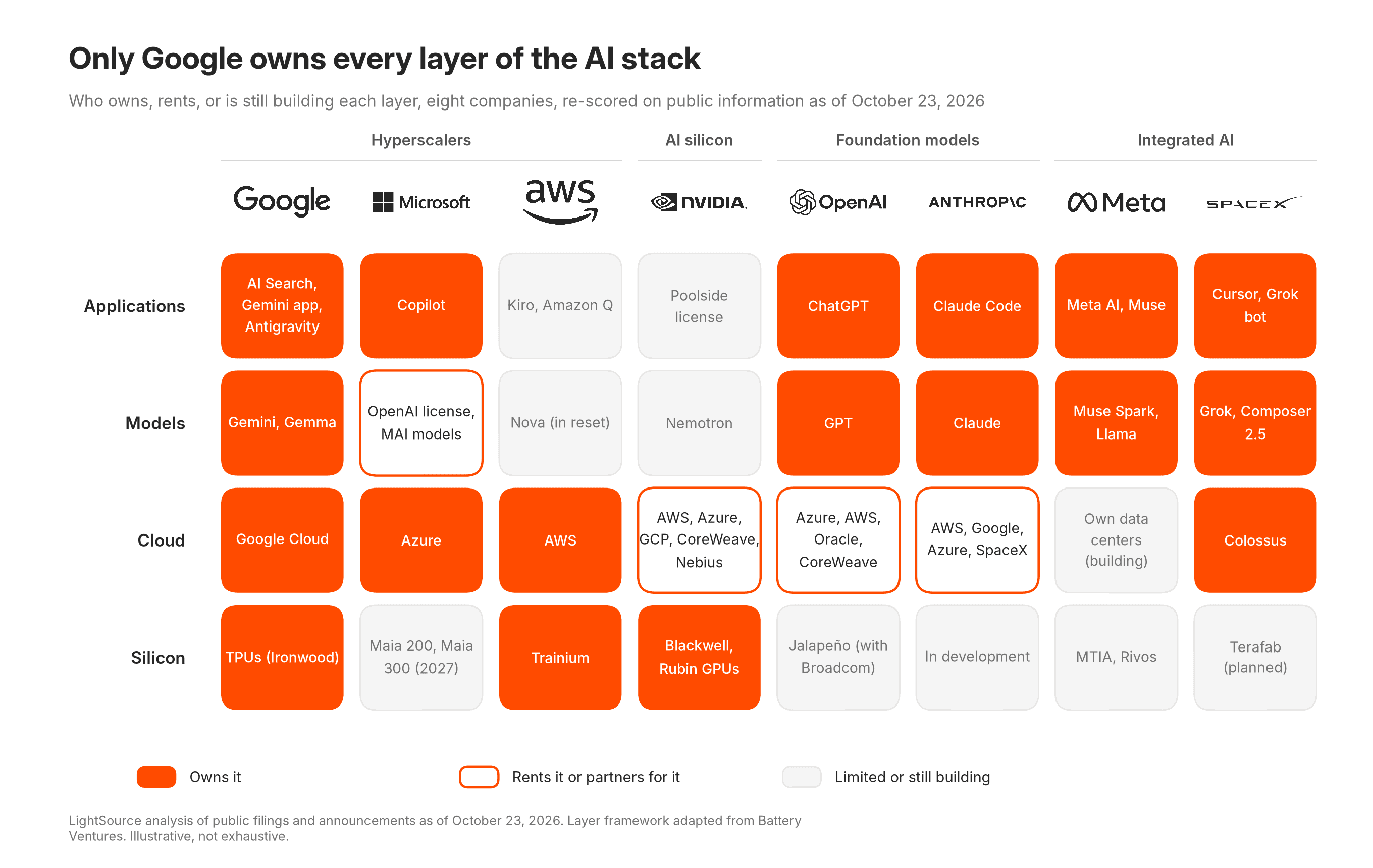
Who owns which layer of the AI stack, scored by LightSource from filings and announcements as of October 23, 2026. Solid orange = owns; outline = rents or partners; grey = limited or still building. The eight-by-four frame follows Battery Ventures' October 22 chart.
The version of Microsoft's silicon cell that usually circulates is Maia 100, which is two generations behind. Maia 200 has been serving Copilot and OpenAI workloads since January, and on October 12 Microsoft announced Maia 300 and multi-gigawatt deployments from 2027, with the stated plan to make Maia the primary inference system for its own products. It is still a smaller fleet than Azure's Nvidia estate, so it stays in the "building" column, but the gap to Google's TPUs is a roadmap, not a blank. Amazon's silicon cell is usually written as Inferentia, which Amazon has discontinued; its chip strategy is Trainium alone, now with more than $225 billion of customer commitments behind it. Its model cell is usually Nova, most of which was wound down in July ahead of a reset at re:Invent. Meta's model cell is usually scored as Llama, but Meta's flagship since April is the proprietary Muse Spark, with Llama demoted to the open-weight line. And Nvidia's Poolside cell, often placed in the application row, is a $6 billion licensing and talent deal for model-training infrastructure, which is a model-layer move rather than an app.
The sixth change is in the cloud row, and it is the one that matters most for the argument. The usual shorthand for the labs' cloud dependencies is AWS, Azure, and GCP. The actual mix is wider and stranger. Anthropic has leased all of SpaceX's Colossus 1, more than 300 megawatts, for a reported $1.25 billion a month, on top of up to 5 gigawatts from Amazon and multiple gigawatts of Google TPUs from 2027. Google, the one fully integrated company on the chart, rents about 110,000 GPUs from SpaceX for $920 million a month, according to SpaceX's own filings. SpaceX's owned Colossus cell is real, but a large share of that compute is operated as a neocloud for its competitors. The outlined cells, the rented layers, are less a sign of weakness than a description of how the whole industry operates.
Ownership Is Not Self-Sufficiency
Three distinctions get lost in a three-color grid, and all three are familiar to anyone who has run a supply base.
Ownership is not self-sufficiency. Google designs TPUs and sells Nvidia-based infrastructure alongside them in Google Cloud. Anthropic runs on Trainium, TPUs, and Nvidia GPUs by deliberate design, and describes the three-platform approach as strategy rather than a gap in its coverage. Nobody on the chart runs a single-source stack, including the one with every cell filled. Follow any owned cell down a few tiers and the same handful of names appears underneath everyone.

The same stack as a supply chain. Rows with three suppliers or fewer are outlined in orange; the dots show which of the eight companies own the layer. Shares from Counterpoint, TrendForce, Yole, ASML, TSMC, Ajinomoto, Hoya and Bloomberg, as of October 2026.
Every accelerator in the diagram's third row, including Google's TPU and Amazon's Trainium, is fabbed at TSMC, packaged on TSMC's CoWoS lines, and filled with high-bandwidth memory from three suppliers whose 2026 output sold out a year in advance. Designing a chip moves a company up one row. It does not change who it depends on for the six rows underneath.
Control is not title. Meta's Hyperion campus in Louisiana will cost about $27 billion, and Meta owns 20% of the joint venture that holds it; funds managed by Blue Owl own the other 80%, while Meta builds and operates the site. CoreWeave reported 1.5 gigawatts of active power against about 3.7 gigawatts contracted in its last quarter, a capacity-planning gap of a kind every plant manager recognizes, and neither number says who owns the dirt. A sourcing team awarding business to a contract manufacturer asks for three figures, installed capacity, capacity already committed to other customers, and capacity actually available for new work; SpaceX's Colossus cell contains all three, and most of the middle one belongs to Anthropic and Google. Microsoft's 20-year power purchase agreement is what is restarting the 835-megawatt Crane nuclear plant in Pennsylvania in 2027; Microsoft will not own a single fuel rod. The right scoring for a supplier risk register has four states, not three: owned, controlled under a long-term agreement or joint venture, bought on the market, and planned. A rented layer backed by a 20-year contract is often a better position than an owned one with poor utilization.
A deployment is not a capability. "In development" covers everything from a slide to engineering samples running at target frequency, which is where OpenAI's Jalapeño inference chip with Broadcom sits as of June, with first deployment targeted for year-end. Meta has hundreds of thousands of its MTIA chips in production, but on ranking and recommendation workloads, not frontier training. The honest version of the chart would carry a maturity stamp on every cell, the way a supplier register carries a qualification status next to every part number.
The Layer Below Silicon
The layer every four-layer grid leaves off is the physical one. Land, grid connections, transformers, turbines, and buildings are where the 2026 buildout is actually constrained, with lead times measured in years, and almost none of it is owned by the eight companies in the columns. I came back from the Berkeley agentic AI summit in September convinced the binding constraint was turbines and transformers; a month of filings has only made that more specific.
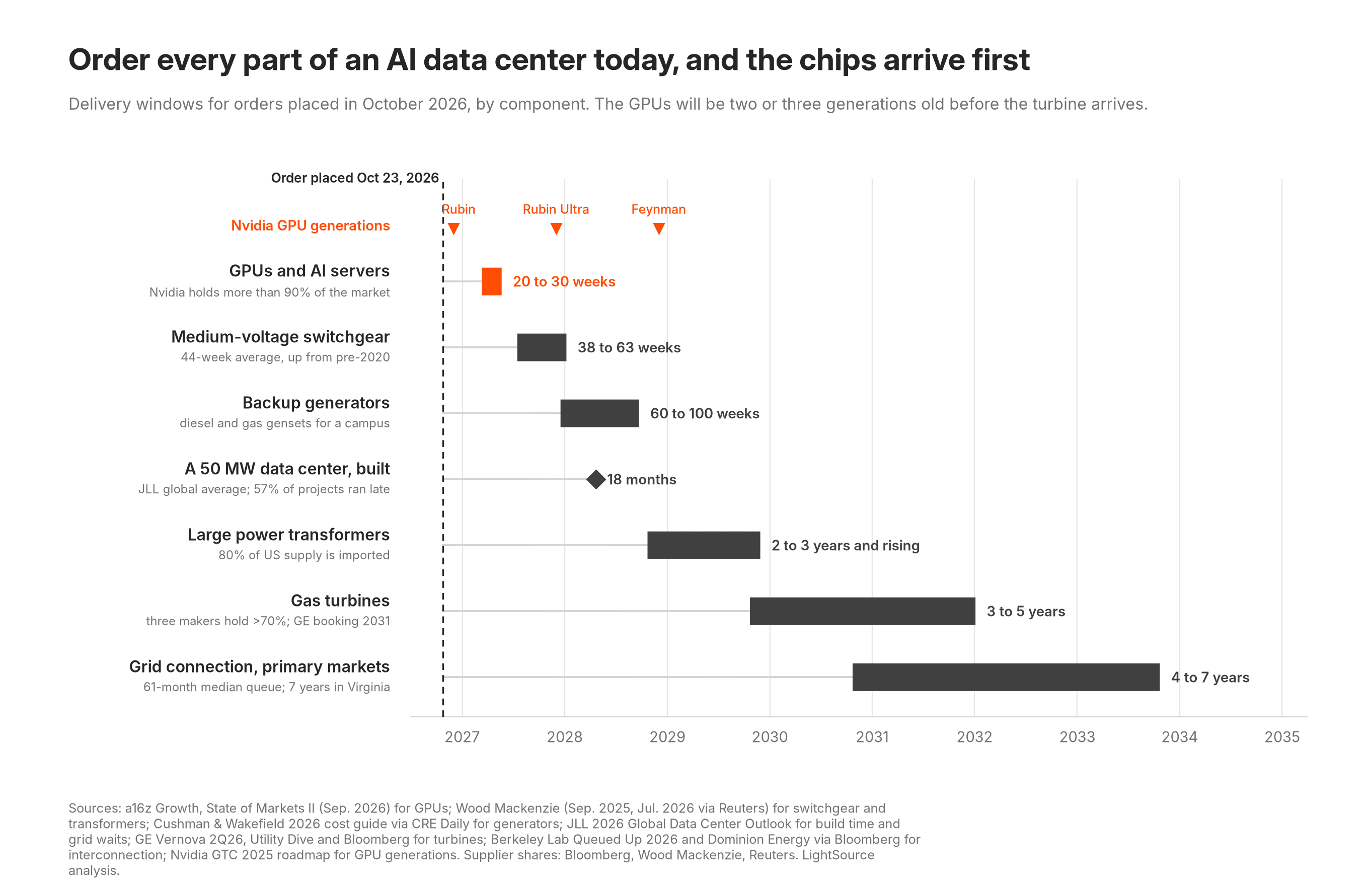
What arrives when, if you ordered every part of an AI data center on October 23, 2026. Lead times from a16z Growth, Wood Mackenzie via Reuters, Cushman & Wakefield, JLL, GE Vernova, Siemens Energy and Berkeley Lab; GPU generations from Nvidia's GTC 2025 roadmap.
The numbers are not close. Wood Mackenzie counted about 110 gigawatts of gas-turbine orders against 60 to 70 gigawatts of annual global manufacturing capacity, with lead times approaching six years and the binding constraint several tiers down, in the single-crystal blades of the turbine's hot section, made by a handful of suppliers. GE Vernova's backlog stands at 116 gigawatts and it is taking reservations for 2031. Siemens Energy's backlog is near 70 gigawatts with lead times of three years or more, and the three largest makers hold more than 70% of the world's turbine manufacturing capacity between them. Large power transformers run two to three years in the US, where about 80% of supply is imported, and Reuters put generator step-up units above 160 weeks in the first quarter against a 143-week average in 2024. Berkeley Lab's queue study has 1,312 gigawatts of generation and 749 gigawatts of storage waiting for interconnection at the end of 2025, and the median project that reached commercial operation in 2025 had waited 61 months in the queue; Dominion has told large customers in Northern Virginia that the wait can run to seven years; in Texas alone, ERCOT's large-load queue reached 474 gigawatts by June, about 90% of it data centers and more than five times the state's peak demand, before the regulator paused new approvals in August. Goldman Sachs counted 86 data-center projects canceled or extensively delayed in 2026, 76 of them over local opposition, while projecting data-center electricity demand to rise 170% by 2030. On October 18, Microsoft walked away from Nscale's Loughton campus outside London after the grid operator said there would be no power until the 2030s. Even the building is slow by chip standards: JLL puts the global average build for a 50-megawatt data center at 18 months, and 57% of projects slipped by three months or more in 2025. Order every part of a campus today and the GPUs arrive next spring, two or three Nvidia generations before the turbine does.

An Amazon Web Services campus in Morrow County, Oregon: three data halls with rooftop cooling and generator rows, a substation, and a fourth hall under construction. The physical layer, in one frame. Photo: Tedder via Wikimedia Commons, CC BY-SA 4.0.
Against that backdrop, the two most telling moves on the chart in 2026 were both downward. Google closed its purchase of the power developer Intersect in March, booking a $5.9 billion purchase price, which is how the company with every cell filled chose to spend on the layer below the bottom row. Nvidia, the supplier to everyone, disclosed in August that it had secured "land, power and shell" for a 4.25-gigawatt campus in Ohio, taken equity in the developer, and guaranteed up to $105 billion of OpenAI's 20-year leases there. A chip company is now in the business of owning dirt on its customers' behalf, because that is what it takes to keep the customers buying chips. JLL's cost benchmarks put the shell and core of an AI campus at about $11.3 million per megawatt in 2026 against up to $25 million for the technology fit-out, so the building is roughly a third of the upfront spend before anyone counts the substation. None of it fits in a four-layer grid, which is the clearest sign that an ownership grid is a product map rather than a supply map.
What Owning Silicon Actually Saves
The reason every column wants to own its silicon cell is the one number everyone knows. Nvidia reported a 75.0% gross margin on $96.2 billion of revenue in its July quarter, with $63.7 billion of operating income. A margin like that is the biggest standing invitation in industrial history to make instead of buy, the same margin that has Apple bidding against data centers for 2nm wafers, and the question is what making actually saves.
The honest answer is that it depends on the workload. SemiAnalysis's independent testing found Google's seventh-generation TPU delivering up to 50% better performance per dollar than Nvidia's Blackwell parts in its specified comparison, which translates to about a third lower cost for the same work. Its newer agentic benchmarks cut both ways: on one large open model at a fixed interactivity, the TPU returned 2.17 times the tokens per dollar of a GB300 rack at FP8, and the same Nvidia rack at FP4 returned 1.56 times the TPU's. Owning the chip does not cost less in general; it costs less on the workloads the chip was designed around, which is the entire argument for designing it. Epoch AI estimates a TPU v6e costs $1,600 to $1,900 to manufacture and $3,400 to $5,000 for Google to buy, because Broadcom sits between Google's design and TSMC's fab and keeps a margin of its own. Morgan Stanley's model of Google's external TPU business, the capacity it now sells to Anthropic and Meta, runs at about 30% gross margin, with Broadcom keeping the silicon margin. Owning the design, in other words, converts a 75% supplier margin into a 30% one plus whatever you save in-house; it does not make the margin disappear.
The capacity numbers are what have changed since the TPU deal I wrote about last spring. Anthropic's commitments now run to a million TPUs, multiple gigawatts of the next generation from 2027, more than 500,000 Trainium2 chips in Amazon's Project Rainier, and over $100 billion of AWS spending over ten years. Microsoft claims 30% better performance per dollar for Maia 200 against its existing fleet. And on October 20, the PyTorch Foundation shipped native TorchTPU and TorchNeuron paths for Google's and Amazon's chips, with vLLM adding a TPU backend the same day. That is the least glamorous and most important news in the silicon row, because a second source you cannot port your workload to is not a second source. My colleague Andy Hunt wrote about the convergence problem in dual sourcing, two suppliers that share a sub-tier; the AI version is two chips that share no software, and October is the month that started to change.
The arithmetic that decides the make-or-buy call is the same one a plant manager runs on a stamping line. Take a hypothetical serving platform with $300 million a year of fixed cost including capital recovery and $1 of variable cost per completed task, against a qualified outside supplier charging $4 for the same task. At 50 million tasks a year the internal platform costs $350 million and buying costs $200 million; at 150 million tasks the numbers flip to $450 million against $600 million; break-even sits at 100 million. A favorable unit cost is a bad investment if the volume never arrives, which is why the sensible pattern in every capital-intensive industry is to make the predictable base load and buy the uncertain growth and the peaks, and why the labs' take-or-pay cloud commitments quietly hand that demand risk back to the buyer.
A Century of Make-or-Buy Lessons
The full-stack argument is a century old, and the record is more mixed than the slogan.
Henry Ford's River Rouge complex, built from 1917 to 1928, took iron ore in one end and drove Model As out the other, ore to engine block in 28 hours, 100,000 workers, about 4,000 cars a day. It is the purest ore-to-product operation ever built, and even at its peak Ford never had fewer than 6,000 outside suppliers. Integration was never about owning everything; it was about owning the flow that had to be synchronized. IBM went the other way with the PC in 1981, buying the processor from Intel and the operating system from Microsoft to hit a $1,500 target price on schedule, and spent the next two decades watching the two suppliers it created take the profit pool. Intel then spent three decades as the last great integrated chipmaker and lost the leading edge to the fabless model it dismissed; TSMC, the specialist it dismissed, reported a 66.4% gross margin in its September quarter, and ASML, the specialist beneath TSMC, the one we mapped in June, made €5 billion of net income on €11.7 billion of sales in the same quarter. The winners in semiconductors have mostly owned a chokepoint, not the chain.
Ronald Coase's answer to when a company should do something itself rather than buy it is still the best one: when coordinating the work inside costs less than contracting for it outside. Oliver Williamson sharpened it: integration pays when the investments are specialized, the contracts cannot anticipate every contingency, and the pieces have to adapt together. A chip, a compiler, a model, a network fabric, and a cooling loop that must co-evolve every twelve months is a Williamson problem. A gas turbine is a commodity with a six-year queue, and owning the turbine factory would not shorten the queue for the blades.
The example I watched up close was the Model 3 ramp at Tesla, where vertical integration was the strategy and the obligation came with it. Owning the line meant owning every bottleneck on it, and the quarter that ended with 5,031 cars built in a single week in mid-2018 was the quarter spent finding them one at a time. Integration gave us the ability to fix problems a supplier would have taken months to fix. It also meant there was nobody else to fix them.
Integration Creates New Dependencies
The sharpest 2026 example of Williamson's point involves the newest column on the chart. SpaceX, which absorbed xAI in February and went public in June, closed its $60 billion acquisition of Cursor in August. On August 28, OpenAI announced it would wind down Cursor's access to its models, with a proposed shutoff on November 12, citing a change-of-control window in the contract. Buying the application layer changed the willingness of an upstream supplier to serve it. Every manufacturer that has acquired a customer's competitor, or been acquired by a supplier's competitor, knows this conversation; it is the reason acquisition due diligence includes a read of every supply agreement for change-of-control, assignment, exclusivity, and termination clauses, and of which capacity reservations and software licenses survive the closing. Thakker's post predicts that all eight companies will keep buying their way toward the full stack. The Cursor episode is a reminder that each acquisition rewires the supplier map underneath it.
The forecast I would bet on, and one Thakker also makes, is that Nvidia, which already bankrolls the neoclouds, keeps extending into every layer but hyperscale. Nvidia holds stakes in CoreWeave, Nebius, Nscale, and now a landlord in Ohio. The supplier with a 75% gross margin can afford to finance its customers' entire stack; its customers are the ones who cannot afford to stop buying from it. (We will take up what that circular financing does to the word "revenue" in a separate piece.)
Scorecard for the Other Seven
Scored as a sourcing team would score suppliers, with maturity and contracts rather than colors, the picture looks like this.
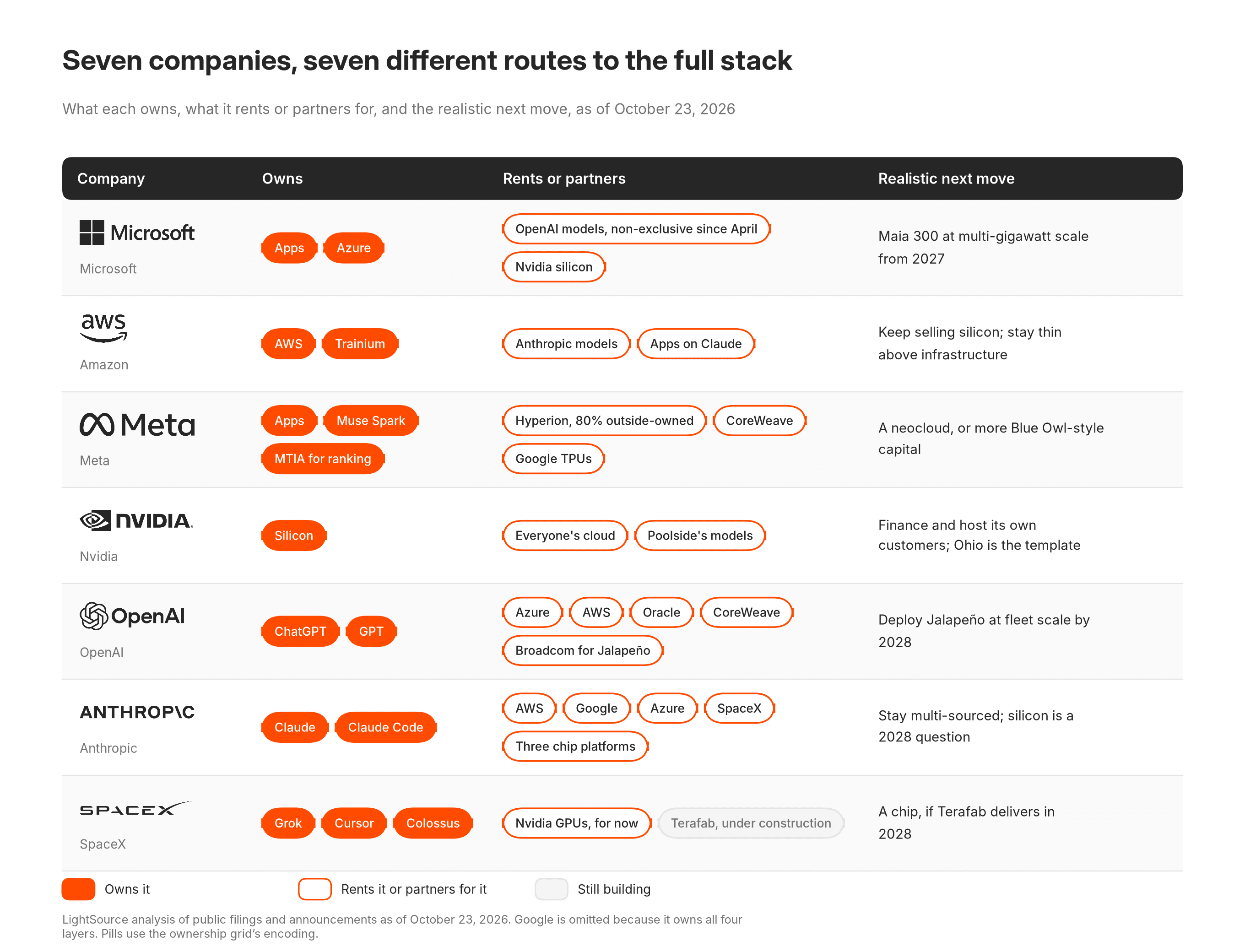
Seven routes to the stack, scored as a sourcing team would score suppliers. Pills use the grid's encoding: solid = owns, outline = rents or partners, grey = still building.
Microsoft is the closest second and the one whose silicon cell is most often underrated. Anthropic is the interesting case: by the chart's logic it is the least integrated lab, and by a sourcing team's logic it has the most resilient supply base of the eight, because it qualified three silicon platforms before it needed any of them. Google, meanwhile, is the company that bought a power developer. Its advantage goes beyond having designed its own chip in 2015: it has been buying the layers under the chip ever since.
From Grid to Dependency Register
If I were rebuilding the ownership grid for a sourcing review, I would keep the eight columns and four rows for legibility and attach the fields any manufacturer attaches to a critical part. What exactly is owned: intellectual property, equipment, land, equity, or reserved capacity? What stage is it at: announced, sampled, qualified, contracted, under construction, energized, or in production? Who is the tier-one dependency, and do apparently independent suppliers share a foundry, a memory maker, a utility, or a turbine-blade shop? Has a second source been qualified on the actual workload, and what does switching cost in software, contracts, and months? What is the obligation: capex, a lease, take-or-pay, a guarantee? And what fails if this layer does: unit cost, expansion, service, or everything?
Peter Kraljic's 1983 matrix, which sorts purchases by supply risk against profit impact, is still the fastest way to decide which of those cells deserve integration and which deserve a good contract. Frontier silicon for a frontier lab is high on both axes, which is why every lab is designing a chip. A gas turbine is high risk and, for a software company, low differentiation, which is why the right answer is a 20-year PPA and a place in GE Vernova's queue, not a turbine plant. The five gates I would run every cell through are the ones a strategic sourcing team runs on a make-or-buy decision: does owning it change the customer's outcome, is the volume large enough to carry the fixed cost, does the piece have to co-evolve with the rest, is buying it exposed to allocation and cancellation, and can we reverse the decision if the technology moves. I would add a sixth that internal teams hate: a renewal test, where the owned capability has to beat a qualified outside bid on the same specification every couple of years. An internal supplier never receives a lost-bid notice, and its costs spread quietly across several budgets, which is how a sensible integration decision outlives its economics.
That register is what LightSource customers keep on their direct materials, where the equivalent of the ownership grid is a BOM with a few thousand rows: for each part, the source, the qualification status, the alternates that have actually been tested, and what a change in one supplier does to the cost of the whole product. The AI companies are building the same thing at a scale of gigawatts rather than grams, and learning the same lesson manufacturers learned at River Rouge: the objective is not to own every supplier, it is to know which dependencies can stop production, which interfaces need to be designed together, and where ownership actually improves the economics.
So, can anyone but Google own the whole stack? Microsoft can get close by 2028, and SpaceX will if its fab pours concrete on time. But the next change on this map will come from the row below silicon, the one a four-layer grid does not draw, where Google and Nvidia have already started buying and where the lead times are measured in years that no amount of integration above them can shorten.
Sources
Dharmesh Thakker on LinkedIn, Oct. 22, 2026 -- the ownership grid whose eight-by-four frame this piece borrows
Battery Ventures: From Dirt to Tokens (Jul. 9, 2026) -- Battery's full-stack essay, for the investor's version of the argument
Microsoft: Azure Maia to multi-gigawatt deployments (Oct. 12, 2026) -- Maia 200 in production, Maia 300 and the 2027 plan
Microsoft and OpenAI: the next phase of the partnership (Apr. 27, 2026) -- the non-exclusive amendment
Anthropic: higher limits with SpaceX compute (May 2026) -- the Colossus 1 lease
Anthropic: expanding to multiple gigawatts of Google TPUs with Broadcom (Apr. 2026) -- the three-platform strategy
CNBC: Google to pay SpaceX $920 million a month for compute capacity (Jun. 5, 2026) -- the Google rental
The Next Platform: Trainium4 and the end of Inferentia -- no Inferentia3
The Next Web: Amazon winds down Nova models -- the Nova reset
Data Center Dynamics: SpaceX filing reveals Anthropic and Google compute rentals -- the $1.25B and $920M monthly figures
TechCrunch: SpaceX to acquire Cursor for $60B (Jun. 16, 2026) -- the acquisition
OpenAI: our decision on Cursor following its acquisition by SpaceX (Aug. 28, 2026) -- the model-access wind-down
OpenAI and Broadcom: Jalapeño inference chip (Jun. 24, 2026) -- engineering samples and deployment timing
Meta and Blue Owl: the Hyperion data center joint venture -- the 80/20 ownership structure
Meta: MTIA at scale (Mar. 2026) -- chips in production and the two-year design cycle
CoreWeave second-quarter 2026 results -- active versus contracted power
Constellation: Crane Clean Energy Center and the Microsoft PPA -- the 835 MW restart
TPG: completion of the $4.75 billion sale of Intersect to Google (Mar. 2026) -- Google's move into power development
Nvidia Form 8-K, Aug. 17, 2026 -- the Ohio campus, land, power and shell, and the lease guarantees
Nvidia second-quarter fiscal 2027 results -- revenue, gross margin, operating income
SemiAnalysis: TPU v7 Ironwood versus GB300 NVL72 (InferenceX) -- workload-dependent cost comparisons
Epoch AI: AI chip sales methodology -- TPU manufacturing cost and price estimates
Morgan Stanley on Google's external TPU business (via Yahoo Finance) -- the ~30% margin estimate
Amazon: Trainium and the Anthropic commitments (Apr. 24, 2026) -- Project Rainier and the $100B commitment
PyTorch Foundation: TorchTPU and TorchNeuron (Oct. 20, 2026) -- portability across chip platforms
Wood Mackenzie: gas turbine prices and lead times (Apr. 2026) -- 110 GW of orders, six-year lead times, blade bottleneck
Utility Dive: GE Vernova's 116 GW turbine backlog -- reservations for 2031
Reuters: transformer lead times (Jul. 9, 2026) -- 160-week generator step-up lead times
Berkeley Lab: Queued Up, 2026 edition -- interconnection queue totals
ERCOT large-load queue testimony (Jul. 29, 2026) -- the 474 GW queue
Goldman Sachs: navigating a system of AI bottlenecks (Oct. 19, 2026) -- project cancellations and electricity demand
Yahoo Finance: Microsoft exits Nscale's UK site over power (Oct. 18, 2026) -- the Loughton withdrawal
JLL 2026 Global Data Center Outlook -- construction and fit-out cost benchmarks
The Henry Ford: River Rouge history and timeline -- the ore-to-assembly complex
IBM: the personal computer -- the 1981 make-or-buy decisions
Cusumano, "Intel's Fall from Grace" (CACM) -- the integrated-device-manufacturer lesson
TSMC third-quarter 2026 results -- gross and operating margin
Williamson, Nobel lecture (2009) -- transaction-cost economics
Kraljic, "Purchasing Must Become Supply Management" (HBR, 1983) -- the supply risk and profit impact matrix
GE Vernova 2Q26 results (Jul. 22, 2026) -- 116 GW of gas turbine backlog and slot reservations
Utility Dive: Siemens Energy's turbine backlog nears 70 GW (Aug. 10, 2026) -- lead times of three years or more
Bloomberg: the gas turbine bottleneck (Oct. 2025) -- the three largest makers' share of capacity
Wood Mackenzie: 80% of US power transformer supply is imported (Aug. 2025)
Wood Mackenzie: Making the connection, executive summary (Sep. 2025) -- transformer and switchgear lead times
Bloomberg: data centers face a seven-year wait for power in Virginia (Aug. 2024)
CRE Daily on Cushman & Wakefield's 2026 data center cost guide -- generator and switchgear lead times
EE Times: three misconceptions about the foundry industry (Apr. 2026) -- Yole on TSMC's share of advanced chips
TSMC 2Q26 earnings call transcript -- packaging capacity "limits my customers' growth"
ASML 2025 annual report -- the only EUV manufacturer
ASML Q3 2026 investor call -- roughly 65 systems in 2026
Reuters: Nvidia's competition at GTC (Mar. 13, 2026) -- the 90%-plus share estimate
CNBC: SK hynix's 2026 memory supply sold out (Oct. 29, 2025)
Ajinomoto investor presentation -- more than 95% of ABF build-up film
Morningstar on Hoya -- more than 75% of EUV mask blanks
Nikkei Asia: Sumco and Shin-Etsu (Oct. 2021) -- more than half of silicon wafers
Nvidia GTC 2025: Blackwell Ultra, Vera Rubin and Rubin Ultra roadmap
Frequently Asked Questions
What is the slowest part of the AI supply chain?
Grid connections and power equipment. Berkeley Lab's 2026 queue study puts the median wait at 61 months for generation projects that came online in 2025, Dominion has quoted large customers in Northern Virginia up to seven years, and gas turbines ordered today ship in three to five years, with GE Vernova booking deliveries for 2031. By comparison, GPUs and AI servers ship in 20 to 30 weeks and a 50-megawatt data center takes about 18 months to build.
Which company owns the entire AI stack?
Only Google: it owns its applications (Search, the Gemini app), its models (Gemini and Gemma), its cloud, and its TPU silicon, and in 2026 it added power development by acquiring Intersect. Even Google rents compute from SpaceX and sells Nvidia-based capacity, so "owns every layer" is not the same as self-sufficient.
Why is power the biggest constraint on AI infrastructure in 2026?
Because the physical equipment has the longest lead times in the stack: gas turbines are quoted at three to six years with 110 gigawatts of orders against 60 to 70 gigawatts of annual manufacturing capacity, large transformers at two to three years and rising, and interconnection queues hold more than a terawatt of generation waiting to connect. Goldman Sachs counted 86 data-center projects canceled or extensively delayed in 2026, most over local opposition.
Does owning a custom AI chip save money versus buying from Nvidia?
On some workloads, substantially: independent testing puts Google's TPU v7 at up to 50% better performance per dollar than Nvidia's Blackwell parts in specified comparisons. On other configurations Nvidia wins, and a custom chip still carries a design partner's margin (Epoch AI estimates a TPU v6e costs about $1,700 to make and about $4,100 for Google to buy). The savings are workload-specific, which is why every large lab designs for its own workloads.
How is a make-or-buy decision made in manufacturing?
Most teams use Peter Kraljic's matrix (supply risk against profit impact) and five gates: whether owning the item changes the customer outcome, whether volume covers the fixed cost, whether the part must co-evolve with the rest of the product, whether buying exposes the company to allocation or cancellation risk, and whether the decision can be reversed. High-risk, high-impact items get integrated or locked under long-term agreements; everything else is bought.
What is a supplier-dependency map?
A register of every critical input to a product with its source, ownership status, qualification stage, alternates that have actually been tested, shared sub-tier suppliers, switching cost, and the contractual obligation attached. It is the procurement version of an ownership grid, and the extra fields (maturity, contract type, shared dependencies) are what turn a colored chart into a decision tool.
Every manufacturer I have worked with keeps a map of its supply base that looks nothing like its org chart: which parts we make, which we buy from a partner under contract, which we have only one source for, and which we are still trying to qualify. Apply that map to the AI industry and the picture is less flattering than the brands suggest. Score the eight companies that matter most on the four layers of the stack, applications, models, cloud, and silicon, and only Google owns all four. Everyone else is renting at least one layer from someone else, usually from Nvidia, a reminder of how much of this industry's capability still sits in the supply base Apple and the phone makers built rather than in the brands on top of it. Even Google rents about 110,000 GPUs from SpaceX.
The question of who can own the whole stack got a lot of attention last week after Dharmesh Thakker of Battery Ventures posted a grid scoring those eight companies on those four layers. It is a useful frame, and I have kept its columns and rows for legibility. But a sourcing team never takes a supplier map at face value, so I scored every cell myself against filings and announcements as of October 23, then went looking for what a four-layer grid leaves out. Six of the cells had already moved. The missing layer, the physical one below silicon, turned out to be the one that actually stops the line. Read as a make-or-buy analysis at gigawatt scale rather than as a leaderboard, the grid says something different from what the colors suggest.
Who Owns What, as of October 23
This market moves faster than any slide. Checking each of the 32 cells against filings and announcements turned up six that had already changed by October 23, and the changes point in one direction.
Who owns which layer of the AI stack, scored by LightSource from filings and announcements as of October 23, 2026. Solid orange = owns; outline = rents or partners; grey = limited or still building. The eight-by-four frame follows Battery Ventures' October 22 chart.
The version of Microsoft's silicon cell that usually circulates is Maia 100, which is two generations behind. Maia 200 has been serving Copilot and OpenAI workloads since January, and on October 12 Microsoft announced Maia 300 and multi-gigawatt deployments from 2027, with the stated plan to make Maia the primary inference system for its own products. It is still a smaller fleet than Azure's Nvidia estate, so it stays in the "building" column, but the gap to Google's TPUs is a roadmap, not a blank. Amazon's silicon cell is usually written as Inferentia, which Amazon has discontinued; its chip strategy is Trainium alone, now with more than $225 billion of customer commitments behind it. Its model cell is usually Nova, most of which was wound down in July ahead of a reset at re:Invent. Meta's model cell is usually scored as Llama, but Meta's flagship since April is the proprietary Muse Spark, with Llama demoted to the open-weight line. And Nvidia's Poolside cell, often placed in the application row, is a $6 billion licensing and talent deal for model-training infrastructure, which is a model-layer move rather than an app.
The sixth change is in the cloud row, and it is the one that matters most for the argument. The usual shorthand for the labs' cloud dependencies is AWS, Azure, and GCP. The actual mix is wider and stranger. Anthropic has leased all of SpaceX's Colossus 1, more than 300 megawatts, for a reported $1.25 billion a month, on top of up to 5 gigawatts from Amazon and multiple gigawatts of Google TPUs from 2027. Google, the one fully integrated company on the chart, rents about 110,000 GPUs from SpaceX for $920 million a month, according to SpaceX's own filings. SpaceX's owned Colossus cell is real, but a large share of that compute is operated as a neocloud for its competitors. The outlined cells, the rented layers, are less a sign of weakness than a description of how the whole industry operates.
Ownership Is Not Self-Sufficiency
Three distinctions get lost in a three-color grid, and all three are familiar to anyone who has run a supply base.
Ownership is not self-sufficiency. Google designs TPUs and sells Nvidia-based infrastructure alongside them in Google Cloud. Anthropic runs on Trainium, TPUs, and Nvidia GPUs by deliberate design, and describes the three-platform approach as strategy rather than a gap in its coverage. Nobody on the chart runs a single-source stack, including the one with every cell filled. Follow any owned cell down a few tiers and the same handful of names appears underneath everyone.
The same stack as a supply chain. Rows with three suppliers or fewer are outlined in orange; the dots show which of the eight companies own the layer. Shares from Counterpoint, TrendForce, Yole, ASML, TSMC, Ajinomoto, Hoya and Bloomberg, as of October 2026.
Every accelerator in the diagram's third row, including Google's TPU and Amazon's Trainium, is fabbed at TSMC, packaged on TSMC's CoWoS lines, and filled with high-bandwidth memory from three suppliers whose 2026 output sold out a year in advance. Designing a chip moves a company up one row. It does not change who it depends on for the six rows underneath.
Control is not title. Meta's Hyperion campus in Louisiana will cost about $27 billion, and Meta owns 20% of the joint venture that holds it; funds managed by Blue Owl own the other 80%, while Meta builds and operates the site. CoreWeave reported 1.5 gigawatts of active power against about 3.7 gigawatts contracted in its last quarter, a capacity-planning gap of a kind every plant manager recognizes, and neither number says who owns the dirt. A sourcing team awarding business to a contract manufacturer asks for three figures, installed capacity, capacity already committed to other customers, and capacity actually available for new work; SpaceX's Colossus cell contains all three, and most of the middle one belongs to Anthropic and Google. Microsoft's 20-year power purchase agreement is what is restarting the 835-megawatt Crane nuclear plant in Pennsylvania in 2027; Microsoft will not own a single fuel rod. The right scoring for a supplier risk register has four states, not three: owned, controlled under a long-term agreement or joint venture, bought on the market, and planned. A rented layer backed by a 20-year contract is often a better position than an owned one with poor utilization.
A deployment is not a capability. "In development" covers everything from a slide to engineering samples running at target frequency, which is where OpenAI's Jalapeño inference chip with Broadcom sits as of June, with first deployment targeted for year-end. Meta has hundreds of thousands of its MTIA chips in production, but on ranking and recommendation workloads, not frontier training. The honest version of the chart would carry a maturity stamp on every cell, the way a supplier register carries a qualification status next to every part number.
The Layer Below Silicon
The layer every four-layer grid leaves off is the physical one. Land, grid connections, transformers, turbines, and buildings are where the 2026 buildout is actually constrained, with lead times measured in years, and almost none of it is owned by the eight companies in the columns. I came back from the Berkeley agentic AI summit in September convinced the binding constraint was turbines and transformers; a month of filings has only made that more specific.
What arrives when, if you ordered every part of an AI data center on October 23, 2026. Lead times from a16z Growth, Wood Mackenzie via Reuters, Cushman & Wakefield, JLL, GE Vernova, Siemens Energy and Berkeley Lab; GPU generations from Nvidia's GTC 2025 roadmap.
The numbers are not close. Wood Mackenzie counted about 110 gigawatts of gas-turbine orders against 60 to 70 gigawatts of annual global manufacturing capacity, with lead times approaching six years and the binding constraint several tiers down, in the single-crystal blades of the turbine's hot section, made by a handful of suppliers. GE Vernova's backlog stands at 116 gigawatts and it is taking reservations for 2031. Siemens Energy's backlog is near 70 gigawatts with lead times of three years or more, and the three largest makers hold more than 70% of the world's turbine manufacturing capacity between them. Large power transformers run two to three years in the US, where about 80% of supply is imported, and Reuters put generator step-up units above 160 weeks in the first quarter against a 143-week average in 2024. Berkeley Lab's queue study has 1,312 gigawatts of generation and 749 gigawatts of storage waiting for interconnection at the end of 2025, and the median project that reached commercial operation in 2025 had waited 61 months in the queue; Dominion has told large customers in Northern Virginia that the wait can run to seven years; in Texas alone, ERCOT's large-load queue reached 474 gigawatts by June, about 90% of it data centers and more than five times the state's peak demand, before the regulator paused new approvals in August. Goldman Sachs counted 86 data-center projects canceled or extensively delayed in 2026, 76 of them over local opposition, while projecting data-center electricity demand to rise 170% by 2030. On October 18, Microsoft walked away from Nscale's Loughton campus outside London after the grid operator said there would be no power until the 2030s. Even the building is slow by chip standards: JLL puts the global average build for a 50-megawatt data center at 18 months, and 57% of projects slipped by three months or more in 2025. Order every part of a campus today and the GPUs arrive next spring, two or three Nvidia generations before the turbine does.
An Amazon Web Services campus in Morrow County, Oregon: three data halls with rooftop cooling and generator rows, a substation, and a fourth hall under construction. The physical layer, in one frame. Photo: Tedder via Wikimedia Commons, CC BY-SA 4.0.
Against that backdrop, the two most telling moves on the chart in 2026 were both downward. Google closed its purchase of the power developer Intersect in March, booking a $5.9 billion purchase price, which is how the company with every cell filled chose to spend on the layer below the bottom row. Nvidia, the supplier to everyone, disclosed in August that it had secured "land, power and shell" for a 4.25-gigawatt campus in Ohio, taken equity in the developer, and guaranteed up to $105 billion of OpenAI's 20-year leases there. A chip company is now in the business of owning dirt on its customers' behalf, because that is what it takes to keep the customers buying chips. JLL's cost benchmarks put the shell and core of an AI campus at about $11.3 million per megawatt in 2026 against up to $25 million for the technology fit-out, so the building is roughly a third of the upfront spend before anyone counts the substation. None of it fits in a four-layer grid, which is the clearest sign that an ownership grid is a product map rather than a supply map.
What Owning Silicon Actually Saves
The reason every column wants to own its silicon cell is the one number everyone knows. Nvidia reported a 75.0% gross margin on $96.2 billion of revenue in its July quarter, with $63.7 billion of operating income. A margin like that is the biggest standing invitation in industrial history to make instead of buy, the same margin that has Apple bidding against data centers for 2nm wafers, and the question is what making actually saves.
The honest answer is that it depends on the workload. SemiAnalysis's independent testing found Google's seventh-generation TPU delivering up to 50% better performance per dollar than Nvidia's Blackwell parts in its specified comparison, which translates to about a third lower cost for the same work. Its newer agentic benchmarks cut both ways: on one large open model at a fixed interactivity, the TPU returned 2.17 times the tokens per dollar of a GB300 rack at FP8, and the same Nvidia rack at FP4 returned 1.56 times the TPU's. Owning the chip does not cost less in general; it costs less on the workloads the chip was designed around, which is the entire argument for designing it. Epoch AI estimates a TPU v6e costs $1,600 to $1,900 to manufacture and $3,400 to $5,000 for Google to buy, because Broadcom sits between Google's design and TSMC's fab and keeps a margin of its own. Morgan Stanley's model of Google's external TPU business, the capacity it now sells to Anthropic and Meta, runs at about 30% gross margin, with Broadcom keeping the silicon margin. Owning the design, in other words, converts a 75% supplier margin into a 30% one plus whatever you save in-house; it does not make the margin disappear.
The capacity numbers are what have changed since the TPU deal I wrote about last spring. Anthropic's commitments now run to a million TPUs, multiple gigawatts of the next generation from 2027, more than 500,000 Trainium2 chips in Amazon's Project Rainier, and over $100 billion of AWS spending over ten years. Microsoft claims 30% better performance per dollar for Maia 200 against its existing fleet. And on October 20, the PyTorch Foundation shipped native TorchTPU and TorchNeuron paths for Google's and Amazon's chips, with vLLM adding a TPU backend the same day. That is the least glamorous and most important news in the silicon row, because a second source you cannot port your workload to is not a second source. My colleague Andy Hunt wrote about the convergence problem in dual sourcing, two suppliers that share a sub-tier; the AI version is two chips that share no software, and October is the month that started to change.
The arithmetic that decides the make-or-buy call is the same one a plant manager runs on a stamping line. Take a hypothetical serving platform with $300 million a year of fixed cost including capital recovery and $1 of variable cost per completed task, against a qualified outside supplier charging $4 for the same task. At 50 million tasks a year the internal platform costs $350 million and buying costs $200 million; at 150 million tasks the numbers flip to $450 million against $600 million; break-even sits at 100 million. A favorable unit cost is a bad investment if the volume never arrives, which is why the sensible pattern in every capital-intensive industry is to make the predictable base load and buy the uncertain growth and the peaks, and why the labs' take-or-pay cloud commitments quietly hand that demand risk back to the buyer.
A Century of Make-or-Buy Lessons
The full-stack argument is a century old, and the record is more mixed than the slogan.
Henry Ford's River Rouge complex, built from 1917 to 1928, took iron ore in one end and drove Model As out the other, ore to engine block in 28 hours, 100,000 workers, about 4,000 cars a day. It is the purest ore-to-product operation ever built, and even at its peak Ford never had fewer than 6,000 outside suppliers. Integration was never about owning everything; it was about owning the flow that had to be synchronized. IBM went the other way with the PC in 1981, buying the processor from Intel and the operating system from Microsoft to hit a $1,500 target price on schedule, and spent the next two decades watching the two suppliers it created take the profit pool. Intel then spent three decades as the last great integrated chipmaker and lost the leading edge to the fabless model it dismissed; TSMC, the specialist it dismissed, reported a 66.4% gross margin in its September quarter, and ASML, the specialist beneath TSMC, the one we mapped in June, made €5 billion of net income on €11.7 billion of sales in the same quarter. The winners in semiconductors have mostly owned a chokepoint, not the chain.
Ronald Coase's answer to when a company should do something itself rather than buy it is still the best one: when coordinating the work inside costs less than contracting for it outside. Oliver Williamson sharpened it: integration pays when the investments are specialized, the contracts cannot anticipate every contingency, and the pieces have to adapt together. A chip, a compiler, a model, a network fabric, and a cooling loop that must co-evolve every twelve months is a Williamson problem. A gas turbine is a commodity with a six-year queue, and owning the turbine factory would not shorten the queue for the blades.
The example I watched up close was the Model 3 ramp at Tesla, where vertical integration was the strategy and the obligation came with it. Owning the line meant owning every bottleneck on it, and the quarter that ended with 5,031 cars built in a single week in mid-2018 was the quarter spent finding them one at a time. Integration gave us the ability to fix problems a supplier would have taken months to fix. It also meant there was nobody else to fix them.
Integration Creates New Dependencies
The sharpest 2026 example of Williamson's point involves the newest column on the chart. SpaceX, which absorbed xAI in February and went public in June, closed its $60 billion acquisition of Cursor in August. On August 28, OpenAI announced it would wind down Cursor's access to its models, with a proposed shutoff on November 12, citing a change-of-control window in the contract. Buying the application layer changed the willingness of an upstream supplier to serve it. Every manufacturer that has acquired a customer's competitor, or been acquired by a supplier's competitor, knows this conversation; it is the reason acquisition due diligence includes a read of every supply agreement for change-of-control, assignment, exclusivity, and termination clauses, and of which capacity reservations and software licenses survive the closing. Thakker's post predicts that all eight companies will keep buying their way toward the full stack. The Cursor episode is a reminder that each acquisition rewires the supplier map underneath it.
The forecast I would bet on, and one Thakker also makes, is that Nvidia, which already bankrolls the neoclouds, keeps extending into every layer but hyperscale. Nvidia holds stakes in CoreWeave, Nebius, Nscale, and now a landlord in Ohio. The supplier with a 75% gross margin can afford to finance its customers' entire stack; its customers are the ones who cannot afford to stop buying from it. (We will take up what that circular financing does to the word "revenue" in a separate piece.)
Scorecard for the Other Seven
Scored as a sourcing team would score suppliers, with maturity and contracts rather than colors, the picture looks like this.
Seven routes to the stack, scored as a sourcing team would score suppliers. Pills use the grid's encoding: solid = owns, outline = rents or partners, grey = still building.
Microsoft is the closest second and the one whose silicon cell is most often underrated. Anthropic is the interesting case: by the chart's logic it is the least integrated lab, and by a sourcing team's logic it has the most resilient supply base of the eight, because it qualified three silicon platforms before it needed any of them. Google, meanwhile, is the company that bought a power developer. Its advantage goes beyond having designed its own chip in 2015: it has been buying the layers under the chip ever since.
From Grid to Dependency Register
If I were rebuilding the ownership grid for a sourcing review, I would keep the eight columns and four rows for legibility and attach the fields any manufacturer attaches to a critical part. What exactly is owned: intellectual property, equipment, land, equity, or reserved capacity? What stage is it at: announced, sampled, qualified, contracted, under construction, energized, or in production? Who is the tier-one dependency, and do apparently independent suppliers share a foundry, a memory maker, a utility, or a turbine-blade shop? Has a second source been qualified on the actual workload, and what does switching cost in software, contracts, and months? What is the obligation: capex, a lease, take-or-pay, a guarantee? And what fails if this layer does: unit cost, expansion, service, or everything?
Peter Kraljic's 1983 matrix, which sorts purchases by supply risk against profit impact, is still the fastest way to decide which of those cells deserve integration and which deserve a good contract. Frontier silicon for a frontier lab is high on both axes, which is why every lab is designing a chip. A gas turbine is high risk and, for a software company, low differentiation, which is why the right answer is a 20-year PPA and a place in GE Vernova's queue, not a turbine plant. The five gates I would run every cell through are the ones a strategic sourcing team runs on a make-or-buy decision: does owning it change the customer's outcome, is the volume large enough to carry the fixed cost, does the piece have to co-evolve with the rest, is buying it exposed to allocation and cancellation, and can we reverse the decision if the technology moves. I would add a sixth that internal teams hate: a renewal test, where the owned capability has to beat a qualified outside bid on the same specification every couple of years. An internal supplier never receives a lost-bid notice, and its costs spread quietly across several budgets, which is how a sensible integration decision outlives its economics.
That register is what LightSource customers keep on their direct materials, where the equivalent of the ownership grid is a BOM with a few thousand rows: for each part, the source, the qualification status, the alternates that have actually been tested, and what a change in one supplier does to the cost of the whole product. The AI companies are building the same thing at a scale of gigawatts rather than grams, and learning the same lesson manufacturers learned at River Rouge: the objective is not to own every supplier, it is to know which dependencies can stop production, which interfaces need to be designed together, and where ownership actually improves the economics.
So, can anyone but Google own the whole stack? Microsoft can get close by 2028, and SpaceX will if its fab pours concrete on time. But the next change on this map will come from the row below silicon, the one a four-layer grid does not draw, where Google and Nvidia have already started buying and where the lead times are measured in years that no amount of integration above them can shorten.
Sources
Dharmesh Thakker on LinkedIn, Oct. 22, 2026 -- the ownership grid whose eight-by-four frame this piece borrows
Battery Ventures: From Dirt to Tokens (Jul. 9, 2026) -- Battery's full-stack essay, for the investor's version of the argument
Microsoft: Azure Maia to multi-gigawatt deployments (Oct. 12, 2026) -- Maia 200 in production, Maia 300 and the 2027 plan
Microsoft and OpenAI: the next phase of the partnership (Apr. 27, 2026) -- the non-exclusive amendment
Anthropic: higher limits with SpaceX compute (May 2026) -- the Colossus 1 lease
Anthropic: expanding to multiple gigawatts of Google TPUs with Broadcom (Apr. 2026) -- the three-platform strategy
CNBC: Google to pay SpaceX $920 million a month for compute capacity (Jun. 5, 2026) -- the Google rental
The Next Platform: Trainium4 and the end of Inferentia -- no Inferentia3
The Next Web: Amazon winds down Nova models -- the Nova reset
Data Center Dynamics: SpaceX filing reveals Anthropic and Google compute rentals -- the $1.25B and $920M monthly figures
TechCrunch: SpaceX to acquire Cursor for $60B (Jun. 16, 2026) -- the acquisition
OpenAI: our decision on Cursor following its acquisition by SpaceX (Aug. 28, 2026) -- the model-access wind-down
OpenAI and Broadcom: Jalapeño inference chip (Jun. 24, 2026) -- engineering samples and deployment timing
Meta and Blue Owl: the Hyperion data center joint venture -- the 80/20 ownership structure
Meta: MTIA at scale (Mar. 2026) -- chips in production and the two-year design cycle
CoreWeave second-quarter 2026 results -- active versus contracted power
Constellation: Crane Clean Energy Center and the Microsoft PPA -- the 835 MW restart
TPG: completion of the $4.75 billion sale of Intersect to Google (Mar. 2026) -- Google's move into power development
Nvidia Form 8-K, Aug. 17, 2026 -- the Ohio campus, land, power and shell, and the lease guarantees
Nvidia second-quarter fiscal 2027 results -- revenue, gross margin, operating income
SemiAnalysis: TPU v7 Ironwood versus GB300 NVL72 (InferenceX) -- workload-dependent cost comparisons
Epoch AI: AI chip sales methodology -- TPU manufacturing cost and price estimates
Morgan Stanley on Google's external TPU business (via Yahoo Finance) -- the ~30% margin estimate
Amazon: Trainium and the Anthropic commitments (Apr. 24, 2026) -- Project Rainier and the $100B commitment
PyTorch Foundation: TorchTPU and TorchNeuron (Oct. 20, 2026) -- portability across chip platforms
Wood Mackenzie: gas turbine prices and lead times (Apr. 2026) -- 110 GW of orders, six-year lead times, blade bottleneck
Utility Dive: GE Vernova's 116 GW turbine backlog -- reservations for 2031
Reuters: transformer lead times (Jul. 9, 2026) -- 160-week generator step-up lead times
Berkeley Lab: Queued Up, 2026 edition -- interconnection queue totals
ERCOT large-load queue testimony (Jul. 29, 2026) -- the 474 GW queue
Goldman Sachs: navigating a system of AI bottlenecks (Oct. 19, 2026) -- project cancellations and electricity demand
Yahoo Finance: Microsoft exits Nscale's UK site over power (Oct. 18, 2026) -- the Loughton withdrawal
JLL 2026 Global Data Center Outlook -- construction and fit-out cost benchmarks
The Henry Ford: River Rouge history and timeline -- the ore-to-assembly complex
IBM: the personal computer -- the 1981 make-or-buy decisions
Cusumano, "Intel's Fall from Grace" (CACM) -- the integrated-device-manufacturer lesson
TSMC third-quarter 2026 results -- gross and operating margin
Williamson, Nobel lecture (2009) -- transaction-cost economics
Kraljic, "Purchasing Must Become Supply Management" (HBR, 1983) -- the supply risk and profit impact matrix
GE Vernova 2Q26 results (Jul. 22, 2026) -- 116 GW of gas turbine backlog and slot reservations
Utility Dive: Siemens Energy's turbine backlog nears 70 GW (Aug. 10, 2026) -- lead times of three years or more
Bloomberg: the gas turbine bottleneck (Oct. 2025) -- the three largest makers' share of capacity
Wood Mackenzie: 80% of US power transformer supply is imported (Aug. 2025)
Wood Mackenzie: Making the connection, executive summary (Sep. 2025) -- transformer and switchgear lead times
Bloomberg: data centers face a seven-year wait for power in Virginia (Aug. 2024)
CRE Daily on Cushman & Wakefield's 2026 data center cost guide -- generator and switchgear lead times
EE Times: three misconceptions about the foundry industry (Apr. 2026) -- Yole on TSMC's share of advanced chips
TSMC 2Q26 earnings call transcript -- packaging capacity "limits my customers' growth"
ASML 2025 annual report -- the only EUV manufacturer
ASML Q3 2026 investor call -- roughly 65 systems in 2026
Reuters: Nvidia's competition at GTC (Mar. 13, 2026) -- the 90%-plus share estimate
CNBC: SK hynix's 2026 memory supply sold out (Oct. 29, 2025)
Ajinomoto investor presentation -- more than 95% of ABF build-up film
Morningstar on Hoya -- more than 75% of EUV mask blanks
Nikkei Asia: Sumco and Shin-Etsu (Oct. 2021) -- more than half of silicon wafers
Nvidia GTC 2025: Blackwell Ultra, Vera Rubin and Rubin Ultra roadmap
Frequently Asked Questions
What is the slowest part of the AI supply chain?
Grid connections and power equipment. Berkeley Lab's 2026 queue study puts the median wait at 61 months for generation projects that came online in 2025, Dominion has quoted large customers in Northern Virginia up to seven years, and gas turbines ordered today ship in three to five years, with GE Vernova booking deliveries for 2031. By comparison, GPUs and AI servers ship in 20 to 30 weeks and a 50-megawatt data center takes about 18 months to build.
Which company owns the entire AI stack?
Only Google: it owns its applications (Search, the Gemini app), its models (Gemini and Gemma), its cloud, and its TPU silicon, and in 2026 it added power development by acquiring Intersect. Even Google rents compute from SpaceX and sells Nvidia-based capacity, so "owns every layer" is not the same as self-sufficient.
Why is power the biggest constraint on AI infrastructure in 2026?
Because the physical equipment has the longest lead times in the stack: gas turbines are quoted at three to six years with 110 gigawatts of orders against 60 to 70 gigawatts of annual manufacturing capacity, large transformers at two to three years and rising, and interconnection queues hold more than a terawatt of generation waiting to connect. Goldman Sachs counted 86 data-center projects canceled or extensively delayed in 2026, most over local opposition.
Does owning a custom AI chip save money versus buying from Nvidia?
On some workloads, substantially: independent testing puts Google's TPU v7 at up to 50% better performance per dollar than Nvidia's Blackwell parts in specified comparisons. On other configurations Nvidia wins, and a custom chip still carries a design partner's margin (Epoch AI estimates a TPU v6e costs about $1,700 to make and about $4,100 for Google to buy). The savings are workload-specific, which is why every large lab designs for its own workloads.
How is a make-or-buy decision made in manufacturing?
Most teams use Peter Kraljic's matrix (supply risk against profit impact) and five gates: whether owning the item changes the customer outcome, whether volume covers the fixed cost, whether the part must co-evolve with the rest of the product, whether buying exposes the company to allocation or cancellation risk, and whether the decision can be reversed. High-risk, high-impact items get integrated or locked under long-term agreements; everything else is bought.
What is a supplier-dependency map?
A register of every critical input to a product with its source, ownership status, qualification stage, alternates that have actually been tested, shared sub-tier suppliers, switching cost, and the contractual obligation attached. It is the procurement version of an ownership grid, and the extra fields (maturity, contract type, shared dependencies) are what turn a colored chart into a decision tool.


Faster sourcing. Lower cost. Less chaos.
See how LightSource connects engineering, procurement, and suppliers in one operating system to help you launch faster at lower cost.
SOC 2
Kearney #1 2024
Gartner Cool Vendor
Procuretech 100
G2 Top Rated
Faster sourcing. Lower cost. Less chaos.
See how LightSource connects engineering, procurement, and suppliers in one operating system to help you launch faster at lower cost.
SOC 2
Kearney #1 2024
Gartner Cool Vendor
Procuretech 100
G2 Top Rated
Faster sourcing. Lower cost. Less chaos.
See how LightSource connects engineering, procurement, and suppliers in one operating system to help you launch faster at lower cost.
SOC 2
Kearney #1 2024
Gartner Cool Vendor
Procuretech 100
G2 Top Rated
Trusted by:
Trusted by:
Trusted by: