

In September, at a Goldman Sachs conference, an analyst asked Jensen Huang whether Nvidia investing in OpenAI so that OpenAI could buy Nvidia chips was circular. "Is that circular? If that is, let's do more of that," he said. "We put in one and 100 comes back in." A month later Bloomberg published a map of exactly that: 26 companies, dozens of arrows, Nvidia in the middle, the arrows labeled investment, hardware, or services depending on which direction the money was pointing at the time. We rebuilt the map from the underlying deals, and we count 71 of them.
The map raises a question that sounds naive and turns out to be the whole game. If Nvidia puts $30 billion into OpenAI and OpenAI spends it on Nvidia GPUs, if AMD hands OpenAI warrants on 160 million shares in exchange for a commitment to buy six gigawatts of AMD chips, if Amazon and Google own a third of Anthropic and Anthropic spends half its revenue on their clouds, does any of that count as revenue? The accountants have a precise answer, and it is not the one either the bulls or the bears want. Yes, it counts. The chips are real, the contracts are real, and the revenue is recognized correctly under rules that predate the AI boom by a decade. What the rules do not promise is that the demand would exist without the seller's balance sheet behind it. The useful question for anyone selling into this buildout is whose cash is paying for the revenue, because its legality was never really in doubt.

Our recreation of Bloomberg's map of the circular AI deals: 71 investment, hardware and cloud relationships among 26 companies, sized by valuation as of October 20, 2026. Chart: LightSource, after Bloomberg (Cedric Sam, Rachael Dottle, Agnee Ghosh and Kyle Kim).
Why the Accountants Say Yes
Start with the version of this that nobody finds suspicious. A supplier sells a $60 assembly to a manufacturer that sells the finished product for $100, and together they report $160 of revenue against $100 of final spending. Every supply chain multiplies revenue this way, and nobody calls it circular. The AI version adds one twist: the supplier also provided the money its customer used to buy the assembly. Under US GAAP's revenue standard, ASC 606, that twist changes less than you would think. A sale is revenue when there is an approved contract, the goods have been delivered, and collection is probable. Nothing in the standard asks whether the customer raised the money from you. What the standard does police is price. If a seller pays its customer in conjunction with a sale, in cash, credits, or shares, that payment is "consideration payable to a customer" and reduces revenue, unless it buys something distinct at fair value. A $100 invoice accompanied by a $10 incentive is $90 of revenue. Deloitte's guidance goes a step further than most people expect: paying a financing company to give your customer a better borrowing rate can itself be consideration payable to the customer. Routing the subsidy through a lender does not take it out of the revenue math.
AMD's deal with OpenAI is the clean illustration, because AMD's own 10-K spells it out. The warrant on up to 160 million shares, struck at a penny, vests as OpenAI hits purchase and share-price milestones. AMD states that the warrant's grant-date fair value "will be recognized as a reduction to revenue when revenue is recognized." None of it had vested as of mid-2026, so AMD's 2025 statements carried no impact at all. The same company's CFO called the deal "highly accretive" to non-GAAP earnings, which tells you where the two bookkeepings diverge: GAAP nets the warrant out of the sale, and the adjusted number does not.
The second thing the rules police is disclosure. Microsoft, which holds about a 25% as-converted interest in OpenAI, treats OpenAI as a related party under ASC 850, and its fiscal 2026 annual report says plainly what readers of the Bloomberg map want to know: $24.1 billion of commercial revenue from OpenAI that year, with $6.0 billion still owed. Nvidia's stakes are minority positions carried at cost or fair value, so no equivalent disclosure is required, even though its commercial dependence on the same customers is arguably larger. As an auditor would put it, the disclosure trigger is the ownership structure, not the dependence.
Columbia's Shivaram Rajgopal, an accounting professor who has spent the year taking these deals apart, makes the distinction that keeps the argument honest. Not all circular financing is created equal. There is productive risk sharing, where a supplier takes equity in a customer that has real paying users; there is ordinary credit failure, where a supplier lends to customers who do not survive; and there is revenue fabrication, where the sale never had substance. They have different accounting, different disclosures, and different ways of going wrong. The 2026 deals mostly live in the first category and are financed in ways that could slide into the second. Almost none of them look like the third. The SEC's deputy chief accountant, Sheri York, said as much in May when asked about AI data-center financing: "The facts really matter here," and the agency's emphasis was on clear disclosure, not prohibition.
How Equity Gains Get Booked
This is where "revenue" quietly gets substituted for something else. Nvidia's equity stakes stood at $99 billion in its July 10-Q, up from a few billion in early 2025, and the first half of fiscal 2027 carried $23.7 billion of net gains on those positions. The gains run through other income, not through chip revenue, and the filing says they are mostly unrealized. Amazon's first-half 2026 filing shows $62.8 billion of upward adjustments on its Anthropic preferred stock plus $4.5 billion of gains on note conversions: $67.3 billion of pretax earnings that are neither AWS sales nor cash from a customer. When Anthropic raised at a $965 billion valuation in May, its investors' income statements moved before any of their data centers did.
The same mechanism works in reverse for the labs. Anthropic's S-1, filed today, shows $16.3 billion of revenue in the first half of 2026 against an operating loss of $693 million, a business close to breakeven on an operating basis. The net loss for the same six months is roughly $80.7 billion, almost all of it the swing in value of convertible instruments. The cash burn and the loss are different numbers by two orders of magnitude, in the same way Nvidia's net income of $59.7 billion in the half compares with $24.1 billion of operating cash flow. In both directions, the valuation flywheel and the operating flywheel reinforce each other, and they are not the same line.
Then there is gross versus net, the most boring distinction in accounting and the one that moved OpenAI's reported run-rate from $70 billion to about $50 billion in a single Financial Times correction in October. OpenAI's $70 billion counted the full value of transactions that flow through it; the $50 billion counts what it keeps. Accounting professor Francine McKenna's point in Axios was that both numbers can be GAAP-compliant, because principal-versus-agent treatment follows the facts of each contract rather than a policy election. Anthropic, for its part, books marketplace sales gross as principal, and its S-1 discloses that 48% of first-half revenue came through AWS, Google Cloud, and Azure, three channels that are also its shareholders. We wrote last spring about Google selling a million TPUs to Anthropic; the S-1 is what that relationship looks like from the buyer's side of the ledger.
Where Each Capex Dollar Lands
BNP Paribas' equity research team broke an illustrative $100 of AI data-center capex into where it lands, and a16z Growth turned it into the Sankey that Ryan Lemand, a wealth-management CEO in Abu Dhabi, pushed across LinkedIn on October 20 with a line worth quoting: the suppliers "get paid in cash at the point of sale, the operators get a depreciation schedule and a hope." We rebuilt the chart from the slide, and one correction is worth making. The original prints lithography at "$12" inside an $8 wafer-fab-equipment node; the ribbon widths and the arithmetic (2+2+1+1+2) make clear it is $2, a typo that has now circulated through several thousand reposts.
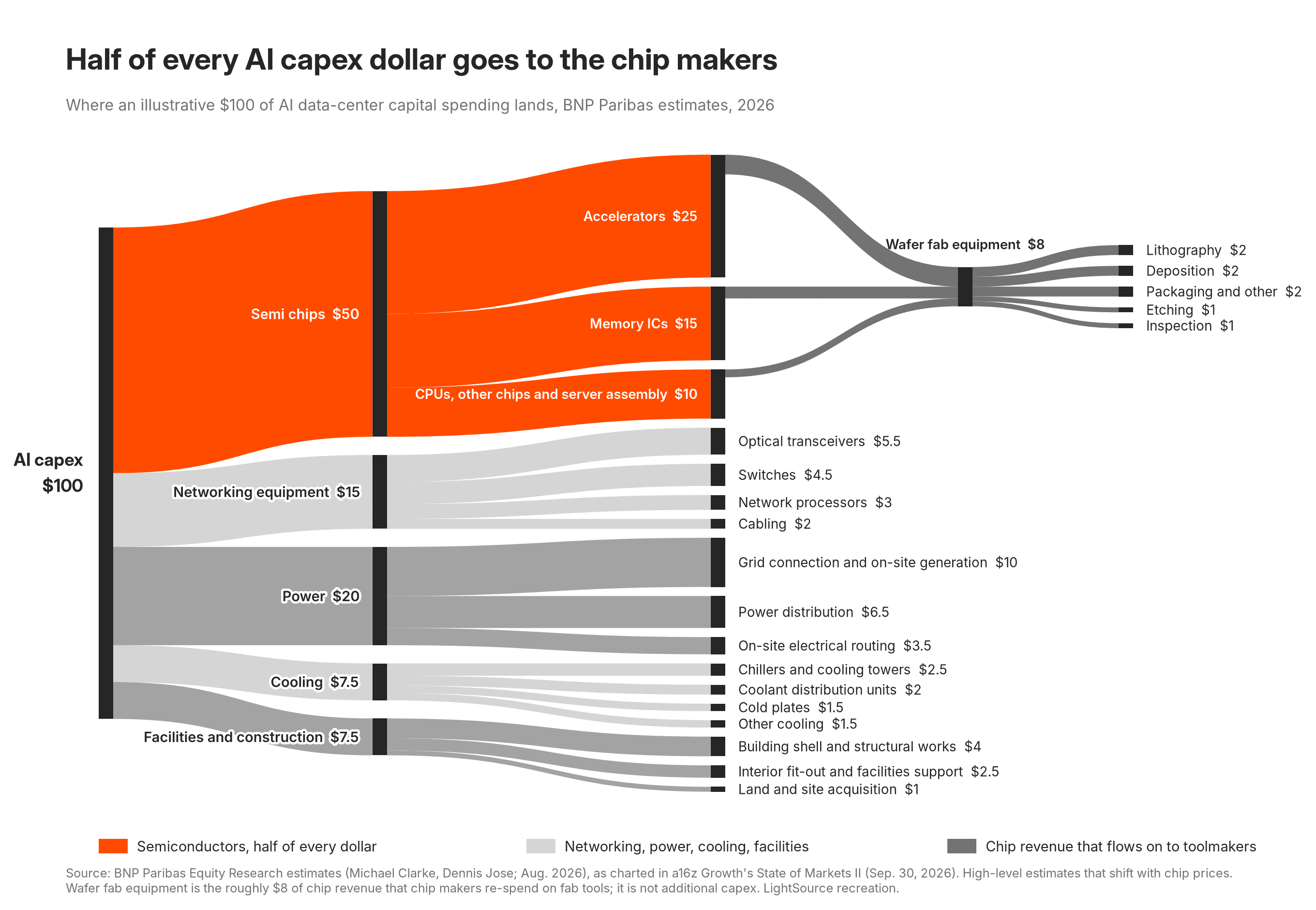
Where an illustrative $100 of AI data-center capex lands, per BNP Paribas Equity Research as charted in a16z Growth's State of Markets II (Sep. 30, 2026). Lithography is shown at $2; the original slide prints "$12", a typo. Chart: LightSource recreation.
The split is $50 to semiconductors ($25 accelerators, $15 memory, $10 CPUs and server assembly), $15 to networking, $20 to power, $7.50 to cooling, and $7.50 to the building. Lemand's reading is that half the money never leaves the chip makers. That overstates it in one direction and understates it in another. Revenue received is not profit retained, and the $8 of wafer-fab equipment inside the semiconductor slice shows chip makers re-spending their take on ASML, Applied Materials, and Lam. But the margin structure down the chain makes the point sharper than the dollar split does. Nvidia reported a 75.0% gross margin in its July quarter on $89 billion of data-center revenue. Micron's latest quarter carried an 86.8% gross margin in the memory supercycle. TSMC runs at 67.7%. Then the chain drops off a cliff: Vertiv at 22.6%, Eaton's electrical business at 27.5%, GE Vernova at a 5.8% net margin, Foxconn at 6.1% gross, and Turner Construction, which pours the concrete, at a 3.8% EBITDA margin. One analyst's conversion of the BNP split into profit terms has semiconductors at 50% of the spend and roughly two-thirds of the gross profit, while power, cooling, and buildings take 35% of the spend and about a sixth of the profit.
That is the asymmetry under the whole debate. For every dollar the hyperscalers borrow in the bond market, half lands with a handful of chip vendors as revenue, with margin, now, while the buyer books an asset to depreciate over five or six years and has to earn a return on the whole dollar. Lemand's earlier chart put consensus forward free cash flow of the five big spenders falling from about $275 billion in 2024 to roughly negative $25 billion, while Nvidia, Broadcom, Micron, and Applied Materials go from about $50 billion to $420 billion. He called it an accounting identity, and he is right: the hyperscalers' capex is the chip makers' revenue. Both forecasts cannot be wrong at once. They also cannot both be right in the way each side's shareholders expect.
The Guarantees Behind the Demand
The arrows on the Bloomberg map are mostly equity. The exposure that will matter if the cycle turns is mostly not. Nvidia's much-reported $100 billion commitment to OpenAI was always an up-to figure that was reworked by February; the funded number is $30 billion, with the final $10 billion wired in early October, the same week SoftBank completed its own $30 billion tranche. What Nvidia disclosed in August is larger and quieter: guarantees of up to $105 billion backstopping roughly 4.25 gigawatts of 20-year leases at SB Energy's Ohio campus on OpenAI's behalf, with maximum gross exposure of $108.5 billion. Nvidia pays only if OpenAI defaults and the landlord comes up short, and OpenAI has promised to reimburse it, which is not independent protection if OpenAI is the one in trouble. A supplier can support a customer's creditworthiness without moving any cash at all, and this is how. (We scored who owns which layer of the AI stack last week; Nvidia's Ohio campus is the supplier moving down into the dirt.)
The receivables side of Nvidia's filing reads the same way. Days sales outstanding went from 45 to 60 in a year. Payment terms for investment-grade customers now run "90 days to one year." Five customers account for 70% of $63.1 billion of receivables. None of that is improper; all of it is Nvidia financing its own demand, in the ordinary sense that it is waiting longer to be paid by fewer people.
The obligations that sit outside the debt tables are bigger still. Microsoft's fiscal 2026 report shows $329.1 billion of leases signed but not yet commenced, due to start between 2027 and 2033 on the five-year lead times that now govern the buildout, and therefore absent from the current lease liability. Oracle's August-quarter filing reportedly carries about $288 billion of the same. Oracle's free cash flow that quarter was negative $5.4 billion after $11.4 billion of customer advances; strip the advances out and it is closer to negative $17 billion. A customer prepayment is real cash, and it can still function as financing for the building the customer has not moved into yet.
The institutions whose job is to worry have started saying so in their own words. The IMF's October Global Financial Stability Report counts 14 deals since 2023 that pair roughly $300 billion of equity and $650 billion of debt with $1.4 trillion of future revenue commitments, and names the hazard "wrong-way risk": the investments lose value precisely when the revenue streams they depend on are impaired. It notes the hyperscalers now account for about 10% of global investment-grade issuance, up from under 1% in 2024. The Bank of England's Financial Policy Committee, in its September record, cites $450 billion of AI-related debt issued by early September, a JPMorgan estimate of $4.1 trillion of debt-financed capex through 2030, and the fact that AI hyperscalers represent 47% of sterling corporate-bond issuance this year, before warning that "circular arrangements" could amplify losses if expectations disappoint. The Kansas City Fed adds the detail that gives the whole thing its shape: the hyperscalers' bonds carry a weighted average maturity of about 16 years, against 10 for the market, for assets that are depreciated over five or six and that trade at a discount within two.
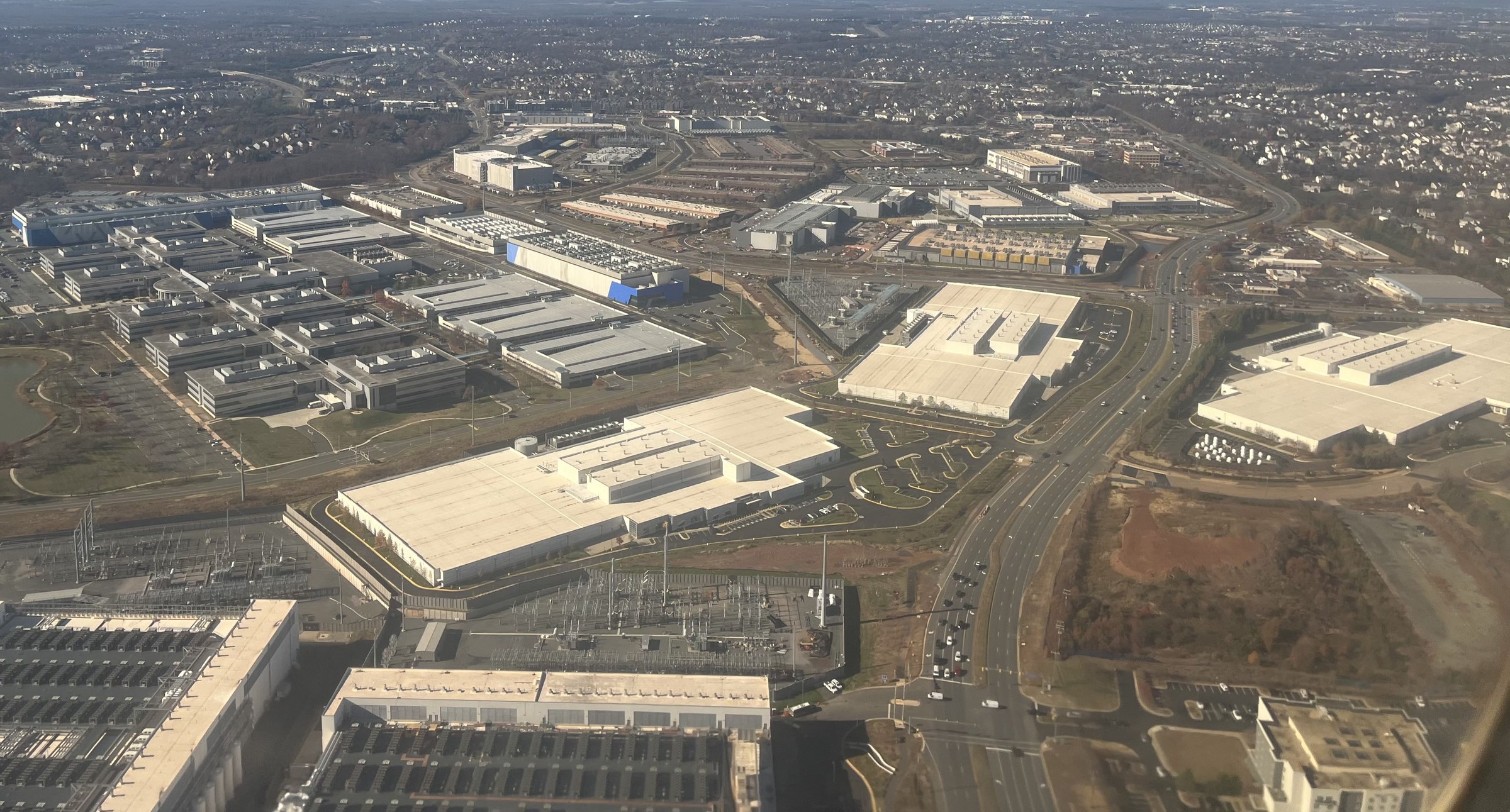
Data centers along Loudoun County Parkway in Ashburn, Virginia, in November 2025. Bloomberg's October feature on the circular deals opens in Loudoun County, where much of the leased capacity in the filings above is being built. Photo: Theodore Christopher via Wikimedia Commons, CC0.
The 2001 Telecom Precedent
The telecom buildout is the analogy everyone reaches for, and the specifics are more useful than the analogy. By late 2000, Lucent had committed about $7 billion of financing to its own customers, with roughly $1.5 billion to $2 billion actually drawn; Nortel had committed $3.1 billion; Cisco about $2.4 billion. Across nine equipment vendors, McKinsey counted $25.6 billion of customer loans. Lucent's single largest exposure was Winstar, a wireless carrier, at about $2 billion. When Lucent declined to extend a further $90 million loan in April 2001, Winstar failed within days and Lucent wrote off roughly $700 million of the credit. Eighteen of the 37 new US carriers were bankrupt by 2002. Newsweek's postmortem on why the vendors kept lending is the line to remember: their own stock prices were by then tied to the fate of their customers, and each loan "bought them one more year."
The important thing about that episode is that most of it was legal. Lucent's loans were disclosed. The equipment shipped. The revenue was recognized correctly right up until the customers could not pay. Where the law got involved was a different category entirely: Qwest's capacity swaps, where the sale of a fiber route was booked as immediate revenue while the identical purchase was capitalized over 20 years. The SEC found about $3.8 billion of improperly recognized revenue and extracted a $250 million penalty. That is Rajgopal's third bucket, fabricated substance, and it is worth keeping separate from the first two, because the AI deals are disclosed in a way the swaps never were. Anyone who wants to call the current cycle "another Enron" has to explain why the guarantees, warrants, and related-party revenue are all sitting in public filings.
The casualties that matter for this blog's readers were further down the chain. JDS Uniphase, which made the optical components the carriers were financing their way into, reported a $50.56 billion loss for fiscal 2001, then the largest in corporate history, most of it write-downs of acquisitions made at the top rather than cash out the door. Cisco took a $2.25 billion inventory charge in the same quarter, and its 10-K explains what it was: about 80% raw materials, bought against forecasts from customers whose forecasts had been financed by their vendors. The suppliers to the suppliers did not get the one more year.
Back at Tesla, I watched this decision get made in the other direction many times. A supplier deciding whether to build a dedicated line for a vehicle program is making a bet on the customer's funding, not just on the forecast, and the ones who asked for tooling money up front were generally the ones still in business at the next program. The difference in 2026 is that the tooling money is coming from the customer's own supplier.
A Supplier’s Checklist
Most readers of this blog will never buy a gigawatt of anything. Many of them will quote a switchgear order, a cooling-distribution-unit program, a rack enclosure, or a cable assembly for a neocloud whose own cash came from the chip maker it buys from. Rajgopal's three questions are the right first pass for that quote, and a better supplier risk assessment than most credit checks: Does the customer have revenue independent of its continued fundraising? What form does its backer's exposure take, equity, loans, or guarantees? And is there an arm's-length end customer paying real money at the bottom of the chain? The rest is procurement discipline, in roughly this order:
Trace the demand to the ultimate payer. Five "customers" that all resell capacity to the same two labs are one customer. Ask whether the order survives if the credit facility behind it does not.
Build a relationship-level cash bridge. For each big counterparty: cash collected, less any financing you supplied, less rebates and incentives, less guarantees actually called. A supplier that collected $12 million from a customer it had just put $5 million into has a $7 million relationship before production costs, whatever the revenue line says. It is not GAAP free cash flow. It tells you whether the account generates cash or consumes it.
Keep separate registers for separate exposures. Receivables, loans and equity, purchase commitments, guarantees, deposits, take-or-pay, termination penalties. A customer's promise to indemnify you against its own default is not credit protection.
Stress the timing, not the valuation. Delayed commissioning, slower collections, a refinancing window that closes, and the combined case where sales fall and your financing exposure impairs at once. For a manufacturer that means tooling, dedicated lines, and customer-specific inventory, which was exactly Cisco's $2.25 billion.
Read the supplier's filings to understand the customer. Days sales outstanding, payment-term language, receivable concentration, guarantee footnotes, and related-party tables. Nvidia's 10-Q tells you more about OpenAI's cash position than OpenAI does.
Tie material commitments to commissioning, not to the signature. A signed order for a site that has no power yet is a conditional order. Microsoft walked away from Nscale's Loughton campus outside London on October 18 after the grid operator said there would be no power until the 2030s; the suppliers who had bought long-lead material against that order learned the difference between a reservation and a non-cancelable purchase obligation. Get cancellation compensation, deposit protection, and the date the order becomes unconditional in writing.
Do not stock raw materials against financed forecasts. The 2001 rule, unchanged.
This is the part of supply-chain finance that never shows up in the glossary definition, and it is also where the manufacturers we work with spend their time. LightSource customers run award decisions with the volume assumption and the customer behind it attached to the quote, so a buyer or a supplier can see what a 40% demand haircut does to a tooling business case before anyone signs. Several of them are now on the selling side of this buildout, and the same should-cost and scenario discipline they use on their own BOMs applies to the question of whether their customer's customer can pay.
So, does it count as revenue? Yes. Nvidia's $89 billion quarter of data-center sales is as real as any revenue in corporate history, and the H100 rental market, which rose almost 40% between October 2025 and March 2026 according to SemiAnalysis, says the old chips are still earning. The honest version of the bear case concedes that the revenue is real and worries instead that about half the capex dollar is converting to cash and margin at one end of the chain, that the demand at the other end is increasingly financed by the people collecting the cash, and that the financing has been arranged with 16-year bonds, 20-year leases, and warrants that vest on purchases. We wrote in September about Apple financing its own suppliers to secure supply; this is the mirror image, suppliers financing their customers to secure demand, and the history of that trade, like the factory-building boom that already peaked, is that it works until the quarter it does not. Microsoft, Alphabet, and Oracle report this week, Amazon the day after. I would read the leases-not-yet-commenced footnote before the revenue line.
Sources
Bloomberg: A Guide to the Circular Deals Underpinning the AI Boom -- the deal map (updated Oct. 20, 2026) our chart is rebuilt from
Bloomberg AI Today newsletter, Oct. 13, 2026: the circular AI financing trend -- Shawn Donnan's guide to the deals and the global-risk framing
Bloomberg Big Take: AI's Giant Money Loop Is Drawing Foreign Cash Like 2008 -- the companion feature
a16z Growth, State of Markets II (Sep. 30, 2026) -- the "Following the AI Capex Money" Sankey, slide 44, from BNP Paribas Equity Research
BNP Paribas: AI infrastructure investment 2026 -- the underlying $100 capex breakdown
Ryan Lemand on LinkedIn, Oct. 20, 2026 -- "suppliers get paid in cash at the point of sale, the operators get a depreciation schedule and a hope"
Ryan Lemand on LinkedIn, Oct. 5, 2026 -- the free-cash-flow transfer chart
Nvidia Form 10-Q, quarter ended July 26, 2026 -- equity stakes, equity gains, the $105B guarantee, receivables concentration, DSO
AMD Form 10-K, fiscal 2025 -- the OpenAI warrant "recognized as a reduction to revenue"
Microsoft Annual Report, fiscal 2026 -- $24.1B OpenAI revenue, related-party disclosure, $329.1B of leases not yet commenced
Amazon Form 10-Q, quarter ended June 30, 2026 -- Anthropic investment gains, the OpenAI cloud commitment
Anthropic Form S-1 (Oct. 26, 2026) -- first-half revenue, operating loss, compute commitments, investor-channel revenue
Deloitte Roadmap: consideration payable to a customer (ASC 606) -- the netting rule, including subsidized customer financing
Shivaram Rajgopal: Not all circular financing is created equal (Aug. 28, 2026) -- the three-bucket framework
Axios: OpenAI's $50B run-rate and the gross-vs-net question (Oct. 8, 2026) -- Francine McKenna on principal-versus-agent accounting
Bloomberg Law: SEC calls for clear disclosure about AI data-center financing (May 2026) -- Sheri York's remarks
IMF Global Financial Stability Report, October 2026 -- the 14-deal count and "wrong-way risk"
Bank of England Financial Policy Committee record, September 2026 -- AI debt issuance and circular-arrangement warning
Kansas City Fed: Beyond Valuations (Oct. 5, 2026) -- bond maturities and long-term financing risk
Reuters: Nvidia close to finalizing $30 billion OpenAI investment (Feb. 2026) -- the reworked commitment
Newsweek: The Stupid Loan Bubble (2002) -- telecom vendor financing postmortem
MIT CTL case: Cisco and Lucent in the telecom bust -- financing exposure figures
SEC press release on Qwest (2004) -- the capacity-swap fraud findings
JDS Uniphase Form 10-K, fiscal 2001 -- the $50.56B loss
Cisco fiscal 2001 annual report financial review -- the $2.25B excess-inventory charge
SemiAnalysis: GPU rental market and H100 pricing -- the rental-price rebound
Goldman Sachs via Yahoo Finance: Big Tech to fund a third of AI investment with debt -- hyperscaler capex and debt-share estimates
Jensen Huang at the Goldman Sachs Communacopia conference, Sep. 2026 -- "Is that circular? If that is, let's do more of that"
Frequently Asked Questions
What is "circular" AI financing?
It describes deals where a supplier funds its own customer and the money comes back as purchases: Nvidia investing in OpenAI, which buys Nvidia GPUs; AMD granting OpenAI warrants in exchange for chip-purchase commitments; Amazon and Google owning stakes in Anthropic, which spends heavily on their clouds. The IMF counted 14 such deals since 2023 pairing about $300 billion of equity and $650 billion of debt with $1.4 trillion of future revenue commitments.
Does revenue from a customer you invested in count under GAAP?
Yes, provided there is a real contract, delivery, and probable collection. What the rules require is that any payment or share grant to the customer made in connection with the sale be netted against revenue, which is why AMD books its OpenAI warrant as a reduction of revenue as it vests. Equity stakes above roughly 20% also trigger related-party disclosure, which is how Microsoft reports $24.1 billion of revenue from OpenAI.
What is the difference between an equity gain and revenue in these deals?
When a customer's valuation rises, investors mark up their stakes and book gains in other income, not sales. Nvidia recorded $23.7 billion of such gains in the first half of fiscal 2027 and Amazon about $67.3 billion on Anthropic in the first half of 2026. Those gains are mostly unrealized, generate no cash, and sit on a different line from the revenue the same customers generate by buying chips or cloud capacity.
Where does AI capex money actually go?
BNP Paribas estimates that of every $100 of AI data-center capex, about $50 goes to semiconductors (accelerators, memory, CPUs and servers), $15 to networking, $20 to power, $7.50 to cooling, and $7.50 to the building itself. Margins drop steeply down the chain, from Nvidia's 75% and Micron's 87% gross margins to single digits for contract manufacturers and construction firms, so the chip layer takes roughly two-thirds of the gross profit on half the spend.
How did vendor financing play out in the 2000 telecom bubble?
Equipment makers including Lucent, Nortel, and Cisco lent about $25.6 billion to their carrier customers to fund network purchases. When the carriers could not refinance, 18 of 37 new US carriers went bankrupt by 2002, Lucent wrote off roughly $700 million on Winstar alone, and the suppliers further down the chain absorbed the worst of it: JDS Uniphase lost $50.56 billion in fiscal 2001 and Cisco took a $2.25 billion inventory charge, mostly raw materials bought against financed forecasts.
How should a manufacturer assess a customer whose demand is financed by its own supplier?
Trace the demand to the ultimate paying customer, separate the customer's operating revenue from its fundraising, classify each exposure (receivables, deposits, guarantees, take-or-pay) in its own register, and stress the timing of collections rather than the customer's valuation. Above all, avoid building dedicated tooling or stocking raw materials against forecasts that depend on financing the customer has not yet secured.
In September, at a Goldman Sachs conference, an analyst asked Jensen Huang whether Nvidia investing in OpenAI so that OpenAI could buy Nvidia chips was circular. "Is that circular? If that is, let's do more of that," he said. "We put in one and 100 comes back in." A month later Bloomberg published a map of exactly that: 26 companies, dozens of arrows, Nvidia in the middle, the arrows labeled investment, hardware, or services depending on which direction the money was pointing at the time. We rebuilt the map from the underlying deals, and we count 71 of them.
The map raises a question that sounds naive and turns out to be the whole game. If Nvidia puts $30 billion into OpenAI and OpenAI spends it on Nvidia GPUs, if AMD hands OpenAI warrants on 160 million shares in exchange for a commitment to buy six gigawatts of AMD chips, if Amazon and Google own a third of Anthropic and Anthropic spends half its revenue on their clouds, does any of that count as revenue? The accountants have a precise answer, and it is not the one either the bulls or the bears want. Yes, it counts. The chips are real, the contracts are real, and the revenue is recognized correctly under rules that predate the AI boom by a decade. What the rules do not promise is that the demand would exist without the seller's balance sheet behind it. The useful question for anyone selling into this buildout is whose cash is paying for the revenue, because its legality was never really in doubt.
Our recreation of Bloomberg's map of the circular AI deals: 71 investment, hardware and cloud relationships among 26 companies, sized by valuation as of October 20, 2026. Chart: LightSource, after Bloomberg (Cedric Sam, Rachael Dottle, Agnee Ghosh and Kyle Kim).
Why the Accountants Say Yes
Start with the version of this that nobody finds suspicious. A supplier sells a $60 assembly to a manufacturer that sells the finished product for $100, and together they report $160 of revenue against $100 of final spending. Every supply chain multiplies revenue this way, and nobody calls it circular. The AI version adds one twist: the supplier also provided the money its customer used to buy the assembly. Under US GAAP's revenue standard, ASC 606, that twist changes less than you would think. A sale is revenue when there is an approved contract, the goods have been delivered, and collection is probable. Nothing in the standard asks whether the customer raised the money from you. What the standard does police is price. If a seller pays its customer in conjunction with a sale, in cash, credits, or shares, that payment is "consideration payable to a customer" and reduces revenue, unless it buys something distinct at fair value. A $100 invoice accompanied by a $10 incentive is $90 of revenue. Deloitte's guidance goes a step further than most people expect: paying a financing company to give your customer a better borrowing rate can itself be consideration payable to the customer. Routing the subsidy through a lender does not take it out of the revenue math.
AMD's deal with OpenAI is the clean illustration, because AMD's own 10-K spells it out. The warrant on up to 160 million shares, struck at a penny, vests as OpenAI hits purchase and share-price milestones. AMD states that the warrant's grant-date fair value "will be recognized as a reduction to revenue when revenue is recognized." None of it had vested as of mid-2026, so AMD's 2025 statements carried no impact at all. The same company's CFO called the deal "highly accretive" to non-GAAP earnings, which tells you where the two bookkeepings diverge: GAAP nets the warrant out of the sale, and the adjusted number does not.
The second thing the rules police is disclosure. Microsoft, which holds about a 25% as-converted interest in OpenAI, treats OpenAI as a related party under ASC 850, and its fiscal 2026 annual report says plainly what readers of the Bloomberg map want to know: $24.1 billion of commercial revenue from OpenAI that year, with $6.0 billion still owed. Nvidia's stakes are minority positions carried at cost or fair value, so no equivalent disclosure is required, even though its commercial dependence on the same customers is arguably larger. As an auditor would put it, the disclosure trigger is the ownership structure, not the dependence.
Columbia's Shivaram Rajgopal, an accounting professor who has spent the year taking these deals apart, makes the distinction that keeps the argument honest. Not all circular financing is created equal. There is productive risk sharing, where a supplier takes equity in a customer that has real paying users; there is ordinary credit failure, where a supplier lends to customers who do not survive; and there is revenue fabrication, where the sale never had substance. They have different accounting, different disclosures, and different ways of going wrong. The 2026 deals mostly live in the first category and are financed in ways that could slide into the second. Almost none of them look like the third. The SEC's deputy chief accountant, Sheri York, said as much in May when asked about AI data-center financing: "The facts really matter here," and the agency's emphasis was on clear disclosure, not prohibition.
How Equity Gains Get Booked
This is where "revenue" quietly gets substituted for something else. Nvidia's equity stakes stood at $99 billion in its July 10-Q, up from a few billion in early 2025, and the first half of fiscal 2027 carried $23.7 billion of net gains on those positions. The gains run through other income, not through chip revenue, and the filing says they are mostly unrealized. Amazon's first-half 2026 filing shows $62.8 billion of upward adjustments on its Anthropic preferred stock plus $4.5 billion of gains on note conversions: $67.3 billion of pretax earnings that are neither AWS sales nor cash from a customer. When Anthropic raised at a $965 billion valuation in May, its investors' income statements moved before any of their data centers did.
The same mechanism works in reverse for the labs. Anthropic's S-1, filed today, shows $16.3 billion of revenue in the first half of 2026 against an operating loss of $693 million, a business close to breakeven on an operating basis. The net loss for the same six months is roughly $80.7 billion, almost all of it the swing in value of convertible instruments. The cash burn and the loss are different numbers by two orders of magnitude, in the same way Nvidia's net income of $59.7 billion in the half compares with $24.1 billion of operating cash flow. In both directions, the valuation flywheel and the operating flywheel reinforce each other, and they are not the same line.
Then there is gross versus net, the most boring distinction in accounting and the one that moved OpenAI's reported run-rate from $70 billion to about $50 billion in a single Financial Times correction in October. OpenAI's $70 billion counted the full value of transactions that flow through it; the $50 billion counts what it keeps. Accounting professor Francine McKenna's point in Axios was that both numbers can be GAAP-compliant, because principal-versus-agent treatment follows the facts of each contract rather than a policy election. Anthropic, for its part, books marketplace sales gross as principal, and its S-1 discloses that 48% of first-half revenue came through AWS, Google Cloud, and Azure, three channels that are also its shareholders. We wrote last spring about Google selling a million TPUs to Anthropic; the S-1 is what that relationship looks like from the buyer's side of the ledger.
Where Each Capex Dollar Lands
BNP Paribas' equity research team broke an illustrative $100 of AI data-center capex into where it lands, and a16z Growth turned it into the Sankey that Ryan Lemand, a wealth-management CEO in Abu Dhabi, pushed across LinkedIn on October 20 with a line worth quoting: the suppliers "get paid in cash at the point of sale, the operators get a depreciation schedule and a hope." We rebuilt the chart from the slide, and one correction is worth making. The original prints lithography at "$12" inside an $8 wafer-fab-equipment node; the ribbon widths and the arithmetic (2+2+1+1+2) make clear it is $2, a typo that has now circulated through several thousand reposts.
Where an illustrative $100 of AI data-center capex lands, per BNP Paribas Equity Research as charted in a16z Growth's State of Markets II (Sep. 30, 2026). Lithography is shown at $2; the original slide prints "$12", a typo. Chart: LightSource recreation.
The split is $50 to semiconductors ($25 accelerators, $15 memory, $10 CPUs and server assembly), $15 to networking, $20 to power, $7.50 to cooling, and $7.50 to the building. Lemand's reading is that half the money never leaves the chip makers. That overstates it in one direction and understates it in another. Revenue received is not profit retained, and the $8 of wafer-fab equipment inside the semiconductor slice shows chip makers re-spending their take on ASML, Applied Materials, and Lam. But the margin structure down the chain makes the point sharper than the dollar split does. Nvidia reported a 75.0% gross margin in its July quarter on $89 billion of data-center revenue. Micron's latest quarter carried an 86.8% gross margin in the memory supercycle. TSMC runs at 67.7%. Then the chain drops off a cliff: Vertiv at 22.6%, Eaton's electrical business at 27.5%, GE Vernova at a 5.8% net margin, Foxconn at 6.1% gross, and Turner Construction, which pours the concrete, at a 3.8% EBITDA margin. One analyst's conversion of the BNP split into profit terms has semiconductors at 50% of the spend and roughly two-thirds of the gross profit, while power, cooling, and buildings take 35% of the spend and about a sixth of the profit.
That is the asymmetry under the whole debate. For every dollar the hyperscalers borrow in the bond market, half lands with a handful of chip vendors as revenue, with margin, now, while the buyer books an asset to depreciate over five or six years and has to earn a return on the whole dollar. Lemand's earlier chart put consensus forward free cash flow of the five big spenders falling from about $275 billion in 2024 to roughly negative $25 billion, while Nvidia, Broadcom, Micron, and Applied Materials go from about $50 billion to $420 billion. He called it an accounting identity, and he is right: the hyperscalers' capex is the chip makers' revenue. Both forecasts cannot be wrong at once. They also cannot both be right in the way each side's shareholders expect.
The Guarantees Behind the Demand
The arrows on the Bloomberg map are mostly equity. The exposure that will matter if the cycle turns is mostly not. Nvidia's much-reported $100 billion commitment to OpenAI was always an up-to figure that was reworked by February; the funded number is $30 billion, with the final $10 billion wired in early October, the same week SoftBank completed its own $30 billion tranche. What Nvidia disclosed in August is larger and quieter: guarantees of up to $105 billion backstopping roughly 4.25 gigawatts of 20-year leases at SB Energy's Ohio campus on OpenAI's behalf, with maximum gross exposure of $108.5 billion. Nvidia pays only if OpenAI defaults and the landlord comes up short, and OpenAI has promised to reimburse it, which is not independent protection if OpenAI is the one in trouble. A supplier can support a customer's creditworthiness without moving any cash at all, and this is how. (We scored who owns which layer of the AI stack last week; Nvidia's Ohio campus is the supplier moving down into the dirt.)
The receivables side of Nvidia's filing reads the same way. Days sales outstanding went from 45 to 60 in a year. Payment terms for investment-grade customers now run "90 days to one year." Five customers account for 70% of $63.1 billion of receivables. None of that is improper; all of it is Nvidia financing its own demand, in the ordinary sense that it is waiting longer to be paid by fewer people.
The obligations that sit outside the debt tables are bigger still. Microsoft's fiscal 2026 report shows $329.1 billion of leases signed but not yet commenced, due to start between 2027 and 2033 on the five-year lead times that now govern the buildout, and therefore absent from the current lease liability. Oracle's August-quarter filing reportedly carries about $288 billion of the same. Oracle's free cash flow that quarter was negative $5.4 billion after $11.4 billion of customer advances; strip the advances out and it is closer to negative $17 billion. A customer prepayment is real cash, and it can still function as financing for the building the customer has not moved into yet.
The institutions whose job is to worry have started saying so in their own words. The IMF's October Global Financial Stability Report counts 14 deals since 2023 that pair roughly $300 billion of equity and $650 billion of debt with $1.4 trillion of future revenue commitments, and names the hazard "wrong-way risk": the investments lose value precisely when the revenue streams they depend on are impaired. It notes the hyperscalers now account for about 10% of global investment-grade issuance, up from under 1% in 2024. The Bank of England's Financial Policy Committee, in its September record, cites $450 billion of AI-related debt issued by early September, a JPMorgan estimate of $4.1 trillion of debt-financed capex through 2030, and the fact that AI hyperscalers represent 47% of sterling corporate-bond issuance this year, before warning that "circular arrangements" could amplify losses if expectations disappoint. The Kansas City Fed adds the detail that gives the whole thing its shape: the hyperscalers' bonds carry a weighted average maturity of about 16 years, against 10 for the market, for assets that are depreciated over five or six and that trade at a discount within two.
Data centers along Loudoun County Parkway in Ashburn, Virginia, in November 2025. Bloomberg's October feature on the circular deals opens in Loudoun County, where much of the leased capacity in the filings above is being built. Photo: Theodore Christopher via Wikimedia Commons, CC0.
The 2001 Telecom Precedent
The telecom buildout is the analogy everyone reaches for, and the specifics are more useful than the analogy. By late 2000, Lucent had committed about $7 billion of financing to its own customers, with roughly $1.5 billion to $2 billion actually drawn; Nortel had committed $3.1 billion; Cisco about $2.4 billion. Across nine equipment vendors, McKinsey counted $25.6 billion of customer loans. Lucent's single largest exposure was Winstar, a wireless carrier, at about $2 billion. When Lucent declined to extend a further $90 million loan in April 2001, Winstar failed within days and Lucent wrote off roughly $700 million of the credit. Eighteen of the 37 new US carriers were bankrupt by 2002. Newsweek's postmortem on why the vendors kept lending is the line to remember: their own stock prices were by then tied to the fate of their customers, and each loan "bought them one more year."
The important thing about that episode is that most of it was legal. Lucent's loans were disclosed. The equipment shipped. The revenue was recognized correctly right up until the customers could not pay. Where the law got involved was a different category entirely: Qwest's capacity swaps, where the sale of a fiber route was booked as immediate revenue while the identical purchase was capitalized over 20 years. The SEC found about $3.8 billion of improperly recognized revenue and extracted a $250 million penalty. That is Rajgopal's third bucket, fabricated substance, and it is worth keeping separate from the first two, because the AI deals are disclosed in a way the swaps never were. Anyone who wants to call the current cycle "another Enron" has to explain why the guarantees, warrants, and related-party revenue are all sitting in public filings.
The casualties that matter for this blog's readers were further down the chain. JDS Uniphase, which made the optical components the carriers were financing their way into, reported a $50.56 billion loss for fiscal 2001, then the largest in corporate history, most of it write-downs of acquisitions made at the top rather than cash out the door. Cisco took a $2.25 billion inventory charge in the same quarter, and its 10-K explains what it was: about 80% raw materials, bought against forecasts from customers whose forecasts had been financed by their vendors. The suppliers to the suppliers did not get the one more year.
Back at Tesla, I watched this decision get made in the other direction many times. A supplier deciding whether to build a dedicated line for a vehicle program is making a bet on the customer's funding, not just on the forecast, and the ones who asked for tooling money up front were generally the ones still in business at the next program. The difference in 2026 is that the tooling money is coming from the customer's own supplier.
A Supplier’s Checklist
Most readers of this blog will never buy a gigawatt of anything. Many of them will quote a switchgear order, a cooling-distribution-unit program, a rack enclosure, or a cable assembly for a neocloud whose own cash came from the chip maker it buys from. Rajgopal's three questions are the right first pass for that quote, and a better supplier risk assessment than most credit checks: Does the customer have revenue independent of its continued fundraising? What form does its backer's exposure take, equity, loans, or guarantees? And is there an arm's-length end customer paying real money at the bottom of the chain? The rest is procurement discipline, in roughly this order:
Trace the demand to the ultimate payer. Five "customers" that all resell capacity to the same two labs are one customer. Ask whether the order survives if the credit facility behind it does not.
Build a relationship-level cash bridge. For each big counterparty: cash collected, less any financing you supplied, less rebates and incentives, less guarantees actually called. A supplier that collected $12 million from a customer it had just put $5 million into has a $7 million relationship before production costs, whatever the revenue line says. It is not GAAP free cash flow. It tells you whether the account generates cash or consumes it.
Keep separate registers for separate exposures. Receivables, loans and equity, purchase commitments, guarantees, deposits, take-or-pay, termination penalties. A customer's promise to indemnify you against its own default is not credit protection.
Stress the timing, not the valuation. Delayed commissioning, slower collections, a refinancing window that closes, and the combined case where sales fall and your financing exposure impairs at once. For a manufacturer that means tooling, dedicated lines, and customer-specific inventory, which was exactly Cisco's $2.25 billion.
Read the supplier's filings to understand the customer. Days sales outstanding, payment-term language, receivable concentration, guarantee footnotes, and related-party tables. Nvidia's 10-Q tells you more about OpenAI's cash position than OpenAI does.
Tie material commitments to commissioning, not to the signature. A signed order for a site that has no power yet is a conditional order. Microsoft walked away from Nscale's Loughton campus outside London on October 18 after the grid operator said there would be no power until the 2030s; the suppliers who had bought long-lead material against that order learned the difference between a reservation and a non-cancelable purchase obligation. Get cancellation compensation, deposit protection, and the date the order becomes unconditional in writing.
Do not stock raw materials against financed forecasts. The 2001 rule, unchanged.
This is the part of supply-chain finance that never shows up in the glossary definition, and it is also where the manufacturers we work with spend their time. LightSource customers run award decisions with the volume assumption and the customer behind it attached to the quote, so a buyer or a supplier can see what a 40% demand haircut does to a tooling business case before anyone signs. Several of them are now on the selling side of this buildout, and the same should-cost and scenario discipline they use on their own BOMs applies to the question of whether their customer's customer can pay.
So, does it count as revenue? Yes. Nvidia's $89 billion quarter of data-center sales is as real as any revenue in corporate history, and the H100 rental market, which rose almost 40% between October 2025 and March 2026 according to SemiAnalysis, says the old chips are still earning. The honest version of the bear case concedes that the revenue is real and worries instead that about half the capex dollar is converting to cash and margin at one end of the chain, that the demand at the other end is increasingly financed by the people collecting the cash, and that the financing has been arranged with 16-year bonds, 20-year leases, and warrants that vest on purchases. We wrote in September about Apple financing its own suppliers to secure supply; this is the mirror image, suppliers financing their customers to secure demand, and the history of that trade, like the factory-building boom that already peaked, is that it works until the quarter it does not. Microsoft, Alphabet, and Oracle report this week, Amazon the day after. I would read the leases-not-yet-commenced footnote before the revenue line.
Sources
Bloomberg: A Guide to the Circular Deals Underpinning the AI Boom -- the deal map (updated Oct. 20, 2026) our chart is rebuilt from
Bloomberg AI Today newsletter, Oct. 13, 2026: the circular AI financing trend -- Shawn Donnan's guide to the deals and the global-risk framing
Bloomberg Big Take: AI's Giant Money Loop Is Drawing Foreign Cash Like 2008 -- the companion feature
a16z Growth, State of Markets II (Sep. 30, 2026) -- the "Following the AI Capex Money" Sankey, slide 44, from BNP Paribas Equity Research
BNP Paribas: AI infrastructure investment 2026 -- the underlying $100 capex breakdown
Ryan Lemand on LinkedIn, Oct. 20, 2026 -- "suppliers get paid in cash at the point of sale, the operators get a depreciation schedule and a hope"
Ryan Lemand on LinkedIn, Oct. 5, 2026 -- the free-cash-flow transfer chart
Nvidia Form 10-Q, quarter ended July 26, 2026 -- equity stakes, equity gains, the $105B guarantee, receivables concentration, DSO
AMD Form 10-K, fiscal 2025 -- the OpenAI warrant "recognized as a reduction to revenue"
Microsoft Annual Report, fiscal 2026 -- $24.1B OpenAI revenue, related-party disclosure, $329.1B of leases not yet commenced
Amazon Form 10-Q, quarter ended June 30, 2026 -- Anthropic investment gains, the OpenAI cloud commitment
Anthropic Form S-1 (Oct. 26, 2026) -- first-half revenue, operating loss, compute commitments, investor-channel revenue
Deloitte Roadmap: consideration payable to a customer (ASC 606) -- the netting rule, including subsidized customer financing
Shivaram Rajgopal: Not all circular financing is created equal (Aug. 28, 2026) -- the three-bucket framework
Axios: OpenAI's $50B run-rate and the gross-vs-net question (Oct. 8, 2026) -- Francine McKenna on principal-versus-agent accounting
Bloomberg Law: SEC calls for clear disclosure about AI data-center financing (May 2026) -- Sheri York's remarks
IMF Global Financial Stability Report, October 2026 -- the 14-deal count and "wrong-way risk"
Bank of England Financial Policy Committee record, September 2026 -- AI debt issuance and circular-arrangement warning
Kansas City Fed: Beyond Valuations (Oct. 5, 2026) -- bond maturities and long-term financing risk
Reuters: Nvidia close to finalizing $30 billion OpenAI investment (Feb. 2026) -- the reworked commitment
Newsweek: The Stupid Loan Bubble (2002) -- telecom vendor financing postmortem
MIT CTL case: Cisco and Lucent in the telecom bust -- financing exposure figures
SEC press release on Qwest (2004) -- the capacity-swap fraud findings
JDS Uniphase Form 10-K, fiscal 2001 -- the $50.56B loss
Cisco fiscal 2001 annual report financial review -- the $2.25B excess-inventory charge
SemiAnalysis: GPU rental market and H100 pricing -- the rental-price rebound
Goldman Sachs via Yahoo Finance: Big Tech to fund a third of AI investment with debt -- hyperscaler capex and debt-share estimates
Jensen Huang at the Goldman Sachs Communacopia conference, Sep. 2026 -- "Is that circular? If that is, let's do more of that"
Frequently Asked Questions
What is "circular" AI financing?
It describes deals where a supplier funds its own customer and the money comes back as purchases: Nvidia investing in OpenAI, which buys Nvidia GPUs; AMD granting OpenAI warrants in exchange for chip-purchase commitments; Amazon and Google owning stakes in Anthropic, which spends heavily on their clouds. The IMF counted 14 such deals since 2023 pairing about $300 billion of equity and $650 billion of debt with $1.4 trillion of future revenue commitments.
Does revenue from a customer you invested in count under GAAP?
Yes, provided there is a real contract, delivery, and probable collection. What the rules require is that any payment or share grant to the customer made in connection with the sale be netted against revenue, which is why AMD books its OpenAI warrant as a reduction of revenue as it vests. Equity stakes above roughly 20% also trigger related-party disclosure, which is how Microsoft reports $24.1 billion of revenue from OpenAI.
What is the difference between an equity gain and revenue in these deals?
When a customer's valuation rises, investors mark up their stakes and book gains in other income, not sales. Nvidia recorded $23.7 billion of such gains in the first half of fiscal 2027 and Amazon about $67.3 billion on Anthropic in the first half of 2026. Those gains are mostly unrealized, generate no cash, and sit on a different line from the revenue the same customers generate by buying chips or cloud capacity.
Where does AI capex money actually go?
BNP Paribas estimates that of every $100 of AI data-center capex, about $50 goes to semiconductors (accelerators, memory, CPUs and servers), $15 to networking, $20 to power, $7.50 to cooling, and $7.50 to the building itself. Margins drop steeply down the chain, from Nvidia's 75% and Micron's 87% gross margins to single digits for contract manufacturers and construction firms, so the chip layer takes roughly two-thirds of the gross profit on half the spend.
How did vendor financing play out in the 2000 telecom bubble?
Equipment makers including Lucent, Nortel, and Cisco lent about $25.6 billion to their carrier customers to fund network purchases. When the carriers could not refinance, 18 of 37 new US carriers went bankrupt by 2002, Lucent wrote off roughly $700 million on Winstar alone, and the suppliers further down the chain absorbed the worst of it: JDS Uniphase lost $50.56 billion in fiscal 2001 and Cisco took a $2.25 billion inventory charge, mostly raw materials bought against financed forecasts.
How should a manufacturer assess a customer whose demand is financed by its own supplier?
Trace the demand to the ultimate paying customer, separate the customer's operating revenue from its fundraising, classify each exposure (receivables, deposits, guarantees, take-or-pay) in its own register, and stress the timing of collections rather than the customer's valuation. Above all, avoid building dedicated tooling or stocking raw materials against forecasts that depend on financing the customer has not yet secured.


Faster sourcing. Lower cost. Less chaos.
See how LightSource connects engineering, procurement, and suppliers in one operating system to help you launch faster at lower cost.
SOC 2
Kearney #1 2024
Gartner Cool Vendor
Procuretech 100
G2 Top Rated
Faster sourcing. Lower cost. Less chaos.
See how LightSource connects engineering, procurement, and suppliers in one operating system to help you launch faster at lower cost.
SOC 2
Kearney #1 2024
Gartner Cool Vendor
Procuretech 100
G2 Top Rated
Faster sourcing. Lower cost. Less chaos.
See how LightSource connects engineering, procurement, and suppliers in one operating system to help you launch faster at lower cost.
SOC 2
Kearney #1 2024
Gartner Cool Vendor
Procuretech 100
G2 Top Rated
Trusted by:
Trusted by:
Trusted by: