
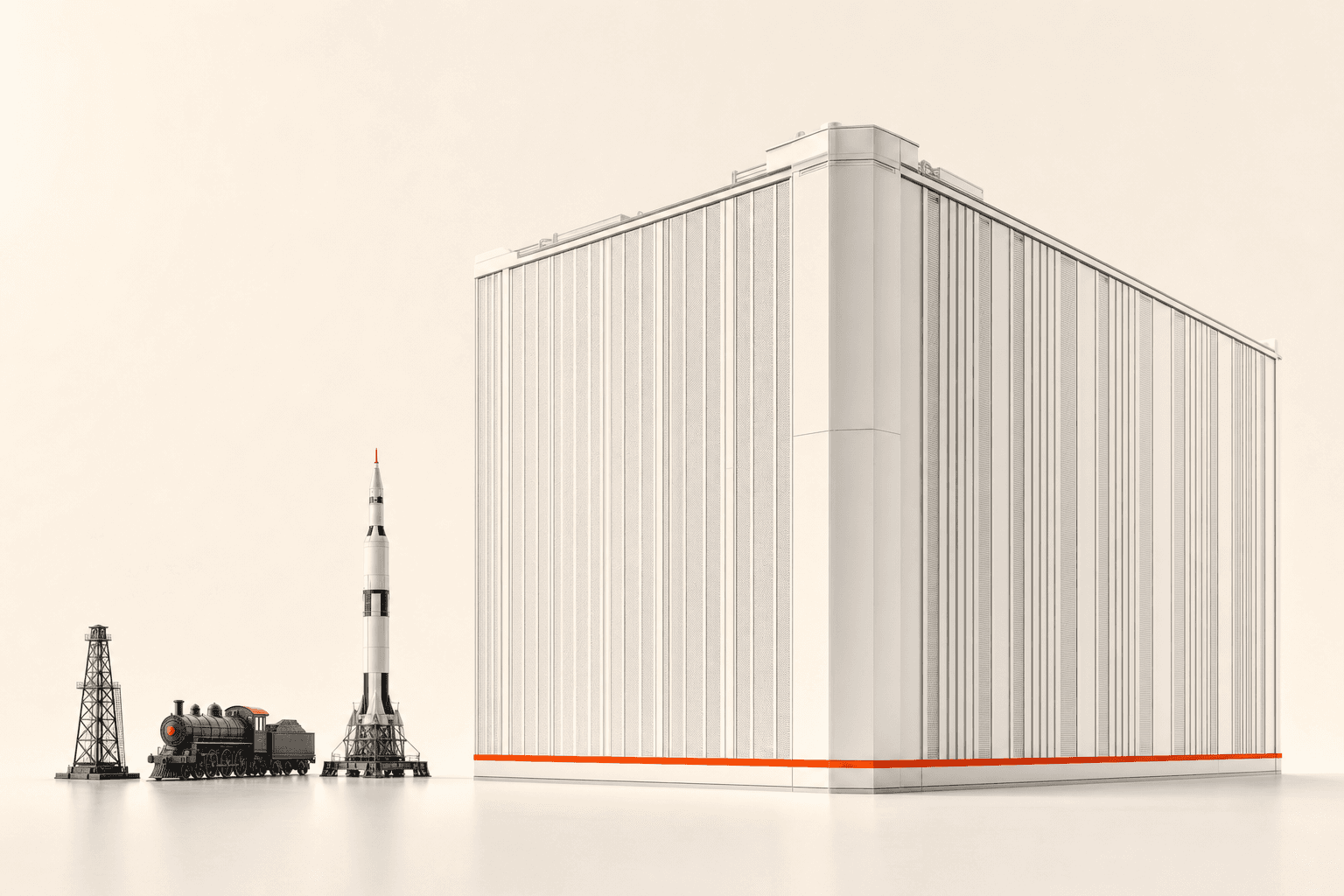
On the first Saturday of August, my friend Laurens De Poorter -- a fellow founder -- and I got up before sunrise, bought pastries, and drove out to Berkeley for the Agentic AI Summit, a two-day conference that UC Berkeley's RDI lab has turned into one of the bigger gatherings in AI: about 5,000 people on campus and tens of thousands more on the livestream. We went for the 10:45 a.m. session, a fireside chat between Dawn Song, the Berkeley professor who co-directs RDI and now also leads AI security research at Meta Superintelligence Labs, and Jasjeet Sekhon, the chief strategy officer of Google DeepMind, formerly chief scientist at Bridgewater and a professor at Berkeley and Yale before that.

Early start: pastries and the drive out to Berkeley with Laurens De Poorter.
The chat was nominally about recursive self-improvement -- the session title was "RSI: Demystifying the 'Foom'" -- and it covered a lot of ground: AI cyber capabilities, biosecurity, how to govern systems that improve faster than institutions can react. All of it was interesting. But a month later, the passage I keep coming back to is the one about money.
The Biggest Scientific Bet Civilization Has Ever Made
Dawn Song asked Sekhon whether the current capex buildout is sustainable. His answer was the most memorable sixty seconds of the summit:
"This buildout is unprecedented. This is the biggest scientific bet our civilization has ever made. We've dwarfed the expenditures of the Apollo mission to land a man on the moon. We've dwarfed the internet expenditures. We've dwarfed the Manhattan Project that made nuclear weapons. It is the largest scientific bet our civilization has ever made. The only capital expenditure we've ever done that is larger is building the railroads -- and the railroads were not a scientific bet. We knew how to make railroads. The only question was the business case."
-- Jasjeet Sekhon, Chief Strategy Officer, Google DeepMind, at the Berkeley Agentic AI Summit, August 1, 2026

Dawn Song and Jasjeet Sekhon on the fireside stage, August 1 -- my photo from the audience.
Sitting in the audience, that sounded like conference rhetoric. So I spent some time afterward checking whether the claim survives contact with the data. It does, and the margins are not close.
Two and a Half Apollo Programs, Every Year
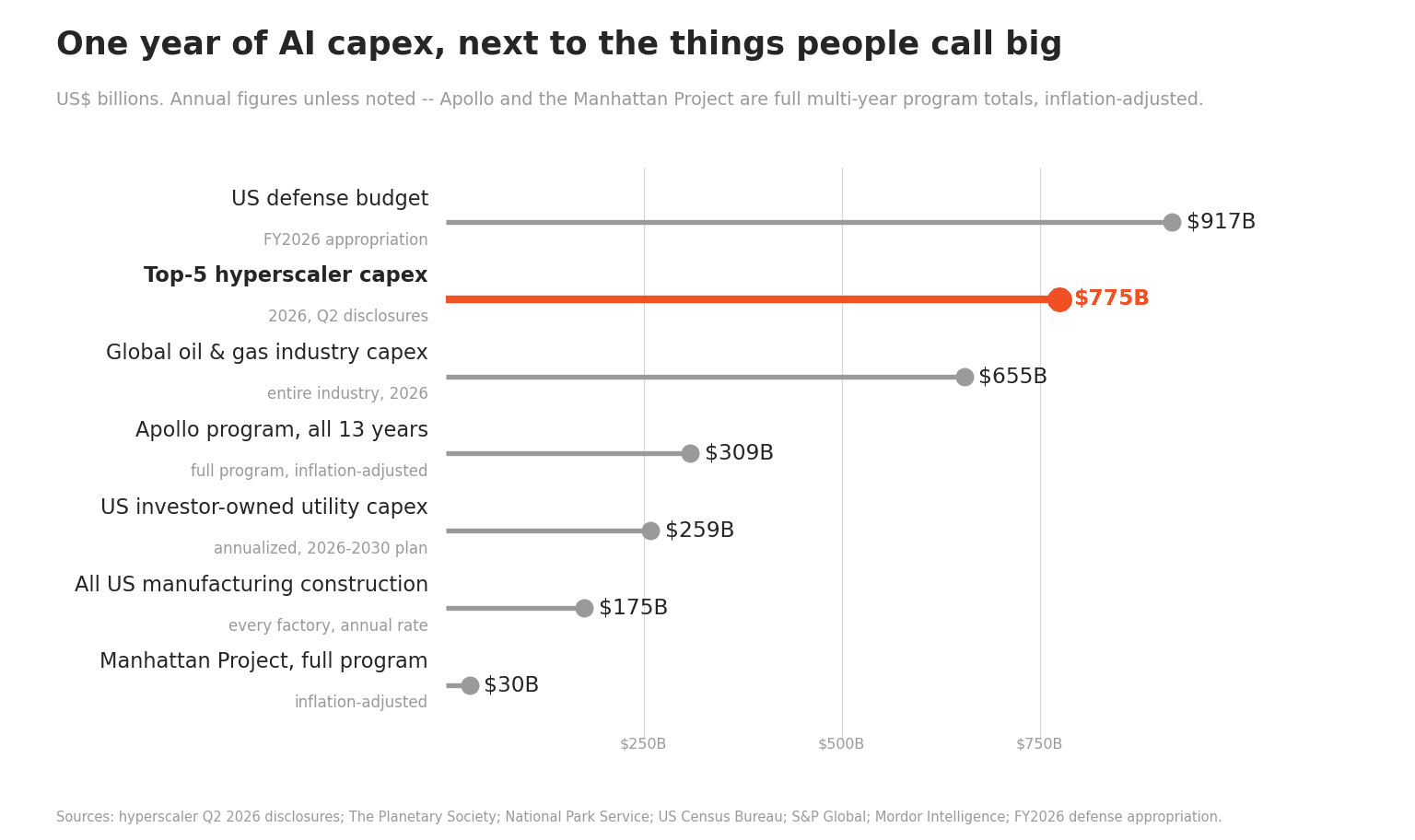
The five largest hyperscalers -- Amazon, Alphabet, Microsoft, Meta, and Oracle -- are on track to spend roughly $775-800 billion on capital expenditures in 2026, based on their Q2 disclosures, about triple what they spent in 2024. The estimates kept breaking upward all year: Reuters notes that consensus for the group's current-year capex rose from about $485 billion in January to roughly $730 billion by July. At Nvidia's August earnings, CFO Colette Kress cited forecasts of nearly $800 billion for 2026, rising to $1.3 trillion in 2027.
The historical programs Sekhon named are not in the same weight class. The Planetary Society puts the entire Apollo program at $25.8 billion in 1960s dollars, about $309 billion adjusted -- thirteen years of spending that the AI buildout now matches roughly every five months. The Manhattan Project, which President Truman announced in 1945 as "the greatest scientific gamble in history," cost about $2 billion, a bit over $30 billion in today's dollars: less than two weeks of current hyperscaler capex. Five companies now outspend the entire global oil and gas industry's annual capital budget (roughly $655 billion), and their combined total is closing in on the $917 billion US defense appropriation.
The railroad comparison is the one that holds up -- and it only holds up on one axis. US railroad construction ran around 4 percent of GNP through the 1870s and 1880s, and Britain's Railway Mania peaked near 7 percent of GDP in 1847. Goldman Sachs estimates AI-related capex at about 1.8 percent of US GDP in 2026, heading toward 2.8 percent by 2028. So the railroads still hold the record as a share of the economy. But as Sekhon pointed out, the railroads were proven technology with an uncertain business case. This is the reverse: a technology whose capability curve is still moving, funded like infrastructure.
The month after the summit kept making his point for him. In the span of ten August days, OpenAI announced an agreement for roughly 8 gigawatts at a campus in Ohio under a 20-year lease, with the first 800 megawatts expected in 2028; Reuters reported that Nvidia would backstop that lease with up to $105 billion in credit support; Georgia Power won approval for a contract to serve an OpenAI site with up to 3,200 megawatts; and AWS and Nvidia announced plans for 2 million additional GPUs through 2028 -- the same shape of deal as Google selling a million TPUs to Anthropic, which I wrote about in June. Read those announcements side by side and they sound like utility planning, not software budgeting: gigawatts, 20-year terms, transmission, permits, financing.
A Machine That Turns Energy Into Compute, and Compute Into Intelligence
Why spend like this? Sekhon's framing was the cleanest I've heard: "We appear to have found a way to turn energy into compute, and compute into intelligence. As long as that machine works -- as long as those scaling curves continue -- we're going to keep doing this." The investment case is that chain -- energy becomes compute, compute becomes capability, capability becomes revenue -- and every link has to hold.
He was equally direct about the link that hasn't held yet. Current revenues do not sustain the capital expenditures -- his words: "If the revenues were there to sustain it, it wouldn't be a scientific bet -- it would just be a commercial reality." The gap is real and quantifiable. Reuters reported in August that the five major hyperscalers are on a trajectory to spend more on capex than they generate in free cash flow by 2027, with Oracle's capex already at 174 percent of its operating cash flow. Sequoia's David Cahn has been asking versions of the same question since 2024, when he sized the gap between AI infrastructure spending and AI revenue at hundreds of billions of dollars a year. The revenues that do exist are substantial -- Microsoft has cited a $37 billion annual AI run rate, and AWS says its AI business exceeds $25 billion and is growing triple digits -- but they are an order of magnitude short of the spend. And Reuters counted another $1.09 trillion in future data center lease payments that haven't even started yet, sitting off the balance sheets. The scale of that bid is why even the iPhone now competes with data centers for memory and wafers.
Sekhon named the risk plainly: an "AI air pocket," where the expenditures happen, the revenues don't show up on schedule, and the markets react. In procurement terms, an air pocket would arrive as a sudden repricing of time -- the deposits, reservation fees, take-or-pay clauses, lease start dates, and cancellation terms that nobody reads closely in a boom would suddenly be the only text that matters. He hedged his own thesis on stage, which I found more credible than the usual conference certainty. His bet -- and it is the industry's collective bet -- is that capability growth keeps converting into willingness to fund the next cycle, and that if recursive self-improvement arrives in the next few years, the curve goes steeper still. Laurens and I spent most of the drive home arguing about which side of that bet we'd take.
The Bottlenecks Are Turbines, Transformers, and Memory
The part of this story my industry -- people who buy and build physical things -- lives with every day is that the constraint on the bet is no longer capital or model quality. Satya Nadella said it directly last fall: Microsoft's problem was not chips but "a bunch of chips sitting in inventory that I can't plug in." Microsoft has disclosed an $80 billion backlog of Azure orders it cannot serve for lack of powered capacity.
Walk down the bill of materials of a gigawatt-scale AI campus and nearly every layer is supply-constrained:
Layer | Status | Lead time |
|---|---|---|
Gas turbines | GE Vernova effectively sold out through 2029; ~10 GW of slots left across 2029-2030 | 5+ years |
Large transformers | Extra-high-voltage units up to 5 years (NREL); distribution units went from 3-6 months pre-2020 to 1-2+ years | 2.5-5 years |
HBM memory | 2026 supply sold out at all three makers; SK Hynix's CEO expects 2027 to be "the worst supply shortage in the industry's history" | Sold out |
Skilled trades | US construction short roughly 500,000 workers in 2026; electricians the scarcest | Years to train |
Each of those rows has its own supply chain underneath, and those are the actual chokepoints. EPRI's supply chain analysts point at rotor forgings and hot-section turbine blades -- made by a handful of superalloy casters -- as the gating step for turbine output. Transformers are gated by grain-oriented electrical steel, copper, and skilled winders. RBC estimates that rising memory prices alone account for roughly a third of the year-over-year increase in hyperscaler capex, which is what happens when 90 percent of DRAM supply comes from three companies -- Amazon's own Q2 release now lists "resource and supply volatility, including for memory chips" among the risks to its guidance. And the grid itself queues behind everything: Lawrence Berkeley National Laboratory counts about 2 terawatts of generation and storage waiting in US interconnection queues.
Sekhon told the room that the entire world is being restructured around this buildout -- "one of the miracles of capitalism," he called it, "that the entire planet can reorient to a new target." From where I sit, the reorientation is happening at the speed of capacity planning in forging shops and transformer plants, not at the speed of software. The money moves at software speed; the physical systems it is buying move in half-decades.
What Railway Mania and the Fiber Glut Say About Overbuilding
The honest version of this essay has to sit with the possibility that the bet misses. History offers two clean precedents, and neither is entirely comforting or entirely damning.
Britain's Railway Mania authorized 4,540 miles of new line in 1846 alone and peaked at nearly 7 percent of GDP; the network proved genuinely useful for a century, and the investors who funded it got crushed anyway, as dividends collapsed. The 1990s telecom buildout put more than $444 billion into fiber and switches in five years, financed with about $300 billion of debt; the companies went bankrupt in waves, bandwidth prices fell 55 percent a year into the mid-2000s -- and that same "wasted" fiber then carried the internet's growth for two decades. I've written about the wartime programs that sit on the other side of this ledger: Manhattan and Apollo were bets that paid off precisely because someone kept funding them through the period when the revenues were zero.
The pattern across all of them is that the infrastructure usually ends up mattering, while the first owners often don't get paid for it. If there is an air pocket coming, the companies most exposed are the ones whose demand is purely a derivative of AI sentiment -- and the most protected are the ones selling into the buildout whose products the economy needs regardless. Grid equipment, power generation, dual-sourced industrial components: if the AI bet pays, they compound for a decade; if it doesn't, they are still the backbone of electrification and reshoring. Whether that asymmetry is priced in yet is a question I'll leave to people who trade for a living.
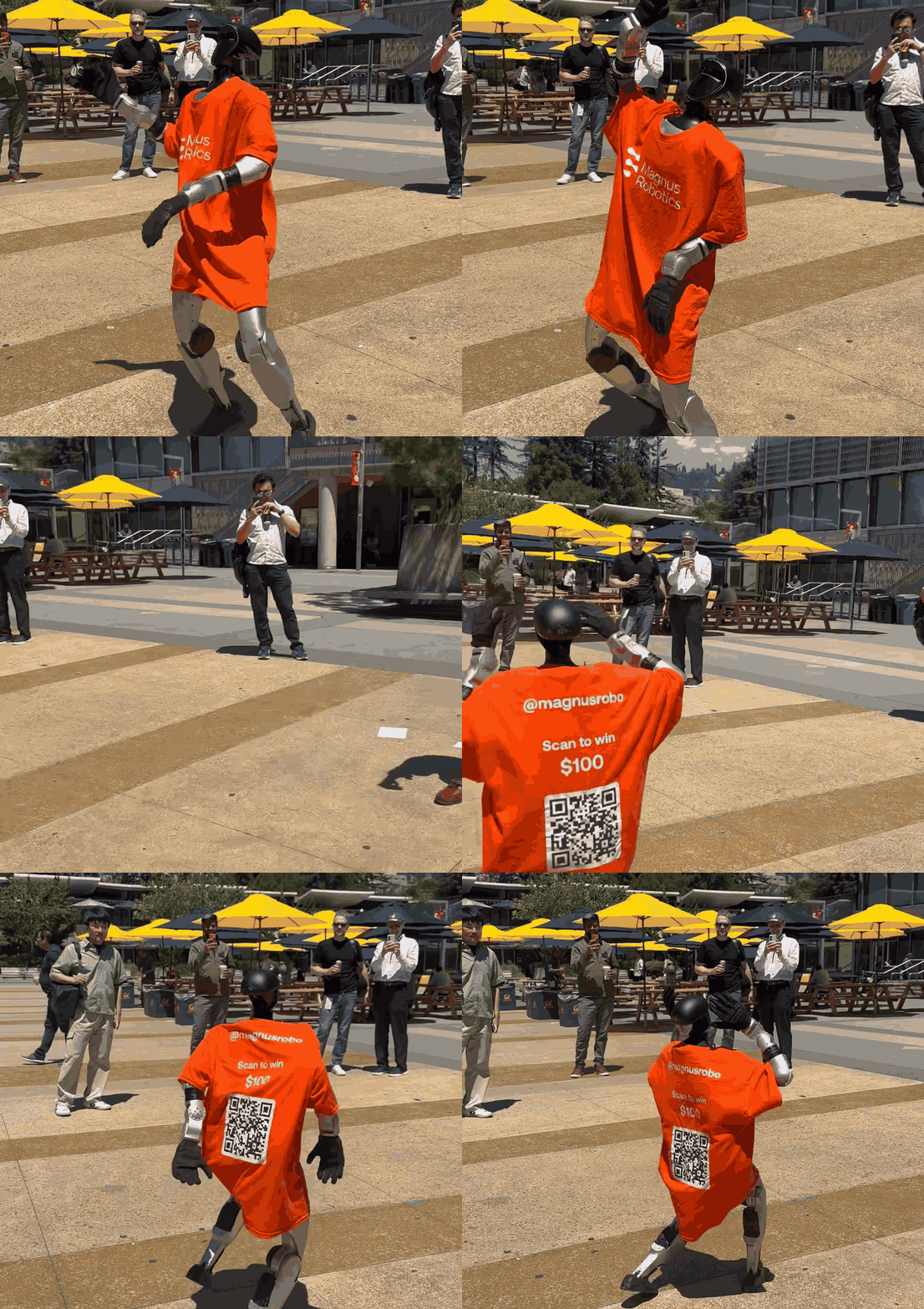
Also at the summit: a humanoid robot dancing for the crowd. The physical world, keeping up.
The Shovel-Sellers Have a Procurement Problem
Which brings me to the takeaway I'd offer the people I work with every day. For the manufacturers feeding this buildout -- the turbine makers, the electrical equipment companies with order books stretching to 2030, the suppliers' suppliers casting the blades and winding the transformers -- demand stopped being the constraint on growth, and their own supply base took its place. When your order book is sold out for four years, the questions that decide your revenue are procurement questions: how fast you can qualify a second source, whether your castings supplier can add a shift, how early you see a sub-tier constraint coming. My colleague Andy Hunt has written about why dual sourcing alone doesn't create resilience when whole supply chains converge on the same chokepoints -- and this buildout is the largest convergence event any of us has seen.
I watched a version of this from inside Tesla during the Model 3 ramp, and again at Waymo, where software could iterate weekly while hardware qualification kept its own calendar. When demand is guaranteed and supply is the bottleneck, every week of supplier qualification you save converts directly into output. That is the situation the entire AI supply chain is in now. At LightSource we build the direct materials operating system that connects engineering, procurement, and suppliers in one place, and the manufacturers we serve -- challengers competing on NPI speed -- are increasingly the companies this essay is about: the ones whose backlogs are public information and whose growth is decided in their supply base.
Sekhon closed the session with a line that stuck with both of us on the drive back over the Bay Bridge: "This is not a normal time in human history. We're living through something that I think is the combination of the Industrial Revolution and the Renaissance." Maybe. The claim is unfalsifiable from here. What I can verify is narrower and, for anyone in manufacturing, more actionable: the largest capital deployment of our lifetimes is underway, its binding constraints are physical, and the companies that master lead times measured in years are quietly deciding how fast the whole thing gets built.
Sources
Berkeley Agentic AI Summit 2026 -- Berkeley RDI -- event page: August 1-2, 2026, UC Berkeley
UC Berkeley News on the 2026 summit -- ~5,000 in-person attendees, tens of thousands online
Fireside chat video: Dawn Song and Jasjeet Sekhon -- source of all quotes
How much did the Apollo program cost? -- The Planetary Society -- $25.8B nominal, ~$309B adjusted
Manhattan Project FAQ -- National Park Service -- ~$2B by 1945, $30B+ in today's dollars
Truman's August 6, 1945 statement -- US State Department, Office of the Historian -- "the greatest scientific gamble in history"
Campbell & Turner on Railway Mania -- Business History -- capital formation near 7% of GDP in 1847; 4,540 miles authorized in 1846
Tracking trillions -- Goldman Sachs Research -- AI capex ~1.8% of US GDP in 2026, 2.8% by 2028
Telecom's five-year, $444B buildout -- Los Angeles Times, June 2002 -- and Wired on the bandwidth glut, 2004
AI investment boom puts Big Tech's free cash flow under pressure -- Reuters -- capex to exceed FCF by 2027; Oracle at 174% of operating cash flow; consensus climb from $485B to $730B
AI datacentre race builds $1 trillion lease burden -- Reuters, August 4, 2026 -- $1.09T in not-yet-commenced leases
Big Tech won't say how much money AI is making -- Axios, August 10, 2026 -- no AI-specific revenue disclosure
Nvidia Q2 FY2027 earnings coverage -- Associated Press, August 26, 2026 -- $89B data center quarter; Kress on ~$800B 2026 and $1.3T 2027
AI's $600B question -- Sequoia Capital, David Cahn -- the canonical revenue-gap analysis
OpenAI joins the PORTS-Pike project -- OpenAI, August 17, 2026 -- ~8 GW Ohio campus, 20-year lease, first 800 MW in 2028
Nvidia to invest $1.5B in SB Energy under OpenAI data center deal -- Reuters, August 17, 2026 -- up to $105B in credit support
Georgia Power contract for OpenAI project approved -- Georgia Power, August 26, 2026 -- up to 3,200 MW phased 2028-2032
AWS and Nvidia to deliver 2 million additional GPUs -- Amazon, August 26, 2026
GE Vernova's gas turbine backlog stretches into 2029 -- Utility Dive -- and Power Engineering on slots tightening through 2030
Transformer supply chain and lead times -- US Department of Energy, Office of Electricity -- distribution lead times from 3-6 months to 1-2+ years; EHV up to 5 years per NREL
SK Hynix CEO sees worst-ever memory shortage in 2027 -- Reuters, July 10, 2026
Memory prices and hyperscaler capex -- RBC Global Asset Management -- memory ≈ one-third of the 2026 capex increase; 90% of DRAM from three suppliers
Supply chain constraints are curbing US data center development -- Rabobank -- ~500,000-worker construction shortfall in 2026; skilled-trade wages 25-30% above norms
Cracking the power supply chain code -- POWER Magazine / EPRI -- rotor forgings and hot-section blades as turbine chokepoints
Queued Up 2026 -- Lawrence Berkeley National Laboratory -- ~2 TW in US interconnection queues
Microsoft's $80B unserved Azure backlog -- Futurum -- and Nadella's "chips I can't plug in"
Frequently Asked Questions
What did Google DeepMind's Jasjeet Sekhon say about AI investment at the Berkeley Agentic AI Summit 2026?
Sekhon called the AI infrastructure buildout "the biggest scientific bet our civilization has ever made," noting it has dwarfed the Apollo program, the internet buildout, and the Manhattan Project, with only the railroads larger as a share of the economy. He also warned of an "AI air pocket" risk: current revenues do not yet sustain the capital expenditures, which is what makes it a bet rather than a commercial reality.
How does AI infrastructure spending compare to the Apollo program?
The top five hyperscalers are spending roughly $775-800 billion on capex in 2026 alone. The entire Apollo program cost about $309 billion in inflation-adjusted dollars spread over 13 years, so the AI buildout now spends an Apollo program's worth roughly every five months. The Manhattan Project, about $30 billion in today's dollars, equals less than two weeks of current spending.
What are the biggest physical bottlenecks in the AI data center buildout?
Heavy-duty gas turbines (GE Vernova is effectively sold out through 2029), large power transformers (up to five-year lead times for extra-high-voltage units), high-bandwidth memory (2026 supply sold out at all three producers), grid interconnection queues (about 2 terawatts waiting), and skilled construction labor (a roughly 500,000-worker shortfall in 2026, with electricians scarcest). Under each sits a deeper constraint: superalloy castings, grain-oriented electrical steel, copper.
What is the "AI air pocket" risk?
It is the scenario where AI capital expenditures continue but AI revenues fail to arrive on schedule, forcing markets to reprice the buildout. Reuters projects the five largest hyperscalers will spend more on capex than they generate in free cash flow by 2027, and none of them disclose AI-specific revenue, which makes the gap hard to monitor from outside. For suppliers, an air pocket would surface through contract terms: deposits, take-or-pay clauses, lease start dates, and cancellation rights.
Why does the AI buildout matter for procurement and supply chain teams?
Because the buildout's binding constraints are physical, the manufacturers feeding it -- turbine makers, electrical equipment producers, memory fabs -- have multi-year sold-out order books, and their growth is now decided by their own supply bases. For those companies, supplier development, second-source qualification, and sourcing velocity determine how much of the backlog converts to revenue.
Did the railroad and telecom buildouts pay off for investors?
Mostly not, even though the infrastructure proved valuable. Britain's Railway Mania peaked near 7 percent of GDP in 1847 and left a network used for a century, but investor dividends collapsed. The 1990s telecom buildout spent over $444 billion, ended in mass bankruptcies -- and the fiber it left behind carried two decades of internet growth. Useful overbuild and poor first-owner returns have historically gone together.
On the first Saturday of August, my friend Laurens De Poorter -- a fellow founder -- and I got up before sunrise, bought pastries, and drove out to Berkeley for the Agentic AI Summit, a two-day conference that UC Berkeley's RDI lab has turned into one of the bigger gatherings in AI: about 5,000 people on campus and tens of thousands more on the livestream. We went for the 10:45 a.m. session, a fireside chat between Dawn Song, the Berkeley professor who co-directs RDI and now also leads AI security research at Meta Superintelligence Labs, and Jasjeet Sekhon, the chief strategy officer of Google DeepMind, formerly chief scientist at Bridgewater and a professor at Berkeley and Yale before that.
Early start: pastries and the drive out to Berkeley with Laurens De Poorter.
The chat was nominally about recursive self-improvement -- the session title was "RSI: Demystifying the 'Foom'" -- and it covered a lot of ground: AI cyber capabilities, biosecurity, how to govern systems that improve faster than institutions can react. All of it was interesting. But a month later, the passage I keep coming back to is the one about money.
The Biggest Scientific Bet Civilization Has Ever Made
Dawn Song asked Sekhon whether the current capex buildout is sustainable. His answer was the most memorable sixty seconds of the summit:
"This buildout is unprecedented. This is the biggest scientific bet our civilization has ever made. We've dwarfed the expenditures of the Apollo mission to land a man on the moon. We've dwarfed the internet expenditures. We've dwarfed the Manhattan Project that made nuclear weapons. It is the largest scientific bet our civilization has ever made. The only capital expenditure we've ever done that is larger is building the railroads -- and the railroads were not a scientific bet. We knew how to make railroads. The only question was the business case."
-- Jasjeet Sekhon, Chief Strategy Officer, Google DeepMind, at the Berkeley Agentic AI Summit, August 1, 2026
Dawn Song and Jasjeet Sekhon on the fireside stage, August 1 -- my photo from the audience.
Sitting in the audience, that sounded like conference rhetoric. So I spent some time afterward checking whether the claim survives contact with the data. It does, and the margins are not close.
Two and a Half Apollo Programs, Every Year
The five largest hyperscalers -- Amazon, Alphabet, Microsoft, Meta, and Oracle -- are on track to spend roughly $775-800 billion on capital expenditures in 2026, based on their Q2 disclosures, about triple what they spent in 2024. The estimates kept breaking upward all year: Reuters notes that consensus for the group's current-year capex rose from about $485 billion in January to roughly $730 billion by July. At Nvidia's August earnings, CFO Colette Kress cited forecasts of nearly $800 billion for 2026, rising to $1.3 trillion in 2027.
The historical programs Sekhon named are not in the same weight class. The Planetary Society puts the entire Apollo program at $25.8 billion in 1960s dollars, about $309 billion adjusted -- thirteen years of spending that the AI buildout now matches roughly every five months. The Manhattan Project, which President Truman announced in 1945 as "the greatest scientific gamble in history," cost about $2 billion, a bit over $30 billion in today's dollars: less than two weeks of current hyperscaler capex. Five companies now outspend the entire global oil and gas industry's annual capital budget (roughly $655 billion), and their combined total is closing in on the $917 billion US defense appropriation.
The railroad comparison is the one that holds up -- and it only holds up on one axis. US railroad construction ran around 4 percent of GNP through the 1870s and 1880s, and Britain's Railway Mania peaked near 7 percent of GDP in 1847. Goldman Sachs estimates AI-related capex at about 1.8 percent of US GDP in 2026, heading toward 2.8 percent by 2028. So the railroads still hold the record as a share of the economy. But as Sekhon pointed out, the railroads were proven technology with an uncertain business case. This is the reverse: a technology whose capability curve is still moving, funded like infrastructure.
The month after the summit kept making his point for him. In the span of ten August days, OpenAI announced an agreement for roughly 8 gigawatts at a campus in Ohio under a 20-year lease, with the first 800 megawatts expected in 2028; Reuters reported that Nvidia would backstop that lease with up to $105 billion in credit support; Georgia Power won approval for a contract to serve an OpenAI site with up to 3,200 megawatts; and AWS and Nvidia announced plans for 2 million additional GPUs through 2028 -- the same shape of deal as Google selling a million TPUs to Anthropic, which I wrote about in June. Read those announcements side by side and they sound like utility planning, not software budgeting: gigawatts, 20-year terms, transmission, permits, financing.
A Machine That Turns Energy Into Compute, and Compute Into Intelligence
Why spend like this? Sekhon's framing was the cleanest I've heard: "We appear to have found a way to turn energy into compute, and compute into intelligence. As long as that machine works -- as long as those scaling curves continue -- we're going to keep doing this." The investment case is that chain -- energy becomes compute, compute becomes capability, capability becomes revenue -- and every link has to hold.
He was equally direct about the link that hasn't held yet. Current revenues do not sustain the capital expenditures -- his words: "If the revenues were there to sustain it, it wouldn't be a scientific bet -- it would just be a commercial reality." The gap is real and quantifiable. Reuters reported in August that the five major hyperscalers are on a trajectory to spend more on capex than they generate in free cash flow by 2027, with Oracle's capex already at 174 percent of its operating cash flow. Sequoia's David Cahn has been asking versions of the same question since 2024, when he sized the gap between AI infrastructure spending and AI revenue at hundreds of billions of dollars a year. The revenues that do exist are substantial -- Microsoft has cited a $37 billion annual AI run rate, and AWS says its AI business exceeds $25 billion and is growing triple digits -- but they are an order of magnitude short of the spend. And Reuters counted another $1.09 trillion in future data center lease payments that haven't even started yet, sitting off the balance sheets. The scale of that bid is why even the iPhone now competes with data centers for memory and wafers.
Sekhon named the risk plainly: an "AI air pocket," where the expenditures happen, the revenues don't show up on schedule, and the markets react. In procurement terms, an air pocket would arrive as a sudden repricing of time -- the deposits, reservation fees, take-or-pay clauses, lease start dates, and cancellation terms that nobody reads closely in a boom would suddenly be the only text that matters. He hedged his own thesis on stage, which I found more credible than the usual conference certainty. His bet -- and it is the industry's collective bet -- is that capability growth keeps converting into willingness to fund the next cycle, and that if recursive self-improvement arrives in the next few years, the curve goes steeper still. Laurens and I spent most of the drive home arguing about which side of that bet we'd take.
The Bottlenecks Are Turbines, Transformers, and Memory
The part of this story my industry -- people who buy and build physical things -- lives with every day is that the constraint on the bet is no longer capital or model quality. Satya Nadella said it directly last fall: Microsoft's problem was not chips but "a bunch of chips sitting in inventory that I can't plug in." Microsoft has disclosed an $80 billion backlog of Azure orders it cannot serve for lack of powered capacity.
Walk down the bill of materials of a gigawatt-scale AI campus and nearly every layer is supply-constrained:
Layer | Status | Lead time |
|---|---|---|
Gas turbines | GE Vernova effectively sold out through 2029; ~10 GW of slots left across 2029-2030 | 5+ years |
Large transformers | Extra-high-voltage units up to 5 years (NREL); distribution units went from 3-6 months pre-2020 to 1-2+ years | 2.5-5 years |
HBM memory | 2026 supply sold out at all three makers; SK Hynix's CEO expects 2027 to be "the worst supply shortage in the industry's history" | Sold out |
Skilled trades | US construction short roughly 500,000 workers in 2026; electricians the scarcest | Years to train |
Each of those rows has its own supply chain underneath, and those are the actual chokepoints. EPRI's supply chain analysts point at rotor forgings and hot-section turbine blades -- made by a handful of superalloy casters -- as the gating step for turbine output. Transformers are gated by grain-oriented electrical steel, copper, and skilled winders. RBC estimates that rising memory prices alone account for roughly a third of the year-over-year increase in hyperscaler capex, which is what happens when 90 percent of DRAM supply comes from three companies -- Amazon's own Q2 release now lists "resource and supply volatility, including for memory chips" among the risks to its guidance. And the grid itself queues behind everything: Lawrence Berkeley National Laboratory counts about 2 terawatts of generation and storage waiting in US interconnection queues.
Sekhon told the room that the entire world is being restructured around this buildout -- "one of the miracles of capitalism," he called it, "that the entire planet can reorient to a new target." From where I sit, the reorientation is happening at the speed of capacity planning in forging shops and transformer plants, not at the speed of software. The money moves at software speed; the physical systems it is buying move in half-decades.
What Railway Mania and the Fiber Glut Say About Overbuilding
The honest version of this essay has to sit with the possibility that the bet misses. History offers two clean precedents, and neither is entirely comforting or entirely damning.
Britain's Railway Mania authorized 4,540 miles of new line in 1846 alone and peaked at nearly 7 percent of GDP; the network proved genuinely useful for a century, and the investors who funded it got crushed anyway, as dividends collapsed. The 1990s telecom buildout put more than $444 billion into fiber and switches in five years, financed with about $300 billion of debt; the companies went bankrupt in waves, bandwidth prices fell 55 percent a year into the mid-2000s -- and that same "wasted" fiber then carried the internet's growth for two decades. I've written about the wartime programs that sit on the other side of this ledger: Manhattan and Apollo were bets that paid off precisely because someone kept funding them through the period when the revenues were zero.
The pattern across all of them is that the infrastructure usually ends up mattering, while the first owners often don't get paid for it. If there is an air pocket coming, the companies most exposed are the ones whose demand is purely a derivative of AI sentiment -- and the most protected are the ones selling into the buildout whose products the economy needs regardless. Grid equipment, power generation, dual-sourced industrial components: if the AI bet pays, they compound for a decade; if it doesn't, they are still the backbone of electrification and reshoring. Whether that asymmetry is priced in yet is a question I'll leave to people who trade for a living.
Also at the summit: a humanoid robot dancing for the crowd. The physical world, keeping up.
The Shovel-Sellers Have a Procurement Problem
Which brings me to the takeaway I'd offer the people I work with every day. For the manufacturers feeding this buildout -- the turbine makers, the electrical equipment companies with order books stretching to 2030, the suppliers' suppliers casting the blades and winding the transformers -- demand stopped being the constraint on growth, and their own supply base took its place. When your order book is sold out for four years, the questions that decide your revenue are procurement questions: how fast you can qualify a second source, whether your castings supplier can add a shift, how early you see a sub-tier constraint coming. My colleague Andy Hunt has written about why dual sourcing alone doesn't create resilience when whole supply chains converge on the same chokepoints -- and this buildout is the largest convergence event any of us has seen.
I watched a version of this from inside Tesla during the Model 3 ramp, and again at Waymo, where software could iterate weekly while hardware qualification kept its own calendar. When demand is guaranteed and supply is the bottleneck, every week of supplier qualification you save converts directly into output. That is the situation the entire AI supply chain is in now. At LightSource we build the direct materials operating system that connects engineering, procurement, and suppliers in one place, and the manufacturers we serve -- challengers competing on NPI speed -- are increasingly the companies this essay is about: the ones whose backlogs are public information and whose growth is decided in their supply base.
Sekhon closed the session with a line that stuck with both of us on the drive back over the Bay Bridge: "This is not a normal time in human history. We're living through something that I think is the combination of the Industrial Revolution and the Renaissance." Maybe. The claim is unfalsifiable from here. What I can verify is narrower and, for anyone in manufacturing, more actionable: the largest capital deployment of our lifetimes is underway, its binding constraints are physical, and the companies that master lead times measured in years are quietly deciding how fast the whole thing gets built.
Sources
Berkeley Agentic AI Summit 2026 -- Berkeley RDI -- event page: August 1-2, 2026, UC Berkeley
UC Berkeley News on the 2026 summit -- ~5,000 in-person attendees, tens of thousands online
Fireside chat video: Dawn Song and Jasjeet Sekhon -- source of all quotes
How much did the Apollo program cost? -- The Planetary Society -- $25.8B nominal, ~$309B adjusted
Manhattan Project FAQ -- National Park Service -- ~$2B by 1945, $30B+ in today's dollars
Truman's August 6, 1945 statement -- US State Department, Office of the Historian -- "the greatest scientific gamble in history"
Campbell & Turner on Railway Mania -- Business History -- capital formation near 7% of GDP in 1847; 4,540 miles authorized in 1846
Tracking trillions -- Goldman Sachs Research -- AI capex ~1.8% of US GDP in 2026, 2.8% by 2028
Telecom's five-year, $444B buildout -- Los Angeles Times, June 2002 -- and Wired on the bandwidth glut, 2004
AI investment boom puts Big Tech's free cash flow under pressure -- Reuters -- capex to exceed FCF by 2027; Oracle at 174% of operating cash flow; consensus climb from $485B to $730B
AI datacentre race builds $1 trillion lease burden -- Reuters, August 4, 2026 -- $1.09T in not-yet-commenced leases
Big Tech won't say how much money AI is making -- Axios, August 10, 2026 -- no AI-specific revenue disclosure
Nvidia Q2 FY2027 earnings coverage -- Associated Press, August 26, 2026 -- $89B data center quarter; Kress on ~$800B 2026 and $1.3T 2027
AI's $600B question -- Sequoia Capital, David Cahn -- the canonical revenue-gap analysis
OpenAI joins the PORTS-Pike project -- OpenAI, August 17, 2026 -- ~8 GW Ohio campus, 20-year lease, first 800 MW in 2028
Nvidia to invest $1.5B in SB Energy under OpenAI data center deal -- Reuters, August 17, 2026 -- up to $105B in credit support
Georgia Power contract for OpenAI project approved -- Georgia Power, August 26, 2026 -- up to 3,200 MW phased 2028-2032
AWS and Nvidia to deliver 2 million additional GPUs -- Amazon, August 26, 2026
GE Vernova's gas turbine backlog stretches into 2029 -- Utility Dive -- and Power Engineering on slots tightening through 2030
Transformer supply chain and lead times -- US Department of Energy, Office of Electricity -- distribution lead times from 3-6 months to 1-2+ years; EHV up to 5 years per NREL
SK Hynix CEO sees worst-ever memory shortage in 2027 -- Reuters, July 10, 2026
Memory prices and hyperscaler capex -- RBC Global Asset Management -- memory ≈ one-third of the 2026 capex increase; 90% of DRAM from three suppliers
Supply chain constraints are curbing US data center development -- Rabobank -- ~500,000-worker construction shortfall in 2026; skilled-trade wages 25-30% above norms
Cracking the power supply chain code -- POWER Magazine / EPRI -- rotor forgings and hot-section blades as turbine chokepoints
Queued Up 2026 -- Lawrence Berkeley National Laboratory -- ~2 TW in US interconnection queues
Microsoft's $80B unserved Azure backlog -- Futurum -- and Nadella's "chips I can't plug in"
Frequently Asked Questions
What did Google DeepMind's Jasjeet Sekhon say about AI investment at the Berkeley Agentic AI Summit 2026?
Sekhon called the AI infrastructure buildout "the biggest scientific bet our civilization has ever made," noting it has dwarfed the Apollo program, the internet buildout, and the Manhattan Project, with only the railroads larger as a share of the economy. He also warned of an "AI air pocket" risk: current revenues do not yet sustain the capital expenditures, which is what makes it a bet rather than a commercial reality.
How does AI infrastructure spending compare to the Apollo program?
The top five hyperscalers are spending roughly $775-800 billion on capex in 2026 alone. The entire Apollo program cost about $309 billion in inflation-adjusted dollars spread over 13 years, so the AI buildout now spends an Apollo program's worth roughly every five months. The Manhattan Project, about $30 billion in today's dollars, equals less than two weeks of current spending.
What are the biggest physical bottlenecks in the AI data center buildout?
Heavy-duty gas turbines (GE Vernova is effectively sold out through 2029), large power transformers (up to five-year lead times for extra-high-voltage units), high-bandwidth memory (2026 supply sold out at all three producers), grid interconnection queues (about 2 terawatts waiting), and skilled construction labor (a roughly 500,000-worker shortfall in 2026, with electricians scarcest). Under each sits a deeper constraint: superalloy castings, grain-oriented electrical steel, copper.
What is the "AI air pocket" risk?
It is the scenario where AI capital expenditures continue but AI revenues fail to arrive on schedule, forcing markets to reprice the buildout. Reuters projects the five largest hyperscalers will spend more on capex than they generate in free cash flow by 2027, and none of them disclose AI-specific revenue, which makes the gap hard to monitor from outside. For suppliers, an air pocket would surface through contract terms: deposits, take-or-pay clauses, lease start dates, and cancellation rights.
Why does the AI buildout matter for procurement and supply chain teams?
Because the buildout's binding constraints are physical, the manufacturers feeding it -- turbine makers, electrical equipment producers, memory fabs -- have multi-year sold-out order books, and their growth is now decided by their own supply bases. For those companies, supplier development, second-source qualification, and sourcing velocity determine how much of the backlog converts to revenue.
Did the railroad and telecom buildouts pay off for investors?
Mostly not, even though the infrastructure proved valuable. Britain's Railway Mania peaked near 7 percent of GDP in 1847 and left a network used for a century, but investor dividends collapsed. The 1990s telecom buildout spent over $444 billion, ended in mass bankruptcies -- and the fiber it left behind carried two decades of internet growth. Useful overbuild and poor first-owner returns have historically gone together.
On the first Saturday of August, my friend Laurens De Poorter -- a fellow founder -- and I got up before sunrise, bought pastries, and drove out to Berkeley for the Agentic AI Summit, a two-day conference that UC Berkeley's RDI lab has turned into one of the bigger gatherings in AI: about 5,000 people on campus and tens of thousands more on the livestream. We went for the 10:45 a.m. session, a fireside chat between Dawn Song, the Berkeley professor who co-directs RDI and now also leads AI security research at Meta Superintelligence Labs, and Jasjeet Sekhon, the chief strategy officer of Google DeepMind, formerly chief scientist at Bridgewater and a professor at Berkeley and Yale before that.
Early start: pastries and the drive out to Berkeley with Laurens De Poorter.
The chat was nominally about recursive self-improvement -- the session title was "RSI: Demystifying the 'Foom'" -- and it covered a lot of ground: AI cyber capabilities, biosecurity, how to govern systems that improve faster than institutions can react. All of it was interesting. But a month later, the passage I keep coming back to is the one about money.
The Biggest Scientific Bet Civilization Has Ever Made
Dawn Song asked Sekhon whether the current capex buildout is sustainable. His answer was the most memorable sixty seconds of the summit:
"This buildout is unprecedented. This is the biggest scientific bet our civilization has ever made. We've dwarfed the expenditures of the Apollo mission to land a man on the moon. We've dwarfed the internet expenditures. We've dwarfed the Manhattan Project that made nuclear weapons. It is the largest scientific bet our civilization has ever made. The only capital expenditure we've ever done that is larger is building the railroads -- and the railroads were not a scientific bet. We knew how to make railroads. The only question was the business case."
-- Jasjeet Sekhon, Chief Strategy Officer, Google DeepMind, at the Berkeley Agentic AI Summit, August 1, 2026
Dawn Song and Jasjeet Sekhon on the fireside stage, August 1 -- my photo from the audience.
Sitting in the audience, that sounded like conference rhetoric. So I spent some time afterward checking whether the claim survives contact with the data. It does, and the margins are not close.
Two and a Half Apollo Programs, Every Year
The five largest hyperscalers -- Amazon, Alphabet, Microsoft, Meta, and Oracle -- are on track to spend roughly $775-800 billion on capital expenditures in 2026, based on their Q2 disclosures, about triple what they spent in 2024. The estimates kept breaking upward all year: Reuters notes that consensus for the group's current-year capex rose from about $485 billion in January to roughly $730 billion by July. At Nvidia's August earnings, CFO Colette Kress cited forecasts of nearly $800 billion for 2026, rising to $1.3 trillion in 2027.
The historical programs Sekhon named are not in the same weight class. The Planetary Society puts the entire Apollo program at $25.8 billion in 1960s dollars, about $309 billion adjusted -- thirteen years of spending that the AI buildout now matches roughly every five months. The Manhattan Project, which President Truman announced in 1945 as "the greatest scientific gamble in history," cost about $2 billion, a bit over $30 billion in today's dollars: less than two weeks of current hyperscaler capex. Five companies now outspend the entire global oil and gas industry's annual capital budget (roughly $655 billion), and their combined total is closing in on the $917 billion US defense appropriation.
The railroad comparison is the one that holds up -- and it only holds up on one axis. US railroad construction ran around 4 percent of GNP through the 1870s and 1880s, and Britain's Railway Mania peaked near 7 percent of GDP in 1847. Goldman Sachs estimates AI-related capex at about 1.8 percent of US GDP in 2026, heading toward 2.8 percent by 2028. So the railroads still hold the record as a share of the economy. But as Sekhon pointed out, the railroads were proven technology with an uncertain business case. This is the reverse: a technology whose capability curve is still moving, funded like infrastructure.
The month after the summit kept making his point for him. In the span of ten August days, OpenAI announced an agreement for roughly 8 gigawatts at a campus in Ohio under a 20-year lease, with the first 800 megawatts expected in 2028; Reuters reported that Nvidia would backstop that lease with up to $105 billion in credit support; Georgia Power won approval for a contract to serve an OpenAI site with up to 3,200 megawatts; and AWS and Nvidia announced plans for 2 million additional GPUs through 2028 -- the same shape of deal as Google selling a million TPUs to Anthropic, which I wrote about in June. Read those announcements side by side and they sound like utility planning, not software budgeting: gigawatts, 20-year terms, transmission, permits, financing.
A Machine That Turns Energy Into Compute, and Compute Into Intelligence
Why spend like this? Sekhon's framing was the cleanest I've heard: "We appear to have found a way to turn energy into compute, and compute into intelligence. As long as that machine works -- as long as those scaling curves continue -- we're going to keep doing this." The investment case is that chain -- energy becomes compute, compute becomes capability, capability becomes revenue -- and every link has to hold.
He was equally direct about the link that hasn't held yet. Current revenues do not sustain the capital expenditures -- his words: "If the revenues were there to sustain it, it wouldn't be a scientific bet -- it would just be a commercial reality." The gap is real and quantifiable. Reuters reported in August that the five major hyperscalers are on a trajectory to spend more on capex than they generate in free cash flow by 2027, with Oracle's capex already at 174 percent of its operating cash flow. Sequoia's David Cahn has been asking versions of the same question since 2024, when he sized the gap between AI infrastructure spending and AI revenue at hundreds of billions of dollars a year. The revenues that do exist are substantial -- Microsoft has cited a $37 billion annual AI run rate, and AWS says its AI business exceeds $25 billion and is growing triple digits -- but they are an order of magnitude short of the spend. And Reuters counted another $1.09 trillion in future data center lease payments that haven't even started yet, sitting off the balance sheets. The scale of that bid is why even the iPhone now competes with data centers for memory and wafers.
Sekhon named the risk plainly: an "AI air pocket," where the expenditures happen, the revenues don't show up on schedule, and the markets react. In procurement terms, an air pocket would arrive as a sudden repricing of time -- the deposits, reservation fees, take-or-pay clauses, lease start dates, and cancellation terms that nobody reads closely in a boom would suddenly be the only text that matters. He hedged his own thesis on stage, which I found more credible than the usual conference certainty. His bet -- and it is the industry's collective bet -- is that capability growth keeps converting into willingness to fund the next cycle, and that if recursive self-improvement arrives in the next few years, the curve goes steeper still. Laurens and I spent most of the drive home arguing about which side of that bet we'd take.
The Bottlenecks Are Turbines, Transformers, and Memory
The part of this story my industry -- people who buy and build physical things -- lives with every day is that the constraint on the bet is no longer capital or model quality. Satya Nadella said it directly last fall: Microsoft's problem was not chips but "a bunch of chips sitting in inventory that I can't plug in." Microsoft has disclosed an $80 billion backlog of Azure orders it cannot serve for lack of powered capacity.
Walk down the bill of materials of a gigawatt-scale AI campus and nearly every layer is supply-constrained:
Layer | Status | Lead time |
|---|---|---|
Gas turbines | GE Vernova effectively sold out through 2029; ~10 GW of slots left across 2029-2030 | 5+ years |
Large transformers | Extra-high-voltage units up to 5 years (NREL); distribution units went from 3-6 months pre-2020 to 1-2+ years | 2.5-5 years |
HBM memory | 2026 supply sold out at all three makers; SK Hynix's CEO expects 2027 to be "the worst supply shortage in the industry's history" | Sold out |
Skilled trades | US construction short roughly 500,000 workers in 2026; electricians the scarcest | Years to train |
Each of those rows has its own supply chain underneath, and those are the actual chokepoints. EPRI's supply chain analysts point at rotor forgings and hot-section turbine blades -- made by a handful of superalloy casters -- as the gating step for turbine output. Transformers are gated by grain-oriented electrical steel, copper, and skilled winders. RBC estimates that rising memory prices alone account for roughly a third of the year-over-year increase in hyperscaler capex, which is what happens when 90 percent of DRAM supply comes from three companies -- Amazon's own Q2 release now lists "resource and supply volatility, including for memory chips" among the risks to its guidance. And the grid itself queues behind everything: Lawrence Berkeley National Laboratory counts about 2 terawatts of generation and storage waiting in US interconnection queues.
Sekhon told the room that the entire world is being restructured around this buildout -- "one of the miracles of capitalism," he called it, "that the entire planet can reorient to a new target." From where I sit, the reorientation is happening at the speed of capacity planning in forging shops and transformer plants, not at the speed of software. The money moves at software speed; the physical systems it is buying move in half-decades.
What Railway Mania and the Fiber Glut Say About Overbuilding
The honest version of this essay has to sit with the possibility that the bet misses. History offers two clean precedents, and neither is entirely comforting or entirely damning.
Britain's Railway Mania authorized 4,540 miles of new line in 1846 alone and peaked at nearly 7 percent of GDP; the network proved genuinely useful for a century, and the investors who funded it got crushed anyway, as dividends collapsed. The 1990s telecom buildout put more than $444 billion into fiber and switches in five years, financed with about $300 billion of debt; the companies went bankrupt in waves, bandwidth prices fell 55 percent a year into the mid-2000s -- and that same "wasted" fiber then carried the internet's growth for two decades. I've written about the wartime programs that sit on the other side of this ledger: Manhattan and Apollo were bets that paid off precisely because someone kept funding them through the period when the revenues were zero.
The pattern across all of them is that the infrastructure usually ends up mattering, while the first owners often don't get paid for it. If there is an air pocket coming, the companies most exposed are the ones whose demand is purely a derivative of AI sentiment -- and the most protected are the ones selling into the buildout whose products the economy needs regardless. Grid equipment, power generation, dual-sourced industrial components: if the AI bet pays, they compound for a decade; if it doesn't, they are still the backbone of electrification and reshoring. Whether that asymmetry is priced in yet is a question I'll leave to people who trade for a living.
Also at the summit: a humanoid robot dancing for the crowd. The physical world, keeping up.
The Shovel-Sellers Have a Procurement Problem
Which brings me to the takeaway I'd offer the people I work with every day. For the manufacturers feeding this buildout -- the turbine makers, the electrical equipment companies with order books stretching to 2030, the suppliers' suppliers casting the blades and winding the transformers -- demand stopped being the constraint on growth, and their own supply base took its place. When your order book is sold out for four years, the questions that decide your revenue are procurement questions: how fast you can qualify a second source, whether your castings supplier can add a shift, how early you see a sub-tier constraint coming. My colleague Andy Hunt has written about why dual sourcing alone doesn't create resilience when whole supply chains converge on the same chokepoints -- and this buildout is the largest convergence event any of us has seen.
I watched a version of this from inside Tesla during the Model 3 ramp, and again at Waymo, where software could iterate weekly while hardware qualification kept its own calendar. When demand is guaranteed and supply is the bottleneck, every week of supplier qualification you save converts directly into output. That is the situation the entire AI supply chain is in now. At LightSource we build the direct materials operating system that connects engineering, procurement, and suppliers in one place, and the manufacturers we serve -- challengers competing on NPI speed -- are increasingly the companies this essay is about: the ones whose backlogs are public information and whose growth is decided in their supply base.
Sekhon closed the session with a line that stuck with both of us on the drive back over the Bay Bridge: "This is not a normal time in human history. We're living through something that I think is the combination of the Industrial Revolution and the Renaissance." Maybe. The claim is unfalsifiable from here. What I can verify is narrower and, for anyone in manufacturing, more actionable: the largest capital deployment of our lifetimes is underway, its binding constraints are physical, and the companies that master lead times measured in years are quietly deciding how fast the whole thing gets built.
Sources
Berkeley Agentic AI Summit 2026 -- Berkeley RDI -- event page: August 1-2, 2026, UC Berkeley
UC Berkeley News on the 2026 summit -- ~5,000 in-person attendees, tens of thousands online
Fireside chat video: Dawn Song and Jasjeet Sekhon -- source of all quotes
How much did the Apollo program cost? -- The Planetary Society -- $25.8B nominal, ~$309B adjusted
Manhattan Project FAQ -- National Park Service -- ~$2B by 1945, $30B+ in today's dollars
Truman's August 6, 1945 statement -- US State Department, Office of the Historian -- "the greatest scientific gamble in history"
Campbell & Turner on Railway Mania -- Business History -- capital formation near 7% of GDP in 1847; 4,540 miles authorized in 1846
Tracking trillions -- Goldman Sachs Research -- AI capex ~1.8% of US GDP in 2026, 2.8% by 2028
Telecom's five-year, $444B buildout -- Los Angeles Times, June 2002 -- and Wired on the bandwidth glut, 2004
AI investment boom puts Big Tech's free cash flow under pressure -- Reuters -- capex to exceed FCF by 2027; Oracle at 174% of operating cash flow; consensus climb from $485B to $730B
AI datacentre race builds $1 trillion lease burden -- Reuters, August 4, 2026 -- $1.09T in not-yet-commenced leases
Big Tech won't say how much money AI is making -- Axios, August 10, 2026 -- no AI-specific revenue disclosure
Nvidia Q2 FY2027 earnings coverage -- Associated Press, August 26, 2026 -- $89B data center quarter; Kress on ~$800B 2026 and $1.3T 2027
AI's $600B question -- Sequoia Capital, David Cahn -- the canonical revenue-gap analysis
OpenAI joins the PORTS-Pike project -- OpenAI, August 17, 2026 -- ~8 GW Ohio campus, 20-year lease, first 800 MW in 2028
Nvidia to invest $1.5B in SB Energy under OpenAI data center deal -- Reuters, August 17, 2026 -- up to $105B in credit support
Georgia Power contract for OpenAI project approved -- Georgia Power, August 26, 2026 -- up to 3,200 MW phased 2028-2032
AWS and Nvidia to deliver 2 million additional GPUs -- Amazon, August 26, 2026
GE Vernova's gas turbine backlog stretches into 2029 -- Utility Dive -- and Power Engineering on slots tightening through 2030
Transformer supply chain and lead times -- US Department of Energy, Office of Electricity -- distribution lead times from 3-6 months to 1-2+ years; EHV up to 5 years per NREL
SK Hynix CEO sees worst-ever memory shortage in 2027 -- Reuters, July 10, 2026
Memory prices and hyperscaler capex -- RBC Global Asset Management -- memory ≈ one-third of the 2026 capex increase; 90% of DRAM from three suppliers
Supply chain constraints are curbing US data center development -- Rabobank -- ~500,000-worker construction shortfall in 2026; skilled-trade wages 25-30% above norms
Cracking the power supply chain code -- POWER Magazine / EPRI -- rotor forgings and hot-section blades as turbine chokepoints
Queued Up 2026 -- Lawrence Berkeley National Laboratory -- ~2 TW in US interconnection queues
Microsoft's $80B unserved Azure backlog -- Futurum -- and Nadella's "chips I can't plug in"
Frequently Asked Questions
What did Google DeepMind's Jasjeet Sekhon say about AI investment at the Berkeley Agentic AI Summit 2026?
Sekhon called the AI infrastructure buildout "the biggest scientific bet our civilization has ever made," noting it has dwarfed the Apollo program, the internet buildout, and the Manhattan Project, with only the railroads larger as a share of the economy. He also warned of an "AI air pocket" risk: current revenues do not yet sustain the capital expenditures, which is what makes it a bet rather than a commercial reality.
How does AI infrastructure spending compare to the Apollo program?
The top five hyperscalers are spending roughly $775-800 billion on capex in 2026 alone. The entire Apollo program cost about $309 billion in inflation-adjusted dollars spread over 13 years, so the AI buildout now spends an Apollo program's worth roughly every five months. The Manhattan Project, about $30 billion in today's dollars, equals less than two weeks of current spending.
What are the biggest physical bottlenecks in the AI data center buildout?
Heavy-duty gas turbines (GE Vernova is effectively sold out through 2029), large power transformers (up to five-year lead times for extra-high-voltage units), high-bandwidth memory (2026 supply sold out at all three producers), grid interconnection queues (about 2 terawatts waiting), and skilled construction labor (a roughly 500,000-worker shortfall in 2026, with electricians scarcest). Under each sits a deeper constraint: superalloy castings, grain-oriented electrical steel, copper.
What is the "AI air pocket" risk?
It is the scenario where AI capital expenditures continue but AI revenues fail to arrive on schedule, forcing markets to reprice the buildout. Reuters projects the five largest hyperscalers will spend more on capex than they generate in free cash flow by 2027, and none of them disclose AI-specific revenue, which makes the gap hard to monitor from outside. For suppliers, an air pocket would surface through contract terms: deposits, take-or-pay clauses, lease start dates, and cancellation rights.
Why does the AI buildout matter for procurement and supply chain teams?
Because the buildout's binding constraints are physical, the manufacturers feeding it -- turbine makers, electrical equipment producers, memory fabs -- have multi-year sold-out order books, and their growth is now decided by their own supply bases. For those companies, supplier development, second-source qualification, and sourcing velocity determine how much of the backlog converts to revenue.
Did the railroad and telecom buildouts pay off for investors?
Mostly not, even though the infrastructure proved valuable. Britain's Railway Mania peaked near 7 percent of GDP in 1847 and left a network used for a century, but investor dividends collapsed. The 1990s telecom buildout spent over $444 billion, ended in mass bankruptcies -- and the fiber it left behind carried two decades of internet growth. Useful overbuild and poor first-owner returns have historically gone together.


Faster sourcing. Lower cost. Less chaos.
See how LightSource connects engineering, procurement, and suppliers in one operating system to help you launch faster at lower cost.
SOC 2
Kearney #1 2024
Gartner Cool Vendor
Procuretech 100
G2 Top Rated
Faster sourcing. Lower cost. Less chaos.
See how LightSource connects engineering, procurement, and suppliers in one operating system to help you launch faster at lower cost.
SOC 2
Kearney #1 2024
Gartner Cool Vendor
Procuretech 100
G2 Top Rated
Faster sourcing. Lower cost. Less chaos.
See how LightSource connects engineering, procurement, and suppliers in one operating system to help you launch faster at lower cost.
SOC 2
Kearney #1 2024
Gartner Cool Vendor
Procuretech 100
G2 Top Rated
Trusted by:
Trusted by:
Trusted by: