

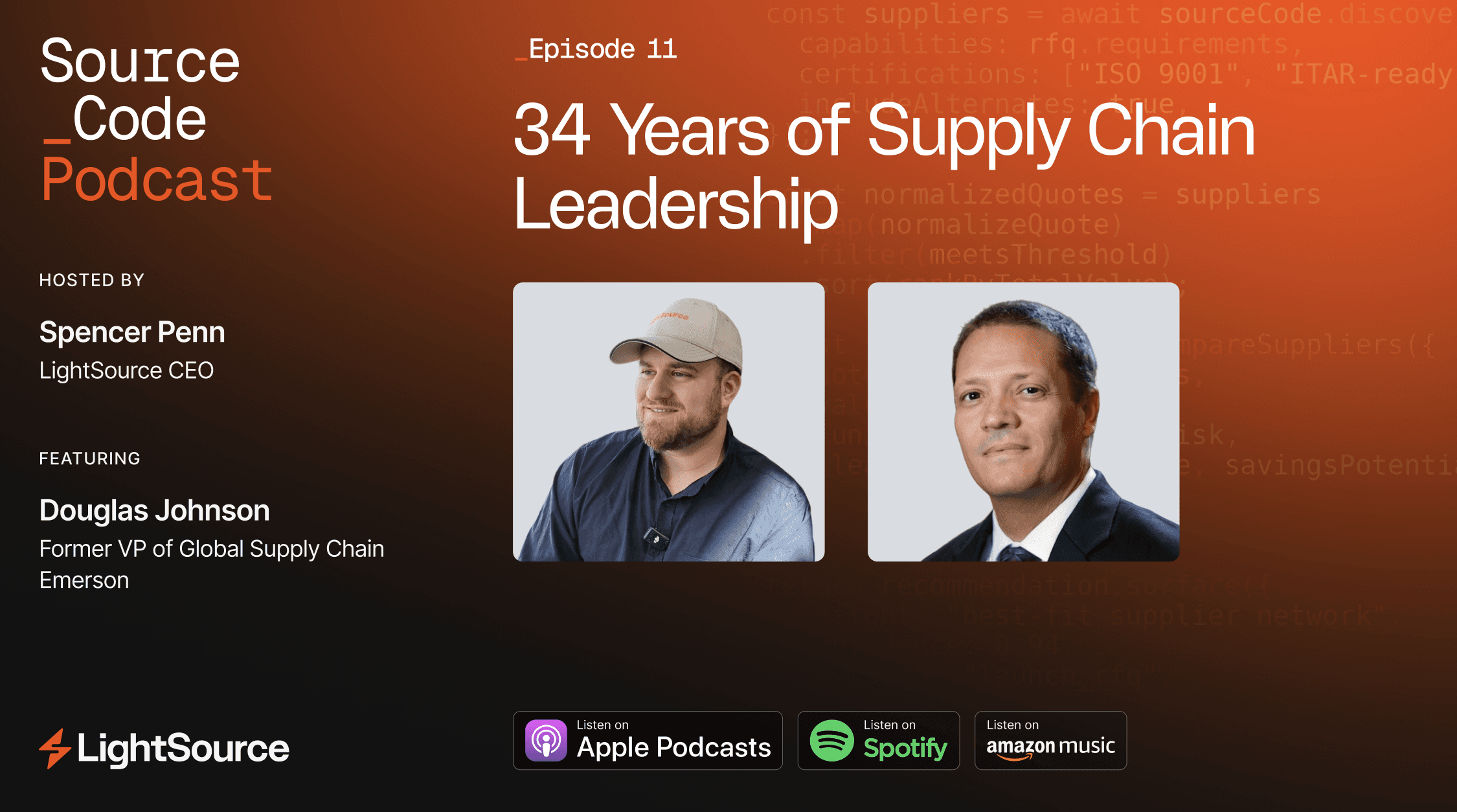
Guest: Douglas Johnson, Former VP of Global Supply Chain at Emerson, on 34 Years of Supply Chain Leadership
Listen on Spotify | Listen on Apple Podcasts | Listen on Amazon Music
Over 34 years, Johnson moved through nearly every corner of a manufacturing business at Emerson, starting in manufacturing engineering, then quality, then supplier quality, then purchasing and global sourcing, before finishing as Vice President of Global Supply Chain. He was never a supply chain specialist by training, which he counts as an advantage. Along the way he helped build a supply base across the United States, China, and Eastern Europe, started a greenfield plant in China, ran the diligence on an acquisition there that grew from single digit millions to nearly 100 million dollars in sales, and led a global team of about 120 people. Calling in from Frisco, Texas, now retired and advising a handful of companies on AI and operations, he talks with Spencer about what actually makes a supply chain valuable, why he stayed at one company for three decades, and where he thinks technology helps and where it just makes a mess faster.
How Doug Fell Into Supply Chain
Johnson did not plan a career in supply chain. Emerson was his second job. He did not like the first one, got recruited in, and started in manufacturing engineering doing capital projects. Then the moves began, mostly other people's ideas. They shifted him from one side of the building to the other and asked him to run quality. "I could do quality," he says. From quality he drifted toward suppliers, and when the company decided to expand its supplier quality program, they moved him into purchasing, where he built a supply chain program, did audits out of Emerson's corporate offices, and eventually got asked to run sourcing. "Not exactly what I expected for a career," he says, "but really has been very good." The unplanned tour turned out to be the point. Because he had touched engineering, quality, and operations inside a manufacturing company, he understood how the pieces fit, which made him far more useful once he was dealing with internal and external customers than a pure specialist would have been.
Why He Stayed for 34 Years
Thirty four years at one company is unusual enough that Spencer asks the obvious question: did he ever come close to leaving? He did, and the reason is honest even if it flatters no one. "The reason I was really outlooking was because I had a bad boss," Johnson says. He liked the company and the people around him, but not the manager one level up, and that pushed him into the market looking at other opportunities. He had a choice, and he chose to stay. The people who made him want to leave eventually moved on, and his last four years were spent working for an operations leader he calls phenomenal, someone who twenty years earlier had worked for him. His read on it is simple. Emerson was never the highest paying place in the industry, and that was fine. "It's not all about money," he says. "It's really about the people that you work with." Spencer names the cliche because it keeps proving true: people do not leave companies, they leave managers. Johnson does not argue.
Two Ears and One Mouth
That bad boss taught Johnson something about the kind of manager he did not want to be. By the end he had about 120 people reporting to him, and the mantra he kept coming back to sounds like a bumper sticker until you watch a direct person try to live it. "God gave you two ears and one mouth for a reason," he says. For a manager whose instinct is to solve the problem in front of him, the hard part is not talking. It is listening long enough to help the team learn to solve it themselves. "Leaders who tell don't get very far," he says. "Leaders who listen and build the team to be empowered" do. He offers a small piece of evidence that it worked. Since he retired, roughly every couple of weeks a former team member calls to think something through with him. The people he started are still running, and doing things he never told them to do.
The clearest example of that philosophy is the operations leader who became his boss. Johnson met him when the man was in his late twenties, a supplier quality engineer with a multilingual background brought in to help with the die casting business. Johnson sent him to China to help start the company's first plant there, and the two spent more than twenty years building a sourcing organization together. Then the younger man came back as Johnson's boss. "No surprise," Johnson says. "Great guy."
A Plant in China with One Computer
Emerson had plants in China, but Johnson's business unit did not, just a small service operation. So they went greenfield, moving production lines over for export and for the Chinese market. While they were there, they made an acquisition, and Johnson went in to run the supply chain and operations diligence. What he found was a company with "one computer and one person who spoke English." The diligence, he says dryly, "was a little challenging." It was also a phenomenal company. On the same site, over about fifteen years, it grew from single digit millions in sales to nearly 100 million dollars. "It really really grew," he says. "It's been fun to watch."
Supplier Quality Is Not About Counting Audits
Ask Johnson what a good supplier quality program looks like and he immediately reframes the question around the business, not the audits. The failure mode he has seen is a quality group that exists to run audits, keep a manual, and declare things bad, without ever connecting to what the company is trying to achieve. "You can have phenomenal audits," he says, and it will not matter. His wife spent a career as a quality auditor in nuclear power, where counting and documentation are the job, but an industrial company is a different animal. There, the measure that matters is not how many audits you ran. It is how the supply chain performs for the customer. "If your measurement is how many audits you did, the business doesn't care," he says. "If you're looking at the performance of that supply chain and how you're performing to customers, that's how you line up to get the most successful business." Quality is the floor. Alignment to the business is the job.
Speed Wins
On the wall behind Johnson during video calls, where his team can see it, is a sign that reads "speed wins." It is a deliberate correction. Quality, he argues, is mostly binary. A part meets the spec or it does not, and you need that floor. After that, the answer depends entirely on the business. He describes three pillars: lead time, on time, and cost. One product line might be so cost sensitive that cost becomes the driver, though you still cannot give up delivery. Another, the assemble to order, customized products he spent his last years managing, won or lost on lead time and delivery. Cost always mattered, but it was not what closed the deal.
This is where he thinks his profession goes wrong. "The mistake that a lot of supply chain people make is it's all about the cost," he says. "If I get it cheap enough, everybody's happy. But if that doesn't line up with what the business needs to service the customer, then you've missed the point." The strategy that follows is regional. Because the products were high mix and engineered to order, new sourcing was constant, and the overarching rule was to source in the part of the world where you build. As sales grew in China or Eastern Europe, the supply base had to grow there too, close enough to hit the lead time the customer expected. A product that used to be made only in Tulsa now also had to be made in Chengdu, which meant a new supply base built to hit the same speed. "If you can get to the customer with a quality product at a reasonable cost," he says, "you win."
Getting a Seat at the Table
Thinking about supply chain from the revenue side, Spencer notes, is rarer than it should be. Most of Johnson's peers, he agrees, look at one thing: "what's my price." The cost of that narrowness is reputational. "If you're not integrated into business success," Johnson says, "you just get pegged in this corner of, well, your stuff's cheap, but it's not very good and it never comes when we want it." The alternative is to be part of the team that looks all the way through to the customer who pays the bills, and to design a supply network around keeping that customer happy.
Getting there required a literal seat at the table. Johnson had one, sitting alongside everyone who reported to the president. Part of that was tenure. After decades in one company he knew, in his phrase, "where the bodies were buried," which things had been tried before and how they turned out. Part of it was proximity to sales. His friend the sales leader had an office around the corner, and Johnson spent real time understanding what the business actually needed. His reframe was to stop walking into leadership meetings with a list of things supply chain needed to do, and instead ask where the business needed to succeed and where the company should put its resources, whether that was engineering, sales, or operations. "When you work in that direction, you make a lot more progress," he says. "Otherwise, it's just a bunch of rocks thrown over the fence at each other."
Right Idea, Wrong Time
Knowing where the bodies are buried is powerful and, Spencer points out, dangerous. The thing that failed a decade ago might work now under different conditions. Johnson has a story that made him sit with exactly that. A global supplier was struggling across several plants, and Johnson had been in, had the conversations, and written them off. "This isn't going to work, folks," he told his team. The operations leader who would later become his boss disagreed. He thought some of the problems could be solved, and he was willing to challenge Johnson to his face. "That's fine," Johnson told him. "Go do what you're going to do. But it isn't going to work out." A couple of years later, that supplier won an award. "Clearly I didn't know everything," Johnson says.
The habit underneath the story is one he built on purpose. He trained his teams to disagree with him, and it started in China, where a senior American showing up and expecting people to do what he said would have been useless. "I would throw crazy stuff out and make them disagree with me," he says. "They thought I was crazy. But I needed that local input. Otherwise, it was just another white guy showing up in China that didn't really know what he was doing."
The Case for Seeing Your Face
Johnson managed a global team, so some of his work was always remote. But he is clear about what an office gives you that a calendar full of video calls does not. The sales leader around the corner meant chance encounters, the kind of hallway conversations that carry real business value and not just social value. "I've never had a video call as I was walking down the hallway and ran into somebody," he says. He does not think everyone needs to be in the office every day. He does think that if you never see your peers, you are not as strong. And when the work is remote, he has one request that doubles as a philosophy. Turn your camera on. "I don't care what you look like," he says. "If the dog's running around in the background or the kids are screaming, I'd like to see you." A culture where people join the call but never show their face, he thinks, quietly loses something.
A Solution Looking for a Problem
Since retiring, Johnson has spent more time on AI than he did while running supply chain, which he finds a little funny and a little telling. In the seat, you do not have time to step back, read the reports, and talk to people. You need a solution today. Now he advises a couple of companies on their AI and operations work, and the pattern he keeps seeing in large corporations is backwards. "Here's a solution, let's go find a problem," he says. The fix is to understand what the business actually needs, which is hard when the customer base is so diverse that one firm wants AI to sharpen its sales and operations planning and the next wants it to watch global risk. His advice to startup founders trying to sell into big companies is the same advice he would give the corporations: anchor in the real need, not the product. He reaches, on his own, for the same instinct Spencer lives by. He remembers the Segway from 2003, a genuinely clever balancing scooter that solved a problem most people did not have. "Walking wasn't a problem," he says. A device that cost 5,000 dollars could be replaced by a bicycle that cost 200. "There are often really simple solutions that solve the problem if you're anchored in the problem, not just the tech gizmo."
Feeding Dirty Gas Into the Engine
Johnson's enthusiasm comes with a hard precondition: your data has to be ready. At Emerson they had enormous amounts of data, but it was so unstructured that dropping AI on top produced, in his words, "very efficient regurgitation of garbage." Structure comes first. Otherwise you are just "feeding dirty gas into the engine," and it will not run well.
Before the data problem, though, comes fear. The first barrier he runs into is security, a conviction that the moment you say the word AI, all of the company's data is about to become public. He is unsentimental about it. The existing data structures, he points out, usually have more holes than the new ones. And a lot of what people guard as trade secrets are not really trade secrets. He has watched companies hand over an Excel quoting template as if it were classified, insisting it never appear anywhere else, when it is the same template everyone else is using. "It's not that special," he says, though you cannot say that to people.
He has seen the sequel to this movie before, too. A wave of business intelligence tools and citizen developers arrived without, as he puts it, a landscaping plan before anyone started planting trees. The result was twenty different BI tools that mostly talked to each other until someone pushed an update and they did not. "I need AI for my BI," he joked to his data team. The lesson is that a master plan has to come before the tools, and every new engine has to interface with the Oracle or SAP systems already running the business, where each connection is its own slow fight.
The Holy Grail of Forecasting
When Spencer asks what problem Johnson wishes technology could have solved, the burning one, he answers without hesitation. It is the business he spent his last years in: high mix, inconsistent demand, a lot of capital tied up in inventory, and a customer who expects a shorter lead time than the supply chain can actually deliver. The whole game, he says, is forecasting demand a little better at the front end. Everything downstream, the purchase order releases, the endless change dates, the move ins and move outs and cancellations, gets a little better if the front end does. "It's never solved," he says. "But if you can be a little bit better at the front end on what demand is going to be, I think that makes a big difference."
The obstacle is that forecasting in his world was rarely linear and almost always treated as if it were. These were products with twenty and thirty year life cycles, not ramp up and ramp down curves. Demand shifted for reasons buried in the market, more customers suddenly wanting the carbon steel version instead of the cast iron one, and the standard approach was to look at last year and assume this year would look the same. He gives the tell. Sell 1,200 units last year and the spreadsheet says 100 a month, but if you actually sold 600 in June and 600 in July, 100 a month is a fiction. Outside signals mattered and were mostly ignored. In a business tied to the oil patch, watching West Texas Intermediate and the number of new wells was a real input, and the historic numbers were always wrong.
The problem, he says, was not really a technology problem yet. It was a discipline problem. The planning process ran on two flawed assumptions: that demand was linear, and that the forecast was already good enough. The inputs were almost all internal, mostly a sales person's gut. "It wasn't data science," he says. "It was Excel science." Spencer agrees with the sequencing, the rule he gives his own team: solve it by hand first, then find an efficient way to do it, then automate, because AI will not find a pattern a capable person could not find by hand in a better spreadsheet. What Johnson wanted was to keep the sales person's read on the market, because they are the ones in it, and mix it with outside data and an honest feedback loop that asked how many units the company actually used, not just what it had guessed.
Let the Tension Be
One more piece of the forecasting problem is human, and it is the part Johnson handled most unusually. Sales teams, he has found, run trailing. When demand is falling, they resist the fall. When it turns back up, they resist the rise, because the last drop still stings. You end up chasing the curve one way and then the other, human momentum layered on top of the numbers. His answer was not to force everyone onto one figure. His planning process took the sales forecast and the operations forecast, and when they disagreed, he let them. Each side explained why. Each person stayed responsible for their own number. "We let that tension be," he says. "We didn't push the alignment." Finance still had to land on a single number to run the business, but internally, the point was never who was right. "It's really not about the person being right," he says. "It's about is the business successful."
What the Seat Taught Him
The thread running through 34 years is that Johnson never let supply chain be the department that only knows the price. Speed wins, quality is the floor, the customer pays the bills, and the job is to serve the business, not to win an argument or hit an audit count. When he talks about AI, the same discipline shows up in a different suit. Name the problem before you buy the solution. Fix the data before you drop an engine on it. Keep the human in the loop where judgment and market feel still matter, and automate the parts that really are just steps written down. He is honest that none of it gets solved, only a little better, and that a little better, repeated across a whole supply chain, is worth a lot. Now retired, he spends his time helping the people still in the seat see what he did not have time to see while he was in it. "My passion is helping those that are still out there doing this," he says. He learned the business by touching every part of it, and he cannot quite stop.
Guest: Douglas Johnson, Former VP of Global Supply Chain at Emerson, on 34 Years of Supply Chain Leadership
Listen on Spotify | Listen on Apple Podcasts | Listen on Amazon Music
Over 34 years, Johnson moved through nearly every corner of a manufacturing business at Emerson, starting in manufacturing engineering, then quality, then supplier quality, then purchasing and global sourcing, before finishing as Vice President of Global Supply Chain. He was never a supply chain specialist by training, which he counts as an advantage. Along the way he helped build a supply base across the United States, China, and Eastern Europe, started a greenfield plant in China, ran the diligence on an acquisition there that grew from single digit millions to nearly 100 million dollars in sales, and led a global team of about 120 people. Calling in from Frisco, Texas, now retired and advising a handful of companies on AI and operations, he talks with Spencer about what actually makes a supply chain valuable, why he stayed at one company for three decades, and where he thinks technology helps and where it just makes a mess faster.
How Doug Fell Into Supply Chain
Johnson did not plan a career in supply chain. Emerson was his second job. He did not like the first one, got recruited in, and started in manufacturing engineering doing capital projects. Then the moves began, mostly other people's ideas. They shifted him from one side of the building to the other and asked him to run quality. "I could do quality," he says. From quality he drifted toward suppliers, and when the company decided to expand its supplier quality program, they moved him into purchasing, where he built a supply chain program, did audits out of Emerson's corporate offices, and eventually got asked to run sourcing. "Not exactly what I expected for a career," he says, "but really has been very good." The unplanned tour turned out to be the point. Because he had touched engineering, quality, and operations inside a manufacturing company, he understood how the pieces fit, which made him far more useful once he was dealing with internal and external customers than a pure specialist would have been.
Why He Stayed for 34 Years
Thirty four years at one company is unusual enough that Spencer asks the obvious question: did he ever come close to leaving? He did, and the reason is honest even if it flatters no one. "The reason I was really outlooking was because I had a bad boss," Johnson says. He liked the company and the people around him, but not the manager one level up, and that pushed him into the market looking at other opportunities. He had a choice, and he chose to stay. The people who made him want to leave eventually moved on, and his last four years were spent working for an operations leader he calls phenomenal, someone who twenty years earlier had worked for him. His read on it is simple. Emerson was never the highest paying place in the industry, and that was fine. "It's not all about money," he says. "It's really about the people that you work with." Spencer names the cliche because it keeps proving true: people do not leave companies, they leave managers. Johnson does not argue.
Two Ears and One Mouth
That bad boss taught Johnson something about the kind of manager he did not want to be. By the end he had about 120 people reporting to him, and the mantra he kept coming back to sounds like a bumper sticker until you watch a direct person try to live it. "God gave you two ears and one mouth for a reason," he says. For a manager whose instinct is to solve the problem in front of him, the hard part is not talking. It is listening long enough to help the team learn to solve it themselves. "Leaders who tell don't get very far," he says. "Leaders who listen and build the team to be empowered" do. He offers a small piece of evidence that it worked. Since he retired, roughly every couple of weeks a former team member calls to think something through with him. The people he started are still running, and doing things he never told them to do.
The clearest example of that philosophy is the operations leader who became his boss. Johnson met him when the man was in his late twenties, a supplier quality engineer with a multilingual background brought in to help with the die casting business. Johnson sent him to China to help start the company's first plant there, and the two spent more than twenty years building a sourcing organization together. Then the younger man came back as Johnson's boss. "No surprise," Johnson says. "Great guy."
A Plant in China with One Computer
Emerson had plants in China, but Johnson's business unit did not, just a small service operation. So they went greenfield, moving production lines over for export and for the Chinese market. While they were there, they made an acquisition, and Johnson went in to run the supply chain and operations diligence. What he found was a company with "one computer and one person who spoke English." The diligence, he says dryly, "was a little challenging." It was also a phenomenal company. On the same site, over about fifteen years, it grew from single digit millions in sales to nearly 100 million dollars. "It really really grew," he says. "It's been fun to watch."
Supplier Quality Is Not About Counting Audits
Ask Johnson what a good supplier quality program looks like and he immediately reframes the question around the business, not the audits. The failure mode he has seen is a quality group that exists to run audits, keep a manual, and declare things bad, without ever connecting to what the company is trying to achieve. "You can have phenomenal audits," he says, and it will not matter. His wife spent a career as a quality auditor in nuclear power, where counting and documentation are the job, but an industrial company is a different animal. There, the measure that matters is not how many audits you ran. It is how the supply chain performs for the customer. "If your measurement is how many audits you did, the business doesn't care," he says. "If you're looking at the performance of that supply chain and how you're performing to customers, that's how you line up to get the most successful business." Quality is the floor. Alignment to the business is the job.
Speed Wins
On the wall behind Johnson during video calls, where his team can see it, is a sign that reads "speed wins." It is a deliberate correction. Quality, he argues, is mostly binary. A part meets the spec or it does not, and you need that floor. After that, the answer depends entirely on the business. He describes three pillars: lead time, on time, and cost. One product line might be so cost sensitive that cost becomes the driver, though you still cannot give up delivery. Another, the assemble to order, customized products he spent his last years managing, won or lost on lead time and delivery. Cost always mattered, but it was not what closed the deal.
This is where he thinks his profession goes wrong. "The mistake that a lot of supply chain people make is it's all about the cost," he says. "If I get it cheap enough, everybody's happy. But if that doesn't line up with what the business needs to service the customer, then you've missed the point." The strategy that follows is regional. Because the products were high mix and engineered to order, new sourcing was constant, and the overarching rule was to source in the part of the world where you build. As sales grew in China or Eastern Europe, the supply base had to grow there too, close enough to hit the lead time the customer expected. A product that used to be made only in Tulsa now also had to be made in Chengdu, which meant a new supply base built to hit the same speed. "If you can get to the customer with a quality product at a reasonable cost," he says, "you win."
Getting a Seat at the Table
Thinking about supply chain from the revenue side, Spencer notes, is rarer than it should be. Most of Johnson's peers, he agrees, look at one thing: "what's my price." The cost of that narrowness is reputational. "If you're not integrated into business success," Johnson says, "you just get pegged in this corner of, well, your stuff's cheap, but it's not very good and it never comes when we want it." The alternative is to be part of the team that looks all the way through to the customer who pays the bills, and to design a supply network around keeping that customer happy.
Getting there required a literal seat at the table. Johnson had one, sitting alongside everyone who reported to the president. Part of that was tenure. After decades in one company he knew, in his phrase, "where the bodies were buried," which things had been tried before and how they turned out. Part of it was proximity to sales. His friend the sales leader had an office around the corner, and Johnson spent real time understanding what the business actually needed. His reframe was to stop walking into leadership meetings with a list of things supply chain needed to do, and instead ask where the business needed to succeed and where the company should put its resources, whether that was engineering, sales, or operations. "When you work in that direction, you make a lot more progress," he says. "Otherwise, it's just a bunch of rocks thrown over the fence at each other."
Right Idea, Wrong Time
Knowing where the bodies are buried is powerful and, Spencer points out, dangerous. The thing that failed a decade ago might work now under different conditions. Johnson has a story that made him sit with exactly that. A global supplier was struggling across several plants, and Johnson had been in, had the conversations, and written them off. "This isn't going to work, folks," he told his team. The operations leader who would later become his boss disagreed. He thought some of the problems could be solved, and he was willing to challenge Johnson to his face. "That's fine," Johnson told him. "Go do what you're going to do. But it isn't going to work out." A couple of years later, that supplier won an award. "Clearly I didn't know everything," Johnson says.
The habit underneath the story is one he built on purpose. He trained his teams to disagree with him, and it started in China, where a senior American showing up and expecting people to do what he said would have been useless. "I would throw crazy stuff out and make them disagree with me," he says. "They thought I was crazy. But I needed that local input. Otherwise, it was just another white guy showing up in China that didn't really know what he was doing."
The Case for Seeing Your Face
Johnson managed a global team, so some of his work was always remote. But he is clear about what an office gives you that a calendar full of video calls does not. The sales leader around the corner meant chance encounters, the kind of hallway conversations that carry real business value and not just social value. "I've never had a video call as I was walking down the hallway and ran into somebody," he says. He does not think everyone needs to be in the office every day. He does think that if you never see your peers, you are not as strong. And when the work is remote, he has one request that doubles as a philosophy. Turn your camera on. "I don't care what you look like," he says. "If the dog's running around in the background or the kids are screaming, I'd like to see you." A culture where people join the call but never show their face, he thinks, quietly loses something.
A Solution Looking for a Problem
Since retiring, Johnson has spent more time on AI than he did while running supply chain, which he finds a little funny and a little telling. In the seat, you do not have time to step back, read the reports, and talk to people. You need a solution today. Now he advises a couple of companies on their AI and operations work, and the pattern he keeps seeing in large corporations is backwards. "Here's a solution, let's go find a problem," he says. The fix is to understand what the business actually needs, which is hard when the customer base is so diverse that one firm wants AI to sharpen its sales and operations planning and the next wants it to watch global risk. His advice to startup founders trying to sell into big companies is the same advice he would give the corporations: anchor in the real need, not the product. He reaches, on his own, for the same instinct Spencer lives by. He remembers the Segway from 2003, a genuinely clever balancing scooter that solved a problem most people did not have. "Walking wasn't a problem," he says. A device that cost 5,000 dollars could be replaced by a bicycle that cost 200. "There are often really simple solutions that solve the problem if you're anchored in the problem, not just the tech gizmo."
Feeding Dirty Gas Into the Engine
Johnson's enthusiasm comes with a hard precondition: your data has to be ready. At Emerson they had enormous amounts of data, but it was so unstructured that dropping AI on top produced, in his words, "very efficient regurgitation of garbage." Structure comes first. Otherwise you are just "feeding dirty gas into the engine," and it will not run well.
Before the data problem, though, comes fear. The first barrier he runs into is security, a conviction that the moment you say the word AI, all of the company's data is about to become public. He is unsentimental about it. The existing data structures, he points out, usually have more holes than the new ones. And a lot of what people guard as trade secrets are not really trade secrets. He has watched companies hand over an Excel quoting template as if it were classified, insisting it never appear anywhere else, when it is the same template everyone else is using. "It's not that special," he says, though you cannot say that to people.
He has seen the sequel to this movie before, too. A wave of business intelligence tools and citizen developers arrived without, as he puts it, a landscaping plan before anyone started planting trees. The result was twenty different BI tools that mostly talked to each other until someone pushed an update and they did not. "I need AI for my BI," he joked to his data team. The lesson is that a master plan has to come before the tools, and every new engine has to interface with the Oracle or SAP systems already running the business, where each connection is its own slow fight.
The Holy Grail of Forecasting
When Spencer asks what problem Johnson wishes technology could have solved, the burning one, he answers without hesitation. It is the business he spent his last years in: high mix, inconsistent demand, a lot of capital tied up in inventory, and a customer who expects a shorter lead time than the supply chain can actually deliver. The whole game, he says, is forecasting demand a little better at the front end. Everything downstream, the purchase order releases, the endless change dates, the move ins and move outs and cancellations, gets a little better if the front end does. "It's never solved," he says. "But if you can be a little bit better at the front end on what demand is going to be, I think that makes a big difference."
The obstacle is that forecasting in his world was rarely linear and almost always treated as if it were. These were products with twenty and thirty year life cycles, not ramp up and ramp down curves. Demand shifted for reasons buried in the market, more customers suddenly wanting the carbon steel version instead of the cast iron one, and the standard approach was to look at last year and assume this year would look the same. He gives the tell. Sell 1,200 units last year and the spreadsheet says 100 a month, but if you actually sold 600 in June and 600 in July, 100 a month is a fiction. Outside signals mattered and were mostly ignored. In a business tied to the oil patch, watching West Texas Intermediate and the number of new wells was a real input, and the historic numbers were always wrong.
The problem, he says, was not really a technology problem yet. It was a discipline problem. The planning process ran on two flawed assumptions: that demand was linear, and that the forecast was already good enough. The inputs were almost all internal, mostly a sales person's gut. "It wasn't data science," he says. "It was Excel science." Spencer agrees with the sequencing, the rule he gives his own team: solve it by hand first, then find an efficient way to do it, then automate, because AI will not find a pattern a capable person could not find by hand in a better spreadsheet. What Johnson wanted was to keep the sales person's read on the market, because they are the ones in it, and mix it with outside data and an honest feedback loop that asked how many units the company actually used, not just what it had guessed.
Let the Tension Be
One more piece of the forecasting problem is human, and it is the part Johnson handled most unusually. Sales teams, he has found, run trailing. When demand is falling, they resist the fall. When it turns back up, they resist the rise, because the last drop still stings. You end up chasing the curve one way and then the other, human momentum layered on top of the numbers. His answer was not to force everyone onto one figure. His planning process took the sales forecast and the operations forecast, and when they disagreed, he let them. Each side explained why. Each person stayed responsible for their own number. "We let that tension be," he says. "We didn't push the alignment." Finance still had to land on a single number to run the business, but internally, the point was never who was right. "It's really not about the person being right," he says. "It's about is the business successful."
What the Seat Taught Him
The thread running through 34 years is that Johnson never let supply chain be the department that only knows the price. Speed wins, quality is the floor, the customer pays the bills, and the job is to serve the business, not to win an argument or hit an audit count. When he talks about AI, the same discipline shows up in a different suit. Name the problem before you buy the solution. Fix the data before you drop an engine on it. Keep the human in the loop where judgment and market feel still matter, and automate the parts that really are just steps written down. He is honest that none of it gets solved, only a little better, and that a little better, repeated across a whole supply chain, is worth a lot. Now retired, he spends his time helping the people still in the seat see what he did not have time to see while he was in it. "My passion is helping those that are still out there doing this," he says. He learned the business by touching every part of it, and he cannot quite stop.
Guest: Douglas Johnson, Former VP of Global Supply Chain at Emerson, on 34 Years of Supply Chain Leadership
Listen on Spotify | Listen on Apple Podcasts | Listen on Amazon Music
Over 34 years, Johnson moved through nearly every corner of a manufacturing business at Emerson, starting in manufacturing engineering, then quality, then supplier quality, then purchasing and global sourcing, before finishing as Vice President of Global Supply Chain. He was never a supply chain specialist by training, which he counts as an advantage. Along the way he helped build a supply base across the United States, China, and Eastern Europe, started a greenfield plant in China, ran the diligence on an acquisition there that grew from single digit millions to nearly 100 million dollars in sales, and led a global team of about 120 people. Calling in from Frisco, Texas, now retired and advising a handful of companies on AI and operations, he talks with Spencer about what actually makes a supply chain valuable, why he stayed at one company for three decades, and where he thinks technology helps and where it just makes a mess faster.
How Doug Fell Into Supply Chain
Johnson did not plan a career in supply chain. Emerson was his second job. He did not like the first one, got recruited in, and started in manufacturing engineering doing capital projects. Then the moves began, mostly other people's ideas. They shifted him from one side of the building to the other and asked him to run quality. "I could do quality," he says. From quality he drifted toward suppliers, and when the company decided to expand its supplier quality program, they moved him into purchasing, where he built a supply chain program, did audits out of Emerson's corporate offices, and eventually got asked to run sourcing. "Not exactly what I expected for a career," he says, "but really has been very good." The unplanned tour turned out to be the point. Because he had touched engineering, quality, and operations inside a manufacturing company, he understood how the pieces fit, which made him far more useful once he was dealing with internal and external customers than a pure specialist would have been.
Why He Stayed for 34 Years
Thirty four years at one company is unusual enough that Spencer asks the obvious question: did he ever come close to leaving? He did, and the reason is honest even if it flatters no one. "The reason I was really outlooking was because I had a bad boss," Johnson says. He liked the company and the people around him, but not the manager one level up, and that pushed him into the market looking at other opportunities. He had a choice, and he chose to stay. The people who made him want to leave eventually moved on, and his last four years were spent working for an operations leader he calls phenomenal, someone who twenty years earlier had worked for him. His read on it is simple. Emerson was never the highest paying place in the industry, and that was fine. "It's not all about money," he says. "It's really about the people that you work with." Spencer names the cliche because it keeps proving true: people do not leave companies, they leave managers. Johnson does not argue.
Two Ears and One Mouth
That bad boss taught Johnson something about the kind of manager he did not want to be. By the end he had about 120 people reporting to him, and the mantra he kept coming back to sounds like a bumper sticker until you watch a direct person try to live it. "God gave you two ears and one mouth for a reason," he says. For a manager whose instinct is to solve the problem in front of him, the hard part is not talking. It is listening long enough to help the team learn to solve it themselves. "Leaders who tell don't get very far," he says. "Leaders who listen and build the team to be empowered" do. He offers a small piece of evidence that it worked. Since he retired, roughly every couple of weeks a former team member calls to think something through with him. The people he started are still running, and doing things he never told them to do.
The clearest example of that philosophy is the operations leader who became his boss. Johnson met him when the man was in his late twenties, a supplier quality engineer with a multilingual background brought in to help with the die casting business. Johnson sent him to China to help start the company's first plant there, and the two spent more than twenty years building a sourcing organization together. Then the younger man came back as Johnson's boss. "No surprise," Johnson says. "Great guy."
A Plant in China with One Computer
Emerson had plants in China, but Johnson's business unit did not, just a small service operation. So they went greenfield, moving production lines over for export and for the Chinese market. While they were there, they made an acquisition, and Johnson went in to run the supply chain and operations diligence. What he found was a company with "one computer and one person who spoke English." The diligence, he says dryly, "was a little challenging." It was also a phenomenal company. On the same site, over about fifteen years, it grew from single digit millions in sales to nearly 100 million dollars. "It really really grew," he says. "It's been fun to watch."
Supplier Quality Is Not About Counting Audits
Ask Johnson what a good supplier quality program looks like and he immediately reframes the question around the business, not the audits. The failure mode he has seen is a quality group that exists to run audits, keep a manual, and declare things bad, without ever connecting to what the company is trying to achieve. "You can have phenomenal audits," he says, and it will not matter. His wife spent a career as a quality auditor in nuclear power, where counting and documentation are the job, but an industrial company is a different animal. There, the measure that matters is not how many audits you ran. It is how the supply chain performs for the customer. "If your measurement is how many audits you did, the business doesn't care," he says. "If you're looking at the performance of that supply chain and how you're performing to customers, that's how you line up to get the most successful business." Quality is the floor. Alignment to the business is the job.
Speed Wins
On the wall behind Johnson during video calls, where his team can see it, is a sign that reads "speed wins." It is a deliberate correction. Quality, he argues, is mostly binary. A part meets the spec or it does not, and you need that floor. After that, the answer depends entirely on the business. He describes three pillars: lead time, on time, and cost. One product line might be so cost sensitive that cost becomes the driver, though you still cannot give up delivery. Another, the assemble to order, customized products he spent his last years managing, won or lost on lead time and delivery. Cost always mattered, but it was not what closed the deal.
This is where he thinks his profession goes wrong. "The mistake that a lot of supply chain people make is it's all about the cost," he says. "If I get it cheap enough, everybody's happy. But if that doesn't line up with what the business needs to service the customer, then you've missed the point." The strategy that follows is regional. Because the products were high mix and engineered to order, new sourcing was constant, and the overarching rule was to source in the part of the world where you build. As sales grew in China or Eastern Europe, the supply base had to grow there too, close enough to hit the lead time the customer expected. A product that used to be made only in Tulsa now also had to be made in Chengdu, which meant a new supply base built to hit the same speed. "If you can get to the customer with a quality product at a reasonable cost," he says, "you win."
Getting a Seat at the Table
Thinking about supply chain from the revenue side, Spencer notes, is rarer than it should be. Most of Johnson's peers, he agrees, look at one thing: "what's my price." The cost of that narrowness is reputational. "If you're not integrated into business success," Johnson says, "you just get pegged in this corner of, well, your stuff's cheap, but it's not very good and it never comes when we want it." The alternative is to be part of the team that looks all the way through to the customer who pays the bills, and to design a supply network around keeping that customer happy.
Getting there required a literal seat at the table. Johnson had one, sitting alongside everyone who reported to the president. Part of that was tenure. After decades in one company he knew, in his phrase, "where the bodies were buried," which things had been tried before and how they turned out. Part of it was proximity to sales. His friend the sales leader had an office around the corner, and Johnson spent real time understanding what the business actually needed. His reframe was to stop walking into leadership meetings with a list of things supply chain needed to do, and instead ask where the business needed to succeed and where the company should put its resources, whether that was engineering, sales, or operations. "When you work in that direction, you make a lot more progress," he says. "Otherwise, it's just a bunch of rocks thrown over the fence at each other."
Right Idea, Wrong Time
Knowing where the bodies are buried is powerful and, Spencer points out, dangerous. The thing that failed a decade ago might work now under different conditions. Johnson has a story that made him sit with exactly that. A global supplier was struggling across several plants, and Johnson had been in, had the conversations, and written them off. "This isn't going to work, folks," he told his team. The operations leader who would later become his boss disagreed. He thought some of the problems could be solved, and he was willing to challenge Johnson to his face. "That's fine," Johnson told him. "Go do what you're going to do. But it isn't going to work out." A couple of years later, that supplier won an award. "Clearly I didn't know everything," Johnson says.
The habit underneath the story is one he built on purpose. He trained his teams to disagree with him, and it started in China, where a senior American showing up and expecting people to do what he said would have been useless. "I would throw crazy stuff out and make them disagree with me," he says. "They thought I was crazy. But I needed that local input. Otherwise, it was just another white guy showing up in China that didn't really know what he was doing."
The Case for Seeing Your Face
Johnson managed a global team, so some of his work was always remote. But he is clear about what an office gives you that a calendar full of video calls does not. The sales leader around the corner meant chance encounters, the kind of hallway conversations that carry real business value and not just social value. "I've never had a video call as I was walking down the hallway and ran into somebody," he says. He does not think everyone needs to be in the office every day. He does think that if you never see your peers, you are not as strong. And when the work is remote, he has one request that doubles as a philosophy. Turn your camera on. "I don't care what you look like," he says. "If the dog's running around in the background or the kids are screaming, I'd like to see you." A culture where people join the call but never show their face, he thinks, quietly loses something.
A Solution Looking for a Problem
Since retiring, Johnson has spent more time on AI than he did while running supply chain, which he finds a little funny and a little telling. In the seat, you do not have time to step back, read the reports, and talk to people. You need a solution today. Now he advises a couple of companies on their AI and operations work, and the pattern he keeps seeing in large corporations is backwards. "Here's a solution, let's go find a problem," he says. The fix is to understand what the business actually needs, which is hard when the customer base is so diverse that one firm wants AI to sharpen its sales and operations planning and the next wants it to watch global risk. His advice to startup founders trying to sell into big companies is the same advice he would give the corporations: anchor in the real need, not the product. He reaches, on his own, for the same instinct Spencer lives by. He remembers the Segway from 2003, a genuinely clever balancing scooter that solved a problem most people did not have. "Walking wasn't a problem," he says. A device that cost 5,000 dollars could be replaced by a bicycle that cost 200. "There are often really simple solutions that solve the problem if you're anchored in the problem, not just the tech gizmo."
Feeding Dirty Gas Into the Engine
Johnson's enthusiasm comes with a hard precondition: your data has to be ready. At Emerson they had enormous amounts of data, but it was so unstructured that dropping AI on top produced, in his words, "very efficient regurgitation of garbage." Structure comes first. Otherwise you are just "feeding dirty gas into the engine," and it will not run well.
Before the data problem, though, comes fear. The first barrier he runs into is security, a conviction that the moment you say the word AI, all of the company's data is about to become public. He is unsentimental about it. The existing data structures, he points out, usually have more holes than the new ones. And a lot of what people guard as trade secrets are not really trade secrets. He has watched companies hand over an Excel quoting template as if it were classified, insisting it never appear anywhere else, when it is the same template everyone else is using. "It's not that special," he says, though you cannot say that to people.
He has seen the sequel to this movie before, too. A wave of business intelligence tools and citizen developers arrived without, as he puts it, a landscaping plan before anyone started planting trees. The result was twenty different BI tools that mostly talked to each other until someone pushed an update and they did not. "I need AI for my BI," he joked to his data team. The lesson is that a master plan has to come before the tools, and every new engine has to interface with the Oracle or SAP systems already running the business, where each connection is its own slow fight.
The Holy Grail of Forecasting
When Spencer asks what problem Johnson wishes technology could have solved, the burning one, he answers without hesitation. It is the business he spent his last years in: high mix, inconsistent demand, a lot of capital tied up in inventory, and a customer who expects a shorter lead time than the supply chain can actually deliver. The whole game, he says, is forecasting demand a little better at the front end. Everything downstream, the purchase order releases, the endless change dates, the move ins and move outs and cancellations, gets a little better if the front end does. "It's never solved," he says. "But if you can be a little bit better at the front end on what demand is going to be, I think that makes a big difference."
The obstacle is that forecasting in his world was rarely linear and almost always treated as if it were. These were products with twenty and thirty year life cycles, not ramp up and ramp down curves. Demand shifted for reasons buried in the market, more customers suddenly wanting the carbon steel version instead of the cast iron one, and the standard approach was to look at last year and assume this year would look the same. He gives the tell. Sell 1,200 units last year and the spreadsheet says 100 a month, but if you actually sold 600 in June and 600 in July, 100 a month is a fiction. Outside signals mattered and were mostly ignored. In a business tied to the oil patch, watching West Texas Intermediate and the number of new wells was a real input, and the historic numbers were always wrong.
The problem, he says, was not really a technology problem yet. It was a discipline problem. The planning process ran on two flawed assumptions: that demand was linear, and that the forecast was already good enough. The inputs were almost all internal, mostly a sales person's gut. "It wasn't data science," he says. "It was Excel science." Spencer agrees with the sequencing, the rule he gives his own team: solve it by hand first, then find an efficient way to do it, then automate, because AI will not find a pattern a capable person could not find by hand in a better spreadsheet. What Johnson wanted was to keep the sales person's read on the market, because they are the ones in it, and mix it with outside data and an honest feedback loop that asked how many units the company actually used, not just what it had guessed.
Let the Tension Be
One more piece of the forecasting problem is human, and it is the part Johnson handled most unusually. Sales teams, he has found, run trailing. When demand is falling, they resist the fall. When it turns back up, they resist the rise, because the last drop still stings. You end up chasing the curve one way and then the other, human momentum layered on top of the numbers. His answer was not to force everyone onto one figure. His planning process took the sales forecast and the operations forecast, and when they disagreed, he let them. Each side explained why. Each person stayed responsible for their own number. "We let that tension be," he says. "We didn't push the alignment." Finance still had to land on a single number to run the business, but internally, the point was never who was right. "It's really not about the person being right," he says. "It's about is the business successful."
What the Seat Taught Him
The thread running through 34 years is that Johnson never let supply chain be the department that only knows the price. Speed wins, quality is the floor, the customer pays the bills, and the job is to serve the business, not to win an argument or hit an audit count. When he talks about AI, the same discipline shows up in a different suit. Name the problem before you buy the solution. Fix the data before you drop an engine on it. Keep the human in the loop where judgment and market feel still matter, and automate the parts that really are just steps written down. He is honest that none of it gets solved, only a little better, and that a little better, repeated across a whole supply chain, is worth a lot. Now retired, he spends his time helping the people still in the seat see what he did not have time to see while he was in it. "My passion is helping those that are still out there doing this," he says. He learned the business by touching every part of it, and he cannot quite stop.


Faster sourcing. Lower cost. Less chaos.
See how LightSource connects engineering, procurement, and suppliers in one operating system to help you launch faster at lower cost.
SOC 2
Kearney #1 2024
Gartner Cool Vendor
Procuretech 100
G2 Top Rated
Faster sourcing. Lower cost. Less chaos.
See how LightSource connects engineering, procurement, and suppliers in one operating system to help you launch faster at lower cost.
SOC 2
Kearney #1 2024
Gartner Cool Vendor
Procuretech 100
G2 Top Rated
Faster sourcing. Lower cost. Less chaos.
See how LightSource connects engineering, procurement, and suppliers in one operating system to help you launch faster at lower cost.
SOC 2
Kearney #1 2024
Gartner Cool Vendor
Procuretech 100
G2 Top Rated
Trusted by:
Trusted by:
Trusted by: