
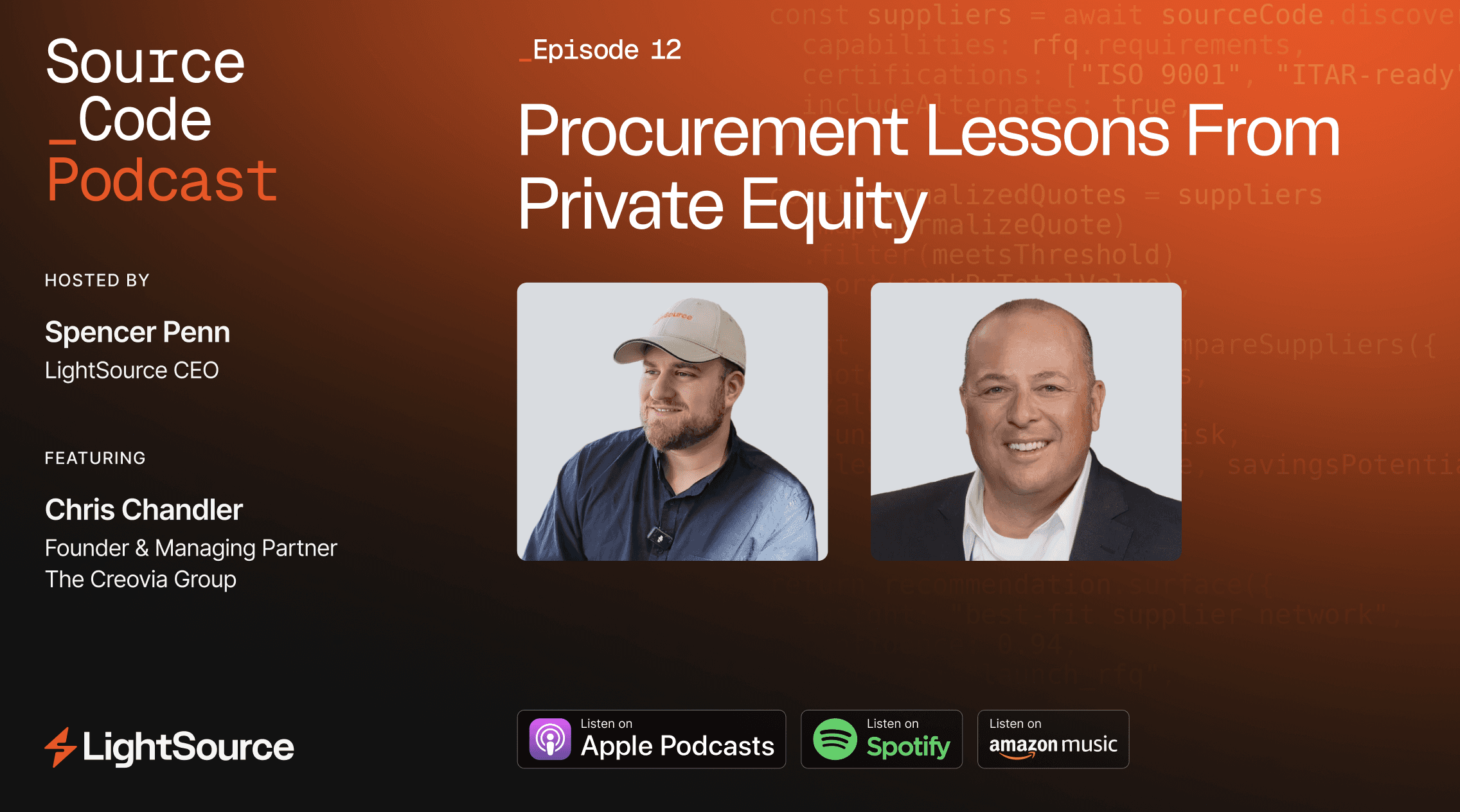
Guest: Chris Chandler, Founder and Managing Partner of The Creovia Group, on Procurement Lessons From Private Equity
Listen on Spotify | Listen on Apple Podcasts | Listen on Amazon Music
Chandler did not fall into procurement the way most people in it did. He went to school for supply chain at Michigan State, one of the first classes out of the program that pioneered the field, and then spent his career moving through it: GM, Eaton, a privately held German manufacturer, Kellogg's, where he traded corn commodities straight through the 2008 crash, Dr Pepper Snapple, where he ran ingredient and packaging sourcing and stood up a 2.5 billion dollar indirect practice, and MoneyGram, where he built the sourcing department from scratch. He started at ground level, on plant floors and in warehouses, understanding the things he was buying. Now Founder and Managing Partner of The Creovia Group, a supply chain focused consulting firm that supports some of the largest companies and private equity firms in the world, he talks with Spencer about what makes private equity procurement different, why a dollar saved is worth more than a dollar of new revenue, how to win over the teams you are there to help, and why the best negotiators give more away than people expect.
He Did Not Fall Into Procurement, He Chose It
Most people in procurement will tell you they fell into it. Chandler is the rare one who did not. "I've literally done this my whole life and I actually went to school for this," he says. He went to Michigan State, one of the first classes out of the program that pioneered supply chain management, at a time in the late nineties when the field was suddenly the big thing and students were heavily recruited. He thought he was headed for finance until he talked to someone about supply chain and went to check it out. From there it was GM for five and a half years, then Eaton, a privately held German manufacturer, Kellogg's, where he traded corn commodities through the 2008 crash and came out mostly unscathed, Dr Pepper Snapple, where he stood up a 2.5 billion dollar indirect practice, and MoneyGram, where he built the sourcing department from the ground up. What ties it together is that he started at the bottom and stayed close to the work. "You can't just sit behind a screen all day and effectively manage this," he says. He walked plant floors, stood in warehouses, and understood the things he was buying, which he counts as the foundation of everything since.
Direct, Indirect, and Where to Start
Ask Chandler which is more fun, direct or indirect, and he says it depends on your personality, then makes the case for both. Direct is leverage. "I could go run one RFP and put 5 million dollars on the table because you have a massive spend," he says. Indirect is a different muscle. You can drive real impact with fewer events, but you do not own the budget or the agenda, so you have to influence the stakeholders, sell them on why procurement is there and how it makes their dollars go further. His advice to anyone early in a procurement career is refreshingly simple: it does not matter whether you start in direct or indirect, just get in, and try to work somewhere with good process and structure. The commodity knowledge comes later. "Learning the commodities is something anybody can do if you put enough time and effort in," he says. What is rare, and what actually transfers, is understanding supply chain and procurement as a methodology. He learned that at big, established companies, and it is exactly what lets him now walk into a smaller business and say, this is how the big guys do it, and you should too.
Best Practice, But Only Where It Earns Its Keep
That does not mean copying the big company playbook wholesale. "I don't think you can just institute process for the sake of process," Chandler says. The expertise, in his telling, is knowing where the full process earns its keep and where it does not. He can spend six months on spend analysis and a category plan and every nit and nat before a contract, or he can get into the market and run a proper negotiation without all the elegant upfront work. He is not saying skip the rigor. He is saying pick your spots. Growing up in an environment that required the formal version taught him where it added value and where it did not, so now, with a smaller company, he can say, we are not putting you through all of this because it does not make sense, but for this particular thing, we go through every step. And a lot of it comes down to time. Getting the result six months sooner, he points out, completely changes the return equation. "We already have the playbook," he says. "Let's just go get to the right answer and put some value into the business."
Speed Is the Whole Game
The single biggest difference between private equity procurement and corporate procurement, Chandler says without hesitation, is speed. Big companies can move fast, but there are more constituents, more communication, and sometimes a lot of red tape. Private equity has an appetite to just get there faster. He points to what the funds themselves have found: the investments where they act immediately and start extracting value in the first year tend to be the most successful, while the ones where value trickles in over two, three, or four years tend to be less impactful. Spencer does the math out loud, doing the same thing in three months instead of nine roughly doubles the outcome, and Chandler agrees. It is why he only half jokes that his firm is the best kept secret in private equity value creation. The work is not just being right. It is being right quickly, and knowing when to run the shortcut instead of the full pace.
A Dollar Is a Dollar
This is the line Chandler has been making since his corporate days, and it is the cleanest argument for why procurement matters. "For every dollar of topline that you get, you only get 30 cents on the dollar," he says. "For every dollar of procurement improvement that I get, I get a dollar." In a thin margin business it is even starker. Spencer adds that at a 5 percent margin you might keep 5 cents of every new revenue dollar, which makes the procurement dollar look even better. It does not mean procurement is always the top priority, and Chandler is clear about that. For a small technology firm, the value is in scaling the top line, and procurement is a smaller lever. For a manufacturer, lowering the cost base drives margin, and procurement becomes central. But when it is on the table, the case is simple and transparent in a way revenue never quite is. A dollar saved is a dollar, and you can see exactly where it came from.
The Three Ways Into Private Equity
For anyone eyeing procurement in private equity, Chandler sketches three roles. There is the operating partner, which is closest to what he does. There is the advisor or consultant. And there is what Spencer calls the plug and play CPO, the chief procurement officer who comes in at the start of an investment, drives the cost takeout, and moves on to the next one a few years later when the company is ready to exit. A growing fourth option, Chandler notes, is the full time portfolio procurement leader sitting inside a fund, a role that barely existed a few years ago and is now increasingly common. The catch is that most of these seats go to people with twenty or twenty five years of experience across directs, indirects, and every kind of commodity, because they touch every company in the portfolio. His own advice is the one he lived: start at ground level and learn the business by touching it. And once you are in and you deliver, the door keeps opening. "Why waste time looking for the next mouse trap?" he says. "Just use what's working."
Winning Over the Team You Are There to Help
The hardest part of the job is not the sourcing. It is the people. When Chandler walks into a portfolio company, he is dealing with a CPO and a procurement team running their own show, and the biggest predictor of whether a cost program succeeds, both he and Spencer agree, is not skill but whether that team is willing to partner. Some greet the help. Others quietly compete, hearing his offer and thinking, give me five weeks, I will go show you where I can beat you, which usually just burns five weeks. So he does not lead with answers. He would never walk in and say, here is what you need to do, he says. Someone once told him he has very high EQ, and he only realized later they were right. His approach is to ask, tell me what you are doing today, what are your challenges, where do you think we can help, and let them pick from what the fund can offer. And crucially, he makes sure the credit lands with them. When it is time to face the CFO, the story is not look what Chris did. It is our sponsor brought us opportunities it had already vetted, and we delivered millions in savings without expending our own resources. "If you can make the people you work with look like a superhero," he says, "then there won't be as much of an allergic reaction." Part of why this matters is that procurement is rarely paid on what it saves. Salespeople get commission, procurement gets goals and a bonus, so a portfolio CPO's real incentive is often just to be seen as the expert. Chandler's whole method is built around that. As Spencer puts it, quoting a line often credited to Truman, it is amazing what you can accomplish if you are willing to forego credit.
Savings That Never Show Up
Chandler will run a cost out road map, but he always caveats it the same way: in parallel with the savings, you have to fix process, policy, and technology. You can source the whole company and put beautiful agreements on paper, but if people can still buy from wherever they want, the savings never materialize. "How do you get them off of email and spreadsheets," he says, and onto tools that guide the process and automate the manual work, so people can think about their jobs instead of wrestling with a process. Private equity flips the usual technology pitch. Instead of a three year ERP transformation, the ask is usually a lightweight tool that delivers in the next two quarters. Sometimes the long project is still right, he negotiated an ERP deal for one company that runs a two year road map, but that company spans many countries, multiple systems, and a lot of business units. Another company with no real ERP, one business unit, US based, he can stand up in six to eight months. His bigger point is to fix this while the company is still small. "The bigger the boat, the longer it takes to turn," he says. A hundred million dollar company can be agile and decisive. Wait until it is a billion, and every change means untangling a lot more.
The Best Negotiators Give More Away
Chandler is most animated on negotiation, and his philosophy runs against the caricature of procurement as the heavy brought in to beat up suppliers. "You have to be transparent. You have to be credible. And I think you have to be respectful," he says, and direct. Most people think negotiation is holding your cards close. He does hold things back, but when he feels reciprocity from the other side, he gives it back, because that is how you get to a good deal faster. The piece most people skip is the other side. Most people go into a negotiation and line out everything they need, he says, but miss the obvious question of what the other party has to get. You either think you know it, or you ask them. He keeps a negotiation strategy template he has used for years, and its core is exactly that: what does the other side want. The proof is a deal he still points to, the best of his career, a half day in a room with a vendor rep where the conversation was open and transparent on both sides. That contract is still in place roughly eighteen years later, renewed four or five times. He teaches the same thing to his two teenage sons, and to service providers unlucky enough to work on his house. "The worst somebody can tell you is no," he says, "so why wouldn't you ask?"
The Weirdest Thing He Ever Sourced
Asked the strangest thing he has ever had to buy, Chandler does not hesitate: during COVID he became, in his words, the mask and hand sanitizer czar for about a year and a half. He had never sourced either in his life, but he happened to know people rooted in manufacturing, and one company had an FDA formula variance the bigger players did not. So the calls came in. "I heard you're the hand sanitizer guy," people would say, and he would say, yeah, I got a guy, and start delivering truckloads of it because nobody else could get it. It is the perfect illustration of a thing he believes completely. "Your network is the most important thing in your career," he says. "It absolutely is."
What the Work Comes Down To
Underneath the private equity war stories, Chandler keeps returning to the same handful of ideas. A dollar saved is worth more than a dollar earned, and you can prove it. Speed changes the math more than almost anything else. Best practice is only worth running where it actually adds value. And the whole thing lives or dies on people, on being transparent and credible and respectful, on understanding what the other side wants, and on being willing to let someone else look like the hero. He did not fall into any of it. He went to school for it, started on the plant floor, and spent a career learning the business by touching every part of it. What he does now, walking into company after company with a playbook and a lot of patience for other people's egos, is just that same instinct pointed at a faster clock.
Guest: Chris Chandler, Founder and Managing Partner of The Creovia Group, on Procurement Lessons From Private Equity
Listen on Spotify | Listen on Apple Podcasts | Listen on Amazon Music
Chandler did not fall into procurement the way most people in it did. He went to school for supply chain at Michigan State, one of the first classes out of the program that pioneered the field, and then spent his career moving through it: GM, Eaton, a privately held German manufacturer, Kellogg's, where he traded corn commodities straight through the 2008 crash, Dr Pepper Snapple, where he ran ingredient and packaging sourcing and stood up a 2.5 billion dollar indirect practice, and MoneyGram, where he built the sourcing department from scratch. He started at ground level, on plant floors and in warehouses, understanding the things he was buying. Now Founder and Managing Partner of The Creovia Group, a supply chain focused consulting firm that supports some of the largest companies and private equity firms in the world, he talks with Spencer about what makes private equity procurement different, why a dollar saved is worth more than a dollar of new revenue, how to win over the teams you are there to help, and why the best negotiators give more away than people expect.
He Did Not Fall Into Procurement, He Chose It
Most people in procurement will tell you they fell into it. Chandler is the rare one who did not. "I've literally done this my whole life and I actually went to school for this," he says. He went to Michigan State, one of the first classes out of the program that pioneered supply chain management, at a time in the late nineties when the field was suddenly the big thing and students were heavily recruited. He thought he was headed for finance until he talked to someone about supply chain and went to check it out. From there it was GM for five and a half years, then Eaton, a privately held German manufacturer, Kellogg's, where he traded corn commodities through the 2008 crash and came out mostly unscathed, Dr Pepper Snapple, where he stood up a 2.5 billion dollar indirect practice, and MoneyGram, where he built the sourcing department from the ground up. What ties it together is that he started at the bottom and stayed close to the work. "You can't just sit behind a screen all day and effectively manage this," he says. He walked plant floors, stood in warehouses, and understood the things he was buying, which he counts as the foundation of everything since.
Direct, Indirect, and Where to Start
Ask Chandler which is more fun, direct or indirect, and he says it depends on your personality, then makes the case for both. Direct is leverage. "I could go run one RFP and put 5 million dollars on the table because you have a massive spend," he says. Indirect is a different muscle. You can drive real impact with fewer events, but you do not own the budget or the agenda, so you have to influence the stakeholders, sell them on why procurement is there and how it makes their dollars go further. His advice to anyone early in a procurement career is refreshingly simple: it does not matter whether you start in direct or indirect, just get in, and try to work somewhere with good process and structure. The commodity knowledge comes later. "Learning the commodities is something anybody can do if you put enough time and effort in," he says. What is rare, and what actually transfers, is understanding supply chain and procurement as a methodology. He learned that at big, established companies, and it is exactly what lets him now walk into a smaller business and say, this is how the big guys do it, and you should too.
Best Practice, But Only Where It Earns Its Keep
That does not mean copying the big company playbook wholesale. "I don't think you can just institute process for the sake of process," Chandler says. The expertise, in his telling, is knowing where the full process earns its keep and where it does not. He can spend six months on spend analysis and a category plan and every nit and nat before a contract, or he can get into the market and run a proper negotiation without all the elegant upfront work. He is not saying skip the rigor. He is saying pick your spots. Growing up in an environment that required the formal version taught him where it added value and where it did not, so now, with a smaller company, he can say, we are not putting you through all of this because it does not make sense, but for this particular thing, we go through every step. And a lot of it comes down to time. Getting the result six months sooner, he points out, completely changes the return equation. "We already have the playbook," he says. "Let's just go get to the right answer and put some value into the business."
Speed Is the Whole Game
The single biggest difference between private equity procurement and corporate procurement, Chandler says without hesitation, is speed. Big companies can move fast, but there are more constituents, more communication, and sometimes a lot of red tape. Private equity has an appetite to just get there faster. He points to what the funds themselves have found: the investments where they act immediately and start extracting value in the first year tend to be the most successful, while the ones where value trickles in over two, three, or four years tend to be less impactful. Spencer does the math out loud, doing the same thing in three months instead of nine roughly doubles the outcome, and Chandler agrees. It is why he only half jokes that his firm is the best kept secret in private equity value creation. The work is not just being right. It is being right quickly, and knowing when to run the shortcut instead of the full pace.
A Dollar Is a Dollar
This is the line Chandler has been making since his corporate days, and it is the cleanest argument for why procurement matters. "For every dollar of topline that you get, you only get 30 cents on the dollar," he says. "For every dollar of procurement improvement that I get, I get a dollar." In a thin margin business it is even starker. Spencer adds that at a 5 percent margin you might keep 5 cents of every new revenue dollar, which makes the procurement dollar look even better. It does not mean procurement is always the top priority, and Chandler is clear about that. For a small technology firm, the value is in scaling the top line, and procurement is a smaller lever. For a manufacturer, lowering the cost base drives margin, and procurement becomes central. But when it is on the table, the case is simple and transparent in a way revenue never quite is. A dollar saved is a dollar, and you can see exactly where it came from.
The Three Ways Into Private Equity
For anyone eyeing procurement in private equity, Chandler sketches three roles. There is the operating partner, which is closest to what he does. There is the advisor or consultant. And there is what Spencer calls the plug and play CPO, the chief procurement officer who comes in at the start of an investment, drives the cost takeout, and moves on to the next one a few years later when the company is ready to exit. A growing fourth option, Chandler notes, is the full time portfolio procurement leader sitting inside a fund, a role that barely existed a few years ago and is now increasingly common. The catch is that most of these seats go to people with twenty or twenty five years of experience across directs, indirects, and every kind of commodity, because they touch every company in the portfolio. His own advice is the one he lived: start at ground level and learn the business by touching it. And once you are in and you deliver, the door keeps opening. "Why waste time looking for the next mouse trap?" he says. "Just use what's working."
Winning Over the Team You Are There to Help
The hardest part of the job is not the sourcing. It is the people. When Chandler walks into a portfolio company, he is dealing with a CPO and a procurement team running their own show, and the biggest predictor of whether a cost program succeeds, both he and Spencer agree, is not skill but whether that team is willing to partner. Some greet the help. Others quietly compete, hearing his offer and thinking, give me five weeks, I will go show you where I can beat you, which usually just burns five weeks. So he does not lead with answers. He would never walk in and say, here is what you need to do, he says. Someone once told him he has very high EQ, and he only realized later they were right. His approach is to ask, tell me what you are doing today, what are your challenges, where do you think we can help, and let them pick from what the fund can offer. And crucially, he makes sure the credit lands with them. When it is time to face the CFO, the story is not look what Chris did. It is our sponsor brought us opportunities it had already vetted, and we delivered millions in savings without expending our own resources. "If you can make the people you work with look like a superhero," he says, "then there won't be as much of an allergic reaction." Part of why this matters is that procurement is rarely paid on what it saves. Salespeople get commission, procurement gets goals and a bonus, so a portfolio CPO's real incentive is often just to be seen as the expert. Chandler's whole method is built around that. As Spencer puts it, quoting a line often credited to Truman, it is amazing what you can accomplish if you are willing to forego credit.
Savings That Never Show Up
Chandler will run a cost out road map, but he always caveats it the same way: in parallel with the savings, you have to fix process, policy, and technology. You can source the whole company and put beautiful agreements on paper, but if people can still buy from wherever they want, the savings never materialize. "How do you get them off of email and spreadsheets," he says, and onto tools that guide the process and automate the manual work, so people can think about their jobs instead of wrestling with a process. Private equity flips the usual technology pitch. Instead of a three year ERP transformation, the ask is usually a lightweight tool that delivers in the next two quarters. Sometimes the long project is still right, he negotiated an ERP deal for one company that runs a two year road map, but that company spans many countries, multiple systems, and a lot of business units. Another company with no real ERP, one business unit, US based, he can stand up in six to eight months. His bigger point is to fix this while the company is still small. "The bigger the boat, the longer it takes to turn," he says. A hundred million dollar company can be agile and decisive. Wait until it is a billion, and every change means untangling a lot more.
The Best Negotiators Give More Away
Chandler is most animated on negotiation, and his philosophy runs against the caricature of procurement as the heavy brought in to beat up suppliers. "You have to be transparent. You have to be credible. And I think you have to be respectful," he says, and direct. Most people think negotiation is holding your cards close. He does hold things back, but when he feels reciprocity from the other side, he gives it back, because that is how you get to a good deal faster. The piece most people skip is the other side. Most people go into a negotiation and line out everything they need, he says, but miss the obvious question of what the other party has to get. You either think you know it, or you ask them. He keeps a negotiation strategy template he has used for years, and its core is exactly that: what does the other side want. The proof is a deal he still points to, the best of his career, a half day in a room with a vendor rep where the conversation was open and transparent on both sides. That contract is still in place roughly eighteen years later, renewed four or five times. He teaches the same thing to his two teenage sons, and to service providers unlucky enough to work on his house. "The worst somebody can tell you is no," he says, "so why wouldn't you ask?"
The Weirdest Thing He Ever Sourced
Asked the strangest thing he has ever had to buy, Chandler does not hesitate: during COVID he became, in his words, the mask and hand sanitizer czar for about a year and a half. He had never sourced either in his life, but he happened to know people rooted in manufacturing, and one company had an FDA formula variance the bigger players did not. So the calls came in. "I heard you're the hand sanitizer guy," people would say, and he would say, yeah, I got a guy, and start delivering truckloads of it because nobody else could get it. It is the perfect illustration of a thing he believes completely. "Your network is the most important thing in your career," he says. "It absolutely is."
What the Work Comes Down To
Underneath the private equity war stories, Chandler keeps returning to the same handful of ideas. A dollar saved is worth more than a dollar earned, and you can prove it. Speed changes the math more than almost anything else. Best practice is only worth running where it actually adds value. And the whole thing lives or dies on people, on being transparent and credible and respectful, on understanding what the other side wants, and on being willing to let someone else look like the hero. He did not fall into any of it. He went to school for it, started on the plant floor, and spent a career learning the business by touching every part of it. What he does now, walking into company after company with a playbook and a lot of patience for other people's egos, is just that same instinct pointed at a faster clock.
Guest: Chris Chandler, Founder and Managing Partner of The Creovia Group, on Procurement Lessons From Private Equity
Listen on Spotify | Listen on Apple Podcasts | Listen on Amazon Music
Chandler did not fall into procurement the way most people in it did. He went to school for supply chain at Michigan State, one of the first classes out of the program that pioneered the field, and then spent his career moving through it: GM, Eaton, a privately held German manufacturer, Kellogg's, where he traded corn commodities straight through the 2008 crash, Dr Pepper Snapple, where he ran ingredient and packaging sourcing and stood up a 2.5 billion dollar indirect practice, and MoneyGram, where he built the sourcing department from scratch. He started at ground level, on plant floors and in warehouses, understanding the things he was buying. Now Founder and Managing Partner of The Creovia Group, a supply chain focused consulting firm that supports some of the largest companies and private equity firms in the world, he talks with Spencer about what makes private equity procurement different, why a dollar saved is worth more than a dollar of new revenue, how to win over the teams you are there to help, and why the best negotiators give more away than people expect.
He Did Not Fall Into Procurement, He Chose It
Most people in procurement will tell you they fell into it. Chandler is the rare one who did not. "I've literally done this my whole life and I actually went to school for this," he says. He went to Michigan State, one of the first classes out of the program that pioneered supply chain management, at a time in the late nineties when the field was suddenly the big thing and students were heavily recruited. He thought he was headed for finance until he talked to someone about supply chain and went to check it out. From there it was GM for five and a half years, then Eaton, a privately held German manufacturer, Kellogg's, where he traded corn commodities through the 2008 crash and came out mostly unscathed, Dr Pepper Snapple, where he stood up a 2.5 billion dollar indirect practice, and MoneyGram, where he built the sourcing department from the ground up. What ties it together is that he started at the bottom and stayed close to the work. "You can't just sit behind a screen all day and effectively manage this," he says. He walked plant floors, stood in warehouses, and understood the things he was buying, which he counts as the foundation of everything since.
Direct, Indirect, and Where to Start
Ask Chandler which is more fun, direct or indirect, and he says it depends on your personality, then makes the case for both. Direct is leverage. "I could go run one RFP and put 5 million dollars on the table because you have a massive spend," he says. Indirect is a different muscle. You can drive real impact with fewer events, but you do not own the budget or the agenda, so you have to influence the stakeholders, sell them on why procurement is there and how it makes their dollars go further. His advice to anyone early in a procurement career is refreshingly simple: it does not matter whether you start in direct or indirect, just get in, and try to work somewhere with good process and structure. The commodity knowledge comes later. "Learning the commodities is something anybody can do if you put enough time and effort in," he says. What is rare, and what actually transfers, is understanding supply chain and procurement as a methodology. He learned that at big, established companies, and it is exactly what lets him now walk into a smaller business and say, this is how the big guys do it, and you should too.
Best Practice, But Only Where It Earns Its Keep
That does not mean copying the big company playbook wholesale. "I don't think you can just institute process for the sake of process," Chandler says. The expertise, in his telling, is knowing where the full process earns its keep and where it does not. He can spend six months on spend analysis and a category plan and every nit and nat before a contract, or he can get into the market and run a proper negotiation without all the elegant upfront work. He is not saying skip the rigor. He is saying pick your spots. Growing up in an environment that required the formal version taught him where it added value and where it did not, so now, with a smaller company, he can say, we are not putting you through all of this because it does not make sense, but for this particular thing, we go through every step. And a lot of it comes down to time. Getting the result six months sooner, he points out, completely changes the return equation. "We already have the playbook," he says. "Let's just go get to the right answer and put some value into the business."
Speed Is the Whole Game
The single biggest difference between private equity procurement and corporate procurement, Chandler says without hesitation, is speed. Big companies can move fast, but there are more constituents, more communication, and sometimes a lot of red tape. Private equity has an appetite to just get there faster. He points to what the funds themselves have found: the investments where they act immediately and start extracting value in the first year tend to be the most successful, while the ones where value trickles in over two, three, or four years tend to be less impactful. Spencer does the math out loud, doing the same thing in three months instead of nine roughly doubles the outcome, and Chandler agrees. It is why he only half jokes that his firm is the best kept secret in private equity value creation. The work is not just being right. It is being right quickly, and knowing when to run the shortcut instead of the full pace.
A Dollar Is a Dollar
This is the line Chandler has been making since his corporate days, and it is the cleanest argument for why procurement matters. "For every dollar of topline that you get, you only get 30 cents on the dollar," he says. "For every dollar of procurement improvement that I get, I get a dollar." In a thin margin business it is even starker. Spencer adds that at a 5 percent margin you might keep 5 cents of every new revenue dollar, which makes the procurement dollar look even better. It does not mean procurement is always the top priority, and Chandler is clear about that. For a small technology firm, the value is in scaling the top line, and procurement is a smaller lever. For a manufacturer, lowering the cost base drives margin, and procurement becomes central. But when it is on the table, the case is simple and transparent in a way revenue never quite is. A dollar saved is a dollar, and you can see exactly where it came from.
The Three Ways Into Private Equity
For anyone eyeing procurement in private equity, Chandler sketches three roles. There is the operating partner, which is closest to what he does. There is the advisor or consultant. And there is what Spencer calls the plug and play CPO, the chief procurement officer who comes in at the start of an investment, drives the cost takeout, and moves on to the next one a few years later when the company is ready to exit. A growing fourth option, Chandler notes, is the full time portfolio procurement leader sitting inside a fund, a role that barely existed a few years ago and is now increasingly common. The catch is that most of these seats go to people with twenty or twenty five years of experience across directs, indirects, and every kind of commodity, because they touch every company in the portfolio. His own advice is the one he lived: start at ground level and learn the business by touching it. And once you are in and you deliver, the door keeps opening. "Why waste time looking for the next mouse trap?" he says. "Just use what's working."
Winning Over the Team You Are There to Help
The hardest part of the job is not the sourcing. It is the people. When Chandler walks into a portfolio company, he is dealing with a CPO and a procurement team running their own show, and the biggest predictor of whether a cost program succeeds, both he and Spencer agree, is not skill but whether that team is willing to partner. Some greet the help. Others quietly compete, hearing his offer and thinking, give me five weeks, I will go show you where I can beat you, which usually just burns five weeks. So he does not lead with answers. He would never walk in and say, here is what you need to do, he says. Someone once told him he has very high EQ, and he only realized later they were right. His approach is to ask, tell me what you are doing today, what are your challenges, where do you think we can help, and let them pick from what the fund can offer. And crucially, he makes sure the credit lands with them. When it is time to face the CFO, the story is not look what Chris did. It is our sponsor brought us opportunities it had already vetted, and we delivered millions in savings without expending our own resources. "If you can make the people you work with look like a superhero," he says, "then there won't be as much of an allergic reaction." Part of why this matters is that procurement is rarely paid on what it saves. Salespeople get commission, procurement gets goals and a bonus, so a portfolio CPO's real incentive is often just to be seen as the expert. Chandler's whole method is built around that. As Spencer puts it, quoting a line often credited to Truman, it is amazing what you can accomplish if you are willing to forego credit.
Savings That Never Show Up
Chandler will run a cost out road map, but he always caveats it the same way: in parallel with the savings, you have to fix process, policy, and technology. You can source the whole company and put beautiful agreements on paper, but if people can still buy from wherever they want, the savings never materialize. "How do you get them off of email and spreadsheets," he says, and onto tools that guide the process and automate the manual work, so people can think about their jobs instead of wrestling with a process. Private equity flips the usual technology pitch. Instead of a three year ERP transformation, the ask is usually a lightweight tool that delivers in the next two quarters. Sometimes the long project is still right, he negotiated an ERP deal for one company that runs a two year road map, but that company spans many countries, multiple systems, and a lot of business units. Another company with no real ERP, one business unit, US based, he can stand up in six to eight months. His bigger point is to fix this while the company is still small. "The bigger the boat, the longer it takes to turn," he says. A hundred million dollar company can be agile and decisive. Wait until it is a billion, and every change means untangling a lot more.
The Best Negotiators Give More Away
Chandler is most animated on negotiation, and his philosophy runs against the caricature of procurement as the heavy brought in to beat up suppliers. "You have to be transparent. You have to be credible. And I think you have to be respectful," he says, and direct. Most people think negotiation is holding your cards close. He does hold things back, but when he feels reciprocity from the other side, he gives it back, because that is how you get to a good deal faster. The piece most people skip is the other side. Most people go into a negotiation and line out everything they need, he says, but miss the obvious question of what the other party has to get. You either think you know it, or you ask them. He keeps a negotiation strategy template he has used for years, and its core is exactly that: what does the other side want. The proof is a deal he still points to, the best of his career, a half day in a room with a vendor rep where the conversation was open and transparent on both sides. That contract is still in place roughly eighteen years later, renewed four or five times. He teaches the same thing to his two teenage sons, and to service providers unlucky enough to work on his house. "The worst somebody can tell you is no," he says, "so why wouldn't you ask?"
The Weirdest Thing He Ever Sourced
Asked the strangest thing he has ever had to buy, Chandler does not hesitate: during COVID he became, in his words, the mask and hand sanitizer czar for about a year and a half. He had never sourced either in his life, but he happened to know people rooted in manufacturing, and one company had an FDA formula variance the bigger players did not. So the calls came in. "I heard you're the hand sanitizer guy," people would say, and he would say, yeah, I got a guy, and start delivering truckloads of it because nobody else could get it. It is the perfect illustration of a thing he believes completely. "Your network is the most important thing in your career," he says. "It absolutely is."
What the Work Comes Down To
Underneath the private equity war stories, Chandler keeps returning to the same handful of ideas. A dollar saved is worth more than a dollar earned, and you can prove it. Speed changes the math more than almost anything else. Best practice is only worth running where it actually adds value. And the whole thing lives or dies on people, on being transparent and credible and respectful, on understanding what the other side wants, and on being willing to let someone else look like the hero. He did not fall into any of it. He went to school for it, started on the plant floor, and spent a career learning the business by touching every part of it. What he does now, walking into company after company with a playbook and a lot of patience for other people's egos, is just that same instinct pointed at a faster clock.


Faster sourcing. Lower cost. Less chaos.
See how LightSource connects engineering, procurement, and suppliers in one operating system to help you launch faster at lower cost.
SOC 2
Kearney #1 2024
Gartner Cool Vendor
Procuretech 100
G2 Top Rated
Faster sourcing. Lower cost. Less chaos.
See how LightSource connects engineering, procurement, and suppliers in one operating system to help you launch faster at lower cost.
SOC 2
Kearney #1 2024
Gartner Cool Vendor
Procuretech 100
G2 Top Rated
Faster sourcing. Lower cost. Less chaos.
See how LightSource connects engineering, procurement, and suppliers in one operating system to help you launch faster at lower cost.
SOC 2
Kearney #1 2024
Gartner Cool Vendor
Procuretech 100
G2 Top Rated
Trusted by:
Trusted by:
Trusted by: