

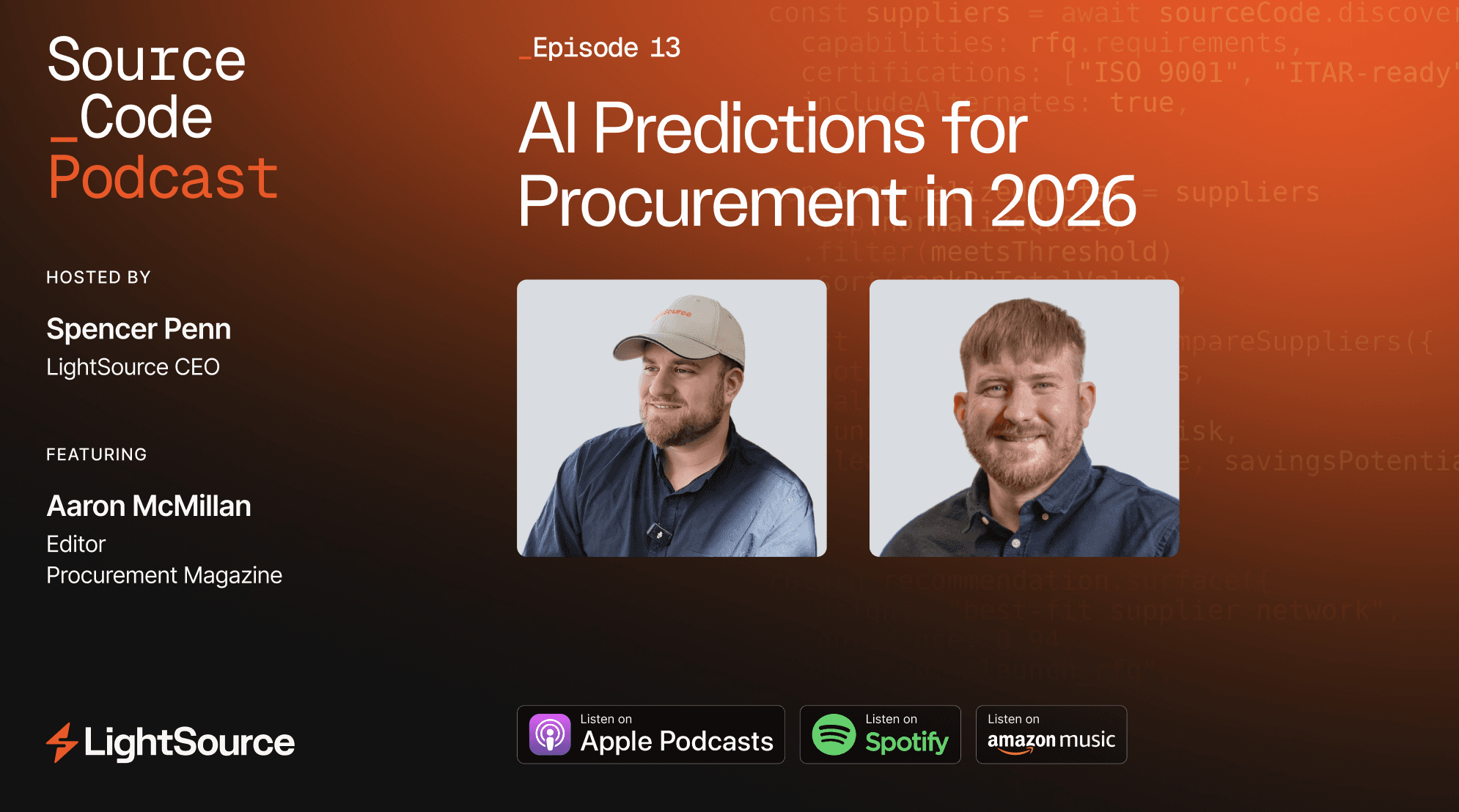
Guest: Aaron McMillan, Editor of Procurement Magazine, on AI Predictions for Procurement in 2026
Listen on Spotify | Listen on Apple Podcasts | Listen on Amazon Music
This one is a crossover. Instead of hosting, Spencer went on the Procurement Magazine podcast with its editor, Aaron McMillan, for the show's first proper episode. The two look back at what actually happened with AI in procurement across 2025 and then make some specific, occasionally uncomfortable predictions for 2026. Spencer gets into why adoption is always slower than people expect and then suddenly faster, why half of white collar work could be automated inside three years, why most AI vendors will not deliver what they promise, why the smart buyers start with the problem and not the technology, and why he thinks 2026 is the year procurement finally moves from experimenting to implementing. He also makes one genuinely wild prediction about a company run by a single person.
Slow to Adopt, Then Fast to Take Over
Spencer is wary of anyone who claims to know the future. "It's basically a guarantee of being wrong, and anyone who says they really know for sure is probably not being 100 percent truthful," he says. His own forecasting comes down to two things: which technology paths are likely, and, the harder part, the timeline. He learned the timeline lesson at Waymo, where the joke was that full autonomy had been two years away for a decade. The first 90 percent comes fast, and the last 10 percent, plus actually operationalizing it in the rain, at night, with depots and an app, is the slow grind. His rule of thumb: "It is slower than people think to get basic adoption, and it's faster than people think to get mass adoption."
Tech Ambition and Role Plasticity
To predict whether AI supplements a job or replaces it, Spencer uses two vectors. The first is tech ambition, how much the person wants to use AI. Lean in and it becomes a tailwind. Lean out and "eventually the role will be better done without their presence there." The second is role plasticity, how much the job can change. A toll booth operator has almost none, so even an AI enthusiast in that seat cannot reshape the work. Software engineering is the opposite: it has reinvented itself constantly, from punch cards to cloud, and "that role has been 95 percent automated, but that doesn't mean software engineers are out of work." Instead their pay grew, because the machine took the grind and left them the higher work.
Half of White Collar Work in Three Years
The blunt version: "Anything that can be done behind a computer screen in its entirety is automatable." Real world work, going to plants, visiting suppliers, building trust, is much harder. From there Spencer makes his boldest claim, that 50 percent of white collar jobs will be automated within three years, and says that when he talks with people at OpenAI and Anthropic about the trajectory, it feels conservative. For procurement specifically, he draws a clear line. A transactional buyer placing orders, checking invoice receipts, and reconciling between systems looks very automatable. Someone building a category strategy, earning supplier credibility, and getting out into the field, especially in direct materials, is very hard to replace, "because there isn't today a really easy way to bring that intelligence to the real world."
Efficiency, Not Savings
The thing Spencer did not see coming in 2025 was the shift in what CPOs actually ask for. "A lot of CPOs we meet with, they're not telling me we're looking for savings. What they say is we're looking for efficiency." And they do not mean cost efficiency. They mean headcount efficiency: flat or shrinking teams expected to cover a growing business. AI is a strong way to extend a workforce, but only under one condition. "If you're going to say AI is a force multiplier and not a people replacer, then the people have to know how to work the knobs." Tools alone do nothing without the training to use them.
The AI Capability Overhang
Spencer's favorite framing from a talk he gave last year is what he calls the AI capability overhang: the raw technology raced ahead while the actual AI products lagged behind. That gap breeds confusion. People do something impressive in ChatGPT, then ask why their enterprise procurement tool cannot do the same at scale, buy something that promises it can, and get an experience that "overpromises and underdelivers." His real fear for the year ahead is a backlash, where enough disappointment makes people decide AI was a false promise and pull back. Agentic AI worries him most here, not because the idea is wrong, but because "100 percent of vendors talk about AI and agentic AI," and he estimates 80 percent of them are not what they market themselves as.
Start With the Problem, Not the Technology
The most common mistake Spencer sees is technology hunting for a problem. Boards tell CEOs to have an AI strategy, CEOs push it to VPs, and eventually someone is asking vendors "what do you do with AI that we can plug in," which he calls the reverse of how it should work. "You don't go to the doctor and say what medication should I take before they diagnose you." He points to the Segway, a $4,000 self balancing scooter backed by brilliant people that solved a pain almost nobody had, and to blockchain, where after years of hype the one use case that truly stuck was currency. "Bitcoin is the best use case of blockchain, in my opinion," and the rest have been hard to prove out. He is also clear that AI is not a blunt instrument for everything. Payment systems, for instance, should stay deterministic. "I don't want there to be agents. That routing number, that bank account number, gets sent that amount of money. It's ironclad."
Make Them Prove It
Asked how buyers should hold "AI native" vendors accountable in 2026, Spencer leans on his New York upbringing. "We're from what we call the show me culture. I want to just see it." Anyone can build a deck or a rehearsed one off demo. The real test is unscripted: "I don't want you to be able to prepare. I want to give you my data right now and see what your system is capable of." He remembers a company that launched 50 different agents at once, a great marketing picture, none of them actually good, and warns that these flops poison the well for everyone. His other tell is the team itself. Look at the CTO and the engineers on LinkedIn. If they come from places like Waymo, Google, Meta, and Airbnb, they are probably close enough to the frontier to deliver. LightSource's own CTO came from Google X and Google Research, the birthplace of the transformer model, the T in ChatGPT.
Why a Team of 100 Beats 10,000
Spencer says he feels lucky to be running LightSource at this exact moment, and part of that is a belief that the old advantages have flipped. Incumbents have three things: a technology base that is now aging fast, deep resources, and a lot of people. But "a team of a hundred can do just as much or more than a team of 10,000" when they share a unified direction and have the AI tools to extend themselves. AI has also become an external tailwind. Every CPO is being told to bring AI into their environment, and "the answer they can't come back with is, we're doing something more with the legacy provider." That alone pulls buyers toward newer, high growth companies.
The Case for Direct Materials
Spencer keeps returning to the problem LightSource was built for. Direct materials, the physical stuff that goes into the product, makes up around 80 percent of spend, and in his words it is "the big unsung hero of the procurement universe," the elephant in the room almost nobody built for. His Spec to Scale manifesto, which he wrote himself and published this year, argues that procurement technology has been aimed at indirect spend for decades. Even the canonical source to pay stack ends at procure to pay, which is indirect, not the ERP. Direct materials needs a different set of tools entirely: pulling from engineering and PLM systems, aligning on specs, whether CAD drawings or chemical cast numbers, and running the full lifecycle through payment and beyond, into quality, index adjustments, and risk. Those are things today's procure to pay systems barely touch.
Why Companies Buy Startups, and Why LightSource Won't Sell
Aaron asks why big players keep acquiring AI startups instead of building. Spencer lays out three reasons: to acquire the customers, to cross sell the broader suite into that startup's base, or to acquire the talent, the aqua hire. But he is blunt that LightSource is "absolutely 0 percent for sale," and that building a company to be acquired is a trap, because you make short term bets, you cannot control the acquirer's timing, and you have no leverage. His actual goal is to build the definitive procurement operating system for direct materials and take it public, a company he believes could rival or exceed a business like Salesforce. He also notes that acquisitions are often not worth it now: twice his CTO looked at buying a product and concluded it would be more work than building it fresh, and with AI making software faster to write, "I think it's becoming less and less important to acquire pre written software."
2026 Is the Year of Implementation
Spencer's headline prediction is a clean one. "Last year was the year of experimentation, and this year is the year of implementation." His advice depends on who is listening. An individual buyer should get access to a safe LLM at work and, frankly, "become addicted to ChatGPT," treating it like an army of AI interns that are not always right but are a real accelerant. A CPO should partner closely with IT, ideally with a dedicated IT resource that reports into procurement, map their real workflows, and then actually commit. The failure mode is endless pilots: "It's very easy to run proofs of concept and put things on a wish list and not revisit them for six months," which just delays the business. He also makes the case for storing data in a unified layer, a data lake, so switching tools gets cheap. His analogy: "You can upgrade your computer without changing the wiring in your house."
The One Person Unicorn
For the closing "most shocking development" question, Spencer goes for it. Within the next year, he predicts a news story about a company valued at a billion dollars that turns out to be one person in a garage, orchestrating a stack of AI agents, an SDR agent, an account executive agent, a payment agent, a coding team run through Claude Code with another agent reviewing the work. "One person just really good at orchestrating AI tools that builds a billion dollar company," and then, he thinks, the floodgates open. He is not that person, LightSource passed the two person stage long ago, but he practices what he preaches. Over one Thanksgiving day off he built Job Source, an AI tool that pulls procurement jobs from across the web and matches people to them, "like Tinder for procurement." The point was not the app. "It's important for leaders to stay close to this themselves. If you're not staying close to it, the art of the possible will be out of your reach."
Guest: Aaron McMillan, Editor of Procurement Magazine, on AI Predictions for Procurement in 2026
Listen on Spotify | Listen on Apple Podcasts | Listen on Amazon Music
This one is a crossover. Instead of hosting, Spencer went on the Procurement Magazine podcast with its editor, Aaron McMillan, for the show's first proper episode. The two look back at what actually happened with AI in procurement across 2025 and then make some specific, occasionally uncomfortable predictions for 2026. Spencer gets into why adoption is always slower than people expect and then suddenly faster, why half of white collar work could be automated inside three years, why most AI vendors will not deliver what they promise, why the smart buyers start with the problem and not the technology, and why he thinks 2026 is the year procurement finally moves from experimenting to implementing. He also makes one genuinely wild prediction about a company run by a single person.
Slow to Adopt, Then Fast to Take Over
Spencer is wary of anyone who claims to know the future. "It's basically a guarantee of being wrong, and anyone who says they really know for sure is probably not being 100 percent truthful," he says. His own forecasting comes down to two things: which technology paths are likely, and, the harder part, the timeline. He learned the timeline lesson at Waymo, where the joke was that full autonomy had been two years away for a decade. The first 90 percent comes fast, and the last 10 percent, plus actually operationalizing it in the rain, at night, with depots and an app, is the slow grind. His rule of thumb: "It is slower than people think to get basic adoption, and it's faster than people think to get mass adoption."
Tech Ambition and Role Plasticity
To predict whether AI supplements a job or replaces it, Spencer uses two vectors. The first is tech ambition, how much the person wants to use AI. Lean in and it becomes a tailwind. Lean out and "eventually the role will be better done without their presence there." The second is role plasticity, how much the job can change. A toll booth operator has almost none, so even an AI enthusiast in that seat cannot reshape the work. Software engineering is the opposite: it has reinvented itself constantly, from punch cards to cloud, and "that role has been 95 percent automated, but that doesn't mean software engineers are out of work." Instead their pay grew, because the machine took the grind and left them the higher work.
Half of White Collar Work in Three Years
The blunt version: "Anything that can be done behind a computer screen in its entirety is automatable." Real world work, going to plants, visiting suppliers, building trust, is much harder. From there Spencer makes his boldest claim, that 50 percent of white collar jobs will be automated within three years, and says that when he talks with people at OpenAI and Anthropic about the trajectory, it feels conservative. For procurement specifically, he draws a clear line. A transactional buyer placing orders, checking invoice receipts, and reconciling between systems looks very automatable. Someone building a category strategy, earning supplier credibility, and getting out into the field, especially in direct materials, is very hard to replace, "because there isn't today a really easy way to bring that intelligence to the real world."
Efficiency, Not Savings
The thing Spencer did not see coming in 2025 was the shift in what CPOs actually ask for. "A lot of CPOs we meet with, they're not telling me we're looking for savings. What they say is we're looking for efficiency." And they do not mean cost efficiency. They mean headcount efficiency: flat or shrinking teams expected to cover a growing business. AI is a strong way to extend a workforce, but only under one condition. "If you're going to say AI is a force multiplier and not a people replacer, then the people have to know how to work the knobs." Tools alone do nothing without the training to use them.
The AI Capability Overhang
Spencer's favorite framing from a talk he gave last year is what he calls the AI capability overhang: the raw technology raced ahead while the actual AI products lagged behind. That gap breeds confusion. People do something impressive in ChatGPT, then ask why their enterprise procurement tool cannot do the same at scale, buy something that promises it can, and get an experience that "overpromises and underdelivers." His real fear for the year ahead is a backlash, where enough disappointment makes people decide AI was a false promise and pull back. Agentic AI worries him most here, not because the idea is wrong, but because "100 percent of vendors talk about AI and agentic AI," and he estimates 80 percent of them are not what they market themselves as.
Start With the Problem, Not the Technology
The most common mistake Spencer sees is technology hunting for a problem. Boards tell CEOs to have an AI strategy, CEOs push it to VPs, and eventually someone is asking vendors "what do you do with AI that we can plug in," which he calls the reverse of how it should work. "You don't go to the doctor and say what medication should I take before they diagnose you." He points to the Segway, a $4,000 self balancing scooter backed by brilliant people that solved a pain almost nobody had, and to blockchain, where after years of hype the one use case that truly stuck was currency. "Bitcoin is the best use case of blockchain, in my opinion," and the rest have been hard to prove out. He is also clear that AI is not a blunt instrument for everything. Payment systems, for instance, should stay deterministic. "I don't want there to be agents. That routing number, that bank account number, gets sent that amount of money. It's ironclad."
Make Them Prove It
Asked how buyers should hold "AI native" vendors accountable in 2026, Spencer leans on his New York upbringing. "We're from what we call the show me culture. I want to just see it." Anyone can build a deck or a rehearsed one off demo. The real test is unscripted: "I don't want you to be able to prepare. I want to give you my data right now and see what your system is capable of." He remembers a company that launched 50 different agents at once, a great marketing picture, none of them actually good, and warns that these flops poison the well for everyone. His other tell is the team itself. Look at the CTO and the engineers on LinkedIn. If they come from places like Waymo, Google, Meta, and Airbnb, they are probably close enough to the frontier to deliver. LightSource's own CTO came from Google X and Google Research, the birthplace of the transformer model, the T in ChatGPT.
Why a Team of 100 Beats 10,000
Spencer says he feels lucky to be running LightSource at this exact moment, and part of that is a belief that the old advantages have flipped. Incumbents have three things: a technology base that is now aging fast, deep resources, and a lot of people. But "a team of a hundred can do just as much or more than a team of 10,000" when they share a unified direction and have the AI tools to extend themselves. AI has also become an external tailwind. Every CPO is being told to bring AI into their environment, and "the answer they can't come back with is, we're doing something more with the legacy provider." That alone pulls buyers toward newer, high growth companies.
The Case for Direct Materials
Spencer keeps returning to the problem LightSource was built for. Direct materials, the physical stuff that goes into the product, makes up around 80 percent of spend, and in his words it is "the big unsung hero of the procurement universe," the elephant in the room almost nobody built for. His Spec to Scale manifesto, which he wrote himself and published this year, argues that procurement technology has been aimed at indirect spend for decades. Even the canonical source to pay stack ends at procure to pay, which is indirect, not the ERP. Direct materials needs a different set of tools entirely: pulling from engineering and PLM systems, aligning on specs, whether CAD drawings or chemical cast numbers, and running the full lifecycle through payment and beyond, into quality, index adjustments, and risk. Those are things today's procure to pay systems barely touch.
Why Companies Buy Startups, and Why LightSource Won't Sell
Aaron asks why big players keep acquiring AI startups instead of building. Spencer lays out three reasons: to acquire the customers, to cross sell the broader suite into that startup's base, or to acquire the talent, the aqua hire. But he is blunt that LightSource is "absolutely 0 percent for sale," and that building a company to be acquired is a trap, because you make short term bets, you cannot control the acquirer's timing, and you have no leverage. His actual goal is to build the definitive procurement operating system for direct materials and take it public, a company he believes could rival or exceed a business like Salesforce. He also notes that acquisitions are often not worth it now: twice his CTO looked at buying a product and concluded it would be more work than building it fresh, and with AI making software faster to write, "I think it's becoming less and less important to acquire pre written software."
2026 Is the Year of Implementation
Spencer's headline prediction is a clean one. "Last year was the year of experimentation, and this year is the year of implementation." His advice depends on who is listening. An individual buyer should get access to a safe LLM at work and, frankly, "become addicted to ChatGPT," treating it like an army of AI interns that are not always right but are a real accelerant. A CPO should partner closely with IT, ideally with a dedicated IT resource that reports into procurement, map their real workflows, and then actually commit. The failure mode is endless pilots: "It's very easy to run proofs of concept and put things on a wish list and not revisit them for six months," which just delays the business. He also makes the case for storing data in a unified layer, a data lake, so switching tools gets cheap. His analogy: "You can upgrade your computer without changing the wiring in your house."
The One Person Unicorn
For the closing "most shocking development" question, Spencer goes for it. Within the next year, he predicts a news story about a company valued at a billion dollars that turns out to be one person in a garage, orchestrating a stack of AI agents, an SDR agent, an account executive agent, a payment agent, a coding team run through Claude Code with another agent reviewing the work. "One person just really good at orchestrating AI tools that builds a billion dollar company," and then, he thinks, the floodgates open. He is not that person, LightSource passed the two person stage long ago, but he practices what he preaches. Over one Thanksgiving day off he built Job Source, an AI tool that pulls procurement jobs from across the web and matches people to them, "like Tinder for procurement." The point was not the app. "It's important for leaders to stay close to this themselves. If you're not staying close to it, the art of the possible will be out of your reach."
Guest: Aaron McMillan, Editor of Procurement Magazine, on AI Predictions for Procurement in 2026
Listen on Spotify | Listen on Apple Podcasts | Listen on Amazon Music
This one is a crossover. Instead of hosting, Spencer went on the Procurement Magazine podcast with its editor, Aaron McMillan, for the show's first proper episode. The two look back at what actually happened with AI in procurement across 2025 and then make some specific, occasionally uncomfortable predictions for 2026. Spencer gets into why adoption is always slower than people expect and then suddenly faster, why half of white collar work could be automated inside three years, why most AI vendors will not deliver what they promise, why the smart buyers start with the problem and not the technology, and why he thinks 2026 is the year procurement finally moves from experimenting to implementing. He also makes one genuinely wild prediction about a company run by a single person.
Slow to Adopt, Then Fast to Take Over
Spencer is wary of anyone who claims to know the future. "It's basically a guarantee of being wrong, and anyone who says they really know for sure is probably not being 100 percent truthful," he says. His own forecasting comes down to two things: which technology paths are likely, and, the harder part, the timeline. He learned the timeline lesson at Waymo, where the joke was that full autonomy had been two years away for a decade. The first 90 percent comes fast, and the last 10 percent, plus actually operationalizing it in the rain, at night, with depots and an app, is the slow grind. His rule of thumb: "It is slower than people think to get basic adoption, and it's faster than people think to get mass adoption."
Tech Ambition and Role Plasticity
To predict whether AI supplements a job or replaces it, Spencer uses two vectors. The first is tech ambition, how much the person wants to use AI. Lean in and it becomes a tailwind. Lean out and "eventually the role will be better done without their presence there." The second is role plasticity, how much the job can change. A toll booth operator has almost none, so even an AI enthusiast in that seat cannot reshape the work. Software engineering is the opposite: it has reinvented itself constantly, from punch cards to cloud, and "that role has been 95 percent automated, but that doesn't mean software engineers are out of work." Instead their pay grew, because the machine took the grind and left them the higher work.
Half of White Collar Work in Three Years
The blunt version: "Anything that can be done behind a computer screen in its entirety is automatable." Real world work, going to plants, visiting suppliers, building trust, is much harder. From there Spencer makes his boldest claim, that 50 percent of white collar jobs will be automated within three years, and says that when he talks with people at OpenAI and Anthropic about the trajectory, it feels conservative. For procurement specifically, he draws a clear line. A transactional buyer placing orders, checking invoice receipts, and reconciling between systems looks very automatable. Someone building a category strategy, earning supplier credibility, and getting out into the field, especially in direct materials, is very hard to replace, "because there isn't today a really easy way to bring that intelligence to the real world."
Efficiency, Not Savings
The thing Spencer did not see coming in 2025 was the shift in what CPOs actually ask for. "A lot of CPOs we meet with, they're not telling me we're looking for savings. What they say is we're looking for efficiency." And they do not mean cost efficiency. They mean headcount efficiency: flat or shrinking teams expected to cover a growing business. AI is a strong way to extend a workforce, but only under one condition. "If you're going to say AI is a force multiplier and not a people replacer, then the people have to know how to work the knobs." Tools alone do nothing without the training to use them.
The AI Capability Overhang
Spencer's favorite framing from a talk he gave last year is what he calls the AI capability overhang: the raw technology raced ahead while the actual AI products lagged behind. That gap breeds confusion. People do something impressive in ChatGPT, then ask why their enterprise procurement tool cannot do the same at scale, buy something that promises it can, and get an experience that "overpromises and underdelivers." His real fear for the year ahead is a backlash, where enough disappointment makes people decide AI was a false promise and pull back. Agentic AI worries him most here, not because the idea is wrong, but because "100 percent of vendors talk about AI and agentic AI," and he estimates 80 percent of them are not what they market themselves as.
Start With the Problem, Not the Technology
The most common mistake Spencer sees is technology hunting for a problem. Boards tell CEOs to have an AI strategy, CEOs push it to VPs, and eventually someone is asking vendors "what do you do with AI that we can plug in," which he calls the reverse of how it should work. "You don't go to the doctor and say what medication should I take before they diagnose you." He points to the Segway, a $4,000 self balancing scooter backed by brilliant people that solved a pain almost nobody had, and to blockchain, where after years of hype the one use case that truly stuck was currency. "Bitcoin is the best use case of blockchain, in my opinion," and the rest have been hard to prove out. He is also clear that AI is not a blunt instrument for everything. Payment systems, for instance, should stay deterministic. "I don't want there to be agents. That routing number, that bank account number, gets sent that amount of money. It's ironclad."
Make Them Prove It
Asked how buyers should hold "AI native" vendors accountable in 2026, Spencer leans on his New York upbringing. "We're from what we call the show me culture. I want to just see it." Anyone can build a deck or a rehearsed one off demo. The real test is unscripted: "I don't want you to be able to prepare. I want to give you my data right now and see what your system is capable of." He remembers a company that launched 50 different agents at once, a great marketing picture, none of them actually good, and warns that these flops poison the well for everyone. His other tell is the team itself. Look at the CTO and the engineers on LinkedIn. If they come from places like Waymo, Google, Meta, and Airbnb, they are probably close enough to the frontier to deliver. LightSource's own CTO came from Google X and Google Research, the birthplace of the transformer model, the T in ChatGPT.
Why a Team of 100 Beats 10,000
Spencer says he feels lucky to be running LightSource at this exact moment, and part of that is a belief that the old advantages have flipped. Incumbents have three things: a technology base that is now aging fast, deep resources, and a lot of people. But "a team of a hundred can do just as much or more than a team of 10,000" when they share a unified direction and have the AI tools to extend themselves. AI has also become an external tailwind. Every CPO is being told to bring AI into their environment, and "the answer they can't come back with is, we're doing something more with the legacy provider." That alone pulls buyers toward newer, high growth companies.
The Case for Direct Materials
Spencer keeps returning to the problem LightSource was built for. Direct materials, the physical stuff that goes into the product, makes up around 80 percent of spend, and in his words it is "the big unsung hero of the procurement universe," the elephant in the room almost nobody built for. His Spec to Scale manifesto, which he wrote himself and published this year, argues that procurement technology has been aimed at indirect spend for decades. Even the canonical source to pay stack ends at procure to pay, which is indirect, not the ERP. Direct materials needs a different set of tools entirely: pulling from engineering and PLM systems, aligning on specs, whether CAD drawings or chemical cast numbers, and running the full lifecycle through payment and beyond, into quality, index adjustments, and risk. Those are things today's procure to pay systems barely touch.
Why Companies Buy Startups, and Why LightSource Won't Sell
Aaron asks why big players keep acquiring AI startups instead of building. Spencer lays out three reasons: to acquire the customers, to cross sell the broader suite into that startup's base, or to acquire the talent, the aqua hire. But he is blunt that LightSource is "absolutely 0 percent for sale," and that building a company to be acquired is a trap, because you make short term bets, you cannot control the acquirer's timing, and you have no leverage. His actual goal is to build the definitive procurement operating system for direct materials and take it public, a company he believes could rival or exceed a business like Salesforce. He also notes that acquisitions are often not worth it now: twice his CTO looked at buying a product and concluded it would be more work than building it fresh, and with AI making software faster to write, "I think it's becoming less and less important to acquire pre written software."
2026 Is the Year of Implementation
Spencer's headline prediction is a clean one. "Last year was the year of experimentation, and this year is the year of implementation." His advice depends on who is listening. An individual buyer should get access to a safe LLM at work and, frankly, "become addicted to ChatGPT," treating it like an army of AI interns that are not always right but are a real accelerant. A CPO should partner closely with IT, ideally with a dedicated IT resource that reports into procurement, map their real workflows, and then actually commit. The failure mode is endless pilots: "It's very easy to run proofs of concept and put things on a wish list and not revisit them for six months," which just delays the business. He also makes the case for storing data in a unified layer, a data lake, so switching tools gets cheap. His analogy: "You can upgrade your computer without changing the wiring in your house."
The One Person Unicorn
For the closing "most shocking development" question, Spencer goes for it. Within the next year, he predicts a news story about a company valued at a billion dollars that turns out to be one person in a garage, orchestrating a stack of AI agents, an SDR agent, an account executive agent, a payment agent, a coding team run through Claude Code with another agent reviewing the work. "One person just really good at orchestrating AI tools that builds a billion dollar company," and then, he thinks, the floodgates open. He is not that person, LightSource passed the two person stage long ago, but he practices what he preaches. Over one Thanksgiving day off he built Job Source, an AI tool that pulls procurement jobs from across the web and matches people to them, "like Tinder for procurement." The point was not the app. "It's important for leaders to stay close to this themselves. If you're not staying close to it, the art of the possible will be out of your reach."
Read more


Read more
Read more
Faster sourcing. Lower cost. Less chaos.
See how LightSource connects engineering, procurement, and suppliers in one operating system to help you launch faster at lower cost.
SOC 2
Kearney #1 2024
Gartner Cool Vendor
Procuretech 100
G2 Top Rated
Faster sourcing. Lower cost. Less chaos.
See how LightSource connects engineering, procurement, and suppliers in one operating system to help you launch faster at lower cost.
SOC 2
Kearney #1 2024
Gartner Cool Vendor
Procuretech 100
G2 Top Rated
Faster sourcing. Lower cost. Less chaos.
See how LightSource connects engineering, procurement, and suppliers in one operating system to help you launch faster at lower cost.
SOC 2
Kearney #1 2024
Gartner Cool Vendor
Procuretech 100
G2 Top Rated
Trusted by:
Trusted by:
Trusted by: