

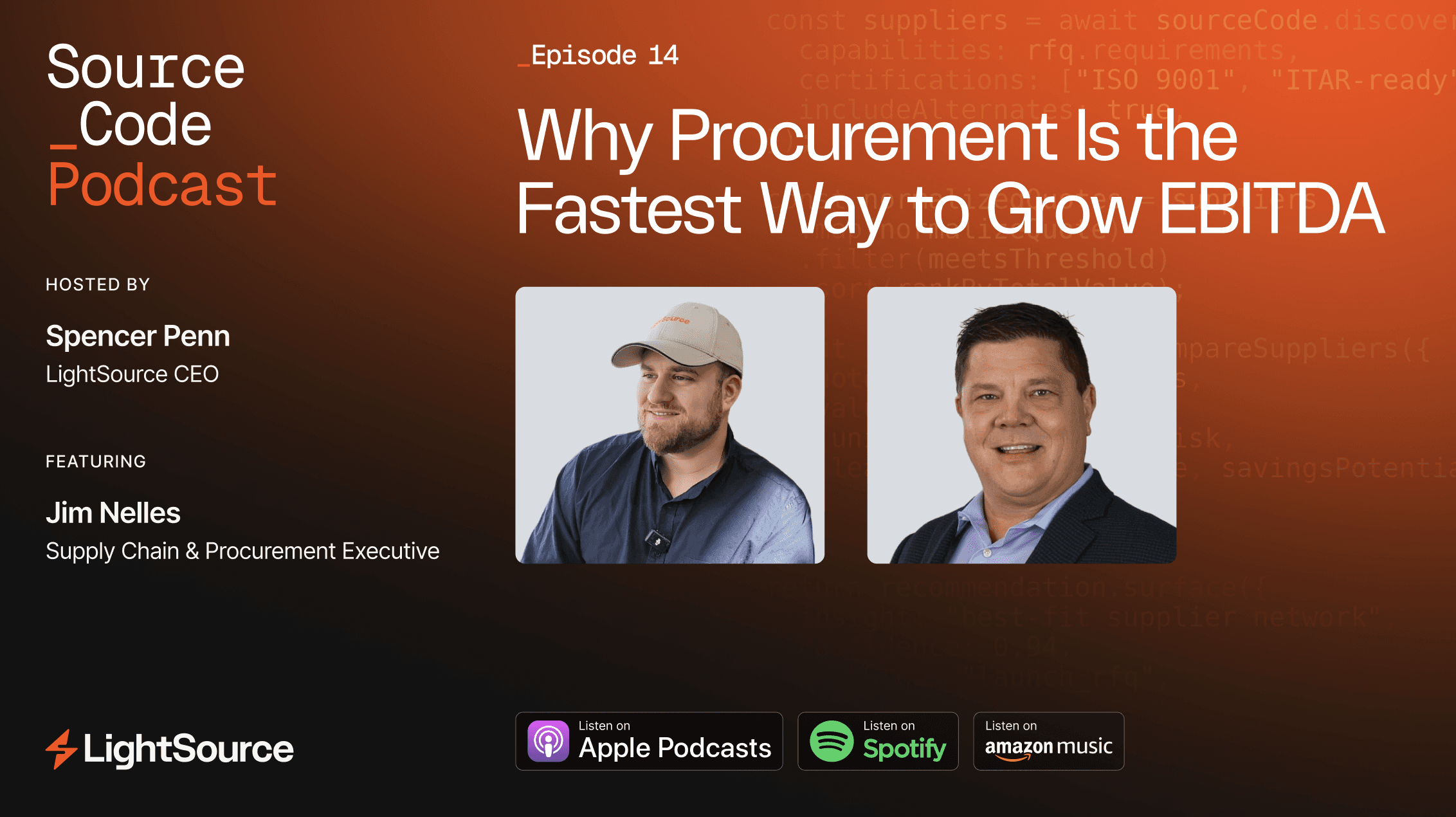
Guest: Jim Nelles, Supply Chain and Procurement Executive, on Why Procurement Is the Fastest Way to Grow EBITDA
Listen on Spotify | Listen on Apple Podcasts | Listen on Amazon Music
Nelles is the first to admit nobody grows up dreaming about procurement. He was an economics and French major who spent five years in the Navy learning how to shoot missiles, then landed at McMaster-Carr in a rotational program where the procurement manager training him quit and, the next day, Nelles had the job. From there it was McKinsey, where he joined a procurement practice that had just been stood up, and as he puts it, in consulting if you do something twice you are the expert. He went on to leadership roles including vice president of supply chain at Blue Bird and time at LG Electronics, then more than a decade as an operating partner helping private equity firms pull EBITDA out of their portfolio companies. He talks with Spencer about why private equity fell for procurement, why a dollar saved is worth more than a dollar earned, how to win over the very team you are there to help, why he would rather teach a team than hand it answers, how AI should give procurement people their day back, and what the United States keeps getting wrong about manufacturing.
Nobody Grows Up Wanting to Be in Procurement
Nelles did not plan any of this. After the Navy he joined McMaster-Carr, and during his rotation through procurement his manager quit, so overnight he became the manager. When McKinsey hired him, they had just launched a procurement practice and figured he already knew the space, so that is where he went. "No one ever grew up saying one day I want to be in purchasing," he says, "but that's how I ended up in purchasing and supply chain and operations." What comes through is that he learned the discipline from the ground up rather than from a textbook, which is the thing he still trusts most about his own judgment.
A Dollar Saved Is Worth More Than a Dollar Earned
This is the cleanest argument for why private equity cares about procurement, and Nelles makes it fast. "You don't have to go sell with a 20 percent margin and sell five units to get a dollar's worth of margin," he says. "Every dollar you save goes right to the bottom line for the most part." It is quick, it does not require raising prices, launching a product, or getting customers to behave differently, and it shows up as real money. "It's quick, it's actionable, and most importantly for private equity, it's tangible and quantifiable." You can sit in a meeting before a sale and show, dollar for dollar, exactly what procurement delivered and exactly what is left to do.
Stop Nibbling Around the Edges
When Nelles first got into private equity over a decade ago, he says the firms were not thinking strategically about procurement. They were signing a single shipping contract across the portfolio, or making everyone buy the same laptops, and calling it a win. Then he added up the numbers. "You realize that we're like a Fortune 75 company if you take all the direct material spend that we use, and the money's going to be there," he says. "It's not by nibbling around the edges." Going after direct material spend, not the easy shared contracts, is what turned procurement into a serious EBITDA lever in private equity.
What the Diligence Actually Looks Like
Spencer asks how much homework really gets done before a deal, and the honest answer is that it varies wildly. The good firms pull in an operating person to run rough math or read the confidential information memo. "You can actually learn a lot by reading through the SIMs," Nelles says. "If they don't talk about procurement, that tells me they haven't done anything with it," which usually means a lot of ripe fruit. His back of the envelope version is blunt: on average he gets 10 percent, so on 400 million dollars of spend he will tell you 40 million over 18 months. And the tidy spend cube everyone assumes exists? "It almost never exists before we get in there. Almost never." When it does, 90 to 95 percent of the time it is a one time Excel pull built for a single meeting, not something the team actually runs the business on.
Never Leave Money on the Bone
Spencer mentions someone who deliberately left savings untouched so the next private equity buyer would have something to find. Nelles would never do it. "I would go get all the money that I could get, but I would have a roadmap," he says. He describes it as a tree. First you pick up the fruit already on the ground, then the low hanging fruit, then you build the ladder and climb for what is at the top, and you hand the next owner the plan for the higher branches rather than a category you left untouched on purpose. Part of why he goes hard early is culture. "We don't go in there hoping to save 3 percent. We go in there telling them we're going to save 17 percent, and we keep going until we find it." Doing procurement first sets the tone that change is possible and teaches the organization to think bigger.
Brute Force First, Then Teach the Team
His playbook is simple. Unless a company already has a system, it starts with brute force, and brute force is mostly discipline. You build the first spend cube and run everything through a real process, out to bid, competition created, specifications on the table, rather than guessing what looks overpriced. But the part he says people in his role get wrong is the teaching. "You have to start teaching the team what good looks like, and then give them the tools so that they can be good." A lot of teams think a 3 to 5 percent reduction every year is winning and have never seen what 15 or 20 percent looks like, and they often do not know how to build a clean sheet cost model or run a strong RFP. He uses the should cost model of a t shirt to make it tangible, the fabric, the cutting, the labor. And he is not subtle about where tools come in. "Geez, Spencer, if only there was a really cool tool that would help them with the RFPs," he jokes, before landing on the real point: start with the blunt work while you teach, then bring in something like LightSource to put the team into overdrive.
The Hardest Person to Sell Is the CPO
The toughest sell is not the CFO or the CEO. It is the chief procurement officer, because any savings you find can feel like a verdict on their last few years. So Nelles reframes it. "Any success we have here is not a damnation of the past. It's just looking at it with a different set of eyes, different tools, different techniques." He tells teams they probably already have 95 percent of the answers, they have just been told no so many times they stopped asking. He compares it to an abused dog that flinches when a hand goes up, and says that is often what has happened to procurement people. Then there is plain risk aversion, the local supplier you have used for 20 years, whose kids go to school with yours, versus a stranger 12,000 miles away and a supply chain to match, all to save 17 percent. His rule for cutting through it is to refuse what he calls religious debates. "If we agree to do this process, we're not going to talk about suppliers until we have some data." And once wins start landing, attitudes flip fast. "If you feed the greed, people see the money roll in and they want more."
Pay Procurement Like It's Sales
Nelles has long thought procurement incentives are broken. Salespeople get commission and high fives. Procurement gets a bonus for, roughly, not killing anybody. He tells the story of interviewing for a CPO job where he offered to take 20 percent of everything he saved. The CEO said that would be 200 million dollars. "Yeah, that would be," Nelles told him. "Don't tell me my numbers are BS if you're not willing to put your money where your mouth is." The reason real pay for performance is rare, he says, is that procurement is easy to measure the wrong way. He has seen people quietly tell a supplier to bid high so the negotiated drop looks huge on paper. His fix is to measure green money, not gray money, and to take the scorekeeping out of procurement's hands entirely. "I work with finance to look at the savings calculations, and they're the ones that report the numbers, not procurement." It has to be real dollars against last price paid or the average over the past year, with the rules for things like inflation agreed at the start, so there are no gotchas at the end.
Measure the Process, Not Just the Result
Spencer floats an idea: since you cannot control commodity swings or engineering changes, why not measure whether people run the right process every time, a real competitive event, at least three credible suppliers, a TCO based decision. Nelles buys it, with one caveat. "If you just have a person who follows a process but never gets the results, that's probably just a bad person," and you replace them rather than reward them. But he agrees the right structures matter more than heroics. He wants a category manager who does nothing but new product development, sitting on the product team, because an engineer with a fresh drawing will spec "a gold plated left handed monkey wrench every single time when a silver plated right handed monkey wrench would have done." He points at platforming too, the plant making the same machine that somehow carries 1700 different screws. This is where he says the middle market suffers most, since a giant like Ford saving a fraction of a cent on a screw across platforms is real money, but a smaller manufacturer struggles to even see it. His reminder: "Even Elon Musk will stop, bend over, and pick up a 20 dollar bill. Every single penny counts."
AI Should Give People Their Day Back
Nelles calls himself an old man who is not remotely afraid of AI, because he sees it as augmentation, not replacement. He remembers when a should cost model for a technical product meant two analysts and three months. "Now you can take ChatGPT, put the parameters into it, and it'll come out with an 80 percent model," at minimum laying out every variable you should account for before you go do the real diligence. The bigger prize is time. If a procurement person spends six of eight hours just executing, placing and chasing orders, and tools like LightSource cut that to two, they get six hours back to find suppliers, learn to negotiate, and actually think. "One thing AI can't be yet is strategic," he says, so give the strategy back to the humans and let the software handle the grind.
America's Strength Was Never Manufacturing
Nelles spent about five months across Asia in 2025 and pushes back on the idea that the game is lost. He saw world class plants and factories still running equipment that looked unchanged since 1903. Countries like China have real advantages, leapfrogging straight to mobile payments, and a government that can approve and build at a speed a democracy cannot match. But his most contrarian point is about the US itself. "The United States was never a manufacturing powerhouse," he says. The country's strength is ideas and the next better mousetrap, not making everything at home. So if America is going to invest in manufacturing, he argues it should be the strategically important things, and he quotes Jamie Dimon: "I shouldn't care where my t shirt comes from, but I sure as hell care where my drones are manufactured." Defense, pharmaceuticals, biologics, chips, the things whose absence hurt during COVID. What he actually wants is a level playing field and genuinely free and fair trade, even if he doubts we ever fully get there.
The Weirdest Thing He Ever Sourced
Asked the strangest thing he has ever bought, Nelles does not flinch: bull semen, for a company in the artificial insemination business. But the stranger stretch, he says, was COVID, the one time in his career when nobody cared what anything cost. "They only cared about, could you go find it for me," he says. Not save me 10 percent, but "I'll pay double if you can just get it and get it here in the next six months." It flipped every instinct the job normally runs on.
Buyers Are Actually Entrepreneurs
Underneath the private equity war stories, Nelles keeps landing on the same belief. "Procurement folks need to stop thinking of themselves as cost centers and start thinking of themselves as profit centers," he says, and organizations need to stop treating procurement as the place you send people to die. When his own kids ask what he does, he tells them the best thing about procurement is that you get to run your own business young. "You are the general manager of your category," setting strategy, executing it, building the supply base, negotiating, getting trained on all of it. Which is why it still frustrates him that so few C level leaders come out of procurement. They get pigeonholed as buyers, he says, "and they're not buyers. They're actually entrepreneurs, if they're doing the job the right way."
Guest: Jim Nelles, Supply Chain and Procurement Executive, on Why Procurement Is the Fastest Way to Grow EBITDA
Listen on Spotify | Listen on Apple Podcasts | Listen on Amazon Music
Nelles is the first to admit nobody grows up dreaming about procurement. He was an economics and French major who spent five years in the Navy learning how to shoot missiles, then landed at McMaster-Carr in a rotational program where the procurement manager training him quit and, the next day, Nelles had the job. From there it was McKinsey, where he joined a procurement practice that had just been stood up, and as he puts it, in consulting if you do something twice you are the expert. He went on to leadership roles including vice president of supply chain at Blue Bird and time at LG Electronics, then more than a decade as an operating partner helping private equity firms pull EBITDA out of their portfolio companies. He talks with Spencer about why private equity fell for procurement, why a dollar saved is worth more than a dollar earned, how to win over the very team you are there to help, why he would rather teach a team than hand it answers, how AI should give procurement people their day back, and what the United States keeps getting wrong about manufacturing.
Nobody Grows Up Wanting to Be in Procurement
Nelles did not plan any of this. After the Navy he joined McMaster-Carr, and during his rotation through procurement his manager quit, so overnight he became the manager. When McKinsey hired him, they had just launched a procurement practice and figured he already knew the space, so that is where he went. "No one ever grew up saying one day I want to be in purchasing," he says, "but that's how I ended up in purchasing and supply chain and operations." What comes through is that he learned the discipline from the ground up rather than from a textbook, which is the thing he still trusts most about his own judgment.
A Dollar Saved Is Worth More Than a Dollar Earned
This is the cleanest argument for why private equity cares about procurement, and Nelles makes it fast. "You don't have to go sell with a 20 percent margin and sell five units to get a dollar's worth of margin," he says. "Every dollar you save goes right to the bottom line for the most part." It is quick, it does not require raising prices, launching a product, or getting customers to behave differently, and it shows up as real money. "It's quick, it's actionable, and most importantly for private equity, it's tangible and quantifiable." You can sit in a meeting before a sale and show, dollar for dollar, exactly what procurement delivered and exactly what is left to do.
Stop Nibbling Around the Edges
When Nelles first got into private equity over a decade ago, he says the firms were not thinking strategically about procurement. They were signing a single shipping contract across the portfolio, or making everyone buy the same laptops, and calling it a win. Then he added up the numbers. "You realize that we're like a Fortune 75 company if you take all the direct material spend that we use, and the money's going to be there," he says. "It's not by nibbling around the edges." Going after direct material spend, not the easy shared contracts, is what turned procurement into a serious EBITDA lever in private equity.
What the Diligence Actually Looks Like
Spencer asks how much homework really gets done before a deal, and the honest answer is that it varies wildly. The good firms pull in an operating person to run rough math or read the confidential information memo. "You can actually learn a lot by reading through the SIMs," Nelles says. "If they don't talk about procurement, that tells me they haven't done anything with it," which usually means a lot of ripe fruit. His back of the envelope version is blunt: on average he gets 10 percent, so on 400 million dollars of spend he will tell you 40 million over 18 months. And the tidy spend cube everyone assumes exists? "It almost never exists before we get in there. Almost never." When it does, 90 to 95 percent of the time it is a one time Excel pull built for a single meeting, not something the team actually runs the business on.
Never Leave Money on the Bone
Spencer mentions someone who deliberately left savings untouched so the next private equity buyer would have something to find. Nelles would never do it. "I would go get all the money that I could get, but I would have a roadmap," he says. He describes it as a tree. First you pick up the fruit already on the ground, then the low hanging fruit, then you build the ladder and climb for what is at the top, and you hand the next owner the plan for the higher branches rather than a category you left untouched on purpose. Part of why he goes hard early is culture. "We don't go in there hoping to save 3 percent. We go in there telling them we're going to save 17 percent, and we keep going until we find it." Doing procurement first sets the tone that change is possible and teaches the organization to think bigger.
Brute Force First, Then Teach the Team
His playbook is simple. Unless a company already has a system, it starts with brute force, and brute force is mostly discipline. You build the first spend cube and run everything through a real process, out to bid, competition created, specifications on the table, rather than guessing what looks overpriced. But the part he says people in his role get wrong is the teaching. "You have to start teaching the team what good looks like, and then give them the tools so that they can be good." A lot of teams think a 3 to 5 percent reduction every year is winning and have never seen what 15 or 20 percent looks like, and they often do not know how to build a clean sheet cost model or run a strong RFP. He uses the should cost model of a t shirt to make it tangible, the fabric, the cutting, the labor. And he is not subtle about where tools come in. "Geez, Spencer, if only there was a really cool tool that would help them with the RFPs," he jokes, before landing on the real point: start with the blunt work while you teach, then bring in something like LightSource to put the team into overdrive.
The Hardest Person to Sell Is the CPO
The toughest sell is not the CFO or the CEO. It is the chief procurement officer, because any savings you find can feel like a verdict on their last few years. So Nelles reframes it. "Any success we have here is not a damnation of the past. It's just looking at it with a different set of eyes, different tools, different techniques." He tells teams they probably already have 95 percent of the answers, they have just been told no so many times they stopped asking. He compares it to an abused dog that flinches when a hand goes up, and says that is often what has happened to procurement people. Then there is plain risk aversion, the local supplier you have used for 20 years, whose kids go to school with yours, versus a stranger 12,000 miles away and a supply chain to match, all to save 17 percent. His rule for cutting through it is to refuse what he calls religious debates. "If we agree to do this process, we're not going to talk about suppliers until we have some data." And once wins start landing, attitudes flip fast. "If you feed the greed, people see the money roll in and they want more."
Pay Procurement Like It's Sales
Nelles has long thought procurement incentives are broken. Salespeople get commission and high fives. Procurement gets a bonus for, roughly, not killing anybody. He tells the story of interviewing for a CPO job where he offered to take 20 percent of everything he saved. The CEO said that would be 200 million dollars. "Yeah, that would be," Nelles told him. "Don't tell me my numbers are BS if you're not willing to put your money where your mouth is." The reason real pay for performance is rare, he says, is that procurement is easy to measure the wrong way. He has seen people quietly tell a supplier to bid high so the negotiated drop looks huge on paper. His fix is to measure green money, not gray money, and to take the scorekeeping out of procurement's hands entirely. "I work with finance to look at the savings calculations, and they're the ones that report the numbers, not procurement." It has to be real dollars against last price paid or the average over the past year, with the rules for things like inflation agreed at the start, so there are no gotchas at the end.
Measure the Process, Not Just the Result
Spencer floats an idea: since you cannot control commodity swings or engineering changes, why not measure whether people run the right process every time, a real competitive event, at least three credible suppliers, a TCO based decision. Nelles buys it, with one caveat. "If you just have a person who follows a process but never gets the results, that's probably just a bad person," and you replace them rather than reward them. But he agrees the right structures matter more than heroics. He wants a category manager who does nothing but new product development, sitting on the product team, because an engineer with a fresh drawing will spec "a gold plated left handed monkey wrench every single time when a silver plated right handed monkey wrench would have done." He points at platforming too, the plant making the same machine that somehow carries 1700 different screws. This is where he says the middle market suffers most, since a giant like Ford saving a fraction of a cent on a screw across platforms is real money, but a smaller manufacturer struggles to even see it. His reminder: "Even Elon Musk will stop, bend over, and pick up a 20 dollar bill. Every single penny counts."
AI Should Give People Their Day Back
Nelles calls himself an old man who is not remotely afraid of AI, because he sees it as augmentation, not replacement. He remembers when a should cost model for a technical product meant two analysts and three months. "Now you can take ChatGPT, put the parameters into it, and it'll come out with an 80 percent model," at minimum laying out every variable you should account for before you go do the real diligence. The bigger prize is time. If a procurement person spends six of eight hours just executing, placing and chasing orders, and tools like LightSource cut that to two, they get six hours back to find suppliers, learn to negotiate, and actually think. "One thing AI can't be yet is strategic," he says, so give the strategy back to the humans and let the software handle the grind.
America's Strength Was Never Manufacturing
Nelles spent about five months across Asia in 2025 and pushes back on the idea that the game is lost. He saw world class plants and factories still running equipment that looked unchanged since 1903. Countries like China have real advantages, leapfrogging straight to mobile payments, and a government that can approve and build at a speed a democracy cannot match. But his most contrarian point is about the US itself. "The United States was never a manufacturing powerhouse," he says. The country's strength is ideas and the next better mousetrap, not making everything at home. So if America is going to invest in manufacturing, he argues it should be the strategically important things, and he quotes Jamie Dimon: "I shouldn't care where my t shirt comes from, but I sure as hell care where my drones are manufactured." Defense, pharmaceuticals, biologics, chips, the things whose absence hurt during COVID. What he actually wants is a level playing field and genuinely free and fair trade, even if he doubts we ever fully get there.
The Weirdest Thing He Ever Sourced
Asked the strangest thing he has ever bought, Nelles does not flinch: bull semen, for a company in the artificial insemination business. But the stranger stretch, he says, was COVID, the one time in his career when nobody cared what anything cost. "They only cared about, could you go find it for me," he says. Not save me 10 percent, but "I'll pay double if you can just get it and get it here in the next six months." It flipped every instinct the job normally runs on.
Buyers Are Actually Entrepreneurs
Underneath the private equity war stories, Nelles keeps landing on the same belief. "Procurement folks need to stop thinking of themselves as cost centers and start thinking of themselves as profit centers," he says, and organizations need to stop treating procurement as the place you send people to die. When his own kids ask what he does, he tells them the best thing about procurement is that you get to run your own business young. "You are the general manager of your category," setting strategy, executing it, building the supply base, negotiating, getting trained on all of it. Which is why it still frustrates him that so few C level leaders come out of procurement. They get pigeonholed as buyers, he says, "and they're not buyers. They're actually entrepreneurs, if they're doing the job the right way."
Guest: Jim Nelles, Supply Chain and Procurement Executive, on Why Procurement Is the Fastest Way to Grow EBITDA
Listen on Spotify | Listen on Apple Podcasts | Listen on Amazon Music
Nelles is the first to admit nobody grows up dreaming about procurement. He was an economics and French major who spent five years in the Navy learning how to shoot missiles, then landed at McMaster-Carr in a rotational program where the procurement manager training him quit and, the next day, Nelles had the job. From there it was McKinsey, where he joined a procurement practice that had just been stood up, and as he puts it, in consulting if you do something twice you are the expert. He went on to leadership roles including vice president of supply chain at Blue Bird and time at LG Electronics, then more than a decade as an operating partner helping private equity firms pull EBITDA out of their portfolio companies. He talks with Spencer about why private equity fell for procurement, why a dollar saved is worth more than a dollar earned, how to win over the very team you are there to help, why he would rather teach a team than hand it answers, how AI should give procurement people their day back, and what the United States keeps getting wrong about manufacturing.
Nobody Grows Up Wanting to Be in Procurement
Nelles did not plan any of this. After the Navy he joined McMaster-Carr, and during his rotation through procurement his manager quit, so overnight he became the manager. When McKinsey hired him, they had just launched a procurement practice and figured he already knew the space, so that is where he went. "No one ever grew up saying one day I want to be in purchasing," he says, "but that's how I ended up in purchasing and supply chain and operations." What comes through is that he learned the discipline from the ground up rather than from a textbook, which is the thing he still trusts most about his own judgment.
A Dollar Saved Is Worth More Than a Dollar Earned
This is the cleanest argument for why private equity cares about procurement, and Nelles makes it fast. "You don't have to go sell with a 20 percent margin and sell five units to get a dollar's worth of margin," he says. "Every dollar you save goes right to the bottom line for the most part." It is quick, it does not require raising prices, launching a product, or getting customers to behave differently, and it shows up as real money. "It's quick, it's actionable, and most importantly for private equity, it's tangible and quantifiable." You can sit in a meeting before a sale and show, dollar for dollar, exactly what procurement delivered and exactly what is left to do.
Stop Nibbling Around the Edges
When Nelles first got into private equity over a decade ago, he says the firms were not thinking strategically about procurement. They were signing a single shipping contract across the portfolio, or making everyone buy the same laptops, and calling it a win. Then he added up the numbers. "You realize that we're like a Fortune 75 company if you take all the direct material spend that we use, and the money's going to be there," he says. "It's not by nibbling around the edges." Going after direct material spend, not the easy shared contracts, is what turned procurement into a serious EBITDA lever in private equity.
What the Diligence Actually Looks Like
Spencer asks how much homework really gets done before a deal, and the honest answer is that it varies wildly. The good firms pull in an operating person to run rough math or read the confidential information memo. "You can actually learn a lot by reading through the SIMs," Nelles says. "If they don't talk about procurement, that tells me they haven't done anything with it," which usually means a lot of ripe fruit. His back of the envelope version is blunt: on average he gets 10 percent, so on 400 million dollars of spend he will tell you 40 million over 18 months. And the tidy spend cube everyone assumes exists? "It almost never exists before we get in there. Almost never." When it does, 90 to 95 percent of the time it is a one time Excel pull built for a single meeting, not something the team actually runs the business on.
Never Leave Money on the Bone
Spencer mentions someone who deliberately left savings untouched so the next private equity buyer would have something to find. Nelles would never do it. "I would go get all the money that I could get, but I would have a roadmap," he says. He describes it as a tree. First you pick up the fruit already on the ground, then the low hanging fruit, then you build the ladder and climb for what is at the top, and you hand the next owner the plan for the higher branches rather than a category you left untouched on purpose. Part of why he goes hard early is culture. "We don't go in there hoping to save 3 percent. We go in there telling them we're going to save 17 percent, and we keep going until we find it." Doing procurement first sets the tone that change is possible and teaches the organization to think bigger.
Brute Force First, Then Teach the Team
His playbook is simple. Unless a company already has a system, it starts with brute force, and brute force is mostly discipline. You build the first spend cube and run everything through a real process, out to bid, competition created, specifications on the table, rather than guessing what looks overpriced. But the part he says people in his role get wrong is the teaching. "You have to start teaching the team what good looks like, and then give them the tools so that they can be good." A lot of teams think a 3 to 5 percent reduction every year is winning and have never seen what 15 or 20 percent looks like, and they often do not know how to build a clean sheet cost model or run a strong RFP. He uses the should cost model of a t shirt to make it tangible, the fabric, the cutting, the labor. And he is not subtle about where tools come in. "Geez, Spencer, if only there was a really cool tool that would help them with the RFPs," he jokes, before landing on the real point: start with the blunt work while you teach, then bring in something like LightSource to put the team into overdrive.
The Hardest Person to Sell Is the CPO
The toughest sell is not the CFO or the CEO. It is the chief procurement officer, because any savings you find can feel like a verdict on their last few years. So Nelles reframes it. "Any success we have here is not a damnation of the past. It's just looking at it with a different set of eyes, different tools, different techniques." He tells teams they probably already have 95 percent of the answers, they have just been told no so many times they stopped asking. He compares it to an abused dog that flinches when a hand goes up, and says that is often what has happened to procurement people. Then there is plain risk aversion, the local supplier you have used for 20 years, whose kids go to school with yours, versus a stranger 12,000 miles away and a supply chain to match, all to save 17 percent. His rule for cutting through it is to refuse what he calls religious debates. "If we agree to do this process, we're not going to talk about suppliers until we have some data." And once wins start landing, attitudes flip fast. "If you feed the greed, people see the money roll in and they want more."
Pay Procurement Like It's Sales
Nelles has long thought procurement incentives are broken. Salespeople get commission and high fives. Procurement gets a bonus for, roughly, not killing anybody. He tells the story of interviewing for a CPO job where he offered to take 20 percent of everything he saved. The CEO said that would be 200 million dollars. "Yeah, that would be," Nelles told him. "Don't tell me my numbers are BS if you're not willing to put your money where your mouth is." The reason real pay for performance is rare, he says, is that procurement is easy to measure the wrong way. He has seen people quietly tell a supplier to bid high so the negotiated drop looks huge on paper. His fix is to measure green money, not gray money, and to take the scorekeeping out of procurement's hands entirely. "I work with finance to look at the savings calculations, and they're the ones that report the numbers, not procurement." It has to be real dollars against last price paid or the average over the past year, with the rules for things like inflation agreed at the start, so there are no gotchas at the end.
Measure the Process, Not Just the Result
Spencer floats an idea: since you cannot control commodity swings or engineering changes, why not measure whether people run the right process every time, a real competitive event, at least three credible suppliers, a TCO based decision. Nelles buys it, with one caveat. "If you just have a person who follows a process but never gets the results, that's probably just a bad person," and you replace them rather than reward them. But he agrees the right structures matter more than heroics. He wants a category manager who does nothing but new product development, sitting on the product team, because an engineer with a fresh drawing will spec "a gold plated left handed monkey wrench every single time when a silver plated right handed monkey wrench would have done." He points at platforming too, the plant making the same machine that somehow carries 1700 different screws. This is where he says the middle market suffers most, since a giant like Ford saving a fraction of a cent on a screw across platforms is real money, but a smaller manufacturer struggles to even see it. His reminder: "Even Elon Musk will stop, bend over, and pick up a 20 dollar bill. Every single penny counts."
AI Should Give People Their Day Back
Nelles calls himself an old man who is not remotely afraid of AI, because he sees it as augmentation, not replacement. He remembers when a should cost model for a technical product meant two analysts and three months. "Now you can take ChatGPT, put the parameters into it, and it'll come out with an 80 percent model," at minimum laying out every variable you should account for before you go do the real diligence. The bigger prize is time. If a procurement person spends six of eight hours just executing, placing and chasing orders, and tools like LightSource cut that to two, they get six hours back to find suppliers, learn to negotiate, and actually think. "One thing AI can't be yet is strategic," he says, so give the strategy back to the humans and let the software handle the grind.
America's Strength Was Never Manufacturing
Nelles spent about five months across Asia in 2025 and pushes back on the idea that the game is lost. He saw world class plants and factories still running equipment that looked unchanged since 1903. Countries like China have real advantages, leapfrogging straight to mobile payments, and a government that can approve and build at a speed a democracy cannot match. But his most contrarian point is about the US itself. "The United States was never a manufacturing powerhouse," he says. The country's strength is ideas and the next better mousetrap, not making everything at home. So if America is going to invest in manufacturing, he argues it should be the strategically important things, and he quotes Jamie Dimon: "I shouldn't care where my t shirt comes from, but I sure as hell care where my drones are manufactured." Defense, pharmaceuticals, biologics, chips, the things whose absence hurt during COVID. What he actually wants is a level playing field and genuinely free and fair trade, even if he doubts we ever fully get there.
The Weirdest Thing He Ever Sourced
Asked the strangest thing he has ever bought, Nelles does not flinch: bull semen, for a company in the artificial insemination business. But the stranger stretch, he says, was COVID, the one time in his career when nobody cared what anything cost. "They only cared about, could you go find it for me," he says. Not save me 10 percent, but "I'll pay double if you can just get it and get it here in the next six months." It flipped every instinct the job normally runs on.
Buyers Are Actually Entrepreneurs
Underneath the private equity war stories, Nelles keeps landing on the same belief. "Procurement folks need to stop thinking of themselves as cost centers and start thinking of themselves as profit centers," he says, and organizations need to stop treating procurement as the place you send people to die. When his own kids ask what he does, he tells them the best thing about procurement is that you get to run your own business young. "You are the general manager of your category," setting strategy, executing it, building the supply base, negotiating, getting trained on all of it. Which is why it still frustrates him that so few C level leaders come out of procurement. They get pigeonholed as buyers, he says, "and they're not buyers. They're actually entrepreneurs, if they're doing the job the right way."
Read more


Read more
Read more
Faster sourcing. Lower cost. Less chaos.
See how LightSource connects engineering, procurement, and suppliers in one operating system to help you launch faster at lower cost.
SOC 2
Kearney #1 2024
Gartner Cool Vendor
Procuretech 100
G2 Top Rated
Faster sourcing. Lower cost. Less chaos.
See how LightSource connects engineering, procurement, and suppliers in one operating system to help you launch faster at lower cost.
SOC 2
Kearney #1 2024
Gartner Cool Vendor
Procuretech 100
G2 Top Rated
Faster sourcing. Lower cost. Less chaos.
See how LightSource connects engineering, procurement, and suppliers in one operating system to help you launch faster at lower cost.
SOC 2
Kearney #1 2024
Gartner Cool Vendor
Procuretech 100
G2 Top Rated
Trusted by:
Trusted by:
Trusted by: