$90M+ in cost avoidance and a 24% faster sourcing cycle on a new EV program
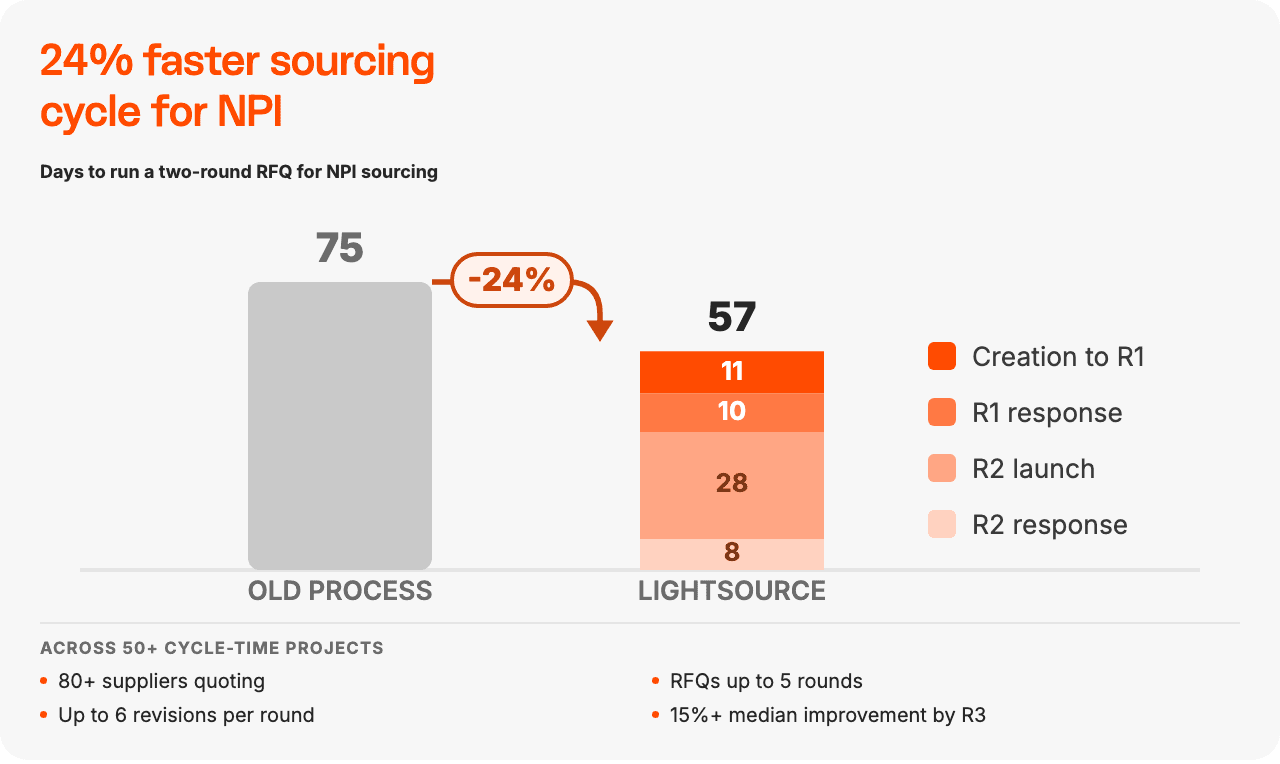
A Big Three auto OEM replaced spreadsheet-and-email RFQs with LightSource, cutting part-release-to-LOI cycle time from 75 days to 57 and averaging 37%+ cost avoidance from LOI through start of production.

Internal note -- remove before production deploy: the customer quote below is drafted and pending customer approval; metric framing (24% / 37% definitions) awaits final sign-off.
37%+ average cost avoidance, LOI through SOP · 24% faster sourcing cycle, part release to LOI (75 days to 57) · $90M+ cost avoidance in NPI sourcing
At a glance
"On a program moving this fast, sourcing is usually the long pole. LightSource compressed our part-release-to-LOI cycle by a quarter and held our costs from LOI all the way to start of production."
-- VP of Supply Chain
Customer: A Big Three auto OEM
Industry: Automotive
Region: North America
Program: A new EV program with compressed NPI timelines and tight BOM cost targets, launched to compete head-on with lower-cost entrants
Before LightSource
Multi-round RFQs across hundreds of parts ran on spreadsheets and email
Supplier quotes arrived in each supplier's own format, so line-item comparison was slow and error-prone
Costs crept upward between LOI and start of production, against BOM targets with no slack
After LightSource
Part-release-to-LOI cycle down 24% -- from 75 days to 57 for a two-round RFQ
37%+ average cost avoidance held from LOI through SOP
$90M+ in total cost avoidance across 220+ sourcing projects
Workflows used: Multi-round RFQs · Standardized cost breakdowns · AI-normalized quote comparison · In-app and Excel supplier quoting
The challenge
The business case was written before sourcing ever started
The OEM was taking a new EV program to market against lower-cost entrants, and the program entered sourcing with two constraints already fixed: compressed NPI timing and a tight BOM cost target. Sourcing sat directly on both critical paths -- schedule slips and piece-cost increases put the launch plan and the margin math at risk together.
The existing process was built for programs with more slack. A two-round RFQ took 75 days to get from part release to a letter of intent (LOI), run over spreadsheets and email across hundreds of parts at once. Because every supplier quoted in its own format, buyers had to rebuild line-item comparisons before they could decide what to challenge in the next round. The cost was cumulative: time lost to setup, quote cleanup, and the lag between rounds.
The LOI-to-SOP phase carried a second risk: cost creep after award. Between LOI and start of production (SOP), costs on a typical program drift upward -- a slow leak the program's margin math could not absorb.
Had to hit aggressive NPI timelines to reach market ahead of lower-cost competitors
Tight BOM cost targets left no room for the cost creep that typically accumulates between LOI and SOP
Multi-round RFQs across hundreds of parts ran on spreadsheets and email, stretching sourcing cycles
Supplier quotes arrived in inconsistent formats, making line-item comparison slow and error-prone
The solution
One template, every supplier, every round
The OEM moved the program's NPI sourcing onto LightSource -- eventually roughly 30% of vehicle BOM cost, across 220+ sourcing projects covering 900+ parts and systems and 300+ suppliers, with 30%+ of projects dual-sourced. Cost-avoidance results below are measured across that full base; cycle-time results are measured across 50+ sourcing projects and 80+ suppliers.
Multi-round RFQs -- up to 5 rounds, with up to 6 quote revisions inside a single round -- run on one platform shared by buyers and suppliers. A standardized global cost-breakdown template meant every quote arrived in the same line-item structure, comparable on arrival, whether the supplier submitted in-app or in Excel with formulas intact. Between rounds, AI-normalized quote comparison flagged which lines were out of family and by how much, so buyers reviewed comparable bids and targeted the next ask instead of rebuilding a comparison file.
The results
From 75 days to 57 -- and $90M+ kept out of program cost
Cut the part-release-to-LOI sourcing cycle 24% -- from 75 days to 57 for a two-round RFQ
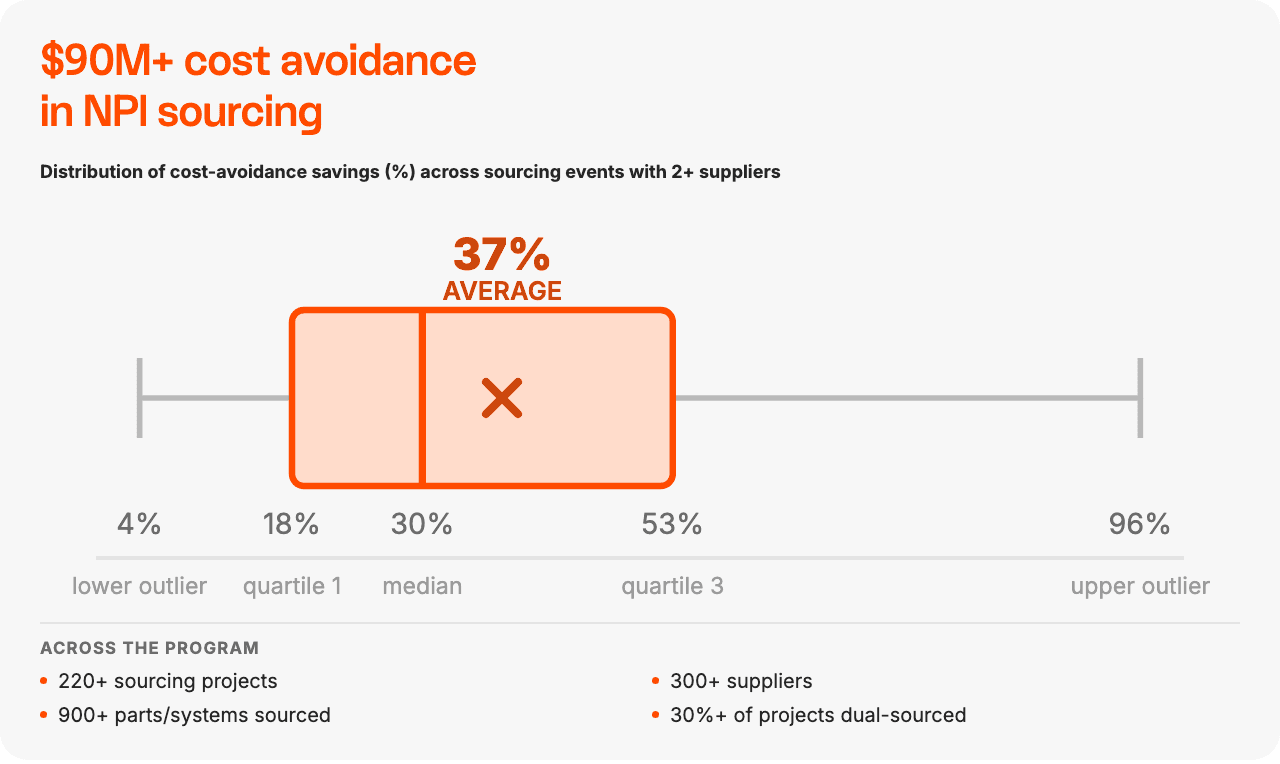
Achieved 37%+ average cost avoidance from LOI through SOP
Delivered $90M+ in total cost avoidance across NPI sourcing
Drove 15%+ median cost improvement by RFQ round 3
Each number carries its own denominator. The cycle-time gain is measured across 50+ sourcing projects and 80+ suppliers: a two-round RFQ that took 75 days from part release to LOI now closes in 57 -- a 24% reduction on the exact path the launch timeline runs through.
The 37%+ is an average, measured from LOI through SOP -- the stretch where cost creep normally erodes the business case -- across sourcing events with two or more suppliers. The distribution behind the average is wide: the median was 30% and the average 37%. Dual-sourcing and multi-round RFQs gave buyers more comparison points: 30%+ of projects were dual-sourced, and median cost improvement reached 15%+ by round 3 of an RFQ.
Summed across the program, cost avoidance in NPI sourcing exceeds $90M, earned on the roughly 30% of vehicle BOM cost that runs through LightSource -- while the two-round RFQ cycle came down from 75 days to 57.
About LightSource
LightSource is the AI-native direct materials operating system. It connects engineering, procurement, and suppliers in one platform so manufacturers can launch products faster and at lower cost. Customers include Amazon, Conair, Canada Goose, BRP, Shure, and Medtronic.
Internal note -- remove before production deploy: the customer quote below is drafted and pending customer approval; metric framing (24% / 37% definitions) awaits final sign-off.
37%+ average cost avoidance, LOI through SOP · 24% faster sourcing cycle, part release to LOI (75 days to 57) · $90M+ cost avoidance in NPI sourcing
At a glance
"On a program moving this fast, sourcing is usually the long pole. LightSource compressed our part-release-to-LOI cycle by a quarter and held our costs from LOI all the way to start of production."
-- VP of Supply Chain
Customer: A Big Three auto OEM
Industry: Automotive
Region: North America
Program: A new EV program with compressed NPI timelines and tight BOM cost targets, launched to compete head-on with lower-cost entrants
Before LightSource
Multi-round RFQs across hundreds of parts ran on spreadsheets and email
Supplier quotes arrived in each supplier's own format, so line-item comparison was slow and error-prone
Costs crept upward between LOI and start of production, against BOM targets with no slack
After LightSource
Part-release-to-LOI cycle down 24% -- from 75 days to 57 for a two-round RFQ
37%+ average cost avoidance held from LOI through SOP
$90M+ in total cost avoidance across 220+ sourcing projects
Workflows used: Multi-round RFQs · Standardized cost breakdowns · AI-normalized quote comparison · In-app and Excel supplier quoting
The challenge
The business case was written before sourcing ever started
The OEM was taking a new EV program to market against lower-cost entrants, and the program entered sourcing with two constraints already fixed: compressed NPI timing and a tight BOM cost target. Sourcing sat directly on both critical paths -- schedule slips and piece-cost increases put the launch plan and the margin math at risk together.
The existing process was built for programs with more slack. A two-round RFQ took 75 days to get from part release to a letter of intent (LOI), run over spreadsheets and email across hundreds of parts at once. Because every supplier quoted in its own format, buyers had to rebuild line-item comparisons before they could decide what to challenge in the next round. The cost was cumulative: time lost to setup, quote cleanup, and the lag between rounds.
The LOI-to-SOP phase carried a second risk: cost creep after award. Between LOI and start of production (SOP), costs on a typical program drift upward -- a slow leak the program's margin math could not absorb.
Had to hit aggressive NPI timelines to reach market ahead of lower-cost competitors
Tight BOM cost targets left no room for the cost creep that typically accumulates between LOI and SOP
Multi-round RFQs across hundreds of parts ran on spreadsheets and email, stretching sourcing cycles
Supplier quotes arrived in inconsistent formats, making line-item comparison slow and error-prone
The solution
One template, every supplier, every round
The OEM moved the program's NPI sourcing onto LightSource -- eventually roughly 30% of vehicle BOM cost, across 220+ sourcing projects covering 900+ parts and systems and 300+ suppliers, with 30%+ of projects dual-sourced. Cost-avoidance results below are measured across that full base; cycle-time results are measured across 50+ sourcing projects and 80+ suppliers.
Multi-round RFQs -- up to 5 rounds, with up to 6 quote revisions inside a single round -- run on one platform shared by buyers and suppliers. A standardized global cost-breakdown template meant every quote arrived in the same line-item structure, comparable on arrival, whether the supplier submitted in-app or in Excel with formulas intact. Between rounds, AI-normalized quote comparison flagged which lines were out of family and by how much, so buyers reviewed comparable bids and targeted the next ask instead of rebuilding a comparison file.
The results
From 75 days to 57 -- and $90M+ kept out of program cost
Cut the part-release-to-LOI sourcing cycle 24% -- from 75 days to 57 for a two-round RFQ
Achieved 37%+ average cost avoidance from LOI through SOP
Delivered $90M+ in total cost avoidance across NPI sourcing
Drove 15%+ median cost improvement by RFQ round 3
Each number carries its own denominator. The cycle-time gain is measured across 50+ sourcing projects and 80+ suppliers: a two-round RFQ that took 75 days from part release to LOI now closes in 57 -- a 24% reduction on the exact path the launch timeline runs through.
The 37%+ is an average, measured from LOI through SOP -- the stretch where cost creep normally erodes the business case -- across sourcing events with two or more suppliers. The distribution behind the average is wide: the median was 30% and the average 37%. Dual-sourcing and multi-round RFQs gave buyers more comparison points: 30%+ of projects were dual-sourced, and median cost improvement reached 15%+ by round 3 of an RFQ.
Summed across the program, cost avoidance in NPI sourcing exceeds $90M, earned on the roughly 30% of vehicle BOM cost that runs through LightSource -- while the two-round RFQ cycle came down from 75 days to 57.
About LightSource
LightSource is the AI-native direct materials operating system. It connects engineering, procurement, and suppliers in one platform so manufacturers can launch products faster and at lower cost. Customers include Amazon, Conair, Canada Goose, BRP, Shure, and Medtronic.
Internal note -- remove before production deploy: the customer quote below is drafted and pending customer approval; metric framing (24% / 37% definitions) awaits final sign-off.
37%+ average cost avoidance, LOI through SOP · 24% faster sourcing cycle, part release to LOI (75 days to 57) · $90M+ cost avoidance in NPI sourcing
At a glance
"On a program moving this fast, sourcing is usually the long pole. LightSource compressed our part-release-to-LOI cycle by a quarter and held our costs from LOI all the way to start of production."
-- VP of Supply Chain
Customer: A Big Three auto OEM
Industry: Automotive
Region: North America
Program: A new EV program with compressed NPI timelines and tight BOM cost targets, launched to compete head-on with lower-cost entrants
Before LightSource
Multi-round RFQs across hundreds of parts ran on spreadsheets and email
Supplier quotes arrived in each supplier's own format, so line-item comparison was slow and error-prone
Costs crept upward between LOI and start of production, against BOM targets with no slack
After LightSource
Part-release-to-LOI cycle down 24% -- from 75 days to 57 for a two-round RFQ
37%+ average cost avoidance held from LOI through SOP
$90M+ in total cost avoidance across 220+ sourcing projects
Workflows used: Multi-round RFQs · Standardized cost breakdowns · AI-normalized quote comparison · In-app and Excel supplier quoting
The challenge
The business case was written before sourcing ever started
The OEM was taking a new EV program to market against lower-cost entrants, and the program entered sourcing with two constraints already fixed: compressed NPI timing and a tight BOM cost target. Sourcing sat directly on both critical paths -- schedule slips and piece-cost increases put the launch plan and the margin math at risk together.
The existing process was built for programs with more slack. A two-round RFQ took 75 days to get from part release to a letter of intent (LOI), run over spreadsheets and email across hundreds of parts at once. Because every supplier quoted in its own format, buyers had to rebuild line-item comparisons before they could decide what to challenge in the next round. The cost was cumulative: time lost to setup, quote cleanup, and the lag between rounds.
The LOI-to-SOP phase carried a second risk: cost creep after award. Between LOI and start of production (SOP), costs on a typical program drift upward -- a slow leak the program's margin math could not absorb.
Had to hit aggressive NPI timelines to reach market ahead of lower-cost competitors
Tight BOM cost targets left no room for the cost creep that typically accumulates between LOI and SOP
Multi-round RFQs across hundreds of parts ran on spreadsheets and email, stretching sourcing cycles
Supplier quotes arrived in inconsistent formats, making line-item comparison slow and error-prone
The solution
One template, every supplier, every round
The OEM moved the program's NPI sourcing onto LightSource -- eventually roughly 30% of vehicle BOM cost, across 220+ sourcing projects covering 900+ parts and systems and 300+ suppliers, with 30%+ of projects dual-sourced. Cost-avoidance results below are measured across that full base; cycle-time results are measured across 50+ sourcing projects and 80+ suppliers.
Multi-round RFQs -- up to 5 rounds, with up to 6 quote revisions inside a single round -- run on one platform shared by buyers and suppliers. A standardized global cost-breakdown template meant every quote arrived in the same line-item structure, comparable on arrival, whether the supplier submitted in-app or in Excel with formulas intact. Between rounds, AI-normalized quote comparison flagged which lines were out of family and by how much, so buyers reviewed comparable bids and targeted the next ask instead of rebuilding a comparison file.
The results
From 75 days to 57 -- and $90M+ kept out of program cost
Cut the part-release-to-LOI sourcing cycle 24% -- from 75 days to 57 for a two-round RFQ
Achieved 37%+ average cost avoidance from LOI through SOP
Delivered $90M+ in total cost avoidance across NPI sourcing
Drove 15%+ median cost improvement by RFQ round 3
Each number carries its own denominator. The cycle-time gain is measured across 50+ sourcing projects and 80+ suppliers: a two-round RFQ that took 75 days from part release to LOI now closes in 57 -- a 24% reduction on the exact path the launch timeline runs through.
The 37%+ is an average, measured from LOI through SOP -- the stretch where cost creep normally erodes the business case -- across sourcing events with two or more suppliers. The distribution behind the average is wide: the median was 30% and the average 37%. Dual-sourcing and multi-round RFQs gave buyers more comparison points: 30%+ of projects were dual-sourced, and median cost improvement reached 15%+ by round 3 of an RFQ.
Summed across the program, cost avoidance in NPI sourcing exceeds $90M, earned on the roughly 30% of vehicle BOM cost that runs through LightSource -- while the two-round RFQ cycle came down from 75 days to 57.
About LightSource
LightSource is the AI-native direct materials operating system. It connects engineering, procurement, and suppliers in one platform so manufacturers can launch products faster and at lower cost. Customers include Amazon, Conair, Canada Goose, BRP, Shure, and Medtronic.
Faster sourcing. Lower cost. Less chaos.
Try out LightSource and you’ll never go back to Excel and email.
Faster sourcing. Lower cost. Less chaos.
Try out LightSource and you’ll never go back to Excel and email.
Faster sourcing. Lower cost. Less chaos.
Try out LightSource and you’ll never go back to Excel and email.
Read more
Aramsco Accelerated Procurement Cycles and Unlocked Seven-Figure Savings with LightSource

Leading Industrial Manufacturer Achieved Multi-Million Dollar Savings and Accelerated Sourcing Cycles with AI-Powered Platform

Specialty Chemicals Leader Arxada Leverages LightSource to Drive Process Efficiency, Impact, and Cost Control in Tail Spend Chemicals Sourcing.
Read more
Aramsco Accelerated Procurement Cycles and Unlocked Seven-Figure Savings with LightSource
Leading Industrial Manufacturer Achieved Multi-Million Dollar Savings and Accelerated Sourcing Cycles with AI-Powered Platform
Specialty Chemicals Leader Arxada Leverages LightSource to Drive Process Efficiency, Impact, and Cost Control in Tail Spend Chemicals Sourcing.
Read more
Aramsco Accelerated Procurement Cycles and Unlocked Seven-Figure Savings with LightSource
Leading Industrial Manufacturer Achieved Multi-Million Dollar Savings and Accelerated Sourcing Cycles with AI-Powered Platform
Specialty Chemicals Leader Arxada Leverages LightSource to Drive Process Efficiency, Impact, and Cost Control in Tail Spend Chemicals Sourcing.
Trusted by:
Trusted by:
Trusted by: