Professional audio juggernaut Shure drives $4.5M in savings and 20% faster supplier responses through LightSource
Shure centralized its distributor and contract-manufacturer negotiations on LightSource -- 8,500+ parts across two commodity teams -- and consolidated a duplicate-riddled part database to a single clean item per part number.

Internal note -- remove before production deploy: quotes are real and Gong-verified (Kris Stasukaitis; Greg Hatcher fragments) but Shure marketing approval is still required.
$4.5M in savings across 14 awarded CM projects · 20% faster supplier responses to RFQs, 2026 vs 2025 · 8,500+ parts negotiated across two commodity teams
At a glance
"We actually trust the data the tool is giving us when we go out for RFQs."
-- Kris Stasukaitis, Director of Mechanical Commodities, Shure
Before LightSource
Negotiations with distributors and contract manufacturers ran without a centralized place to manage them
Duplicate internal IDs spawned from combinations of Shure, contract-manufacturer, and manufacturer part numbers
Quote data sat scattered across files, leaving cost history hard to trust
After LightSource
67 negotiation events across 8,500+ parts run on one platform, with median setup under 21 minutes
A single clean item per Shure part number, kept clean by AI part deduplication
148 suppliers onboarded; 88% of projects receive at least one quote
Workflows used: Global multi-part RFQs and RFIs · Part repository consolidation · AI part deduplication · Supplier onboarding and messaging
About Shure: The American audio company behind the world's most recognized microphones and wireless systems -- a century of audio engineering since 1925. HQ: Niles, Illinois · Founded 1925 · Privately held · shure.com
The challenge
One component, three part numbers
Shure has built precision audio instruments since 1925. Across its product lines, it sources thousands of electronic and mechanical components through distributors and contract manufacturers (CMs) -- and the sourcing data behind those components was hard to trust.
The part database had grown a separate internal ID for combinations of Shure part number, contract-manufacturer part number, and original-manufacturer part number. The same physical component could exist several times over, and quote data lived in scattered files -- so before anyone could say what Shure last paid for a part, they first had to establish which of several records the part actually was.
Negotiations compounded the problem. They ran without a centralized home, and regional price volatility demanded frequent, large-scale requoting that the old process could not keep up with.
Negotiations with distributors and contract manufacturers ran without a centralized place to manage them
The part database carried widespread duplication -- separate IDs from Shure, CM, and manufacturer part numbers
Regional price volatility demanded frequent, large-scale requoting the old process could not keep up with
Quote data lived in scattered files, making cost history hard to trust
The solution
Clean part data, and negotiation at scale
The work ran as two connected workstreams. On the data side, LightSource's customer success and engineering teams mapped historical IDs across thousands of components and consolidated Shure's repository to a single clean item per Shure part number. AI part deduplication keeps new records from recreating the old pattern.
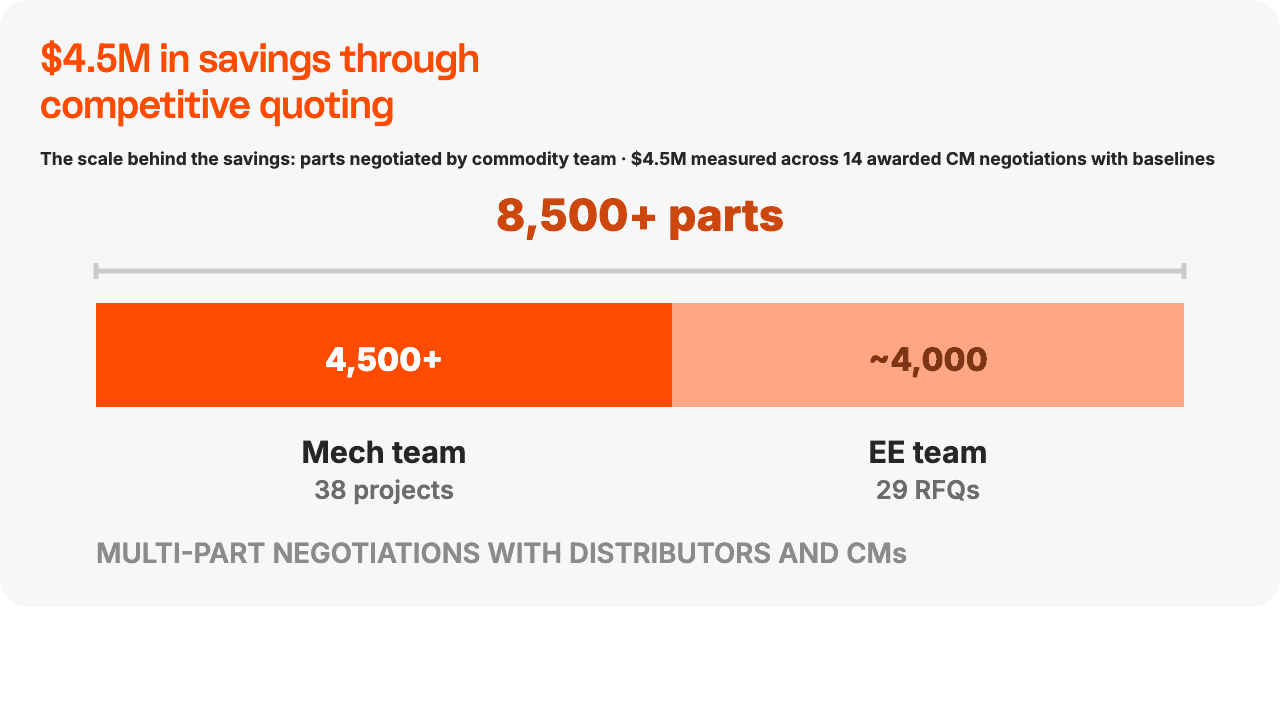
On the negotiation side, Shure made LightSource the vehicle for global multi-part negotiations. The EE team ran 29 distinct RFQs across roughly 4,000 parts to capture volatile regional pricing. The Mech team organized 38 complex projects encompassing 4,500+ parts. Median project setup, from first draft to launch, is under 21 minutes -- the median, not a best case -- which is what makes frequent requoting practical.
The results
$4.5M in savings, 20% faster cycles, and cost history worth relying on
Delivered $4.5M in savings across 14 awarded CM negotiations with cost baselines
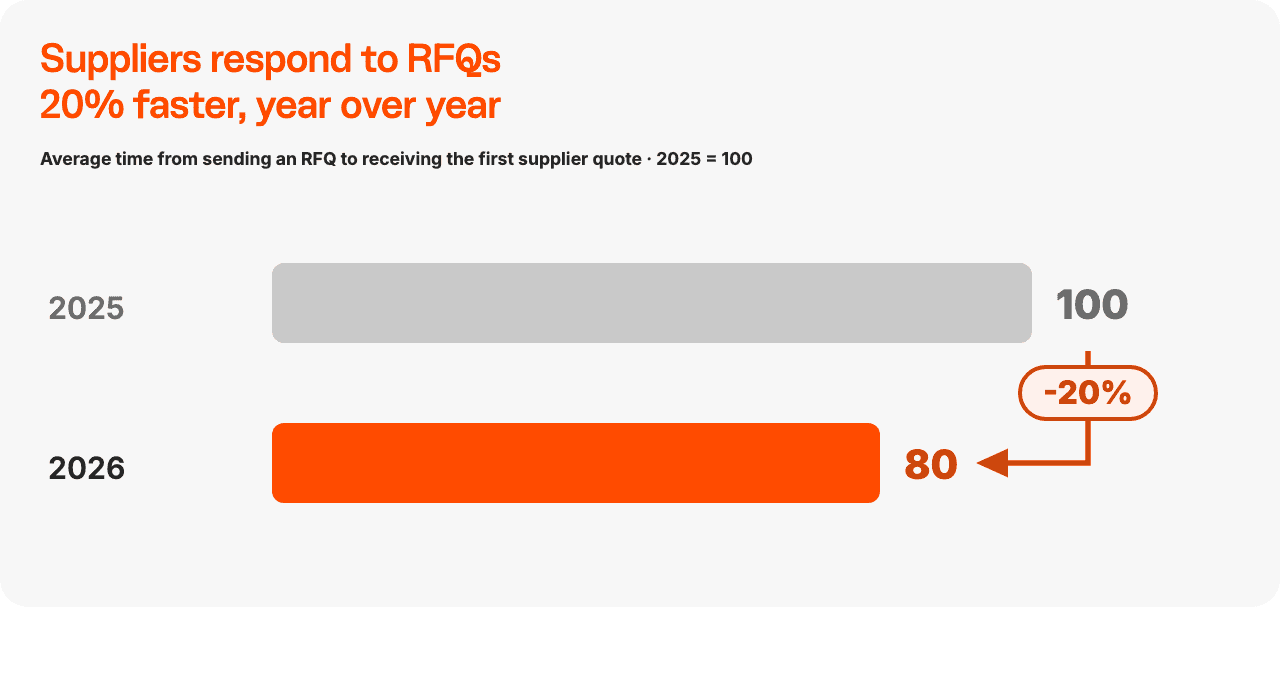
Suppliers respond 20% faster: average time from RFQ launch to first quote, down 20% for projects sent in 2026 versus 2025
Received at least one supplier quote on 88% of projects, with an all-time median of 17.2 days from launch to first quote
Onboarded 148 suppliers, who have submitted 851 responses across RFQs and RFIs
The savings figure counts only measured wins against recorded baselines: 14 negotiations sent to contract manufacturers, awarded, and measured against known prior costs, worth $4.5M.
The cycle-time numbers are two different measurements. The 20% is the drop in average time from sending an RFQ to receiving the first supplier quote, comparing projects sent in 2026 against 2025. The all-time median for the same interval is 17.2 days.
That speed changes which negotiations are worth running at all. Being able to quote multiple times in a year "has paid dividends," says Greg Hatcher, Associate Vice President of Global Commodity Management at Shure, with "very noticeable incremental savings." Requoting a volatile region used to be a project in itself; now it is a routine the team repeats as market conditions move -- backed by 2,428 messages exchanged between buyers and the 148 onboarded suppliers.
About LightSource
LightSource is the AI-native direct materials operating system. It connects engineering, procurement, and suppliers in one platform so manufacturers can launch products faster and at lower cost. Sourcing teams at Amazon, Lucid, Zebra, Shure, and Canada Goose run on LightSource.
Internal note -- remove before production deploy: quotes are real and Gong-verified (Kris Stasukaitis; Greg Hatcher fragments) but Shure marketing approval is still required.
$4.5M in savings across 14 awarded CM projects · 20% faster supplier responses to RFQs, 2026 vs 2025 · 8,500+ parts negotiated across two commodity teams
At a glance
"We actually trust the data the tool is giving us when we go out for RFQs."
-- Kris Stasukaitis, Director of Mechanical Commodities, Shure
Before LightSource
Negotiations with distributors and contract manufacturers ran without a centralized place to manage them
Duplicate internal IDs spawned from combinations of Shure, contract-manufacturer, and manufacturer part numbers
Quote data sat scattered across files, leaving cost history hard to trust
After LightSource
67 negotiation events across 8,500+ parts run on one platform, with median setup under 21 minutes
A single clean item per Shure part number, kept clean by AI part deduplication
148 suppliers onboarded; 88% of projects receive at least one quote
Workflows used: Global multi-part RFQs and RFIs · Part repository consolidation · AI part deduplication · Supplier onboarding and messaging
About Shure: The American audio company behind the world's most recognized microphones and wireless systems -- a century of audio engineering since 1925. HQ: Niles, Illinois · Founded 1925 · Privately held · shure.com
The challenge
One component, three part numbers
Shure has built precision audio instruments since 1925. Across its product lines, it sources thousands of electronic and mechanical components through distributors and contract manufacturers (CMs) -- and the sourcing data behind those components was hard to trust.
The part database had grown a separate internal ID for combinations of Shure part number, contract-manufacturer part number, and original-manufacturer part number. The same physical component could exist several times over, and quote data lived in scattered files -- so before anyone could say what Shure last paid for a part, they first had to establish which of several records the part actually was.
Negotiations compounded the problem. They ran without a centralized home, and regional price volatility demanded frequent, large-scale requoting that the old process could not keep up with.
Negotiations with distributors and contract manufacturers ran without a centralized place to manage them
The part database carried widespread duplication -- separate IDs from Shure, CM, and manufacturer part numbers
Regional price volatility demanded frequent, large-scale requoting the old process could not keep up with
Quote data lived in scattered files, making cost history hard to trust
The solution
Clean part data, and negotiation at scale
The work ran as two connected workstreams. On the data side, LightSource's customer success and engineering teams mapped historical IDs across thousands of components and consolidated Shure's repository to a single clean item per Shure part number. AI part deduplication keeps new records from recreating the old pattern.
On the negotiation side, Shure made LightSource the vehicle for global multi-part negotiations. The EE team ran 29 distinct RFQs across roughly 4,000 parts to capture volatile regional pricing. The Mech team organized 38 complex projects encompassing 4,500+ parts. Median project setup, from first draft to launch, is under 21 minutes -- the median, not a best case -- which is what makes frequent requoting practical.
The results
$4.5M in savings, 20% faster cycles, and cost history worth relying on
Delivered $4.5M in savings across 14 awarded CM negotiations with cost baselines
Suppliers respond 20% faster: average time from RFQ launch to first quote, down 20% for projects sent in 2026 versus 2025
Received at least one supplier quote on 88% of projects, with an all-time median of 17.2 days from launch to first quote
Onboarded 148 suppliers, who have submitted 851 responses across RFQs and RFIs
The savings figure counts only measured wins against recorded baselines: 14 negotiations sent to contract manufacturers, awarded, and measured against known prior costs, worth $4.5M.
The cycle-time numbers are two different measurements. The 20% is the drop in average time from sending an RFQ to receiving the first supplier quote, comparing projects sent in 2026 against 2025. The all-time median for the same interval is 17.2 days.
That speed changes which negotiations are worth running at all. Being able to quote multiple times in a year "has paid dividends," says Greg Hatcher, Associate Vice President of Global Commodity Management at Shure, with "very noticeable incremental savings." Requoting a volatile region used to be a project in itself; now it is a routine the team repeats as market conditions move -- backed by 2,428 messages exchanged between buyers and the 148 onboarded suppliers.
About LightSource
LightSource is the AI-native direct materials operating system. It connects engineering, procurement, and suppliers in one platform so manufacturers can launch products faster and at lower cost. Sourcing teams at Amazon, Lucid, Zebra, Shure, and Canada Goose run on LightSource.
Internal note -- remove before production deploy: quotes are real and Gong-verified (Kris Stasukaitis; Greg Hatcher fragments) but Shure marketing approval is still required.
$4.5M in savings across 14 awarded CM projects · 20% faster supplier responses to RFQs, 2026 vs 2025 · 8,500+ parts negotiated across two commodity teams
At a glance
"We actually trust the data the tool is giving us when we go out for RFQs."
-- Kris Stasukaitis, Director of Mechanical Commodities, Shure
Before LightSource
Negotiations with distributors and contract manufacturers ran without a centralized place to manage them
Duplicate internal IDs spawned from combinations of Shure, contract-manufacturer, and manufacturer part numbers
Quote data sat scattered across files, leaving cost history hard to trust
After LightSource
67 negotiation events across 8,500+ parts run on one platform, with median setup under 21 minutes
A single clean item per Shure part number, kept clean by AI part deduplication
148 suppliers onboarded; 88% of projects receive at least one quote
Workflows used: Global multi-part RFQs and RFIs · Part repository consolidation · AI part deduplication · Supplier onboarding and messaging
About Shure: The American audio company behind the world's most recognized microphones and wireless systems -- a century of audio engineering since 1925. HQ: Niles, Illinois · Founded 1925 · Privately held · shure.com
The challenge
One component, three part numbers
Shure has built precision audio instruments since 1925. Across its product lines, it sources thousands of electronic and mechanical components through distributors and contract manufacturers (CMs) -- and the sourcing data behind those components was hard to trust.
The part database had grown a separate internal ID for combinations of Shure part number, contract-manufacturer part number, and original-manufacturer part number. The same physical component could exist several times over, and quote data lived in scattered files -- so before anyone could say what Shure last paid for a part, they first had to establish which of several records the part actually was.
Negotiations compounded the problem. They ran without a centralized home, and regional price volatility demanded frequent, large-scale requoting that the old process could not keep up with.
Negotiations with distributors and contract manufacturers ran without a centralized place to manage them
The part database carried widespread duplication -- separate IDs from Shure, CM, and manufacturer part numbers
Regional price volatility demanded frequent, large-scale requoting the old process could not keep up with
Quote data lived in scattered files, making cost history hard to trust
The solution
Clean part data, and negotiation at scale
The work ran as two connected workstreams. On the data side, LightSource's customer success and engineering teams mapped historical IDs across thousands of components and consolidated Shure's repository to a single clean item per Shure part number. AI part deduplication keeps new records from recreating the old pattern.
On the negotiation side, Shure made LightSource the vehicle for global multi-part negotiations. The EE team ran 29 distinct RFQs across roughly 4,000 parts to capture volatile regional pricing. The Mech team organized 38 complex projects encompassing 4,500+ parts. Median project setup, from first draft to launch, is under 21 minutes -- the median, not a best case -- which is what makes frequent requoting practical.
The results
$4.5M in savings, 20% faster cycles, and cost history worth relying on
Delivered $4.5M in savings across 14 awarded CM negotiations with cost baselines
Suppliers respond 20% faster: average time from RFQ launch to first quote, down 20% for projects sent in 2026 versus 2025
Received at least one supplier quote on 88% of projects, with an all-time median of 17.2 days from launch to first quote
Onboarded 148 suppliers, who have submitted 851 responses across RFQs and RFIs
The savings figure counts only measured wins against recorded baselines: 14 negotiations sent to contract manufacturers, awarded, and measured against known prior costs, worth $4.5M.
The cycle-time numbers are two different measurements. The 20% is the drop in average time from sending an RFQ to receiving the first supplier quote, comparing projects sent in 2026 against 2025. The all-time median for the same interval is 17.2 days.
That speed changes which negotiations are worth running at all. Being able to quote multiple times in a year "has paid dividends," says Greg Hatcher, Associate Vice President of Global Commodity Management at Shure, with "very noticeable incremental savings." Requoting a volatile region used to be a project in itself; now it is a routine the team repeats as market conditions move -- backed by 2,428 messages exchanged between buyers and the 148 onboarded suppliers.
About LightSource
LightSource is the AI-native direct materials operating system. It connects engineering, procurement, and suppliers in one platform so manufacturers can launch products faster and at lower cost. Sourcing teams at Amazon, Lucid, Zebra, Shure, and Canada Goose run on LightSource.
Faster sourcing. Lower cost. Less chaos.
Try out LightSource and you’ll never go back to Excel and email.
Faster sourcing. Lower cost. Less chaos.
Try out LightSource and you’ll never go back to Excel and email.
Faster sourcing. Lower cost. Less chaos.
Try out LightSource and you’ll never go back to Excel and email.
Read more

Aramsco Accelerated Procurement Cycles and Unlocked Seven-Figure Savings with LightSource

Leading Industrial Manufacturer Achieved Multi-Million Dollar Savings and Accelerated Sourcing Cycles with AI-Powered Platform

Specialty Chemicals Leader Arxada Leverages LightSource to Drive Process Efficiency, Impact, and Cost Control in Tail Spend Chemicals Sourcing.
Read more
Aramsco Accelerated Procurement Cycles and Unlocked Seven-Figure Savings with LightSource
Leading Industrial Manufacturer Achieved Multi-Million Dollar Savings and Accelerated Sourcing Cycles with AI-Powered Platform
Specialty Chemicals Leader Arxada Leverages LightSource to Drive Process Efficiency, Impact, and Cost Control in Tail Spend Chemicals Sourcing.
Read more
Aramsco Accelerated Procurement Cycles and Unlocked Seven-Figure Savings with LightSource
Leading Industrial Manufacturer Achieved Multi-Million Dollar Savings and Accelerated Sourcing Cycles with AI-Powered Platform
Specialty Chemicals Leader Arxada Leverages LightSource to Drive Process Efficiency, Impact, and Cost Control in Tail Spend Chemicals Sourcing.
Trusted by:
Trusted by:
Trusted by: