Verified Sep 2026
Batteries & E-Mobility
·

Ningde, China
·
Since 2011
CATL (Contemporary Amperex Technology Co., Limited) is the world's largest maker of EV and energy-storage batteries, headquartered in Ningde, Fujian, China. Founded in 2011 and dual-listed in Shenzhen and Hong Kong, it sold 661 GWh of lithium-ion batteries in 2025, held a 39.2% global power-battery share for the ninth straight year, and reported RMB 423.7 billion in revenue.

CATL at a glance
Revenue
€39.0B
Automotive FY2025 · RMB 423.7B group total
Employees
100,000+
Est. · no company-published headcount
Founded
2011
Headquarters
Ningde, China
Ownership
Listed
SZSE: 300750 · HKEX: 3750
Import activity
315
US import shipments on record · US subsidiary (Auburn Hills, MI)
Known customers
BMW · Yutong · SAIC · Changan · Fisker
Company press · program announcements
Industries
Automotive
Electric Vehicles
Renewable Energy
Sourcing and import activity
From US customs bill-of-lading records for its US subsidiary (Auburn Hills, MI), through September 2026
US sea imports
315
Named foreign suppliers
2
Top origins
China
Most recent shipment
Sep 14, 2026
Shared foreign counterparties do not establish that these companies buy from CATL.
What this tells a buyer
Both suppliers in the US customs record are CATL entities (Contemporary Amperex Technology and Guangdong Ruiqing Contemporary), indicating internal transfer shipments -- CATL ships its own cells and modules from its Chinese plants to its Auburn Hills office for North American program support rather than sourcing from independent intermediaries.
A September 2026 shipment is the most recent on record, consistent with the company's active ramp of North American customer relationships and its stated commitment to a US supply presence. The 315-shipment total reflects several years of US-bound activity from a primarily China-based manufacturing base.
The concentrated two-supplier picture (both CATL entities) means buyers have no visibility into second-tier dependencies through the US customs record -- supply-chain risk assessment for CATL programs should focus on the company's disclosed China factory network and its Debrecen, Hungary cell ramp.
Source: US customs bill-of-lading records and public filings · Last verified Sep 22, 2026
STABILITY SIGNALS
Established & strong
RMB 423.7 billion revenue in FY2025, up 17%, with net profit of RMB 72.2 billion, up 42%, per the company's annual report.
World's largest EV battery supplier for nine consecutive years, with a 39.2% global market share and 661 GWh of lithium-ion batteries sold in 2025.
Dual-listed in Shenzhen (300750) and Hong Kong (03750), with 772 GWh of production capacity and 321 GWh more under construction at the end of 2025.
What CATL makes
Contemporary Amperex Technology Co., Limited, known as CATL, is the world's largest maker of lithium-ion batteries for electric vehicles and energy storage, headquartered in Ningde, Fujian, China. It supplies traction batteries to passenger-car and commercial-vehicle OEMs as a Tier-1 supplier, and battery energy storage systems to utilities and industry.
The product line is organized around named platforms. On the vehicle side: the Qilin cell-to-pack battery (2022), the Shenxing superfast-charging family (2023, with a Shenxing Pro variant for Europe launched in 2025 on the company's NP3.0 safety platform), the Freevoy hybrid and dual-power batteries (2024 and 2025), and the Naxtra sodium-ion battery, which the company says reached large-scale mass production in 2025. The company's published passenger-vehicle claims include charging to 80 percent in as little as 3 minutes 44 seconds and a 280 Wh/kg system that it says delivers 1,500 km of range. Commercial vehicles get the TECTRANS battery brand, updated to TECTRANS II at IAA Transportation in September 2026. Beyond cells and packs, CATL sells the TENER energy storage system, the Choco-Swap battery-swapping solution with standardized 20#, 25#, and 26# swap blocks, the Bedrock integrated chassis, battery recycling through Guangdong Brunp (acquired 2015), and an aftermarket brand, Ning Service.
Financial performance
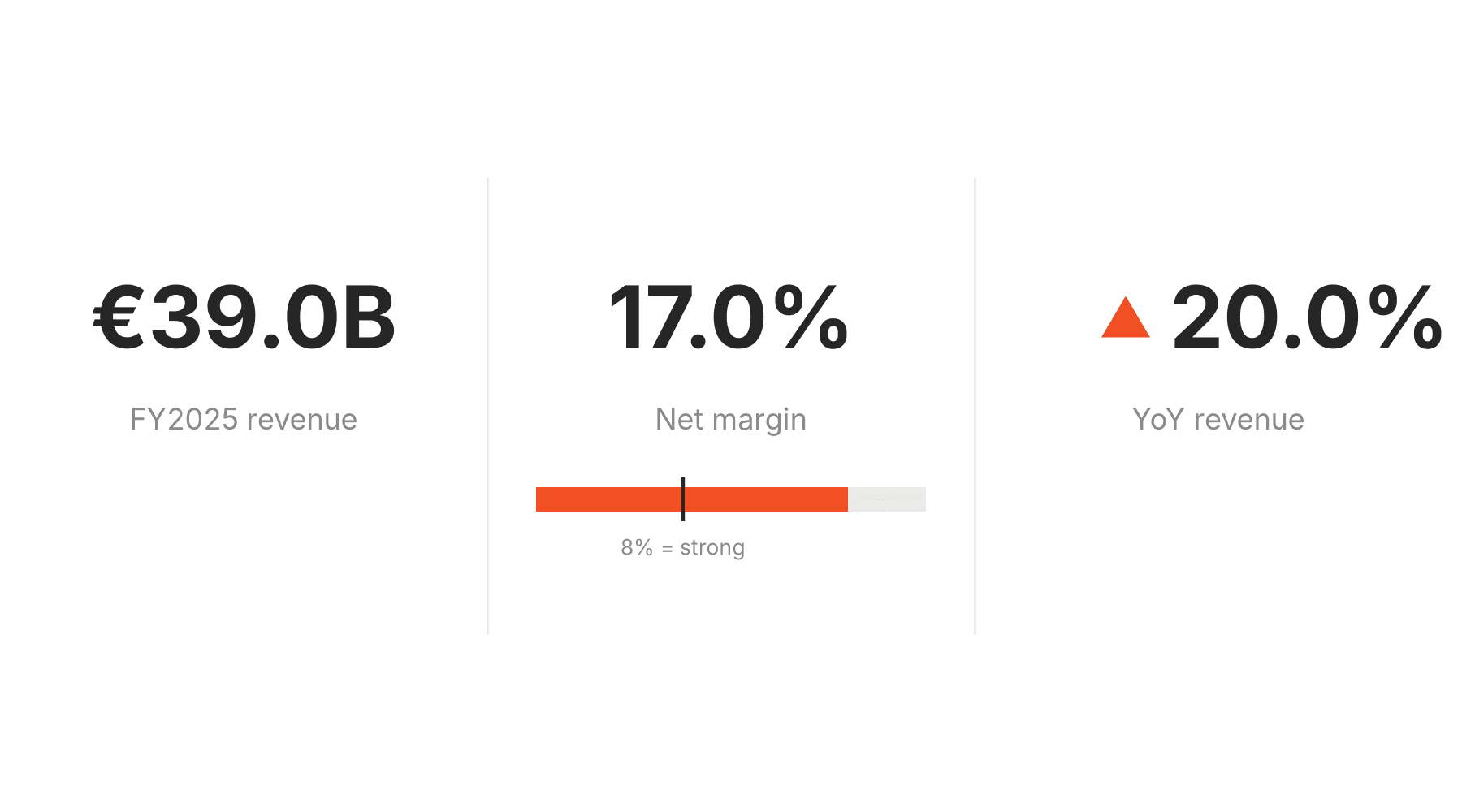
The Berylls by AlixPartners Top-100 study for 2026 ranks CATL the No. 3 automotive supplier worldwide, with automotive-sector revenue of 38,987 million euros in FY2025, up 20 percent from 32,493 million euros in 2024. That study covers the automotive slice only; the company's own 2025 annual report puts total revenue at RMB 423.7 billion, up 17 percent, with net profit of RMB 72.2 billion, up 42 percent, its fastest profit growth in three years.
The operating numbers behind that: 661 GWh of lithium-ion batteries sold in 2025, up 39 percent, a 39.2 percent global power-battery market share (No. 1 for the ninth consecutive year per SNE Research, cited in company materials), and the top spot in energy-storage battery shipments for the fifth consecutive year. R&D spending reached RMB 22.1 billion in 2025, and production capacity stood at 772 GWh with a further 321 GWh under construction at year end.
Ownership and history
CATL was founded in 2011 in Ningde, where its founding team had built ATL, a consumer-electronics lithium-battery maker, starting in 1999. The company listed on the Shenzhen Stock Exchange in 2018 (300750) and added a Hong Kong Main Board listing in 2025 (03750.HK), creating what it calls an A+H capital platform. Zeng Yuqun (Robin Zeng), the founder, serves as chairman and general manager, with Pan Jian as co-chairman and Zheng Shu as chief financial officer.
The footprint is global: manufacturing bases across China (including Ningde, Yibin, Liyang, Lingang, and Xining), a German subsidiary established in 2014 with a plant in Thuringia, and a large plant in Debrecen, Hungary, where module assembly began in 2025 and cell production was ramping through 2026. Three of its Chinese plants have been named World Economic Forum Lighthouse factories, and the company says 20 of its battery plants operated as zero-carbon factories in 2025, when it reports reaching carbon neutrality in core operations. A US subsidiary in Auburn Hills, Michigan supports North American customers, a footprint relevant to buyers weighing nearshoring against a China-centered supply base.
Known customers
All entries below are documented in CATL's own published materials. Most battery supply contracts are not publicly itemized.
Customer | Evidence | Confidence |
|---|---|---|
BMW | "Key EV battery supplier" to BMW; company history documents strategic partnership start (2012) | Documented |
Yutong | EV batteries for Yutong commercial vehicles, per company history (2013) | Documented |
SAIC Motor | Joint ventures formed; per company history and partner announcements (2017) | Documented |
Changan | Joint launch of world's first mass-production sodium-ion passenger vehicle (Yakeshi), per company press (Feb 2026) | Documented |
Frequently asked questions
What does CATL make?
CATL makes lithium-ion and sodium-ion batteries for electric vehicles and energy storage. Named product platforms include the Qilin cell-to-pack battery, the Shenxing superfast-charging family, the Freevoy hybrid battery, the Naxtra sodium-ion battery, the TENER energy storage system, and the TECTRANS commercial-vehicle line, plus battery swapping, integrated chassis, and battery recycling.
Who owns CATL?
CATL is a publicly traded company, listed on the Shenzhen Stock Exchange since 2018 (300750) and on the Hong Kong Stock Exchange since 2025 (03750.HK). Founder Zeng Yuqun (Robin Zeng) is chairman and general manager.
What is CATL's annual revenue?
CATL reported total revenue of RMB 423.7 billion for FY2025, up 17 percent, with net profit of RMB 72.2 billion, up 42 percent. The Berylls by AlixPartners Top-100 study counts 38,987 million euros of that as automotive-sector revenue, ranking CATL the world's No. 3 automotive supplier.
Where is CATL headquartered?
CATL is headquartered at No. 2 Xingang Road, Zhangwan Town, Jiaocheng District, Ningde, Fujian, China. It operates manufacturing bases across China plus plants in Germany and Hungary, and a US subsidiary in Auburn Hills, Michigan.
Who are CATL's customers?
Documented customers include BMW (partnership since 2012), Yutong (since 2013), SAIC Motor (joint ventures since 2017), Changan (joint sodium-ion vehicle launch, 2026), and Fisker (long-term capacity agreement). CATL held a 39.2 percent global power-battery market share in 2025, so most major EV programs source from it directly or indirectly; most contracts are not publicly itemized.
Last verified September 22, 2026. Is this your company? Request a correction.
Latest news
Sep 2026
CATL launched TECTRANS II for commercial vehicles at IAA Transportation, signed a technology licensing deal with BME for battery pack manufacturing in Egypt, and an MoU with DHL Group on green freight corridors in Europe (company announcements).
Sep 2026
Cell production at CATL's Debrecen, Hungary plant was temporarily suspended following a worker nickel-exposure incident, per Caixin Global reporting.
Mar 2026
CATL released its 2025 annual report: revenue RMB 423.7 billion, up 17 percent, net profit RMB 72.2 billion, up 42 percent, and 661 GWh of batteries sold (company announcement).
Refreshed weekly · updated Sep 22, 2026
Leadership

Zeng Yuqun (Robin Zeng)
Chairman & General Manager

Pan Jian
Co-chairman of the Board

Zheng Shu
Chief Financial Officer
Location & contact
Evaluating suppliers like these?
LightSource gives procurement teams verified supplier intelligence and AI-run sourcing events.