Verified Sep 2026
Diversified Tier 1
·

Kariya, Japan
·
Since 1949
DENSO Corporation is a publicly listed Japanese automotive supplier founded in 1949 and headquartered in Kariya, Aichi. The company manufactures electrification systems, thermal systems, mobility electronics, advanced devices, and powertrain components, operating 127 production bases across 25 countries with approximately 158,000 employees. Toyota Motor Corporation is its largest shareholder at roughly 22% of voting rights.

DENSO Corporation at a glance
Revenue
€42.8B
FY2025 · Berylls automotive segment
Employees
~158,000
FY2025 · company-published
Founded
1949
Spun from Toyota · Dec 16 1949
Headquarters
Kariya, Japan
Ownership
Listed
TSE: 6902 · Toyota ~22% voting rights
Certifications
IATF 16949:2016
Claimed · all manufacturing sites
Import activity
17,600+
US import shipments on record
Known customers
Toyota · Stellantis · Honda · GM
Company IR · press release
Industries
Automotive
Electric Vehicles
Electronics
STABILITY SIGNALS
Established & strong
€42.8B automotive-sector revenue (FY2025 Berylls study), 6.7% operating income margin, +0.7% YoY -- publicly reported figures.
Listed on the Tokyo Stock Exchange (TSE: 6902) since 1949; Toyota Motor Corporation holds approximately 22% of voting rights as the largest single shareholder.
IATF 16949 certification across all manufacturing sites (company statement); 127 production bases in 25 countries with DENSO-branded US subsidiaries importing as recently as September 2026.
What Denso makes
Denso is one of the largest automotive component manufacturers in the world, organized around five product areas: electrification systems, thermal systems, mobility electronics, advanced devices, and powertrain systems. As of January 2026 the company merged its separate Powertrain Systems and Electrification Systems business groups into a single Powertrain Systems unit to manage the transition between internal combustion and electric vehicles within one organizational structure.
The electrification segment produces inverters, motors, and power control units for hybrid and battery electric vehicles. Denso targets approximately 12 million inverter units per year by 2025 and describes this segment as a core growth area. Thermal systems covers vehicle air conditioning, heat exchangers, and cooling modules -- an area where the company traces product leadership back decades. Mobility electronics includes engine control units, cameras, radar, and the embedded software that runs them; Hayashi, the current CEO, built his career as a software engineer on the diesel common rail ECU, the world's first fully electronic control diesel system. Advanced devices covers sensors and semiconductor components.
On the non-automotive side, Denso has been expanding into agriculture and factory automation. In July 2025 it acquired Axia Vegetable Seeds, a Dutch tomato-seed breeding company, combining Denso's image recognition and AI work with seed development and greenhouse automation. The company also operates a robotics division with a product line used in factory automation.
Financial performance
Denso's automotive-sector revenue reached €42.8B in FY2025, up 0.7% from €42.5B the prior year, according to the Berylls by AlixPartners Top-100 supplier study for 2026. The operating income margin was 6.7% for FY2025, down from 7.7% in FY2024, reflecting pressures across the sector from lower Asian production volumes and currency effects. On a consolidated basis, Denso's own April 2025 announcement reported total revenue of ¥7,161.8B (US$47.9B) and consolidated operating profit of ¥519B, a 36% increase over the prior year, with a 7.2% consolidated operating margin.
In its FY2026 results (year ended March 31, 2026), Denso reported consolidated revenue of ¥7,540B (US$47.2B), up 5.3% from FY2025, and operating profit of ¥552.5B, up 6.5%, with North American revenue up 8.7% to ¥2,025B. The company attributed growth to higher vehicle sales and cost recovery, while noting that tariff-related costs, higher materials prices, and increased workforce investment created headwinds.
In North America alone, Denso reported consolidated sales of approximately $12.5B for the fiscal year ending March 2025, employing more than 27,000 people across its US and Canadian operations. The company spends roughly 8.6% of global consolidated sales on research and development. Denso launched a mid-term management plan, "CORE 2030," in March 2026, committing ¥3.7 trillion in investment through FY2030 focused on electrification and intelligent vehicle technology.
Ownership and history
Denso was established on December 16, 1949, as Nippon Denso Co., Ltd., when Toyota Motor Corporation separated its electrical components manufacturing operations into an independent entity under the Enterprise Reconstruction and Reorganization Act. The Kariya, Aichi factories producing starters, coils, and radiators became the foundation of the new company. The name changed to Denso Corporation in 1996.
Denso is listed on the Tokyo Stock Exchange under ticker 6902. Toyota Motor Corporation holds approximately 22% of voting rights and remains the largest single shareholder, though Toyota has been steadily reducing its cross-shareholding position. Sales to the Toyota Group account for about 48.6% of Denso's net sales; the remainder goes to Honda, BMW, General Motors, and other original equipment manufacturers. The company operates 193 consolidated group companies, with 127 production bases across 25 countries and approximately 158,000 employees as of FY2025.
Certifications and quality
Denso states it has completed IATF 16949 certification at all of its manufacturing sites. Individual plant certificates are registered with certification bodies including DQS Global; the Kariya Plant and Kota Plant hold current-cycle IATF 16949:2016 certificates per public registry records. Denso's North America supplier quality assurance manual integrates IATF 16949:2015 requirements alongside the customer-specific requirements of its major OEM customers. The company requires its own tier-2 suppliers to comply with IATF 16949 and conducts monthly monitoring of supplier quality targets.
Known customers
Customer | Evidence | Confidence |
|---|---|---|
Toyota Motor Corporation | ~48.6% of net sales, per Denso annual investor disclosures; transactions at arm's length per company filings (FY2025) | Documented |
Stellantis (Jeep Cherokee) | Two-Motor Hybrid Drive Module (with BluE Nexus and AISIN) installed in Stellantis new Jeep Cherokee; Denso Manufacturing Tennessee produces the inverter component (Aug 2026) | Documented |
Honda | Named as significant OEM customer in Denso investor and press materials (2025) | Reported |
General Motors | Named in investor and press materials as significant OEM customer (2025) | Reported |
Sourcing evidence
From US customs bill-of-lading records, two Denso US subsidiaries appear as active importers: Denso Products and Services Americas (Long Beach, CA, 5,763 shipments; most recent Sep 16, 2026) and Denso Manufacturing North Carolina (Statesville, NC, 11,850 shipments; most recent Sep 16, 2026). Combined, these entities account for approximately 17,600 recorded US import shipments, reflecting active intra-group supply from Denso Japan and Asia into North American manufacturing and distribution. Supplier origins listed in customs records include Denso (Japan), Denso Manufacturing Indonesia, and Denso Air Systems de Mexico. This represents 2 of the company's US entities; additional subsidiaries may also import independently.
Frequently asked questions
What does Denso make?
Denso manufactures automotive components and systems across five major areas: electrification systems (inverters, motors, power control units), thermal systems (air conditioning, heat exchangers), mobility electronics (engine ECUs, cameras, radar, ADAS sensors), advanced devices (sensors, semiconductors), and powertrain systems (fuel systems, ignition, exhaust components). The company supplies nearly every major vehicle make and model globally and has been expanding into factory automation and agricultural technology.
Who owns Denso?
Denso Corporation is publicly listed on the Tokyo Stock Exchange under ticker 6902. Toyota Motor Corporation is the largest shareholder with approximately 22% of voting rights; Toyota has been reducing its cross-holding position since 2023. Sales to the Toyota Group represent about 48.6% of Denso's net sales, with the remainder going to Honda, BMW, General Motors, and other OEMs. Individual investors hold approximately 37% of the company.
What is Denso's annual revenue?
Denso's automotive-sector revenue was approximately €42.8B in FY2025, per the Berylls by AlixPartners Top-100 supplier study. On a consolidated basis, Denso's own reporting for FY2025 (year ended March 31, 2025) showed total revenue of ¥7,161.8B (approximately US$47.9B). For FY2026 (year ended March 31, 2026), Denso reported consolidated revenue of ¥7,540B (US$47.2B), up 5.3%.
Where is Denso headquartered?
Denso Corporation is headquartered at 1-1, Showa-cho, Kariya, Aichi 448-8661, Japan. Kariya is a city in Aichi Prefecture in central Japan, in the Toyota Group's traditional home region. The company also maintains a North American headquarters in Southfield, Michigan.
Who are Denso's customers?
Toyota Motor Corporation is Denso's largest customer at roughly 48.6% of net sales, per the company's own investor disclosures. Stellantis (Jeep Cherokee program), Honda, BMW, and General Motors are cited in investor and press materials as significant customers. Denso supplies components across virtually all major automotive OEM programs worldwide, including hybrid and battery electric vehicle programs.
Last verified September 2026. Is this your company? Request a correction.
Latest news
Aug 2026
DENSO announces executive and senior director responsibility changes, continuing management restructuring begun in early 2026 (Denso newsroom)
Aug 2026
DENSO, AISIN, and BluE Nexus jointly develop a two-motor hybrid drive module adopted for the Stellantis new Jeep Cherokee; Denso Manufacturing Tennessee produces the inverter (Denso newsroom)
Aug 2026
DENSO launches its battery passport service supporting compliance with the European Battery Regulation, enabling traceability for automakers and battery manufacturers (Denso newsroom)
Refreshed weekly · updated Sep 22, 2026
Leadership

Shinnosuke Hayashi
President & CEO, Representative Member of the Board
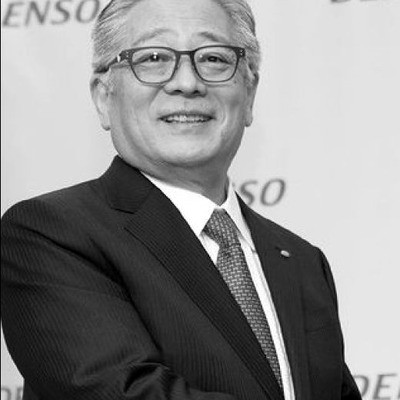
Koji Arima
Chairman, Member of the Board

Yasushi Matsui
Executive Vice President, Member of the Board
Location & contact
Certification

IATF 16949:2016
All manufacturing sites — automotive components and systems
Evaluating suppliers like these?
LightSource gives procurement teams verified supplier intelligence and AI-run sourcing events.