Verified Sep 2026
Batteries & E-Mobility
·

Yongin, South Korea
·
Since 1970
Samsung SDI Co., Ltd. is a South Korean battery and electronic materials manufacturer founded in 1970, headquartered in Yongin, Gyeonggi. The company develops and manufactures lithium-ion cells, modules, and packs for electric vehicles and energy storage systems, alongside semiconductor and display materials. It operates 11 manufacturing plants globally and employs approximately 26,000 people.

Samsung SDI at a glance
Revenue
€3.4B
FY2025 · automotive sector · Berylls
Employees
~26,000
FY2025 · published
Founded
1970
Samsung Group subsidiary
Headquarters
Yongin, South Korea
150-20 Gongse-ro, Giheung-gu
Ownership
Listed
KRX: 006400 · Samsung Group
Certifications
IATF 16949:2016
Multi-site · Ulsan · Hungary · Auburn Hills
Known customers
BMW · Rivian · Volkswagen · Mercedes-Benz · GM
Company press
Industries
Automotive
Electric Vehicles
Electronics
What Samsung SDI makes
Samsung SDI produces lithium-ion batteries for electric vehicles, energy storage systems (ESS), and smaller-format devices, alongside electronic materials for semiconductors and displays. The automotive and ESS battery lines are the company's largest business by revenue and its primary growth focus.
For electric vehicle customers, Samsung SDI supplies cylindrical cells, prismatic cells, and battery packs. The company's 46-series cylindrical cells target high-energy-density EV and power-tool applications. Its prismatic lineup covers both nickel-cobalt-manganese (NCA and NCM chemistry) and lithium iron phosphate (LFP) formats -- the LFP prismatic is the company's primary ESS offering and, per the company's own materials, the only non-Chinese prismatic ESS solution in production. Pack assembly -- combining cells into modules and full battery packs -- is performed at the Ulsan plant in Korea and through its Hungary and North America facilities.
The electronic materials division produces semiconductor packaging materials including epoxy molding compounds and high-thermal-conductivity compounds for mobile AP and memory chips, phosphorescent sensitized fluorescence (PSF) materials for OLED displays, and patterning films for foldable phones. This division has remained profitable through the 2025 battery downturn and reported quarterly operating profit of roughly KRW 39 billion in Q4 2025, per the company's IR materials.
All-solid-state batteries are in advanced development. Samsung SDI completed a pilot line in 2023 and signed a joint development agreement with BMW in 2025 to validate solid-state cell technology for future vehicles.
Financial performance
Samsung SDI's automotive-sector revenue was EUR 3,440 million in FY2025, down 38% from EUR 5,547 million in FY2024, per the Berylls by AlixPartners Top-100 automotive supplier study. The operating income margin on that perimeter was -24.5% for FY2025, compared to +1.1% in FY2024 -- a swing into significant operating loss.
On a total-company basis (automotive, ESS, small-sized batteries, and electronic materials combined), the company reported revenue of KRW 13.27 trillion (approximately $9.3 billion) for FY2025, down 20% from KRW 16.59 trillion in FY2024. The total operating loss was KRW 1.72 trillion at a -13.0% margin, compared to a KRW 363 billion operating profit (+2.2% margin) in the prior year, per the company's February 2026 earnings release. Q4 2025 showed sequential improvement: revenue rose 26.4% quarter-on-quarter to KRW 3.86 trillion, and the operating loss narrowed to KRW 299 billion, roughly half the prior quarter's loss, driven by record ESS battery sales and US Advanced Manufacturing Production Credit (AMPC) benefits.
The company employs 26,090 people as of 2025, per its own published figures. Total assets were KRW 42.3 trillion at year-end 2025. The company is listed on the Korea Exchange (ticker: 006400) and is part of the Samsung Group.
The 2025 loss reflects the combination of weaker-than-expected EV demand from key customers, pricing pressure across the battery industry, and ongoing investment in capacity for future growth. Samsung SDI has described 2026 as a "turning point year," pointing to full-capacity ESS production, US local mass production ramp, and new EV supply contracts signed in 2026.
Ownership and history
Samsung SDI was established in 1970 as a Samsung Group subsidiary initially focused on electronic materials and cathode ray tubes for televisions. The company shifted progressively toward energy storage over subsequent decades -- entering small-sized lithium-ion batteries in the early 2000s, automotive batteries in the 2010s, and ESS at scale through the 2020s.
The company is majority-controlled by Samsung Electronics and other Samsung Group entities. It has been listed on the Korea Exchange since the 1990s and files under Korean IFRS. Headquarters and R&D leadership sit in Yongin, Gyeonggi Province, Korea, at 150-20, Gongse-ro, Giheung-gu. The global network includes 11 manufacturing plants, 9 sales offices, and 8 R&D labs as of 2025.
Certifications and quality
Samsung SDI holds IATF 16949:2016 certification at multiple manufacturing sites. The Ulsan plant, its primary automotive and ESS production facility, is certified for the design and manufacture of cells, modules, and packs of lithium-ion battery for powertrain. Samsung SDI's Hungary plant in Göd and its Samsung SDI America entity in Auburn Hills, Michigan, hold separate IATF 16949:2016 registrations covering cells, modules, and packs for EV applications, per certificates posted by the company.
The company describes its quality policy under the motto "All for nothing without quality" and applies APQP and PPAP across its automotive battery programs. The sustainability report references GRI Standards 2021, SASB alignment, and TCFD-consistent disclosure, with financial data audited by KPMG Samjong.
Known customers
Samsung SDI supplies or has documented supply agreements with the following OEM and industrial customers:
Customer | Evidence | Confidence |
|---|---|---|
BMW | Joint development agreement for all-solid-state battery validation, per company IR highlights (FY2025) | Documented |
Rivian | Named as strategic cylindrical cell supply partner in company press and IR materials (Ongoing) | Documented |
Volkswagen Group | Large-scale battery supply contract signed June 2026; mass production planned 2027 (S&P Global Automotive Technology Insight) (Jun 2026) | Documented |
Mercedes-Benz | Multi-year EV battery supply agreement for high-nickel NCM batteries signed April 2026; CEOs of both companies attended the signing (Samsung SDI press release) (Apr 2026) | Documented |
General Motors | Joint development agreement for next-generation prismatic batteries; Samsung SDI acquired GM's 49.99% stake in SynergyCells New Carlisle plant (Samsung SDI press release) (Aug 2026) | Documented |
Customer relationships with other OEMs, including Hyundai Motor, Kia, and KG Mobility, are documented via MOUs referenced in company IR materials but not yet in volume supply agreements.
Frequently asked questions
What does Samsung SDI make?
Samsung SDI manufactures lithium-ion batteries for electric vehicles, energy storage systems, and small-sized applications such as power tools and IT devices, along with electronic materials for semiconductors and displays. Its automotive and ESS battery lines -- including prismatic and 46-series cylindrical cells -- are the core of the business. The company is headquartered in Yongin, South Korea, and operates 11 manufacturing plants globally as of 2025.
Who owns Samsung SDI?
Samsung SDI is a publicly listed company on the Korea Exchange (ticker: 006400). It is a member of the Samsung Group, with Samsung Electronics holding a significant ownership stake. The company has been listed since the 1990s and reports under Korean IFRS.
What is Samsung SDI's annual revenue?
Samsung SDI reported total company revenue of KRW 13.27 trillion (approximately $9.3 billion) for FY2025, down 20% from KRW 16.59 trillion in FY2024, per the company's official earnings release. Its automotive-sector revenue was EUR 3,440 million in FY2025, per the Berylls by AlixPartners Top-100 study, down 38% year-on-year.
Where is Samsung SDI headquartered?
Samsung SDI's global headquarters is at 150-20, Gongse-ro, Giheung-gu, Yongin-si, Gyeonggi-do, Korea (postal code 17084). The primary automotive and ESS battery manufacturing facility is in Ulsan, Korea. The company also operates major plants in Hungary and, as of 2026, a wholly-owned plant in New Carlisle, Indiana, USA.
Who are Samsung SDI's customers?
Documented OEM customers include BMW, Rivian, Volkswagen Group, Mercedes-Benz, General Motors, Hyundai Motor, Kia, and KG Mobility, based on publicly announced supply contracts and joint development agreements. Samsung SDI describes itself as a tier-1 supplier to global automakers across EV battery cell, module, and pack supply.
Last verified September 2026. Is this your company? Request a correction.
Latest news
Aug 2026
Samsung SDI and General Motors signed a new joint development agreement for next-generation prismatic batteries, and Samsung SDI acquired GM's stake in the New Carlisle, Indiana plant, making it the company's first wholly-owned North American facility (Samsung SDI press release).
Jun 2026
Samsung SDI signed a large-scale battery supply contract with Volkswagen Group, with mass production planned to begin in 2027 (S&P Global Automotive Technology Insight).
Apr 2026
Samsung SDI signed its first EV battery supply agreement with Mercedes-Benz, a multi-year contract for high-nickel NCM batteries for next-generation compact and mid-size electric vehicles (Samsung SDI press release).
Refreshed weekly · updated Sep 22, 2026
Leadership

Joo Sun Choi
President & CEO

Han Jae Cho
EVP, Head of Global Sales
Location & contact
Certification

IATF 16949:2016
Design and manufacture of lithium-ion battery cells, modules and packs for powertrain and ESS
Inside the facility

Samsung SDI headquarters, Giheung-gu, Yongin, South Korea

NCA and LFP prismatic batteries for ESS applications

LMO UPS battery and rack system for AI data center applications
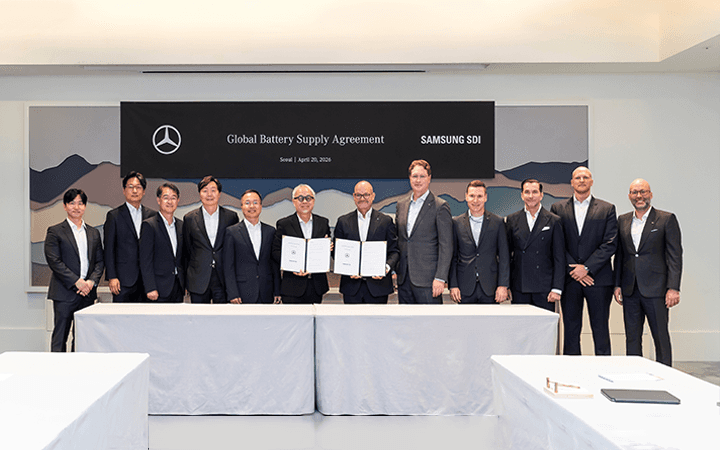
Mercedes-Benz and Samsung SDI CEOs sign global battery supply agreement, April 2026
Photos: samsungsdi.com newsroom
Why robots welcome All-Solid-State Batteries
Evaluating suppliers like these?
LightSource gives procurement teams verified supplier intelligence and AI-run sourcing events.