Verified Sep 2026
Diversified Tier 1
·

Stockdorf, Germany
·
Since 1901
Webasto SE is a German, family-owned automotive supplier founded in 1901 and headquartered in Stockdorf near Munich. The company develops and manufactures roof systems (openable and panoramic), traction battery packs, and vehicle thermal management products for OEMs worldwide. It reported approximately €4.0 billion in group revenue in fiscal year 2025 across more than 50 locations and around 13,100 employees.

Webasto at a glance
Revenue
€4.0B
FY2025 · published
Employees
~13,100
Year-end 2025 · company-published
Founded
1901
Founded March 7, 1901
Headquarters
Stockdorf, Germany
Ownership
Private
Baier family · Family-controlled SE · not listed
Certifications
IATF 16949
Claimed · multi-site
Import activity
10,470+
US import shipments on record across group entities
Known customers
Kia · Mahindra · Ford · FAW-VW
Company press · Ford Q1 recognized
Industries
Automotive
Electric Vehicles
Electronics
Sourcing and import activity
From US customs bill-of-lading records — Webasto Roof Systems (8,991), Webasto Thermo & Comfort (1,252), Webasto (227)
US sea imports
10,470
Top origins
Germany · Japan · Austria · Italy
Most recent shipment
Sep 14, 2026
Shared foreign counterparties do not establish that these companies buy from Webasto.
What this tells a buyer
Roof systems generate approximately €3.0 billion, or 79 percent of group revenue, making Webasto one of the largest dedicated automotive roof suppliers globally — the product that defines the company's competitive position.
The Dangjin, South Korea battery plant produces up to 1,000 battery packs per day for Hyundai-Kia Group vehicles, positioning Webasto's battery systems division as a high-volume EV production partner, not a niche supplier.
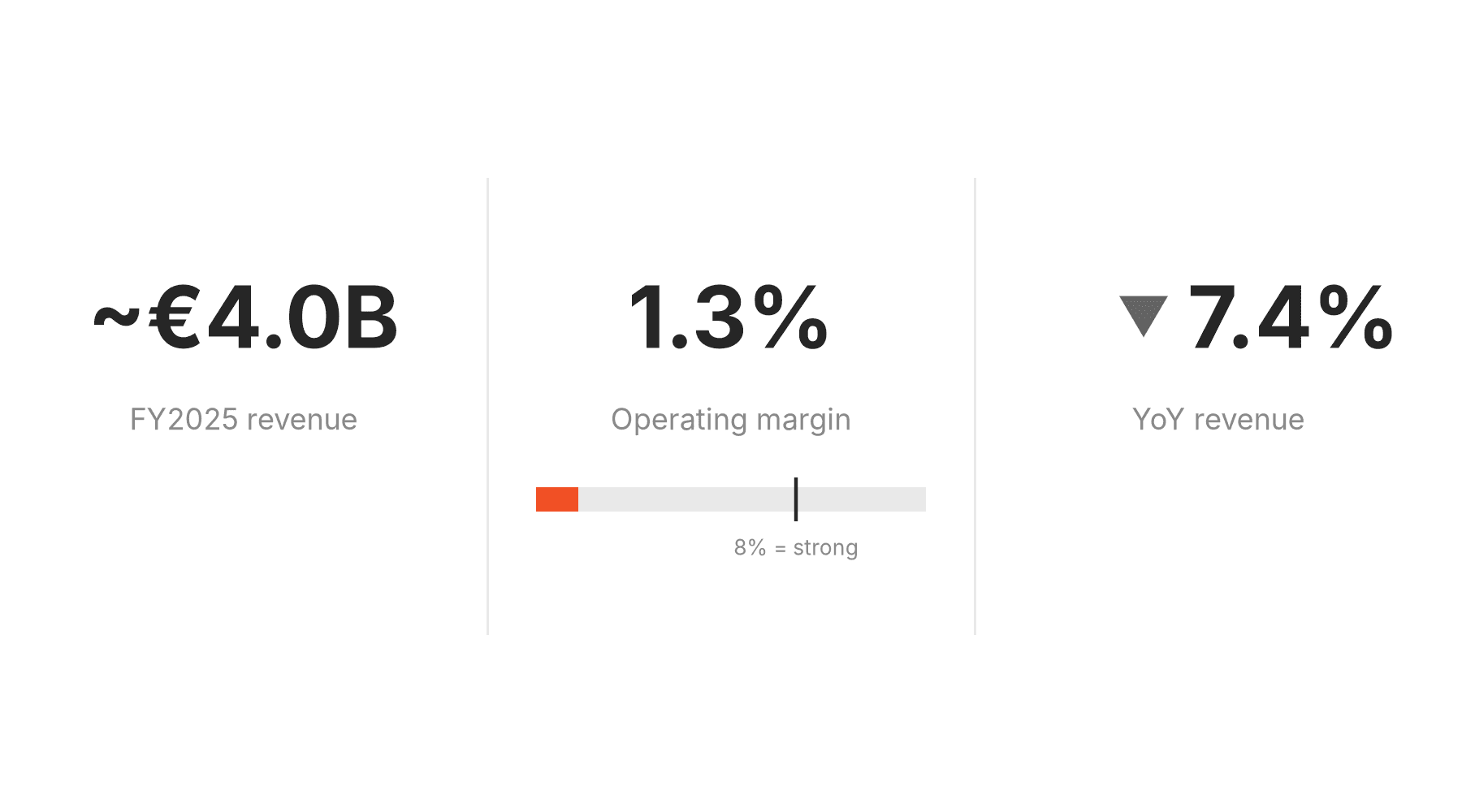
Webasto is actively restructuring under a plan targeting completion in 2028, with financing secured through that period. Revenue has declined from €4.6B in 2023 to €4.0B in 2025; the unadjusted EBIT was negative in 2025 due to restructuring charges.
Source: US customs bill-of-lading records and public company filings · Last verified Sep 2026
STABILITY SIGNALS
Operating
~€4.0 billion revenue (FY2025); adjusted EBIT €51 million; unadjusted result negative due to restructuring charges. Financing secured through 2028.
Founded in 1901; 125 years of continuous operation as a family-controlled group; more than 50 production locations across Europe, Americas, and Asia.
IATF 16949 certified across production sites; documented battery and roof supply programs for Kia EV3 and Mahindra electric SUVs in active production.
What Webasto makes
Webasto is structured around three product lines: roof systems, battery systems, and thermal management solutions. Roof systems are the largest by far, generating approximately €3.0 billion in revenue in 2025, or 79 percent of the group total. The product range spans openable sunroofs and panoramic systems (both mechanical and glass), fixed glass roofs, and convertible soft- and hard-top systems for passenger cars. Webasto supplies these to original equipment manufacturers across Europe, North America, China, and the Asia Pacific region, and the company claims to equip roughly every other car with a sunroof or panoramic roof globally.
Battery Systems contributed approximately €300 million in 2025 and centers on traction battery packs for electric vehicles. Webasto designs, tests, and manufactures battery systems at its own facilities, including a high-volume plant in Dangjin, South Korea, that produces up to 1,000 battery packs per day. Thermal Management Solutions, at around €500 million, covers vehicle parking heaters, auxiliary heaters, HVAC systems, and thermal conditioning products for both conventional and electrified powertrains. Webasto introduced vehicle heaters in the 1930s and has continuously extended this category into EV-compatible systems, including high-voltage PTC heaters and battery thermal management hardware.
Research and development spending in 2025 was approximately €280 million, representing around 7 percent of group revenue. The company describes that level as consistent with recent years, indicating it has protected its development budget through the restructuring rather than cutting it as a cost lever.
Financial performance
Webasto reported group revenue of approximately €4.0 billion in fiscal year 2025, down 7.4 percent from €4.3 billion in 2024, which itself declined from €4.6 billion in 2023. The two-year revenue decline reflects a combination of weaker European and North American vehicle production volumes, intensified competitive pressure in China from domestic manufacturers, and mix effects from ongoing restructuring. EBIT, adjusted for restructuring charges and one-time items, was €51 million in 2025, compared with €63 million the prior year. On an unadjusted basis the annual result was negative, reflecting the cash cost of restructuring measures. The company secured financing through 2028 in 2025, removing near-term liquidity risk while transformation proceeds.
The regional revenue mix in 2025 was approximately 35 percent Europe, 28 percent Americas, 18 percent China, and 19 percent Asia Pacific. The APAC share increased four percentage points year over year, driven by growth in roof systems in India and battery program volumes. The company employed approximately 13,100 people at year-end 2025, reflecting workforce adjustments made as part of the ongoing restructuring.
Webasto is privately held, a Societas Europaea (SE), and prepares its financial statements under IFRS. It does not publish detailed EBITDA or net income figures separately from its annual accounts.
Ownership and history
Webasto was founded on March 7, 1901 by Wilhelm Baier as a small sheet-metal workshop in Esslingen, Germany. The company moved to Stockdorf near Munich in 1908, where it took its current name -- a contraction of "Wilhelm Baier" and "Stockdorf." After decades in bicycle accessories and vehicle accessories, Webasto developed its first foldable fabric vehicle roof in the 1930s and, shortly after, its first vehicle heater. Both product lines remain core to the group today.
The Baier family has retained ownership across all five generations of the business. Werner Baier, great-grandson of the founder, sits on the current Supervisory Board. The company is structured as a Societas Europaea, a European cross-border corporate form, and is not listed on any stock exchange. In March 2026, Webasto marked its 125th anniversary, citing the occasion as a moment of renewal alongside restructuring.
Webasto entered the North American market in February 1974. It entered China and established production there in later decades, with plants in multiple cities including Chongqing and several others serving local OEM customers. Battery systems activity began in 2015 with electromobility solutions, and the company opened its Dangjin battery plant in South Korea in 2022.
Certifications and quality
Webasto's production sites hold IATF 16949 certification, the sector-standard automotive quality management system, per the company's own certificates page, which lists plant-level certificates including active credentials for its Webasto Japan subsidiary with certification extended through December 2027. Individual plants also carry ISO 14001 environmental management certification; the Chongqing plant, for example, is cited in company materials as certified to ISO 9001, IATF 16949, and ISO 14001, and recognized as a Ford Q1 and FAW-VW Grade A supplier. Certification is maintained at the plant level across the group's more than 40 production sites, which is the standard Tier 1 structure for a multi-site global supplier. The company also publishes an annual Sustainability Report covering environmental and social performance targets.
Known customers
Customer | Evidence | Confidence |
|---|---|---|
Kia (Hyundai-Kia Group) | Traction batteries (58.3 kWh and 81.4 kWh variants) and openable roof supplied for the Kia EV3; battery production at Dangjin plant, roof at Ulsan plant (Apr 2025) | Documented |
Mahindra | "Infinity Roof" panoramic system with integrated ambient lighting for Mahindra BE 6 and XEV 9e electric SUVs, produced in India (Mar 2025) | Documented |
Ford | Chongqing plant carries Ford Q1 supplier recognition, per the company's own location pages (Company site) | Documented |
FAW-VW | Chongqing plant recognized as FAW-VW Grade A Supplier, per company location page (Company site) | Documented |
The roof systems segment at approximately €3.0 billion implies a broad OEM customer base across European, North American, and Asian manufacturers, consistent with Webasto's own positioning as a global systems partner. Specific program details beyond the above are not individually disclosed in available company materials.
Frequently asked questions
What does Webasto make?
Webasto manufactures roof systems (openable and panoramic sunroofs, convertible tops), electric vehicle battery systems, and thermal management products (vehicle heaters, HVAC, battery thermal conditioning). Roof systems represent approximately 79 percent of the group's roughly €4.0 billion in annual revenue. The company has been producing vehicle heaters since the 1930s and entered the battery systems market in 2015.
Who owns Webasto?
Webasto is privately owned by the Baier family, descendants of founder Wilhelm Baier, who established the company in 1901. The group is structured as a Societas Europaea (SE) and is not listed on any stock exchange. Werner Baier, the founder's great-grandson, serves on the Supervisory Board. The company prepares its financials under IFRS and publishes annual results.
What is Webasto's annual revenue?
Webasto reported approximately €4.0 billion in group revenue for fiscal year 2025, down 7.4 percent from €4.3 billion in 2024 and €4.6 billion in 2023. The decline reflects weaker European and North American vehicle production volumes and competitive pressure in China. The Berylls by AlixPartners Top-100 Automotive Suppliers study ranks Webasto 83rd globally by automotive revenue.
Where is Webasto headquartered?
Webasto SE is headquartered at Kraillinger Strasse 5, 82131 Stockdorf, Germany, a suburb southwest of Munich. The company has operated from Stockdorf since 1908. Its US operations include a Thermo and Comfort division in Fenton, Michigan and a Roof Systems operation in Lexington, Kentucky.
Who are Webasto's customers?
Documented Webasto OEM programs include traction batteries and roof systems for the Kia EV3 (Hyundai-Kia Group), panoramic roof systems for Mahindra electric SUVs (BE 6 and XEV 9e), and supply relationships recognized with Ford Q1 and FAW-VW Grade A status at its Chongqing plant. The company's roof systems segment at approximately €3.0 billion implies broad supply relationships across European, North American, and Asian OEMs, though individual program details are not comprehensively disclosed.
Last verified September 2026. Is this your company? Request a correction.
Latest news
Jun 2026
Yanik Cantieni appointed Chief Financial Officer effective June 1, succeeding Joerg Bremer as part of the ongoing management team restructuring under CEO Buchheim (Webasto press release).
May 2026
Webasto reported FY2025 results: group revenue approximately €4.0 billion, down 7.4 percent year over year; adjusted EBIT of €51 million; unadjusted result negative due to restructuring charges (Webasto press release, May 18, 2026).
Mar 2026
Webasto marked its 125th anniversary, founded March 7, 1901. CEO Jorg Buchheim and Supervisory Board member Werner Baier framed the occasion as the start of a new chapter alongside active restructuring (Webasto press release, March 9, 2026).
Refreshed weekly · updated Sep 22, 2026
Leadership

Jorg Buchheim
Chief Executive Officer

Marcel Bartling
Deputy CEO & Chief Technology Officer

Jan Henning Mehlfeldt
Chief Operating Officer

Yanik Cantieni
Chief Financial Officer
Location & contact

Inside the facility

Webasto headquarters, Stockdorf (Munich), Germany

Robotic panoramic roof assembly line, Webasto plant, India
Facility photos: Webasto Group. Leadership photos: Apollo/LinkedIn (Bartling, Mehlfeldt), Webasto press release (Cantieni).
Evaluating suppliers like these?
LightSource gives procurement teams verified supplier intelligence and AI-run sourcing events.