

Announcing AI Tariff Tracker: Automatic HTS Classification for Every Part on Your BOM
Today we're launching AI Tariff Tracker, the first of four pillars in LightSource's AI-Duty Management suite. We trained a custom HTS classification model on millions of U.S. Customs bill of lading records, and it now runs against every part in your LightSource instance -- assigning a 10-digit HTSUS code from part names, part numbers, descriptions, and (where available) drawings.
Related: Canada's September 2026 surtaxes are assigned at the HTS line level, which is exactly the exposure mapping this tool automates -- context in Tariffs Between Allies.
Related: the desk-level strategy the tracker supports -- duty as a BOM line and five legal mitigation moves -- is in The Buyer's Tariff Playbook.
This was the most-asked-for capability from our customer council. Tariff exposure is increasingly the single most consequential variable in landed cost, and the input that determines it -- the HTS code -- has historically lived in the customs broker's filing software, not in the system where engineers and buyers actually work. We're closing that gap.
The problem we set out to solve
The Harmonized Tariff Schedule has 5,612 subheadings, and the duty rates layered on top -- Section 301, Section 232, MFN, reciprocal -- shift on a near-monthly cadence. Our customers told us they were running into the same three problems over and over:
Assigning HTS codes across the BOM. Most direct-materials BOMs run 200+ line items, with country-of-origin variation across suppliers. Manual classification is slow, inconsistent, and falls behind every revision.
Understanding pending duty rate impacts. Once a code is assigned, the duty rate depends on country of origin and the current schedule. Mapping all three is a separate research task done in spreadsheets.
Assessing the total impact to the BOM. Rolling line-by-line tariff exposure into a program-level number takes weeks, often produced by hand for the CFO once a quarter.
Each of these is solvable individually. The problem is they don't compose -- the data lives in different systems, owned by different functions, and the answer is stale before it's written down.
What AI Tariff Tracker does
We built a custom HTS classification model trained on millions of bill-of-lading records published by U.S. Customs and Border Protection. The model takes a part's metadata -- item name, item number, descriptions, attributes -- plus the part drawing where present, and returns the most-likely 10-digit HTSUS code along with the legal HTS schedule description.
The suggested code appears directly on the item record in LightSource:
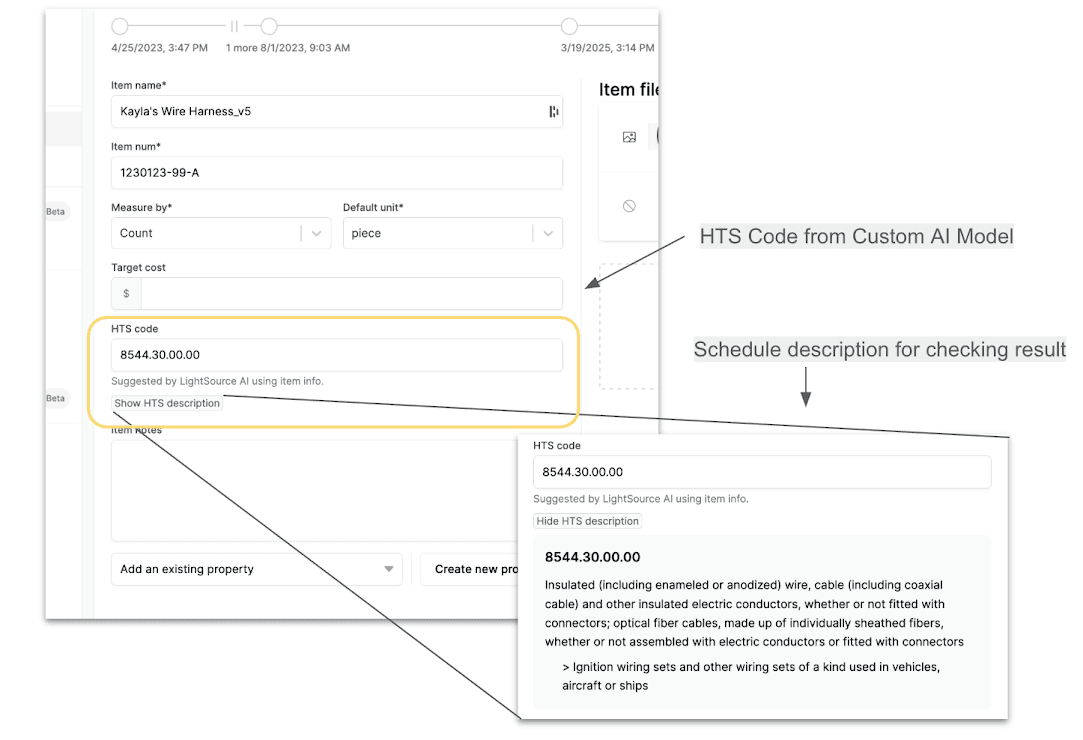
Verification is one click, not a separate research session. The classification runs on every part in the instance: existing items get classified retroactively, and new items get classified the moment they're created. Codes can be accepted, edited, or overridden by the user. LightSource AI's suggestion is a starting point, not a forced answer.
For more on what HTS codes are and why classification matters, see our complete guide to HTS codes.
Why it matters
The point isn't the HTS codes themselves -- it's what becomes possible when every line of a live BOM has one:
Procurement can see tariff exposure as part of an award decision, not after the entry is filed. A Mexican supplier vs. a Chinese supplier becomes a landed-cost comparison, not a unit-price comparison.
Compliance teams can audit a BOM in minutes, not weeks. Every item has a code, every code has a defensible origin, and every change is logged.
CFOs can answer "what's our tariff exposure?" in real time -- tied to the awarded suppliers, not a stale spreadsheet.
Most of our customers built their first internal tariff exposure model the day after Section 301 expanded. They've been maintaining it manually ever since. AI Tariff Tracker is what we wish we'd been able to give them on day one.
What's next
AI Tariff Tracker is the first of four pillars in our AI-Duty Management suite. The roadmap for the rest of 2025 and 2026:
Near-term (Q3-Q4 2025):
Pull in the latest duty rate schedules automatically, so changes to MFN, Section 301, and reciprocal tariffs flow into the platform without a customer update
Real-time tariff exposure tracking at the BOM level
Base expectation + value-at-risk simulation models for tariff scenarios
2026:
Tariff engineering and AI-driven recommendations -- e.g., flagging when a small specification change could move a part into a lower-duty heading
Alternative HTS code suggestions for borderline classifications
Automated duty drawback evidence submission for refund claims
Each pillar builds on the BOM-level foundation that AI Tariff Tracker establishes today. Once every part has a code and an origin, the rest is structured math.
Why LightSource
LightSource is the AI-native direct materials operating system, purpose-built to connect engineering, procurement, and suppliers in one system so challenger companies win on speed and launch at lower cost. Our customers see:
45% faster sourcing cycles -- three months down to one for NPI sourcing
3-8% reduction in direct materials spend in year one
Live in 30 days, not 12-18 months
20,000+ direct-materials suppliers on platform with an 85%+ response rate
We're trusted by Amazon, Conair, Canada Goose, BRP, Shure, Medtronic, and Infinite Machine. The platform was named a Gartner Cool Vendor 2025 in Sourcing and Procurement Technology, included in the ProcureTech100 2025/26, and validated above benchmark in cost modeling, sourcing optimization, and supplier portals in the Fall 2025 Spend Matters SolutionMap.
AI Tariff Tracker is the latest reason direct materials teams choose LightSource: we solve the problems indirect-procurement suites can't, with a velocity model that matches how challenger manufacturers actually operate.
See it in action
If you'd like to see AI Tariff Tracker run against a real BOM, request a demo. Existing customers can find it live in their instance today -- talk to your customer success contact for a walk-through.
Announcing AI Tariff Tracker: Automatic HTS Classification for Every Part on Your BOM
Today we're launching AI Tariff Tracker, the first of four pillars in LightSource's AI-Duty Management suite. We trained a custom HTS classification model on millions of U.S. Customs bill of lading records, and it now runs against every part in your LightSource instance -- assigning a 10-digit HTSUS code from part names, part numbers, descriptions, and (where available) drawings.
Related: Canada's September 2026 surtaxes are assigned at the HTS line level, which is exactly the exposure mapping this tool automates -- context in Tariffs Between Allies.
Related: the desk-level strategy the tracker supports -- duty as a BOM line and five legal mitigation moves -- is in The Buyer's Tariff Playbook.
This was the most-asked-for capability from our customer council. Tariff exposure is increasingly the single most consequential variable in landed cost, and the input that determines it -- the HTS code -- has historically lived in the customs broker's filing software, not in the system where engineers and buyers actually work. We're closing that gap.
The problem we set out to solve
The Harmonized Tariff Schedule has 5,612 subheadings, and the duty rates layered on top -- Section 301, Section 232, MFN, reciprocal -- shift on a near-monthly cadence. Our customers told us they were running into the same three problems over and over:
Assigning HTS codes across the BOM. Most direct-materials BOMs run 200+ line items, with country-of-origin variation across suppliers. Manual classification is slow, inconsistent, and falls behind every revision.
Understanding pending duty rate impacts. Once a code is assigned, the duty rate depends on country of origin and the current schedule. Mapping all three is a separate research task done in spreadsheets.
Assessing the total impact to the BOM. Rolling line-by-line tariff exposure into a program-level number takes weeks, often produced by hand for the CFO once a quarter.
Each of these is solvable individually. The problem is they don't compose -- the data lives in different systems, owned by different functions, and the answer is stale before it's written down.
What AI Tariff Tracker does
We built a custom HTS classification model trained on millions of bill-of-lading records published by U.S. Customs and Border Protection. The model takes a part's metadata -- item name, item number, descriptions, attributes -- plus the part drawing where present, and returns the most-likely 10-digit HTSUS code along with the legal HTS schedule description.
The suggested code appears directly on the item record in LightSource:
Verification is one click, not a separate research session. The classification runs on every part in the instance: existing items get classified retroactively, and new items get classified the moment they're created. Codes can be accepted, edited, or overridden by the user. LightSource AI's suggestion is a starting point, not a forced answer.
For more on what HTS codes are and why classification matters, see our complete guide to HTS codes.
Why it matters
The point isn't the HTS codes themselves -- it's what becomes possible when every line of a live BOM has one:
Procurement can see tariff exposure as part of an award decision, not after the entry is filed. A Mexican supplier vs. a Chinese supplier becomes a landed-cost comparison, not a unit-price comparison.
Compliance teams can audit a BOM in minutes, not weeks. Every item has a code, every code has a defensible origin, and every change is logged.
CFOs can answer "what's our tariff exposure?" in real time -- tied to the awarded suppliers, not a stale spreadsheet.
Most of our customers built their first internal tariff exposure model the day after Section 301 expanded. They've been maintaining it manually ever since. AI Tariff Tracker is what we wish we'd been able to give them on day one.
What's next
AI Tariff Tracker is the first of four pillars in our AI-Duty Management suite. The roadmap for the rest of 2025 and 2026:
Near-term (Q3-Q4 2025):
Pull in the latest duty rate schedules automatically, so changes to MFN, Section 301, and reciprocal tariffs flow into the platform without a customer update
Real-time tariff exposure tracking at the BOM level
Base expectation + value-at-risk simulation models for tariff scenarios
2026:
Tariff engineering and AI-driven recommendations -- e.g., flagging when a small specification change could move a part into a lower-duty heading
Alternative HTS code suggestions for borderline classifications
Automated duty drawback evidence submission for refund claims
Each pillar builds on the BOM-level foundation that AI Tariff Tracker establishes today. Once every part has a code and an origin, the rest is structured math.
Why LightSource
LightSource is the AI-native direct materials operating system, purpose-built to connect engineering, procurement, and suppliers in one system so challenger companies win on speed and launch at lower cost. Our customers see:
45% faster sourcing cycles -- three months down to one for NPI sourcing
3-8% reduction in direct materials spend in year one
Live in 30 days, not 12-18 months
20,000+ direct-materials suppliers on platform with an 85%+ response rate
We're trusted by Amazon, Conair, Canada Goose, BRP, Shure, Medtronic, and Infinite Machine. The platform was named a Gartner Cool Vendor 2025 in Sourcing and Procurement Technology, included in the ProcureTech100 2025/26, and validated above benchmark in cost modeling, sourcing optimization, and supplier portals in the Fall 2025 Spend Matters SolutionMap.
AI Tariff Tracker is the latest reason direct materials teams choose LightSource: we solve the problems indirect-procurement suites can't, with a velocity model that matches how challenger manufacturers actually operate.
See it in action
If you'd like to see AI Tariff Tracker run against a real BOM, request a demo. Existing customers can find it live in their instance today -- talk to your customer success contact for a walk-through.
Announcing AI Tariff Tracker: Automatic HTS Classification for Every Part on Your BOM
Today we're launching AI Tariff Tracker, the first of four pillars in LightSource's AI-Duty Management suite. We trained a custom HTS classification model on millions of U.S. Customs bill of lading records, and it now runs against every part in your LightSource instance -- assigning a 10-digit HTSUS code from part names, part numbers, descriptions, and (where available) drawings.
Related: Canada's September 2026 surtaxes are assigned at the HTS line level, which is exactly the exposure mapping this tool automates -- context in Tariffs Between Allies.
Related: the desk-level strategy the tracker supports -- duty as a BOM line and five legal mitigation moves -- is in The Buyer's Tariff Playbook.
This was the most-asked-for capability from our customer council. Tariff exposure is increasingly the single most consequential variable in landed cost, and the input that determines it -- the HTS code -- has historically lived in the customs broker's filing software, not in the system where engineers and buyers actually work. We're closing that gap.
The problem we set out to solve
The Harmonized Tariff Schedule has 5,612 subheadings, and the duty rates layered on top -- Section 301, Section 232, MFN, reciprocal -- shift on a near-monthly cadence. Our customers told us they were running into the same three problems over and over:
Assigning HTS codes across the BOM. Most direct-materials BOMs run 200+ line items, with country-of-origin variation across suppliers. Manual classification is slow, inconsistent, and falls behind every revision.
Understanding pending duty rate impacts. Once a code is assigned, the duty rate depends on country of origin and the current schedule. Mapping all three is a separate research task done in spreadsheets.
Assessing the total impact to the BOM. Rolling line-by-line tariff exposure into a program-level number takes weeks, often produced by hand for the CFO once a quarter.
Each of these is solvable individually. The problem is they don't compose -- the data lives in different systems, owned by different functions, and the answer is stale before it's written down.
What AI Tariff Tracker does
We built a custom HTS classification model trained on millions of bill-of-lading records published by U.S. Customs and Border Protection. The model takes a part's metadata -- item name, item number, descriptions, attributes -- plus the part drawing where present, and returns the most-likely 10-digit HTSUS code along with the legal HTS schedule description.
The suggested code appears directly on the item record in LightSource:
Verification is one click, not a separate research session. The classification runs on every part in the instance: existing items get classified retroactively, and new items get classified the moment they're created. Codes can be accepted, edited, or overridden by the user. LightSource AI's suggestion is a starting point, not a forced answer.
For more on what HTS codes are and why classification matters, see our complete guide to HTS codes.
Why it matters
The point isn't the HTS codes themselves -- it's what becomes possible when every line of a live BOM has one:
Procurement can see tariff exposure as part of an award decision, not after the entry is filed. A Mexican supplier vs. a Chinese supplier becomes a landed-cost comparison, not a unit-price comparison.
Compliance teams can audit a BOM in minutes, not weeks. Every item has a code, every code has a defensible origin, and every change is logged.
CFOs can answer "what's our tariff exposure?" in real time -- tied to the awarded suppliers, not a stale spreadsheet.
Most of our customers built their first internal tariff exposure model the day after Section 301 expanded. They've been maintaining it manually ever since. AI Tariff Tracker is what we wish we'd been able to give them on day one.
What's next
AI Tariff Tracker is the first of four pillars in our AI-Duty Management suite. The roadmap for the rest of 2025 and 2026:
Near-term (Q3-Q4 2025):
Pull in the latest duty rate schedules automatically, so changes to MFN, Section 301, and reciprocal tariffs flow into the platform without a customer update
Real-time tariff exposure tracking at the BOM level
Base expectation + value-at-risk simulation models for tariff scenarios
2026:
Tariff engineering and AI-driven recommendations -- e.g., flagging when a small specification change could move a part into a lower-duty heading
Alternative HTS code suggestions for borderline classifications
Automated duty drawback evidence submission for refund claims
Each pillar builds on the BOM-level foundation that AI Tariff Tracker establishes today. Once every part has a code and an origin, the rest is structured math.
Why LightSource
LightSource is the AI-native direct materials operating system, purpose-built to connect engineering, procurement, and suppliers in one system so challenger companies win on speed and launch at lower cost. Our customers see:
45% faster sourcing cycles -- three months down to one for NPI sourcing
3-8% reduction in direct materials spend in year one
Live in 30 days, not 12-18 months
20,000+ direct-materials suppliers on platform with an 85%+ response rate
We're trusted by Amazon, Conair, Canada Goose, BRP, Shure, Medtronic, and Infinite Machine. The platform was named a Gartner Cool Vendor 2025 in Sourcing and Procurement Technology, included in the ProcureTech100 2025/26, and validated above benchmark in cost modeling, sourcing optimization, and supplier portals in the Fall 2025 Spend Matters SolutionMap.
AI Tariff Tracker is the latest reason direct materials teams choose LightSource: we solve the problems indirect-procurement suites can't, with a velocity model that matches how challenger manufacturers actually operate.
See it in action
If you'd like to see AI Tariff Tracker run against a real BOM, request a demo. Existing customers can find it live in their instance today -- talk to your customer success contact for a walk-through.
Read more


Read more
Read more
Faster sourcing. Lower cost. Less chaos.
See how LightSource connects engineering, procurement, and suppliers in one operating system to help you launch faster at lower cost.
SOC 2
Kearney #1 2024
Gartner Cool Vendor
Procuretech 100
G2 Top Rated
Faster sourcing. Lower cost. Less chaos.
See how LightSource connects engineering, procurement, and suppliers in one operating system to help you launch faster at lower cost.
SOC 2
Kearney #1 2024
Gartner Cool Vendor
Procuretech 100
G2 Top Rated
Faster sourcing. Lower cost. Less chaos.
See how LightSource connects engineering, procurement, and suppliers in one operating system to help you launch faster at lower cost.
SOC 2
Kearney #1 2024
Gartner Cool Vendor
Procuretech 100
G2 Top Rated
Trusted by:
Trusted by:
Trusted by: