
Last night I sat in the dark at the 92nd Street Y and watched General David Petraeus hold a single white index card in his right hand for the better part of ninety minutes. He barely looked at it.
In conversation with the columnist Bret Stephens, he moved through the state of the war in Iran, the diplomacy that might follow it, the creativity of Israeli intelligence, the morning routine that still governs his day decades after he stopped having to keep it. All of it was sharp. But one idea reorganized the way I think about my own industry, and I have not stopped turning it over since.
Petraeus has traveled to Ukraine ten times since Russia invaded in February 2022. What he has watched take shape along that front, he said, is a crystal ball. Look into it and you see the future of war: machines fighting machines, at speeds no human can match, built not by the dozen but by the million. That last part is the reason a procurement person could not look away. The future he described is, underneath the autonomy and the algorithms, a manufacturing story.

General David Petraeus (right) with Bret Stephens at the 92nd Street Y, May 31, 2026. Photo by the author.
Petraeus's Read: Ukraine Rebuilt the Front and Took Back the Momentum
The striking thing about Petraeus's read on Ukraine is that it inverts the headline. Russia has more men, more artillery, and a far larger economy, and yet, he told CBS News on his most recent trip, Russia "no longer has the upper hand." Over the previous two months, he said, the Ukrainians had made greater incremental gains than the Russians. The reason is not steel. It is that Ukraine has rebuilt the front itself.
Picture the geography. Ukrainian forces now hold what Petraeus describes as nearly absolute surveillance and strike coverage out to roughly 20 miles beyond the line of contact. Anything that moves inside that band can be seen, and anything that can be seen can be hit, usually within minutes. Analysts describe an inner "kill zone" of a few hundred meters out to about ten kilometers on each side, and a "gray zone" of intermittent but real danger stretching twenty to thirty kilometers further back, by some Russian accounts as deep as sixty.
The comparison Petraeus reached for was the First World War, and it is the right one with a brutal update. In 1916 the no-man's-land between trench lines was a few hundred yards of mud. Today the lethal zone is twenty miles deep, and it does not care whether you are a frontline rifleman or a supply truck two villages back. So soldiers have gone underground, literally, into bunkers three to five meters down with reinforced roofs, surfacing as little as the war allows. "Once you're observed on this battlefield," Petraeus said, "and you can't get into a deeply buried position really quickly, it's not going to end well."
What does the observing is a fleet of small machines, and there are more of them every month.
From the exquisite few to the expendable many
For seventy years, the United States and its allies built militaries around the exquisite: a small number of extraordinary machines, each one a marvel, each one expensive enough that losing it is a national event. A single F-35 costs north of $80 million. You do not field it by the thousand, and you do not treat it as expendable.
Ukraine has been forced into the opposite model, and Petraeus thinks the opposite model is the future. The battlefield is shifting from a few sophisticated systems to a vast number of cheap, sacrificial ones, each carrying just enough sensing and navigation to find a target and end its own existence against it. The economics are the whole point. When a drone costs a few hundred dollars, you can build millions, and you can afford to lose almost all of them.
The production figures are the part of the evening I wrote down twice. Ukraine went from essentially no domestic drone industry in 2022 to roughly two million drones in 2024, and, by Petraeus's account, about 3.5 million last year, with seven million projected this year. One Ukrainian manufacturer he visited last week told him it alone will make three million drones in 2026. Kyiv's own published numbers run a little lower than the general's, and the exact tally is contested. What is not contested is the comparison: the entire United States assembles somewhere between 300,000 and 400,000 drones a year. Ukraine is launching about 200,000 a month.
The exquisite few | The expendable many | |
|---|---|---|
Example | F-35, Abrams tank, Reaper | FPV quadcopter, fiber-optic strike drone |
Unit cost | $10M to $100M+ | $300 to a few thousand |
Quantity | Hundreds | Millions |
Who builds it | A handful of primes, over years | A distributed base of small shops, in weeks |
When it last changed | A multi-year program cycle | Every two weeks |
How a loss is treated | A national event | Designed in from the start |
What it optimizes for | Capability per unit | Capability per dollar, at scale |
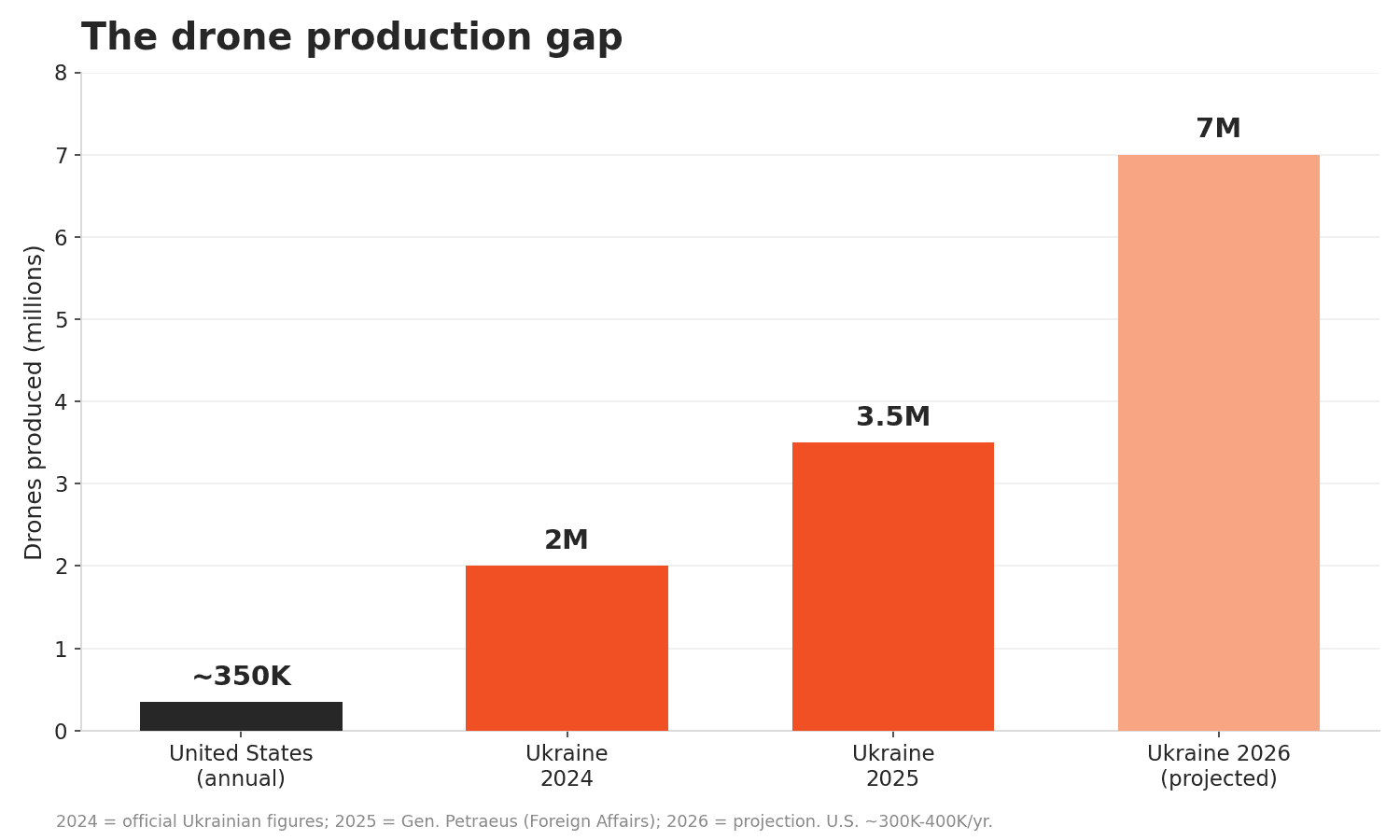
Sources: Foreign Affairs (2026), CBS News (2026), and Ukrainian official figures (Interfax, Ukrinform).
This is the moment the talk stopped being about defense and started being about factories. A war decided by who can build the most of something cheap, iterate on it fastest, and absorb the most loss is not primarily a technology contest. It is a manufacturing and sourcing contest. It rewards the same things that decide whether a company can actually build a car and ship it on time: a supply base you can scale, a bill of materials you can re-source under pressure, and the discipline to drive cost out without breaking the line. The fastest, most consequential manufacturing programs in history have almost always been the ones run under existential pressure, which is its own uncomfortable lesson. The supplier side of that argument is one I later made at MEMA's Commercial Vehicle Outlook Conference: velocity in the industrial base is a security question as much as a commercial one.
The System Around the Drone Matters More Than the Drone
The mistake Western observers make, Petraeus argued, is to fixate on the drones. "What's the real genius is how they're pulling it all together," he said, pointing to the command-and-control system Ukraine has built around the hardware.
At the center of it is a platform called Delta, which an engineer described to CBS as a kind of military Google Maps: a live digital picture of positions, targets, and threats, shared across commanders and the operators actually flying the missions. Feeding it is a sensor layer that is equal parts high technology and improvisation. There is radar. There is also a network of cheap acoustic sensors, tens of thousands of microphones on poles listening for the specific buzz of an incoming drone or cruise missile. Ukraine's "Sky Fortress" network reportedly runs on the order of 14,000 of these, each costing a few hundred to a thousand dollars, and the earliest versions were built around ordinary cell phones. When Petraeus described some of the sensors as iPhones on a stick, he was being almost literal.
The point is not the cleverness of any one piece. It is that radar, acoustics, optical sensors, and drone feeds are fused into a single picture, and that picture turns into a strike before the target can move. I spent time at Waymo, and this is an idea I recognize in my bones: a self-driving car is not a triumph of one sensor but of fusing many imperfect ones into a model of the world reliable enough to act on. Ukraine has built that for a battlefield. The harder problem, as with autonomy on the road, was never the sensor. It was the system that turns sensing into a decision, and doing it fast enough to matter.
Fast enough still has a clock on it. The drones that do the hunting can typically stay up for only about half an hour before they have to come back to recharge, which means the surveillance picture has to be continuously refreshed by the next wave. The war is fought in thirty-minute increments, by an army of operators rotating machines in and out of the sky.
Jamming, fiber optics, and the road to autonomy
The thing trying to break that system is electronic warfare. Inside that twenty-mile band, both sides flood the spectrum with jamming, severing the radio link between a drone and its operator. For a while that was the great equalizer. Then the workarounds arrived, and they point straight at where this is all going.
The first workaround is almost absurdly low-tech: run a wire. Fiber-optic drones trail a hair-thin glass cable that spools out behind them, carrying control signals and crystal-clear video down a physical line that no amount of jamming can touch. Russia began fielding them in force in late 2024, most visibly during the fighting in its Kursk region, and Ukraine raced to match it, approving more than eighty domestic fiber-optic designs within months. They are unjammable and nearly silent on the radio spectrum. They are also tethered, so their range is limited to the length of cable they can carry, usually five to twenty kilometers before the line snaps under its own weight. (I had half-remembered this as a tactic from Lebanon. It is not. Fiber-optic attack drones are, so far, a signature of the Russia-Ukraine war specifically, and analysts have not observed them in other theaters.)
The second workaround is the one that matters more, because it removes the human from the loop entirely. If you cannot keep a radio link to the drone, you teach the drone to finish the mission on its own. "What's coming," Petraeus said, "is going to be algorithmically piloted drones that you can't jam." Object recognition and onboard navigation let a machine identify and strike a target with no live connection to a pilot, which makes jamming irrelevant and lets a single operator manage many drones at once. Fully autonomous systems, where a human still defines the mission but a machine executes it, are, in his estimate, a couple of years away, and "we may well see it first here." His Foreign Affairs essay puts the strategic consequence more bluntly: in a fight at machine speed, "the side that waits for human approval before acting will lose."
The swarm problem, and why defense is losing
Stack those two trends, autonomy plus mass, and you arrive at the thing Petraeus called "very, very worrisome." A real swarm, he said, becomes possible the moment the drones are autonomous, because they no longer need a base station to coordinate. Launch a few hundred machines that talk only to each other, and there is no link to jam and no single operator to stop.
We do not have a good answer to that yet. "We don't have systems yet" to defend against drone swarms, he said plainly. "We need to learn a lot more, much more rapidly than we are." The economics are upside down: it makes no sense to fire a $50,000 interceptor missile at a $500 drone, and you cannot carry enough missiles anyway. A cheap drone does not have to beat an expensive system on the merits; it only has to make that system fight on bad terms, forcing it to spend a missile worth a hundred times more just to survive the encounter. Electronic warfare, the cheap defense, stops working the moment the drone is autonomous or wired. What is left is near-field directed energy, weapons that fry electronics in bulk. The most promising is high-power microwave: Epirus's Leonidas system knocked down a 49-drone swarm with a single pulse in a 2025 demonstration, and in December 2025 became the first to defeat even a fiber-optic drone by burning its electronics rather than its signal. Lasers can do it one target at a time. Neither is close to mature, and neither solves the problem cheaply.
The civilian version of this should keep people up at night, and Petraeus said it does keep him up. As Amazon and Walmart push drone delivery into everyday airspace, the line between a delivery quadcopter and a weapon gets harder to draw, and a coordinated attack gets harder to detect. The same autonomy that wins the war is a terrorism problem waiting for a bad actor.
The operating system for war
Push the logic to its end and you get the picture Petraeus painted last: not a smarter drone, but an operating system for the battlefield. Sensor data flows in, an AI takes stock of the enemy, and it tasks the right mix of autonomous systems against the right targets, coordinating air, ground, and sea at a tempo no staff of humans could match.
His Foreign Affairs piece calls these "autonomous formations," platoon- or battalion-sized fleets that execute a commander's intent even when communications are cut. The companies racing toward this are no longer secret. Anduril's Lattice and Palantir's Maven are early, commercial attempts at exactly this software layer, the connective tissue that turns a pile of sensors and shooters into a coordinated force. And the deepest point Petraeus makes is that the hardware is not the moat. "The winner," he writes, "will not be the side with the most drones but the side that best solves the command-design problem." The side that figures out how to fight this way, and reorganizes itself around it, beats the side that merely owns the gear.
Petraeus on Iran and Israel: The Same Lesson From Other Fronts
Not all of the evening was about Ukraine, and it is worth recording the rest, because it sharpened the same theme from other angles.
On Iran, Petraeus was measured in the way operators tend to be about diplomacy: clear that military pressure had changed the board, cautious about what a durable agreement actually requires, alert to how quickly the situation can reverse. The economic aftershocks of that confrontation are still working their way through global supply chains, which is its own downstream reckoning for anyone who buys physical materials.
On Israel, the word he kept returning to was creativity, and the example everyone in the room was thinking of was the September 2024 operation that turned thousands of Hezbollah pagers and walkie-talkies into simultaneous explosives. What is easy to miss, sitting in a procurement frame of mind, is what kind of operation that actually was. Israeli intelligence reportedly manufactured the devices, embedded the explosive, and sold them into Hezbollah's own purchasing channel months in advance. The most celebrated intelligence operation of the decade was, at its core, a supply-chain attack: a reminder that knowing exactly what is in the thing you bought, and who really made it, is not a paperwork exercise.
And the index card. Petraeus is famous for a morning routine of almost punitive discipline, the early rise and the hard physical training that outlasted his command, and he talked about it with the slight self-awareness of a man who knows it has become a legend. The card, it turned out, held only a few notes he scarcely needed. The discipline was the point. It is the same discipline he is now asking the entire United States military to find.
Ukraine Changed Because It Had No Choice; America May Lack That Forcing Function
Here is the question that has stayed with me. Ukraine built all of this, the millions of drones, the acoustic nets, the wired drones, the battle-management software updated every two weeks, because it had no choice. Necessity forced it. The uncomfortable question Petraeus left in the room was whether the United States has anything like that same necessity, and whether, without it, we can change in time.
The early evidence is not encouraging. The Pentagon's Replicator initiative promised thousands of autonomous systems by the middle of 2025 and delivered, by most accounts, only hundreds. It has since been folded into a new $54.6 billion effort, the Defense Autonomous Warfare Group, which Petraeus and his co-author have called potentially "a $55 billion mistake," not because the money is wrong but because less than two percent of it is going toward the doctrine, organization, and training that turn hardware into capability. We have made this error before. In the early years of Iraq and Afghanistan, every Predator combat air patrol required nearly 150 people to operate, and the limiting factor turned out to be not the aircraft but the humans and the org chart around it. As Secretary of Defense Bob Gates put it then, the hard part of unmanned systems was manning them. A drone without the system around it, Petraeus writes, "is not a weapons system at all. It is an asset on a spreadsheet."
The cultural gap shows up in a single anecdote he told. A commander had proudly reported that he had secured drones for one of his armored units, a few dozen of them, bolted onto the existing force. Petraeus's response was withering. In some Western armies, he said, they think innovation means giving fifty drones to an armored battalion and calling it reform.
"No. What we should do is scrap the armored battalions and replace them with a drone battalion."
Ukraine did exactly that, standing up a dedicated Unmanned Systems Force as its own branch rather than sprinkling drones across the old structure. Sitting there, I kept thinking about the academies still teaching tank-on-tank maneuver as a central art, while the front in Ukraine has made the massed-armor charge look a lot like a cavalry charge in 1916.
The deeper deficiency is speed. Ukraine updates its drone software every two weeks and its hardware every few weeks; a NATO doctrine revision takes fifteen to twenty months. "A technique that works on Monday," Petraeus warns, "may be rendered obsolete by Friday." China is studying every iteration, and Russia is learning under fire. The comparison that matters is no longer platform to platform or missile count to missile count. It is feedback loop to feedback loop: whether you can spot a field failure, trace it to a supplier or a line of code, fix it, requalify the build, and get it back to the front before the enemy has moved on. The advantage in this kind of war does not come from out-spending the other side on hardware. It comes from how fast operational experience turns into the next version of the thing.
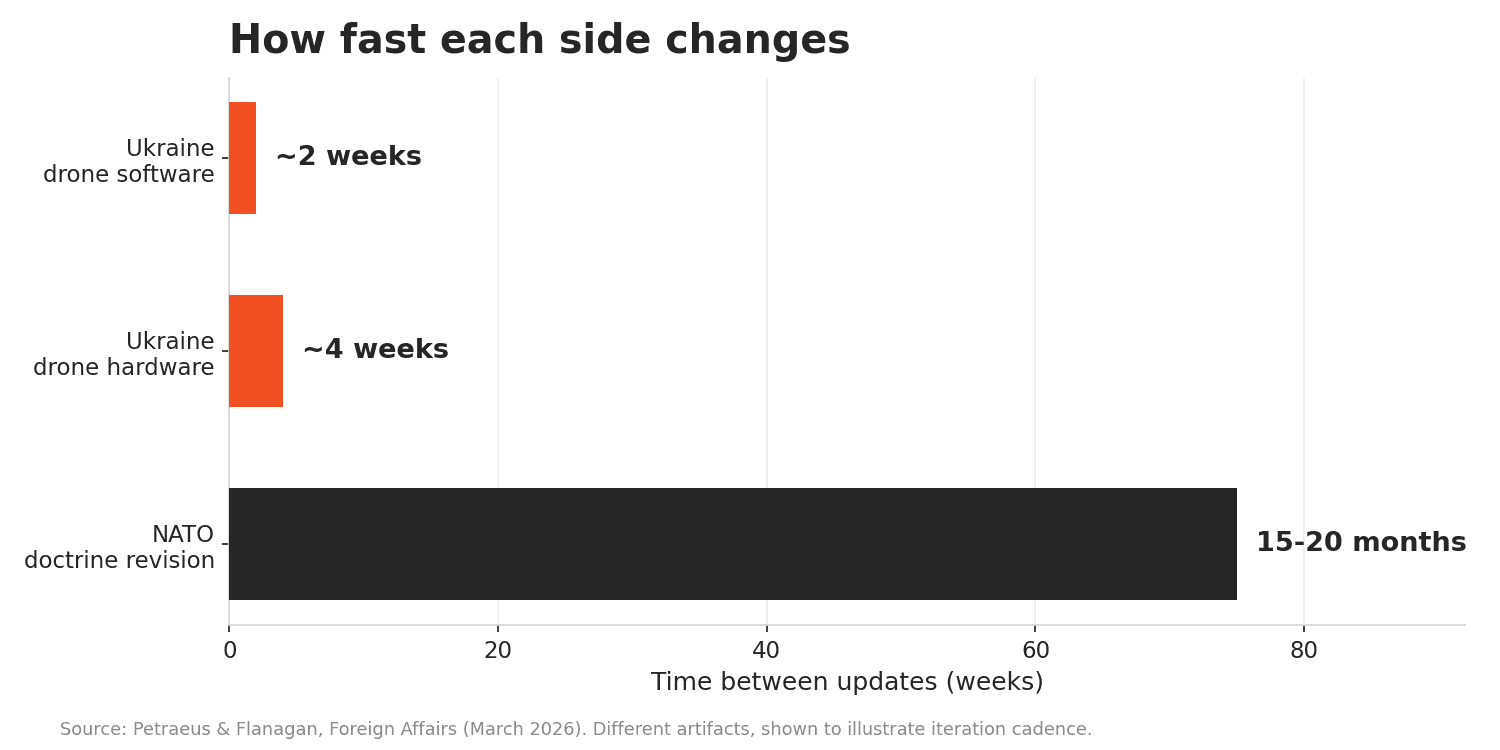
Source: Petraeus and Flanagan, Foreign Affairs (March 2026).
But you still have to take the ground
It would be easy to walk out of that auditorium and announce that the tank is dead, and that would be too simple. Petraeus did not say it, and the history of military prediction is littered with people who did. Airpower was supposed to make armies obsolete, and strategic bombing was going to break nations from the sky on its own. Precision weapons were going to make mass irrelevant. Network-centric warfare was going to hand victory to whoever had the better information. Each of those ideas was partly right and badly oversold, and in every case the older instrument survived while its job changed.
The same caveats apply here, and they are worth saying out loud. Wars are still won by forces that can take and hold ground, and a drone cannot occupy a city or hold a tree line through the night. Weather still grounds aircraft. Endurance and payload still limit what a small machine can carry and how long it can loiter. Electronic warfare cuts both ways, counter-drone systems are improving quickly, and autonomy still fails in exactly the messy edge cases that never show up in a demo. Cheap systems can manufacture expensive chaos without producing political control, which is the only thing that actually ends a war.
So the honest version of the argument is not that armor vanishes. It is that every manned platform now has to survive inside a sensor-saturated, drone-dense, software-mediated kill web, paired with air defense and electronic warfare and its own unmanned systems, or it never gets to play the role the doctrine imagines for it. A force built around the assumption that the central problem is still another tank is preparing for the wrong fight. That is a more defensible claim than "the tank is dead," and a more uncomfortable one, because it points at the organization rather than the machine.
What this has to do with what I do
I run a company that builds sourcing software for manufacturers, so I will be honest about the bias and brief about the connection. What struck me all evening was how little of Petraeus's argument was about weapons and how much of it was about manufacturing velocity and feedback loops. The decisive asymmetry, he keeps saying, is "how quickly operational experience translates into adaptation." That is a sentence about supply chains.
The companies actually winning this race, the Ukrainian drone shops and the new American primes like Anduril and Shield AI, win the way the best hardware challengers have always won: by compressing the loop between design, sourcing, and the field. They source thousands of cheap components fast, often multi-sourced against a fragile global parts base and, in defense, under export-control rules like ITAR, they know what every unit should cost, and they ship a new revision before the incumbent has finished its review. LightSource exists to connect engineering, procurement, and suppliers in one system so that companies competing on speed, the ones running aggressive new-product cycles, can do exactly that, make cost and sourcing decisions while the design is still moving rather than months after it locks. The reason that matters here is the same reason it matters in Ukraine: in a contest decided by iteration, the feedback loop is the weapon.
Petraeus put down his index card and the lights came up, and I walked out onto Lexington Avenue thinking about factories, not battlefields. The front he described is less a prediction than a working prototype, running under fire: a glimpse of a world where the prize goes to whoever can build, learn, and rebuild fastest. That world is already here for anyone who makes physical things. The general has just seen, more clearly than most, where it leads.
Sources
The Autonomous Battlefield -- David Petraeus and Isaac Flanagan, Foreign Affairs (March 12, 2026). The core argument on autonomous formations, production scale, and why the US military is not yet ready.
Ex-CIA director David Petraeus says U.S. needs to learn "whole new concept of warfare" from Ukraine -- CBS News (May 2026). Source for the Delta platform, the 20-mile coverage, fiber-optic drones, and the "drone battalion" quote.
The Pentagon could be about to make a $55 billion mistake -- David Petraeus and Isaac Flanagan, The Hill (April 21, 2026). The Defense Autonomous Warfare Group and the doctrine-versus-hardware critique.
Sky Fortress: Ukraine's acoustic detection system -- United24 Media. The 14,000-sensor acoustic network and its cost structure.
Fiber-optic drones have emerged as critical kit for both Russia and Ukraine -- Atlantic Council. Origins in Kursk, the jamming-immunity tradeoff, and adoption timeline.
One Burst, Dozens Down: How Leonidas Uses High-Power Microwaves to Stop Drone Swarms -- DroneLife, plus Epirus's December 2025 fiber-optic defeat. Directed-energy counter-drone progress.
Replicator lives on as DAWG -- Breaking Defense, and The Pentagon's $54 billion bet on autonomous warfare -- Defense One. The Replicator-to-DAWG transition and the $54.6B figure.
2024 Lebanon electronic device attacks -- background on the September 2024 pager and walkie-talkie operation.
Frequently Asked Questions
Why does General Petraeus call Ukraine the future of war?
Petraeus argues that the Russia-Ukraine front is the first place where the defining features of future conflict have all appeared at once: a battlefield saturated with cheap drones, near-total surveillance out to about 20 miles, electronic warfare severing the link between operators and machines, and the beginnings of autonomy that lets machines finish missions on their own. He calls it a crystal ball because the patterns visible there, especially the shift from a few expensive systems to millions of cheap ones, are likely to define how major militaries fight next.
How many drones does Ukraine produce compared to the United States?
Ukraine scaled from almost no domestic drone production in 2022 to roughly two million drones in 2024, and by Petraeus's account around 3.5 million in 2025, with seven million projected for 2026. One Ukrainian manufacturer alone expects to build three million in 2026. The entire United States, by comparison, assembles an estimated 300,000 to 400,000 drones per year, a gap of more than ten to one that reflects a manufacturing problem, not a technology one.
What are fiber-optic drones, and why can't they be jammed?
Fiber-optic drones trail a thin glass cable that carries control signals and video along a physical line instead of a radio signal, which makes them immune to electronic jamming and nearly invisible on the radio spectrum. Russia began fielding them at scale in late 2024, notably in the Kursk fighting, and Ukraine quickly followed. The tradeoff is range: the drone can only fly as far as the cable it carries, usually five to twenty kilometers before the line breaks.
Are tanks obsolete now that drones dominate the battlefield?
Not obsolete, but their role has narrowed sharply. A manned armored vehicle now has to survive inside a roughly 20-mile zone saturated with drones, sensors, mines, and electronic warfare, which means it only works when paired with air defense, counter-drone coverage, and its own unmanned systems. Petraeus's sharper point is organizational: a military that still treats tank-on-tank combat as its central problem, rather than building formations around unmanned systems, is preparing for the wrong fight. Defending against the drones themselves remains unsolved, since once they are autonomous the cheapest counter, electronic jamming, stops working and the most promising answer, near-field directed energy like high-power microwave, is still early.
Why do experts say the US military is buying drones the wrong way?
Petraeus's critique is that the Pentagon is spending heavily on autonomous hardware, a $54.6 billion program, while directing less than two percent of it toward the doctrine, organization, training, and feedback loops that turn hardware into capability. He points to the early Predator era, when each drone patrol required about 150 people, to argue that a drone without the system around it "is not a weapons system at all. It is an asset on a spreadsheet." The decisive factor, he says, is how fast a military can turn battlefield experience into its next iteration.
What does drone warfare have to do with manufacturing and procurement?
A war won by building the most of something cheap, iterating on it fastest, and absorbing the most loss is fundamentally a manufacturing and sourcing contest. The advantage goes to whoever can scale a supply base, re-source a bill of materials under pressure, drive cost down, and ship new revisions in weeks rather than years. Those are the same capabilities that decide whether any hardware company, defense or commercial, can compete on speed.
Last night I sat in the dark at the 92nd Street Y and watched General David Petraeus hold a single white index card in his right hand for the better part of ninety minutes. He barely looked at it.
In conversation with the columnist Bret Stephens, he moved through the state of the war in Iran, the diplomacy that might follow it, the creativity of Israeli intelligence, the morning routine that still governs his day decades after he stopped having to keep it. All of it was sharp. But one idea reorganized the way I think about my own industry, and I have not stopped turning it over since.
Petraeus has traveled to Ukraine ten times since Russia invaded in February 2022. What he has watched take shape along that front, he said, is a crystal ball. Look into it and you see the future of war: machines fighting machines, at speeds no human can match, built not by the dozen but by the million. That last part is the reason a procurement person could not look away. The future he described is, underneath the autonomy and the algorithms, a manufacturing story.
General David Petraeus (right) with Bret Stephens at the 92nd Street Y, May 31, 2026. Photo by the author.
Petraeus's Read: Ukraine Rebuilt the Front and Took Back the Momentum
The striking thing about Petraeus's read on Ukraine is that it inverts the headline. Russia has more men, more artillery, and a far larger economy, and yet, he told CBS News on his most recent trip, Russia "no longer has the upper hand." Over the previous two months, he said, the Ukrainians had made greater incremental gains than the Russians. The reason is not steel. It is that Ukraine has rebuilt the front itself.
Picture the geography. Ukrainian forces now hold what Petraeus describes as nearly absolute surveillance and strike coverage out to roughly 20 miles beyond the line of contact. Anything that moves inside that band can be seen, and anything that can be seen can be hit, usually within minutes. Analysts describe an inner "kill zone" of a few hundred meters out to about ten kilometers on each side, and a "gray zone" of intermittent but real danger stretching twenty to thirty kilometers further back, by some Russian accounts as deep as sixty.
The comparison Petraeus reached for was the First World War, and it is the right one with a brutal update. In 1916 the no-man's-land between trench lines was a few hundred yards of mud. Today the lethal zone is twenty miles deep, and it does not care whether you are a frontline rifleman or a supply truck two villages back. So soldiers have gone underground, literally, into bunkers three to five meters down with reinforced roofs, surfacing as little as the war allows. "Once you're observed on this battlefield," Petraeus said, "and you can't get into a deeply buried position really quickly, it's not going to end well."
What does the observing is a fleet of small machines, and there are more of them every month.
From the exquisite few to the expendable many
For seventy years, the United States and its allies built militaries around the exquisite: a small number of extraordinary machines, each one a marvel, each one expensive enough that losing it is a national event. A single F-35 costs north of $80 million. You do not field it by the thousand, and you do not treat it as expendable.
Ukraine has been forced into the opposite model, and Petraeus thinks the opposite model is the future. The battlefield is shifting from a few sophisticated systems to a vast number of cheap, sacrificial ones, each carrying just enough sensing and navigation to find a target and end its own existence against it. The economics are the whole point. When a drone costs a few hundred dollars, you can build millions, and you can afford to lose almost all of them.
The production figures are the part of the evening I wrote down twice. Ukraine went from essentially no domestic drone industry in 2022 to roughly two million drones in 2024, and, by Petraeus's account, about 3.5 million last year, with seven million projected this year. One Ukrainian manufacturer he visited last week told him it alone will make three million drones in 2026. Kyiv's own published numbers run a little lower than the general's, and the exact tally is contested. What is not contested is the comparison: the entire United States assembles somewhere between 300,000 and 400,000 drones a year. Ukraine is launching about 200,000 a month.
The exquisite few | The expendable many | |
|---|---|---|
Example | F-35, Abrams tank, Reaper | FPV quadcopter, fiber-optic strike drone |
Unit cost | $10M to $100M+ | $300 to a few thousand |
Quantity | Hundreds | Millions |
Who builds it | A handful of primes, over years | A distributed base of small shops, in weeks |
When it last changed | A multi-year program cycle | Every two weeks |
How a loss is treated | A national event | Designed in from the start |
What it optimizes for | Capability per unit | Capability per dollar, at scale |
Sources: Foreign Affairs (2026), CBS News (2026), and Ukrainian official figures (Interfax, Ukrinform).
This is the moment the talk stopped being about defense and started being about factories. A war decided by who can build the most of something cheap, iterate on it fastest, and absorb the most loss is not primarily a technology contest. It is a manufacturing and sourcing contest. It rewards the same things that decide whether a company can actually build a car and ship it on time: a supply base you can scale, a bill of materials you can re-source under pressure, and the discipline to drive cost out without breaking the line. The fastest, most consequential manufacturing programs in history have almost always been the ones run under existential pressure, which is its own uncomfortable lesson. The supplier side of that argument is one I later made at MEMA's Commercial Vehicle Outlook Conference: velocity in the industrial base is a security question as much as a commercial one.
The System Around the Drone Matters More Than the Drone
The mistake Western observers make, Petraeus argued, is to fixate on the drones. "What's the real genius is how they're pulling it all together," he said, pointing to the command-and-control system Ukraine has built around the hardware.
At the center of it is a platform called Delta, which an engineer described to CBS as a kind of military Google Maps: a live digital picture of positions, targets, and threats, shared across commanders and the operators actually flying the missions. Feeding it is a sensor layer that is equal parts high technology and improvisation. There is radar. There is also a network of cheap acoustic sensors, tens of thousands of microphones on poles listening for the specific buzz of an incoming drone or cruise missile. Ukraine's "Sky Fortress" network reportedly runs on the order of 14,000 of these, each costing a few hundred to a thousand dollars, and the earliest versions were built around ordinary cell phones. When Petraeus described some of the sensors as iPhones on a stick, he was being almost literal.
The point is not the cleverness of any one piece. It is that radar, acoustics, optical sensors, and drone feeds are fused into a single picture, and that picture turns into a strike before the target can move. I spent time at Waymo, and this is an idea I recognize in my bones: a self-driving car is not a triumph of one sensor but of fusing many imperfect ones into a model of the world reliable enough to act on. Ukraine has built that for a battlefield. The harder problem, as with autonomy on the road, was never the sensor. It was the system that turns sensing into a decision, and doing it fast enough to matter.
Fast enough still has a clock on it. The drones that do the hunting can typically stay up for only about half an hour before they have to come back to recharge, which means the surveillance picture has to be continuously refreshed by the next wave. The war is fought in thirty-minute increments, by an army of operators rotating machines in and out of the sky.
Jamming, fiber optics, and the road to autonomy
The thing trying to break that system is electronic warfare. Inside that twenty-mile band, both sides flood the spectrum with jamming, severing the radio link between a drone and its operator. For a while that was the great equalizer. Then the workarounds arrived, and they point straight at where this is all going.
The first workaround is almost absurdly low-tech: run a wire. Fiber-optic drones trail a hair-thin glass cable that spools out behind them, carrying control signals and crystal-clear video down a physical line that no amount of jamming can touch. Russia began fielding them in force in late 2024, most visibly during the fighting in its Kursk region, and Ukraine raced to match it, approving more than eighty domestic fiber-optic designs within months. They are unjammable and nearly silent on the radio spectrum. They are also tethered, so their range is limited to the length of cable they can carry, usually five to twenty kilometers before the line snaps under its own weight. (I had half-remembered this as a tactic from Lebanon. It is not. Fiber-optic attack drones are, so far, a signature of the Russia-Ukraine war specifically, and analysts have not observed them in other theaters.)
The second workaround is the one that matters more, because it removes the human from the loop entirely. If you cannot keep a radio link to the drone, you teach the drone to finish the mission on its own. "What's coming," Petraeus said, "is going to be algorithmically piloted drones that you can't jam." Object recognition and onboard navigation let a machine identify and strike a target with no live connection to a pilot, which makes jamming irrelevant and lets a single operator manage many drones at once. Fully autonomous systems, where a human still defines the mission but a machine executes it, are, in his estimate, a couple of years away, and "we may well see it first here." His Foreign Affairs essay puts the strategic consequence more bluntly: in a fight at machine speed, "the side that waits for human approval before acting will lose."
The swarm problem, and why defense is losing
Stack those two trends, autonomy plus mass, and you arrive at the thing Petraeus called "very, very worrisome." A real swarm, he said, becomes possible the moment the drones are autonomous, because they no longer need a base station to coordinate. Launch a few hundred machines that talk only to each other, and there is no link to jam and no single operator to stop.
We do not have a good answer to that yet. "We don't have systems yet" to defend against drone swarms, he said plainly. "We need to learn a lot more, much more rapidly than we are." The economics are upside down: it makes no sense to fire a $50,000 interceptor missile at a $500 drone, and you cannot carry enough missiles anyway. A cheap drone does not have to beat an expensive system on the merits; it only has to make that system fight on bad terms, forcing it to spend a missile worth a hundred times more just to survive the encounter. Electronic warfare, the cheap defense, stops working the moment the drone is autonomous or wired. What is left is near-field directed energy, weapons that fry electronics in bulk. The most promising is high-power microwave: Epirus's Leonidas system knocked down a 49-drone swarm with a single pulse in a 2025 demonstration, and in December 2025 became the first to defeat even a fiber-optic drone by burning its electronics rather than its signal. Lasers can do it one target at a time. Neither is close to mature, and neither solves the problem cheaply.
The civilian version of this should keep people up at night, and Petraeus said it does keep him up. As Amazon and Walmart push drone delivery into everyday airspace, the line between a delivery quadcopter and a weapon gets harder to draw, and a coordinated attack gets harder to detect. The same autonomy that wins the war is a terrorism problem waiting for a bad actor.
The operating system for war
Push the logic to its end and you get the picture Petraeus painted last: not a smarter drone, but an operating system for the battlefield. Sensor data flows in, an AI takes stock of the enemy, and it tasks the right mix of autonomous systems against the right targets, coordinating air, ground, and sea at a tempo no staff of humans could match.
His Foreign Affairs piece calls these "autonomous formations," platoon- or battalion-sized fleets that execute a commander's intent even when communications are cut. The companies racing toward this are no longer secret. Anduril's Lattice and Palantir's Maven are early, commercial attempts at exactly this software layer, the connective tissue that turns a pile of sensors and shooters into a coordinated force. And the deepest point Petraeus makes is that the hardware is not the moat. "The winner," he writes, "will not be the side with the most drones but the side that best solves the command-design problem." The side that figures out how to fight this way, and reorganizes itself around it, beats the side that merely owns the gear.
Petraeus on Iran and Israel: The Same Lesson From Other Fronts
Not all of the evening was about Ukraine, and it is worth recording the rest, because it sharpened the same theme from other angles.
On Iran, Petraeus was measured in the way operators tend to be about diplomacy: clear that military pressure had changed the board, cautious about what a durable agreement actually requires, alert to how quickly the situation can reverse. The economic aftershocks of that confrontation are still working their way through global supply chains, which is its own downstream reckoning for anyone who buys physical materials.
On Israel, the word he kept returning to was creativity, and the example everyone in the room was thinking of was the September 2024 operation that turned thousands of Hezbollah pagers and walkie-talkies into simultaneous explosives. What is easy to miss, sitting in a procurement frame of mind, is what kind of operation that actually was. Israeli intelligence reportedly manufactured the devices, embedded the explosive, and sold them into Hezbollah's own purchasing channel months in advance. The most celebrated intelligence operation of the decade was, at its core, a supply-chain attack: a reminder that knowing exactly what is in the thing you bought, and who really made it, is not a paperwork exercise.
And the index card. Petraeus is famous for a morning routine of almost punitive discipline, the early rise and the hard physical training that outlasted his command, and he talked about it with the slight self-awareness of a man who knows it has become a legend. The card, it turned out, held only a few notes he scarcely needed. The discipline was the point. It is the same discipline he is now asking the entire United States military to find.
Ukraine Changed Because It Had No Choice; America May Lack That Forcing Function
Here is the question that has stayed with me. Ukraine built all of this, the millions of drones, the acoustic nets, the wired drones, the battle-management software updated every two weeks, because it had no choice. Necessity forced it. The uncomfortable question Petraeus left in the room was whether the United States has anything like that same necessity, and whether, without it, we can change in time.
The early evidence is not encouraging. The Pentagon's Replicator initiative promised thousands of autonomous systems by the middle of 2025 and delivered, by most accounts, only hundreds. It has since been folded into a new $54.6 billion effort, the Defense Autonomous Warfare Group, which Petraeus and his co-author have called potentially "a $55 billion mistake," not because the money is wrong but because less than two percent of it is going toward the doctrine, organization, and training that turn hardware into capability. We have made this error before. In the early years of Iraq and Afghanistan, every Predator combat air patrol required nearly 150 people to operate, and the limiting factor turned out to be not the aircraft but the humans and the org chart around it. As Secretary of Defense Bob Gates put it then, the hard part of unmanned systems was manning them. A drone without the system around it, Petraeus writes, "is not a weapons system at all. It is an asset on a spreadsheet."
The cultural gap shows up in a single anecdote he told. A commander had proudly reported that he had secured drones for one of his armored units, a few dozen of them, bolted onto the existing force. Petraeus's response was withering. In some Western armies, he said, they think innovation means giving fifty drones to an armored battalion and calling it reform.
"No. What we should do is scrap the armored battalions and replace them with a drone battalion."
Ukraine did exactly that, standing up a dedicated Unmanned Systems Force as its own branch rather than sprinkling drones across the old structure. Sitting there, I kept thinking about the academies still teaching tank-on-tank maneuver as a central art, while the front in Ukraine has made the massed-armor charge look a lot like a cavalry charge in 1916.
The deeper deficiency is speed. Ukraine updates its drone software every two weeks and its hardware every few weeks; a NATO doctrine revision takes fifteen to twenty months. "A technique that works on Monday," Petraeus warns, "may be rendered obsolete by Friday." China is studying every iteration, and Russia is learning under fire. The comparison that matters is no longer platform to platform or missile count to missile count. It is feedback loop to feedback loop: whether you can spot a field failure, trace it to a supplier or a line of code, fix it, requalify the build, and get it back to the front before the enemy has moved on. The advantage in this kind of war does not come from out-spending the other side on hardware. It comes from how fast operational experience turns into the next version of the thing.
Source: Petraeus and Flanagan, Foreign Affairs (March 2026).
But you still have to take the ground
It would be easy to walk out of that auditorium and announce that the tank is dead, and that would be too simple. Petraeus did not say it, and the history of military prediction is littered with people who did. Airpower was supposed to make armies obsolete, and strategic bombing was going to break nations from the sky on its own. Precision weapons were going to make mass irrelevant. Network-centric warfare was going to hand victory to whoever had the better information. Each of those ideas was partly right and badly oversold, and in every case the older instrument survived while its job changed.
The same caveats apply here, and they are worth saying out loud. Wars are still won by forces that can take and hold ground, and a drone cannot occupy a city or hold a tree line through the night. Weather still grounds aircraft. Endurance and payload still limit what a small machine can carry and how long it can loiter. Electronic warfare cuts both ways, counter-drone systems are improving quickly, and autonomy still fails in exactly the messy edge cases that never show up in a demo. Cheap systems can manufacture expensive chaos without producing political control, which is the only thing that actually ends a war.
So the honest version of the argument is not that armor vanishes. It is that every manned platform now has to survive inside a sensor-saturated, drone-dense, software-mediated kill web, paired with air defense and electronic warfare and its own unmanned systems, or it never gets to play the role the doctrine imagines for it. A force built around the assumption that the central problem is still another tank is preparing for the wrong fight. That is a more defensible claim than "the tank is dead," and a more uncomfortable one, because it points at the organization rather than the machine.
What this has to do with what I do
I run a company that builds sourcing software for manufacturers, so I will be honest about the bias and brief about the connection. What struck me all evening was how little of Petraeus's argument was about weapons and how much of it was about manufacturing velocity and feedback loops. The decisive asymmetry, he keeps saying, is "how quickly operational experience translates into adaptation." That is a sentence about supply chains.
The companies actually winning this race, the Ukrainian drone shops and the new American primes like Anduril and Shield AI, win the way the best hardware challengers have always won: by compressing the loop between design, sourcing, and the field. They source thousands of cheap components fast, often multi-sourced against a fragile global parts base and, in defense, under export-control rules like ITAR, they know what every unit should cost, and they ship a new revision before the incumbent has finished its review. LightSource exists to connect engineering, procurement, and suppliers in one system so that companies competing on speed, the ones running aggressive new-product cycles, can do exactly that, make cost and sourcing decisions while the design is still moving rather than months after it locks. The reason that matters here is the same reason it matters in Ukraine: in a contest decided by iteration, the feedback loop is the weapon.
Petraeus put down his index card and the lights came up, and I walked out onto Lexington Avenue thinking about factories, not battlefields. The front he described is less a prediction than a working prototype, running under fire: a glimpse of a world where the prize goes to whoever can build, learn, and rebuild fastest. That world is already here for anyone who makes physical things. The general has just seen, more clearly than most, where it leads.
Sources
The Autonomous Battlefield -- David Petraeus and Isaac Flanagan, Foreign Affairs (March 12, 2026). The core argument on autonomous formations, production scale, and why the US military is not yet ready.
Ex-CIA director David Petraeus says U.S. needs to learn "whole new concept of warfare" from Ukraine -- CBS News (May 2026). Source for the Delta platform, the 20-mile coverage, fiber-optic drones, and the "drone battalion" quote.
The Pentagon could be about to make a $55 billion mistake -- David Petraeus and Isaac Flanagan, The Hill (April 21, 2026). The Defense Autonomous Warfare Group and the doctrine-versus-hardware critique.
Sky Fortress: Ukraine's acoustic detection system -- United24 Media. The 14,000-sensor acoustic network and its cost structure.
Fiber-optic drones have emerged as critical kit for both Russia and Ukraine -- Atlantic Council. Origins in Kursk, the jamming-immunity tradeoff, and adoption timeline.
One Burst, Dozens Down: How Leonidas Uses High-Power Microwaves to Stop Drone Swarms -- DroneLife, plus Epirus's December 2025 fiber-optic defeat. Directed-energy counter-drone progress.
Replicator lives on as DAWG -- Breaking Defense, and The Pentagon's $54 billion bet on autonomous warfare -- Defense One. The Replicator-to-DAWG transition and the $54.6B figure.
2024 Lebanon electronic device attacks -- background on the September 2024 pager and walkie-talkie operation.
Frequently Asked Questions
Why does General Petraeus call Ukraine the future of war?
Petraeus argues that the Russia-Ukraine front is the first place where the defining features of future conflict have all appeared at once: a battlefield saturated with cheap drones, near-total surveillance out to about 20 miles, electronic warfare severing the link between operators and machines, and the beginnings of autonomy that lets machines finish missions on their own. He calls it a crystal ball because the patterns visible there, especially the shift from a few expensive systems to millions of cheap ones, are likely to define how major militaries fight next.
How many drones does Ukraine produce compared to the United States?
Ukraine scaled from almost no domestic drone production in 2022 to roughly two million drones in 2024, and by Petraeus's account around 3.5 million in 2025, with seven million projected for 2026. One Ukrainian manufacturer alone expects to build three million in 2026. The entire United States, by comparison, assembles an estimated 300,000 to 400,000 drones per year, a gap of more than ten to one that reflects a manufacturing problem, not a technology one.
What are fiber-optic drones, and why can't they be jammed?
Fiber-optic drones trail a thin glass cable that carries control signals and video along a physical line instead of a radio signal, which makes them immune to electronic jamming and nearly invisible on the radio spectrum. Russia began fielding them at scale in late 2024, notably in the Kursk fighting, and Ukraine quickly followed. The tradeoff is range: the drone can only fly as far as the cable it carries, usually five to twenty kilometers before the line breaks.
Are tanks obsolete now that drones dominate the battlefield?
Not obsolete, but their role has narrowed sharply. A manned armored vehicle now has to survive inside a roughly 20-mile zone saturated with drones, sensors, mines, and electronic warfare, which means it only works when paired with air defense, counter-drone coverage, and its own unmanned systems. Petraeus's sharper point is organizational: a military that still treats tank-on-tank combat as its central problem, rather than building formations around unmanned systems, is preparing for the wrong fight. Defending against the drones themselves remains unsolved, since once they are autonomous the cheapest counter, electronic jamming, stops working and the most promising answer, near-field directed energy like high-power microwave, is still early.
Why do experts say the US military is buying drones the wrong way?
Petraeus's critique is that the Pentagon is spending heavily on autonomous hardware, a $54.6 billion program, while directing less than two percent of it toward the doctrine, organization, training, and feedback loops that turn hardware into capability. He points to the early Predator era, when each drone patrol required about 150 people, to argue that a drone without the system around it "is not a weapons system at all. It is an asset on a spreadsheet." The decisive factor, he says, is how fast a military can turn battlefield experience into its next iteration.
What does drone warfare have to do with manufacturing and procurement?
A war won by building the most of something cheap, iterating on it fastest, and absorbing the most loss is fundamentally a manufacturing and sourcing contest. The advantage goes to whoever can scale a supply base, re-source a bill of materials under pressure, drive cost down, and ship new revisions in weeks rather than years. Those are the same capabilities that decide whether any hardware company, defense or commercial, can compete on speed.
Last night I sat in the dark at the 92nd Street Y and watched General David Petraeus hold a single white index card in his right hand for the better part of ninety minutes. He barely looked at it.
In conversation with the columnist Bret Stephens, he moved through the state of the war in Iran, the diplomacy that might follow it, the creativity of Israeli intelligence, the morning routine that still governs his day decades after he stopped having to keep it. All of it was sharp. But one idea reorganized the way I think about my own industry, and I have not stopped turning it over since.
Petraeus has traveled to Ukraine ten times since Russia invaded in February 2022. What he has watched take shape along that front, he said, is a crystal ball. Look into it and you see the future of war: machines fighting machines, at speeds no human can match, built not by the dozen but by the million. That last part is the reason a procurement person could not look away. The future he described is, underneath the autonomy and the algorithms, a manufacturing story.
General David Petraeus (right) with Bret Stephens at the 92nd Street Y, May 31, 2026. Photo by the author.
Petraeus's Read: Ukraine Rebuilt the Front and Took Back the Momentum
The striking thing about Petraeus's read on Ukraine is that it inverts the headline. Russia has more men, more artillery, and a far larger economy, and yet, he told CBS News on his most recent trip, Russia "no longer has the upper hand." Over the previous two months, he said, the Ukrainians had made greater incremental gains than the Russians. The reason is not steel. It is that Ukraine has rebuilt the front itself.
Picture the geography. Ukrainian forces now hold what Petraeus describes as nearly absolute surveillance and strike coverage out to roughly 20 miles beyond the line of contact. Anything that moves inside that band can be seen, and anything that can be seen can be hit, usually within minutes. Analysts describe an inner "kill zone" of a few hundred meters out to about ten kilometers on each side, and a "gray zone" of intermittent but real danger stretching twenty to thirty kilometers further back, by some Russian accounts as deep as sixty.
The comparison Petraeus reached for was the First World War, and it is the right one with a brutal update. In 1916 the no-man's-land between trench lines was a few hundred yards of mud. Today the lethal zone is twenty miles deep, and it does not care whether you are a frontline rifleman or a supply truck two villages back. So soldiers have gone underground, literally, into bunkers three to five meters down with reinforced roofs, surfacing as little as the war allows. "Once you're observed on this battlefield," Petraeus said, "and you can't get into a deeply buried position really quickly, it's not going to end well."
What does the observing is a fleet of small machines, and there are more of them every month.
From the exquisite few to the expendable many
For seventy years, the United States and its allies built militaries around the exquisite: a small number of extraordinary machines, each one a marvel, each one expensive enough that losing it is a national event. A single F-35 costs north of $80 million. You do not field it by the thousand, and you do not treat it as expendable.
Ukraine has been forced into the opposite model, and Petraeus thinks the opposite model is the future. The battlefield is shifting from a few sophisticated systems to a vast number of cheap, sacrificial ones, each carrying just enough sensing and navigation to find a target and end its own existence against it. The economics are the whole point. When a drone costs a few hundred dollars, you can build millions, and you can afford to lose almost all of them.
The production figures are the part of the evening I wrote down twice. Ukraine went from essentially no domestic drone industry in 2022 to roughly two million drones in 2024, and, by Petraeus's account, about 3.5 million last year, with seven million projected this year. One Ukrainian manufacturer he visited last week told him it alone will make three million drones in 2026. Kyiv's own published numbers run a little lower than the general's, and the exact tally is contested. What is not contested is the comparison: the entire United States assembles somewhere between 300,000 and 400,000 drones a year. Ukraine is launching about 200,000 a month.
The exquisite few | The expendable many | |
|---|---|---|
Example | F-35, Abrams tank, Reaper | FPV quadcopter, fiber-optic strike drone |
Unit cost | $10M to $100M+ | $300 to a few thousand |
Quantity | Hundreds | Millions |
Who builds it | A handful of primes, over years | A distributed base of small shops, in weeks |
When it last changed | A multi-year program cycle | Every two weeks |
How a loss is treated | A national event | Designed in from the start |
What it optimizes for | Capability per unit | Capability per dollar, at scale |
Sources: Foreign Affairs (2026), CBS News (2026), and Ukrainian official figures (Interfax, Ukrinform).
This is the moment the talk stopped being about defense and started being about factories. A war decided by who can build the most of something cheap, iterate on it fastest, and absorb the most loss is not primarily a technology contest. It is a manufacturing and sourcing contest. It rewards the same things that decide whether a company can actually build a car and ship it on time: a supply base you can scale, a bill of materials you can re-source under pressure, and the discipline to drive cost out without breaking the line. The fastest, most consequential manufacturing programs in history have almost always been the ones run under existential pressure, which is its own uncomfortable lesson. The supplier side of that argument is one I later made at MEMA's Commercial Vehicle Outlook Conference: velocity in the industrial base is a security question as much as a commercial one.
The System Around the Drone Matters More Than the Drone
The mistake Western observers make, Petraeus argued, is to fixate on the drones. "What's the real genius is how they're pulling it all together," he said, pointing to the command-and-control system Ukraine has built around the hardware.
At the center of it is a platform called Delta, which an engineer described to CBS as a kind of military Google Maps: a live digital picture of positions, targets, and threats, shared across commanders and the operators actually flying the missions. Feeding it is a sensor layer that is equal parts high technology and improvisation. There is radar. There is also a network of cheap acoustic sensors, tens of thousands of microphones on poles listening for the specific buzz of an incoming drone or cruise missile. Ukraine's "Sky Fortress" network reportedly runs on the order of 14,000 of these, each costing a few hundred to a thousand dollars, and the earliest versions were built around ordinary cell phones. When Petraeus described some of the sensors as iPhones on a stick, he was being almost literal.
The point is not the cleverness of any one piece. It is that radar, acoustics, optical sensors, and drone feeds are fused into a single picture, and that picture turns into a strike before the target can move. I spent time at Waymo, and this is an idea I recognize in my bones: a self-driving car is not a triumph of one sensor but of fusing many imperfect ones into a model of the world reliable enough to act on. Ukraine has built that for a battlefield. The harder problem, as with autonomy on the road, was never the sensor. It was the system that turns sensing into a decision, and doing it fast enough to matter.
Fast enough still has a clock on it. The drones that do the hunting can typically stay up for only about half an hour before they have to come back to recharge, which means the surveillance picture has to be continuously refreshed by the next wave. The war is fought in thirty-minute increments, by an army of operators rotating machines in and out of the sky.
Jamming, fiber optics, and the road to autonomy
The thing trying to break that system is electronic warfare. Inside that twenty-mile band, both sides flood the spectrum with jamming, severing the radio link between a drone and its operator. For a while that was the great equalizer. Then the workarounds arrived, and they point straight at where this is all going.
The first workaround is almost absurdly low-tech: run a wire. Fiber-optic drones trail a hair-thin glass cable that spools out behind them, carrying control signals and crystal-clear video down a physical line that no amount of jamming can touch. Russia began fielding them in force in late 2024, most visibly during the fighting in its Kursk region, and Ukraine raced to match it, approving more than eighty domestic fiber-optic designs within months. They are unjammable and nearly silent on the radio spectrum. They are also tethered, so their range is limited to the length of cable they can carry, usually five to twenty kilometers before the line snaps under its own weight. (I had half-remembered this as a tactic from Lebanon. It is not. Fiber-optic attack drones are, so far, a signature of the Russia-Ukraine war specifically, and analysts have not observed them in other theaters.)
The second workaround is the one that matters more, because it removes the human from the loop entirely. If you cannot keep a radio link to the drone, you teach the drone to finish the mission on its own. "What's coming," Petraeus said, "is going to be algorithmically piloted drones that you can't jam." Object recognition and onboard navigation let a machine identify and strike a target with no live connection to a pilot, which makes jamming irrelevant and lets a single operator manage many drones at once. Fully autonomous systems, where a human still defines the mission but a machine executes it, are, in his estimate, a couple of years away, and "we may well see it first here." His Foreign Affairs essay puts the strategic consequence more bluntly: in a fight at machine speed, "the side that waits for human approval before acting will lose."
The swarm problem, and why defense is losing
Stack those two trends, autonomy plus mass, and you arrive at the thing Petraeus called "very, very worrisome." A real swarm, he said, becomes possible the moment the drones are autonomous, because they no longer need a base station to coordinate. Launch a few hundred machines that talk only to each other, and there is no link to jam and no single operator to stop.
We do not have a good answer to that yet. "We don't have systems yet" to defend against drone swarms, he said plainly. "We need to learn a lot more, much more rapidly than we are." The economics are upside down: it makes no sense to fire a $50,000 interceptor missile at a $500 drone, and you cannot carry enough missiles anyway. A cheap drone does not have to beat an expensive system on the merits; it only has to make that system fight on bad terms, forcing it to spend a missile worth a hundred times more just to survive the encounter. Electronic warfare, the cheap defense, stops working the moment the drone is autonomous or wired. What is left is near-field directed energy, weapons that fry electronics in bulk. The most promising is high-power microwave: Epirus's Leonidas system knocked down a 49-drone swarm with a single pulse in a 2025 demonstration, and in December 2025 became the first to defeat even a fiber-optic drone by burning its electronics rather than its signal. Lasers can do it one target at a time. Neither is close to mature, and neither solves the problem cheaply.
The civilian version of this should keep people up at night, and Petraeus said it does keep him up. As Amazon and Walmart push drone delivery into everyday airspace, the line between a delivery quadcopter and a weapon gets harder to draw, and a coordinated attack gets harder to detect. The same autonomy that wins the war is a terrorism problem waiting for a bad actor.
The operating system for war
Push the logic to its end and you get the picture Petraeus painted last: not a smarter drone, but an operating system for the battlefield. Sensor data flows in, an AI takes stock of the enemy, and it tasks the right mix of autonomous systems against the right targets, coordinating air, ground, and sea at a tempo no staff of humans could match.
His Foreign Affairs piece calls these "autonomous formations," platoon- or battalion-sized fleets that execute a commander's intent even when communications are cut. The companies racing toward this are no longer secret. Anduril's Lattice and Palantir's Maven are early, commercial attempts at exactly this software layer, the connective tissue that turns a pile of sensors and shooters into a coordinated force. And the deepest point Petraeus makes is that the hardware is not the moat. "The winner," he writes, "will not be the side with the most drones but the side that best solves the command-design problem." The side that figures out how to fight this way, and reorganizes itself around it, beats the side that merely owns the gear.
Petraeus on Iran and Israel: The Same Lesson From Other Fronts
Not all of the evening was about Ukraine, and it is worth recording the rest, because it sharpened the same theme from other angles.
On Iran, Petraeus was measured in the way operators tend to be about diplomacy: clear that military pressure had changed the board, cautious about what a durable agreement actually requires, alert to how quickly the situation can reverse. The economic aftershocks of that confrontation are still working their way through global supply chains, which is its own downstream reckoning for anyone who buys physical materials.
On Israel, the word he kept returning to was creativity, and the example everyone in the room was thinking of was the September 2024 operation that turned thousands of Hezbollah pagers and walkie-talkies into simultaneous explosives. What is easy to miss, sitting in a procurement frame of mind, is what kind of operation that actually was. Israeli intelligence reportedly manufactured the devices, embedded the explosive, and sold them into Hezbollah's own purchasing channel months in advance. The most celebrated intelligence operation of the decade was, at its core, a supply-chain attack: a reminder that knowing exactly what is in the thing you bought, and who really made it, is not a paperwork exercise.
And the index card. Petraeus is famous for a morning routine of almost punitive discipline, the early rise and the hard physical training that outlasted his command, and he talked about it with the slight self-awareness of a man who knows it has become a legend. The card, it turned out, held only a few notes he scarcely needed. The discipline was the point. It is the same discipline he is now asking the entire United States military to find.
Ukraine Changed Because It Had No Choice; America May Lack That Forcing Function
Here is the question that has stayed with me. Ukraine built all of this, the millions of drones, the acoustic nets, the wired drones, the battle-management software updated every two weeks, because it had no choice. Necessity forced it. The uncomfortable question Petraeus left in the room was whether the United States has anything like that same necessity, and whether, without it, we can change in time.
The early evidence is not encouraging. The Pentagon's Replicator initiative promised thousands of autonomous systems by the middle of 2025 and delivered, by most accounts, only hundreds. It has since been folded into a new $54.6 billion effort, the Defense Autonomous Warfare Group, which Petraeus and his co-author have called potentially "a $55 billion mistake," not because the money is wrong but because less than two percent of it is going toward the doctrine, organization, and training that turn hardware into capability. We have made this error before. In the early years of Iraq and Afghanistan, every Predator combat air patrol required nearly 150 people to operate, and the limiting factor turned out to be not the aircraft but the humans and the org chart around it. As Secretary of Defense Bob Gates put it then, the hard part of unmanned systems was manning them. A drone without the system around it, Petraeus writes, "is not a weapons system at all. It is an asset on a spreadsheet."
The cultural gap shows up in a single anecdote he told. A commander had proudly reported that he had secured drones for one of his armored units, a few dozen of them, bolted onto the existing force. Petraeus's response was withering. In some Western armies, he said, they think innovation means giving fifty drones to an armored battalion and calling it reform.
"No. What we should do is scrap the armored battalions and replace them with a drone battalion."
Ukraine did exactly that, standing up a dedicated Unmanned Systems Force as its own branch rather than sprinkling drones across the old structure. Sitting there, I kept thinking about the academies still teaching tank-on-tank maneuver as a central art, while the front in Ukraine has made the massed-armor charge look a lot like a cavalry charge in 1916.
The deeper deficiency is speed. Ukraine updates its drone software every two weeks and its hardware every few weeks; a NATO doctrine revision takes fifteen to twenty months. "A technique that works on Monday," Petraeus warns, "may be rendered obsolete by Friday." China is studying every iteration, and Russia is learning under fire. The comparison that matters is no longer platform to platform or missile count to missile count. It is feedback loop to feedback loop: whether you can spot a field failure, trace it to a supplier or a line of code, fix it, requalify the build, and get it back to the front before the enemy has moved on. The advantage in this kind of war does not come from out-spending the other side on hardware. It comes from how fast operational experience turns into the next version of the thing.
Source: Petraeus and Flanagan, Foreign Affairs (March 2026).
But you still have to take the ground
It would be easy to walk out of that auditorium and announce that the tank is dead, and that would be too simple. Petraeus did not say it, and the history of military prediction is littered with people who did. Airpower was supposed to make armies obsolete, and strategic bombing was going to break nations from the sky on its own. Precision weapons were going to make mass irrelevant. Network-centric warfare was going to hand victory to whoever had the better information. Each of those ideas was partly right and badly oversold, and in every case the older instrument survived while its job changed.
The same caveats apply here, and they are worth saying out loud. Wars are still won by forces that can take and hold ground, and a drone cannot occupy a city or hold a tree line through the night. Weather still grounds aircraft. Endurance and payload still limit what a small machine can carry and how long it can loiter. Electronic warfare cuts both ways, counter-drone systems are improving quickly, and autonomy still fails in exactly the messy edge cases that never show up in a demo. Cheap systems can manufacture expensive chaos without producing political control, which is the only thing that actually ends a war.
So the honest version of the argument is not that armor vanishes. It is that every manned platform now has to survive inside a sensor-saturated, drone-dense, software-mediated kill web, paired with air defense and electronic warfare and its own unmanned systems, or it never gets to play the role the doctrine imagines for it. A force built around the assumption that the central problem is still another tank is preparing for the wrong fight. That is a more defensible claim than "the tank is dead," and a more uncomfortable one, because it points at the organization rather than the machine.
What this has to do with what I do
I run a company that builds sourcing software for manufacturers, so I will be honest about the bias and brief about the connection. What struck me all evening was how little of Petraeus's argument was about weapons and how much of it was about manufacturing velocity and feedback loops. The decisive asymmetry, he keeps saying, is "how quickly operational experience translates into adaptation." That is a sentence about supply chains.
The companies actually winning this race, the Ukrainian drone shops and the new American primes like Anduril and Shield AI, win the way the best hardware challengers have always won: by compressing the loop between design, sourcing, and the field. They source thousands of cheap components fast, often multi-sourced against a fragile global parts base and, in defense, under export-control rules like ITAR, they know what every unit should cost, and they ship a new revision before the incumbent has finished its review. LightSource exists to connect engineering, procurement, and suppliers in one system so that companies competing on speed, the ones running aggressive new-product cycles, can do exactly that, make cost and sourcing decisions while the design is still moving rather than months after it locks. The reason that matters here is the same reason it matters in Ukraine: in a contest decided by iteration, the feedback loop is the weapon.
Petraeus put down his index card and the lights came up, and I walked out onto Lexington Avenue thinking about factories, not battlefields. The front he described is less a prediction than a working prototype, running under fire: a glimpse of a world where the prize goes to whoever can build, learn, and rebuild fastest. That world is already here for anyone who makes physical things. The general has just seen, more clearly than most, where it leads.
Sources
The Autonomous Battlefield -- David Petraeus and Isaac Flanagan, Foreign Affairs (March 12, 2026). The core argument on autonomous formations, production scale, and why the US military is not yet ready.
Ex-CIA director David Petraeus says U.S. needs to learn "whole new concept of warfare" from Ukraine -- CBS News (May 2026). Source for the Delta platform, the 20-mile coverage, fiber-optic drones, and the "drone battalion" quote.
The Pentagon could be about to make a $55 billion mistake -- David Petraeus and Isaac Flanagan, The Hill (April 21, 2026). The Defense Autonomous Warfare Group and the doctrine-versus-hardware critique.
Sky Fortress: Ukraine's acoustic detection system -- United24 Media. The 14,000-sensor acoustic network and its cost structure.
Fiber-optic drones have emerged as critical kit for both Russia and Ukraine -- Atlantic Council. Origins in Kursk, the jamming-immunity tradeoff, and adoption timeline.
One Burst, Dozens Down: How Leonidas Uses High-Power Microwaves to Stop Drone Swarms -- DroneLife, plus Epirus's December 2025 fiber-optic defeat. Directed-energy counter-drone progress.
Replicator lives on as DAWG -- Breaking Defense, and The Pentagon's $54 billion bet on autonomous warfare -- Defense One. The Replicator-to-DAWG transition and the $54.6B figure.
2024 Lebanon electronic device attacks -- background on the September 2024 pager and walkie-talkie operation.
Frequently Asked Questions
Why does General Petraeus call Ukraine the future of war?
Petraeus argues that the Russia-Ukraine front is the first place where the defining features of future conflict have all appeared at once: a battlefield saturated with cheap drones, near-total surveillance out to about 20 miles, electronic warfare severing the link between operators and machines, and the beginnings of autonomy that lets machines finish missions on their own. He calls it a crystal ball because the patterns visible there, especially the shift from a few expensive systems to millions of cheap ones, are likely to define how major militaries fight next.
How many drones does Ukraine produce compared to the United States?
Ukraine scaled from almost no domestic drone production in 2022 to roughly two million drones in 2024, and by Petraeus's account around 3.5 million in 2025, with seven million projected for 2026. One Ukrainian manufacturer alone expects to build three million in 2026. The entire United States, by comparison, assembles an estimated 300,000 to 400,000 drones per year, a gap of more than ten to one that reflects a manufacturing problem, not a technology one.
What are fiber-optic drones, and why can't they be jammed?
Fiber-optic drones trail a thin glass cable that carries control signals and video along a physical line instead of a radio signal, which makes them immune to electronic jamming and nearly invisible on the radio spectrum. Russia began fielding them at scale in late 2024, notably in the Kursk fighting, and Ukraine quickly followed. The tradeoff is range: the drone can only fly as far as the cable it carries, usually five to twenty kilometers before the line breaks.
Are tanks obsolete now that drones dominate the battlefield?
Not obsolete, but their role has narrowed sharply. A manned armored vehicle now has to survive inside a roughly 20-mile zone saturated with drones, sensors, mines, and electronic warfare, which means it only works when paired with air defense, counter-drone coverage, and its own unmanned systems. Petraeus's sharper point is organizational: a military that still treats tank-on-tank combat as its central problem, rather than building formations around unmanned systems, is preparing for the wrong fight. Defending against the drones themselves remains unsolved, since once they are autonomous the cheapest counter, electronic jamming, stops working and the most promising answer, near-field directed energy like high-power microwave, is still early.
Why do experts say the US military is buying drones the wrong way?
Petraeus's critique is that the Pentagon is spending heavily on autonomous hardware, a $54.6 billion program, while directing less than two percent of it toward the doctrine, organization, training, and feedback loops that turn hardware into capability. He points to the early Predator era, when each drone patrol required about 150 people, to argue that a drone without the system around it "is not a weapons system at all. It is an asset on a spreadsheet." The decisive factor, he says, is how fast a military can turn battlefield experience into its next iteration.
What does drone warfare have to do with manufacturing and procurement?
A war won by building the most of something cheap, iterating on it fastest, and absorbing the most loss is fundamentally a manufacturing and sourcing contest. The advantage goes to whoever can scale a supply base, re-source a bill of materials under pressure, drive cost down, and ship new revisions in weeks rather than years. Those are the same capabilities that decide whether any hardware company, defense or commercial, can compete on speed.
Read more


Read more
Read more
Faster sourcing. Lower cost. Less chaos.
See how LightSource connects engineering, procurement, and suppliers in one operating system to help you launch faster at lower cost.
SOC 2
Kearney #1 2024
Gartner Cool Vendor
Procuretech 100
G2 Top Rated
Faster sourcing. Lower cost. Less chaos.
See how LightSource connects engineering, procurement, and suppliers in one operating system to help you launch faster at lower cost.
SOC 2
Kearney #1 2024
Gartner Cool Vendor
Procuretech 100
G2 Top Rated
Faster sourcing. Lower cost. Less chaos.
See how LightSource connects engineering, procurement, and suppliers in one operating system to help you launch faster at lower cost.
SOC 2
Kearney #1 2024
Gartner Cool Vendor
Procuretech 100
G2 Top Rated
Trusted by:
Trusted by:
Trusted by: