
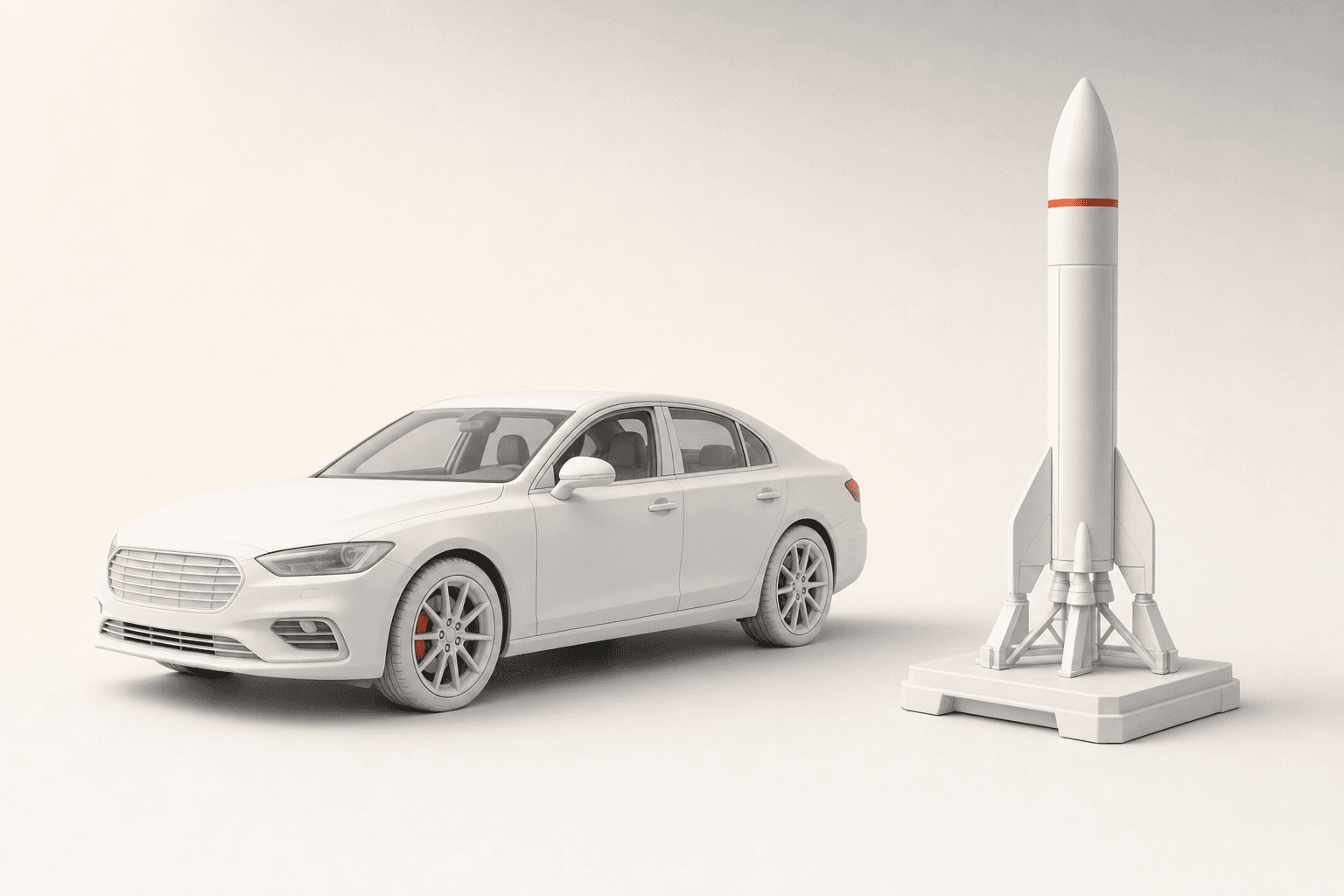
A growing number of procurement and supply chain professionals are making the jump from automotive to aerospace. If you’ve spent time at Tesla, Rivian, Lucid, or one of the legacy OEMs, you’ve probably noticed the pattern -- colleagues leaving for SpaceX, Rocket Lab, Anduril, Relativity, or one of the defense-tech startups that have emerged in the last five years.
I’ve watched this happen across my network since leaving Tesla. The pull is real. The missions are compelling, the companies are growing fast, and the compensation is competitive. But the transition isn’t seamless. Automotive procurement and aerospace procurement share a lot of DNA, but the differences will trip you up if you don’t see them coming.
This is the guide I wish someone had written for the Tesla alumni who called me before making the move.
What Transfers Directly
The good news first. If you’ve run procurement at an automotive OEM -- especially one operating at Tesla’s pace -- you bring skills that aerospace desperately needs.
Supplier negotiation and cost modeling. Automotive procurement runs on should-cost models, competitive bidding, and annual price reduction targets. You know how to decompose a part into material, labor, overhead, and margin. You know how to benchmark suppliers against each other and against your own cost models. Aerospace has historically been less rigorous about this -- particularly in defense, where cost-plus contracts reduced the incentive to optimize. The “new space” companies (SpaceX, Rocket Lab, Anduril) are specifically hiring automotive procurement talent because they want that cost discipline.
High-volume production thinking. Traditional aerospace builds tens or hundreds of units. A satellite constellation or a drone program might need thousands. Automotive people know how to think about production ramp, line rate, BOM cost at scale, and the difference between prototype pricing and production pricing. This is increasingly relevant as aerospace moves toward mass manufacturing -- Anduril’s autonomous systems, SpaceX’s Starlink satellites, Rocket Lab’s Neutron vehicle.
NPI velocity. At Tesla, new product introduction happened at a pace that traditional auto OEMs considered reckless. The Model 3 program sourced, qualified, and industrialized thousands of parts in a compressed timeline. That NPI muscle -- the ability to move from spec to source to supply in months rather than years -- is exactly what the new space and defense companies need.
Supplier development. Automotive has a deep culture of supplier development -- working with suppliers to improve their processes, reduce defects, and hit quality and cost targets. Toyota’s supplier development model is legendary. Tesla adapted this at speed. Aerospace is adopting similar practices, especially as the supply base expands beyond the traditional primes.
What’s Different
Here’s where the transition gets interesting. The table below puts the key differences side by side, and the sections that follow go deeper on each.
Auto vs. Aerospace at a Glance
Dimension | Automotive | Aerospace (Traditional) | New Space (SpaceX, Anduril) |
|---|---|---|---|
Volume | Thousands/day | Tens-hundreds/year | Hundreds-thousands/year |
Quality standard | IATF 16949, PPAP | AS9100, FAI (AS9102) | AS9100 + automotive speed |
Qualification | PPAP levels 1-5, weeks | FAI + Nadcap, months | Compressed FAI, weeks-months |
Sourcing cycle | 4-8 weeks | 6-12 months | 2-4 months |
Cost approach | Annual price reductions, VA/VE | Cost-plus common | Fixed price, cost discipline |
Export controls | Minimal | ITAR/EAR, security clearances | ITAR/EAR + OTA flexibility |
Traceability | Lot-level, statistical | Batch/serial, 100% verification | Batch/serial, automated |
Failure consequence | Warranty, recall | Catastrophic, lives | Mission failure, lives |
Contract type | Piece price + tooling | FFP, CPFF, IDIQ, FAR/DFARS | OTA, FFP, commercial-style |
Implementation timeline | JIT, daily delivery | Scheduled deliveries, buffer stock | Moving toward JIT |
Quality Standards: IATF 16949 vs. AS9100
In automotive, you lived in the world of IATF 16949. PPAP (Production Part Approval Process) was your qualification framework -- five levels of documentation, process capability studies (Cpk), measurement system analysis, control plans. The emphasis was on statistical process control and defect prevention at volume.
In aerospace, the governing standard is AS9100 (evolving to IA9100 in 2026). The qualification framework is FAI -- First Article Inspection per AS9102. The emphasis shifts from statistical capability to complete traceability and verification of every characteristic on the drawing.
The practical difference: in automotive, you might accept a supplier based on process capability data showing they can hold a tolerance 99.7% of the time. In aerospace, you need to verify that the first article actually met every single dimension, and you need traceability back to the raw material heat lot. The documentation burden is heavier, the qualification cycles are longer, and the consequences of a quality escape are measured in lives, not warranty costs.
What this means for you: Your PPAP discipline transfers well, but you need to layer on AS9102 FAI requirements, configuration management, and counterfeit parts prevention (AS5553). If you’ve never worked with special process approvals (Nadcap for heat treating, welding, NDT), that’s a learning curve.
Regulatory Environment: ITAR and Export Controls
This is the one that catches most automotive people off guard.
If you’re moving into defense aerospace -- SpaceX’s government programs, Anduril, or any company working with the Department of Defense -- you’ll encounter ITAR (International Traffic in Arms Regulations) and EAR (Export Administration Regulations). These aren’t just compliance checkboxes. They fundamentally constrain your supply chain.
Under ITAR, you cannot share certain technical data with non-US persons without a license. This means your supplier in Germany or Japan might not be able to see the drawings for the part they’re quoting. Your procurement team may need security clearances. Your sourcing strategy must account for ITAR-controlled components that can only be manufactured by US-person companies at US facilities.
In automotive, you sourced globally with relatively few export control restrictions. In defense aerospace, the supply base is constrained by regulation, and that constraint shapes every sourcing decision.
Volume and Cadence
At Tesla, we were building 5,000 vehicles per week at peak Model 3 production. Each vehicle contained thousands of unique parts. The supply chain was optimized for daily deliveries, just-in-time inventory, and relentless cycle time reduction.
Traditional aerospace operates differently. You might procure 50 flight units over a two-year production run. A “high-rate” program might mean 20 per month. The supply chain is built for reliability and traceability, not throughput. Inventory isn’t a waste to be minimized -- it’s a buffer against supply disruptions on programs where a single missing part can ground a fleet.
That said, the “new space” companies are blurring this line. SpaceX builds Merlin engines at a rate that would be respectable for an automotive component. Anduril is ramping autonomous systems manufacturing at volumes that look more like consumer electronics than traditional defense. If you’re joining one of these companies, your automotive volume mindset is an asset, not a liability.
The Low-Volume Trap
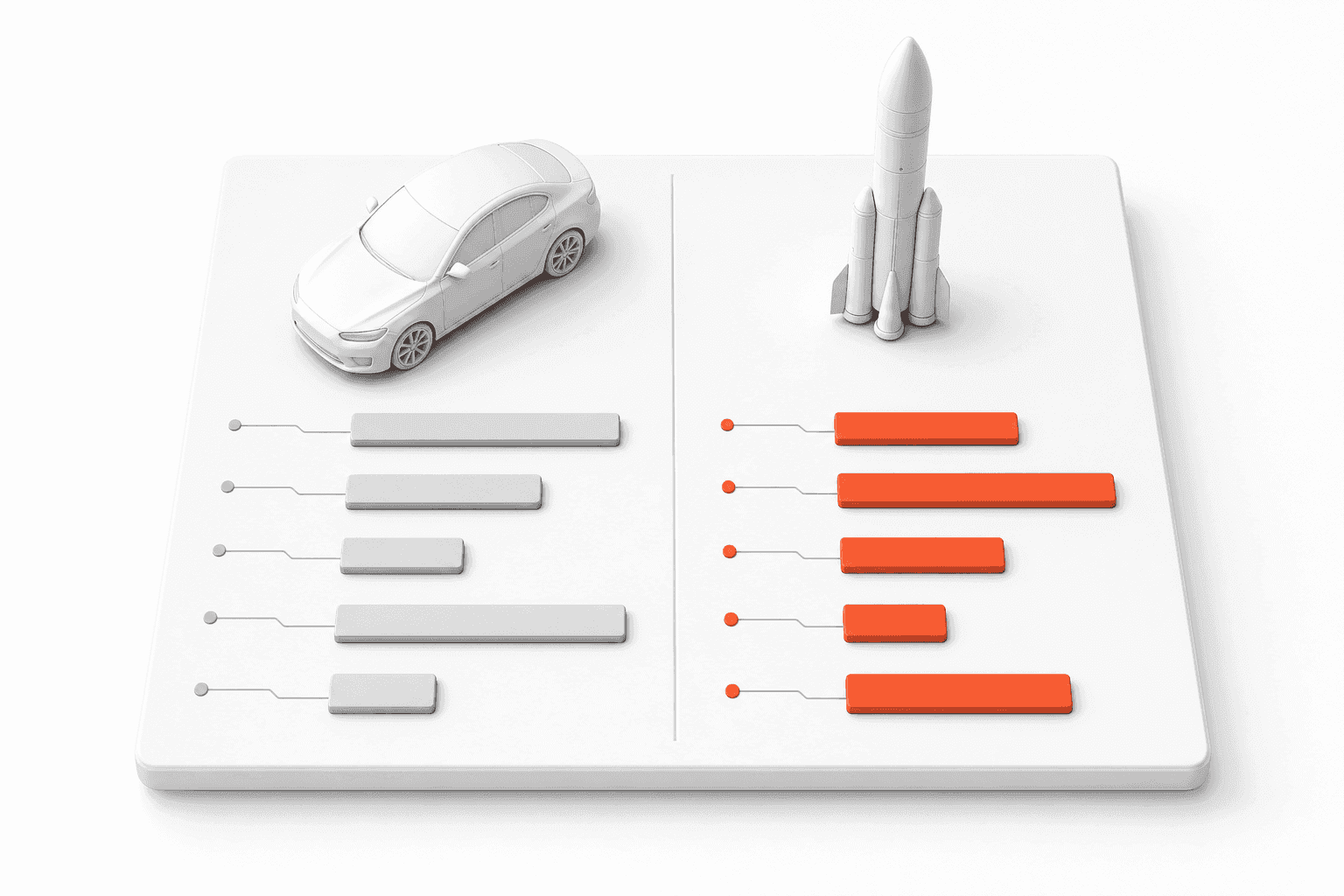
This is the mistake that catches most automotive people. In auto, a 10-piece prototype run is informal -- you might not even issue a PO. In aerospace, a 10-piece production buy can still require full FAI documentation, approved special processes (Nadcap), complete material certifications, and customer acceptance before you ship. Low volume does not mean low rigor. The documentation burden on a 50-unit aerospace production run can exceed the documentation on a 50,000-unit automotive run, because every unit needs individual traceability and every process needs formal approval.
Procurement Cycle Length
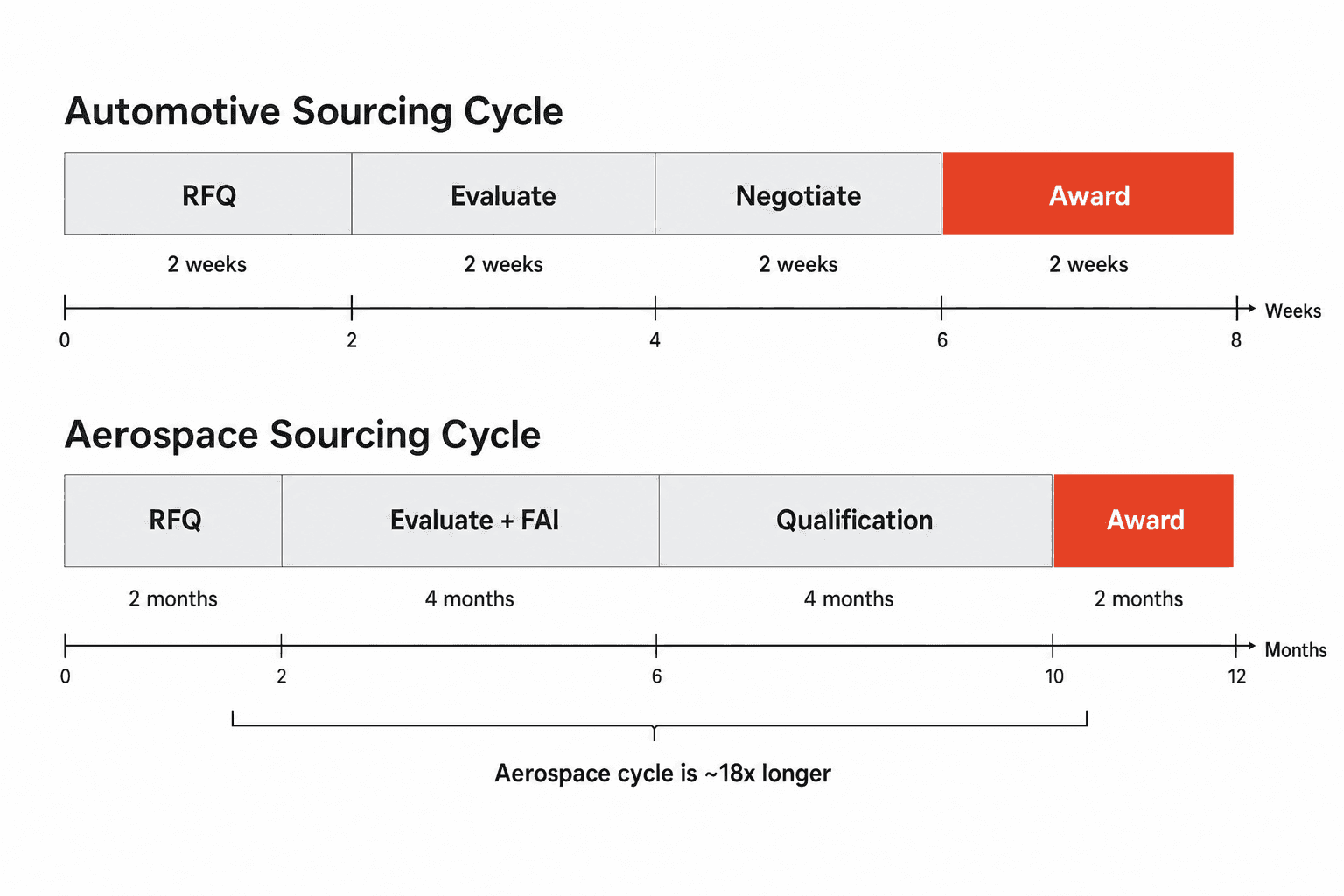
In automotive, a typical sourcing cycle for a new part -- from RFQ to award -- might take 4-8 weeks. At Tesla during NPI, sometimes less.
In aerospace, a sourcing cycle for a flight-critical component can take 6-12 months. The qualification process alone -- first article inspection, material certifications, process validation -- can take longer than an entire automotive sourcing cycle. And if the component is ITAR-controlled, add time for export license processing.
The patience required is real. If you’re used to awarding parts in weeks, prepare for a cadence where some sourcing decisions take a full year to close.
Contract Structures
Automotive contracts are typically based on piece price with annual volume commitments, tooling amortization, and year-over-year cost reduction targets. The negotiation is primarily about unit economics.
Aerospace contracts -- especially in defense -- come in several flavors you may not have seen:
Firm Fixed Price (FFP): Closest to automotive. Price is agreed upfront; supplier bears the cost risk.
Cost Plus Fixed Fee (CPFF): Supplier is reimbursed for costs plus a negotiated fee. Common in development programs where the scope is uncertain.
Time and Materials (T&M): Supplier bills for hours and materials. Used for R&D and services.
IDIQ (Indefinite Delivery, Indefinite Quantity): Framework contract with task orders. Common in government procurement.
If you’ve never navigated FAR/DFARS (Federal Acquisition Regulation / Defense Federal Acquisition Regulation Supplement), the compliance requirements will be new. Government contracts come with audit rights, cost accounting standards, and reporting requirements that commercial automotive contracts don’t have.
The “New Space” Category
SpaceX, Rocket Lab, Anduril, Relativity, Firefly, and the broader wave of defense-tech startups represent a hybrid category that’s neither traditional automotive nor traditional aerospace. They’re building hardware at speeds and volumes that traditional aerospace primes find uncomfortable, using supply chain practices borrowed from automotive and consumer electronics.
At SpaceX, the Merlin engine went through roughly a dozen iterations while flying paying customers -- a development methodology that would be unthinkable at a legacy aerospace prime but familiar to anyone who worked at Tesla during the Model 3 ramp.
Anduril is manufacturing autonomous drones at volumes that require automotive-style production planning, a preview of how warfare itself is being rebuilt around mass-manufactured autonomy. Rocket Lab’s Electron vehicle uses 3D-printed engine components and has launched over 50 times, with a backlog that requires production-line thinking.
These companies use Other Transactional Authority (OTA) contracts that bypass traditional FAR/DFARS procurement rules, giving them more flexibility in how they engage suppliers and structure deals. They want people who can bring automotive speed to aerospace quality standards.
If you’re an automotive procurement professional considering a move, these “new space” companies are the most natural landing spot. You won’t have to unlearn everything you know. You’ll have to learn AS9100, ITAR, and longer qualification cycles -- but the pace, the culture, and the expectations around NPI velocity will feel familiar.
A Practical Transition Checklist
If you’re making the move, here’s what to do in your first 90 days:
Get familiar with AS9100 and AS9102 (FAI). Read the standards. Understand how they differ from IATF 16949 and PPAP. The quality framework is the foundation of everything else.
Learn ITAR basics. If you’re in defense, understand which components and technical data are controlled, and how export restrictions affect your sourcing options.
Map the approval chain. Aerospace procurement decisions often require more internal approvals than automotive -- engineering sign-off on sources, quality approval on FAIs, sometimes government customer approval on supplier selections.
Adjust your timeline expectations. Your first sourcing cycle will take longer than you expect. Build that into your planning.
Bring your cost tools. Should-cost models, competitive bidding frameworks, BOM-level cost tracking -- these are your competitive advantage. Aerospace needs them, and the fact that you already have the discipline is why they hired you.
Build your supplier network. Your automotive supplier contacts are valuable but may not be qualified for aerospace work. Start mapping the AS9100-certified supply base in your commodity areas. The OASIS (Online Aerospace Supplier Information System) database is a good starting point.
Sources
AS9100 vs IATF 16949: Aerospace vs Automotive Quality Standards -- BPR Hub comparison of the two industry quality frameworks
Where Former Tesla and SpaceX Ops Leaders Go Next -- The Big Byte on talent movement from Tesla/SpaceX to defense-tech
Understanding FAI, PPAP, and AS9102 -- Lexco Cable guide on aerospace vs automotive qualification processes
Silicon Valley Players Aim to Follow SpaceX’s Disruptive Path in Defense -- SpaceNews on new space companies adopting startup procurement approaches
ISO 9001 in 2026: AS9100 (IA9100), IATF 16949 Evolution -- Quality Magazine on 2026 standards evolution
SpaceX, Anduril Among Companies to Win Golden Dome Contracts -- Fortune on defense contract awards using OTA procurement
Frequently Asked Questions
What skills transfer directly from automotive to aerospace procurement?
Supplier negotiation, should-cost modeling, competitive bidding, NPI management, supplier development, and production ramp planning all transfer directly. Automotive procurement professionals are particularly valued at “new space” companies (SpaceX, Rocket Lab, Anduril) that need cost discipline and high-volume production thinking that traditional aerospace procurement teams often lack.
What is the biggest difference between automotive and aerospace procurement?
The quality and regulatory framework. Automotive uses IATF 16949 with PPAP-based supplier qualification. Aerospace uses AS9100 with First Article Inspection (AS9102), plus ITAR export controls for defense programs. The traceability requirements are more stringent (down to raw material batch level), qualification cycles are longer, and the consequences of quality failures are measured in safety rather than warranty cost.
What is ITAR and why does it matter for procurement?
ITAR (International Traffic in Arms Regulations) controls the export of defense-related articles and technical data. In procurement, this means certain components can only be sourced from US-person companies, technical drawings may not be shared with non-US suppliers without licenses, and your team may need security clearances. ITAR fundamentally constrains your supply base and must be factored into every sourcing strategy for defense programs.
Are “new space” companies like SpaceX different from traditional aerospace?
Yes. Companies like SpaceX, Rocket Lab, and Anduril blend automotive speed with aerospace quality requirements. They manufacture at higher volumes, iterate faster, use OTA contracts that bypass traditional FAR/DFARS procurement rules, and actively recruit automotive procurement talent. They’re the most natural landing spot for automotive procurement professionals making the transition.
How long should I expect the transition to take?
Plan for 6-12 months to feel fully comfortable. The first 90 days should focus on learning AS9100/AS9102, understanding ITAR implications, and mapping the aerospace supplier base in your commodity areas. Your cost modeling and negotiation skills will be immediately valuable; the quality framework and regulatory knowledge take longer to build.
A growing number of procurement and supply chain professionals are making the jump from automotive to aerospace. If you’ve spent time at Tesla, Rivian, Lucid, or one of the legacy OEMs, you’ve probably noticed the pattern -- colleagues leaving for SpaceX, Rocket Lab, Anduril, Relativity, or one of the defense-tech startups that have emerged in the last five years.
I’ve watched this happen across my network since leaving Tesla. The pull is real. The missions are compelling, the companies are growing fast, and the compensation is competitive. But the transition isn’t seamless. Automotive procurement and aerospace procurement share a lot of DNA, but the differences will trip you up if you don’t see them coming.
This is the guide I wish someone had written for the Tesla alumni who called me before making the move.
What Transfers Directly
The good news first. If you’ve run procurement at an automotive OEM -- especially one operating at Tesla’s pace -- you bring skills that aerospace desperately needs.
Supplier negotiation and cost modeling. Automotive procurement runs on should-cost models, competitive bidding, and annual price reduction targets. You know how to decompose a part into material, labor, overhead, and margin. You know how to benchmark suppliers against each other and against your own cost models. Aerospace has historically been less rigorous about this -- particularly in defense, where cost-plus contracts reduced the incentive to optimize. The “new space” companies (SpaceX, Rocket Lab, Anduril) are specifically hiring automotive procurement talent because they want that cost discipline.
High-volume production thinking. Traditional aerospace builds tens or hundreds of units. A satellite constellation or a drone program might need thousands. Automotive people know how to think about production ramp, line rate, BOM cost at scale, and the difference between prototype pricing and production pricing. This is increasingly relevant as aerospace moves toward mass manufacturing -- Anduril’s autonomous systems, SpaceX’s Starlink satellites, Rocket Lab’s Neutron vehicle.
NPI velocity. At Tesla, new product introduction happened at a pace that traditional auto OEMs considered reckless. The Model 3 program sourced, qualified, and industrialized thousands of parts in a compressed timeline. That NPI muscle -- the ability to move from spec to source to supply in months rather than years -- is exactly what the new space and defense companies need.
Supplier development. Automotive has a deep culture of supplier development -- working with suppliers to improve their processes, reduce defects, and hit quality and cost targets. Toyota’s supplier development model is legendary. Tesla adapted this at speed. Aerospace is adopting similar practices, especially as the supply base expands beyond the traditional primes.
What’s Different
Here’s where the transition gets interesting. The table below puts the key differences side by side, and the sections that follow go deeper on each.
Auto vs. Aerospace at a Glance
Dimension | Automotive | Aerospace (Traditional) | New Space (SpaceX, Anduril) |
|---|---|---|---|
Volume | Thousands/day | Tens-hundreds/year | Hundreds-thousands/year |
Quality standard | IATF 16949, PPAP | AS9100, FAI (AS9102) | AS9100 + automotive speed |
Qualification | PPAP levels 1-5, weeks | FAI + Nadcap, months | Compressed FAI, weeks-months |
Sourcing cycle | 4-8 weeks | 6-12 months | 2-4 months |
Cost approach | Annual price reductions, VA/VE | Cost-plus common | Fixed price, cost discipline |
Export controls | Minimal | ITAR/EAR, security clearances | ITAR/EAR + OTA flexibility |
Traceability | Lot-level, statistical | Batch/serial, 100% verification | Batch/serial, automated |
Failure consequence | Warranty, recall | Catastrophic, lives | Mission failure, lives |
Contract type | Piece price + tooling | FFP, CPFF, IDIQ, FAR/DFARS | OTA, FFP, commercial-style |
Implementation timeline | JIT, daily delivery | Scheduled deliveries, buffer stock | Moving toward JIT |
Quality Standards: IATF 16949 vs. AS9100
In automotive, you lived in the world of IATF 16949. PPAP (Production Part Approval Process) was your qualification framework -- five levels of documentation, process capability studies (Cpk), measurement system analysis, control plans. The emphasis was on statistical process control and defect prevention at volume.
In aerospace, the governing standard is AS9100 (evolving to IA9100 in 2026). The qualification framework is FAI -- First Article Inspection per AS9102. The emphasis shifts from statistical capability to complete traceability and verification of every characteristic on the drawing.
The practical difference: in automotive, you might accept a supplier based on process capability data showing they can hold a tolerance 99.7% of the time. In aerospace, you need to verify that the first article actually met every single dimension, and you need traceability back to the raw material heat lot. The documentation burden is heavier, the qualification cycles are longer, and the consequences of a quality escape are measured in lives, not warranty costs.
What this means for you: Your PPAP discipline transfers well, but you need to layer on AS9102 FAI requirements, configuration management, and counterfeit parts prevention (AS5553). If you’ve never worked with special process approvals (Nadcap for heat treating, welding, NDT), that’s a learning curve.
Regulatory Environment: ITAR and Export Controls
This is the one that catches most automotive people off guard.
If you’re moving into defense aerospace -- SpaceX’s government programs, Anduril, or any company working with the Department of Defense -- you’ll encounter ITAR (International Traffic in Arms Regulations) and EAR (Export Administration Regulations). These aren’t just compliance checkboxes. They fundamentally constrain your supply chain.
Under ITAR, you cannot share certain technical data with non-US persons without a license. This means your supplier in Germany or Japan might not be able to see the drawings for the part they’re quoting. Your procurement team may need security clearances. Your sourcing strategy must account for ITAR-controlled components that can only be manufactured by US-person companies at US facilities.
In automotive, you sourced globally with relatively few export control restrictions. In defense aerospace, the supply base is constrained by regulation, and that constraint shapes every sourcing decision.
Volume and Cadence
At Tesla, we were building 5,000 vehicles per week at peak Model 3 production. Each vehicle contained thousands of unique parts. The supply chain was optimized for daily deliveries, just-in-time inventory, and relentless cycle time reduction.
Traditional aerospace operates differently. You might procure 50 flight units over a two-year production run. A “high-rate” program might mean 20 per month. The supply chain is built for reliability and traceability, not throughput. Inventory isn’t a waste to be minimized -- it’s a buffer against supply disruptions on programs where a single missing part can ground a fleet.
That said, the “new space” companies are blurring this line. SpaceX builds Merlin engines at a rate that would be respectable for an automotive component. Anduril is ramping autonomous systems manufacturing at volumes that look more like consumer electronics than traditional defense. If you’re joining one of these companies, your automotive volume mindset is an asset, not a liability.
The Low-Volume Trap
This is the mistake that catches most automotive people. In auto, a 10-piece prototype run is informal -- you might not even issue a PO. In aerospace, a 10-piece production buy can still require full FAI documentation, approved special processes (Nadcap), complete material certifications, and customer acceptance before you ship. Low volume does not mean low rigor. The documentation burden on a 50-unit aerospace production run can exceed the documentation on a 50,000-unit automotive run, because every unit needs individual traceability and every process needs formal approval.
Procurement Cycle Length
In automotive, a typical sourcing cycle for a new part -- from RFQ to award -- might take 4-8 weeks. At Tesla during NPI, sometimes less.
In aerospace, a sourcing cycle for a flight-critical component can take 6-12 months. The qualification process alone -- first article inspection, material certifications, process validation -- can take longer than an entire automotive sourcing cycle. And if the component is ITAR-controlled, add time for export license processing.
The patience required is real. If you’re used to awarding parts in weeks, prepare for a cadence where some sourcing decisions take a full year to close.
Contract Structures
Automotive contracts are typically based on piece price with annual volume commitments, tooling amortization, and year-over-year cost reduction targets. The negotiation is primarily about unit economics.
Aerospace contracts -- especially in defense -- come in several flavors you may not have seen:
Firm Fixed Price (FFP): Closest to automotive. Price is agreed upfront; supplier bears the cost risk.
Cost Plus Fixed Fee (CPFF): Supplier is reimbursed for costs plus a negotiated fee. Common in development programs where the scope is uncertain.
Time and Materials (T&M): Supplier bills for hours and materials. Used for R&D and services.
IDIQ (Indefinite Delivery, Indefinite Quantity): Framework contract with task orders. Common in government procurement.
If you’ve never navigated FAR/DFARS (Federal Acquisition Regulation / Defense Federal Acquisition Regulation Supplement), the compliance requirements will be new. Government contracts come with audit rights, cost accounting standards, and reporting requirements that commercial automotive contracts don’t have.
The “New Space” Category
SpaceX, Rocket Lab, Anduril, Relativity, Firefly, and the broader wave of defense-tech startups represent a hybrid category that’s neither traditional automotive nor traditional aerospace. They’re building hardware at speeds and volumes that traditional aerospace primes find uncomfortable, using supply chain practices borrowed from automotive and consumer electronics.
At SpaceX, the Merlin engine went through roughly a dozen iterations while flying paying customers -- a development methodology that would be unthinkable at a legacy aerospace prime but familiar to anyone who worked at Tesla during the Model 3 ramp.
Anduril is manufacturing autonomous drones at volumes that require automotive-style production planning, a preview of how warfare itself is being rebuilt around mass-manufactured autonomy. Rocket Lab’s Electron vehicle uses 3D-printed engine components and has launched over 50 times, with a backlog that requires production-line thinking.
These companies use Other Transactional Authority (OTA) contracts that bypass traditional FAR/DFARS procurement rules, giving them more flexibility in how they engage suppliers and structure deals. They want people who can bring automotive speed to aerospace quality standards.
If you’re an automotive procurement professional considering a move, these “new space” companies are the most natural landing spot. You won’t have to unlearn everything you know. You’ll have to learn AS9100, ITAR, and longer qualification cycles -- but the pace, the culture, and the expectations around NPI velocity will feel familiar.
A Practical Transition Checklist
If you’re making the move, here’s what to do in your first 90 days:
Get familiar with AS9100 and AS9102 (FAI). Read the standards. Understand how they differ from IATF 16949 and PPAP. The quality framework is the foundation of everything else.
Learn ITAR basics. If you’re in defense, understand which components and technical data are controlled, and how export restrictions affect your sourcing options.
Map the approval chain. Aerospace procurement decisions often require more internal approvals than automotive -- engineering sign-off on sources, quality approval on FAIs, sometimes government customer approval on supplier selections.
Adjust your timeline expectations. Your first sourcing cycle will take longer than you expect. Build that into your planning.
Bring your cost tools. Should-cost models, competitive bidding frameworks, BOM-level cost tracking -- these are your competitive advantage. Aerospace needs them, and the fact that you already have the discipline is why they hired you.
Build your supplier network. Your automotive supplier contacts are valuable but may not be qualified for aerospace work. Start mapping the AS9100-certified supply base in your commodity areas. The OASIS (Online Aerospace Supplier Information System) database is a good starting point.
Sources
AS9100 vs IATF 16949: Aerospace vs Automotive Quality Standards -- BPR Hub comparison of the two industry quality frameworks
Where Former Tesla and SpaceX Ops Leaders Go Next -- The Big Byte on talent movement from Tesla/SpaceX to defense-tech
Understanding FAI, PPAP, and AS9102 -- Lexco Cable guide on aerospace vs automotive qualification processes
Silicon Valley Players Aim to Follow SpaceX’s Disruptive Path in Defense -- SpaceNews on new space companies adopting startup procurement approaches
ISO 9001 in 2026: AS9100 (IA9100), IATF 16949 Evolution -- Quality Magazine on 2026 standards evolution
SpaceX, Anduril Among Companies to Win Golden Dome Contracts -- Fortune on defense contract awards using OTA procurement
Frequently Asked Questions
What skills transfer directly from automotive to aerospace procurement?
Supplier negotiation, should-cost modeling, competitive bidding, NPI management, supplier development, and production ramp planning all transfer directly. Automotive procurement professionals are particularly valued at “new space” companies (SpaceX, Rocket Lab, Anduril) that need cost discipline and high-volume production thinking that traditional aerospace procurement teams often lack.
What is the biggest difference between automotive and aerospace procurement?
The quality and regulatory framework. Automotive uses IATF 16949 with PPAP-based supplier qualification. Aerospace uses AS9100 with First Article Inspection (AS9102), plus ITAR export controls for defense programs. The traceability requirements are more stringent (down to raw material batch level), qualification cycles are longer, and the consequences of quality failures are measured in safety rather than warranty cost.
What is ITAR and why does it matter for procurement?
ITAR (International Traffic in Arms Regulations) controls the export of defense-related articles and technical data. In procurement, this means certain components can only be sourced from US-person companies, technical drawings may not be shared with non-US suppliers without licenses, and your team may need security clearances. ITAR fundamentally constrains your supply base and must be factored into every sourcing strategy for defense programs.
Are “new space” companies like SpaceX different from traditional aerospace?
Yes. Companies like SpaceX, Rocket Lab, and Anduril blend automotive speed with aerospace quality requirements. They manufacture at higher volumes, iterate faster, use OTA contracts that bypass traditional FAR/DFARS procurement rules, and actively recruit automotive procurement talent. They’re the most natural landing spot for automotive procurement professionals making the transition.
How long should I expect the transition to take?
Plan for 6-12 months to feel fully comfortable. The first 90 days should focus on learning AS9100/AS9102, understanding ITAR implications, and mapping the aerospace supplier base in your commodity areas. Your cost modeling and negotiation skills will be immediately valuable; the quality framework and regulatory knowledge take longer to build.
A growing number of procurement and supply chain professionals are making the jump from automotive to aerospace. If you’ve spent time at Tesla, Rivian, Lucid, or one of the legacy OEMs, you’ve probably noticed the pattern -- colleagues leaving for SpaceX, Rocket Lab, Anduril, Relativity, or one of the defense-tech startups that have emerged in the last five years.
I’ve watched this happen across my network since leaving Tesla. The pull is real. The missions are compelling, the companies are growing fast, and the compensation is competitive. But the transition isn’t seamless. Automotive procurement and aerospace procurement share a lot of DNA, but the differences will trip you up if you don’t see them coming.
This is the guide I wish someone had written for the Tesla alumni who called me before making the move.
What Transfers Directly
The good news first. If you’ve run procurement at an automotive OEM -- especially one operating at Tesla’s pace -- you bring skills that aerospace desperately needs.
Supplier negotiation and cost modeling. Automotive procurement runs on should-cost models, competitive bidding, and annual price reduction targets. You know how to decompose a part into material, labor, overhead, and margin. You know how to benchmark suppliers against each other and against your own cost models. Aerospace has historically been less rigorous about this -- particularly in defense, where cost-plus contracts reduced the incentive to optimize. The “new space” companies (SpaceX, Rocket Lab, Anduril) are specifically hiring automotive procurement talent because they want that cost discipline.
High-volume production thinking. Traditional aerospace builds tens or hundreds of units. A satellite constellation or a drone program might need thousands. Automotive people know how to think about production ramp, line rate, BOM cost at scale, and the difference between prototype pricing and production pricing. This is increasingly relevant as aerospace moves toward mass manufacturing -- Anduril’s autonomous systems, SpaceX’s Starlink satellites, Rocket Lab’s Neutron vehicle.
NPI velocity. At Tesla, new product introduction happened at a pace that traditional auto OEMs considered reckless. The Model 3 program sourced, qualified, and industrialized thousands of parts in a compressed timeline. That NPI muscle -- the ability to move from spec to source to supply in months rather than years -- is exactly what the new space and defense companies need.
Supplier development. Automotive has a deep culture of supplier development -- working with suppliers to improve their processes, reduce defects, and hit quality and cost targets. Toyota’s supplier development model is legendary. Tesla adapted this at speed. Aerospace is adopting similar practices, especially as the supply base expands beyond the traditional primes.
What’s Different
Here’s where the transition gets interesting. The table below puts the key differences side by side, and the sections that follow go deeper on each.
Auto vs. Aerospace at a Glance
Dimension | Automotive | Aerospace (Traditional) | New Space (SpaceX, Anduril) |
|---|---|---|---|
Volume | Thousands/day | Tens-hundreds/year | Hundreds-thousands/year |
Quality standard | IATF 16949, PPAP | AS9100, FAI (AS9102) | AS9100 + automotive speed |
Qualification | PPAP levels 1-5, weeks | FAI + Nadcap, months | Compressed FAI, weeks-months |
Sourcing cycle | 4-8 weeks | 6-12 months | 2-4 months |
Cost approach | Annual price reductions, VA/VE | Cost-plus common | Fixed price, cost discipline |
Export controls | Minimal | ITAR/EAR, security clearances | ITAR/EAR + OTA flexibility |
Traceability | Lot-level, statistical | Batch/serial, 100% verification | Batch/serial, automated |
Failure consequence | Warranty, recall | Catastrophic, lives | Mission failure, lives |
Contract type | Piece price + tooling | FFP, CPFF, IDIQ, FAR/DFARS | OTA, FFP, commercial-style |
Implementation timeline | JIT, daily delivery | Scheduled deliveries, buffer stock | Moving toward JIT |
Quality Standards: IATF 16949 vs. AS9100
In automotive, you lived in the world of IATF 16949. PPAP (Production Part Approval Process) was your qualification framework -- five levels of documentation, process capability studies (Cpk), measurement system analysis, control plans. The emphasis was on statistical process control and defect prevention at volume.
In aerospace, the governing standard is AS9100 (evolving to IA9100 in 2026). The qualification framework is FAI -- First Article Inspection per AS9102. The emphasis shifts from statistical capability to complete traceability and verification of every characteristic on the drawing.
The practical difference: in automotive, you might accept a supplier based on process capability data showing they can hold a tolerance 99.7% of the time. In aerospace, you need to verify that the first article actually met every single dimension, and you need traceability back to the raw material heat lot. The documentation burden is heavier, the qualification cycles are longer, and the consequences of a quality escape are measured in lives, not warranty costs.
What this means for you: Your PPAP discipline transfers well, but you need to layer on AS9102 FAI requirements, configuration management, and counterfeit parts prevention (AS5553). If you’ve never worked with special process approvals (Nadcap for heat treating, welding, NDT), that’s a learning curve.
Regulatory Environment: ITAR and Export Controls
This is the one that catches most automotive people off guard.
If you’re moving into defense aerospace -- SpaceX’s government programs, Anduril, or any company working with the Department of Defense -- you’ll encounter ITAR (International Traffic in Arms Regulations) and EAR (Export Administration Regulations). These aren’t just compliance checkboxes. They fundamentally constrain your supply chain.
Under ITAR, you cannot share certain technical data with non-US persons without a license. This means your supplier in Germany or Japan might not be able to see the drawings for the part they’re quoting. Your procurement team may need security clearances. Your sourcing strategy must account for ITAR-controlled components that can only be manufactured by US-person companies at US facilities.
In automotive, you sourced globally with relatively few export control restrictions. In defense aerospace, the supply base is constrained by regulation, and that constraint shapes every sourcing decision.
Volume and Cadence
At Tesla, we were building 5,000 vehicles per week at peak Model 3 production. Each vehicle contained thousands of unique parts. The supply chain was optimized for daily deliveries, just-in-time inventory, and relentless cycle time reduction.
Traditional aerospace operates differently. You might procure 50 flight units over a two-year production run. A “high-rate” program might mean 20 per month. The supply chain is built for reliability and traceability, not throughput. Inventory isn’t a waste to be minimized -- it’s a buffer against supply disruptions on programs where a single missing part can ground a fleet.
That said, the “new space” companies are blurring this line. SpaceX builds Merlin engines at a rate that would be respectable for an automotive component. Anduril is ramping autonomous systems manufacturing at volumes that look more like consumer electronics than traditional defense. If you’re joining one of these companies, your automotive volume mindset is an asset, not a liability.
The Low-Volume Trap
This is the mistake that catches most automotive people. In auto, a 10-piece prototype run is informal -- you might not even issue a PO. In aerospace, a 10-piece production buy can still require full FAI documentation, approved special processes (Nadcap), complete material certifications, and customer acceptance before you ship. Low volume does not mean low rigor. The documentation burden on a 50-unit aerospace production run can exceed the documentation on a 50,000-unit automotive run, because every unit needs individual traceability and every process needs formal approval.
Procurement Cycle Length
In automotive, a typical sourcing cycle for a new part -- from RFQ to award -- might take 4-8 weeks. At Tesla during NPI, sometimes less.
In aerospace, a sourcing cycle for a flight-critical component can take 6-12 months. The qualification process alone -- first article inspection, material certifications, process validation -- can take longer than an entire automotive sourcing cycle. And if the component is ITAR-controlled, add time for export license processing.
The patience required is real. If you’re used to awarding parts in weeks, prepare for a cadence where some sourcing decisions take a full year to close.
Contract Structures
Automotive contracts are typically based on piece price with annual volume commitments, tooling amortization, and year-over-year cost reduction targets. The negotiation is primarily about unit economics.
Aerospace contracts -- especially in defense -- come in several flavors you may not have seen:
Firm Fixed Price (FFP): Closest to automotive. Price is agreed upfront; supplier bears the cost risk.
Cost Plus Fixed Fee (CPFF): Supplier is reimbursed for costs plus a negotiated fee. Common in development programs where the scope is uncertain.
Time and Materials (T&M): Supplier bills for hours and materials. Used for R&D and services.
IDIQ (Indefinite Delivery, Indefinite Quantity): Framework contract with task orders. Common in government procurement.
If you’ve never navigated FAR/DFARS (Federal Acquisition Regulation / Defense Federal Acquisition Regulation Supplement), the compliance requirements will be new. Government contracts come with audit rights, cost accounting standards, and reporting requirements that commercial automotive contracts don’t have.
The “New Space” Category
SpaceX, Rocket Lab, Anduril, Relativity, Firefly, and the broader wave of defense-tech startups represent a hybrid category that’s neither traditional automotive nor traditional aerospace. They’re building hardware at speeds and volumes that traditional aerospace primes find uncomfortable, using supply chain practices borrowed from automotive and consumer electronics.
At SpaceX, the Merlin engine went through roughly a dozen iterations while flying paying customers -- a development methodology that would be unthinkable at a legacy aerospace prime but familiar to anyone who worked at Tesla during the Model 3 ramp.
Anduril is manufacturing autonomous drones at volumes that require automotive-style production planning, a preview of how warfare itself is being rebuilt around mass-manufactured autonomy. Rocket Lab’s Electron vehicle uses 3D-printed engine components and has launched over 50 times, with a backlog that requires production-line thinking.
These companies use Other Transactional Authority (OTA) contracts that bypass traditional FAR/DFARS procurement rules, giving them more flexibility in how they engage suppliers and structure deals. They want people who can bring automotive speed to aerospace quality standards.
If you’re an automotive procurement professional considering a move, these “new space” companies are the most natural landing spot. You won’t have to unlearn everything you know. You’ll have to learn AS9100, ITAR, and longer qualification cycles -- but the pace, the culture, and the expectations around NPI velocity will feel familiar.
A Practical Transition Checklist
If you’re making the move, here’s what to do in your first 90 days:
Get familiar with AS9100 and AS9102 (FAI). Read the standards. Understand how they differ from IATF 16949 and PPAP. The quality framework is the foundation of everything else.
Learn ITAR basics. If you’re in defense, understand which components and technical data are controlled, and how export restrictions affect your sourcing options.
Map the approval chain. Aerospace procurement decisions often require more internal approvals than automotive -- engineering sign-off on sources, quality approval on FAIs, sometimes government customer approval on supplier selections.
Adjust your timeline expectations. Your first sourcing cycle will take longer than you expect. Build that into your planning.
Bring your cost tools. Should-cost models, competitive bidding frameworks, BOM-level cost tracking -- these are your competitive advantage. Aerospace needs them, and the fact that you already have the discipline is why they hired you.
Build your supplier network. Your automotive supplier contacts are valuable but may not be qualified for aerospace work. Start mapping the AS9100-certified supply base in your commodity areas. The OASIS (Online Aerospace Supplier Information System) database is a good starting point.
Sources
AS9100 vs IATF 16949: Aerospace vs Automotive Quality Standards -- BPR Hub comparison of the two industry quality frameworks
Where Former Tesla and SpaceX Ops Leaders Go Next -- The Big Byte on talent movement from Tesla/SpaceX to defense-tech
Understanding FAI, PPAP, and AS9102 -- Lexco Cable guide on aerospace vs automotive qualification processes
Silicon Valley Players Aim to Follow SpaceX’s Disruptive Path in Defense -- SpaceNews on new space companies adopting startup procurement approaches
ISO 9001 in 2026: AS9100 (IA9100), IATF 16949 Evolution -- Quality Magazine on 2026 standards evolution
SpaceX, Anduril Among Companies to Win Golden Dome Contracts -- Fortune on defense contract awards using OTA procurement
Frequently Asked Questions
What skills transfer directly from automotive to aerospace procurement?
Supplier negotiation, should-cost modeling, competitive bidding, NPI management, supplier development, and production ramp planning all transfer directly. Automotive procurement professionals are particularly valued at “new space” companies (SpaceX, Rocket Lab, Anduril) that need cost discipline and high-volume production thinking that traditional aerospace procurement teams often lack.
What is the biggest difference between automotive and aerospace procurement?
The quality and regulatory framework. Automotive uses IATF 16949 with PPAP-based supplier qualification. Aerospace uses AS9100 with First Article Inspection (AS9102), plus ITAR export controls for defense programs. The traceability requirements are more stringent (down to raw material batch level), qualification cycles are longer, and the consequences of quality failures are measured in safety rather than warranty cost.
What is ITAR and why does it matter for procurement?
ITAR (International Traffic in Arms Regulations) controls the export of defense-related articles and technical data. In procurement, this means certain components can only be sourced from US-person companies, technical drawings may not be shared with non-US suppliers without licenses, and your team may need security clearances. ITAR fundamentally constrains your supply base and must be factored into every sourcing strategy for defense programs.
Are “new space” companies like SpaceX different from traditional aerospace?
Yes. Companies like SpaceX, Rocket Lab, and Anduril blend automotive speed with aerospace quality requirements. They manufacture at higher volumes, iterate faster, use OTA contracts that bypass traditional FAR/DFARS procurement rules, and actively recruit automotive procurement talent. They’re the most natural landing spot for automotive procurement professionals making the transition.
How long should I expect the transition to take?
Plan for 6-12 months to feel fully comfortable. The first 90 days should focus on learning AS9100/AS9102, understanding ITAR implications, and mapping the aerospace supplier base in your commodity areas. Your cost modeling and negotiation skills will be immediately valuable; the quality framework and regulatory knowledge take longer to build.
Read more


Read more
Read more
Faster sourcing. Lower cost. Less chaos.
See how LightSource connects engineering, procurement, and suppliers in one operating system to help you launch faster at lower cost.
SOC 2
Kearney #1 2024
Gartner Cool Vendor
Procuretech 100
G2 Top Rated
Faster sourcing. Lower cost. Less chaos.
See how LightSource connects engineering, procurement, and suppliers in one operating system to help you launch faster at lower cost.
SOC 2
Kearney #1 2024
Gartner Cool Vendor
Procuretech 100
G2 Top Rated
Faster sourcing. Lower cost. Less chaos.
See how LightSource connects engineering, procurement, and suppliers in one operating system to help you launch faster at lower cost.
SOC 2
Kearney #1 2024
Gartner Cool Vendor
Procuretech 100
G2 Top Rated
Trusted by:
Trusted by:
Trusted by: