

I’ve spent the last decade working across procurement organizations -- at Tesla, at Waymo, and now at LightSource, where we build the AI tooling that’s reshaping how sourcing teams work. The question I get most from procurement leaders isn’t “will AI change our function?” They already know it will. The question is: “Which of my people should I be worried about, and which should I be investing in?” (I’ve also written up what the people building AI themselves agree on -- and where they contradict each other; it’s useful context for this ranking.)
Related: Fluency First lays out the order of operations behind these exposure scores -- fluency, systems, then the org chart.
The honest answer is that the impact isn’t uniform. A purchasing clerk and a global sourcing manager both work in “procurement,” but the overlap in what they do day-to-day is minimal. AI hits them in completely different ways. The clerk’s job is mostly data entry and transactional processing -- exactly what AI is built to automate. The GSM’s job is relationships, negotiation strategy, and cross-functional influence -- exactly what AI can’t do.
This post maps every major role in procurement and supply chain, explains what each one actually does, and scores it on how much AI will change the work over the next three years. It’s written for CPOs planning headcount, for procurement professionals thinking about their careers, and for anyone trying to separate the signal from the hype.
The Roles: A Complete Taxonomy
Before scoring AI impact, it helps to see the full landscape. Procurement and supply chain contains roughly 25 distinct roles across four functional clusters.
Cluster 1: Transactional Procurement
These roles execute purchases, process paperwork, and maintain the operational backbone.
Purchasing Clerk -- Creates POs, processes invoices, maintains records, handles data entry. ($40K-$55K)
Buyer / Purchasing Agent -- Manages supplier quotes, places orders, handles routine negotiations for assigned commodities. ($55K-$80K)
Senior Buyer -- Same as buyer but for higher-value or more complex categories. Mentors junior buyers. ($75K-$100K)
Expediter / Production Planner Clerk -- Coordinates material flow, follows up on late deliveries, manages hot lists. ($45K-$65K)
Cluster 2: Strategic Sourcing
These roles develop category strategies, manage supplier relationships, and drive cost optimization.
Strategic Sourcing Analyst -- Runs spend analysis, builds should-cost models, supports category strategies with data. ($65K-$90K)
Category Manager -- Owns a spend category end-to-end: market analysis, supplier strategy, RFQ execution, negotiations, contract management. ($90K-$130K)
Global Sourcing Manager (GSM) -- Manages sourcing across geographies, handles international suppliers, navigates trade compliance and Incoterms. ($110K-$150K)
Commodity Manager -- Deep specialist in a specific material family (metals, plastics, electronics). Tracks commodity markets, hedges risk. ($95K-$140K)
Procurement Engineer / Cost Engineer -- Bridges engineering and procurement. Builds parametric cost models, evaluates supplier manufacturing processes, drives design-for-cost decisions. ($85K-$120K)
Contract Manager -- Drafts, negotiates, and manages supplier contracts. Handles terms, compliance, renewals, and dispute resolution. ($80K-$115K)
Cluster 3: Supplier Quality and Engineering
These roles ensure suppliers can actually deliver what they’ve been awarded.
Supplier Quality Engineer (SQE) -- Qualifies supplier manufacturing processes, conducts audits, manages PPAP/APQP, resolves quality escapes. ($75K-$110K)
Supplier Industrialization Engineer (SIE) -- Supports new product introduction at supplier sites. Ensures production readiness, validates tooling, manages launch timelines. ($85K-$120K)
Vendor Manager -- Manages the overall supplier relationship for strategic partners. Conducts business reviews, drives continuous improvement. ($80K-$110K)
Cluster 4: Supply Chain Operations
These roles manage the physical flow of materials from supplier to factory to customer.
Material Planner -- Converts demand forecasts into purchase requirements. Manages MRP, safety stock, and replenishment schedules. ($60K-$85K)
Demand Planner -- Forecasts customer demand using historical data, market intelligence, and sales input. ($70K-$100K)
Supply Planner -- Balances supply against demand across factories, manages production scheduling and capacity constraints. ($70K-$100K)
Logistics Coordinator -- Arranges transportation, tracks shipments, manages freight documentation and customs. ($50K-$75K)
Warehouse / Inventory Manager -- Manages physical inventory, storage optimization, receiving, and distribution. ($60K-$90K)
Supply Chain Analyst -- Builds dashboards, analyzes lead times, identifies bottlenecks, supports S&OP processes. ($65K-$95K)
Supply Chain Risk Manager -- Monitors disruption signals, maps sub-tier dependencies, develops contingency plans. ($90K-$130K)
Cluster 5: Leadership
Procurement Data Analyst / AI Manager -- Emerging role. Manages AI tools, trains models, validates outputs, builds prompt libraries. ($80K-$120K)
Director of Procurement -- Leads the procurement function for a business unit or region. Sets strategy, manages team. ($140K-$200K)
VP of Supply Chain -- Enterprise-level supply chain leadership across procurement, logistics, and planning. ($180K-$300K)
Chief Procurement Officer (CPO) -- Highest procurement executive. Strategy, governance, board-level reporting. ($250K-$540K+ at F500)
The AI Impact Scorecard
Now the table that matters. For each role, I’ve scored three dimensions:
Automation Exposure (1-5): How much of the current daily work is automatable by AI within 3 years. 5 = nearly all tasks automatable.
AI Augmentation Value (1-5): How much better the role becomes when paired with AI tools. 5 = dramatically more effective.
Net Impact: The overall verdict -- 🔴 Role shrinks significantly, 🟡 Role transforms (same headcount, different work), 🟢 Role grows or is enhanced, ⚪ Essentially unchanged.
Transactional Procurement
Role | Automation Exposure | Augmentation Value | Net Impact | 3-Year Outlook |
|---|---|---|---|---|
Purchasing Clerk | 5 | 1 | 🔴 Shrinks | 60-80% of these positions eliminated. Remaining clerks handle exceptions only. |
Buyer / Purchasing Agent | 4 | 3 | 🔴 Shrinks | Routine buying automated. Surviving buyers shift to strategic work or specialize. |
Senior Buyer | 3 | 4 | 🟡 Transforms | Less time on quotes and spreadsheets. More time on supplier development and negotiation. |
Expediter / Production Planner Clerk | 4 | 2 | 🔴 Shrinks | AI-driven MRP and automated exception management replaces most expediting. |
Strategic Sourcing
Role | Automation Exposure | Augmentation Value | Net Impact | 3-Year Outlook |
|---|---|---|---|---|
Strategic Sourcing Analyst | 3 | 5 | 🟡 Transforms | AI does the data work. Analyst shifts to insight generation and strategy. |
Category Manager | 2 | 5 | 🟢 Enhanced | AI handles research, benchmarking, quote analysis. CM focuses on strategy and relationships. |
Global Sourcing Manager | 1 | 4 | 🟢 Enhanced | Relationships, trade navigation, and cross-cultural management remain human. AI provides better market intelligence. |
Commodity Manager | 2 | 5 | 🟢 Enhanced | AI-powered market monitoring, should-cost models, and risk alerts make commodity managers far more effective. |
Procurement Engineer | 2 | 5 | 🟢 Enhanced | Parametric cost modeling, spec optimization, and DFM analysis are AI’s sweet spot as augmentation tools. |
Contract Manager | 3 | 4 | 🟡 Transforms | AI drafts, reviews, and flags contract risks. Humans handle negotiation of complex terms and disputes. |
Supplier Quality and Engineering
Role | Automation Exposure | Augmentation Value | Net Impact | 3-Year Outlook |
|---|---|---|---|---|
Supplier Quality Engineer | 1 | 3 | ⚪ Unchanged | Physical audits, PPAP reviews, and quality investigations require on-site human judgment. AI helps with data analysis between visits. |
Supplier Industrialization Engineer | 1 | 2 | ⚪ Unchanged | Launch support is hands-on factory work. AI can’t validate tooling or troubleshoot production issues remotely. |
Vendor Manager | 1 | 3 | ⚪ Unchanged | Relationship management, business reviews, and supplier development are fundamentally human activities. |
Supply Chain Operations
Role | Automation Exposure | Augmentation Value | Net Impact | 3-Year Outlook |
|---|---|---|---|---|
Material Planner | 4 | 4 | 🟡 Transforms | AI-driven MRP reduces manual planning. Planners shift to exception management and scenario analysis. |
Demand Planner | 3 | 5 | 🟡 Transforms | AI forecasting is better than human forecasting for most categories. Planners become forecast managers, not forecast creators. |
Supply Planner | 2 | 4 | 🟢 Enhanced | Optimization problems with constraints require human trade-off judgment. AI provides better scenario modeling. |
Logistics Coordinator | 4 | 2 | 🔴 Shrinks | Routine dispatch, tracking, and rebooking automated. Fewer coordinators needed per shipment volume. |
Warehouse / Inventory Manager | 2 | 3 | 🟡 Transforms | Physical management unchanged. AI optimizes layout, pick paths, and replenishment. Manager role shifts to technology integration. |
Supply Chain Analyst | 3 | 5 | 🟡 Transforms | AI generates the dashboards and flags the anomalies. Analyst shifts to interpretation and action recommendation. |
Supply Chain Risk Manager | 1 | 5 | 🟢 Enhanced | AI massively extends monitoring capability. Risk managers become more valuable, not less, as the scope of visible risk expands. |
Leadership and Emerging Roles
Role | Automation Exposure | Augmentation Value | Net Impact | 3-Year Outlook |
|---|---|---|---|---|
Procurement AI Manager | 0 | 5 | 🟢 New Role | Didn’t exist 3 years ago. Manages AI tools, validates outputs, bridges tech and procurement teams. |
Director of Procurement | 1 | 4 | 🟢 Enhanced | Better data → better decisions. More time for strategy, less for firefighting. |
VP Supply Chain | 1 | 4 | 🟢 Enhanced | AI provides real-time visibility that transforms executive decision-making. |
CPO | 1 | 3 | ⚪ Unchanged | Board relationships, enterprise strategy, and political navigation remain fully human. AI informs but doesn’t replace. |
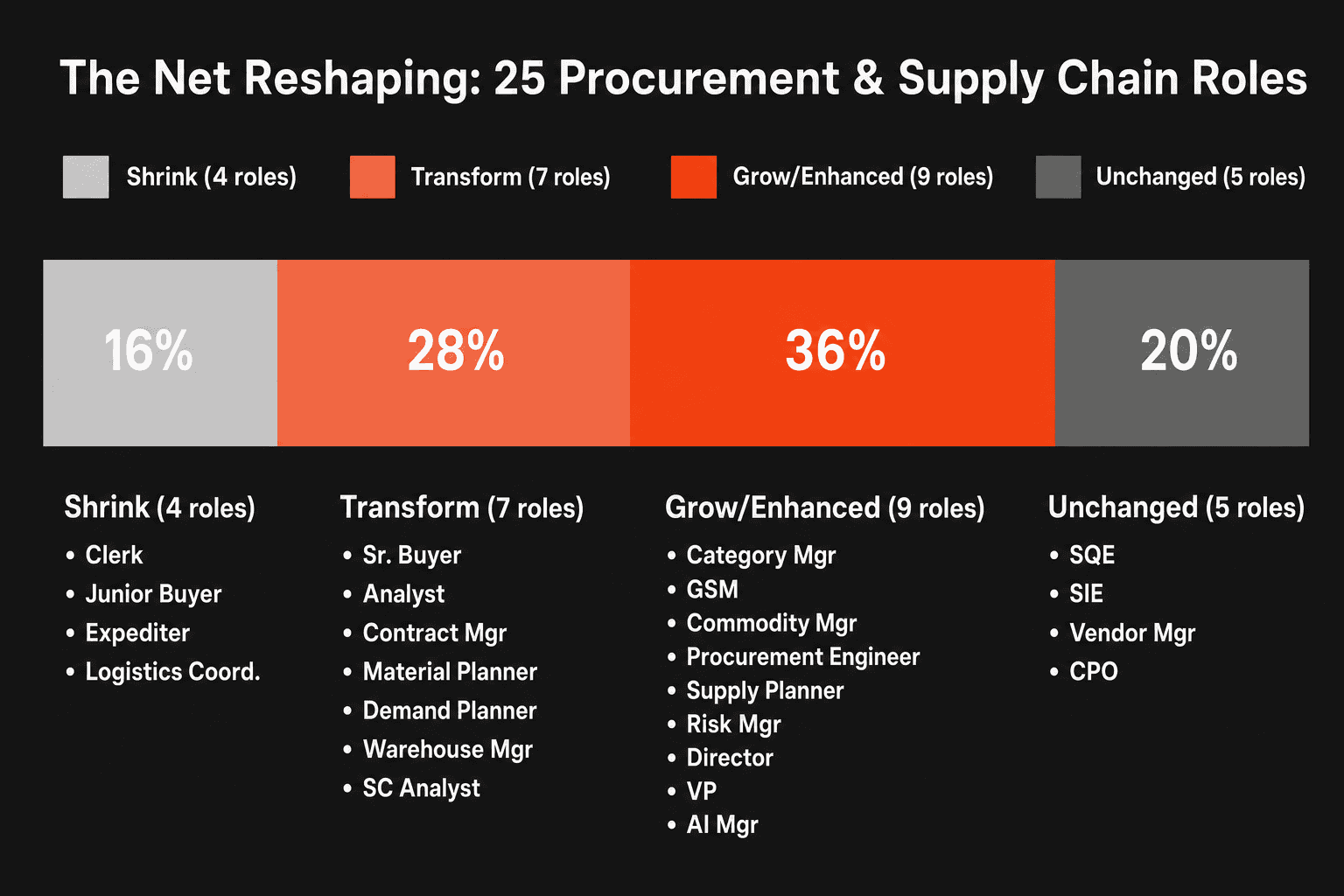
The Pattern: Who Shrinks, Who Grows
Counting across the 25 roles:
🔴 Roles that shrink (4): Purchasing clerk, buyer/purchasing agent, expediter, logistics coordinator. These are the transactional roles where the daily work is primarily data processing, order management, and routine coordination. Combined, they represent the largest headcount in most procurement organizations -- and the largest reduction.
🟡 Roles that transform (7): Senior buyer, strategic sourcing analyst, contract manager, material planner, demand planner, warehouse manager, supply chain analyst. Same people, fundamentally different work. Less time on data gathering and spreadsheet manipulation. More time on analysis, strategy, and judgment.
🟢 Roles that grow or are enhanced (8): Category manager, GSM, commodity manager, procurement engineer, supply planner, supply chain risk manager, director, VP. These roles become more effective with AI augmentation. The humans in them are more productive, cover more spend, and make better decisions.
⚪ Roles essentially unchanged (5): SQE, SIE, vendor manager, CPO, and one new role (procurement AI manager). Physical-presence roles and the highest-level strategic/relationship roles aren’t touched.
🟢 New role emerging (1): Procurement AI Manager -- the person who bridges the gap between the technology and the procurement team.
The net: AI doesn’t eliminate procurement. It compresses the bottom of the pyramid and expands the middle and top. The function gets smaller in headcount but larger in impact. The Hackett Group projects this could mean a 40% reduction in SG&A costs over 5-7 years -- but that doesn’t mean 40% fewer people. It means fewer transactional roles, more strategic ones, and higher value per employee.
The Training Ground Problem
There’s an uncomfortable consequence buried in the data above. If AI eliminates most purchasing clerk and junior buyer positions, where do the next generation of category managers come from?
Every senior procurement leader I know started somewhere transactional -- processing POs, running basic quotes, learning how to talk to suppliers by doing it badly a hundred times first. The entry-level roles are the training ground. Kill the training ground and you have a talent pipeline problem in five to seven years: plenty of demand for strategic sourcing leaders, nobody with the foundational experience to fill the roles.
The answer isn’t to preserve clerking jobs artificially. It’s to redesign the entry-level experience. New procurement hires should start on supplier-facing work -- shadowing SQEs on factory visits, supporting category managers in negotiations, running AI-assisted sourcing events where the tool handles data and the human learns judgment. The entry point shifts from “process this PO” to “interpret this AI output and decide what to do.” That’s a better training ground anyway -- it’s just a fundamentally different one.
The organizations that figure this out first will have a structural talent advantage in 2030. The ones that simply eliminate entry-level headcount will be hiring category managers from competitors at 2x the cost because they can’t grow their own.
The Supplier Side of the Equation
There’s a mirror version of this reshaping happening on the supplier side. As AI-native sourcing platforms become the default, suppliers that adopt machine-readable quoting -- structured formats, digital catalogs, automated RFQ responses -- become visible to every competitive sourcing event on the platform. Suppliers that still operate through email and PDF attachments become invisible to the algorithms.
This is a form of natural selection. The analog shop that won business because the buyer knew them personally will struggle when AI-driven supplier discovery surfaces five alternatives the buyer never heard of. The digital supplier that formats quotes cleanly and responds within 48 hours will win disproportionate share -- not because they’re cheaper, but because the system can see them.
What This Means for Your Career
If you’re in a transactional role today, the clock is running. The path forward is up, not sideways. Develop negotiation skills, build supplier relationships, learn to read a should-cost model. The buyers who survive the next three years won’t be the ones who process the most POs. They’ll be the ones who can do something AI can’t: walk into a supplier’s office, assess the situation, and make a judgment call.
If you’re in a strategic role, lean into the AI tools. The category manager who uses AI to run 10x more sourcing events, benchmark every quote against historical data, and monitor supplier risk in real time will outperform the one who’s still building comparison spreadsheets manually. The technology isn’t replacing you. It’s giving you a superpower -- but only if you use it.
If you’re a CPO planning headcount, the uncomfortable conversation is with your transactional team. The compassionate version of that conversation starts now, with retraining paths, role transitions, and honest timelines. The uncompassionate version is a layoff in 18 months when the board asks why the procurement function hasn’t captured the efficiency gains that every analyst report promises.
At LightSource, we see this transition in real time. Customers deploy the platform and their sourcing cycle times compress from weeks to days. Quote normalization that took a senior buyer two days happens in seconds. The buyer doesn’t disappear -- they spend those two days on supplier development, competitive bidding strategy, and the kind of strategic work that actually moves the margin needle.
The function isn’t shrinking. It’s reshaping. The question is which side of the reshape you’re on.
Sources
Suplari -- 10 Procurement Job Roles Most Impacted by AI -- Role-by-role automation exposure estimates (purchasing clerk 95%, purchasing agent 70%)
McKinsey -- Redefining Procurement Performance in the Era of Agentic AI -- 25-40% efficiency gains; hybrid workforce model
The Hackett Group -- Generative AI Will Drive Profound Reductions in SG&A -- Up to 40% SG&A reduction over 5-7 years
Gartner -- Agentic AI Reshaping Supply Chain Roles -- 1 in 5 procurement roles AI-driven by 2030; $2B to $53B market forecast
Art of Procurement -- State of AI in Procurement 2026 -- 80% CPOs investing; only 4% at meaningful deployment; 62% expect transformational impact
SCMR -- AI Is Automating Procurement; It’s Also Creating Jobs -- New roles emerging: AI agent managers, prompt engineers
Scope Recruiting -- Supply Chain Career Paths -- Role progression, salary benchmarks, career trajectory data
Scope Recruiting -- Which Supply Chain Roles Will AI Replace by 2026 -- Logistics coordination and demand planning automation analysis
World Economic Forum -- Future of Jobs Report 2025 -- 170M new jobs, 92M displaced by 2030 (net +78M)
Frequently Asked Questions
Will AI eliminate procurement jobs?
AI will eliminate some procurement jobs and create others. The net effect is a smaller function by headcount but a higher-impact one. Transactional roles -- purchasing clerks, routine buyers, expediters -- face the most significant reduction (KPMG estimates 50-80% of procurement tasks could be automated). But strategic roles -- category managers, global sourcing managers, supply chain risk managers -- will grow as AI gives them capabilities that didn’t exist before. Gartner projects 1 in 5 procurement professionals will occupy new AI-driven roles by 2030.
Which procurement role is safest from AI?
Supplier Quality Engineer (SQE) and Supplier Industrialization Engineer (SIE) are the most AI-resistant roles because they require physical presence at supplier factories, hands-on assessment of manufacturing processes, and in-person problem-solving. No AI system can walk a production floor and assess whether a factory’s quality culture is real. Global Sourcing Managers are also highly protected because their value comes from cross-cultural relationships and geopolitical navigation that AI can inform but not replicate.
Which procurement role is most at risk from AI?
Purchasing clerks face the highest automation exposure. Suplari estimates a 95% chance of role reduction, as nearly every daily task -- PO creation, invoice processing, data entry, record maintenance -- can be handled by AI procurement systems. Purchasing agents face roughly 70% exposure for similar reasons. Both roles are primarily data-processing functions that AI does faster and more accurately than humans.
What new procurement roles are being created by AI?
The most significant emerging role is the Procurement AI Manager -- someone who bridges procurement domain knowledge with AI tool management. They train models, validate outputs, build prompt libraries for sourcing workflows, and ensure AI recommendations align with business strategy. Other emerging roles include Supply Chain Data Scientist, AI Agent Manager (managing autonomous procurement agents), and Procurement Prompt Engineer. These roles didn’t exist three years ago.
Should procurement professionals learn to code?
Not necessarily code, but they should learn to work with AI tools effectively. The skills that matter in the next three years are: prompt engineering (getting useful outputs from AI systems), data interpretation (validating AI recommendations against business context), scenario design (setting up AI analyses to answer strategic questions), and cross-functional communication (translating AI-generated insights into business language for engineering, finance, and operations partners). The procurement professional of 2029 doesn’t write Python. They write prompts, interpret outputs, and make decisions.
How should CPOs plan headcount for the AI transition?
Start by mapping every role in your organization against the automation exposure and augmentation value scores in this post. Identify the transactional roles with high automation exposure (purchasing clerks, routine buyers, expediters) and develop 12-18 month transition plans: retraining paths to strategic roles, natural attrition targets, and honest timelines. Simultaneously, invest in the roles that AI enhances -- category managers, procurement engineers, risk managers -- by giving them AI tools that multiply their effectiveness. The goal isn’t fewer people. It’s higher value per person.
I’ve spent the last decade working across procurement organizations -- at Tesla, at Waymo, and now at LightSource, where we build the AI tooling that’s reshaping how sourcing teams work. The question I get most from procurement leaders isn’t “will AI change our function?” They already know it will. The question is: “Which of my people should I be worried about, and which should I be investing in?” (I’ve also written up what the people building AI themselves agree on -- and where they contradict each other; it’s useful context for this ranking.)
Related: Fluency First lays out the order of operations behind these exposure scores -- fluency, systems, then the org chart.
The honest answer is that the impact isn’t uniform. A purchasing clerk and a global sourcing manager both work in “procurement,” but the overlap in what they do day-to-day is minimal. AI hits them in completely different ways. The clerk’s job is mostly data entry and transactional processing -- exactly what AI is built to automate. The GSM’s job is relationships, negotiation strategy, and cross-functional influence -- exactly what AI can’t do.
This post maps every major role in procurement and supply chain, explains what each one actually does, and scores it on how much AI will change the work over the next three years. It’s written for CPOs planning headcount, for procurement professionals thinking about their careers, and for anyone trying to separate the signal from the hype.
The Roles: A Complete Taxonomy
Before scoring AI impact, it helps to see the full landscape. Procurement and supply chain contains roughly 25 distinct roles across four functional clusters.
Cluster 1: Transactional Procurement
These roles execute purchases, process paperwork, and maintain the operational backbone.
Purchasing Clerk -- Creates POs, processes invoices, maintains records, handles data entry. ($40K-$55K)
Buyer / Purchasing Agent -- Manages supplier quotes, places orders, handles routine negotiations for assigned commodities. ($55K-$80K)
Senior Buyer -- Same as buyer but for higher-value or more complex categories. Mentors junior buyers. ($75K-$100K)
Expediter / Production Planner Clerk -- Coordinates material flow, follows up on late deliveries, manages hot lists. ($45K-$65K)
Cluster 2: Strategic Sourcing
These roles develop category strategies, manage supplier relationships, and drive cost optimization.
Strategic Sourcing Analyst -- Runs spend analysis, builds should-cost models, supports category strategies with data. ($65K-$90K)
Category Manager -- Owns a spend category end-to-end: market analysis, supplier strategy, RFQ execution, negotiations, contract management. ($90K-$130K)
Global Sourcing Manager (GSM) -- Manages sourcing across geographies, handles international suppliers, navigates trade compliance and Incoterms. ($110K-$150K)
Commodity Manager -- Deep specialist in a specific material family (metals, plastics, electronics). Tracks commodity markets, hedges risk. ($95K-$140K)
Procurement Engineer / Cost Engineer -- Bridges engineering and procurement. Builds parametric cost models, evaluates supplier manufacturing processes, drives design-for-cost decisions. ($85K-$120K)
Contract Manager -- Drafts, negotiates, and manages supplier contracts. Handles terms, compliance, renewals, and dispute resolution. ($80K-$115K)
Cluster 3: Supplier Quality and Engineering
These roles ensure suppliers can actually deliver what they’ve been awarded.
Supplier Quality Engineer (SQE) -- Qualifies supplier manufacturing processes, conducts audits, manages PPAP/APQP, resolves quality escapes. ($75K-$110K)
Supplier Industrialization Engineer (SIE) -- Supports new product introduction at supplier sites. Ensures production readiness, validates tooling, manages launch timelines. ($85K-$120K)
Vendor Manager -- Manages the overall supplier relationship for strategic partners. Conducts business reviews, drives continuous improvement. ($80K-$110K)
Cluster 4: Supply Chain Operations
These roles manage the physical flow of materials from supplier to factory to customer.
Material Planner -- Converts demand forecasts into purchase requirements. Manages MRP, safety stock, and replenishment schedules. ($60K-$85K)
Demand Planner -- Forecasts customer demand using historical data, market intelligence, and sales input. ($70K-$100K)
Supply Planner -- Balances supply against demand across factories, manages production scheduling and capacity constraints. ($70K-$100K)
Logistics Coordinator -- Arranges transportation, tracks shipments, manages freight documentation and customs. ($50K-$75K)
Warehouse / Inventory Manager -- Manages physical inventory, storage optimization, receiving, and distribution. ($60K-$90K)
Supply Chain Analyst -- Builds dashboards, analyzes lead times, identifies bottlenecks, supports S&OP processes. ($65K-$95K)
Supply Chain Risk Manager -- Monitors disruption signals, maps sub-tier dependencies, develops contingency plans. ($90K-$130K)
Cluster 5: Leadership
Procurement Data Analyst / AI Manager -- Emerging role. Manages AI tools, trains models, validates outputs, builds prompt libraries. ($80K-$120K)
Director of Procurement -- Leads the procurement function for a business unit or region. Sets strategy, manages team. ($140K-$200K)
VP of Supply Chain -- Enterprise-level supply chain leadership across procurement, logistics, and planning. ($180K-$300K)
Chief Procurement Officer (CPO) -- Highest procurement executive. Strategy, governance, board-level reporting. ($250K-$540K+ at F500)
The AI Impact Scorecard
Now the table that matters. For each role, I’ve scored three dimensions:
Automation Exposure (1-5): How much of the current daily work is automatable by AI within 3 years. 5 = nearly all tasks automatable.
AI Augmentation Value (1-5): How much better the role becomes when paired with AI tools. 5 = dramatically more effective.
Net Impact: The overall verdict -- 🔴 Role shrinks significantly, 🟡 Role transforms (same headcount, different work), 🟢 Role grows or is enhanced, ⚪ Essentially unchanged.
Transactional Procurement
Role | Automation Exposure | Augmentation Value | Net Impact | 3-Year Outlook |
|---|---|---|---|---|
Purchasing Clerk | 5 | 1 | 🔴 Shrinks | 60-80% of these positions eliminated. Remaining clerks handle exceptions only. |
Buyer / Purchasing Agent | 4 | 3 | 🔴 Shrinks | Routine buying automated. Surviving buyers shift to strategic work or specialize. |
Senior Buyer | 3 | 4 | 🟡 Transforms | Less time on quotes and spreadsheets. More time on supplier development and negotiation. |
Expediter / Production Planner Clerk | 4 | 2 | 🔴 Shrinks | AI-driven MRP and automated exception management replaces most expediting. |
Strategic Sourcing
Role | Automation Exposure | Augmentation Value | Net Impact | 3-Year Outlook |
|---|---|---|---|---|
Strategic Sourcing Analyst | 3 | 5 | 🟡 Transforms | AI does the data work. Analyst shifts to insight generation and strategy. |
Category Manager | 2 | 5 | 🟢 Enhanced | AI handles research, benchmarking, quote analysis. CM focuses on strategy and relationships. |
Global Sourcing Manager | 1 | 4 | 🟢 Enhanced | Relationships, trade navigation, and cross-cultural management remain human. AI provides better market intelligence. |
Commodity Manager | 2 | 5 | 🟢 Enhanced | AI-powered market monitoring, should-cost models, and risk alerts make commodity managers far more effective. |
Procurement Engineer | 2 | 5 | 🟢 Enhanced | Parametric cost modeling, spec optimization, and DFM analysis are AI’s sweet spot as augmentation tools. |
Contract Manager | 3 | 4 | 🟡 Transforms | AI drafts, reviews, and flags contract risks. Humans handle negotiation of complex terms and disputes. |
Supplier Quality and Engineering
Role | Automation Exposure | Augmentation Value | Net Impact | 3-Year Outlook |
|---|---|---|---|---|
Supplier Quality Engineer | 1 | 3 | ⚪ Unchanged | Physical audits, PPAP reviews, and quality investigations require on-site human judgment. AI helps with data analysis between visits. |
Supplier Industrialization Engineer | 1 | 2 | ⚪ Unchanged | Launch support is hands-on factory work. AI can’t validate tooling or troubleshoot production issues remotely. |
Vendor Manager | 1 | 3 | ⚪ Unchanged | Relationship management, business reviews, and supplier development are fundamentally human activities. |
Supply Chain Operations
Role | Automation Exposure | Augmentation Value | Net Impact | 3-Year Outlook |
|---|---|---|---|---|
Material Planner | 4 | 4 | 🟡 Transforms | AI-driven MRP reduces manual planning. Planners shift to exception management and scenario analysis. |
Demand Planner | 3 | 5 | 🟡 Transforms | AI forecasting is better than human forecasting for most categories. Planners become forecast managers, not forecast creators. |
Supply Planner | 2 | 4 | 🟢 Enhanced | Optimization problems with constraints require human trade-off judgment. AI provides better scenario modeling. |
Logistics Coordinator | 4 | 2 | 🔴 Shrinks | Routine dispatch, tracking, and rebooking automated. Fewer coordinators needed per shipment volume. |
Warehouse / Inventory Manager | 2 | 3 | 🟡 Transforms | Physical management unchanged. AI optimizes layout, pick paths, and replenishment. Manager role shifts to technology integration. |
Supply Chain Analyst | 3 | 5 | 🟡 Transforms | AI generates the dashboards and flags the anomalies. Analyst shifts to interpretation and action recommendation. |
Supply Chain Risk Manager | 1 | 5 | 🟢 Enhanced | AI massively extends monitoring capability. Risk managers become more valuable, not less, as the scope of visible risk expands. |
Leadership and Emerging Roles
Role | Automation Exposure | Augmentation Value | Net Impact | 3-Year Outlook |
|---|---|---|---|---|
Procurement AI Manager | 0 | 5 | 🟢 New Role | Didn’t exist 3 years ago. Manages AI tools, validates outputs, bridges tech and procurement teams. |
Director of Procurement | 1 | 4 | 🟢 Enhanced | Better data → better decisions. More time for strategy, less for firefighting. |
VP Supply Chain | 1 | 4 | 🟢 Enhanced | AI provides real-time visibility that transforms executive decision-making. |
CPO | 1 | 3 | ⚪ Unchanged | Board relationships, enterprise strategy, and political navigation remain fully human. AI informs but doesn’t replace. |
The Pattern: Who Shrinks, Who Grows
Counting across the 25 roles:
🔴 Roles that shrink (4): Purchasing clerk, buyer/purchasing agent, expediter, logistics coordinator. These are the transactional roles where the daily work is primarily data processing, order management, and routine coordination. Combined, they represent the largest headcount in most procurement organizations -- and the largest reduction.
🟡 Roles that transform (7): Senior buyer, strategic sourcing analyst, contract manager, material planner, demand planner, warehouse manager, supply chain analyst. Same people, fundamentally different work. Less time on data gathering and spreadsheet manipulation. More time on analysis, strategy, and judgment.
🟢 Roles that grow or are enhanced (8): Category manager, GSM, commodity manager, procurement engineer, supply planner, supply chain risk manager, director, VP. These roles become more effective with AI augmentation. The humans in them are more productive, cover more spend, and make better decisions.
⚪ Roles essentially unchanged (5): SQE, SIE, vendor manager, CPO, and one new role (procurement AI manager). Physical-presence roles and the highest-level strategic/relationship roles aren’t touched.
🟢 New role emerging (1): Procurement AI Manager -- the person who bridges the gap between the technology and the procurement team.
The net: AI doesn’t eliminate procurement. It compresses the bottom of the pyramid and expands the middle and top. The function gets smaller in headcount but larger in impact. The Hackett Group projects this could mean a 40% reduction in SG&A costs over 5-7 years -- but that doesn’t mean 40% fewer people. It means fewer transactional roles, more strategic ones, and higher value per employee.
The Training Ground Problem
There’s an uncomfortable consequence buried in the data above. If AI eliminates most purchasing clerk and junior buyer positions, where do the next generation of category managers come from?
Every senior procurement leader I know started somewhere transactional -- processing POs, running basic quotes, learning how to talk to suppliers by doing it badly a hundred times first. The entry-level roles are the training ground. Kill the training ground and you have a talent pipeline problem in five to seven years: plenty of demand for strategic sourcing leaders, nobody with the foundational experience to fill the roles.
The answer isn’t to preserve clerking jobs artificially. It’s to redesign the entry-level experience. New procurement hires should start on supplier-facing work -- shadowing SQEs on factory visits, supporting category managers in negotiations, running AI-assisted sourcing events where the tool handles data and the human learns judgment. The entry point shifts from “process this PO” to “interpret this AI output and decide what to do.” That’s a better training ground anyway -- it’s just a fundamentally different one.
The organizations that figure this out first will have a structural talent advantage in 2030. The ones that simply eliminate entry-level headcount will be hiring category managers from competitors at 2x the cost because they can’t grow their own.
The Supplier Side of the Equation
There’s a mirror version of this reshaping happening on the supplier side. As AI-native sourcing platforms become the default, suppliers that adopt machine-readable quoting -- structured formats, digital catalogs, automated RFQ responses -- become visible to every competitive sourcing event on the platform. Suppliers that still operate through email and PDF attachments become invisible to the algorithms.
This is a form of natural selection. The analog shop that won business because the buyer knew them personally will struggle when AI-driven supplier discovery surfaces five alternatives the buyer never heard of. The digital supplier that formats quotes cleanly and responds within 48 hours will win disproportionate share -- not because they’re cheaper, but because the system can see them.
What This Means for Your Career
If you’re in a transactional role today, the clock is running. The path forward is up, not sideways. Develop negotiation skills, build supplier relationships, learn to read a should-cost model. The buyers who survive the next three years won’t be the ones who process the most POs. They’ll be the ones who can do something AI can’t: walk into a supplier’s office, assess the situation, and make a judgment call.
If you’re in a strategic role, lean into the AI tools. The category manager who uses AI to run 10x more sourcing events, benchmark every quote against historical data, and monitor supplier risk in real time will outperform the one who’s still building comparison spreadsheets manually. The technology isn’t replacing you. It’s giving you a superpower -- but only if you use it.
If you’re a CPO planning headcount, the uncomfortable conversation is with your transactional team. The compassionate version of that conversation starts now, with retraining paths, role transitions, and honest timelines. The uncompassionate version is a layoff in 18 months when the board asks why the procurement function hasn’t captured the efficiency gains that every analyst report promises.
At LightSource, we see this transition in real time. Customers deploy the platform and their sourcing cycle times compress from weeks to days. Quote normalization that took a senior buyer two days happens in seconds. The buyer doesn’t disappear -- they spend those two days on supplier development, competitive bidding strategy, and the kind of strategic work that actually moves the margin needle.
The function isn’t shrinking. It’s reshaping. The question is which side of the reshape you’re on.
Sources
Suplari -- 10 Procurement Job Roles Most Impacted by AI -- Role-by-role automation exposure estimates (purchasing clerk 95%, purchasing agent 70%)
McKinsey -- Redefining Procurement Performance in the Era of Agentic AI -- 25-40% efficiency gains; hybrid workforce model
The Hackett Group -- Generative AI Will Drive Profound Reductions in SG&A -- Up to 40% SG&A reduction over 5-7 years
Gartner -- Agentic AI Reshaping Supply Chain Roles -- 1 in 5 procurement roles AI-driven by 2030; $2B to $53B market forecast
Art of Procurement -- State of AI in Procurement 2026 -- 80% CPOs investing; only 4% at meaningful deployment; 62% expect transformational impact
SCMR -- AI Is Automating Procurement; It’s Also Creating Jobs -- New roles emerging: AI agent managers, prompt engineers
Scope Recruiting -- Supply Chain Career Paths -- Role progression, salary benchmarks, career trajectory data
Scope Recruiting -- Which Supply Chain Roles Will AI Replace by 2026 -- Logistics coordination and demand planning automation analysis
World Economic Forum -- Future of Jobs Report 2025 -- 170M new jobs, 92M displaced by 2030 (net +78M)
Frequently Asked Questions
Will AI eliminate procurement jobs?
AI will eliminate some procurement jobs and create others. The net effect is a smaller function by headcount but a higher-impact one. Transactional roles -- purchasing clerks, routine buyers, expediters -- face the most significant reduction (KPMG estimates 50-80% of procurement tasks could be automated). But strategic roles -- category managers, global sourcing managers, supply chain risk managers -- will grow as AI gives them capabilities that didn’t exist before. Gartner projects 1 in 5 procurement professionals will occupy new AI-driven roles by 2030.
Which procurement role is safest from AI?
Supplier Quality Engineer (SQE) and Supplier Industrialization Engineer (SIE) are the most AI-resistant roles because they require physical presence at supplier factories, hands-on assessment of manufacturing processes, and in-person problem-solving. No AI system can walk a production floor and assess whether a factory’s quality culture is real. Global Sourcing Managers are also highly protected because their value comes from cross-cultural relationships and geopolitical navigation that AI can inform but not replicate.
Which procurement role is most at risk from AI?
Purchasing clerks face the highest automation exposure. Suplari estimates a 95% chance of role reduction, as nearly every daily task -- PO creation, invoice processing, data entry, record maintenance -- can be handled by AI procurement systems. Purchasing agents face roughly 70% exposure for similar reasons. Both roles are primarily data-processing functions that AI does faster and more accurately than humans.
What new procurement roles are being created by AI?
The most significant emerging role is the Procurement AI Manager -- someone who bridges procurement domain knowledge with AI tool management. They train models, validate outputs, build prompt libraries for sourcing workflows, and ensure AI recommendations align with business strategy. Other emerging roles include Supply Chain Data Scientist, AI Agent Manager (managing autonomous procurement agents), and Procurement Prompt Engineer. These roles didn’t exist three years ago.
Should procurement professionals learn to code?
Not necessarily code, but they should learn to work with AI tools effectively. The skills that matter in the next three years are: prompt engineering (getting useful outputs from AI systems), data interpretation (validating AI recommendations against business context), scenario design (setting up AI analyses to answer strategic questions), and cross-functional communication (translating AI-generated insights into business language for engineering, finance, and operations partners). The procurement professional of 2029 doesn’t write Python. They write prompts, interpret outputs, and make decisions.
How should CPOs plan headcount for the AI transition?
Start by mapping every role in your organization against the automation exposure and augmentation value scores in this post. Identify the transactional roles with high automation exposure (purchasing clerks, routine buyers, expediters) and develop 12-18 month transition plans: retraining paths to strategic roles, natural attrition targets, and honest timelines. Simultaneously, invest in the roles that AI enhances -- category managers, procurement engineers, risk managers -- by giving them AI tools that multiply their effectiveness. The goal isn’t fewer people. It’s higher value per person.
I’ve spent the last decade working across procurement organizations -- at Tesla, at Waymo, and now at LightSource, where we build the AI tooling that’s reshaping how sourcing teams work. The question I get most from procurement leaders isn’t “will AI change our function?” They already know it will. The question is: “Which of my people should I be worried about, and which should I be investing in?” (I’ve also written up what the people building AI themselves agree on -- and where they contradict each other; it’s useful context for this ranking.)
Related: Fluency First lays out the order of operations behind these exposure scores -- fluency, systems, then the org chart.
The honest answer is that the impact isn’t uniform. A purchasing clerk and a global sourcing manager both work in “procurement,” but the overlap in what they do day-to-day is minimal. AI hits them in completely different ways. The clerk’s job is mostly data entry and transactional processing -- exactly what AI is built to automate. The GSM’s job is relationships, negotiation strategy, and cross-functional influence -- exactly what AI can’t do.
This post maps every major role in procurement and supply chain, explains what each one actually does, and scores it on how much AI will change the work over the next three years. It’s written for CPOs planning headcount, for procurement professionals thinking about their careers, and for anyone trying to separate the signal from the hype.
The Roles: A Complete Taxonomy
Before scoring AI impact, it helps to see the full landscape. Procurement and supply chain contains roughly 25 distinct roles across four functional clusters.
Cluster 1: Transactional Procurement
These roles execute purchases, process paperwork, and maintain the operational backbone.
Purchasing Clerk -- Creates POs, processes invoices, maintains records, handles data entry. ($40K-$55K)
Buyer / Purchasing Agent -- Manages supplier quotes, places orders, handles routine negotiations for assigned commodities. ($55K-$80K)
Senior Buyer -- Same as buyer but for higher-value or more complex categories. Mentors junior buyers. ($75K-$100K)
Expediter / Production Planner Clerk -- Coordinates material flow, follows up on late deliveries, manages hot lists. ($45K-$65K)
Cluster 2: Strategic Sourcing
These roles develop category strategies, manage supplier relationships, and drive cost optimization.
Strategic Sourcing Analyst -- Runs spend analysis, builds should-cost models, supports category strategies with data. ($65K-$90K)
Category Manager -- Owns a spend category end-to-end: market analysis, supplier strategy, RFQ execution, negotiations, contract management. ($90K-$130K)
Global Sourcing Manager (GSM) -- Manages sourcing across geographies, handles international suppliers, navigates trade compliance and Incoterms. ($110K-$150K)
Commodity Manager -- Deep specialist in a specific material family (metals, plastics, electronics). Tracks commodity markets, hedges risk. ($95K-$140K)
Procurement Engineer / Cost Engineer -- Bridges engineering and procurement. Builds parametric cost models, evaluates supplier manufacturing processes, drives design-for-cost decisions. ($85K-$120K)
Contract Manager -- Drafts, negotiates, and manages supplier contracts. Handles terms, compliance, renewals, and dispute resolution. ($80K-$115K)
Cluster 3: Supplier Quality and Engineering
These roles ensure suppliers can actually deliver what they’ve been awarded.
Supplier Quality Engineer (SQE) -- Qualifies supplier manufacturing processes, conducts audits, manages PPAP/APQP, resolves quality escapes. ($75K-$110K)
Supplier Industrialization Engineer (SIE) -- Supports new product introduction at supplier sites. Ensures production readiness, validates tooling, manages launch timelines. ($85K-$120K)
Vendor Manager -- Manages the overall supplier relationship for strategic partners. Conducts business reviews, drives continuous improvement. ($80K-$110K)
Cluster 4: Supply Chain Operations
These roles manage the physical flow of materials from supplier to factory to customer.
Material Planner -- Converts demand forecasts into purchase requirements. Manages MRP, safety stock, and replenishment schedules. ($60K-$85K)
Demand Planner -- Forecasts customer demand using historical data, market intelligence, and sales input. ($70K-$100K)
Supply Planner -- Balances supply against demand across factories, manages production scheduling and capacity constraints. ($70K-$100K)
Logistics Coordinator -- Arranges transportation, tracks shipments, manages freight documentation and customs. ($50K-$75K)
Warehouse / Inventory Manager -- Manages physical inventory, storage optimization, receiving, and distribution. ($60K-$90K)
Supply Chain Analyst -- Builds dashboards, analyzes lead times, identifies bottlenecks, supports S&OP processes. ($65K-$95K)
Supply Chain Risk Manager -- Monitors disruption signals, maps sub-tier dependencies, develops contingency plans. ($90K-$130K)
Cluster 5: Leadership
Procurement Data Analyst / AI Manager -- Emerging role. Manages AI tools, trains models, validates outputs, builds prompt libraries. ($80K-$120K)
Director of Procurement -- Leads the procurement function for a business unit or region. Sets strategy, manages team. ($140K-$200K)
VP of Supply Chain -- Enterprise-level supply chain leadership across procurement, logistics, and planning. ($180K-$300K)
Chief Procurement Officer (CPO) -- Highest procurement executive. Strategy, governance, board-level reporting. ($250K-$540K+ at F500)
The AI Impact Scorecard
Now the table that matters. For each role, I’ve scored three dimensions:
Automation Exposure (1-5): How much of the current daily work is automatable by AI within 3 years. 5 = nearly all tasks automatable.
AI Augmentation Value (1-5): How much better the role becomes when paired with AI tools. 5 = dramatically more effective.
Net Impact: The overall verdict -- 🔴 Role shrinks significantly, 🟡 Role transforms (same headcount, different work), 🟢 Role grows or is enhanced, ⚪ Essentially unchanged.
Transactional Procurement
Role | Automation Exposure | Augmentation Value | Net Impact | 3-Year Outlook |
|---|---|---|---|---|
Purchasing Clerk | 5 | 1 | 🔴 Shrinks | 60-80% of these positions eliminated. Remaining clerks handle exceptions only. |
Buyer / Purchasing Agent | 4 | 3 | 🔴 Shrinks | Routine buying automated. Surviving buyers shift to strategic work or specialize. |
Senior Buyer | 3 | 4 | 🟡 Transforms | Less time on quotes and spreadsheets. More time on supplier development and negotiation. |
Expediter / Production Planner Clerk | 4 | 2 | 🔴 Shrinks | AI-driven MRP and automated exception management replaces most expediting. |
Strategic Sourcing
Role | Automation Exposure | Augmentation Value | Net Impact | 3-Year Outlook |
|---|---|---|---|---|
Strategic Sourcing Analyst | 3 | 5 | 🟡 Transforms | AI does the data work. Analyst shifts to insight generation and strategy. |
Category Manager | 2 | 5 | 🟢 Enhanced | AI handles research, benchmarking, quote analysis. CM focuses on strategy and relationships. |
Global Sourcing Manager | 1 | 4 | 🟢 Enhanced | Relationships, trade navigation, and cross-cultural management remain human. AI provides better market intelligence. |
Commodity Manager | 2 | 5 | 🟢 Enhanced | AI-powered market monitoring, should-cost models, and risk alerts make commodity managers far more effective. |
Procurement Engineer | 2 | 5 | 🟢 Enhanced | Parametric cost modeling, spec optimization, and DFM analysis are AI’s sweet spot as augmentation tools. |
Contract Manager | 3 | 4 | 🟡 Transforms | AI drafts, reviews, and flags contract risks. Humans handle negotiation of complex terms and disputes. |
Supplier Quality and Engineering
Role | Automation Exposure | Augmentation Value | Net Impact | 3-Year Outlook |
|---|---|---|---|---|
Supplier Quality Engineer | 1 | 3 | ⚪ Unchanged | Physical audits, PPAP reviews, and quality investigations require on-site human judgment. AI helps with data analysis between visits. |
Supplier Industrialization Engineer | 1 | 2 | ⚪ Unchanged | Launch support is hands-on factory work. AI can’t validate tooling or troubleshoot production issues remotely. |
Vendor Manager | 1 | 3 | ⚪ Unchanged | Relationship management, business reviews, and supplier development are fundamentally human activities. |
Supply Chain Operations
Role | Automation Exposure | Augmentation Value | Net Impact | 3-Year Outlook |
|---|---|---|---|---|
Material Planner | 4 | 4 | 🟡 Transforms | AI-driven MRP reduces manual planning. Planners shift to exception management and scenario analysis. |
Demand Planner | 3 | 5 | 🟡 Transforms | AI forecasting is better than human forecasting for most categories. Planners become forecast managers, not forecast creators. |
Supply Planner | 2 | 4 | 🟢 Enhanced | Optimization problems with constraints require human trade-off judgment. AI provides better scenario modeling. |
Logistics Coordinator | 4 | 2 | 🔴 Shrinks | Routine dispatch, tracking, and rebooking automated. Fewer coordinators needed per shipment volume. |
Warehouse / Inventory Manager | 2 | 3 | 🟡 Transforms | Physical management unchanged. AI optimizes layout, pick paths, and replenishment. Manager role shifts to technology integration. |
Supply Chain Analyst | 3 | 5 | 🟡 Transforms | AI generates the dashboards and flags the anomalies. Analyst shifts to interpretation and action recommendation. |
Supply Chain Risk Manager | 1 | 5 | 🟢 Enhanced | AI massively extends monitoring capability. Risk managers become more valuable, not less, as the scope of visible risk expands. |
Leadership and Emerging Roles
Role | Automation Exposure | Augmentation Value | Net Impact | 3-Year Outlook |
|---|---|---|---|---|
Procurement AI Manager | 0 | 5 | 🟢 New Role | Didn’t exist 3 years ago. Manages AI tools, validates outputs, bridges tech and procurement teams. |
Director of Procurement | 1 | 4 | 🟢 Enhanced | Better data → better decisions. More time for strategy, less for firefighting. |
VP Supply Chain | 1 | 4 | 🟢 Enhanced | AI provides real-time visibility that transforms executive decision-making. |
CPO | 1 | 3 | ⚪ Unchanged | Board relationships, enterprise strategy, and political navigation remain fully human. AI informs but doesn’t replace. |
The Pattern: Who Shrinks, Who Grows
Counting across the 25 roles:
🔴 Roles that shrink (4): Purchasing clerk, buyer/purchasing agent, expediter, logistics coordinator. These are the transactional roles where the daily work is primarily data processing, order management, and routine coordination. Combined, they represent the largest headcount in most procurement organizations -- and the largest reduction.
🟡 Roles that transform (7): Senior buyer, strategic sourcing analyst, contract manager, material planner, demand planner, warehouse manager, supply chain analyst. Same people, fundamentally different work. Less time on data gathering and spreadsheet manipulation. More time on analysis, strategy, and judgment.
🟢 Roles that grow or are enhanced (8): Category manager, GSM, commodity manager, procurement engineer, supply planner, supply chain risk manager, director, VP. These roles become more effective with AI augmentation. The humans in them are more productive, cover more spend, and make better decisions.
⚪ Roles essentially unchanged (5): SQE, SIE, vendor manager, CPO, and one new role (procurement AI manager). Physical-presence roles and the highest-level strategic/relationship roles aren’t touched.
🟢 New role emerging (1): Procurement AI Manager -- the person who bridges the gap between the technology and the procurement team.
The net: AI doesn’t eliminate procurement. It compresses the bottom of the pyramid and expands the middle and top. The function gets smaller in headcount but larger in impact. The Hackett Group projects this could mean a 40% reduction in SG&A costs over 5-7 years -- but that doesn’t mean 40% fewer people. It means fewer transactional roles, more strategic ones, and higher value per employee.
The Training Ground Problem
There’s an uncomfortable consequence buried in the data above. If AI eliminates most purchasing clerk and junior buyer positions, where do the next generation of category managers come from?
Every senior procurement leader I know started somewhere transactional -- processing POs, running basic quotes, learning how to talk to suppliers by doing it badly a hundred times first. The entry-level roles are the training ground. Kill the training ground and you have a talent pipeline problem in five to seven years: plenty of demand for strategic sourcing leaders, nobody with the foundational experience to fill the roles.
The answer isn’t to preserve clerking jobs artificially. It’s to redesign the entry-level experience. New procurement hires should start on supplier-facing work -- shadowing SQEs on factory visits, supporting category managers in negotiations, running AI-assisted sourcing events where the tool handles data and the human learns judgment. The entry point shifts from “process this PO” to “interpret this AI output and decide what to do.” That’s a better training ground anyway -- it’s just a fundamentally different one.
The organizations that figure this out first will have a structural talent advantage in 2030. The ones that simply eliminate entry-level headcount will be hiring category managers from competitors at 2x the cost because they can’t grow their own.
The Supplier Side of the Equation
There’s a mirror version of this reshaping happening on the supplier side. As AI-native sourcing platforms become the default, suppliers that adopt machine-readable quoting -- structured formats, digital catalogs, automated RFQ responses -- become visible to every competitive sourcing event on the platform. Suppliers that still operate through email and PDF attachments become invisible to the algorithms.
This is a form of natural selection. The analog shop that won business because the buyer knew them personally will struggle when AI-driven supplier discovery surfaces five alternatives the buyer never heard of. The digital supplier that formats quotes cleanly and responds within 48 hours will win disproportionate share -- not because they’re cheaper, but because the system can see them.
What This Means for Your Career
If you’re in a transactional role today, the clock is running. The path forward is up, not sideways. Develop negotiation skills, build supplier relationships, learn to read a should-cost model. The buyers who survive the next three years won’t be the ones who process the most POs. They’ll be the ones who can do something AI can’t: walk into a supplier’s office, assess the situation, and make a judgment call.
If you’re in a strategic role, lean into the AI tools. The category manager who uses AI to run 10x more sourcing events, benchmark every quote against historical data, and monitor supplier risk in real time will outperform the one who’s still building comparison spreadsheets manually. The technology isn’t replacing you. It’s giving you a superpower -- but only if you use it.
If you’re a CPO planning headcount, the uncomfortable conversation is with your transactional team. The compassionate version of that conversation starts now, with retraining paths, role transitions, and honest timelines. The uncompassionate version is a layoff in 18 months when the board asks why the procurement function hasn’t captured the efficiency gains that every analyst report promises.
At LightSource, we see this transition in real time. Customers deploy the platform and their sourcing cycle times compress from weeks to days. Quote normalization that took a senior buyer two days happens in seconds. The buyer doesn’t disappear -- they spend those two days on supplier development, competitive bidding strategy, and the kind of strategic work that actually moves the margin needle.
The function isn’t shrinking. It’s reshaping. The question is which side of the reshape you’re on.
Sources
Suplari -- 10 Procurement Job Roles Most Impacted by AI -- Role-by-role automation exposure estimates (purchasing clerk 95%, purchasing agent 70%)
McKinsey -- Redefining Procurement Performance in the Era of Agentic AI -- 25-40% efficiency gains; hybrid workforce model
The Hackett Group -- Generative AI Will Drive Profound Reductions in SG&A -- Up to 40% SG&A reduction over 5-7 years
Gartner -- Agentic AI Reshaping Supply Chain Roles -- 1 in 5 procurement roles AI-driven by 2030; $2B to $53B market forecast
Art of Procurement -- State of AI in Procurement 2026 -- 80% CPOs investing; only 4% at meaningful deployment; 62% expect transformational impact
SCMR -- AI Is Automating Procurement; It’s Also Creating Jobs -- New roles emerging: AI agent managers, prompt engineers
Scope Recruiting -- Supply Chain Career Paths -- Role progression, salary benchmarks, career trajectory data
Scope Recruiting -- Which Supply Chain Roles Will AI Replace by 2026 -- Logistics coordination and demand planning automation analysis
World Economic Forum -- Future of Jobs Report 2025 -- 170M new jobs, 92M displaced by 2030 (net +78M)
Frequently Asked Questions
Will AI eliminate procurement jobs?
AI will eliminate some procurement jobs and create others. The net effect is a smaller function by headcount but a higher-impact one. Transactional roles -- purchasing clerks, routine buyers, expediters -- face the most significant reduction (KPMG estimates 50-80% of procurement tasks could be automated). But strategic roles -- category managers, global sourcing managers, supply chain risk managers -- will grow as AI gives them capabilities that didn’t exist before. Gartner projects 1 in 5 procurement professionals will occupy new AI-driven roles by 2030.
Which procurement role is safest from AI?
Supplier Quality Engineer (SQE) and Supplier Industrialization Engineer (SIE) are the most AI-resistant roles because they require physical presence at supplier factories, hands-on assessment of manufacturing processes, and in-person problem-solving. No AI system can walk a production floor and assess whether a factory’s quality culture is real. Global Sourcing Managers are also highly protected because their value comes from cross-cultural relationships and geopolitical navigation that AI can inform but not replicate.
Which procurement role is most at risk from AI?
Purchasing clerks face the highest automation exposure. Suplari estimates a 95% chance of role reduction, as nearly every daily task -- PO creation, invoice processing, data entry, record maintenance -- can be handled by AI procurement systems. Purchasing agents face roughly 70% exposure for similar reasons. Both roles are primarily data-processing functions that AI does faster and more accurately than humans.
What new procurement roles are being created by AI?
The most significant emerging role is the Procurement AI Manager -- someone who bridges procurement domain knowledge with AI tool management. They train models, validate outputs, build prompt libraries for sourcing workflows, and ensure AI recommendations align with business strategy. Other emerging roles include Supply Chain Data Scientist, AI Agent Manager (managing autonomous procurement agents), and Procurement Prompt Engineer. These roles didn’t exist three years ago.
Should procurement professionals learn to code?
Not necessarily code, but they should learn to work with AI tools effectively. The skills that matter in the next three years are: prompt engineering (getting useful outputs from AI systems), data interpretation (validating AI recommendations against business context), scenario design (setting up AI analyses to answer strategic questions), and cross-functional communication (translating AI-generated insights into business language for engineering, finance, and operations partners). The procurement professional of 2029 doesn’t write Python. They write prompts, interpret outputs, and make decisions.
How should CPOs plan headcount for the AI transition?
Start by mapping every role in your organization against the automation exposure and augmentation value scores in this post. Identify the transactional roles with high automation exposure (purchasing clerks, routine buyers, expediters) and develop 12-18 month transition plans: retraining paths to strategic roles, natural attrition targets, and honest timelines. Simultaneously, invest in the roles that AI enhances -- category managers, procurement engineers, risk managers -- by giving them AI tools that multiply their effectiveness. The goal isn’t fewer people. It’s higher value per person.
Read more


Read more
Read more
Faster sourcing. Lower cost. Less chaos.
See how LightSource connects engineering, procurement, and suppliers in one operating system to help you launch faster at lower cost.
SOC 2
Kearney #1 2024
Gartner Cool Vendor
Procuretech 100
G2 Top Rated
Faster sourcing. Lower cost. Less chaos.
See how LightSource connects engineering, procurement, and suppliers in one operating system to help you launch faster at lower cost.
SOC 2
Kearney #1 2024
Gartner Cool Vendor
Procuretech 100
G2 Top Rated
Faster sourcing. Lower cost. Less chaos.
See how LightSource connects engineering, procurement, and suppliers in one operating system to help you launch faster at lower cost.
SOC 2
Kearney #1 2024
Gartner Cool Vendor
Procuretech 100
G2 Top Rated
Trusted by:
Trusted by:
Trusted by: