

A good chunk of the LightSource team spent last weekend in Golden Gate Park at Outside Lands, watching Charli XCX, The Strokes, and RÜFÜS DU SOL headline the festival's 18th edition. The three-day passes sold out in six days back in March. I have my own history with this festival: seven years ago today, on August 11, 2019, I stood on the polo field and watched Paul Simon close the Sunday night slot. The cover image on this post is the photo I took from the crowd. Simon had come out of retirement for it, and he donated his entire fee -- a seven-figure number, by industry estimates -- to the San Francisco Parks Alliance and Friends of the Urban Forest.
Somewhere between sets, the professional deformation kicked in. A festival is a procurement organization with a stage attached. The lineup is a bill of materials. The artists are suppliers -- and the headliners are sole-source suppliers with absolute leverage, because there is exactly one Charli XCX and she knows it. The contracts that put her on that stage are full of concepts any sourcing manager would recognize: guarantees, deposits, riders, exclusivity windows, penalty clauses. So this post is the procurement tour of a music festival: how the talent gets sourced and priced, what the whole event costs to build, whether the P&L actually works, and what happened when one man in this same park decided the P&L was beside the point.

Scenes from the polo field, Outside Lands 2026. Commitment to the bit is its own supplier qualification. Video: Spencer Penn.
The Lineup Is a Bill of Materials
Festivals do not post an RFQ and wait for bands to bid. The sourcing process runs through a small professional layer that procurement people would recognize as brokers and category managers. On the festival side sits a talent buyer -- at Outside Lands, that function lives with Another Planet Entertainment, the independent Bay Area promoter that produces the festival. On the artist side sits a booking agent at an agency like WME, CAA, or Wasserman, who negotiates on the artist's behalf and typically takes 10-15% of the gross performance fee.
The sourcing cycle is long. Major festivals start pursuing headliners 12 to 18 months before the gates open, which means the acts you saw this weekend were likely being negotiated in early 2025. That sequencing matters: the headliners get locked first because everything else keys off them -- the poster, the ticket on-sale, the sponsorship pitch, and the undercard, which agents fill in later, often by packaging supporting acts from the same roster alongside the star you actually wanted. Anyone who has had a distributor bundle B-tier line items onto a strategic award will recognize the move, and the discipline is the same too: you need an independent view of what each act is worth, or the package price quietly hides weak pricing on the lower-billed names. Relationships modulate all of it: promoters with long agency ties see earlier looks and better numbers, which is supplier relationship management wearing a laminate.
The core sourcing document is the offer sheet, and it is a quote package in everything but name. A typical one specifies the date, the stage, the set length, the guarantee, the deposit schedule, billing position on the poster, the technical rider (staging, sound, video requirements), the hospitality rider, travel and lodging terms, recording and livestream rights, cancellation and force majeure terms, and the radius clause. If you stripped the artist names out, you could file it next to any RFQ your sourcing team sent last quarter. My colleague Mason Morgan has written about what happens when this kind of structured commercial data lives in email and spreadsheets; the music industry runs a version of that problem at seven figures per line item.
What a Headliner Costs
Talent fees are the least transparent part of the industry -- actual settlement numbers almost never leak, and Outside Lands' fees for Charli XCX, The Strokes, and RÜFÜS DU SOL are not public. But enough reported data points exist to sketch the market, mostly from Coachella, the industry's loudest price signal:
Act | Reported fee | Context |
|---|---|---|
Coachella headliners, 2017 | $3-4M | New Yorker reporting |
Beyoncé, 2018 | $8M | Two weekends |
Ariana Grande, 2019 | $8M | Two weekends |
Carpenter / Karol G, 2026 | $5-8M | Two weekends, reported range |
Justin Bieber, 2026 | ~$10M | Two weekends, per Rolling Stone |
These are comps, not quotes. Coachella buys two weekends and an enormous media moment, so a rough single-weekend translation puts a top headliner at $2-5 million per festival appearance, with routing as the swing factor: an artist already touring the West Coast in August costs less than one mounting a one-off production. Below the top line, the structure fans out the way any supply base does. The reported numbers get scarce below headliner level, but the industry rule-of-thumb shape looks like this: direct support acts (the 6 p.m. slots) in the high six figures, mid-card acts in the low-to-mid six figures, and the noon-slot locals in the four-to-low-five-figure range. Treat those as estimates -- unlike the headliner numbers above, they do not come from reported settlements. What is well documented is the aggregate: talent typically consumes 30-50% of a major festival's total budget, the single largest cost category, ahead of staging, security, and everything else. And the guarantee is only part of what an act costs. Production contributions, hospitality riders, travel, and ground transport all land on the promoter's side of the ledger, which means the total cost of ownership of a headliner runs meaningfully past the sticker.
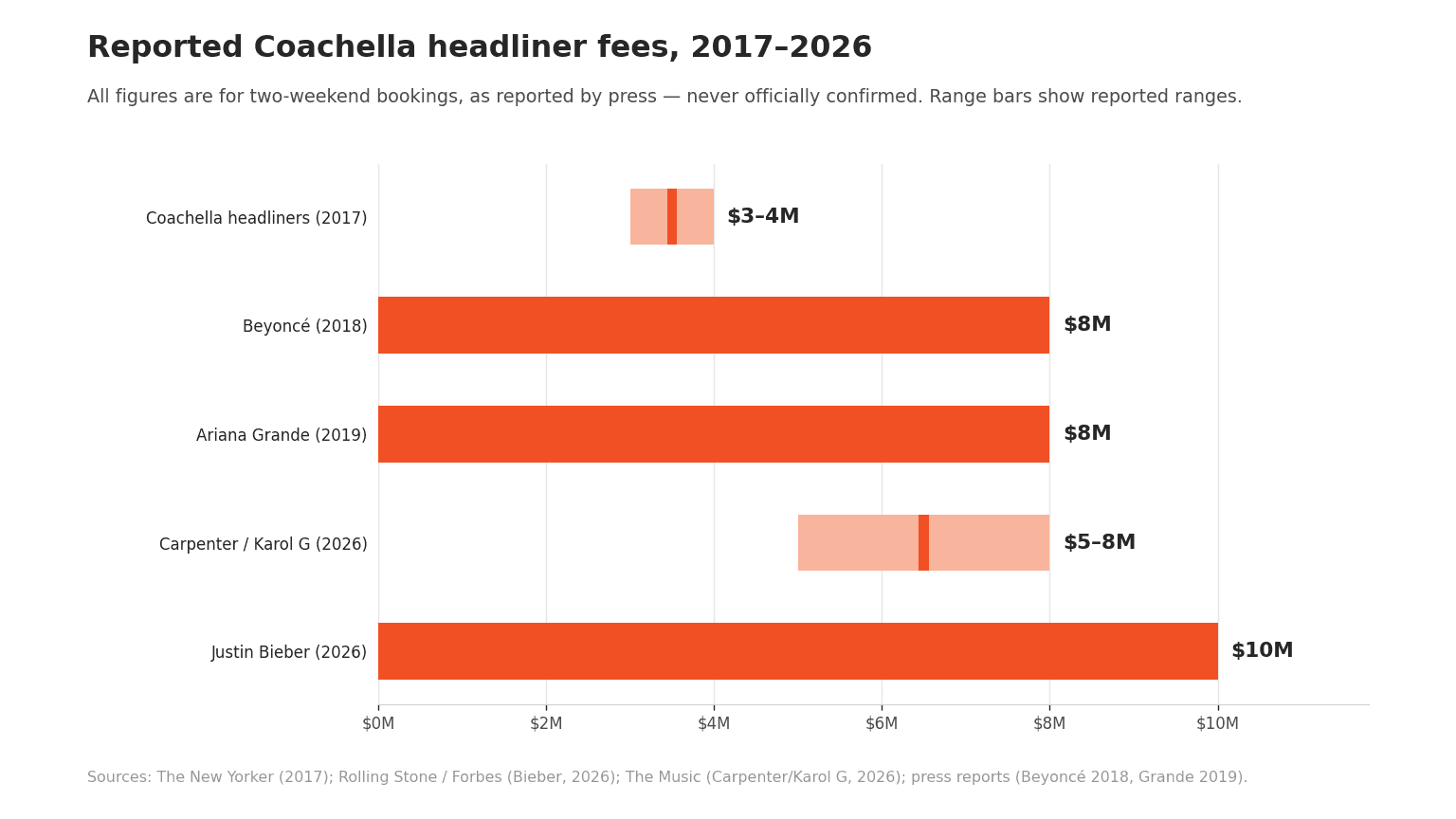
Reported Coachella headliner fees, 2017-2026. The price of the top of the poster has roughly tripled in nine years. Chart: LightSource, from press reports (The New Yorker, Rolling Stone, Forbes, The Music).
The Negotiation, Clause by Clause
The deal structures themselves are worth a procurement person's attention, because the industry solved a cost-attribution problem that direct materials teams would find familiar.
The flat guarantee. Nearly every festival deal is a fixed fee paid regardless of ticket sales. Clubs and theaters often do "versus" deals -- a guarantee versus a percentage of the door, whichever is greater -- but festivals can't, because no single act on a bill of eighty-plus can claim credit for the gate. It is the same reason you don't write cost-plus contracts when you can't isolate the cost driver. The fixed price transfers all demand risk to the promoter: if it rains on Sunday, Another Planet eats it, not the artist.
The deposit. Convention is 50% on signing, the balance at settlement -- often in the artist's hands before the first ticket sells. Procurement teams that wince at supplier prepayment terms should note what absolute leverage looks like when it's the supplier who has it.
The radius clause. This is a geographic non-compete: the artist agrees not to play within a defined radius for a window before and after the festival. A commonly cited San Francisco formulation is 60 miles and 60 days on either side; bigger festivals push further, and Lollapalooza's radius terms have drawn complaints from Chicago venues and neighborhood festivals for years. The clause exists to protect the festival's scarcity -- if Charli XCX plays an Oakland side show in July, the festival's $500 ticket loses some of its reason to exist. It is exclusivity purchased as a contract term, the way a manufacturer buys allocation or an exclusivity window from a capacity-constrained supplier, and it means a festival contract does more than set a price; it allocates scarcity across a city's whole summer calendar.
Billing position. The poster is the org chart of the supply base, and it is negotiated like one -- line placement and even font size are contested terms, because next year's fee anchors on this year's position. Agents negotiate typography. I have seen procurement teams fight over award-letter language with the same energy, and for the same reason: the paper trail sets the benchmark for the next negotiation. Agents are, functionally, some of the best salespeople in any industry, and watching them work is a reminder that procurement has plenty to steal from sales.
Leverage and timing. The uncomfortable procurement lesson is that most of the price is settled before the negotiation starts. A festival that must announce a lineup by March has a hard deadline its counterparty can see; an artist with three competing festival offers in the same window is running a competitive bid without telling you. Jason Busch made exactly this point about reverse auctions on our podcast: 99% of the auction happens before bid day. The festival version: 99% of the guarantee is set by routing, scarcity, and calendar math before the agent picks up the phone.
Where the Procurement Analogy Breaks
A skeptical festival promoter would push back on all of this, and the pushback is worth taking seriously. Nobody sends Charli XCX, The Strokes, and RÜFÜS DU SOL the same spreadsheet and awards the slot to the lowest compliant bidder. Artist supply has no clean substitutes, and a reverse auction would be exactly the wrong tool, because the buyer is not discovering the lowest price for a fixed commodity -- the buyer is discovering which combination of artists, dates, and restrictions can make the weekend sell at all.
The deeper difference is that a headliner is not just a supplier; she is part of the demand curve. A supplier of fasteners does not change how many products you sell. A headliner does. Over-optimizing the fee can damage the product itself, and overpaying for the wrong headliner can destroy the margin, so the buyer is not minimizing cost against a fixed spec -- the buyer is assembling the spec that 75,000 people a day will pay for. Back at Tesla, the hardest sourcing calls on new-product timelines had a similar shape: the question was rarely just piece price, it was timing, qualification, capacity, and risk, and the nominally cheaper supplier was worthless if the part could not arrive in the week the line needed it. Festival buying is that logic with stage lights: availability, audience fit, production feasibility, and contractual cleanliness in the local market all screen before price does.
So the procurement frame is not that booking is a bidding exercise. It is that even in a market of unsubstitutable, demand-creating suppliers, the discipline underneath -- structured offers, explicit terms, cost models, an honest view of leverage -- is what separates promoters who survive on 8% margins from the ones who join the cancellation statistics.
Building the P&L for One Weekend in the Park
Now the exercise. Suppose you wanted to stand up an Outside Lands from scratch -- what would it cost, and what would it earn? One ground rule first: regional economic impact is not promoter revenue. The festival's own impact page reports $97.5 million in 2025 Bay Area economic benefit, but that measures hotel nights, wages, and spillover across the city. The promoter's P&L is a much smaller and less forgiving document.
Outside Lands publishes no financials, but there are enough hard anchors to build a defensible model: Billboard Boxscore reported 205,500 tickets and $29.6 million gross in 2019 (about $144 per attendee-day); Pollstar reported 225,000 visitors and north of $40 million gross in 2023 (about $178); the 2025 edition drew 214,000; and the full 2026 price sheet is public, from the $509-569 three-day GA tiers to the $5,096-5,299 Golden Gate Club passes.
At 2026 prices, roughly 215,000 attendee-days at a blended $215-225 per attendee-day puts gross ticket receipts around $47 million. Sponsorship is unpublished; for a festival with this much brand activation, $5-7 million is a reasonable planning number. Food and beverage runs through more than 100 Bay Area restaurants and wineries, with one vendor telling CBS the festival takes roughly 30% of every sale -- call the festival's share $4 million. Add a couple million for shuttles ($84 a head), the SOMA Social Club ($1,550 per person, groups of eight), and premium upsells, and total revenue lands near $59 million.
The cost side, using the industry's own budget norms and the few OSL-specific numbers that are public:
Line | Estimate | Basis |
|---|---|---|
Talent | $22M | Modeled; 30-50% of budget norm |
Staging & production | $12M | Modeled; industry norm, 7 stages |
Security, medical, staffing | $6M | Modeled; industry norm |
City & park fees | $5M | Anchored; 2019 actual $3.6M, 10% of gross formula |
Marketing & ticketing ops | $3M | Modeled |
Site ops, sanitation, cleanup | $2.5M | Modeled |
Insurance & legal | $2M | Modeled; cancellation premiums ~doubled since COVID |
G&A and contingency | $1.5M | Modeled |
Total | ~$54M |
That leaves an operating surplus around $5 million on $59 million of revenue -- an 8-9% margin, squarely inside the 5-10% that industry observers cite for well-run festivals in good years. Every line is an estimate and the model is the point, not the decimals: the margin is one headliner cancellation, one atmospheric river, or one soft VIP year from zero. That fragility is not theoretical. NPR counted a wave of U.S. festival cancellations in 2024 driven by cost inflation across security, equipment, insurance, and artist fees; the UK lost 78 festivals the same year.
One aside on the resale market, since this year's numbers were striking: by August, three-day GA was reselling around $1,082 against a $509-569 face value. Resale prices are a demand signal -- they say the festival underpriced the primary market -- but reseller markup is not promoter revenue, so it belongs next to the P&L as evidence of pricing power, not in it.
The city's position in this P&L deserves a procurement award of its own. San Francisco did not rent Another Planet a lawn for a flat fee. The original permit set a $950,000 minimum that escalates annually, plus percentage rent of 10% of gross ticket revenue -- which is why Rec & Parks collected $3.6 million in 2019 and $49 million cumulatively since 2008. The city negotiated itself into being a royalty partner with upside and no demand risk. Somebody on that side of the table understood leverage: there is only one Golden Gate Park, and it does not go on tour.
Two things about this exercise generalize. First, this is should-cost modeling with a bass drop: decomposing a price you cannot see into cost drivers you can estimate, anchored to the few observable data points. I have written about doing the same thing for consumer electronics, where the inputs are copper and injection molding instead of staging and security. Second, the discipline of labeling which numbers are reported and which are modeled is the whole game -- most of the cost intelligence our customers build at LightSource works exactly this way, assembling a defensible estimate from partial information, because a supplier will not volunteer their margin structure any more than a booking agent will.
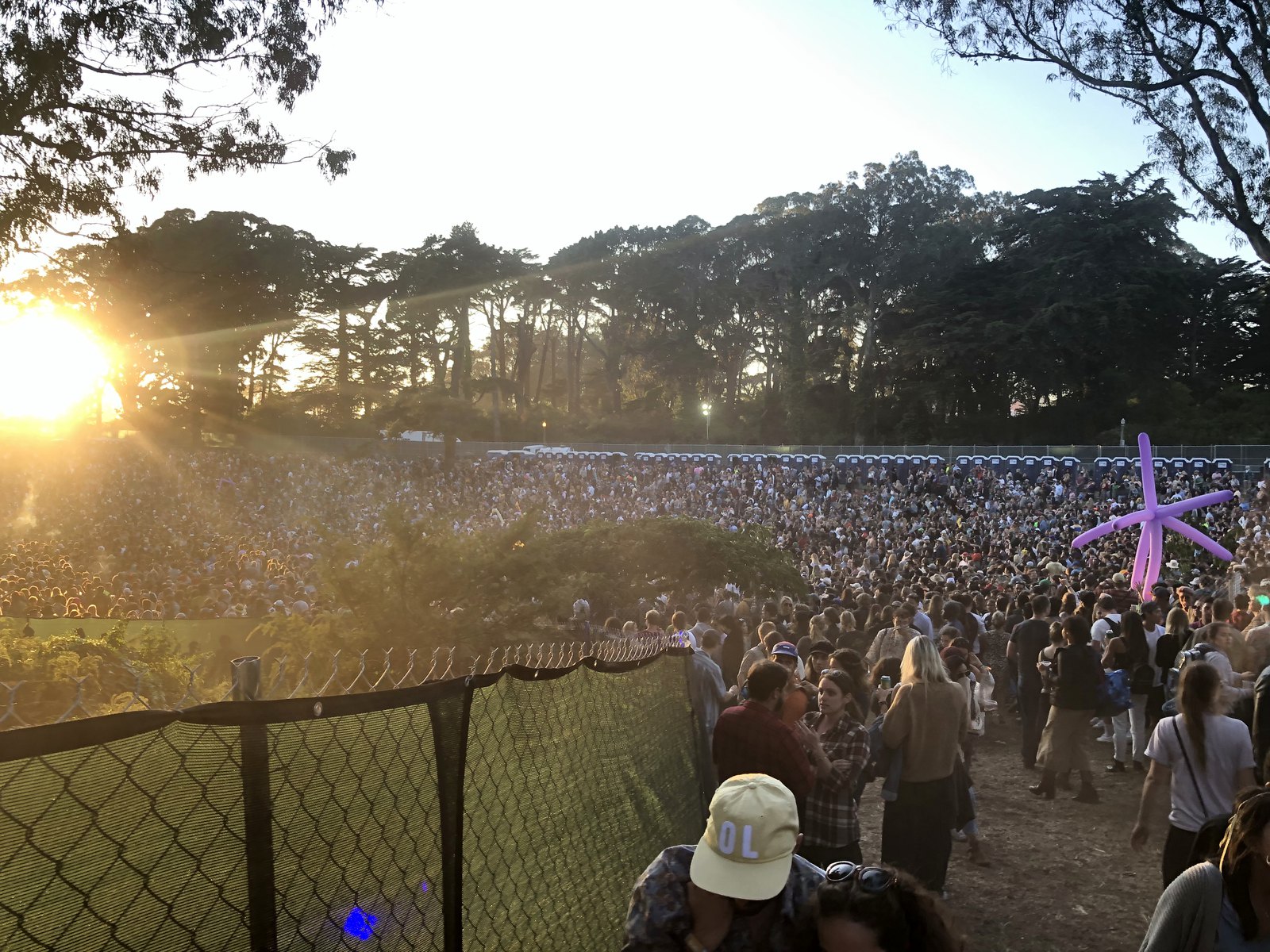
Golden hour over the crowd in Golden Gate Park. At 2026 prices, every head in this frame represents roughly $220 of daily ticket gross. Photo: Spencer Penn.
Hardly Strictly Bluegrass: The Man Who Deleted the Revenue Line
Every October, two months after Outside Lands strikes its stages, the same park hosts the other proof point in festival economics. Hardly Strictly Bluegrass runs three days across six stages with 80-plus acts, draws crowds reported north of 700,000 across the weekend, and charges nothing -- no tickets, no sponsors, no VIP tier. Emmylou Harris plays and you just walk in.
Set the two side by side and you have the same park funded by opposite balance sheets. The festival exists because Warren Hellman, co-founder of the private equity firm Hellman & Friedman and an obsessive banjo player, started paying for it personally in 2001 and kept paying until he died in December 2011. He was explicit that it was a gift to the city, and he structured it to outlive him. The often-repeated claim that he "endowed it forever" turns out to be looser than the legend: the family clarified in 2016 that there is no formal endowment -- Hellman left roughly five years of funding when he died, and the Hellman Foundation distributed about $25 million in festival grants between 2011 and 2016, roughly $5 million a year, with the family committed to continuing indefinitely. "It's not technically endowed, but it's secured for a long time," his son Mick put it.
The scenario math makes the scale of the gift concrete. A recurring obligation of $5 million a year, funded in perpetuity at a conventional 4-5% endowment payout rate, requires a corpus of $100-125 million. If the true cost is closer to $10 million today -- plausible, given what has happened to artist fees, security, and insurance since 2016 -- the perpetual number is $200-250 million. That is the price of deleting the revenue line from a festival P&L: park nine figures and let the payout write the checks. And free admission changes the payer, not the work. Hardly Strictly still buys talent, stages, sound, security, sanitation, and insurance; it has simply swapped Outside Lands' ticket-demand and sponsor-market risk for donor-capital, governance, and cost-inflation risk.
Outside Lands has to re-win its 8% margin every August against rising guarantees and doubling insurance premiums; it survives by being excellent at procurement -- and by having negotiated the only park of its kind into a long-term partnership. Hardly Strictly carries no revenue risk at all, but its single point of failure is a family's continued willingness to write a $5-million-plus check every year for a founder who has been gone fourteen years. So far, they keep writing it. Whether a great P&L or a great patron is the more durable foundation for a festival is a genuinely open question; San Francisco is lucky enough to be running both experiments in the same park.
What stays with me, seven years after that Paul Simon photo, is how much sourcing hides behind a weekend that most of us experience as a wristband and a set time. Someone negotiated every guarantee, every radius clause, every stage build, and the city's 10% before a single note was played. Paul Simon, for one evening in 2019, added his own line to the ledger: he took the seven-figure guarantee that absolute leverage entitled him to, and handed it to the people who take care of the lawn.
Sources
Outside Lands 2026 tickets (Front Gate) -- 2026 3-day GA tier pricing ($509-569); companion pages for GA+, VIP, and Golden Gate Club tiers
SFist: Outside Lands sells out 3-day tickets in less than a week -- 2026 sellout timing and single-day pricing
Outside Lands Community Impact -- $49M cumulative to SF Rec & Parks, $97.5M 2025 economic impact, 2025 attendance and vendor counts
Bay Area Council Economic Institute: APE Golden Gate Park concert series impact -- $245.1M 2025 series impact study
Richmond Review/Sunset Beacon: Outside Lands generates millions for city -- 2019 Boxscore figures (205,500 tickets, $29.6M) and $3.6M Rec & Park payment
SF Legistar: Outside Lands permit agreement -- minimum fee structure and 10%-of-gross percentage rent
Pollstar: mid-year 2024 festival market analysis -- OSL 2023 gross (>$40M) and attendance (225,000)
CBS San Francisco: Outside Lands' billion-dollar benefit -- vendor anecdote that the festival takes ~30% of every sale
Rolling Stone: Justin Bieber's Coachella payday -- reported ~$10M 2026 headliner fee
The Music: how much Coachella headliners get paid -- reported $5-8M range for 2026 headliners
Grey Journal: Coachella performer pay -- Beyoncé and headliner fee benchmarks
Rolling Stone: where to buy last-minute Outside Lands tickets -- August 2026 resale pricing
Brakkus: How festival lineups actually get booked -- agent commissions, flat guarantees vs. door deals
Tools4Music: the guarantee -- 50% deposit convention
Calisto: artist booking and settlement -- deal-type taxonomy: flat guarantee, versus, door split, co-promotion
Wikipedia: Radius clause -- radius clause mechanics and Lollapalooza examples
Ticket Fairy: festival production budgeting -- talent as 30-50% of budget; cost category norms
NPR Planet Money: why music festivals are getting canceled -- 2024 cancellation wave and cost inflation
Azzet: music festivals go silent -- UK Association of Independent Festivals count of 78 festivals axed in 2024
Paul Simon: donation announcement -- OSL 2019 proceeds to SF Parks Alliance and Friends of the Urban Forest
Consequence: Paul Simon comes out of retirement to headline Outside Lands -- retirement context and seven-figure fee reporting
SFist: Hardly Strictly Bluegrass isn't actually endowed forever -- Hellman Foundation grants ($25M, 2011-2016), five years of funding, family quotes
Washington Post: Warren Hellman obituary -- Hellman's death and the festival's continuation
Frequently Asked Questions
How much do festival headliners get paid?
Top headliners at major U.S. festivals reportedly earn $2-5 million per festival weekend, based on leaked Coachella figures: Beyoncé earned a reported $8 million for two weekends in 2018, and Justin Bieber reportedly earned about $10 million for two weekends in 2026. Fees at single-weekend festivals like Outside Lands are never officially disclosed. Aggregate talent budgets typically consume 30-50% of a major festival's total costs.
How do music festivals book their lineups?
A festival's talent buyer negotiates with each artist's booking agent, starting with headliners 12-18 months before the event. Deals are made through offer sheets that specify the guarantee (a flat fee), a deposit (commonly 50% on signing), set length, billing position, technical and hospitality riders, and a radius clause. Agents, who take 10-15% commission, often package supporting acts from their roster alongside in-demand headliners.
What is a radius clause in a festival contract?
A radius clause is a geographic non-compete that prevents an artist from playing other shows near the festival for a defined window -- for example, within 60 miles for 60 days before and after a San Francisco date. Festivals use radius clauses to protect ticket demand, since a nearby side show would undercut the festival's exclusivity. Larger festivals like Lollapalooza have drawn criticism from local venues for aggressive radius terms.
How much does it cost to put on a festival like Outside Lands?
A defensible estimate for a three-day, 75,000-person-per-day festival like Outside Lands is roughly $50-55 million, with talent ($20-22M) as the largest line, followed by staging and production ($12M), security and staffing ($6M), city and park fees ($5M), marketing, insurance, and site operations. Outside Lands does not publish financials; these are modeled estimates anchored to reported figures like its $29.6M gross in 2019 and $40M+ gross in 2023.
Is Outside Lands profitable?
Probably, but not by an enormous margin. Modeling 2026 prices against reported attendance suggests roughly $59 million in revenue against $54 million in costs -- an operating margin around 8-9%, consistent with the 5-10% industry observers cite for successful festivals. The festival has also paid San Francisco's Rec & Parks department $49 million since 2008 under a contract that includes 10% of gross ticket revenue.
How is Hardly Strictly Bluegrass free?
Billionaire Warren Hellman personally funded the festival from its founding in 2001 until his death in 2011, and left behind roughly five years of funding; the Hellman Foundation then distributed about $25 million in festival grants from 2011 to 2016, and the family has committed to continuing support. Contrary to legend, there is no formal endowment. Funding a $5 million annual festival in perpetuity at a 4-5% payout rate would require a corpus of $100-125 million.
A good chunk of the LightSource team spent last weekend in Golden Gate Park at Outside Lands, watching Charli XCX, The Strokes, and RÜFÜS DU SOL headline the festival's 18th edition. The three-day passes sold out in six days back in March. I have my own history with this festival: seven years ago today, on August 11, 2019, I stood on the polo field and watched Paul Simon close the Sunday night slot. The cover image on this post is the photo I took from the crowd. Simon had come out of retirement for it, and he donated his entire fee -- a seven-figure number, by industry estimates -- to the San Francisco Parks Alliance and Friends of the Urban Forest.
Somewhere between sets, the professional deformation kicked in. A festival is a procurement organization with a stage attached. The lineup is a bill of materials. The artists are suppliers -- and the headliners are sole-source suppliers with absolute leverage, because there is exactly one Charli XCX and she knows it. The contracts that put her on that stage are full of concepts any sourcing manager would recognize: guarantees, deposits, riders, exclusivity windows, penalty clauses. So this post is the procurement tour of a music festival: how the talent gets sourced and priced, what the whole event costs to build, whether the P&L actually works, and what happened when one man in this same park decided the P&L was beside the point.
Scenes from the polo field, Outside Lands 2026. Commitment to the bit is its own supplier qualification. Video: Spencer Penn.
The Lineup Is a Bill of Materials
Festivals do not post an RFQ and wait for bands to bid. The sourcing process runs through a small professional layer that procurement people would recognize as brokers and category managers. On the festival side sits a talent buyer -- at Outside Lands, that function lives with Another Planet Entertainment, the independent Bay Area promoter that produces the festival. On the artist side sits a booking agent at an agency like WME, CAA, or Wasserman, who negotiates on the artist's behalf and typically takes 10-15% of the gross performance fee.
The sourcing cycle is long. Major festivals start pursuing headliners 12 to 18 months before the gates open, which means the acts you saw this weekend were likely being negotiated in early 2025. That sequencing matters: the headliners get locked first because everything else keys off them -- the poster, the ticket on-sale, the sponsorship pitch, and the undercard, which agents fill in later, often by packaging supporting acts from the same roster alongside the star you actually wanted. Anyone who has had a distributor bundle B-tier line items onto a strategic award will recognize the move, and the discipline is the same too: you need an independent view of what each act is worth, or the package price quietly hides weak pricing on the lower-billed names. Relationships modulate all of it: promoters with long agency ties see earlier looks and better numbers, which is supplier relationship management wearing a laminate.
The core sourcing document is the offer sheet, and it is a quote package in everything but name. A typical one specifies the date, the stage, the set length, the guarantee, the deposit schedule, billing position on the poster, the technical rider (staging, sound, video requirements), the hospitality rider, travel and lodging terms, recording and livestream rights, cancellation and force majeure terms, and the radius clause. If you stripped the artist names out, you could file it next to any RFQ your sourcing team sent last quarter. My colleague Mason Morgan has written about what happens when this kind of structured commercial data lives in email and spreadsheets; the music industry runs a version of that problem at seven figures per line item.
What a Headliner Costs
Talent fees are the least transparent part of the industry -- actual settlement numbers almost never leak, and Outside Lands' fees for Charli XCX, The Strokes, and RÜFÜS DU SOL are not public. But enough reported data points exist to sketch the market, mostly from Coachella, the industry's loudest price signal:
Act | Reported fee | Context |
|---|---|---|
Coachella headliners, 2017 | $3-4M | New Yorker reporting |
Beyoncé, 2018 | $8M | Two weekends |
Ariana Grande, 2019 | $8M | Two weekends |
Carpenter / Karol G, 2026 | $5-8M | Two weekends, reported range |
Justin Bieber, 2026 | ~$10M | Two weekends, per Rolling Stone |
These are comps, not quotes. Coachella buys two weekends and an enormous media moment, so a rough single-weekend translation puts a top headliner at $2-5 million per festival appearance, with routing as the swing factor: an artist already touring the West Coast in August costs less than one mounting a one-off production. Below the top line, the structure fans out the way any supply base does. The reported numbers get scarce below headliner level, but the industry rule-of-thumb shape looks like this: direct support acts (the 6 p.m. slots) in the high six figures, mid-card acts in the low-to-mid six figures, and the noon-slot locals in the four-to-low-five-figure range. Treat those as estimates -- unlike the headliner numbers above, they do not come from reported settlements. What is well documented is the aggregate: talent typically consumes 30-50% of a major festival's total budget, the single largest cost category, ahead of staging, security, and everything else. And the guarantee is only part of what an act costs. Production contributions, hospitality riders, travel, and ground transport all land on the promoter's side of the ledger, which means the total cost of ownership of a headliner runs meaningfully past the sticker.
Reported Coachella headliner fees, 2017-2026. The price of the top of the poster has roughly tripled in nine years. Chart: LightSource, from press reports (The New Yorker, Rolling Stone, Forbes, The Music).
The Negotiation, Clause by Clause
The deal structures themselves are worth a procurement person's attention, because the industry solved a cost-attribution problem that direct materials teams would find familiar.
The flat guarantee. Nearly every festival deal is a fixed fee paid regardless of ticket sales. Clubs and theaters often do "versus" deals -- a guarantee versus a percentage of the door, whichever is greater -- but festivals can't, because no single act on a bill of eighty-plus can claim credit for the gate. It is the same reason you don't write cost-plus contracts when you can't isolate the cost driver. The fixed price transfers all demand risk to the promoter: if it rains on Sunday, Another Planet eats it, not the artist.
The deposit. Convention is 50% on signing, the balance at settlement -- often in the artist's hands before the first ticket sells. Procurement teams that wince at supplier prepayment terms should note what absolute leverage looks like when it's the supplier who has it.
The radius clause. This is a geographic non-compete: the artist agrees not to play within a defined radius for a window before and after the festival. A commonly cited San Francisco formulation is 60 miles and 60 days on either side; bigger festivals push further, and Lollapalooza's radius terms have drawn complaints from Chicago venues and neighborhood festivals for years. The clause exists to protect the festival's scarcity -- if Charli XCX plays an Oakland side show in July, the festival's $500 ticket loses some of its reason to exist. It is exclusivity purchased as a contract term, the way a manufacturer buys allocation or an exclusivity window from a capacity-constrained supplier, and it means a festival contract does more than set a price; it allocates scarcity across a city's whole summer calendar.
Billing position. The poster is the org chart of the supply base, and it is negotiated like one -- line placement and even font size are contested terms, because next year's fee anchors on this year's position. Agents negotiate typography. I have seen procurement teams fight over award-letter language with the same energy, and for the same reason: the paper trail sets the benchmark for the next negotiation. Agents are, functionally, some of the best salespeople in any industry, and watching them work is a reminder that procurement has plenty to steal from sales.
Leverage and timing. The uncomfortable procurement lesson is that most of the price is settled before the negotiation starts. A festival that must announce a lineup by March has a hard deadline its counterparty can see; an artist with three competing festival offers in the same window is running a competitive bid without telling you. Jason Busch made exactly this point about reverse auctions on our podcast: 99% of the auction happens before bid day. The festival version: 99% of the guarantee is set by routing, scarcity, and calendar math before the agent picks up the phone.
Where the Procurement Analogy Breaks
A skeptical festival promoter would push back on all of this, and the pushback is worth taking seriously. Nobody sends Charli XCX, The Strokes, and RÜFÜS DU SOL the same spreadsheet and awards the slot to the lowest compliant bidder. Artist supply has no clean substitutes, and a reverse auction would be exactly the wrong tool, because the buyer is not discovering the lowest price for a fixed commodity -- the buyer is discovering which combination of artists, dates, and restrictions can make the weekend sell at all.
The deeper difference is that a headliner is not just a supplier; she is part of the demand curve. A supplier of fasteners does not change how many products you sell. A headliner does. Over-optimizing the fee can damage the product itself, and overpaying for the wrong headliner can destroy the margin, so the buyer is not minimizing cost against a fixed spec -- the buyer is assembling the spec that 75,000 people a day will pay for. Back at Tesla, the hardest sourcing calls on new-product timelines had a similar shape: the question was rarely just piece price, it was timing, qualification, capacity, and risk, and the nominally cheaper supplier was worthless if the part could not arrive in the week the line needed it. Festival buying is that logic with stage lights: availability, audience fit, production feasibility, and contractual cleanliness in the local market all screen before price does.
So the procurement frame is not that booking is a bidding exercise. It is that even in a market of unsubstitutable, demand-creating suppliers, the discipline underneath -- structured offers, explicit terms, cost models, an honest view of leverage -- is what separates promoters who survive on 8% margins from the ones who join the cancellation statistics.
Building the P&L for One Weekend in the Park
Now the exercise. Suppose you wanted to stand up an Outside Lands from scratch -- what would it cost, and what would it earn? One ground rule first: regional economic impact is not promoter revenue. The festival's own impact page reports $97.5 million in 2025 Bay Area economic benefit, but that measures hotel nights, wages, and spillover across the city. The promoter's P&L is a much smaller and less forgiving document.
Outside Lands publishes no financials, but there are enough hard anchors to build a defensible model: Billboard Boxscore reported 205,500 tickets and $29.6 million gross in 2019 (about $144 per attendee-day); Pollstar reported 225,000 visitors and north of $40 million gross in 2023 (about $178); the 2025 edition drew 214,000; and the full 2026 price sheet is public, from the $509-569 three-day GA tiers to the $5,096-5,299 Golden Gate Club passes.
At 2026 prices, roughly 215,000 attendee-days at a blended $215-225 per attendee-day puts gross ticket receipts around $47 million. Sponsorship is unpublished; for a festival with this much brand activation, $5-7 million is a reasonable planning number. Food and beverage runs through more than 100 Bay Area restaurants and wineries, with one vendor telling CBS the festival takes roughly 30% of every sale -- call the festival's share $4 million. Add a couple million for shuttles ($84 a head), the SOMA Social Club ($1,550 per person, groups of eight), and premium upsells, and total revenue lands near $59 million.
The cost side, using the industry's own budget norms and the few OSL-specific numbers that are public:
Line | Estimate | Basis |
|---|---|---|
Talent | $22M | Modeled; 30-50% of budget norm |
Staging & production | $12M | Modeled; industry norm, 7 stages |
Security, medical, staffing | $6M | Modeled; industry norm |
City & park fees | $5M | Anchored; 2019 actual $3.6M, 10% of gross formula |
Marketing & ticketing ops | $3M | Modeled |
Site ops, sanitation, cleanup | $2.5M | Modeled |
Insurance & legal | $2M | Modeled; cancellation premiums ~doubled since COVID |
G&A and contingency | $1.5M | Modeled |
Total | ~$54M |
That leaves an operating surplus around $5 million on $59 million of revenue -- an 8-9% margin, squarely inside the 5-10% that industry observers cite for well-run festivals in good years. Every line is an estimate and the model is the point, not the decimals: the margin is one headliner cancellation, one atmospheric river, or one soft VIP year from zero. That fragility is not theoretical. NPR counted a wave of U.S. festival cancellations in 2024 driven by cost inflation across security, equipment, insurance, and artist fees; the UK lost 78 festivals the same year.
One aside on the resale market, since this year's numbers were striking: by August, three-day GA was reselling around $1,082 against a $509-569 face value. Resale prices are a demand signal -- they say the festival underpriced the primary market -- but reseller markup is not promoter revenue, so it belongs next to the P&L as evidence of pricing power, not in it.
The city's position in this P&L deserves a procurement award of its own. San Francisco did not rent Another Planet a lawn for a flat fee. The original permit set a $950,000 minimum that escalates annually, plus percentage rent of 10% of gross ticket revenue -- which is why Rec & Parks collected $3.6 million in 2019 and $49 million cumulatively since 2008. The city negotiated itself into being a royalty partner with upside and no demand risk. Somebody on that side of the table understood leverage: there is only one Golden Gate Park, and it does not go on tour.
Two things about this exercise generalize. First, this is should-cost modeling with a bass drop: decomposing a price you cannot see into cost drivers you can estimate, anchored to the few observable data points. I have written about doing the same thing for consumer electronics, where the inputs are copper and injection molding instead of staging and security. Second, the discipline of labeling which numbers are reported and which are modeled is the whole game -- most of the cost intelligence our customers build at LightSource works exactly this way, assembling a defensible estimate from partial information, because a supplier will not volunteer their margin structure any more than a booking agent will.
Golden hour over the crowd in Golden Gate Park. At 2026 prices, every head in this frame represents roughly $220 of daily ticket gross. Photo: Spencer Penn.
Hardly Strictly Bluegrass: The Man Who Deleted the Revenue Line
Every October, two months after Outside Lands strikes its stages, the same park hosts the other proof point in festival economics. Hardly Strictly Bluegrass runs three days across six stages with 80-plus acts, draws crowds reported north of 700,000 across the weekend, and charges nothing -- no tickets, no sponsors, no VIP tier. Emmylou Harris plays and you just walk in.
Set the two side by side and you have the same park funded by opposite balance sheets. The festival exists because Warren Hellman, co-founder of the private equity firm Hellman & Friedman and an obsessive banjo player, started paying for it personally in 2001 and kept paying until he died in December 2011. He was explicit that it was a gift to the city, and he structured it to outlive him. The often-repeated claim that he "endowed it forever" turns out to be looser than the legend: the family clarified in 2016 that there is no formal endowment -- Hellman left roughly five years of funding when he died, and the Hellman Foundation distributed about $25 million in festival grants between 2011 and 2016, roughly $5 million a year, with the family committed to continuing indefinitely. "It's not technically endowed, but it's secured for a long time," his son Mick put it.
The scenario math makes the scale of the gift concrete. A recurring obligation of $5 million a year, funded in perpetuity at a conventional 4-5% endowment payout rate, requires a corpus of $100-125 million. If the true cost is closer to $10 million today -- plausible, given what has happened to artist fees, security, and insurance since 2016 -- the perpetual number is $200-250 million. That is the price of deleting the revenue line from a festival P&L: park nine figures and let the payout write the checks. And free admission changes the payer, not the work. Hardly Strictly still buys talent, stages, sound, security, sanitation, and insurance; it has simply swapped Outside Lands' ticket-demand and sponsor-market risk for donor-capital, governance, and cost-inflation risk.
Outside Lands has to re-win its 8% margin every August against rising guarantees and doubling insurance premiums; it survives by being excellent at procurement -- and by having negotiated the only park of its kind into a long-term partnership. Hardly Strictly carries no revenue risk at all, but its single point of failure is a family's continued willingness to write a $5-million-plus check every year for a founder who has been gone fourteen years. So far, they keep writing it. Whether a great P&L or a great patron is the more durable foundation for a festival is a genuinely open question; San Francisco is lucky enough to be running both experiments in the same park.
What stays with me, seven years after that Paul Simon photo, is how much sourcing hides behind a weekend that most of us experience as a wristband and a set time. Someone negotiated every guarantee, every radius clause, every stage build, and the city's 10% before a single note was played. Paul Simon, for one evening in 2019, added his own line to the ledger: he took the seven-figure guarantee that absolute leverage entitled him to, and handed it to the people who take care of the lawn.
Sources
Outside Lands 2026 tickets (Front Gate) -- 2026 3-day GA tier pricing ($509-569); companion pages for GA+, VIP, and Golden Gate Club tiers
SFist: Outside Lands sells out 3-day tickets in less than a week -- 2026 sellout timing and single-day pricing
Outside Lands Community Impact -- $49M cumulative to SF Rec & Parks, $97.5M 2025 economic impact, 2025 attendance and vendor counts
Bay Area Council Economic Institute: APE Golden Gate Park concert series impact -- $245.1M 2025 series impact study
Richmond Review/Sunset Beacon: Outside Lands generates millions for city -- 2019 Boxscore figures (205,500 tickets, $29.6M) and $3.6M Rec & Park payment
SF Legistar: Outside Lands permit agreement -- minimum fee structure and 10%-of-gross percentage rent
Pollstar: mid-year 2024 festival market analysis -- OSL 2023 gross (>$40M) and attendance (225,000)
CBS San Francisco: Outside Lands' billion-dollar benefit -- vendor anecdote that the festival takes ~30% of every sale
Rolling Stone: Justin Bieber's Coachella payday -- reported ~$10M 2026 headliner fee
The Music: how much Coachella headliners get paid -- reported $5-8M range for 2026 headliners
Grey Journal: Coachella performer pay -- Beyoncé and headliner fee benchmarks
Rolling Stone: where to buy last-minute Outside Lands tickets -- August 2026 resale pricing
Brakkus: How festival lineups actually get booked -- agent commissions, flat guarantees vs. door deals
Tools4Music: the guarantee -- 50% deposit convention
Calisto: artist booking and settlement -- deal-type taxonomy: flat guarantee, versus, door split, co-promotion
Wikipedia: Radius clause -- radius clause mechanics and Lollapalooza examples
Ticket Fairy: festival production budgeting -- talent as 30-50% of budget; cost category norms
NPR Planet Money: why music festivals are getting canceled -- 2024 cancellation wave and cost inflation
Azzet: music festivals go silent -- UK Association of Independent Festivals count of 78 festivals axed in 2024
Paul Simon: donation announcement -- OSL 2019 proceeds to SF Parks Alliance and Friends of the Urban Forest
Consequence: Paul Simon comes out of retirement to headline Outside Lands -- retirement context and seven-figure fee reporting
SFist: Hardly Strictly Bluegrass isn't actually endowed forever -- Hellman Foundation grants ($25M, 2011-2016), five years of funding, family quotes
Washington Post: Warren Hellman obituary -- Hellman's death and the festival's continuation
Frequently Asked Questions
How much do festival headliners get paid?
Top headliners at major U.S. festivals reportedly earn $2-5 million per festival weekend, based on leaked Coachella figures: Beyoncé earned a reported $8 million for two weekends in 2018, and Justin Bieber reportedly earned about $10 million for two weekends in 2026. Fees at single-weekend festivals like Outside Lands are never officially disclosed. Aggregate talent budgets typically consume 30-50% of a major festival's total costs.
How do music festivals book their lineups?
A festival's talent buyer negotiates with each artist's booking agent, starting with headliners 12-18 months before the event. Deals are made through offer sheets that specify the guarantee (a flat fee), a deposit (commonly 50% on signing), set length, billing position, technical and hospitality riders, and a radius clause. Agents, who take 10-15% commission, often package supporting acts from their roster alongside in-demand headliners.
What is a radius clause in a festival contract?
A radius clause is a geographic non-compete that prevents an artist from playing other shows near the festival for a defined window -- for example, within 60 miles for 60 days before and after a San Francisco date. Festivals use radius clauses to protect ticket demand, since a nearby side show would undercut the festival's exclusivity. Larger festivals like Lollapalooza have drawn criticism from local venues for aggressive radius terms.
How much does it cost to put on a festival like Outside Lands?
A defensible estimate for a three-day, 75,000-person-per-day festival like Outside Lands is roughly $50-55 million, with talent ($20-22M) as the largest line, followed by staging and production ($12M), security and staffing ($6M), city and park fees ($5M), marketing, insurance, and site operations. Outside Lands does not publish financials; these are modeled estimates anchored to reported figures like its $29.6M gross in 2019 and $40M+ gross in 2023.
Is Outside Lands profitable?
Probably, but not by an enormous margin. Modeling 2026 prices against reported attendance suggests roughly $59 million in revenue against $54 million in costs -- an operating margin around 8-9%, consistent with the 5-10% industry observers cite for successful festivals. The festival has also paid San Francisco's Rec & Parks department $49 million since 2008 under a contract that includes 10% of gross ticket revenue.
How is Hardly Strictly Bluegrass free?
Billionaire Warren Hellman personally funded the festival from its founding in 2001 until his death in 2011, and left behind roughly five years of funding; the Hellman Foundation then distributed about $25 million in festival grants from 2011 to 2016, and the family has committed to continuing support. Contrary to legend, there is no formal endowment. Funding a $5 million annual festival in perpetuity at a 4-5% payout rate would require a corpus of $100-125 million.
A good chunk of the LightSource team spent last weekend in Golden Gate Park at Outside Lands, watching Charli XCX, The Strokes, and RÜFÜS DU SOL headline the festival's 18th edition. The three-day passes sold out in six days back in March. I have my own history with this festival: seven years ago today, on August 11, 2019, I stood on the polo field and watched Paul Simon close the Sunday night slot. The cover image on this post is the photo I took from the crowd. Simon had come out of retirement for it, and he donated his entire fee -- a seven-figure number, by industry estimates -- to the San Francisco Parks Alliance and Friends of the Urban Forest.
Somewhere between sets, the professional deformation kicked in. A festival is a procurement organization with a stage attached. The lineup is a bill of materials. The artists are suppliers -- and the headliners are sole-source suppliers with absolute leverage, because there is exactly one Charli XCX and she knows it. The contracts that put her on that stage are full of concepts any sourcing manager would recognize: guarantees, deposits, riders, exclusivity windows, penalty clauses. So this post is the procurement tour of a music festival: how the talent gets sourced and priced, what the whole event costs to build, whether the P&L actually works, and what happened when one man in this same park decided the P&L was beside the point.
Scenes from the polo field, Outside Lands 2026. Commitment to the bit is its own supplier qualification. Video: Spencer Penn.
The Lineup Is a Bill of Materials
Festivals do not post an RFQ and wait for bands to bid. The sourcing process runs through a small professional layer that procurement people would recognize as brokers and category managers. On the festival side sits a talent buyer -- at Outside Lands, that function lives with Another Planet Entertainment, the independent Bay Area promoter that produces the festival. On the artist side sits a booking agent at an agency like WME, CAA, or Wasserman, who negotiates on the artist's behalf and typically takes 10-15% of the gross performance fee.
The sourcing cycle is long. Major festivals start pursuing headliners 12 to 18 months before the gates open, which means the acts you saw this weekend were likely being negotiated in early 2025. That sequencing matters: the headliners get locked first because everything else keys off them -- the poster, the ticket on-sale, the sponsorship pitch, and the undercard, which agents fill in later, often by packaging supporting acts from the same roster alongside the star you actually wanted. Anyone who has had a distributor bundle B-tier line items onto a strategic award will recognize the move, and the discipline is the same too: you need an independent view of what each act is worth, or the package price quietly hides weak pricing on the lower-billed names. Relationships modulate all of it: promoters with long agency ties see earlier looks and better numbers, which is supplier relationship management wearing a laminate.
The core sourcing document is the offer sheet, and it is a quote package in everything but name. A typical one specifies the date, the stage, the set length, the guarantee, the deposit schedule, billing position on the poster, the technical rider (staging, sound, video requirements), the hospitality rider, travel and lodging terms, recording and livestream rights, cancellation and force majeure terms, and the radius clause. If you stripped the artist names out, you could file it next to any RFQ your sourcing team sent last quarter. My colleague Mason Morgan has written about what happens when this kind of structured commercial data lives in email and spreadsheets; the music industry runs a version of that problem at seven figures per line item.
What a Headliner Costs
Talent fees are the least transparent part of the industry -- actual settlement numbers almost never leak, and Outside Lands' fees for Charli XCX, The Strokes, and RÜFÜS DU SOL are not public. But enough reported data points exist to sketch the market, mostly from Coachella, the industry's loudest price signal:
Act | Reported fee | Context |
|---|---|---|
Coachella headliners, 2017 | $3-4M | New Yorker reporting |
Beyoncé, 2018 | $8M | Two weekends |
Ariana Grande, 2019 | $8M | Two weekends |
Carpenter / Karol G, 2026 | $5-8M | Two weekends, reported range |
Justin Bieber, 2026 | ~$10M | Two weekends, per Rolling Stone |
These are comps, not quotes. Coachella buys two weekends and an enormous media moment, so a rough single-weekend translation puts a top headliner at $2-5 million per festival appearance, with routing as the swing factor: an artist already touring the West Coast in August costs less than one mounting a one-off production. Below the top line, the structure fans out the way any supply base does. The reported numbers get scarce below headliner level, but the industry rule-of-thumb shape looks like this: direct support acts (the 6 p.m. slots) in the high six figures, mid-card acts in the low-to-mid six figures, and the noon-slot locals in the four-to-low-five-figure range. Treat those as estimates -- unlike the headliner numbers above, they do not come from reported settlements. What is well documented is the aggregate: talent typically consumes 30-50% of a major festival's total budget, the single largest cost category, ahead of staging, security, and everything else. And the guarantee is only part of what an act costs. Production contributions, hospitality riders, travel, and ground transport all land on the promoter's side of the ledger, which means the total cost of ownership of a headliner runs meaningfully past the sticker.
Reported Coachella headliner fees, 2017-2026. The price of the top of the poster has roughly tripled in nine years. Chart: LightSource, from press reports (The New Yorker, Rolling Stone, Forbes, The Music).
The Negotiation, Clause by Clause
The deal structures themselves are worth a procurement person's attention, because the industry solved a cost-attribution problem that direct materials teams would find familiar.
The flat guarantee. Nearly every festival deal is a fixed fee paid regardless of ticket sales. Clubs and theaters often do "versus" deals -- a guarantee versus a percentage of the door, whichever is greater -- but festivals can't, because no single act on a bill of eighty-plus can claim credit for the gate. It is the same reason you don't write cost-plus contracts when you can't isolate the cost driver. The fixed price transfers all demand risk to the promoter: if it rains on Sunday, Another Planet eats it, not the artist.
The deposit. Convention is 50% on signing, the balance at settlement -- often in the artist's hands before the first ticket sells. Procurement teams that wince at supplier prepayment terms should note what absolute leverage looks like when it's the supplier who has it.
The radius clause. This is a geographic non-compete: the artist agrees not to play within a defined radius for a window before and after the festival. A commonly cited San Francisco formulation is 60 miles and 60 days on either side; bigger festivals push further, and Lollapalooza's radius terms have drawn complaints from Chicago venues and neighborhood festivals for years. The clause exists to protect the festival's scarcity -- if Charli XCX plays an Oakland side show in July, the festival's $500 ticket loses some of its reason to exist. It is exclusivity purchased as a contract term, the way a manufacturer buys allocation or an exclusivity window from a capacity-constrained supplier, and it means a festival contract does more than set a price; it allocates scarcity across a city's whole summer calendar.
Billing position. The poster is the org chart of the supply base, and it is negotiated like one -- line placement and even font size are contested terms, because next year's fee anchors on this year's position. Agents negotiate typography. I have seen procurement teams fight over award-letter language with the same energy, and for the same reason: the paper trail sets the benchmark for the next negotiation. Agents are, functionally, some of the best salespeople in any industry, and watching them work is a reminder that procurement has plenty to steal from sales.
Leverage and timing. The uncomfortable procurement lesson is that most of the price is settled before the negotiation starts. A festival that must announce a lineup by March has a hard deadline its counterparty can see; an artist with three competing festival offers in the same window is running a competitive bid without telling you. Jason Busch made exactly this point about reverse auctions on our podcast: 99% of the auction happens before bid day. The festival version: 99% of the guarantee is set by routing, scarcity, and calendar math before the agent picks up the phone.
Where the Procurement Analogy Breaks
A skeptical festival promoter would push back on all of this, and the pushback is worth taking seriously. Nobody sends Charli XCX, The Strokes, and RÜFÜS DU SOL the same spreadsheet and awards the slot to the lowest compliant bidder. Artist supply has no clean substitutes, and a reverse auction would be exactly the wrong tool, because the buyer is not discovering the lowest price for a fixed commodity -- the buyer is discovering which combination of artists, dates, and restrictions can make the weekend sell at all.
The deeper difference is that a headliner is not just a supplier; she is part of the demand curve. A supplier of fasteners does not change how many products you sell. A headliner does. Over-optimizing the fee can damage the product itself, and overpaying for the wrong headliner can destroy the margin, so the buyer is not minimizing cost against a fixed spec -- the buyer is assembling the spec that 75,000 people a day will pay for. Back at Tesla, the hardest sourcing calls on new-product timelines had a similar shape: the question was rarely just piece price, it was timing, qualification, capacity, and risk, and the nominally cheaper supplier was worthless if the part could not arrive in the week the line needed it. Festival buying is that logic with stage lights: availability, audience fit, production feasibility, and contractual cleanliness in the local market all screen before price does.
So the procurement frame is not that booking is a bidding exercise. It is that even in a market of unsubstitutable, demand-creating suppliers, the discipline underneath -- structured offers, explicit terms, cost models, an honest view of leverage -- is what separates promoters who survive on 8% margins from the ones who join the cancellation statistics.
Building the P&L for One Weekend in the Park
Now the exercise. Suppose you wanted to stand up an Outside Lands from scratch -- what would it cost, and what would it earn? One ground rule first: regional economic impact is not promoter revenue. The festival's own impact page reports $97.5 million in 2025 Bay Area economic benefit, but that measures hotel nights, wages, and spillover across the city. The promoter's P&L is a much smaller and less forgiving document.
Outside Lands publishes no financials, but there are enough hard anchors to build a defensible model: Billboard Boxscore reported 205,500 tickets and $29.6 million gross in 2019 (about $144 per attendee-day); Pollstar reported 225,000 visitors and north of $40 million gross in 2023 (about $178); the 2025 edition drew 214,000; and the full 2026 price sheet is public, from the $509-569 three-day GA tiers to the $5,096-5,299 Golden Gate Club passes.
At 2026 prices, roughly 215,000 attendee-days at a blended $215-225 per attendee-day puts gross ticket receipts around $47 million. Sponsorship is unpublished; for a festival with this much brand activation, $5-7 million is a reasonable planning number. Food and beverage runs through more than 100 Bay Area restaurants and wineries, with one vendor telling CBS the festival takes roughly 30% of every sale -- call the festival's share $4 million. Add a couple million for shuttles ($84 a head), the SOMA Social Club ($1,550 per person, groups of eight), and premium upsells, and total revenue lands near $59 million.
The cost side, using the industry's own budget norms and the few OSL-specific numbers that are public:
Line | Estimate | Basis |
|---|---|---|
Talent | $22M | Modeled; 30-50% of budget norm |
Staging & production | $12M | Modeled; industry norm, 7 stages |
Security, medical, staffing | $6M | Modeled; industry norm |
City & park fees | $5M | Anchored; 2019 actual $3.6M, 10% of gross formula |
Marketing & ticketing ops | $3M | Modeled |
Site ops, sanitation, cleanup | $2.5M | Modeled |
Insurance & legal | $2M | Modeled; cancellation premiums ~doubled since COVID |
G&A and contingency | $1.5M | Modeled |
Total | ~$54M |
That leaves an operating surplus around $5 million on $59 million of revenue -- an 8-9% margin, squarely inside the 5-10% that industry observers cite for well-run festivals in good years. Every line is an estimate and the model is the point, not the decimals: the margin is one headliner cancellation, one atmospheric river, or one soft VIP year from zero. That fragility is not theoretical. NPR counted a wave of U.S. festival cancellations in 2024 driven by cost inflation across security, equipment, insurance, and artist fees; the UK lost 78 festivals the same year.
One aside on the resale market, since this year's numbers were striking: by August, three-day GA was reselling around $1,082 against a $509-569 face value. Resale prices are a demand signal -- they say the festival underpriced the primary market -- but reseller markup is not promoter revenue, so it belongs next to the P&L as evidence of pricing power, not in it.
The city's position in this P&L deserves a procurement award of its own. San Francisco did not rent Another Planet a lawn for a flat fee. The original permit set a $950,000 minimum that escalates annually, plus percentage rent of 10% of gross ticket revenue -- which is why Rec & Parks collected $3.6 million in 2019 and $49 million cumulatively since 2008. The city negotiated itself into being a royalty partner with upside and no demand risk. Somebody on that side of the table understood leverage: there is only one Golden Gate Park, and it does not go on tour.
Two things about this exercise generalize. First, this is should-cost modeling with a bass drop: decomposing a price you cannot see into cost drivers you can estimate, anchored to the few observable data points. I have written about doing the same thing for consumer electronics, where the inputs are copper and injection molding instead of staging and security. Second, the discipline of labeling which numbers are reported and which are modeled is the whole game -- most of the cost intelligence our customers build at LightSource works exactly this way, assembling a defensible estimate from partial information, because a supplier will not volunteer their margin structure any more than a booking agent will.
Golden hour over the crowd in Golden Gate Park. At 2026 prices, every head in this frame represents roughly $220 of daily ticket gross. Photo: Spencer Penn.
Hardly Strictly Bluegrass: The Man Who Deleted the Revenue Line
Every October, two months after Outside Lands strikes its stages, the same park hosts the other proof point in festival economics. Hardly Strictly Bluegrass runs three days across six stages with 80-plus acts, draws crowds reported north of 700,000 across the weekend, and charges nothing -- no tickets, no sponsors, no VIP tier. Emmylou Harris plays and you just walk in.
Set the two side by side and you have the same park funded by opposite balance sheets. The festival exists because Warren Hellman, co-founder of the private equity firm Hellman & Friedman and an obsessive banjo player, started paying for it personally in 2001 and kept paying until he died in December 2011. He was explicit that it was a gift to the city, and he structured it to outlive him. The often-repeated claim that he "endowed it forever" turns out to be looser than the legend: the family clarified in 2016 that there is no formal endowment -- Hellman left roughly five years of funding when he died, and the Hellman Foundation distributed about $25 million in festival grants between 2011 and 2016, roughly $5 million a year, with the family committed to continuing indefinitely. "It's not technically endowed, but it's secured for a long time," his son Mick put it.
The scenario math makes the scale of the gift concrete. A recurring obligation of $5 million a year, funded in perpetuity at a conventional 4-5% endowment payout rate, requires a corpus of $100-125 million. If the true cost is closer to $10 million today -- plausible, given what has happened to artist fees, security, and insurance since 2016 -- the perpetual number is $200-250 million. That is the price of deleting the revenue line from a festival P&L: park nine figures and let the payout write the checks. And free admission changes the payer, not the work. Hardly Strictly still buys talent, stages, sound, security, sanitation, and insurance; it has simply swapped Outside Lands' ticket-demand and sponsor-market risk for donor-capital, governance, and cost-inflation risk.
Outside Lands has to re-win its 8% margin every August against rising guarantees and doubling insurance premiums; it survives by being excellent at procurement -- and by having negotiated the only park of its kind into a long-term partnership. Hardly Strictly carries no revenue risk at all, but its single point of failure is a family's continued willingness to write a $5-million-plus check every year for a founder who has been gone fourteen years. So far, they keep writing it. Whether a great P&L or a great patron is the more durable foundation for a festival is a genuinely open question; San Francisco is lucky enough to be running both experiments in the same park.
What stays with me, seven years after that Paul Simon photo, is how much sourcing hides behind a weekend that most of us experience as a wristband and a set time. Someone negotiated every guarantee, every radius clause, every stage build, and the city's 10% before a single note was played. Paul Simon, for one evening in 2019, added his own line to the ledger: he took the seven-figure guarantee that absolute leverage entitled him to, and handed it to the people who take care of the lawn.
Sources
Outside Lands 2026 tickets (Front Gate) -- 2026 3-day GA tier pricing ($509-569); companion pages for GA+, VIP, and Golden Gate Club tiers
SFist: Outside Lands sells out 3-day tickets in less than a week -- 2026 sellout timing and single-day pricing
Outside Lands Community Impact -- $49M cumulative to SF Rec & Parks, $97.5M 2025 economic impact, 2025 attendance and vendor counts
Bay Area Council Economic Institute: APE Golden Gate Park concert series impact -- $245.1M 2025 series impact study
Richmond Review/Sunset Beacon: Outside Lands generates millions for city -- 2019 Boxscore figures (205,500 tickets, $29.6M) and $3.6M Rec & Park payment
SF Legistar: Outside Lands permit agreement -- minimum fee structure and 10%-of-gross percentage rent
Pollstar: mid-year 2024 festival market analysis -- OSL 2023 gross (>$40M) and attendance (225,000)
CBS San Francisco: Outside Lands' billion-dollar benefit -- vendor anecdote that the festival takes ~30% of every sale
Rolling Stone: Justin Bieber's Coachella payday -- reported ~$10M 2026 headliner fee
The Music: how much Coachella headliners get paid -- reported $5-8M range for 2026 headliners
Grey Journal: Coachella performer pay -- Beyoncé and headliner fee benchmarks
Rolling Stone: where to buy last-minute Outside Lands tickets -- August 2026 resale pricing
Brakkus: How festival lineups actually get booked -- agent commissions, flat guarantees vs. door deals
Tools4Music: the guarantee -- 50% deposit convention
Calisto: artist booking and settlement -- deal-type taxonomy: flat guarantee, versus, door split, co-promotion
Wikipedia: Radius clause -- radius clause mechanics and Lollapalooza examples
Ticket Fairy: festival production budgeting -- talent as 30-50% of budget; cost category norms
NPR Planet Money: why music festivals are getting canceled -- 2024 cancellation wave and cost inflation
Azzet: music festivals go silent -- UK Association of Independent Festivals count of 78 festivals axed in 2024
Paul Simon: donation announcement -- OSL 2019 proceeds to SF Parks Alliance and Friends of the Urban Forest
Consequence: Paul Simon comes out of retirement to headline Outside Lands -- retirement context and seven-figure fee reporting
SFist: Hardly Strictly Bluegrass isn't actually endowed forever -- Hellman Foundation grants ($25M, 2011-2016), five years of funding, family quotes
Washington Post: Warren Hellman obituary -- Hellman's death and the festival's continuation
Frequently Asked Questions
How much do festival headliners get paid?
Top headliners at major U.S. festivals reportedly earn $2-5 million per festival weekend, based on leaked Coachella figures: Beyoncé earned a reported $8 million for two weekends in 2018, and Justin Bieber reportedly earned about $10 million for two weekends in 2026. Fees at single-weekend festivals like Outside Lands are never officially disclosed. Aggregate talent budgets typically consume 30-50% of a major festival's total costs.
How do music festivals book their lineups?
A festival's talent buyer negotiates with each artist's booking agent, starting with headliners 12-18 months before the event. Deals are made through offer sheets that specify the guarantee (a flat fee), a deposit (commonly 50% on signing), set length, billing position, technical and hospitality riders, and a radius clause. Agents, who take 10-15% commission, often package supporting acts from their roster alongside in-demand headliners.
What is a radius clause in a festival contract?
A radius clause is a geographic non-compete that prevents an artist from playing other shows near the festival for a defined window -- for example, within 60 miles for 60 days before and after a San Francisco date. Festivals use radius clauses to protect ticket demand, since a nearby side show would undercut the festival's exclusivity. Larger festivals like Lollapalooza have drawn criticism from local venues for aggressive radius terms.
How much does it cost to put on a festival like Outside Lands?
A defensible estimate for a three-day, 75,000-person-per-day festival like Outside Lands is roughly $50-55 million, with talent ($20-22M) as the largest line, followed by staging and production ($12M), security and staffing ($6M), city and park fees ($5M), marketing, insurance, and site operations. Outside Lands does not publish financials; these are modeled estimates anchored to reported figures like its $29.6M gross in 2019 and $40M+ gross in 2023.
Is Outside Lands profitable?
Probably, but not by an enormous margin. Modeling 2026 prices against reported attendance suggests roughly $59 million in revenue against $54 million in costs -- an operating margin around 8-9%, consistent with the 5-10% industry observers cite for successful festivals. The festival has also paid San Francisco's Rec & Parks department $49 million since 2008 under a contract that includes 10% of gross ticket revenue.
How is Hardly Strictly Bluegrass free?
Billionaire Warren Hellman personally funded the festival from its founding in 2001 until his death in 2011, and left behind roughly five years of funding; the Hellman Foundation then distributed about $25 million in festival grants from 2011 to 2016, and the family has committed to continuing support. Contrary to legend, there is no formal endowment. Funding a $5 million annual festival in perpetuity at a 4-5% payout rate would require a corpus of $100-125 million.


Faster sourcing. Lower cost. Less chaos.
See how LightSource connects engineering, procurement, and suppliers in one operating system to help you launch faster at lower cost.
SOC 2
Kearney #1 2024
Gartner Cool Vendor
Procuretech 100
G2 Top Rated
Faster sourcing. Lower cost. Less chaos.
See how LightSource connects engineering, procurement, and suppliers in one operating system to help you launch faster at lower cost.
SOC 2
Kearney #1 2024
Gartner Cool Vendor
Procuretech 100
G2 Top Rated
Faster sourcing. Lower cost. Less chaos.
See how LightSource connects engineering, procurement, and suppliers in one operating system to help you launch faster at lower cost.
SOC 2
Kearney #1 2024
Gartner Cool Vendor
Procuretech 100
G2 Top Rated
Trusted by:
Trusted by:
Trusted by: