

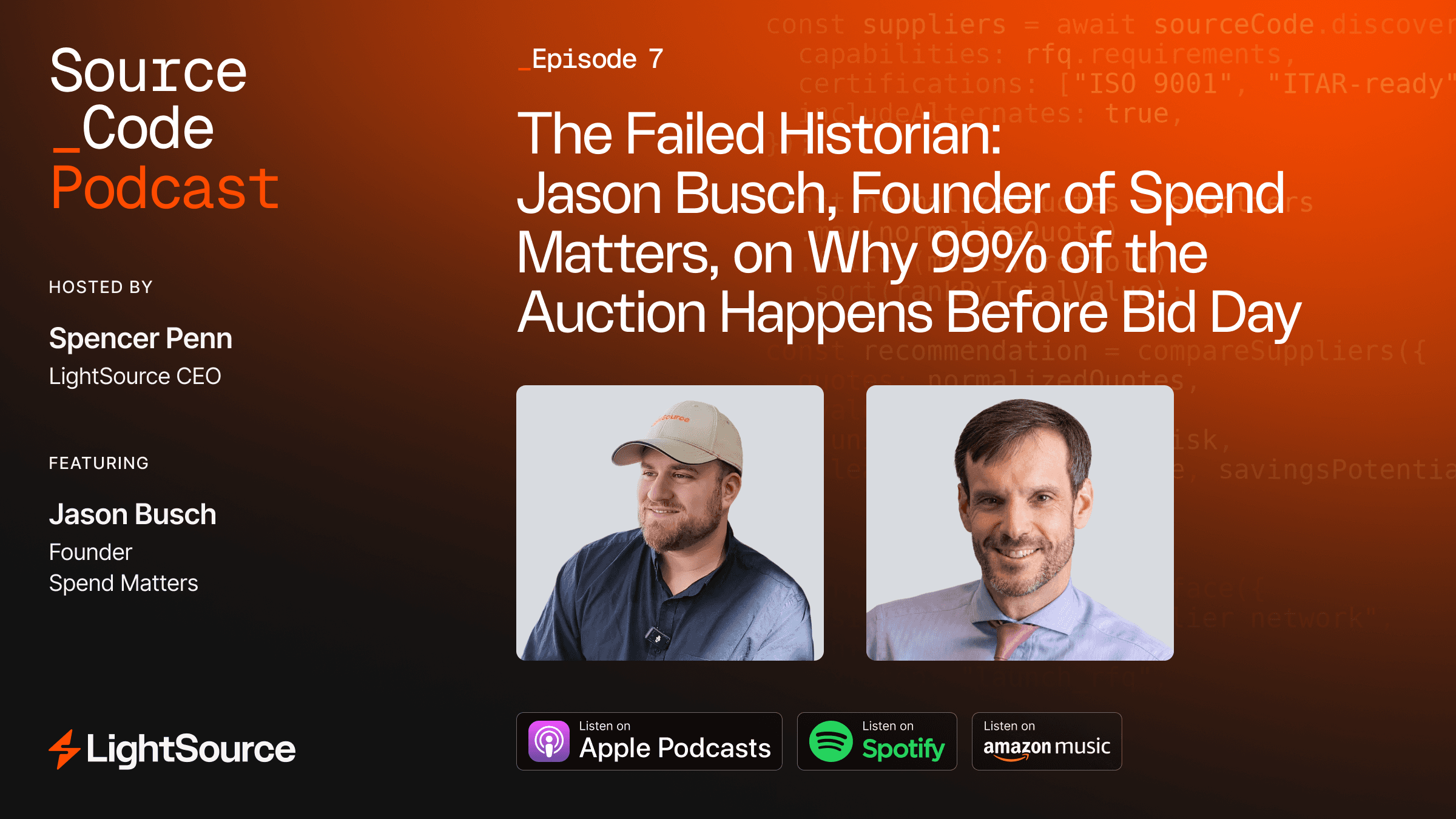
Guest: Jason Busch, Founder, Spend Matters; FreeMarkets alum; now building his next procurement startup
Listen on Spotify | Listen on Apple Podcasts | Listen on Amazon Music
Every procurement veteran has an opinion about reverse auctions. Jason Busch helped build the company that made them famous, and his verdict is the last one you’d expect from a FreeMarkets insider: the auction was never the point. “99% of the work was the preparation and then the implementation.” The bid-day drama that made FreeMarkets a legend was the crescendo of a wave. Everything that mattered happened before and after.
Jason describes himself as a failed historian. He studied history at Penn, wrote his thesis on the Civil War era under Bob Engs, proofread books for Drew Faust, and was told by his own advisor to get out of the academy and into business. Consulting pulled him into the gravitational orbit of procurement, FreeMarkets pulled him into tech, and two decades as the analyst behind Spend Matters put him at the center of every sourcing technology debate since. Now he’s back in the startup world, working on autonomous sourcing. In this episode, he and Spencer dig into why e-auctions became a fad, what an RFP really asks for, why indirect is a wholly different animal from direct, and a question most people in the industry won’t say out loud: does manufacturing even need procurement anymore?
A Failed Historian Walks Into Procurement
Jason’s training wasn’t in supply chains. It was in primary sources, reams of Civil War letters from the front, and the discipline of not concluding anything until the evidence is in. He argues that discipline transfers directly to building technology: “I do think having an appreciation for what’s happened in the past and not jumping to conclusions until you have a lot of source material and data can really help you put things in perspective as well as a builder.”
It also gives him a wider lens on the present. “We’re living through a period of history right now, and I don’t think a lot of people in it kind of see that.” Two political parties that don’t resemble what they were a decade ago, a technology shift rewriting how work gets done, and an industry in the middle of both. The historian’s instinct, gather the sources first, runs through everything else he says in the episode.
FreeMarkets’ Real Legacy Wasn’t the Auction
Jason joined FreeMarkets as a zealot for reverse auctions, creating competition where it didn’t exist. Looking back, he thinks the auctions were almost a distraction. The lasting contribution was leveling the playing field between incumbent and challenger suppliers, because incumbents had privileged access to information about what it actually took to build the part. And the quiet scandal underneath: “even today, a lot of bids are rigged, not financially so, but design engineers want to see certain suppliers get the awards.”
What FreeMarkets was really good at was specifying requirements and communicating them. Massive bid packs mailed to suppliers, design drawings sent out ahead of time, market-making engineers answering supplier questions for weeks. “By the time bid day came around, suppliers were incredibly well prepared to bid. They knew exactly what they were bidding on and they knew how far they could go.” That preparation process, not the auction format, became the basis of modern direct material sourcing and the extension of PLM into supplier collaboration.
Why E-Auctions Became a Fad
So why did auctions fade everywhere except a handful of giants like Walmart, BASF, and Amazon? Because the copycats stole the wrong thing. Commerce One, Procuri, and others took the auction formats and put them into self-service tools that skipped the market making entirely. Companies ran the event without the preparation before it or the implementation discipline after it. “You may identify the savings, but they may never become realized savings.” Bid day would show 30 or 40% savings, none of it would stick, and auctions got a bad name.
The exception proves the rule. The negotiations that still get successfully implemented on direct materials today are often run by large consultancies, for one reason: they still do the tremendous preparation most procurement teams skip. Which is why Jason has no interest in building the next event tool. “I don’t think the world needs another e-sourcing tool.” Sourcing is the crescendo. “It’s everything that comes before and everything that comes after that makes the beauty of that negotiation a great outcome.”
An RFQ Is an Auction With a Margin for Error
Spencer’s addition to the auction post-mortem is mathematical. “As an RFQ’s number of rounds approaches infinity, it becomes an e-auction.” The two formats sit on the same continuum; the difference is tolerance for imperfection. An auction demands near-perfect preparation, because when a drawing is missing or a spec is ambiguous on bid day, there’s no time to fix it before the event falls apart. An RFQ iterates, so blemishes in the data can be repaired between rounds.
That’s also why spec alignment comes first in the Spec to Scale framework. If you can’t describe to suppliers what you’re asking them to quote, they can’t bid, and the preparation phase becomes a monumental transformation project instead of a routine step. The teams that win are the ones whose data is already in order before the event starts.
The RFP Is Really a Request for Potential
Nearly 30 years ago, Jason tried to acquire a company called Hologix while in corporate development at FreeMarkets. The idea: map what a supplier’s machines could theoretically produce, not just what they produce today, and match a buyer’s part specification against that latent capability. The pilot didn’t work. They were too early. He thinks AI finally makes it possible, and it reframes the whole instrument: “A request for proposal is really a request for potential. What is the potential you can bring to me as a partner in this?”
On that reading, an RFP isn’t a weaker RFQ. It’s a deliberate widening of the aperture, inviting the supplier to change the alloy, the coating, the process, when your true north might be cost savings or might be something else entirely. The buyer trades some pricing leverage for supplier creativity, and AI’s job is to make that trade legible.
$3 a Kilogram at Tesla, $500 at SpaceX
The conversation turns to procurement’s most awkward question: is cost savings the primary objective? Spencer’s answer is that price is the universal medium. “I can solve any problem within a business with money.” At Tesla, that meant maintaining a bill of mass alongside the bill of materials, and a finance-approved exchange rate between them: engineers could spend $3 per vehicle to remove a kilogram of mass, and no more. When Spencer met his counterpart at SpaceX, their number was around $500 per kilogram, because their cost basis is launching payload into orbit. Same trade-off logic, wildly different constant.
That’s the case for keeping cost at the center. Not because procurement is just negotiators, but because a common currency is the only way to make trade-offs between things as different as vehicle range, material choice, and launch fuel legible across an organization.
Indirect Is a Wholly Different Animal
Jason came to indirect late, and his framing starts with the unstated purpose of e-procurement suites going back to Ariba: surveillance. The first thing that happens when a company installs one? “People buy less because they’re being monitored.” No stockpiled toner, no annual laptop upgrades. The watched clock behaves differently.
From there the categories diverge completely. Direct is the lifeblood of what you produce, and it’s about direct engagement with the end supplier. Indirect is a demand management and channel game: “The factory is not going to shut down if you cut the T&E budget.” The job is aligning what a user actually needs, questioning whether they need it at all, and guiding them to the best-fit channel, whether that’s a punchout catalog tied to a GPO rebate or a complex services engagement. Beating up suppliers on price is the direct playbook. Managing demand is the indirect one, and confusing the two is how both get done badly.
Does Manufacturing Need Procurement at All?
Asked what question Spencer should have posed, Jason supplies the uncomfortable one himself: “When you have a team of super design engineers and a crack supply chain team and with better data and AI in the middle, is procurement just creating friction?” He doesn’t claim to have the answer.
Spencer’s response draws on Airbnb’s operating model, where the surrounding functions exist to take everything off the engineers’ plates that isn’t building product. A design engineer could run cost models and RFQs, but it would be 5% of their day and none of their expertise. Specialization pays: automotive OEMs don’t run procurement teams of five, they run teams of 500, and in Spencer’s view that isn’t 490 people of waste. “A great procurement person is worth their literal weight in gold.” The honest answer is the nuanced one: in some organizations procurement is an obstacle, and in others it’s the enablement layer that lets expensive engineering talent stay expensive at the right things.
Then Jason Flipped the Script
The episode ends with the guest interviewing the host: aside from Tesla, does the US have an automotive industry in 30 years? Spencer’s answer dissolves the question into a bigger one. He doesn’t believe personal car ownership survives that long. Autonomy is still underperforming expectations, which by Clayton Christensen’s integration curve is exactly why the winners today are the expensive, fully integrated end-to-end players. Once autonomy is ubiquitous and boring, competition shifts to efficiency and service delivery, fleets become securitized cash flows owned by the most efficient capital providers, and driving your own car becomes the legal equivalent of taking a horse onto the interstate.
It’s a fitting close for a conversation between a builder trained on Civil War archives and a host who ran trade-off math at Tesla. Jason’s throughline is the historian’s: the artifact everyone remembers, the auction, the RFP, the savings number on bid day, is never the story. The story is the source material underneath it, and whether anyone did the work to get it right before the crescendo hit.
Guest: Jason Busch, Founder, Spend Matters; FreeMarkets alum; now building his next procurement startup
Listen on Spotify | Listen on Apple Podcasts | Listen on Amazon Music
Every procurement veteran has an opinion about reverse auctions. Jason Busch helped build the company that made them famous, and his verdict is the last one you’d expect from a FreeMarkets insider: the auction was never the point. “99% of the work was the preparation and then the implementation.” The bid-day drama that made FreeMarkets a legend was the crescendo of a wave. Everything that mattered happened before and after.
Jason describes himself as a failed historian. He studied history at Penn, wrote his thesis on the Civil War era under Bob Engs, proofread books for Drew Faust, and was told by his own advisor to get out of the academy and into business. Consulting pulled him into the gravitational orbit of procurement, FreeMarkets pulled him into tech, and two decades as the analyst behind Spend Matters put him at the center of every sourcing technology debate since. Now he’s back in the startup world, working on autonomous sourcing. In this episode, he and Spencer dig into why e-auctions became a fad, what an RFP really asks for, why indirect is a wholly different animal from direct, and a question most people in the industry won’t say out loud: does manufacturing even need procurement anymore?
A Failed Historian Walks Into Procurement
Jason’s training wasn’t in supply chains. It was in primary sources, reams of Civil War letters from the front, and the discipline of not concluding anything until the evidence is in. He argues that discipline transfers directly to building technology: “I do think having an appreciation for what’s happened in the past and not jumping to conclusions until you have a lot of source material and data can really help you put things in perspective as well as a builder.”
It also gives him a wider lens on the present. “We’re living through a period of history right now, and I don’t think a lot of people in it kind of see that.” Two political parties that don’t resemble what they were a decade ago, a technology shift rewriting how work gets done, and an industry in the middle of both. The historian’s instinct, gather the sources first, runs through everything else he says in the episode.
FreeMarkets’ Real Legacy Wasn’t the Auction
Jason joined FreeMarkets as a zealot for reverse auctions, creating competition where it didn’t exist. Looking back, he thinks the auctions were almost a distraction. The lasting contribution was leveling the playing field between incumbent and challenger suppliers, because incumbents had privileged access to information about what it actually took to build the part. And the quiet scandal underneath: “even today, a lot of bids are rigged, not financially so, but design engineers want to see certain suppliers get the awards.”
What FreeMarkets was really good at was specifying requirements and communicating them. Massive bid packs mailed to suppliers, design drawings sent out ahead of time, market-making engineers answering supplier questions for weeks. “By the time bid day came around, suppliers were incredibly well prepared to bid. They knew exactly what they were bidding on and they knew how far they could go.” That preparation process, not the auction format, became the basis of modern direct material sourcing and the extension of PLM into supplier collaboration.
Why E-Auctions Became a Fad
So why did auctions fade everywhere except a handful of giants like Walmart, BASF, and Amazon? Because the copycats stole the wrong thing. Commerce One, Procuri, and others took the auction formats and put them into self-service tools that skipped the market making entirely. Companies ran the event without the preparation before it or the implementation discipline after it. “You may identify the savings, but they may never become realized savings.” Bid day would show 30 or 40% savings, none of it would stick, and auctions got a bad name.
The exception proves the rule. The negotiations that still get successfully implemented on direct materials today are often run by large consultancies, for one reason: they still do the tremendous preparation most procurement teams skip. Which is why Jason has no interest in building the next event tool. “I don’t think the world needs another e-sourcing tool.” Sourcing is the crescendo. “It’s everything that comes before and everything that comes after that makes the beauty of that negotiation a great outcome.”
An RFQ Is an Auction With a Margin for Error
Spencer’s addition to the auction post-mortem is mathematical. “As an RFQ’s number of rounds approaches infinity, it becomes an e-auction.” The two formats sit on the same continuum; the difference is tolerance for imperfection. An auction demands near-perfect preparation, because when a drawing is missing or a spec is ambiguous on bid day, there’s no time to fix it before the event falls apart. An RFQ iterates, so blemishes in the data can be repaired between rounds.
That’s also why spec alignment comes first in the Spec to Scale framework. If you can’t describe to suppliers what you’re asking them to quote, they can’t bid, and the preparation phase becomes a monumental transformation project instead of a routine step. The teams that win are the ones whose data is already in order before the event starts.
The RFP Is Really a Request for Potential
Nearly 30 years ago, Jason tried to acquire a company called Hologix while in corporate development at FreeMarkets. The idea: map what a supplier’s machines could theoretically produce, not just what they produce today, and match a buyer’s part specification against that latent capability. The pilot didn’t work. They were too early. He thinks AI finally makes it possible, and it reframes the whole instrument: “A request for proposal is really a request for potential. What is the potential you can bring to me as a partner in this?”
On that reading, an RFP isn’t a weaker RFQ. It’s a deliberate widening of the aperture, inviting the supplier to change the alloy, the coating, the process, when your true north might be cost savings or might be something else entirely. The buyer trades some pricing leverage for supplier creativity, and AI’s job is to make that trade legible.
$3 a Kilogram at Tesla, $500 at SpaceX
The conversation turns to procurement’s most awkward question: is cost savings the primary objective? Spencer’s answer is that price is the universal medium. “I can solve any problem within a business with money.” At Tesla, that meant maintaining a bill of mass alongside the bill of materials, and a finance-approved exchange rate between them: engineers could spend $3 per vehicle to remove a kilogram of mass, and no more. When Spencer met his counterpart at SpaceX, their number was around $500 per kilogram, because their cost basis is launching payload into orbit. Same trade-off logic, wildly different constant.
That’s the case for keeping cost at the center. Not because procurement is just negotiators, but because a common currency is the only way to make trade-offs between things as different as vehicle range, material choice, and launch fuel legible across an organization.
Indirect Is a Wholly Different Animal
Jason came to indirect late, and his framing starts with the unstated purpose of e-procurement suites going back to Ariba: surveillance. The first thing that happens when a company installs one? “People buy less because they’re being monitored.” No stockpiled toner, no annual laptop upgrades. The watched clock behaves differently.
From there the categories diverge completely. Direct is the lifeblood of what you produce, and it’s about direct engagement with the end supplier. Indirect is a demand management and channel game: “The factory is not going to shut down if you cut the T&E budget.” The job is aligning what a user actually needs, questioning whether they need it at all, and guiding them to the best-fit channel, whether that’s a punchout catalog tied to a GPO rebate or a complex services engagement. Beating up suppliers on price is the direct playbook. Managing demand is the indirect one, and confusing the two is how both get done badly.
Does Manufacturing Need Procurement at All?
Asked what question Spencer should have posed, Jason supplies the uncomfortable one himself: “When you have a team of super design engineers and a crack supply chain team and with better data and AI in the middle, is procurement just creating friction?” He doesn’t claim to have the answer.
Spencer’s response draws on Airbnb’s operating model, where the surrounding functions exist to take everything off the engineers’ plates that isn’t building product. A design engineer could run cost models and RFQs, but it would be 5% of their day and none of their expertise. Specialization pays: automotive OEMs don’t run procurement teams of five, they run teams of 500, and in Spencer’s view that isn’t 490 people of waste. “A great procurement person is worth their literal weight in gold.” The honest answer is the nuanced one: in some organizations procurement is an obstacle, and in others it’s the enablement layer that lets expensive engineering talent stay expensive at the right things.
Then Jason Flipped the Script
The episode ends with the guest interviewing the host: aside from Tesla, does the US have an automotive industry in 30 years? Spencer’s answer dissolves the question into a bigger one. He doesn’t believe personal car ownership survives that long. Autonomy is still underperforming expectations, which by Clayton Christensen’s integration curve is exactly why the winners today are the expensive, fully integrated end-to-end players. Once autonomy is ubiquitous and boring, competition shifts to efficiency and service delivery, fleets become securitized cash flows owned by the most efficient capital providers, and driving your own car becomes the legal equivalent of taking a horse onto the interstate.
It’s a fitting close for a conversation between a builder trained on Civil War archives and a host who ran trade-off math at Tesla. Jason’s throughline is the historian’s: the artifact everyone remembers, the auction, the RFP, the savings number on bid day, is never the story. The story is the source material underneath it, and whether anyone did the work to get it right before the crescendo hit.
Guest: Jason Busch, Founder, Spend Matters; FreeMarkets alum; now building his next procurement startup
Listen on Spotify | Listen on Apple Podcasts | Listen on Amazon Music
Every procurement veteran has an opinion about reverse auctions. Jason Busch helped build the company that made them famous, and his verdict is the last one you’d expect from a FreeMarkets insider: the auction was never the point. “99% of the work was the preparation and then the implementation.” The bid-day drama that made FreeMarkets a legend was the crescendo of a wave. Everything that mattered happened before and after.
Jason describes himself as a failed historian. He studied history at Penn, wrote his thesis on the Civil War era under Bob Engs, proofread books for Drew Faust, and was told by his own advisor to get out of the academy and into business. Consulting pulled him into the gravitational orbit of procurement, FreeMarkets pulled him into tech, and two decades as the analyst behind Spend Matters put him at the center of every sourcing technology debate since. Now he’s back in the startup world, working on autonomous sourcing. In this episode, he and Spencer dig into why e-auctions became a fad, what an RFP really asks for, why indirect is a wholly different animal from direct, and a question most people in the industry won’t say out loud: does manufacturing even need procurement anymore?
A Failed Historian Walks Into Procurement
Jason’s training wasn’t in supply chains. It was in primary sources, reams of Civil War letters from the front, and the discipline of not concluding anything until the evidence is in. He argues that discipline transfers directly to building technology: “I do think having an appreciation for what’s happened in the past and not jumping to conclusions until you have a lot of source material and data can really help you put things in perspective as well as a builder.”
It also gives him a wider lens on the present. “We’re living through a period of history right now, and I don’t think a lot of people in it kind of see that.” Two political parties that don’t resemble what they were a decade ago, a technology shift rewriting how work gets done, and an industry in the middle of both. The historian’s instinct, gather the sources first, runs through everything else he says in the episode.
FreeMarkets’ Real Legacy Wasn’t the Auction
Jason joined FreeMarkets as a zealot for reverse auctions, creating competition where it didn’t exist. Looking back, he thinks the auctions were almost a distraction. The lasting contribution was leveling the playing field between incumbent and challenger suppliers, because incumbents had privileged access to information about what it actually took to build the part. And the quiet scandal underneath: “even today, a lot of bids are rigged, not financially so, but design engineers want to see certain suppliers get the awards.”
What FreeMarkets was really good at was specifying requirements and communicating them. Massive bid packs mailed to suppliers, design drawings sent out ahead of time, market-making engineers answering supplier questions for weeks. “By the time bid day came around, suppliers were incredibly well prepared to bid. They knew exactly what they were bidding on and they knew how far they could go.” That preparation process, not the auction format, became the basis of modern direct material sourcing and the extension of PLM into supplier collaboration.
Why E-Auctions Became a Fad
So why did auctions fade everywhere except a handful of giants like Walmart, BASF, and Amazon? Because the copycats stole the wrong thing. Commerce One, Procuri, and others took the auction formats and put them into self-service tools that skipped the market making entirely. Companies ran the event without the preparation before it or the implementation discipline after it. “You may identify the savings, but they may never become realized savings.” Bid day would show 30 or 40% savings, none of it would stick, and auctions got a bad name.
The exception proves the rule. The negotiations that still get successfully implemented on direct materials today are often run by large consultancies, for one reason: they still do the tremendous preparation most procurement teams skip. Which is why Jason has no interest in building the next event tool. “I don’t think the world needs another e-sourcing tool.” Sourcing is the crescendo. “It’s everything that comes before and everything that comes after that makes the beauty of that negotiation a great outcome.”
An RFQ Is an Auction With a Margin for Error
Spencer’s addition to the auction post-mortem is mathematical. “As an RFQ’s number of rounds approaches infinity, it becomes an e-auction.” The two formats sit on the same continuum; the difference is tolerance for imperfection. An auction demands near-perfect preparation, because when a drawing is missing or a spec is ambiguous on bid day, there’s no time to fix it before the event falls apart. An RFQ iterates, so blemishes in the data can be repaired between rounds.
That’s also why spec alignment comes first in the Spec to Scale framework. If you can’t describe to suppliers what you’re asking them to quote, they can’t bid, and the preparation phase becomes a monumental transformation project instead of a routine step. The teams that win are the ones whose data is already in order before the event starts.
The RFP Is Really a Request for Potential
Nearly 30 years ago, Jason tried to acquire a company called Hologix while in corporate development at FreeMarkets. The idea: map what a supplier’s machines could theoretically produce, not just what they produce today, and match a buyer’s part specification against that latent capability. The pilot didn’t work. They were too early. He thinks AI finally makes it possible, and it reframes the whole instrument: “A request for proposal is really a request for potential. What is the potential you can bring to me as a partner in this?”
On that reading, an RFP isn’t a weaker RFQ. It’s a deliberate widening of the aperture, inviting the supplier to change the alloy, the coating, the process, when your true north might be cost savings or might be something else entirely. The buyer trades some pricing leverage for supplier creativity, and AI’s job is to make that trade legible.
$3 a Kilogram at Tesla, $500 at SpaceX
The conversation turns to procurement’s most awkward question: is cost savings the primary objective? Spencer’s answer is that price is the universal medium. “I can solve any problem within a business with money.” At Tesla, that meant maintaining a bill of mass alongside the bill of materials, and a finance-approved exchange rate between them: engineers could spend $3 per vehicle to remove a kilogram of mass, and no more. When Spencer met his counterpart at SpaceX, their number was around $500 per kilogram, because their cost basis is launching payload into orbit. Same trade-off logic, wildly different constant.
That’s the case for keeping cost at the center. Not because procurement is just negotiators, but because a common currency is the only way to make trade-offs between things as different as vehicle range, material choice, and launch fuel legible across an organization.
Indirect Is a Wholly Different Animal
Jason came to indirect late, and his framing starts with the unstated purpose of e-procurement suites going back to Ariba: surveillance. The first thing that happens when a company installs one? “People buy less because they’re being monitored.” No stockpiled toner, no annual laptop upgrades. The watched clock behaves differently.
From there the categories diverge completely. Direct is the lifeblood of what you produce, and it’s about direct engagement with the end supplier. Indirect is a demand management and channel game: “The factory is not going to shut down if you cut the T&E budget.” The job is aligning what a user actually needs, questioning whether they need it at all, and guiding them to the best-fit channel, whether that’s a punchout catalog tied to a GPO rebate or a complex services engagement. Beating up suppliers on price is the direct playbook. Managing demand is the indirect one, and confusing the two is how both get done badly.
Does Manufacturing Need Procurement at All?
Asked what question Spencer should have posed, Jason supplies the uncomfortable one himself: “When you have a team of super design engineers and a crack supply chain team and with better data and AI in the middle, is procurement just creating friction?” He doesn’t claim to have the answer.
Spencer’s response draws on Airbnb’s operating model, where the surrounding functions exist to take everything off the engineers’ plates that isn’t building product. A design engineer could run cost models and RFQs, but it would be 5% of their day and none of their expertise. Specialization pays: automotive OEMs don’t run procurement teams of five, they run teams of 500, and in Spencer’s view that isn’t 490 people of waste. “A great procurement person is worth their literal weight in gold.” The honest answer is the nuanced one: in some organizations procurement is an obstacle, and in others it’s the enablement layer that lets expensive engineering talent stay expensive at the right things.
Then Jason Flipped the Script
The episode ends with the guest interviewing the host: aside from Tesla, does the US have an automotive industry in 30 years? Spencer’s answer dissolves the question into a bigger one. He doesn’t believe personal car ownership survives that long. Autonomy is still underperforming expectations, which by Clayton Christensen’s integration curve is exactly why the winners today are the expensive, fully integrated end-to-end players. Once autonomy is ubiquitous and boring, competition shifts to efficiency and service delivery, fleets become securitized cash flows owned by the most efficient capital providers, and driving your own car becomes the legal equivalent of taking a horse onto the interstate.
It’s a fitting close for a conversation between a builder trained on Civil War archives and a host who ran trade-off math at Tesla. Jason’s throughline is the historian’s: the artifact everyone remembers, the auction, the RFP, the savings number on bid day, is never the story. The story is the source material underneath it, and whether anyone did the work to get it right before the crescendo hit.
Read more


Read more
Read more
Faster sourcing. Lower cost. Less chaos.
See how LightSource connects engineering, procurement, and suppliers in one operating system to help you launch faster at lower cost.
SOC 2
Kearney #1 2024
Gartner Cool Vendor
Procuretech 100
G2 Top Rated
Faster sourcing. Lower cost. Less chaos.
See how LightSource connects engineering, procurement, and suppliers in one operating system to help you launch faster at lower cost.
SOC 2
Kearney #1 2024
Gartner Cool Vendor
Procuretech 100
G2 Top Rated
Faster sourcing. Lower cost. Less chaos.
See how LightSource connects engineering, procurement, and suppliers in one operating system to help you launch faster at lower cost.
SOC 2
Kearney #1 2024
Gartner Cool Vendor
Procuretech 100
G2 Top Rated
Trusted by:
Trusted by:
Trusted by: