
Let’s say you’re sourcing a new Bluetooth speaker. Your contract manufacturer sends a quote: $18.40 per unit at 10,000 pieces. You get two more quotes -- $19.10 and $17.85. The spread is tight. In traditional procurement, you’d take the lowest bid and move on.
But is $17.85 a good price? You don’t actually know. You know it’s the best price you received, but that’s a different thing entirely. The gap between “lowest bid” and “what this product should cost” is where real money lives -- and in consumer electronics, that gap is often wider than procurement teams realize.
Should-cost modeling is the discipline of building a bottom-up estimate of what a product should cost to manufacture, independent of any supplier’s quote. It gives you a negotiation anchor rooted in data rather than in the hope that competitive bidding will find the right number. (The method generalizes surprisingly far: I recently used the same discipline to build a one-weekend P&L for the Outside Lands music festival.) But in consumer electronics, the approach looks fundamentally different from should-cost modeling in automotive or aerospace -- and if you try to apply traditional manufacturing costing methods to a PCBA-based product, you’ll get it wrong.
This guide covers how should-cost modeling works specifically for consumer electronics, where the data comes from, and how to build models that give your procurement team a real negotiating position.
Why Consumer Electronics Should-Costing Is Different
In automotive or aerospace procurement, should-cost models are typically built from the ground up. You model the raw material weight, calculate machining time based on cycle rates, add labor at known regional rates, layer in overhead, and arrive at a cost. The physical manufacturing process -- stamping, casting, machining, welding -- is the primary cost driver, and an experienced cost engineer can estimate it with reasonable accuracy from a drawing.
Consumer electronics doesn’t work that way.
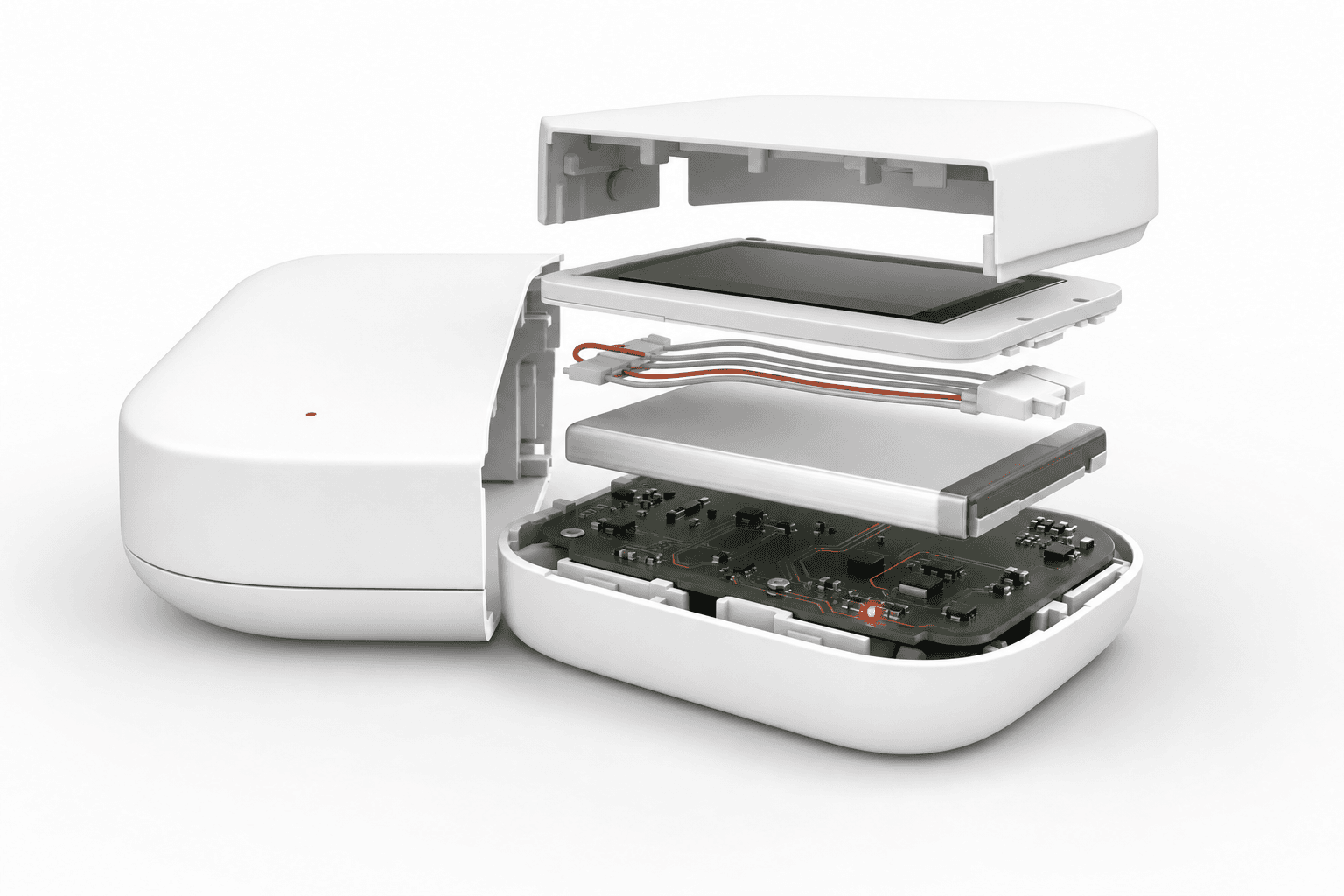
In a typical CE product -- a smart home device, a wireless earbud, a fitness tracker -- the BOM is dominated by purchased electronic components: microcontrollers, sensors, memory, connectivity modules, displays, batteries. These components are priced by markets, not by manufacturing process. An STM32 microcontroller costs what STMicroelectronics and its distribution channel say it costs, at a given volume, at a given moment in the market cycle. You can’t “should-cost” it from raw silicon and fab time -- that’s the chipmaker’s problem, not yours.
This means the should-cost model for a consumer electronics product is fundamentally a component pricing exercise layered on top of assembly and enclosure cost estimation. The ratio is roughly:
Cost Category | Typical % of COGS | Primary Costing Method |
|---|---|---|
Electronic components (ICs, passives, connectors) | 40-60% | Market pricing / distributor benchmarks |
PCBA assembly (SMT, test, programming) | 8-15% | Process-based estimation |
Enclosure and mechanicals (plastics, metals, fasteners) | 10-20% | Tooling amortization + piece price |
Display module (if applicable) | 5-25% | Market pricing by size/resolution/technology |
Battery (if applicable) | 5-15% | $/kWh curves by chemistry and form factor |
Cables, packaging, accessories | 3-8% | Commodity pricing |
Regulatory and certification | 1-3% (amortized) | Fixed cost / volume |
CM overhead, margin, and NRE amortization | 8-15% | Rate-based estimation |
Step 1: Freeze Your Costing Assumptions
Should-cost models get messy when everyone is costing a different product. Before you build the model, freeze the assumptions.
Assumption | Example |
|---|---|
Annual volume | 10k, 50k, 250k units |
Build region | Shenzhen, Penang, Guadalajara, US domestic |
Incoterm | EXW, FOB, DDP |
BOM revision | EVT, DVT, PVT, MP |
Yield assumption | 92% PCBA, 97% final assembly |
Packaging config | Retail box, brown box, master carton |
Compliance scope | FCC only, FCC + UL, FCC + CE + battery |
Freight mode | Ocean, air, deferred air |
Tariff treatment | HTS code, country of origin, Section 301 exposure |
Tooling ownership | Customer-owned or supplier-owned |
Pretty simple right? Except this is where a lot of teams get it wrong. They compare a China FOB quote to a Mexico DDP quote. They compare a 100k volume quote to a 50k should-cost. They compare a CM quote that includes test fixtures to a model that excludes NRE. If the assumptions don’t match, the analysis creates arguments instead of decisions.
Step 2: Classify Your BOM Lines
Not all BOM lines behave the same way. A 10k resistor, a custom LCD, an injection-molded housing, and a lithium battery pack should not be modeled with the same method.
BOM Type | Examples | Best Should-Cost Method |
|---|---|---|
Commodity electronic components | Passives, common connectors, commodity MOSFETs | Distribution pricing, benchmark index, volume curve |
Strategic electronic components | MCU, Wi-Fi/BLE module, PMIC, memory, image sensor | Multi-source quote, OEM direct pricing, benchmark |
Semi-custom modules | Display, camera module, speaker, antenna, battery pack | Cost-driver model + supplier quote comparison |
Custom mechanical | Plastic enclosure, die-cast frame, stamped bracket | Material + cycle time + tooling amortization |
Process-heavy parts | Flex PCB, bonded display, waterproof gasket | Supplier process map, yield analysis, labor |
Regulated items | Battery cell, charger, RF module, power supply | Certification cost, approved vendor status, test flow |
The mistake is treating every line like it has a clean market price. A 0.1uF capacitor does. A custom battery pack does not.
Step 3: Benchmark Electronic Components
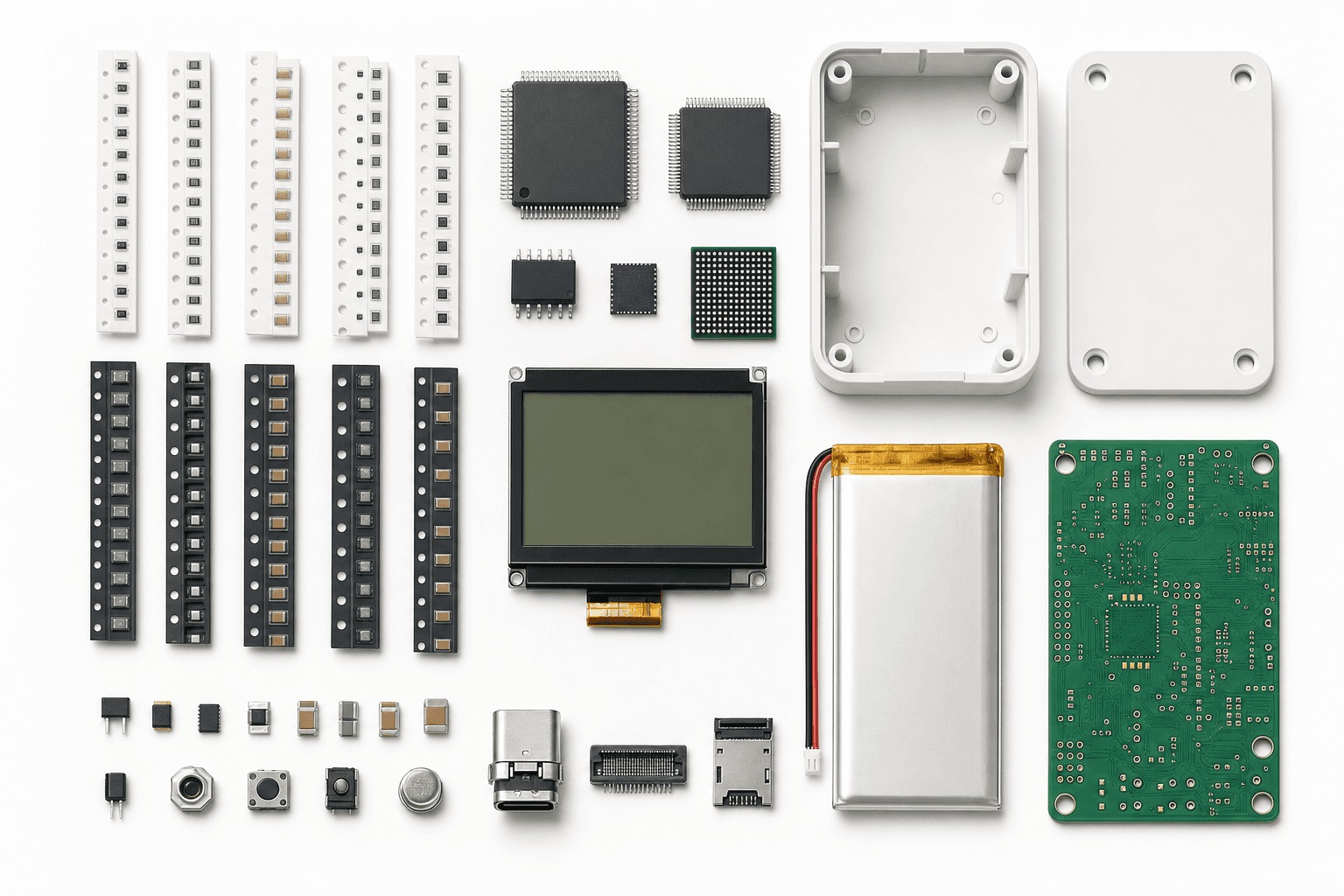
Components typically represent 50-70% of total PCBA cost and 40-60% of finished product cost. This is where your should-cost model has the most impact, and it’s also where the data is most accessible.
Data Sources for Component Pricing
Unlike machined parts where you need manufacturing expertise to estimate cost, electronic component pricing is surprisingly transparent.
Distributor pricing (your baseline). DigiKey, Mouser, Arrow, Avnet, and other authorized distributors publish tiered pricing online. Pull pricing at your expected volume tier. A component priced at $0.82 for 1,000 pieces might be $0.54 at 10,000 and $0.38 at 100,000. The volume break structure is the single biggest variable in your component cost model.
Octopart (aggregator). Octopart searches across 600+ distributors and returns consolidated pricing, stock levels, and lifecycle status. Its API can price an entire BOM in seconds -- feed in part numbers and quantities, get back market pricing across all major distributors. Data updates daily. This is the fastest way to benchmark a BOM.
Lytica SupplyLens (anonymized buyer intelligence). Where distributor pricing tells you the list price, Lytica tells you what companies are actually paying. Built on $550 billion in anonymized buyer transaction data, SupplyLens benchmarks your component prices against real purchase records. Their March 2026 market report showed an overall price index increase of +2.30%, with memory and high-bandwidth memory leading the increases -- the squeeze that tripled memory's share of the iPhone's build cost in a year. If your CM is marking up components 8-12% above what the market data shows, Lytica surfaces that gap.
TechInsights teardowns (competitive benchmarking). TechInsights has conducted over 3,000 product teardowns with millions of components identified and priced. When Apple launched the iPhone X at $999, TechInsights estimated the BOM at roughly $370 -- with the OLED display at ~$110, the stainless steel frame at ~$61, and the dual-lens camera at ~$35. Teardown data lets you benchmark your BOM cost against a competitor’s. If your 5-inch display costs $14 and a teardown shows a competitor’s comparable display at $9, you have a data point for negotiation.
Component Costing Nuances
Volume-dependent pricing is the #1 variable. A BOM priced at 1,000-unit distributor pricing will look 30-50% more expensive than the same BOM at 100,000-unit contract pricing. Always match your should-cost to the actual production volume.
Memory pricing is cyclical. DRAM and NAND pricing can swing 40% in a single quarter. A 4GB LPDDR4 module that cost $1.80 in Q1 2025 might cost $2.40 in Q1 2026. The memory market in early 2026 is in an upswing driven by AI-related demand. Timestamp your model and update at least quarterly.
Lifecycle and obsolescence risk. A component at end-of-life will cost more to source through brokers. Your model should flag parts in the “not recommended for new designs” (NRND) phase. Octopart and Altium’s part intelligence platform both provide lifecycle status.
MOQs on semi-custom parts. Some components -- application-specific ICs, custom connectors, specific LED packages -- have MOQs that affect per-unit cost. If you need 5,000 of a connector but the MOQ is 10,000, your effective cost doubles unless you plan to use the excess.
Step 4: Model PCBA Assembly
The assembly cost is where should-costing shifts from market pricing to process-based estimation.
The Assembly Cost Stack
PCB fabrication. Cost depends on layer count, board size, material (FR-4 vs. high-frequency), copper weight, and surface finish (HASL, ENIG, OSP). A standard 4-layer FR-4 board in a 100x80mm format: $2-5 per board at 1,000 units, dropping to $0.80-1.50 at 10,000. PCB fabrication typically represents 10-20% of total PCBA cost.
SMT placement. Current rates: $0.01-0.03 per placement for standard components, with fine-pitch or BGA commanding a premium. A board with 300 SMT placements costs $3-9 in assembly labor at volume. Stencil NRE ($100-300) amortized across the run.
Through-hole assembly. $0.05-0.15 per insertion depending on complexity and process (hand-solder vs. wave/selective). If your design has 20 through-hole components, that’s $1-3 per board. DFM reviews that minimize through-hole placements can meaningfully reduce assembly cost.
Testing. This is where assembly costs can balloon if you’re not careful.
Test Type | Typical Cost per Board | NRE | When to Use |
|---|---|---|---|
In-circuit test (ICT) | $0.50-2.00 | $5,000-15,000 fixture | High-volume, stable design |
Flying probe | $2.00-8.00 | None | Low-medium volume, NPI, frequent changes |
Functional test | $1.00-5.00 | $2,000-10,000 fixture | Required for most CE products |
Burn-in | $0.50-3.00 | Minimal | Reliability-critical products |
AOI (automated optical) | $0.10-0.50 | None | Standard on most SMT lines |
During NPI, flying probe is typical because you’re not committing to a $10,000 ICT fixture before the design stabilizes. At production volume, ICT plus functional test is standard.
The EMS Margin Structure
This is the part most procurement teams underestimate. Materials typically represent 75-85% of what you pay to an EMS provider. The remaining 15-25% is where the EMS builds its business.
Material markup. Most CMs mark up components 3-12% above acquisition cost. Tier 1 EMS providers (Foxconn, Jabil, Flex, Celestica) buying at massive volume may achieve component pricing 5-15% below what a mid-size OEM can access directly, then retain some of that spread. Smaller CMs mark up 5-12%.
Labor rates vary dramatically by geography:
Region | Loaded Labor Rate ($/hr) | Typical Application |
|---|---|---|
China (Shenzhen/Dongguan) | $6-12 | High-volume consumer electronics |
Vietnam | $4-8 | Growing China alternative |
Mexico | $8-15 | Nearshoring for US market |
Eastern Europe | $12-20 | EU-market electronics |
US domestic | $25-50 | Low-volume, ITAR, rapid-turn |
Turnkey vs. consigned: an underused diagnostic. A turnkey quote hides component pricing inside the EMS quote. A consigned quote exposes conversion cost. You don’t need to consign forever, but quoting both ways reveals whether the EMS is competitive on buying, on conversion, or on both. If the EMS has strong conversion cost but weak component pricing, you can negotiate direct buys for strategic components while leaving the rest turnkey.
Profit margin. Tier 1 EMS providers typically target 3-5% operating margin (they make it up on volume). Smaller, specialized CMs might charge 8-12% on lower-volume, higher-mix work.
Step 5: Model Enclosures and Mechanical Parts
For most consumer electronics, the enclosure is the second-largest cost element after the PCBA. This is where traditional manufacturing costing methods apply more directly.
Injection Molded Enclosures
Mold Complexity | China Tooling | US/EU Tooling |
|---|---|---|
Simple (2-piece, no undercuts) | $3,000-8,000 | $8,000-20,000 |
Moderate (side actions, texture, multi-material) | $8,000-25,000 | $20,000-50,000 |
Complex (multi-cavity, tight tolerance, overmold) | $25,000-60,000 | $50,000-150,000 |
Piece price at volume: $0.30-2.00 per part depending on size, material, and finish. A two-piece ABS enclosure for a typical IoT device costs $0.80-1.50 total at 10,000 units. Post-processing (painting, pad printing, laser etching) adds $0.20-1.00.
Tooling amortization is the key insight here. A $40,000 tool over 20,000 units is $2.00/unit. The same tool over 400,000 units is $0.10/unit. When someone says “the enclosure is expensive,” ask whether they mean piece price, tooling, or amortized tooling.
Displays, Batteries, and Other Subsystems
Displays (5-25% of BOM if applicable):
Small character LCD (128x64, monochrome): $0.80-2.00
2.4” TFT color LCD: $2.50-5.00
5” IPS LCD with capacitive touch: $8-15
OLED panels: 2-3x premium over equivalent LCD
Batteries -- lithium-ion pack-level pricing as of early 2026 is roughly $100-140/kWh. A 3.7V, 2000mAh pouch cell (7.4Wh) costs $1.50-3.00 depending on volume and form factor. Custom-shape cells cost more per Wh than commodity form factors.
Cables, packaging, accessories -- commodity items costed from catalog: USB-C cable ($0.30-0.80), power adapter ($1.50-3.00), retail packaging ($0.50-2.00).
Step 6: Add Regulatory, Tariffs, and Landed Cost
A factory cost is not a landed cost. Your should-cost model needs two views:
View | What It Answers |
|---|---|
Ex-works or FOB cost | Is the supplier’s manufacturing quote reasonable? |
Fully landed cost | What will this product actually cost in the destination market? |
Regulatory Certification
Often forgotten in should-cost models, certification is a real fixed cost that scales with volume:
Certification | Typical Cost | Notes |
|---|---|---|
FCC (US) | $5,000-15,000 | Required for any device with a clock >9kHz |
CE marking (EU) | $5,000-20,000 | EMC + safety + radio (if applicable) |
UL/ETL safety | $8,000-25,000 | Required by most US retailers |
Bluetooth SIG | $8,000 annual + per-product | If using Bluetooth |
Wi-Fi Alliance | $5,000-15,000 | If claiming Wi-Fi certification |
At 10,000 units, FCC + CE + UL alone adds $1.80-6.00 per unit. At 100,000 units, it drops to $0.18-0.60. This volume sensitivity can determine whether a product is financially viable at initial volumes.
Tariffs
As of May 2026, Section 301 tariffs on Chinese-origin electronics range from 25-35%. A $18 COGS with a 25% tariff becomes $22.50 landed. Your should-cost model needs to capture this -- see our Incoterms guide for how trade terms affect the cost basis.
A China-plus-one cost model (Mexico, Vietnam, Malaysia, Eastern Europe) may look higher at the factory level and lower at the landed level. You need to model labor, overhead, freight, tariffs, local supplier base, yield ramp, and management overhead. Otherwise you’ll either overpay to move or stay put for the wrong reason.
Putting It All Together: A Worked Example
Let’s build a should-cost model for a Wi-Fi connected smart home sensor (motion + temperature + humidity). Target: 10,000 units, built in Shenzhen, FOB.
Line Item | Source | Unit Cost |
|---|---|---|
Electronic Components | ||
Wi-Fi SoC (ESP32-S3) | Octopart / distributor | $1.85 |
PIR motion sensor | Distributor pricing | $1.20 |
Temp/humidity sensor (SHT40) | Distributor pricing | $0.95 |
Power management IC | Distributor pricing | $0.45 |
Passives (~80 pcs) | Reel pricing | $0.40 |
Connectors (USB-C, headers) | Distributor pricing | $0.55 |
Misc (LEDs, ESD protection, antenna) | Distributor pricing | $0.65 |
Component subtotal | $6.05 | |
PCBA Assembly | ||
PCB fabrication (4-layer, 60x40mm) | Process estimation | $1.20 |
SMT assembly (~180 placements @ $0.015) | Rate-based | $2.70 |
Through-hole (4 components @ $0.10) | Rate-based | $0.40 |
ICT + functional test | Amortized | $1.50 |
Programming | Per-board | $0.20 |
Assembly subtotal | $6.00 | |
Enclosure | ||
2-piece ABS enclosure (tooling amortized) | Material + process | $1.40 |
Wall mount bracket | Stamped metal | $0.25 |
Fasteners and gaskets | Catalog | $0.15 |
Enclosure subtotal | $1.80 | |
Other | ||
USB-C cable | Catalog | $0.40 |
Retail packaging | Supplier quote | $0.85 |
Documentation insert | Supplier quote | $0.10 |
Regulatory (FCC + CE + UL amortized) | Fixed / volume | $2.50 |
Other subtotal | $3.85 | |
Total should-cost (manufacturing) | $17.70 | |
CM overhead + margin (10%) | $1.77 | |
Total landed should-cost (FOB) | $19.47 |
Compare this to the CM quote of $18.40. The should-cost comes in slightly higher -- which means either the CM has better component pricing than distributor list (likely at scale), your model is conservative on some lines, or the CM is genuinely competitive. The model tells you the quote is reasonable, and your negotiation energy should focus on specific lines rather than an across-the-board price reduction.
If the CM quote had been $24.00, this model tells you there’s roughly $4.50 of unexplained cost. That’s your line-by-line starting point.
The $1.20 Connector Problem: Design-for-Cost in Action
Here’s a pattern that shows up more often than it should.
A team gets a CM quote for a consumer device PCBA. The total is high, but nothing looks outrageous at first glance. The MCU is in range. Memory is in range. Passives are fine.
Then one connector jumps out. The CM is quoting $1.68 for a board-to-board connector that benchmarks at $0.45-0.60 at the program volume. The buyer asks why. The CM says it’s the approved MPN and the MOQ is high.
Engineering checks the history. The connector was chosen during EVT because it was available on DigiKey, easy to hand-solder during prototyping, and worked with the early mechanical stack. Nobody revisited it before DVT. The pitch, height, and mating cycle requirements were all more expensive than the final product needed.
The fix wasn’t a negotiation. It was a redesign. The team moved to a lower-cost connector family, updated the PCB and mechanical stack, and qualified a second source before PVT. The savings were about $1 per unit. On a few hundred thousand units, that paid for the engineering work many times over.
This is the part of should-cost modeling people underuse. It’s not just a procurement tool. It’s a design review tool. Most consumer electronics cost is committed before the RFQ goes out. By the time you’re asking three CMs to bid a frozen design, the cheap options are gone. A should-cost model that identifies overspecified or single-sourced components during DVT -- not after PVT -- is worth more than any price negotiation.
Design Area | Cost Question to Ask Before DVT |
|---|---|
Architecture | Can one IC replace two? Can firmware replace hardware? |
Component selection | Are alternates approved for the top 20 costed parts? |
PCB | Can the board stay at 4 layers instead of 6? Can the area shrink? |
Mechanical | Can we reduce part count, screws, adhesives, or cosmetic rejects? |
Test | Can test time be reduced through firmware, parallelization, or fixture design? |
Compliance | Are we using pre-certified modules where it makes sense? |
Pre-certified Wi-Fi/BLE modules are a good example of the tradeoff. A module may cost more than a discrete chipset design, but if it reduces RF engineering, certification risk, antenna tuning, and schedule risk, it may be the right answer for a low-volume or time-sensitive product. At higher volumes, the math flips. The should-cost model should surface that inflection point.
When NOT to Should-Cost
Should-cost modeling is useful, but it’s not always the right tool at the right moment.
Situation | Why Should-Cost May Not Help |
|---|---|
Early proof-of-concept builds | Speed and learning matter more than unit economics |
Severe component allocation | Market clearing price may beat your modeled “fair” price |
Very low-volume products (<500 units) | NRE, MOQ, and handling dominate unit cost |
Sole-source licensed technology | No real market comparison exists |
Design changing weekly | The model goes stale immediately |
Launch is schedule-critical | A 3% savings isn’t worth missing the market window |
The point isn’t to avoid should-costing. It’s to use it at the right resolution for the stage of the program.
For EVT, you want directional cost targets. For DVT, you want cost-driver visibility and alternate plans. For PVT, you want negotiated pricing, yield assumptions, test time, tooling amortization, and landed cost. For mass production, you want variance tracking against the model every time the BOM, volume, or market changes.
Using Should-Cost Models With Suppliers
The worst way to use a should-cost model is to send it to the supplier and say, “You should be at $19.47 -- fix your quote.” That turns the model into a weapon, and it usually produces bad data in response.
A better approach:
Start with assumptions. “We modeled 10k units, FOB Shenzhen, 4-layer PCB, 180 placements, 55 seconds of test time.”
Ask for correction. “Which assumptions are wrong?”
Separate material and conversion. “Can we review the top 20 BOM cost drivers and the manufacturing cost separately?”
Ask about constraints. “Which parts are driving MOQ, lead time, or inventory carrying cost?”
Discuss design changes. “If we change this connector, reduce test time, or adjust packaging -- where would you see savings?”
Agree on actions. “You re-quote the top five components. We review alternates. Engineering checks the connector and layer count.”
Back at Tesla, we used should-cost models not as weapons but as shared tools. When a supplier understood that we knew the cost structure, the conversation shifted from price negotiation to joint cost reduction. The savings were often larger and more sustainable. The same approach applies in consumer electronics -- particularly with EMS partners who appreciate a customer that understands manufacturing economics.

Sensitivity: Where Leadership Decisions Happen
A single unit cost number is less useful than showing how key variables change the answer. Add a sensitivity layer to your model:
Variable | Base Case | Downside Case | Cost Impact |
|---|---|---|---|
PCBA yield | 96% | 90% | +$0.42/unit |
Air freight share | 10% | 60% | +$0.85/unit |
Tariff rate (Section 301) | 0% | 25% | +$4.87/unit |
Battery price | $120/kWh | $150/kWh | +$0.18/unit |
EMS markup | 6% | 10% | +$0.48/unit |
Test time | 60 sec | 150 sec | +$0.55/unit |
This turns the conversation from “the product costs $19.47” to “the base case is $19.47, the tariff-exposed case is $24.34, and the biggest controllable risks are test time, yield, and component obsolescence.” That’s a much better way to run an NPI program.
How LightSource Supports CE Should-Costing
For consumer electronics companies running high-velocity NPI programs, the challenge isn’t building one should-cost model -- it’s maintaining cost visibility across a portfolio of products that evolve every quarter. LightSource connects BOM data directly to sourcing, so cost models stay current as specs change and new supplier quotes arrive. When engineering revises a BOM mid-cycle, the cost impact surfaces immediately rather than three months later when procurement gets around to re-quoting.
Sources
Octopart Electronic Components Search Engine -- Aggregated pricing across 600+ distributors with daily data updates
Lytica State of the Electronic Components Market: March 2026 -- Monthly component pricing index and market analysis built on $550B+ in buyer data
TechInsights Consumer Electronics Teardowns -- BOM costing database with three decades of teardown data and millions of components priced
VentureOutsource: Should-Cost Analysis for Contract Electronics Manufacturing -- EMS pricing models and OEM cost structures
PCB Manufacturing Cost 2026: Full BOM Crisis Explained -- Current PCB and component cost pressures affecting PCBA pricing
Lytica and the Emergence of a Pricing Science Layer in Procurement -- ARC Advisory Group on component price intelligence platforms
Injection Molding Cost Guide 2026 -- Tooling and per-part cost breakdowns by complexity and geography
BloombergNEF Battery Pack Price Survey -- Lithium-ion battery pricing benchmarks and trends
Frequently Asked Questions
What is should-cost modeling for consumer electronics?
Should-cost modeling for consumer electronics is the practice of building a bottom-up estimate of what a product should cost to manufacture, using component market pricing, assembly process rates, tooling amortization, and overhead estimates. Unlike traditional manufacturing should-costing -- which estimates from raw material and machining time -- CE should-costing relies heavily on distributor benchmarks and market pricing for electronic components, which typically represent 40-60% of finished product cost.
Where can I find reliable component pricing data for a should-cost model?
The primary sources are distributor pricing (DigiKey, Mouser, Arrow), aggregators like Octopart (which searches 600+ distributors with daily updates), and benchmarking platforms like Lytica SupplyLens (which benchmarks against $550 billion in anonymized buyer transaction data). For competitive benchmarking, TechInsights teardown reports provide BOM cost estimates for competitor products. Always pull pricing at your actual volume tier -- component costs can drop 30-50% between 1K and 100K quantities.
How much do EMS providers typically mark up components?
EMS markup on components typically ranges from 3-12%, depending on the provider’s scale and your volume. Tier 1 providers (Foxconn, Jabil, Flex) often achieve component pricing 5-15% below what mid-size OEMs can access directly, then retain some of that spread. Smaller contract manufacturers tend to mark up 5-12%. Quoting the same BOM as both turnkey and consigned can reveal whether your CM is competitive on component buying, on conversion cost, or on both.
How do tariffs affect a consumer electronics should-cost model?
As of May 2026, Section 301 tariffs on Chinese-origin electronics range from 25-35%. This means a product with $18 in manufacturing cost and a 25% tariff has a landed cost of approximately $22.50 before domestic logistics. Your should-cost model needs both a factory-gate view (for evaluating the CM’s manufacturing quote) and a fully landed view (for business case decisions). A China-plus-one sourcing strategy may show a higher factory cost but lower landed cost once tariffs and freight are factored in.
When should I start should-cost modeling during NPI?
Start with a directional cost target during architecture and EVT -- even a rough model identifies which design choices drive cost. Refine during DVT with benchmarked component pricing and should-cost analysis of the top 20 BOM lines. By PVT, the model should include negotiated pricing, yield assumptions, tooling amortization, test time, and landed cost scenarios. For mass production, track variance against the model whenever BOM, volume, or market conditions change.
Is should-cost modeling just a procurement tool?
No. In consumer electronics, the highest-value use of a should-cost model is as a design review tool. Most product cost is committed before the RFQ goes out -- by component selection, layer count, connector choices, and test requirements decided during EVT and DVT. A should-cost model that identifies overspecified or single-sourced components during DVT is worth more than any supplier negotiation after the design is frozen.
Let’s say you’re sourcing a new Bluetooth speaker. Your contract manufacturer sends a quote: $18.40 per unit at 10,000 pieces. You get two more quotes -- $19.10 and $17.85. The spread is tight. In traditional procurement, you’d take the lowest bid and move on.
But is $17.85 a good price? You don’t actually know. You know it’s the best price you received, but that’s a different thing entirely. The gap between “lowest bid” and “what this product should cost” is where real money lives -- and in consumer electronics, that gap is often wider than procurement teams realize.
Should-cost modeling is the discipline of building a bottom-up estimate of what a product should cost to manufacture, independent of any supplier’s quote. It gives you a negotiation anchor rooted in data rather than in the hope that competitive bidding will find the right number. (The method generalizes surprisingly far: I recently used the same discipline to build a one-weekend P&L for the Outside Lands music festival.) But in consumer electronics, the approach looks fundamentally different from should-cost modeling in automotive or aerospace -- and if you try to apply traditional manufacturing costing methods to a PCBA-based product, you’ll get it wrong.
This guide covers how should-cost modeling works specifically for consumer electronics, where the data comes from, and how to build models that give your procurement team a real negotiating position.
Why Consumer Electronics Should-Costing Is Different
In automotive or aerospace procurement, should-cost models are typically built from the ground up. You model the raw material weight, calculate machining time based on cycle rates, add labor at known regional rates, layer in overhead, and arrive at a cost. The physical manufacturing process -- stamping, casting, machining, welding -- is the primary cost driver, and an experienced cost engineer can estimate it with reasonable accuracy from a drawing.
Consumer electronics doesn’t work that way.
In a typical CE product -- a smart home device, a wireless earbud, a fitness tracker -- the BOM is dominated by purchased electronic components: microcontrollers, sensors, memory, connectivity modules, displays, batteries. These components are priced by markets, not by manufacturing process. An STM32 microcontroller costs what STMicroelectronics and its distribution channel say it costs, at a given volume, at a given moment in the market cycle. You can’t “should-cost” it from raw silicon and fab time -- that’s the chipmaker’s problem, not yours.
This means the should-cost model for a consumer electronics product is fundamentally a component pricing exercise layered on top of assembly and enclosure cost estimation. The ratio is roughly:
Cost Category | Typical % of COGS | Primary Costing Method |
|---|---|---|
Electronic components (ICs, passives, connectors) | 40-60% | Market pricing / distributor benchmarks |
PCBA assembly (SMT, test, programming) | 8-15% | Process-based estimation |
Enclosure and mechanicals (plastics, metals, fasteners) | 10-20% | Tooling amortization + piece price |
Display module (if applicable) | 5-25% | Market pricing by size/resolution/technology |
Battery (if applicable) | 5-15% | $/kWh curves by chemistry and form factor |
Cables, packaging, accessories | 3-8% | Commodity pricing |
Regulatory and certification | 1-3% (amortized) | Fixed cost / volume |
CM overhead, margin, and NRE amortization | 8-15% | Rate-based estimation |
Step 1: Freeze Your Costing Assumptions
Should-cost models get messy when everyone is costing a different product. Before you build the model, freeze the assumptions.
Assumption | Example |
|---|---|
Annual volume | 10k, 50k, 250k units |
Build region | Shenzhen, Penang, Guadalajara, US domestic |
Incoterm | EXW, FOB, DDP |
BOM revision | EVT, DVT, PVT, MP |
Yield assumption | 92% PCBA, 97% final assembly |
Packaging config | Retail box, brown box, master carton |
Compliance scope | FCC only, FCC + UL, FCC + CE + battery |
Freight mode | Ocean, air, deferred air |
Tariff treatment | HTS code, country of origin, Section 301 exposure |
Tooling ownership | Customer-owned or supplier-owned |
Pretty simple right? Except this is where a lot of teams get it wrong. They compare a China FOB quote to a Mexico DDP quote. They compare a 100k volume quote to a 50k should-cost. They compare a CM quote that includes test fixtures to a model that excludes NRE. If the assumptions don’t match, the analysis creates arguments instead of decisions.
Step 2: Classify Your BOM Lines
Not all BOM lines behave the same way. A 10k resistor, a custom LCD, an injection-molded housing, and a lithium battery pack should not be modeled with the same method.
BOM Type | Examples | Best Should-Cost Method |
|---|---|---|
Commodity electronic components | Passives, common connectors, commodity MOSFETs | Distribution pricing, benchmark index, volume curve |
Strategic electronic components | MCU, Wi-Fi/BLE module, PMIC, memory, image sensor | Multi-source quote, OEM direct pricing, benchmark |
Semi-custom modules | Display, camera module, speaker, antenna, battery pack | Cost-driver model + supplier quote comparison |
Custom mechanical | Plastic enclosure, die-cast frame, stamped bracket | Material + cycle time + tooling amortization |
Process-heavy parts | Flex PCB, bonded display, waterproof gasket | Supplier process map, yield analysis, labor |
Regulated items | Battery cell, charger, RF module, power supply | Certification cost, approved vendor status, test flow |
The mistake is treating every line like it has a clean market price. A 0.1uF capacitor does. A custom battery pack does not.
Step 3: Benchmark Electronic Components
Components typically represent 50-70% of total PCBA cost and 40-60% of finished product cost. This is where your should-cost model has the most impact, and it’s also where the data is most accessible.
Data Sources for Component Pricing
Unlike machined parts where you need manufacturing expertise to estimate cost, electronic component pricing is surprisingly transparent.
Distributor pricing (your baseline). DigiKey, Mouser, Arrow, Avnet, and other authorized distributors publish tiered pricing online. Pull pricing at your expected volume tier. A component priced at $0.82 for 1,000 pieces might be $0.54 at 10,000 and $0.38 at 100,000. The volume break structure is the single biggest variable in your component cost model.
Octopart (aggregator). Octopart searches across 600+ distributors and returns consolidated pricing, stock levels, and lifecycle status. Its API can price an entire BOM in seconds -- feed in part numbers and quantities, get back market pricing across all major distributors. Data updates daily. This is the fastest way to benchmark a BOM.
Lytica SupplyLens (anonymized buyer intelligence). Where distributor pricing tells you the list price, Lytica tells you what companies are actually paying. Built on $550 billion in anonymized buyer transaction data, SupplyLens benchmarks your component prices against real purchase records. Their March 2026 market report showed an overall price index increase of +2.30%, with memory and high-bandwidth memory leading the increases -- the squeeze that tripled memory's share of the iPhone's build cost in a year. If your CM is marking up components 8-12% above what the market data shows, Lytica surfaces that gap.
TechInsights teardowns (competitive benchmarking). TechInsights has conducted over 3,000 product teardowns with millions of components identified and priced. When Apple launched the iPhone X at $999, TechInsights estimated the BOM at roughly $370 -- with the OLED display at ~$110, the stainless steel frame at ~$61, and the dual-lens camera at ~$35. Teardown data lets you benchmark your BOM cost against a competitor’s. If your 5-inch display costs $14 and a teardown shows a competitor’s comparable display at $9, you have a data point for negotiation.
Component Costing Nuances
Volume-dependent pricing is the #1 variable. A BOM priced at 1,000-unit distributor pricing will look 30-50% more expensive than the same BOM at 100,000-unit contract pricing. Always match your should-cost to the actual production volume.
Memory pricing is cyclical. DRAM and NAND pricing can swing 40% in a single quarter. A 4GB LPDDR4 module that cost $1.80 in Q1 2025 might cost $2.40 in Q1 2026. The memory market in early 2026 is in an upswing driven by AI-related demand. Timestamp your model and update at least quarterly.
Lifecycle and obsolescence risk. A component at end-of-life will cost more to source through brokers. Your model should flag parts in the “not recommended for new designs” (NRND) phase. Octopart and Altium’s part intelligence platform both provide lifecycle status.
MOQs on semi-custom parts. Some components -- application-specific ICs, custom connectors, specific LED packages -- have MOQs that affect per-unit cost. If you need 5,000 of a connector but the MOQ is 10,000, your effective cost doubles unless you plan to use the excess.
Step 4: Model PCBA Assembly
The assembly cost is where should-costing shifts from market pricing to process-based estimation.
The Assembly Cost Stack
PCB fabrication. Cost depends on layer count, board size, material (FR-4 vs. high-frequency), copper weight, and surface finish (HASL, ENIG, OSP). A standard 4-layer FR-4 board in a 100x80mm format: $2-5 per board at 1,000 units, dropping to $0.80-1.50 at 10,000. PCB fabrication typically represents 10-20% of total PCBA cost.
SMT placement. Current rates: $0.01-0.03 per placement for standard components, with fine-pitch or BGA commanding a premium. A board with 300 SMT placements costs $3-9 in assembly labor at volume. Stencil NRE ($100-300) amortized across the run.
Through-hole assembly. $0.05-0.15 per insertion depending on complexity and process (hand-solder vs. wave/selective). If your design has 20 through-hole components, that’s $1-3 per board. DFM reviews that minimize through-hole placements can meaningfully reduce assembly cost.
Testing. This is where assembly costs can balloon if you’re not careful.
Test Type | Typical Cost per Board | NRE | When to Use |
|---|---|---|---|
In-circuit test (ICT) | $0.50-2.00 | $5,000-15,000 fixture | High-volume, stable design |
Flying probe | $2.00-8.00 | None | Low-medium volume, NPI, frequent changes |
Functional test | $1.00-5.00 | $2,000-10,000 fixture | Required for most CE products |
Burn-in | $0.50-3.00 | Minimal | Reliability-critical products |
AOI (automated optical) | $0.10-0.50 | None | Standard on most SMT lines |
During NPI, flying probe is typical because you’re not committing to a $10,000 ICT fixture before the design stabilizes. At production volume, ICT plus functional test is standard.
The EMS Margin Structure
This is the part most procurement teams underestimate. Materials typically represent 75-85% of what you pay to an EMS provider. The remaining 15-25% is where the EMS builds its business.
Material markup. Most CMs mark up components 3-12% above acquisition cost. Tier 1 EMS providers (Foxconn, Jabil, Flex, Celestica) buying at massive volume may achieve component pricing 5-15% below what a mid-size OEM can access directly, then retain some of that spread. Smaller CMs mark up 5-12%.
Labor rates vary dramatically by geography:
Region | Loaded Labor Rate ($/hr) | Typical Application |
|---|---|---|
China (Shenzhen/Dongguan) | $6-12 | High-volume consumer electronics |
Vietnam | $4-8 | Growing China alternative |
Mexico | $8-15 | Nearshoring for US market |
Eastern Europe | $12-20 | EU-market electronics |
US domestic | $25-50 | Low-volume, ITAR, rapid-turn |
Turnkey vs. consigned: an underused diagnostic. A turnkey quote hides component pricing inside the EMS quote. A consigned quote exposes conversion cost. You don’t need to consign forever, but quoting both ways reveals whether the EMS is competitive on buying, on conversion, or on both. If the EMS has strong conversion cost but weak component pricing, you can negotiate direct buys for strategic components while leaving the rest turnkey.
Profit margin. Tier 1 EMS providers typically target 3-5% operating margin (they make it up on volume). Smaller, specialized CMs might charge 8-12% on lower-volume, higher-mix work.
Step 5: Model Enclosures and Mechanical Parts
For most consumer electronics, the enclosure is the second-largest cost element after the PCBA. This is where traditional manufacturing costing methods apply more directly.
Injection Molded Enclosures
Mold Complexity | China Tooling | US/EU Tooling |
|---|---|---|
Simple (2-piece, no undercuts) | $3,000-8,000 | $8,000-20,000 |
Moderate (side actions, texture, multi-material) | $8,000-25,000 | $20,000-50,000 |
Complex (multi-cavity, tight tolerance, overmold) | $25,000-60,000 | $50,000-150,000 |
Piece price at volume: $0.30-2.00 per part depending on size, material, and finish. A two-piece ABS enclosure for a typical IoT device costs $0.80-1.50 total at 10,000 units. Post-processing (painting, pad printing, laser etching) adds $0.20-1.00.
Tooling amortization is the key insight here. A $40,000 tool over 20,000 units is $2.00/unit. The same tool over 400,000 units is $0.10/unit. When someone says “the enclosure is expensive,” ask whether they mean piece price, tooling, or amortized tooling.
Displays, Batteries, and Other Subsystems
Displays (5-25% of BOM if applicable):
Small character LCD (128x64, monochrome): $0.80-2.00
2.4” TFT color LCD: $2.50-5.00
5” IPS LCD with capacitive touch: $8-15
OLED panels: 2-3x premium over equivalent LCD
Batteries -- lithium-ion pack-level pricing as of early 2026 is roughly $100-140/kWh. A 3.7V, 2000mAh pouch cell (7.4Wh) costs $1.50-3.00 depending on volume and form factor. Custom-shape cells cost more per Wh than commodity form factors.
Cables, packaging, accessories -- commodity items costed from catalog: USB-C cable ($0.30-0.80), power adapter ($1.50-3.00), retail packaging ($0.50-2.00).
Step 6: Add Regulatory, Tariffs, and Landed Cost
A factory cost is not a landed cost. Your should-cost model needs two views:
View | What It Answers |
|---|---|
Ex-works or FOB cost | Is the supplier’s manufacturing quote reasonable? |
Fully landed cost | What will this product actually cost in the destination market? |
Regulatory Certification
Often forgotten in should-cost models, certification is a real fixed cost that scales with volume:
Certification | Typical Cost | Notes |
|---|---|---|
FCC (US) | $5,000-15,000 | Required for any device with a clock >9kHz |
CE marking (EU) | $5,000-20,000 | EMC + safety + radio (if applicable) |
UL/ETL safety | $8,000-25,000 | Required by most US retailers |
Bluetooth SIG | $8,000 annual + per-product | If using Bluetooth |
Wi-Fi Alliance | $5,000-15,000 | If claiming Wi-Fi certification |
At 10,000 units, FCC + CE + UL alone adds $1.80-6.00 per unit. At 100,000 units, it drops to $0.18-0.60. This volume sensitivity can determine whether a product is financially viable at initial volumes.
Tariffs
As of May 2026, Section 301 tariffs on Chinese-origin electronics range from 25-35%. A $18 COGS with a 25% tariff becomes $22.50 landed. Your should-cost model needs to capture this -- see our Incoterms guide for how trade terms affect the cost basis.
A China-plus-one cost model (Mexico, Vietnam, Malaysia, Eastern Europe) may look higher at the factory level and lower at the landed level. You need to model labor, overhead, freight, tariffs, local supplier base, yield ramp, and management overhead. Otherwise you’ll either overpay to move or stay put for the wrong reason.
Putting It All Together: A Worked Example
Let’s build a should-cost model for a Wi-Fi connected smart home sensor (motion + temperature + humidity). Target: 10,000 units, built in Shenzhen, FOB.
Line Item | Source | Unit Cost |
|---|---|---|
Electronic Components | ||
Wi-Fi SoC (ESP32-S3) | Octopart / distributor | $1.85 |
PIR motion sensor | Distributor pricing | $1.20 |
Temp/humidity sensor (SHT40) | Distributor pricing | $0.95 |
Power management IC | Distributor pricing | $0.45 |
Passives (~80 pcs) | Reel pricing | $0.40 |
Connectors (USB-C, headers) | Distributor pricing | $0.55 |
Misc (LEDs, ESD protection, antenna) | Distributor pricing | $0.65 |
Component subtotal | $6.05 | |
PCBA Assembly | ||
PCB fabrication (4-layer, 60x40mm) | Process estimation | $1.20 |
SMT assembly (~180 placements @ $0.015) | Rate-based | $2.70 |
Through-hole (4 components @ $0.10) | Rate-based | $0.40 |
ICT + functional test | Amortized | $1.50 |
Programming | Per-board | $0.20 |
Assembly subtotal | $6.00 | |
Enclosure | ||
2-piece ABS enclosure (tooling amortized) | Material + process | $1.40 |
Wall mount bracket | Stamped metal | $0.25 |
Fasteners and gaskets | Catalog | $0.15 |
Enclosure subtotal | $1.80 | |
Other | ||
USB-C cable | Catalog | $0.40 |
Retail packaging | Supplier quote | $0.85 |
Documentation insert | Supplier quote | $0.10 |
Regulatory (FCC + CE + UL amortized) | Fixed / volume | $2.50 |
Other subtotal | $3.85 | |
Total should-cost (manufacturing) | $17.70 | |
CM overhead + margin (10%) | $1.77 | |
Total landed should-cost (FOB) | $19.47 |
Compare this to the CM quote of $18.40. The should-cost comes in slightly higher -- which means either the CM has better component pricing than distributor list (likely at scale), your model is conservative on some lines, or the CM is genuinely competitive. The model tells you the quote is reasonable, and your negotiation energy should focus on specific lines rather than an across-the-board price reduction.
If the CM quote had been $24.00, this model tells you there’s roughly $4.50 of unexplained cost. That’s your line-by-line starting point.
The $1.20 Connector Problem: Design-for-Cost in Action
Here’s a pattern that shows up more often than it should.
A team gets a CM quote for a consumer device PCBA. The total is high, but nothing looks outrageous at first glance. The MCU is in range. Memory is in range. Passives are fine.
Then one connector jumps out. The CM is quoting $1.68 for a board-to-board connector that benchmarks at $0.45-0.60 at the program volume. The buyer asks why. The CM says it’s the approved MPN and the MOQ is high.
Engineering checks the history. The connector was chosen during EVT because it was available on DigiKey, easy to hand-solder during prototyping, and worked with the early mechanical stack. Nobody revisited it before DVT. The pitch, height, and mating cycle requirements were all more expensive than the final product needed.
The fix wasn’t a negotiation. It was a redesign. The team moved to a lower-cost connector family, updated the PCB and mechanical stack, and qualified a second source before PVT. The savings were about $1 per unit. On a few hundred thousand units, that paid for the engineering work many times over.
This is the part of should-cost modeling people underuse. It’s not just a procurement tool. It’s a design review tool. Most consumer electronics cost is committed before the RFQ goes out. By the time you’re asking three CMs to bid a frozen design, the cheap options are gone. A should-cost model that identifies overspecified or single-sourced components during DVT -- not after PVT -- is worth more than any price negotiation.
Design Area | Cost Question to Ask Before DVT |
|---|---|
Architecture | Can one IC replace two? Can firmware replace hardware? |
Component selection | Are alternates approved for the top 20 costed parts? |
PCB | Can the board stay at 4 layers instead of 6? Can the area shrink? |
Mechanical | Can we reduce part count, screws, adhesives, or cosmetic rejects? |
Test | Can test time be reduced through firmware, parallelization, or fixture design? |
Compliance | Are we using pre-certified modules where it makes sense? |
Pre-certified Wi-Fi/BLE modules are a good example of the tradeoff. A module may cost more than a discrete chipset design, but if it reduces RF engineering, certification risk, antenna tuning, and schedule risk, it may be the right answer for a low-volume or time-sensitive product. At higher volumes, the math flips. The should-cost model should surface that inflection point.
When NOT to Should-Cost
Should-cost modeling is useful, but it’s not always the right tool at the right moment.
Situation | Why Should-Cost May Not Help |
|---|---|
Early proof-of-concept builds | Speed and learning matter more than unit economics |
Severe component allocation | Market clearing price may beat your modeled “fair” price |
Very low-volume products (<500 units) | NRE, MOQ, and handling dominate unit cost |
Sole-source licensed technology | No real market comparison exists |
Design changing weekly | The model goes stale immediately |
Launch is schedule-critical | A 3% savings isn’t worth missing the market window |
The point isn’t to avoid should-costing. It’s to use it at the right resolution for the stage of the program.
For EVT, you want directional cost targets. For DVT, you want cost-driver visibility and alternate plans. For PVT, you want negotiated pricing, yield assumptions, test time, tooling amortization, and landed cost. For mass production, you want variance tracking against the model every time the BOM, volume, or market changes.
Using Should-Cost Models With Suppliers
The worst way to use a should-cost model is to send it to the supplier and say, “You should be at $19.47 -- fix your quote.” That turns the model into a weapon, and it usually produces bad data in response.
A better approach:
Start with assumptions. “We modeled 10k units, FOB Shenzhen, 4-layer PCB, 180 placements, 55 seconds of test time.”
Ask for correction. “Which assumptions are wrong?”
Separate material and conversion. “Can we review the top 20 BOM cost drivers and the manufacturing cost separately?”
Ask about constraints. “Which parts are driving MOQ, lead time, or inventory carrying cost?”
Discuss design changes. “If we change this connector, reduce test time, or adjust packaging -- where would you see savings?”
Agree on actions. “You re-quote the top five components. We review alternates. Engineering checks the connector and layer count.”
Back at Tesla, we used should-cost models not as weapons but as shared tools. When a supplier understood that we knew the cost structure, the conversation shifted from price negotiation to joint cost reduction. The savings were often larger and more sustainable. The same approach applies in consumer electronics -- particularly with EMS partners who appreciate a customer that understands manufacturing economics.
Sensitivity: Where Leadership Decisions Happen
A single unit cost number is less useful than showing how key variables change the answer. Add a sensitivity layer to your model:
Variable | Base Case | Downside Case | Cost Impact |
|---|---|---|---|
PCBA yield | 96% | 90% | +$0.42/unit |
Air freight share | 10% | 60% | +$0.85/unit |
Tariff rate (Section 301) | 0% | 25% | +$4.87/unit |
Battery price | $120/kWh | $150/kWh | +$0.18/unit |
EMS markup | 6% | 10% | +$0.48/unit |
Test time | 60 sec | 150 sec | +$0.55/unit |
This turns the conversation from “the product costs $19.47” to “the base case is $19.47, the tariff-exposed case is $24.34, and the biggest controllable risks are test time, yield, and component obsolescence.” That’s a much better way to run an NPI program.
How LightSource Supports CE Should-Costing
For consumer electronics companies running high-velocity NPI programs, the challenge isn’t building one should-cost model -- it’s maintaining cost visibility across a portfolio of products that evolve every quarter. LightSource connects BOM data directly to sourcing, so cost models stay current as specs change and new supplier quotes arrive. When engineering revises a BOM mid-cycle, the cost impact surfaces immediately rather than three months later when procurement gets around to re-quoting.
Sources
Octopart Electronic Components Search Engine -- Aggregated pricing across 600+ distributors with daily data updates
Lytica State of the Electronic Components Market: March 2026 -- Monthly component pricing index and market analysis built on $550B+ in buyer data
TechInsights Consumer Electronics Teardowns -- BOM costing database with three decades of teardown data and millions of components priced
VentureOutsource: Should-Cost Analysis for Contract Electronics Manufacturing -- EMS pricing models and OEM cost structures
PCB Manufacturing Cost 2026: Full BOM Crisis Explained -- Current PCB and component cost pressures affecting PCBA pricing
Lytica and the Emergence of a Pricing Science Layer in Procurement -- ARC Advisory Group on component price intelligence platforms
Injection Molding Cost Guide 2026 -- Tooling and per-part cost breakdowns by complexity and geography
BloombergNEF Battery Pack Price Survey -- Lithium-ion battery pricing benchmarks and trends
Frequently Asked Questions
What is should-cost modeling for consumer electronics?
Should-cost modeling for consumer electronics is the practice of building a bottom-up estimate of what a product should cost to manufacture, using component market pricing, assembly process rates, tooling amortization, and overhead estimates. Unlike traditional manufacturing should-costing -- which estimates from raw material and machining time -- CE should-costing relies heavily on distributor benchmarks and market pricing for electronic components, which typically represent 40-60% of finished product cost.
Where can I find reliable component pricing data for a should-cost model?
The primary sources are distributor pricing (DigiKey, Mouser, Arrow), aggregators like Octopart (which searches 600+ distributors with daily updates), and benchmarking platforms like Lytica SupplyLens (which benchmarks against $550 billion in anonymized buyer transaction data). For competitive benchmarking, TechInsights teardown reports provide BOM cost estimates for competitor products. Always pull pricing at your actual volume tier -- component costs can drop 30-50% between 1K and 100K quantities.
How much do EMS providers typically mark up components?
EMS markup on components typically ranges from 3-12%, depending on the provider’s scale and your volume. Tier 1 providers (Foxconn, Jabil, Flex) often achieve component pricing 5-15% below what mid-size OEMs can access directly, then retain some of that spread. Smaller contract manufacturers tend to mark up 5-12%. Quoting the same BOM as both turnkey and consigned can reveal whether your CM is competitive on component buying, on conversion cost, or on both.
How do tariffs affect a consumer electronics should-cost model?
As of May 2026, Section 301 tariffs on Chinese-origin electronics range from 25-35%. This means a product with $18 in manufacturing cost and a 25% tariff has a landed cost of approximately $22.50 before domestic logistics. Your should-cost model needs both a factory-gate view (for evaluating the CM’s manufacturing quote) and a fully landed view (for business case decisions). A China-plus-one sourcing strategy may show a higher factory cost but lower landed cost once tariffs and freight are factored in.
When should I start should-cost modeling during NPI?
Start with a directional cost target during architecture and EVT -- even a rough model identifies which design choices drive cost. Refine during DVT with benchmarked component pricing and should-cost analysis of the top 20 BOM lines. By PVT, the model should include negotiated pricing, yield assumptions, tooling amortization, test time, and landed cost scenarios. For mass production, track variance against the model whenever BOM, volume, or market conditions change.
Is should-cost modeling just a procurement tool?
No. In consumer electronics, the highest-value use of a should-cost model is as a design review tool. Most product cost is committed before the RFQ goes out -- by component selection, layer count, connector choices, and test requirements decided during EVT and DVT. A should-cost model that identifies overspecified or single-sourced components during DVT is worth more than any supplier negotiation after the design is frozen.
Let’s say you’re sourcing a new Bluetooth speaker. Your contract manufacturer sends a quote: $18.40 per unit at 10,000 pieces. You get two more quotes -- $19.10 and $17.85. The spread is tight. In traditional procurement, you’d take the lowest bid and move on.
But is $17.85 a good price? You don’t actually know. You know it’s the best price you received, but that’s a different thing entirely. The gap between “lowest bid” and “what this product should cost” is where real money lives -- and in consumer electronics, that gap is often wider than procurement teams realize.
Should-cost modeling is the discipline of building a bottom-up estimate of what a product should cost to manufacture, independent of any supplier’s quote. It gives you a negotiation anchor rooted in data rather than in the hope that competitive bidding will find the right number. (The method generalizes surprisingly far: I recently used the same discipline to build a one-weekend P&L for the Outside Lands music festival.) But in consumer electronics, the approach looks fundamentally different from should-cost modeling in automotive or aerospace -- and if you try to apply traditional manufacturing costing methods to a PCBA-based product, you’ll get it wrong.
This guide covers how should-cost modeling works specifically for consumer electronics, where the data comes from, and how to build models that give your procurement team a real negotiating position.
Why Consumer Electronics Should-Costing Is Different
In automotive or aerospace procurement, should-cost models are typically built from the ground up. You model the raw material weight, calculate machining time based on cycle rates, add labor at known regional rates, layer in overhead, and arrive at a cost. The physical manufacturing process -- stamping, casting, machining, welding -- is the primary cost driver, and an experienced cost engineer can estimate it with reasonable accuracy from a drawing.
Consumer electronics doesn’t work that way.
In a typical CE product -- a smart home device, a wireless earbud, a fitness tracker -- the BOM is dominated by purchased electronic components: microcontrollers, sensors, memory, connectivity modules, displays, batteries. These components are priced by markets, not by manufacturing process. An STM32 microcontroller costs what STMicroelectronics and its distribution channel say it costs, at a given volume, at a given moment in the market cycle. You can’t “should-cost” it from raw silicon and fab time -- that’s the chipmaker’s problem, not yours.
This means the should-cost model for a consumer electronics product is fundamentally a component pricing exercise layered on top of assembly and enclosure cost estimation. The ratio is roughly:
Cost Category | Typical % of COGS | Primary Costing Method |
|---|---|---|
Electronic components (ICs, passives, connectors) | 40-60% | Market pricing / distributor benchmarks |
PCBA assembly (SMT, test, programming) | 8-15% | Process-based estimation |
Enclosure and mechanicals (plastics, metals, fasteners) | 10-20% | Tooling amortization + piece price |
Display module (if applicable) | 5-25% | Market pricing by size/resolution/technology |
Battery (if applicable) | 5-15% | $/kWh curves by chemistry and form factor |
Cables, packaging, accessories | 3-8% | Commodity pricing |
Regulatory and certification | 1-3% (amortized) | Fixed cost / volume |
CM overhead, margin, and NRE amortization | 8-15% | Rate-based estimation |
Step 1: Freeze Your Costing Assumptions
Should-cost models get messy when everyone is costing a different product. Before you build the model, freeze the assumptions.
Assumption | Example |
|---|---|
Annual volume | 10k, 50k, 250k units |
Build region | Shenzhen, Penang, Guadalajara, US domestic |
Incoterm | EXW, FOB, DDP |
BOM revision | EVT, DVT, PVT, MP |
Yield assumption | 92% PCBA, 97% final assembly |
Packaging config | Retail box, brown box, master carton |
Compliance scope | FCC only, FCC + UL, FCC + CE + battery |
Freight mode | Ocean, air, deferred air |
Tariff treatment | HTS code, country of origin, Section 301 exposure |
Tooling ownership | Customer-owned or supplier-owned |
Pretty simple right? Except this is where a lot of teams get it wrong. They compare a China FOB quote to a Mexico DDP quote. They compare a 100k volume quote to a 50k should-cost. They compare a CM quote that includes test fixtures to a model that excludes NRE. If the assumptions don’t match, the analysis creates arguments instead of decisions.
Step 2: Classify Your BOM Lines
Not all BOM lines behave the same way. A 10k resistor, a custom LCD, an injection-molded housing, and a lithium battery pack should not be modeled with the same method.
BOM Type | Examples | Best Should-Cost Method |
|---|---|---|
Commodity electronic components | Passives, common connectors, commodity MOSFETs | Distribution pricing, benchmark index, volume curve |
Strategic electronic components | MCU, Wi-Fi/BLE module, PMIC, memory, image sensor | Multi-source quote, OEM direct pricing, benchmark |
Semi-custom modules | Display, camera module, speaker, antenna, battery pack | Cost-driver model + supplier quote comparison |
Custom mechanical | Plastic enclosure, die-cast frame, stamped bracket | Material + cycle time + tooling amortization |
Process-heavy parts | Flex PCB, bonded display, waterproof gasket | Supplier process map, yield analysis, labor |
Regulated items | Battery cell, charger, RF module, power supply | Certification cost, approved vendor status, test flow |
The mistake is treating every line like it has a clean market price. A 0.1uF capacitor does. A custom battery pack does not.
Step 3: Benchmark Electronic Components
Components typically represent 50-70% of total PCBA cost and 40-60% of finished product cost. This is where your should-cost model has the most impact, and it’s also where the data is most accessible.
Data Sources for Component Pricing
Unlike machined parts where you need manufacturing expertise to estimate cost, electronic component pricing is surprisingly transparent.
Distributor pricing (your baseline). DigiKey, Mouser, Arrow, Avnet, and other authorized distributors publish tiered pricing online. Pull pricing at your expected volume tier. A component priced at $0.82 for 1,000 pieces might be $0.54 at 10,000 and $0.38 at 100,000. The volume break structure is the single biggest variable in your component cost model.
Octopart (aggregator). Octopart searches across 600+ distributors and returns consolidated pricing, stock levels, and lifecycle status. Its API can price an entire BOM in seconds -- feed in part numbers and quantities, get back market pricing across all major distributors. Data updates daily. This is the fastest way to benchmark a BOM.
Lytica SupplyLens (anonymized buyer intelligence). Where distributor pricing tells you the list price, Lytica tells you what companies are actually paying. Built on $550 billion in anonymized buyer transaction data, SupplyLens benchmarks your component prices against real purchase records. Their March 2026 market report showed an overall price index increase of +2.30%, with memory and high-bandwidth memory leading the increases -- the squeeze that tripled memory's share of the iPhone's build cost in a year. If your CM is marking up components 8-12% above what the market data shows, Lytica surfaces that gap.
TechInsights teardowns (competitive benchmarking). TechInsights has conducted over 3,000 product teardowns with millions of components identified and priced. When Apple launched the iPhone X at $999, TechInsights estimated the BOM at roughly $370 -- with the OLED display at ~$110, the stainless steel frame at ~$61, and the dual-lens camera at ~$35. Teardown data lets you benchmark your BOM cost against a competitor’s. If your 5-inch display costs $14 and a teardown shows a competitor’s comparable display at $9, you have a data point for negotiation.
Component Costing Nuances
Volume-dependent pricing is the #1 variable. A BOM priced at 1,000-unit distributor pricing will look 30-50% more expensive than the same BOM at 100,000-unit contract pricing. Always match your should-cost to the actual production volume.
Memory pricing is cyclical. DRAM and NAND pricing can swing 40% in a single quarter. A 4GB LPDDR4 module that cost $1.80 in Q1 2025 might cost $2.40 in Q1 2026. The memory market in early 2026 is in an upswing driven by AI-related demand. Timestamp your model and update at least quarterly.
Lifecycle and obsolescence risk. A component at end-of-life will cost more to source through brokers. Your model should flag parts in the “not recommended for new designs” (NRND) phase. Octopart and Altium’s part intelligence platform both provide lifecycle status.
MOQs on semi-custom parts. Some components -- application-specific ICs, custom connectors, specific LED packages -- have MOQs that affect per-unit cost. If you need 5,000 of a connector but the MOQ is 10,000, your effective cost doubles unless you plan to use the excess.
Step 4: Model PCBA Assembly
The assembly cost is where should-costing shifts from market pricing to process-based estimation.
The Assembly Cost Stack
PCB fabrication. Cost depends on layer count, board size, material (FR-4 vs. high-frequency), copper weight, and surface finish (HASL, ENIG, OSP). A standard 4-layer FR-4 board in a 100x80mm format: $2-5 per board at 1,000 units, dropping to $0.80-1.50 at 10,000. PCB fabrication typically represents 10-20% of total PCBA cost.
SMT placement. Current rates: $0.01-0.03 per placement for standard components, with fine-pitch or BGA commanding a premium. A board with 300 SMT placements costs $3-9 in assembly labor at volume. Stencil NRE ($100-300) amortized across the run.
Through-hole assembly. $0.05-0.15 per insertion depending on complexity and process (hand-solder vs. wave/selective). If your design has 20 through-hole components, that’s $1-3 per board. DFM reviews that minimize through-hole placements can meaningfully reduce assembly cost.
Testing. This is where assembly costs can balloon if you’re not careful.
Test Type | Typical Cost per Board | NRE | When to Use |
|---|---|---|---|
In-circuit test (ICT) | $0.50-2.00 | $5,000-15,000 fixture | High-volume, stable design |
Flying probe | $2.00-8.00 | None | Low-medium volume, NPI, frequent changes |
Functional test | $1.00-5.00 | $2,000-10,000 fixture | Required for most CE products |
Burn-in | $0.50-3.00 | Minimal | Reliability-critical products |
AOI (automated optical) | $0.10-0.50 | None | Standard on most SMT lines |
During NPI, flying probe is typical because you’re not committing to a $10,000 ICT fixture before the design stabilizes. At production volume, ICT plus functional test is standard.
The EMS Margin Structure
This is the part most procurement teams underestimate. Materials typically represent 75-85% of what you pay to an EMS provider. The remaining 15-25% is where the EMS builds its business.
Material markup. Most CMs mark up components 3-12% above acquisition cost. Tier 1 EMS providers (Foxconn, Jabil, Flex, Celestica) buying at massive volume may achieve component pricing 5-15% below what a mid-size OEM can access directly, then retain some of that spread. Smaller CMs mark up 5-12%.
Labor rates vary dramatically by geography:
Region | Loaded Labor Rate ($/hr) | Typical Application |
|---|---|---|
China (Shenzhen/Dongguan) | $6-12 | High-volume consumer electronics |
Vietnam | $4-8 | Growing China alternative |
Mexico | $8-15 | Nearshoring for US market |
Eastern Europe | $12-20 | EU-market electronics |
US domestic | $25-50 | Low-volume, ITAR, rapid-turn |
Turnkey vs. consigned: an underused diagnostic. A turnkey quote hides component pricing inside the EMS quote. A consigned quote exposes conversion cost. You don’t need to consign forever, but quoting both ways reveals whether the EMS is competitive on buying, on conversion, or on both. If the EMS has strong conversion cost but weak component pricing, you can negotiate direct buys for strategic components while leaving the rest turnkey.
Profit margin. Tier 1 EMS providers typically target 3-5% operating margin (they make it up on volume). Smaller, specialized CMs might charge 8-12% on lower-volume, higher-mix work.
Step 5: Model Enclosures and Mechanical Parts
For most consumer electronics, the enclosure is the second-largest cost element after the PCBA. This is where traditional manufacturing costing methods apply more directly.
Injection Molded Enclosures
Mold Complexity | China Tooling | US/EU Tooling |
|---|---|---|
Simple (2-piece, no undercuts) | $3,000-8,000 | $8,000-20,000 |
Moderate (side actions, texture, multi-material) | $8,000-25,000 | $20,000-50,000 |
Complex (multi-cavity, tight tolerance, overmold) | $25,000-60,000 | $50,000-150,000 |
Piece price at volume: $0.30-2.00 per part depending on size, material, and finish. A two-piece ABS enclosure for a typical IoT device costs $0.80-1.50 total at 10,000 units. Post-processing (painting, pad printing, laser etching) adds $0.20-1.00.
Tooling amortization is the key insight here. A $40,000 tool over 20,000 units is $2.00/unit. The same tool over 400,000 units is $0.10/unit. When someone says “the enclosure is expensive,” ask whether they mean piece price, tooling, or amortized tooling.
Displays, Batteries, and Other Subsystems
Displays (5-25% of BOM if applicable):
Small character LCD (128x64, monochrome): $0.80-2.00
2.4” TFT color LCD: $2.50-5.00
5” IPS LCD with capacitive touch: $8-15
OLED panels: 2-3x premium over equivalent LCD
Batteries -- lithium-ion pack-level pricing as of early 2026 is roughly $100-140/kWh. A 3.7V, 2000mAh pouch cell (7.4Wh) costs $1.50-3.00 depending on volume and form factor. Custom-shape cells cost more per Wh than commodity form factors.
Cables, packaging, accessories -- commodity items costed from catalog: USB-C cable ($0.30-0.80), power adapter ($1.50-3.00), retail packaging ($0.50-2.00).
Step 6: Add Regulatory, Tariffs, and Landed Cost
A factory cost is not a landed cost. Your should-cost model needs two views:
View | What It Answers |
|---|---|
Ex-works or FOB cost | Is the supplier’s manufacturing quote reasonable? |
Fully landed cost | What will this product actually cost in the destination market? |
Regulatory Certification
Often forgotten in should-cost models, certification is a real fixed cost that scales with volume:
Certification | Typical Cost | Notes |
|---|---|---|
FCC (US) | $5,000-15,000 | Required for any device with a clock >9kHz |
CE marking (EU) | $5,000-20,000 | EMC + safety + radio (if applicable) |
UL/ETL safety | $8,000-25,000 | Required by most US retailers |
Bluetooth SIG | $8,000 annual + per-product | If using Bluetooth |
Wi-Fi Alliance | $5,000-15,000 | If claiming Wi-Fi certification |
At 10,000 units, FCC + CE + UL alone adds $1.80-6.00 per unit. At 100,000 units, it drops to $0.18-0.60. This volume sensitivity can determine whether a product is financially viable at initial volumes.
Tariffs
As of May 2026, Section 301 tariffs on Chinese-origin electronics range from 25-35%. A $18 COGS with a 25% tariff becomes $22.50 landed. Your should-cost model needs to capture this -- see our Incoterms guide for how trade terms affect the cost basis.
A China-plus-one cost model (Mexico, Vietnam, Malaysia, Eastern Europe) may look higher at the factory level and lower at the landed level. You need to model labor, overhead, freight, tariffs, local supplier base, yield ramp, and management overhead. Otherwise you’ll either overpay to move or stay put for the wrong reason.
Putting It All Together: A Worked Example
Let’s build a should-cost model for a Wi-Fi connected smart home sensor (motion + temperature + humidity). Target: 10,000 units, built in Shenzhen, FOB.
Line Item | Source | Unit Cost |
|---|---|---|
Electronic Components | ||
Wi-Fi SoC (ESP32-S3) | Octopart / distributor | $1.85 |
PIR motion sensor | Distributor pricing | $1.20 |
Temp/humidity sensor (SHT40) | Distributor pricing | $0.95 |
Power management IC | Distributor pricing | $0.45 |
Passives (~80 pcs) | Reel pricing | $0.40 |
Connectors (USB-C, headers) | Distributor pricing | $0.55 |
Misc (LEDs, ESD protection, antenna) | Distributor pricing | $0.65 |
Component subtotal | $6.05 | |
PCBA Assembly | ||
PCB fabrication (4-layer, 60x40mm) | Process estimation | $1.20 |
SMT assembly (~180 placements @ $0.015) | Rate-based | $2.70 |
Through-hole (4 components @ $0.10) | Rate-based | $0.40 |
ICT + functional test | Amortized | $1.50 |
Programming | Per-board | $0.20 |
Assembly subtotal | $6.00 | |
Enclosure | ||
2-piece ABS enclosure (tooling amortized) | Material + process | $1.40 |
Wall mount bracket | Stamped metal | $0.25 |
Fasteners and gaskets | Catalog | $0.15 |
Enclosure subtotal | $1.80 | |
Other | ||
USB-C cable | Catalog | $0.40 |
Retail packaging | Supplier quote | $0.85 |
Documentation insert | Supplier quote | $0.10 |
Regulatory (FCC + CE + UL amortized) | Fixed / volume | $2.50 |
Other subtotal | $3.85 | |
Total should-cost (manufacturing) | $17.70 | |
CM overhead + margin (10%) | $1.77 | |
Total landed should-cost (FOB) | $19.47 |
Compare this to the CM quote of $18.40. The should-cost comes in slightly higher -- which means either the CM has better component pricing than distributor list (likely at scale), your model is conservative on some lines, or the CM is genuinely competitive. The model tells you the quote is reasonable, and your negotiation energy should focus on specific lines rather than an across-the-board price reduction.
If the CM quote had been $24.00, this model tells you there’s roughly $4.50 of unexplained cost. That’s your line-by-line starting point.
The $1.20 Connector Problem: Design-for-Cost in Action
Here’s a pattern that shows up more often than it should.
A team gets a CM quote for a consumer device PCBA. The total is high, but nothing looks outrageous at first glance. The MCU is in range. Memory is in range. Passives are fine.
Then one connector jumps out. The CM is quoting $1.68 for a board-to-board connector that benchmarks at $0.45-0.60 at the program volume. The buyer asks why. The CM says it’s the approved MPN and the MOQ is high.
Engineering checks the history. The connector was chosen during EVT because it was available on DigiKey, easy to hand-solder during prototyping, and worked with the early mechanical stack. Nobody revisited it before DVT. The pitch, height, and mating cycle requirements were all more expensive than the final product needed.
The fix wasn’t a negotiation. It was a redesign. The team moved to a lower-cost connector family, updated the PCB and mechanical stack, and qualified a second source before PVT. The savings were about $1 per unit. On a few hundred thousand units, that paid for the engineering work many times over.
This is the part of should-cost modeling people underuse. It’s not just a procurement tool. It’s a design review tool. Most consumer electronics cost is committed before the RFQ goes out. By the time you’re asking three CMs to bid a frozen design, the cheap options are gone. A should-cost model that identifies overspecified or single-sourced components during DVT -- not after PVT -- is worth more than any price negotiation.
Design Area | Cost Question to Ask Before DVT |
|---|---|
Architecture | Can one IC replace two? Can firmware replace hardware? |
Component selection | Are alternates approved for the top 20 costed parts? |
PCB | Can the board stay at 4 layers instead of 6? Can the area shrink? |
Mechanical | Can we reduce part count, screws, adhesives, or cosmetic rejects? |
Test | Can test time be reduced through firmware, parallelization, or fixture design? |
Compliance | Are we using pre-certified modules where it makes sense? |
Pre-certified Wi-Fi/BLE modules are a good example of the tradeoff. A module may cost more than a discrete chipset design, but if it reduces RF engineering, certification risk, antenna tuning, and schedule risk, it may be the right answer for a low-volume or time-sensitive product. At higher volumes, the math flips. The should-cost model should surface that inflection point.
When NOT to Should-Cost
Should-cost modeling is useful, but it’s not always the right tool at the right moment.
Situation | Why Should-Cost May Not Help |
|---|---|
Early proof-of-concept builds | Speed and learning matter more than unit economics |
Severe component allocation | Market clearing price may beat your modeled “fair” price |
Very low-volume products (<500 units) | NRE, MOQ, and handling dominate unit cost |
Sole-source licensed technology | No real market comparison exists |
Design changing weekly | The model goes stale immediately |
Launch is schedule-critical | A 3% savings isn’t worth missing the market window |
The point isn’t to avoid should-costing. It’s to use it at the right resolution for the stage of the program.
For EVT, you want directional cost targets. For DVT, you want cost-driver visibility and alternate plans. For PVT, you want negotiated pricing, yield assumptions, test time, tooling amortization, and landed cost. For mass production, you want variance tracking against the model every time the BOM, volume, or market changes.
Using Should-Cost Models With Suppliers
The worst way to use a should-cost model is to send it to the supplier and say, “You should be at $19.47 -- fix your quote.” That turns the model into a weapon, and it usually produces bad data in response.
A better approach:
Start with assumptions. “We modeled 10k units, FOB Shenzhen, 4-layer PCB, 180 placements, 55 seconds of test time.”
Ask for correction. “Which assumptions are wrong?”
Separate material and conversion. “Can we review the top 20 BOM cost drivers and the manufacturing cost separately?”
Ask about constraints. “Which parts are driving MOQ, lead time, or inventory carrying cost?”
Discuss design changes. “If we change this connector, reduce test time, or adjust packaging -- where would you see savings?”
Agree on actions. “You re-quote the top five components. We review alternates. Engineering checks the connector and layer count.”
Back at Tesla, we used should-cost models not as weapons but as shared tools. When a supplier understood that we knew the cost structure, the conversation shifted from price negotiation to joint cost reduction. The savings were often larger and more sustainable. The same approach applies in consumer electronics -- particularly with EMS partners who appreciate a customer that understands manufacturing economics.
Sensitivity: Where Leadership Decisions Happen
A single unit cost number is less useful than showing how key variables change the answer. Add a sensitivity layer to your model:
Variable | Base Case | Downside Case | Cost Impact |
|---|---|---|---|
PCBA yield | 96% | 90% | +$0.42/unit |
Air freight share | 10% | 60% | +$0.85/unit |
Tariff rate (Section 301) | 0% | 25% | +$4.87/unit |
Battery price | $120/kWh | $150/kWh | +$0.18/unit |
EMS markup | 6% | 10% | +$0.48/unit |
Test time | 60 sec | 150 sec | +$0.55/unit |
This turns the conversation from “the product costs $19.47” to “the base case is $19.47, the tariff-exposed case is $24.34, and the biggest controllable risks are test time, yield, and component obsolescence.” That’s a much better way to run an NPI program.
How LightSource Supports CE Should-Costing
For consumer electronics companies running high-velocity NPI programs, the challenge isn’t building one should-cost model -- it’s maintaining cost visibility across a portfolio of products that evolve every quarter. LightSource connects BOM data directly to sourcing, so cost models stay current as specs change and new supplier quotes arrive. When engineering revises a BOM mid-cycle, the cost impact surfaces immediately rather than three months later when procurement gets around to re-quoting.
Sources
Octopart Electronic Components Search Engine -- Aggregated pricing across 600+ distributors with daily data updates
Lytica State of the Electronic Components Market: March 2026 -- Monthly component pricing index and market analysis built on $550B+ in buyer data
TechInsights Consumer Electronics Teardowns -- BOM costing database with three decades of teardown data and millions of components priced
VentureOutsource: Should-Cost Analysis for Contract Electronics Manufacturing -- EMS pricing models and OEM cost structures
PCB Manufacturing Cost 2026: Full BOM Crisis Explained -- Current PCB and component cost pressures affecting PCBA pricing
Lytica and the Emergence of a Pricing Science Layer in Procurement -- ARC Advisory Group on component price intelligence platforms
Injection Molding Cost Guide 2026 -- Tooling and per-part cost breakdowns by complexity and geography
BloombergNEF Battery Pack Price Survey -- Lithium-ion battery pricing benchmarks and trends
Frequently Asked Questions
What is should-cost modeling for consumer electronics?
Should-cost modeling for consumer electronics is the practice of building a bottom-up estimate of what a product should cost to manufacture, using component market pricing, assembly process rates, tooling amortization, and overhead estimates. Unlike traditional manufacturing should-costing -- which estimates from raw material and machining time -- CE should-costing relies heavily on distributor benchmarks and market pricing for electronic components, which typically represent 40-60% of finished product cost.
Where can I find reliable component pricing data for a should-cost model?
The primary sources are distributor pricing (DigiKey, Mouser, Arrow), aggregators like Octopart (which searches 600+ distributors with daily updates), and benchmarking platforms like Lytica SupplyLens (which benchmarks against $550 billion in anonymized buyer transaction data). For competitive benchmarking, TechInsights teardown reports provide BOM cost estimates for competitor products. Always pull pricing at your actual volume tier -- component costs can drop 30-50% between 1K and 100K quantities.
How much do EMS providers typically mark up components?
EMS markup on components typically ranges from 3-12%, depending on the provider’s scale and your volume. Tier 1 providers (Foxconn, Jabil, Flex) often achieve component pricing 5-15% below what mid-size OEMs can access directly, then retain some of that spread. Smaller contract manufacturers tend to mark up 5-12%. Quoting the same BOM as both turnkey and consigned can reveal whether your CM is competitive on component buying, on conversion cost, or on both.
How do tariffs affect a consumer electronics should-cost model?
As of May 2026, Section 301 tariffs on Chinese-origin electronics range from 25-35%. This means a product with $18 in manufacturing cost and a 25% tariff has a landed cost of approximately $22.50 before domestic logistics. Your should-cost model needs both a factory-gate view (for evaluating the CM’s manufacturing quote) and a fully landed view (for business case decisions). A China-plus-one sourcing strategy may show a higher factory cost but lower landed cost once tariffs and freight are factored in.
When should I start should-cost modeling during NPI?
Start with a directional cost target during architecture and EVT -- even a rough model identifies which design choices drive cost. Refine during DVT with benchmarked component pricing and should-cost analysis of the top 20 BOM lines. By PVT, the model should include negotiated pricing, yield assumptions, tooling amortization, test time, and landed cost scenarios. For mass production, track variance against the model whenever BOM, volume, or market conditions change.
Is should-cost modeling just a procurement tool?
No. In consumer electronics, the highest-value use of a should-cost model is as a design review tool. Most product cost is committed before the RFQ goes out -- by component selection, layer count, connector choices, and test requirements decided during EVT and DVT. A should-cost model that identifies overspecified or single-sourced components during DVT is worth more than any supplier negotiation after the design is frozen.
Read more


Read more
Read more
Faster sourcing. Lower cost. Less chaos.
See how LightSource connects engineering, procurement, and suppliers in one operating system to help you launch faster at lower cost.
SOC 2
Kearney #1 2024
Gartner Cool Vendor
Procuretech 100
G2 Top Rated
Faster sourcing. Lower cost. Less chaos.
See how LightSource connects engineering, procurement, and suppliers in one operating system to help you launch faster at lower cost.
SOC 2
Kearney #1 2024
Gartner Cool Vendor
Procuretech 100
G2 Top Rated
Faster sourcing. Lower cost. Less chaos.
See how LightSource connects engineering, procurement, and suppliers in one operating system to help you launch faster at lower cost.
SOC 2
Kearney #1 2024
Gartner Cool Vendor
Procuretech 100
G2 Top Rated
Trusted by:
Trusted by:
Trusted by: