

It’s 8:00 a.m. Your team has three open escalations: a late chip shipment, a request from engineering to cost-down a connector module, and an expiring blanket PO with a plastics supplier. You have procurement tools in place, but usage is spotty and data hygiene is mixed. Where do you put the next hour of effort?
Related: before the stage-by-stage playbook, the sequencing argument -- Fluency First: The Right Order of Operations for AI in Procurement.
The procurement AI conversation has a specificity problem. Vendors say “AI-powered sourcing.” Analysts say “25-40% efficiency gains.” CPOs nod along. But nobody maps the claim to the actual work.
Sourcing is not one activity. It’s a sequence of 18 or more discrete activities -- from recognizing that a contract is expiring, to aligning on specifications with engineering, to qualifying a new supplier, to monitoring delivery performance two years after the award. AI doesn’t affect all of these equally. Some stages -- like surfacing contracts that need rebidding or finding new suppliers in unfamiliar geographies -- are fundamentally transformed. Others -- like walking a supplier’s factory floor or negotiating a complex strategic partnership -- are essentially unchanged.
The difference between companies that get value from AI in procurement and those that don’t isn’t whether they “adopted AI.” It’s whether they mapped the technology to the specific stages where it actually works, and invested human effort where it doesn’t.
This guide walks through the complete sourcing lifecycle -- upstream (everything before the award) and downstream (everything after) -- and scores each activity on AI impact. The goal isn’t to sell you on AI. It’s to help you allocate your team’s time and your technology budget to the stages where the return is real.
The Sourcing Lifecycle: 18 Activities, Scored
The table below maps every major activity in a sourcing event, from initial need identification through ongoing supplier management. For each activity, we score:
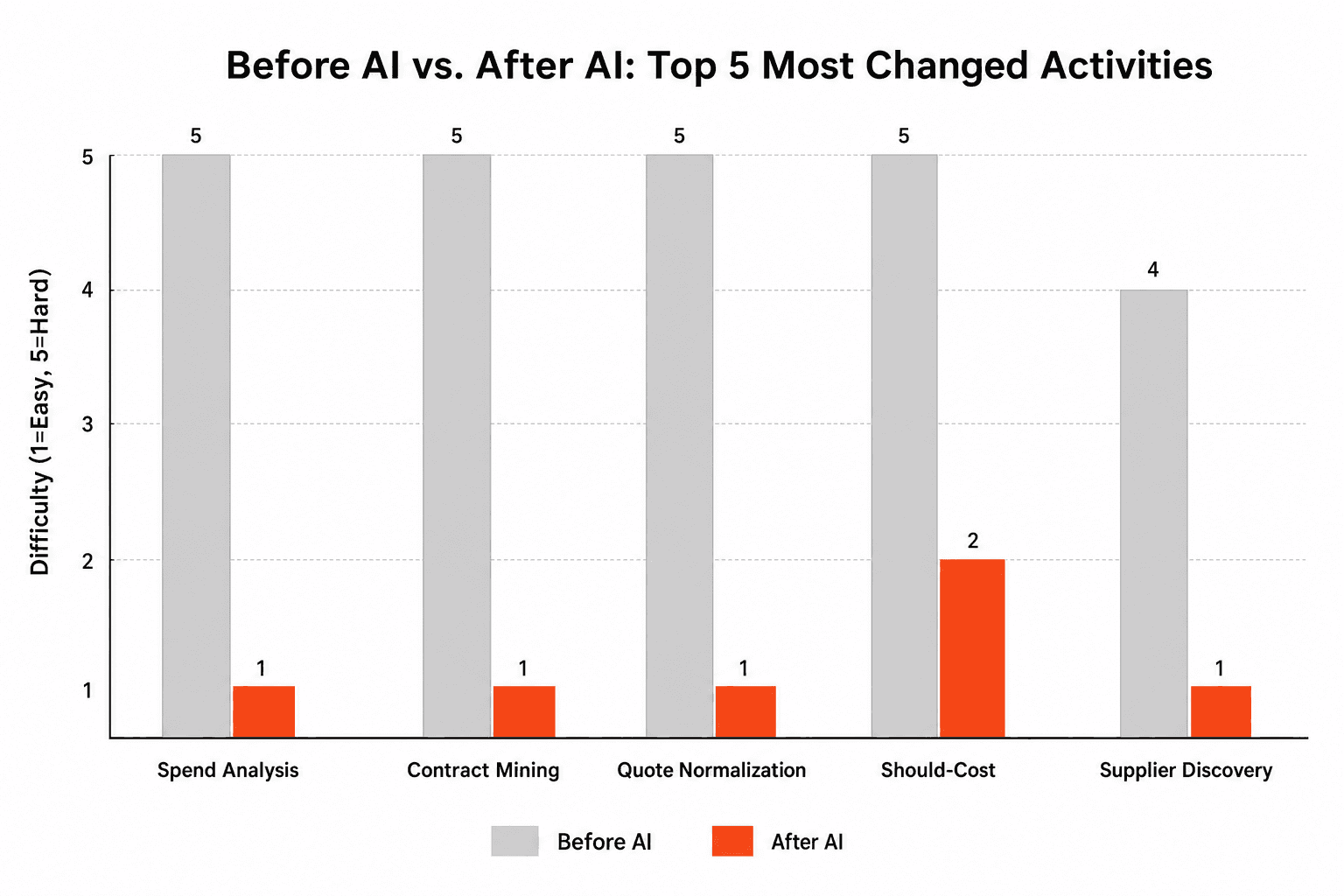
Before AI (Difficulty): How labor-intensive, error-prone, or time-consuming the activity was using manual/spreadsheet-based methods. Scale: 1 (easy) to 5 (extremely difficult).
After AI (Difficulty): How approachable the same activity becomes with AI-native tooling. Scale: 1 to 5.
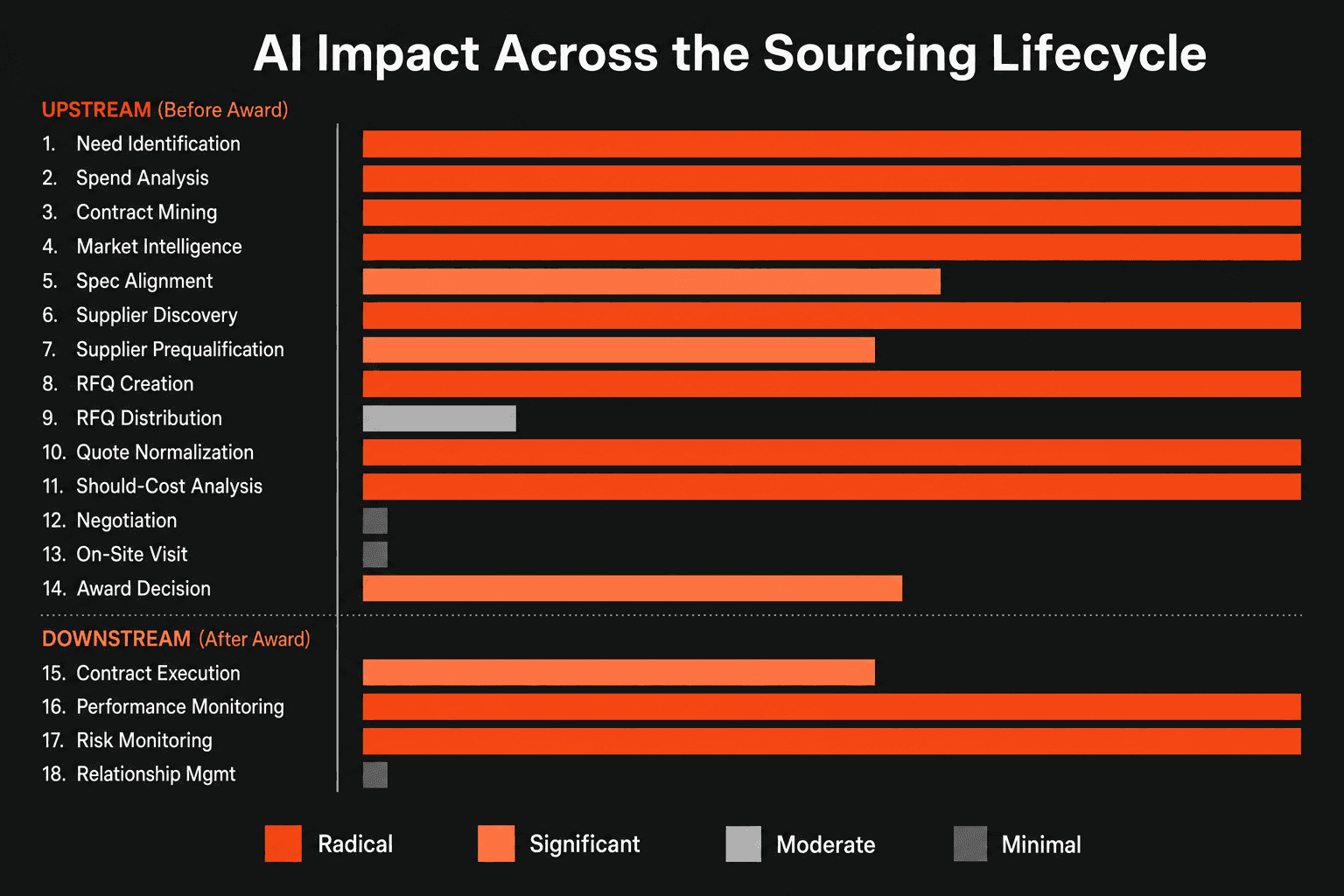
AI Impact: The magnitude of change. 🔴 Radical (fundamentally different), 🟡 Significant (meaningfully easier), 🟢 Moderate (some improvement), ⚪ Minimal (essentially unchanged).
Upstream: Before the Award
# | Activity | What It Involves | Before AI | After AI | AI Impact |
|---|---|---|---|---|---|
1 | Need Identification | Recognizing which items need sourcing -- expiring contracts, new project requirements, inventory triggers | 4 | 1 | 🔴 Radical |
2 | Spend Analysis | Categorizing and analyzing historical spend to identify savings opportunities and consolidation targets | 5 | 1 | 🔴 Radical |
3 | Contract Mining | Reviewing existing contracts to surface renewal dates, auto-renewal clauses, pricing escalators, and rebid triggers | 5 | 1 | 🔴 Radical |
4 | Market Intelligence | Understanding commodity pricing trends, supply/demand dynamics, and optimal sourcing timing based on business cycles | 4 | 2 | 🔴 Radical |
5 | Spec Alignment | Translating engineering drawings, BOMs, and technical requirements into sourcing-ready specifications | 4 | 2 | 🟡 Significant |
6 | Supplier Discovery | Finding qualified suppliers for a category -- especially in unfamiliar geographies or for specialized capabilities | 4 | 1 | 🔴 Radical |
7 | Supplier Prequalification | Screening potential suppliers on certifications, financial health, capacity, and compliance | 3 | 2 | 🟡 Significant |
8 | RFQ/RFP Creation | Drafting the sourcing event -- scope, quantities, specifications, evaluation criteria, timeline | 3 | 1 | 🔴 Radical |
9 | RFQ Distribution | Sending the sourcing event to the right suppliers with the right information | 2 | 1 | 🟢 Moderate |
10 | Quote Collection & Normalization | Receiving bids in different formats and normalizing them for apples-to-apples comparison | 5 | 1 | 🔴 Radical |
11 | Building bottom-up cost models to validate supplier pricing against material, labor, and overhead benchmarks | 5 | 2 | 🔴 Radical | |
12 | Supplier Negotiation | Face-to-face or structured negotiation on pricing, terms, and conditions | 3 | 3 | ⚪ Minimal |
13 | On-Site Supplier Visit | Physical assessment of supplier facilities, equipment, workforce, and quality systems | 3 | 3 | ⚪ Minimal |
14 | Award Decision | Selecting the winning supplier(s) based on total cost of ownership, risk, capability, and strategic fit | 3 | 2 | 🟡 Significant |
Downstream: After the Award
# | Activity | What It Involves | Before AI | After AI | AI Impact |
|---|---|---|---|---|---|
15 | Contract Execution | Finalizing terms, generating the contract, routing for signatures | 3 | 1 | 🟡 Significant |
16 | Tracking delivery, quality, responsiveness, and cost against agreed metrics | 4 | 1 | 🔴 Radical | |
17 | Risk Monitoring | Continuous surveillance of supplier financial health, geopolitical exposure, and supply chain disruptions | 5 | 1 | 🔴 Radical |
18 | Relationship Management | Building strategic partnerships, resolving disputes, conducting business reviews, and developing suppliers | 2 | 2 | ⚪ Minimal |
Summary: Of the 18 activities, AI has radical impact on 9, significant impact on 4, moderate impact on 1, and minimal impact on 4. The activities that remain essentially unchanged are the ones that depend on human judgment, physical presence, or trust -- negotiation, on-site visits, relationship management, and complex award decisions where non-quantifiable factors dominate.
The Nine Radically Changed Activities
1. Need Identification: From Reactive to Predictive
The old way: a buyer reviews a spreadsheet of contract expiration dates once a quarter. If they miss one, the contract auto-renews at the incumbent’s terms. Or a project manager sends an email saying “we need castings for the new program” and the sourcing team scrambles.
The AI way: the system monitors contract databases, BOM changes, inventory trends, and project timelines continuously. It surfaces sourcing needs before humans notice them -- flagging contracts expiring in 90 days, projects entering the sourcing window based on NPI milestones, and categories where pricing has drifted above market.
A chemicals company using AI agents for autonomous need detection increased procurement staff efficiency by 20-30% while boosting value capture by 1-3%, according to McKinsey.
2-3. Spend Analysis and Contract Mining: From Archaeology to Automation
Spend analysis has historically been one of procurement’s most painful activities. Categorizing thousands of line items across multiple ERP systems, cleaning data, and identifying patterns requires weeks of analyst time. Contract mining -- reading hundreds of supplier agreements to find renewal dates, pricing escalators, and change-of-control clauses -- is worse. GE’s separation required AI to parse 7,000 contracts; most procurement teams don’t have that capability and rely on manual review.
AI changes this from weeks to minutes. Natural language processing categorizes spend data automatically, identifies anomalies, and generates explanations in plain language. Contract AI extracts key clauses, flags risks, and creates structured databases of obligations that were previously locked in PDF files.
4. Market Intelligence: From Gut Feel to Real-Time Data
Timing matters in sourcing. A category manager who launches an RFQ when aluminum prices are at a cyclical peak pays more than one who waits three months. But tracking commodity cycles, currency movements, geopolitical disruptions, and seasonal demand patterns across dozens of categories is a full-time job that most procurement teams can’t staff.
AI monitors real-time commodity pricing, freight indices, tariff changes, and supply chain disruptions continuously. It recommends optimal sourcing windows based on historical price patterns and forward curves. A system that says “aluminum has dropped 8% in the last 6 weeks and forward curves suggest further softening -- consider accelerating your Q4 RFQ to now” is worth more than a category manager’s best guess.
6. Supplier Discovery: From Rolodex to Global Database
The traditional approach to finding new suppliers: ask colleagues who they’ve used, attend a trade show, or search a static directory. The result is a narrow, geographically concentrated supply base that reflects the buyer’s personal network more than the global market.
AI-powered supplier discovery scans global databases, trade records, certification registries, and performance histories to surface qualified suppliers the buyer has never heard of. This is particularly valuable for reducing geographic concentration risk -- if 80% of your current supply base for a critical commodity is in one region, the system identifies qualified alternatives in other geographies automatically.
10. Quote Normalization: From Spreadsheet Hell to Instant Comparison
This is the activity where the before/after contrast is most dramatic. In a manual process, a buyer receives five quotes in five different formats -- one prices per unit, another per hundred, a third includes tooling in the piece price while a fourth breaks it out separately. One quotes DDP, another quotes EXW. Converting all of them into a comparable basis takes hours and introduces errors.
AI normalizes quotes on arrival. Different units, different Incoterms, different cost structures -- the system maps them to a common format and presents an apples-to-apples comparison in seconds. LightSource’s platform does this automatically, including flagging outliers, identifying cost drivers, and surfacing the total-cost-of-ownership view that spreadsheet comparisons miss.
11. Should-Cost Analysis: From Expert Art to Data Science
Building a should-cost model manually requires deep knowledge of material costs, labor rates, machine cycle times, overhead allocation, and margin structures for each supplier geography. It’s an expert skill that takes years to develop and hours to execute per part.
AI builds should-cost models by synthesizing commodity price data, regional labor indices, manufacturing process databases, and historical quote data. The model isn’t replacing the expert -- it’s giving every buyer the analytical foundation that only the best cost engineers used to have. A cost breakdown structure that took a senior engineer a day to build can be generated in minutes and refined through human review.
16-17. Performance and Risk Monitoring: From Quarterly Reviews to Continuous Surveillance
Traditional supplier performance management means collecting data once a quarter, building a scorecard, and having a review meeting. Risk monitoring means reading the news and hoping you catch the headline before it hits your supply chain.
AI makes both continuous. Performance data -- delivery dates, quality metrics, responsiveness -- streams in real time and triggers alerts when patterns deviate from norms. Risk monitoring scans financial filings, news sentiment, regulatory changes, weather events, and geopolitical disruptions across the full supply network. The system that flagged Strait of Hormuz shipping risk in February 2026 gave procurement teams days of lead time that manual monitoring couldn’t provide.
What AI Doesn’t Change
Four activities score as “minimal impact” for good reason.
Supplier negotiation remains a fundamentally human activity. AI can provide better data going into a negotiation -- should-cost models, market benchmarks, competitor pricing, historical trends. But the negotiation itself depends on relationship dynamics, cultural context, reading the room, and making judgment calls about long-term partnership value versus short-term price. The best negotiators will use AI-generated intelligence to negotiate more effectively. The negotiation itself doesn’t change.
On-site supplier visits cannot be replaced by data. Walking a factory floor tells you things that no dashboard can: how organized the work cells are, whether operators are engaged or going through the motions, how well maintenance is performed, whether quality is a cultural value or a poster on the wall. AI can help you decide which suppliers to visit (risk-scoring the supply base to prioritize audit resources). It can’t replace the visit itself.
Relationship management -- the ongoing work of building trust, resolving conflicts, developing suppliers, and aligning on long-term strategy -- is human work. AI can surface data that makes those conversations more productive (performance trends, market context, cost benchmarks). But the supplier partnership hierarchy from transactional to strategic is climbed through human interaction, not automation.
Complex award decisions improve with AI-generated analysis, but the final call on a strategic sourcing decision often involves factors that resist quantification: supply chain resilience preferences, relationship history, capacity allocation promises, and alignment with the company’s broader procurement strategy. AI makes the analysis better. The decision remains human.
The Supply Chain Risk Dimension
One of AI’s highest-value applications in sourcing isn’t about cost -- it’s about risk. The ability to map your supply network’s geographic concentration, identify single points of failure, and monitor disruptions in real time is a capability that didn’t exist at scale five years ago.
Consider a Tier 1 automotive supplier sourcing a critical electronic component. The component comes from a single factory in Shenzhen. The factory’s raw materials come from suppliers in the Gulf region. When the Strait of Hormuz closed in February 2026, the component supplier’s petrochemical inputs were disrupted -- but the Tier 1 didn’t know because the geographic dependency was buried two tiers deep.
AI-powered supply chain mapping builds visibility into these hidden dependencies. It connects procurement records, trade data, customs filings, and sub-tier disclosure to construct a network map that shows where your supply chain actually runs -- not where you think it runs. When disruptions occur, the system traces the impact through the network and flags affected purchase orders before the supplier calls with bad news.
Gartner forecasts that supply chain software with agentic AI capabilities will grow from $2 billion in 2025 to $53 billion by 2030 -- a five-year CAGR of 93.5%. Much of that growth is driven by risk intelligence: the ability to monitor, predict, and respond to supply chain disruptions before they become line-down events.
Where to Start: A Prioritization Framework
Not every stage of the sourcing lifecycle deserves AI investment simultaneously. Here’s how to prioritize based on impact and implementation difficulty:
Quick Wins (High impact, fast to implement)
Spend analysis and contract mining -- immediate visibility into savings opportunities
Quote normalization -- eliminates the most time-consuming manual step in every RFQ
Supplier discovery -- expands the competitive field without additional buyer effort
Strategic Investments (High impact, requires data foundation)
Should-cost modeling -- requires clean BOM data and commodity price feeds
Risk monitoring -- requires sub-tier supply chain mapping
Performance tracking -- requires integration with ERP and quality systems
Don’t Automate (Invest in humans instead)
Negotiation skills training -- AI gives better data; humans need better negotiation techniques
Supplier development programs -- the ROI on early supplier involvement is high but requires human investment
Strategic relationship building -- the WRI data shows that OEMs with better supplier relationships get better outcomes on every dimension
The Numbers Behind the Shift
The consulting firms have quantified the impact:
McKinsey: AI agents can make procurement operations 25-40% more efficient. A chemicals company saw 20-30% staff efficiency gains plus 1-3% additional value capture.
BCG: GenAI can streamline manual procurement work by up to 30% and reduce overall costs by 15-45%.
The Hackett Group: Generative AI could drive up to 40% reduction in SG&A costs over 5-7 years across procurement, finance, HR, and IT.
Gartner: Agentic AI in supply chain software projected to grow from $2B (2025) to $53B (2030). 28% of procurement time is ripe for automation. 1 in 5 procurement roles will be AI-driven by 2030.
Ardent Partners: 62% of procurement leaders believe AI’s impact in the next 2-3 years will be “transformational” or “significant.”
But the adoption gap is real. Only 36% of procurement organizations have meaningful GenAI implementations. 49% are running pilots. Only 4% have reached meaningful deployment. The opportunity is enormous, but most organizations are still in the early innings.
The gap between “pilot” and “deployment” has a name: AI theater. The tools exist. The demos are impressive. But scaling from a proof-of-concept on one commodity to a production system across all direct materials requires something the demos don’t show -- clean, joined data. At minimum, an AI sourcing system needs 12-24 months of PO history, a centralized contract repository, standardized supplier master data, and a set of historical RFQs. Without that foundation, the AI hallucinates patterns that don’t exist and surfaces recommendations no buyer trusts. The organizations failing at AI procurement aren’t failing because the technology doesn’t work. They’re failing because their data isn’t ready for the technology to work on -- the same diagnosis the people building AI keep giving: generation got cheap, and verification and context became the bottleneck.
At LightSource, AI is embedded across the sourcing lifecycle -- from spec extraction and supplier matching to quote normalization, should-cost benchmarking, and supplier performance tracking. The platform is built for the nine radically changed activities in the table above, while keeping humans at the center of the four that AI can’t replace.
AI in procurement isn’t a binary. It’s not “AI does your job” or “AI doesn’t work.” It’s a map of 18 activities where the technology’s impact ranges from radical to zero. The companies getting value are the ones that read the map accurately -- investing in automation where the leverage is real, and investing in human capability where it isn’t.
Sources
McKinsey -- Redefining Procurement Performance in the Era of Agentic AI -- 25-40% efficiency gains; chemicals company case study
BCG -- GenAI in Procurement: From Buzz to Bottom-Line Cost Reductions -- 15-45% cost reduction; 30% manual work reduction
The Hackett Group -- Generative AI Will Drive Profound Reductions in SG&A -- Up to 40% SG&A reduction over 5-7 years
Gartner -- Agentic AI in Supply Chain Management Software Forecast -- $2B to $53B by 2030 (93.5% CAGR)
Ardent Partners -- 2025 Procurement AI Impact Study -- 62% of leaders expect transformational impact
Art of Procurement -- State of AI in Procurement 2026 -- 80% of CPOs investing in AI; only 4% at meaningful deployment
McKinsey -- Transforming Procurement Functions for an AI-Driven World -- Hybrid workforce model; 28% of procurement time automatable
Spend Matters -- AI in Procurement Risk Management -- Sub-tier risk mapping and continuous monitoring
Frequently Asked Questions
Which stage of the sourcing lifecycle benefits most from AI?
Quote collection and normalization sees the most dramatic before/after change. In manual processes, normalizing five quotes in different formats, units, and Incoterms takes hours and introduces errors. AI normalizes them in seconds with higher accuracy. Spend analysis and contract mining are close seconds -- activities that took weeks of analyst time now take minutes.
Can AI replace supplier negotiations?
No. AI provides better data going into negotiations -- should-cost models, market benchmarks, historical pricing trends. But the negotiation itself depends on relationship dynamics, judgment, and human communication. The best negotiators use AI-generated intelligence to negotiate more effectively. The negotiation itself remains fundamentally human.
How does AI help with supply chain geographic risk?
AI maps your full supply network -- including sub-tier suppliers you may not have visibility into -- by connecting procurement records, trade data, and customs filings. It identifies geographic concentration risks (e.g., 80% of a commodity sourced from one region), monitors real-time disruption signals (geopolitical events, weather, financial distress), and traces the impact through your network when disruptions occur. This capability didn’t exist at scale five years ago.
What data foundation does AI procurement need to work?
AI requires clean, structured data to deliver value. At minimum: categorized spend data, digitized contracts, standardized BOMs, and supplier master data. The organizations struggling with AI adoption are typically those whose procurement data is fragmented across spreadsheets, email, and disconnected systems. The first step isn’t buying AI software -- it’s getting your data into a system of record.
What percentage of procurement work can AI actually automate?
Gartner estimates that 28% of procurement time is ripe for automation -- primarily transactional activities like managing bids, processing purchase orders, and categorizing spend. McKinsey puts the efficiency gain at 25-40% for procurement operations overall. But “automate” doesn’t mean “eliminate humans.” It means shifting human effort from data entry and spreadsheet manipulation to analysis, strategy, and relationship management.
How is LightSource different from other AI procurement tools?
LightSource is built specifically for direct materials sourcing -- the 80% of procurement spend that involves engineered parts, BOMs, technical specifications, and supplier qualification. The platform embeds AI across the nine radically changed activities identified in this guide: from spec extraction and supplier discovery to quote normalization, should-cost benchmarking, and performance monitoring. It’s designed for the complexity of direct materials, not for buying office supplies.
It’s 8:00 a.m. Your team has three open escalations: a late chip shipment, a request from engineering to cost-down a connector module, and an expiring blanket PO with a plastics supplier. You have procurement tools in place, but usage is spotty and data hygiene is mixed. Where do you put the next hour of effort?
Related: before the stage-by-stage playbook, the sequencing argument -- Fluency First: The Right Order of Operations for AI in Procurement.
The procurement AI conversation has a specificity problem. Vendors say “AI-powered sourcing.” Analysts say “25-40% efficiency gains.” CPOs nod along. But nobody maps the claim to the actual work.
Sourcing is not one activity. It’s a sequence of 18 or more discrete activities -- from recognizing that a contract is expiring, to aligning on specifications with engineering, to qualifying a new supplier, to monitoring delivery performance two years after the award. AI doesn’t affect all of these equally. Some stages -- like surfacing contracts that need rebidding or finding new suppliers in unfamiliar geographies -- are fundamentally transformed. Others -- like walking a supplier’s factory floor or negotiating a complex strategic partnership -- are essentially unchanged.
The difference between companies that get value from AI in procurement and those that don’t isn’t whether they “adopted AI.” It’s whether they mapped the technology to the specific stages where it actually works, and invested human effort where it doesn’t.
This guide walks through the complete sourcing lifecycle -- upstream (everything before the award) and downstream (everything after) -- and scores each activity on AI impact. The goal isn’t to sell you on AI. It’s to help you allocate your team’s time and your technology budget to the stages where the return is real.
The Sourcing Lifecycle: 18 Activities, Scored
The table below maps every major activity in a sourcing event, from initial need identification through ongoing supplier management. For each activity, we score:
Before AI (Difficulty): How labor-intensive, error-prone, or time-consuming the activity was using manual/spreadsheet-based methods. Scale: 1 (easy) to 5 (extremely difficult).
After AI (Difficulty): How approachable the same activity becomes with AI-native tooling. Scale: 1 to 5.
AI Impact: The magnitude of change. 🔴 Radical (fundamentally different), 🟡 Significant (meaningfully easier), 🟢 Moderate (some improvement), ⚪ Minimal (essentially unchanged).
Upstream: Before the Award
# | Activity | What It Involves | Before AI | After AI | AI Impact |
|---|---|---|---|---|---|
1 | Need Identification | Recognizing which items need sourcing -- expiring contracts, new project requirements, inventory triggers | 4 | 1 | 🔴 Radical |
2 | Spend Analysis | Categorizing and analyzing historical spend to identify savings opportunities and consolidation targets | 5 | 1 | 🔴 Radical |
3 | Contract Mining | Reviewing existing contracts to surface renewal dates, auto-renewal clauses, pricing escalators, and rebid triggers | 5 | 1 | 🔴 Radical |
4 | Market Intelligence | Understanding commodity pricing trends, supply/demand dynamics, and optimal sourcing timing based on business cycles | 4 | 2 | 🔴 Radical |
5 | Spec Alignment | Translating engineering drawings, BOMs, and technical requirements into sourcing-ready specifications | 4 | 2 | 🟡 Significant |
6 | Supplier Discovery | Finding qualified suppliers for a category -- especially in unfamiliar geographies or for specialized capabilities | 4 | 1 | 🔴 Radical |
7 | Supplier Prequalification | Screening potential suppliers on certifications, financial health, capacity, and compliance | 3 | 2 | 🟡 Significant |
8 | RFQ/RFP Creation | Drafting the sourcing event -- scope, quantities, specifications, evaluation criteria, timeline | 3 | 1 | 🔴 Radical |
9 | RFQ Distribution | Sending the sourcing event to the right suppliers with the right information | 2 | 1 | 🟢 Moderate |
10 | Quote Collection & Normalization | Receiving bids in different formats and normalizing them for apples-to-apples comparison | 5 | 1 | 🔴 Radical |
11 | Building bottom-up cost models to validate supplier pricing against material, labor, and overhead benchmarks | 5 | 2 | 🔴 Radical | |
12 | Supplier Negotiation | Face-to-face or structured negotiation on pricing, terms, and conditions | 3 | 3 | ⚪ Minimal |
13 | On-Site Supplier Visit | Physical assessment of supplier facilities, equipment, workforce, and quality systems | 3 | 3 | ⚪ Minimal |
14 | Award Decision | Selecting the winning supplier(s) based on total cost of ownership, risk, capability, and strategic fit | 3 | 2 | 🟡 Significant |
Downstream: After the Award
# | Activity | What It Involves | Before AI | After AI | AI Impact |
|---|---|---|---|---|---|
15 | Contract Execution | Finalizing terms, generating the contract, routing for signatures | 3 | 1 | 🟡 Significant |
16 | Tracking delivery, quality, responsiveness, and cost against agreed metrics | 4 | 1 | 🔴 Radical | |
17 | Risk Monitoring | Continuous surveillance of supplier financial health, geopolitical exposure, and supply chain disruptions | 5 | 1 | 🔴 Radical |
18 | Relationship Management | Building strategic partnerships, resolving disputes, conducting business reviews, and developing suppliers | 2 | 2 | ⚪ Minimal |
Summary: Of the 18 activities, AI has radical impact on 9, significant impact on 4, moderate impact on 1, and minimal impact on 4. The activities that remain essentially unchanged are the ones that depend on human judgment, physical presence, or trust -- negotiation, on-site visits, relationship management, and complex award decisions where non-quantifiable factors dominate.
The Nine Radically Changed Activities
1. Need Identification: From Reactive to Predictive
The old way: a buyer reviews a spreadsheet of contract expiration dates once a quarter. If they miss one, the contract auto-renews at the incumbent’s terms. Or a project manager sends an email saying “we need castings for the new program” and the sourcing team scrambles.
The AI way: the system monitors contract databases, BOM changes, inventory trends, and project timelines continuously. It surfaces sourcing needs before humans notice them -- flagging contracts expiring in 90 days, projects entering the sourcing window based on NPI milestones, and categories where pricing has drifted above market.
A chemicals company using AI agents for autonomous need detection increased procurement staff efficiency by 20-30% while boosting value capture by 1-3%, according to McKinsey.
2-3. Spend Analysis and Contract Mining: From Archaeology to Automation
Spend analysis has historically been one of procurement’s most painful activities. Categorizing thousands of line items across multiple ERP systems, cleaning data, and identifying patterns requires weeks of analyst time. Contract mining -- reading hundreds of supplier agreements to find renewal dates, pricing escalators, and change-of-control clauses -- is worse. GE’s separation required AI to parse 7,000 contracts; most procurement teams don’t have that capability and rely on manual review.
AI changes this from weeks to minutes. Natural language processing categorizes spend data automatically, identifies anomalies, and generates explanations in plain language. Contract AI extracts key clauses, flags risks, and creates structured databases of obligations that were previously locked in PDF files.
4. Market Intelligence: From Gut Feel to Real-Time Data
Timing matters in sourcing. A category manager who launches an RFQ when aluminum prices are at a cyclical peak pays more than one who waits three months. But tracking commodity cycles, currency movements, geopolitical disruptions, and seasonal demand patterns across dozens of categories is a full-time job that most procurement teams can’t staff.
AI monitors real-time commodity pricing, freight indices, tariff changes, and supply chain disruptions continuously. It recommends optimal sourcing windows based on historical price patterns and forward curves. A system that says “aluminum has dropped 8% in the last 6 weeks and forward curves suggest further softening -- consider accelerating your Q4 RFQ to now” is worth more than a category manager’s best guess.
6. Supplier Discovery: From Rolodex to Global Database
The traditional approach to finding new suppliers: ask colleagues who they’ve used, attend a trade show, or search a static directory. The result is a narrow, geographically concentrated supply base that reflects the buyer’s personal network more than the global market.
AI-powered supplier discovery scans global databases, trade records, certification registries, and performance histories to surface qualified suppliers the buyer has never heard of. This is particularly valuable for reducing geographic concentration risk -- if 80% of your current supply base for a critical commodity is in one region, the system identifies qualified alternatives in other geographies automatically.
10. Quote Normalization: From Spreadsheet Hell to Instant Comparison
This is the activity where the before/after contrast is most dramatic. In a manual process, a buyer receives five quotes in five different formats -- one prices per unit, another per hundred, a third includes tooling in the piece price while a fourth breaks it out separately. One quotes DDP, another quotes EXW. Converting all of them into a comparable basis takes hours and introduces errors.
AI normalizes quotes on arrival. Different units, different Incoterms, different cost structures -- the system maps them to a common format and presents an apples-to-apples comparison in seconds. LightSource’s platform does this automatically, including flagging outliers, identifying cost drivers, and surfacing the total-cost-of-ownership view that spreadsheet comparisons miss.
11. Should-Cost Analysis: From Expert Art to Data Science
Building a should-cost model manually requires deep knowledge of material costs, labor rates, machine cycle times, overhead allocation, and margin structures for each supplier geography. It’s an expert skill that takes years to develop and hours to execute per part.
AI builds should-cost models by synthesizing commodity price data, regional labor indices, manufacturing process databases, and historical quote data. The model isn’t replacing the expert -- it’s giving every buyer the analytical foundation that only the best cost engineers used to have. A cost breakdown structure that took a senior engineer a day to build can be generated in minutes and refined through human review.
16-17. Performance and Risk Monitoring: From Quarterly Reviews to Continuous Surveillance
Traditional supplier performance management means collecting data once a quarter, building a scorecard, and having a review meeting. Risk monitoring means reading the news and hoping you catch the headline before it hits your supply chain.
AI makes both continuous. Performance data -- delivery dates, quality metrics, responsiveness -- streams in real time and triggers alerts when patterns deviate from norms. Risk monitoring scans financial filings, news sentiment, regulatory changes, weather events, and geopolitical disruptions across the full supply network. The system that flagged Strait of Hormuz shipping risk in February 2026 gave procurement teams days of lead time that manual monitoring couldn’t provide.
What AI Doesn’t Change
Four activities score as “minimal impact” for good reason.
Supplier negotiation remains a fundamentally human activity. AI can provide better data going into a negotiation -- should-cost models, market benchmarks, competitor pricing, historical trends. But the negotiation itself depends on relationship dynamics, cultural context, reading the room, and making judgment calls about long-term partnership value versus short-term price. The best negotiators will use AI-generated intelligence to negotiate more effectively. The negotiation itself doesn’t change.
On-site supplier visits cannot be replaced by data. Walking a factory floor tells you things that no dashboard can: how organized the work cells are, whether operators are engaged or going through the motions, how well maintenance is performed, whether quality is a cultural value or a poster on the wall. AI can help you decide which suppliers to visit (risk-scoring the supply base to prioritize audit resources). It can’t replace the visit itself.
Relationship management -- the ongoing work of building trust, resolving conflicts, developing suppliers, and aligning on long-term strategy -- is human work. AI can surface data that makes those conversations more productive (performance trends, market context, cost benchmarks). But the supplier partnership hierarchy from transactional to strategic is climbed through human interaction, not automation.
Complex award decisions improve with AI-generated analysis, but the final call on a strategic sourcing decision often involves factors that resist quantification: supply chain resilience preferences, relationship history, capacity allocation promises, and alignment with the company’s broader procurement strategy. AI makes the analysis better. The decision remains human.
The Supply Chain Risk Dimension
One of AI’s highest-value applications in sourcing isn’t about cost -- it’s about risk. The ability to map your supply network’s geographic concentration, identify single points of failure, and monitor disruptions in real time is a capability that didn’t exist at scale five years ago.
Consider a Tier 1 automotive supplier sourcing a critical electronic component. The component comes from a single factory in Shenzhen. The factory’s raw materials come from suppliers in the Gulf region. When the Strait of Hormuz closed in February 2026, the component supplier’s petrochemical inputs were disrupted -- but the Tier 1 didn’t know because the geographic dependency was buried two tiers deep.
AI-powered supply chain mapping builds visibility into these hidden dependencies. It connects procurement records, trade data, customs filings, and sub-tier disclosure to construct a network map that shows where your supply chain actually runs -- not where you think it runs. When disruptions occur, the system traces the impact through the network and flags affected purchase orders before the supplier calls with bad news.
Gartner forecasts that supply chain software with agentic AI capabilities will grow from $2 billion in 2025 to $53 billion by 2030 -- a five-year CAGR of 93.5%. Much of that growth is driven by risk intelligence: the ability to monitor, predict, and respond to supply chain disruptions before they become line-down events.
Where to Start: A Prioritization Framework
Not every stage of the sourcing lifecycle deserves AI investment simultaneously. Here’s how to prioritize based on impact and implementation difficulty:
Quick Wins (High impact, fast to implement)
Spend analysis and contract mining -- immediate visibility into savings opportunities
Quote normalization -- eliminates the most time-consuming manual step in every RFQ
Supplier discovery -- expands the competitive field without additional buyer effort
Strategic Investments (High impact, requires data foundation)
Should-cost modeling -- requires clean BOM data and commodity price feeds
Risk monitoring -- requires sub-tier supply chain mapping
Performance tracking -- requires integration with ERP and quality systems
Don’t Automate (Invest in humans instead)
Negotiation skills training -- AI gives better data; humans need better negotiation techniques
Supplier development programs -- the ROI on early supplier involvement is high but requires human investment
Strategic relationship building -- the WRI data shows that OEMs with better supplier relationships get better outcomes on every dimension
The Numbers Behind the Shift
The consulting firms have quantified the impact:
McKinsey: AI agents can make procurement operations 25-40% more efficient. A chemicals company saw 20-30% staff efficiency gains plus 1-3% additional value capture.
BCG: GenAI can streamline manual procurement work by up to 30% and reduce overall costs by 15-45%.
The Hackett Group: Generative AI could drive up to 40% reduction in SG&A costs over 5-7 years across procurement, finance, HR, and IT.
Gartner: Agentic AI in supply chain software projected to grow from $2B (2025) to $53B (2030). 28% of procurement time is ripe for automation. 1 in 5 procurement roles will be AI-driven by 2030.
Ardent Partners: 62% of procurement leaders believe AI’s impact in the next 2-3 years will be “transformational” or “significant.”
But the adoption gap is real. Only 36% of procurement organizations have meaningful GenAI implementations. 49% are running pilots. Only 4% have reached meaningful deployment. The opportunity is enormous, but most organizations are still in the early innings.
The gap between “pilot” and “deployment” has a name: AI theater. The tools exist. The demos are impressive. But scaling from a proof-of-concept on one commodity to a production system across all direct materials requires something the demos don’t show -- clean, joined data. At minimum, an AI sourcing system needs 12-24 months of PO history, a centralized contract repository, standardized supplier master data, and a set of historical RFQs. Without that foundation, the AI hallucinates patterns that don’t exist and surfaces recommendations no buyer trusts. The organizations failing at AI procurement aren’t failing because the technology doesn’t work. They’re failing because their data isn’t ready for the technology to work on -- the same diagnosis the people building AI keep giving: generation got cheap, and verification and context became the bottleneck.
At LightSource, AI is embedded across the sourcing lifecycle -- from spec extraction and supplier matching to quote normalization, should-cost benchmarking, and supplier performance tracking. The platform is built for the nine radically changed activities in the table above, while keeping humans at the center of the four that AI can’t replace.
AI in procurement isn’t a binary. It’s not “AI does your job” or “AI doesn’t work.” It’s a map of 18 activities where the technology’s impact ranges from radical to zero. The companies getting value are the ones that read the map accurately -- investing in automation where the leverage is real, and investing in human capability where it isn’t.
Sources
McKinsey -- Redefining Procurement Performance in the Era of Agentic AI -- 25-40% efficiency gains; chemicals company case study
BCG -- GenAI in Procurement: From Buzz to Bottom-Line Cost Reductions -- 15-45% cost reduction; 30% manual work reduction
The Hackett Group -- Generative AI Will Drive Profound Reductions in SG&A -- Up to 40% SG&A reduction over 5-7 years
Gartner -- Agentic AI in Supply Chain Management Software Forecast -- $2B to $53B by 2030 (93.5% CAGR)
Ardent Partners -- 2025 Procurement AI Impact Study -- 62% of leaders expect transformational impact
Art of Procurement -- State of AI in Procurement 2026 -- 80% of CPOs investing in AI; only 4% at meaningful deployment
McKinsey -- Transforming Procurement Functions for an AI-Driven World -- Hybrid workforce model; 28% of procurement time automatable
Spend Matters -- AI in Procurement Risk Management -- Sub-tier risk mapping and continuous monitoring
Frequently Asked Questions
Which stage of the sourcing lifecycle benefits most from AI?
Quote collection and normalization sees the most dramatic before/after change. In manual processes, normalizing five quotes in different formats, units, and Incoterms takes hours and introduces errors. AI normalizes them in seconds with higher accuracy. Spend analysis and contract mining are close seconds -- activities that took weeks of analyst time now take minutes.
Can AI replace supplier negotiations?
No. AI provides better data going into negotiations -- should-cost models, market benchmarks, historical pricing trends. But the negotiation itself depends on relationship dynamics, judgment, and human communication. The best negotiators use AI-generated intelligence to negotiate more effectively. The negotiation itself remains fundamentally human.
How does AI help with supply chain geographic risk?
AI maps your full supply network -- including sub-tier suppliers you may not have visibility into -- by connecting procurement records, trade data, and customs filings. It identifies geographic concentration risks (e.g., 80% of a commodity sourced from one region), monitors real-time disruption signals (geopolitical events, weather, financial distress), and traces the impact through your network when disruptions occur. This capability didn’t exist at scale five years ago.
What data foundation does AI procurement need to work?
AI requires clean, structured data to deliver value. At minimum: categorized spend data, digitized contracts, standardized BOMs, and supplier master data. The organizations struggling with AI adoption are typically those whose procurement data is fragmented across spreadsheets, email, and disconnected systems. The first step isn’t buying AI software -- it’s getting your data into a system of record.
What percentage of procurement work can AI actually automate?
Gartner estimates that 28% of procurement time is ripe for automation -- primarily transactional activities like managing bids, processing purchase orders, and categorizing spend. McKinsey puts the efficiency gain at 25-40% for procurement operations overall. But “automate” doesn’t mean “eliminate humans.” It means shifting human effort from data entry and spreadsheet manipulation to analysis, strategy, and relationship management.
How is LightSource different from other AI procurement tools?
LightSource is built specifically for direct materials sourcing -- the 80% of procurement spend that involves engineered parts, BOMs, technical specifications, and supplier qualification. The platform embeds AI across the nine radically changed activities identified in this guide: from spec extraction and supplier discovery to quote normalization, should-cost benchmarking, and performance monitoring. It’s designed for the complexity of direct materials, not for buying office supplies.
It’s 8:00 a.m. Your team has three open escalations: a late chip shipment, a request from engineering to cost-down a connector module, and an expiring blanket PO with a plastics supplier. You have procurement tools in place, but usage is spotty and data hygiene is mixed. Where do you put the next hour of effort?
Related: before the stage-by-stage playbook, the sequencing argument -- Fluency First: The Right Order of Operations for AI in Procurement.
The procurement AI conversation has a specificity problem. Vendors say “AI-powered sourcing.” Analysts say “25-40% efficiency gains.” CPOs nod along. But nobody maps the claim to the actual work.
Sourcing is not one activity. It’s a sequence of 18 or more discrete activities -- from recognizing that a contract is expiring, to aligning on specifications with engineering, to qualifying a new supplier, to monitoring delivery performance two years after the award. AI doesn’t affect all of these equally. Some stages -- like surfacing contracts that need rebidding or finding new suppliers in unfamiliar geographies -- are fundamentally transformed. Others -- like walking a supplier’s factory floor or negotiating a complex strategic partnership -- are essentially unchanged.
The difference between companies that get value from AI in procurement and those that don’t isn’t whether they “adopted AI.” It’s whether they mapped the technology to the specific stages where it actually works, and invested human effort where it doesn’t.
This guide walks through the complete sourcing lifecycle -- upstream (everything before the award) and downstream (everything after) -- and scores each activity on AI impact. The goal isn’t to sell you on AI. It’s to help you allocate your team’s time and your technology budget to the stages where the return is real.
The Sourcing Lifecycle: 18 Activities, Scored
The table below maps every major activity in a sourcing event, from initial need identification through ongoing supplier management. For each activity, we score:
Before AI (Difficulty): How labor-intensive, error-prone, or time-consuming the activity was using manual/spreadsheet-based methods. Scale: 1 (easy) to 5 (extremely difficult).
After AI (Difficulty): How approachable the same activity becomes with AI-native tooling. Scale: 1 to 5.
AI Impact: The magnitude of change. 🔴 Radical (fundamentally different), 🟡 Significant (meaningfully easier), 🟢 Moderate (some improvement), ⚪ Minimal (essentially unchanged).
Upstream: Before the Award
# | Activity | What It Involves | Before AI | After AI | AI Impact |
|---|---|---|---|---|---|
1 | Need Identification | Recognizing which items need sourcing -- expiring contracts, new project requirements, inventory triggers | 4 | 1 | 🔴 Radical |
2 | Spend Analysis | Categorizing and analyzing historical spend to identify savings opportunities and consolidation targets | 5 | 1 | 🔴 Radical |
3 | Contract Mining | Reviewing existing contracts to surface renewal dates, auto-renewal clauses, pricing escalators, and rebid triggers | 5 | 1 | 🔴 Radical |
4 | Market Intelligence | Understanding commodity pricing trends, supply/demand dynamics, and optimal sourcing timing based on business cycles | 4 | 2 | 🔴 Radical |
5 | Spec Alignment | Translating engineering drawings, BOMs, and technical requirements into sourcing-ready specifications | 4 | 2 | 🟡 Significant |
6 | Supplier Discovery | Finding qualified suppliers for a category -- especially in unfamiliar geographies or for specialized capabilities | 4 | 1 | 🔴 Radical |
7 | Supplier Prequalification | Screening potential suppliers on certifications, financial health, capacity, and compliance | 3 | 2 | 🟡 Significant |
8 | RFQ/RFP Creation | Drafting the sourcing event -- scope, quantities, specifications, evaluation criteria, timeline | 3 | 1 | 🔴 Radical |
9 | RFQ Distribution | Sending the sourcing event to the right suppliers with the right information | 2 | 1 | 🟢 Moderate |
10 | Quote Collection & Normalization | Receiving bids in different formats and normalizing them for apples-to-apples comparison | 5 | 1 | 🔴 Radical |
11 | Building bottom-up cost models to validate supplier pricing against material, labor, and overhead benchmarks | 5 | 2 | 🔴 Radical | |
12 | Supplier Negotiation | Face-to-face or structured negotiation on pricing, terms, and conditions | 3 | 3 | ⚪ Minimal |
13 | On-Site Supplier Visit | Physical assessment of supplier facilities, equipment, workforce, and quality systems | 3 | 3 | ⚪ Minimal |
14 | Award Decision | Selecting the winning supplier(s) based on total cost of ownership, risk, capability, and strategic fit | 3 | 2 | 🟡 Significant |
Downstream: After the Award
# | Activity | What It Involves | Before AI | After AI | AI Impact |
|---|---|---|---|---|---|
15 | Contract Execution | Finalizing terms, generating the contract, routing for signatures | 3 | 1 | 🟡 Significant |
16 | Tracking delivery, quality, responsiveness, and cost against agreed metrics | 4 | 1 | 🔴 Radical | |
17 | Risk Monitoring | Continuous surveillance of supplier financial health, geopolitical exposure, and supply chain disruptions | 5 | 1 | 🔴 Radical |
18 | Relationship Management | Building strategic partnerships, resolving disputes, conducting business reviews, and developing suppliers | 2 | 2 | ⚪ Minimal |
Summary: Of the 18 activities, AI has radical impact on 9, significant impact on 4, moderate impact on 1, and minimal impact on 4. The activities that remain essentially unchanged are the ones that depend on human judgment, physical presence, or trust -- negotiation, on-site visits, relationship management, and complex award decisions where non-quantifiable factors dominate.
The Nine Radically Changed Activities
1. Need Identification: From Reactive to Predictive
The old way: a buyer reviews a spreadsheet of contract expiration dates once a quarter. If they miss one, the contract auto-renews at the incumbent’s terms. Or a project manager sends an email saying “we need castings for the new program” and the sourcing team scrambles.
The AI way: the system monitors contract databases, BOM changes, inventory trends, and project timelines continuously. It surfaces sourcing needs before humans notice them -- flagging contracts expiring in 90 days, projects entering the sourcing window based on NPI milestones, and categories where pricing has drifted above market.
A chemicals company using AI agents for autonomous need detection increased procurement staff efficiency by 20-30% while boosting value capture by 1-3%, according to McKinsey.
2-3. Spend Analysis and Contract Mining: From Archaeology to Automation
Spend analysis has historically been one of procurement’s most painful activities. Categorizing thousands of line items across multiple ERP systems, cleaning data, and identifying patterns requires weeks of analyst time. Contract mining -- reading hundreds of supplier agreements to find renewal dates, pricing escalators, and change-of-control clauses -- is worse. GE’s separation required AI to parse 7,000 contracts; most procurement teams don’t have that capability and rely on manual review.
AI changes this from weeks to minutes. Natural language processing categorizes spend data automatically, identifies anomalies, and generates explanations in plain language. Contract AI extracts key clauses, flags risks, and creates structured databases of obligations that were previously locked in PDF files.
4. Market Intelligence: From Gut Feel to Real-Time Data
Timing matters in sourcing. A category manager who launches an RFQ when aluminum prices are at a cyclical peak pays more than one who waits three months. But tracking commodity cycles, currency movements, geopolitical disruptions, and seasonal demand patterns across dozens of categories is a full-time job that most procurement teams can’t staff.
AI monitors real-time commodity pricing, freight indices, tariff changes, and supply chain disruptions continuously. It recommends optimal sourcing windows based on historical price patterns and forward curves. A system that says “aluminum has dropped 8% in the last 6 weeks and forward curves suggest further softening -- consider accelerating your Q4 RFQ to now” is worth more than a category manager’s best guess.
6. Supplier Discovery: From Rolodex to Global Database
The traditional approach to finding new suppliers: ask colleagues who they’ve used, attend a trade show, or search a static directory. The result is a narrow, geographically concentrated supply base that reflects the buyer’s personal network more than the global market.
AI-powered supplier discovery scans global databases, trade records, certification registries, and performance histories to surface qualified suppliers the buyer has never heard of. This is particularly valuable for reducing geographic concentration risk -- if 80% of your current supply base for a critical commodity is in one region, the system identifies qualified alternatives in other geographies automatically.
10. Quote Normalization: From Spreadsheet Hell to Instant Comparison
This is the activity where the before/after contrast is most dramatic. In a manual process, a buyer receives five quotes in five different formats -- one prices per unit, another per hundred, a third includes tooling in the piece price while a fourth breaks it out separately. One quotes DDP, another quotes EXW. Converting all of them into a comparable basis takes hours and introduces errors.
AI normalizes quotes on arrival. Different units, different Incoterms, different cost structures -- the system maps them to a common format and presents an apples-to-apples comparison in seconds. LightSource’s platform does this automatically, including flagging outliers, identifying cost drivers, and surfacing the total-cost-of-ownership view that spreadsheet comparisons miss.
11. Should-Cost Analysis: From Expert Art to Data Science
Building a should-cost model manually requires deep knowledge of material costs, labor rates, machine cycle times, overhead allocation, and margin structures for each supplier geography. It’s an expert skill that takes years to develop and hours to execute per part.
AI builds should-cost models by synthesizing commodity price data, regional labor indices, manufacturing process databases, and historical quote data. The model isn’t replacing the expert -- it’s giving every buyer the analytical foundation that only the best cost engineers used to have. A cost breakdown structure that took a senior engineer a day to build can be generated in minutes and refined through human review.
16-17. Performance and Risk Monitoring: From Quarterly Reviews to Continuous Surveillance
Traditional supplier performance management means collecting data once a quarter, building a scorecard, and having a review meeting. Risk monitoring means reading the news and hoping you catch the headline before it hits your supply chain.
AI makes both continuous. Performance data -- delivery dates, quality metrics, responsiveness -- streams in real time and triggers alerts when patterns deviate from norms. Risk monitoring scans financial filings, news sentiment, regulatory changes, weather events, and geopolitical disruptions across the full supply network. The system that flagged Strait of Hormuz shipping risk in February 2026 gave procurement teams days of lead time that manual monitoring couldn’t provide.
What AI Doesn’t Change
Four activities score as “minimal impact” for good reason.
Supplier negotiation remains a fundamentally human activity. AI can provide better data going into a negotiation -- should-cost models, market benchmarks, competitor pricing, historical trends. But the negotiation itself depends on relationship dynamics, cultural context, reading the room, and making judgment calls about long-term partnership value versus short-term price. The best negotiators will use AI-generated intelligence to negotiate more effectively. The negotiation itself doesn’t change.
On-site supplier visits cannot be replaced by data. Walking a factory floor tells you things that no dashboard can: how organized the work cells are, whether operators are engaged or going through the motions, how well maintenance is performed, whether quality is a cultural value or a poster on the wall. AI can help you decide which suppliers to visit (risk-scoring the supply base to prioritize audit resources). It can’t replace the visit itself.
Relationship management -- the ongoing work of building trust, resolving conflicts, developing suppliers, and aligning on long-term strategy -- is human work. AI can surface data that makes those conversations more productive (performance trends, market context, cost benchmarks). But the supplier partnership hierarchy from transactional to strategic is climbed through human interaction, not automation.
Complex award decisions improve with AI-generated analysis, but the final call on a strategic sourcing decision often involves factors that resist quantification: supply chain resilience preferences, relationship history, capacity allocation promises, and alignment with the company’s broader procurement strategy. AI makes the analysis better. The decision remains human.
The Supply Chain Risk Dimension
One of AI’s highest-value applications in sourcing isn’t about cost -- it’s about risk. The ability to map your supply network’s geographic concentration, identify single points of failure, and monitor disruptions in real time is a capability that didn’t exist at scale five years ago.
Consider a Tier 1 automotive supplier sourcing a critical electronic component. The component comes from a single factory in Shenzhen. The factory’s raw materials come from suppliers in the Gulf region. When the Strait of Hormuz closed in February 2026, the component supplier’s petrochemical inputs were disrupted -- but the Tier 1 didn’t know because the geographic dependency was buried two tiers deep.
AI-powered supply chain mapping builds visibility into these hidden dependencies. It connects procurement records, trade data, customs filings, and sub-tier disclosure to construct a network map that shows where your supply chain actually runs -- not where you think it runs. When disruptions occur, the system traces the impact through the network and flags affected purchase orders before the supplier calls with bad news.
Gartner forecasts that supply chain software with agentic AI capabilities will grow from $2 billion in 2025 to $53 billion by 2030 -- a five-year CAGR of 93.5%. Much of that growth is driven by risk intelligence: the ability to monitor, predict, and respond to supply chain disruptions before they become line-down events.
Where to Start: A Prioritization Framework
Not every stage of the sourcing lifecycle deserves AI investment simultaneously. Here’s how to prioritize based on impact and implementation difficulty:
Quick Wins (High impact, fast to implement)
Spend analysis and contract mining -- immediate visibility into savings opportunities
Quote normalization -- eliminates the most time-consuming manual step in every RFQ
Supplier discovery -- expands the competitive field without additional buyer effort
Strategic Investments (High impact, requires data foundation)
Should-cost modeling -- requires clean BOM data and commodity price feeds
Risk monitoring -- requires sub-tier supply chain mapping
Performance tracking -- requires integration with ERP and quality systems
Don’t Automate (Invest in humans instead)
Negotiation skills training -- AI gives better data; humans need better negotiation techniques
Supplier development programs -- the ROI on early supplier involvement is high but requires human investment
Strategic relationship building -- the WRI data shows that OEMs with better supplier relationships get better outcomes on every dimension
The Numbers Behind the Shift
The consulting firms have quantified the impact:
McKinsey: AI agents can make procurement operations 25-40% more efficient. A chemicals company saw 20-30% staff efficiency gains plus 1-3% additional value capture.
BCG: GenAI can streamline manual procurement work by up to 30% and reduce overall costs by 15-45%.
The Hackett Group: Generative AI could drive up to 40% reduction in SG&A costs over 5-7 years across procurement, finance, HR, and IT.
Gartner: Agentic AI in supply chain software projected to grow from $2B (2025) to $53B (2030). 28% of procurement time is ripe for automation. 1 in 5 procurement roles will be AI-driven by 2030.
Ardent Partners: 62% of procurement leaders believe AI’s impact in the next 2-3 years will be “transformational” or “significant.”
But the adoption gap is real. Only 36% of procurement organizations have meaningful GenAI implementations. 49% are running pilots. Only 4% have reached meaningful deployment. The opportunity is enormous, but most organizations are still in the early innings.
The gap between “pilot” and “deployment” has a name: AI theater. The tools exist. The demos are impressive. But scaling from a proof-of-concept on one commodity to a production system across all direct materials requires something the demos don’t show -- clean, joined data. At minimum, an AI sourcing system needs 12-24 months of PO history, a centralized contract repository, standardized supplier master data, and a set of historical RFQs. Without that foundation, the AI hallucinates patterns that don’t exist and surfaces recommendations no buyer trusts. The organizations failing at AI procurement aren’t failing because the technology doesn’t work. They’re failing because their data isn’t ready for the technology to work on -- the same diagnosis the people building AI keep giving: generation got cheap, and verification and context became the bottleneck.
At LightSource, AI is embedded across the sourcing lifecycle -- from spec extraction and supplier matching to quote normalization, should-cost benchmarking, and supplier performance tracking. The platform is built for the nine radically changed activities in the table above, while keeping humans at the center of the four that AI can’t replace.
AI in procurement isn’t a binary. It’s not “AI does your job” or “AI doesn’t work.” It’s a map of 18 activities where the technology’s impact ranges from radical to zero. The companies getting value are the ones that read the map accurately -- investing in automation where the leverage is real, and investing in human capability where it isn’t.
Sources
McKinsey -- Redefining Procurement Performance in the Era of Agentic AI -- 25-40% efficiency gains; chemicals company case study
BCG -- GenAI in Procurement: From Buzz to Bottom-Line Cost Reductions -- 15-45% cost reduction; 30% manual work reduction
The Hackett Group -- Generative AI Will Drive Profound Reductions in SG&A -- Up to 40% SG&A reduction over 5-7 years
Gartner -- Agentic AI in Supply Chain Management Software Forecast -- $2B to $53B by 2030 (93.5% CAGR)
Ardent Partners -- 2025 Procurement AI Impact Study -- 62% of leaders expect transformational impact
Art of Procurement -- State of AI in Procurement 2026 -- 80% of CPOs investing in AI; only 4% at meaningful deployment
McKinsey -- Transforming Procurement Functions for an AI-Driven World -- Hybrid workforce model; 28% of procurement time automatable
Spend Matters -- AI in Procurement Risk Management -- Sub-tier risk mapping and continuous monitoring
Frequently Asked Questions
Which stage of the sourcing lifecycle benefits most from AI?
Quote collection and normalization sees the most dramatic before/after change. In manual processes, normalizing five quotes in different formats, units, and Incoterms takes hours and introduces errors. AI normalizes them in seconds with higher accuracy. Spend analysis and contract mining are close seconds -- activities that took weeks of analyst time now take minutes.
Can AI replace supplier negotiations?
No. AI provides better data going into negotiations -- should-cost models, market benchmarks, historical pricing trends. But the negotiation itself depends on relationship dynamics, judgment, and human communication. The best negotiators use AI-generated intelligence to negotiate more effectively. The negotiation itself remains fundamentally human.
How does AI help with supply chain geographic risk?
AI maps your full supply network -- including sub-tier suppliers you may not have visibility into -- by connecting procurement records, trade data, and customs filings. It identifies geographic concentration risks (e.g., 80% of a commodity sourced from one region), monitors real-time disruption signals (geopolitical events, weather, financial distress), and traces the impact through your network when disruptions occur. This capability didn’t exist at scale five years ago.
What data foundation does AI procurement need to work?
AI requires clean, structured data to deliver value. At minimum: categorized spend data, digitized contracts, standardized BOMs, and supplier master data. The organizations struggling with AI adoption are typically those whose procurement data is fragmented across spreadsheets, email, and disconnected systems. The first step isn’t buying AI software -- it’s getting your data into a system of record.
What percentage of procurement work can AI actually automate?
Gartner estimates that 28% of procurement time is ripe for automation -- primarily transactional activities like managing bids, processing purchase orders, and categorizing spend. McKinsey puts the efficiency gain at 25-40% for procurement operations overall. But “automate” doesn’t mean “eliminate humans.” It means shifting human effort from data entry and spreadsheet manipulation to analysis, strategy, and relationship management.
How is LightSource different from other AI procurement tools?
LightSource is built specifically for direct materials sourcing -- the 80% of procurement spend that involves engineered parts, BOMs, technical specifications, and supplier qualification. The platform embeds AI across the nine radically changed activities identified in this guide: from spec extraction and supplier discovery to quote normalization, should-cost benchmarking, and performance monitoring. It’s designed for the complexity of direct materials, not for buying office supplies.
Read more


Read more
Read more
Faster sourcing. Lower cost. Less chaos.
See how LightSource connects engineering, procurement, and suppliers in one operating system to help you launch faster at lower cost.
SOC 2
Kearney #1 2024
Gartner Cool Vendor
Procuretech 100
G2 Top Rated
Faster sourcing. Lower cost. Less chaos.
See how LightSource connects engineering, procurement, and suppliers in one operating system to help you launch faster at lower cost.
SOC 2
Kearney #1 2024
Gartner Cool Vendor
Procuretech 100
G2 Top Rated
Faster sourcing. Lower cost. Less chaos.
See how LightSource connects engineering, procurement, and suppliers in one operating system to help you launch faster at lower cost.
SOC 2
Kearney #1 2024
Gartner Cool Vendor
Procuretech 100
G2 Top Rated
Trusted by:
Trusted by:
Trusted by: