
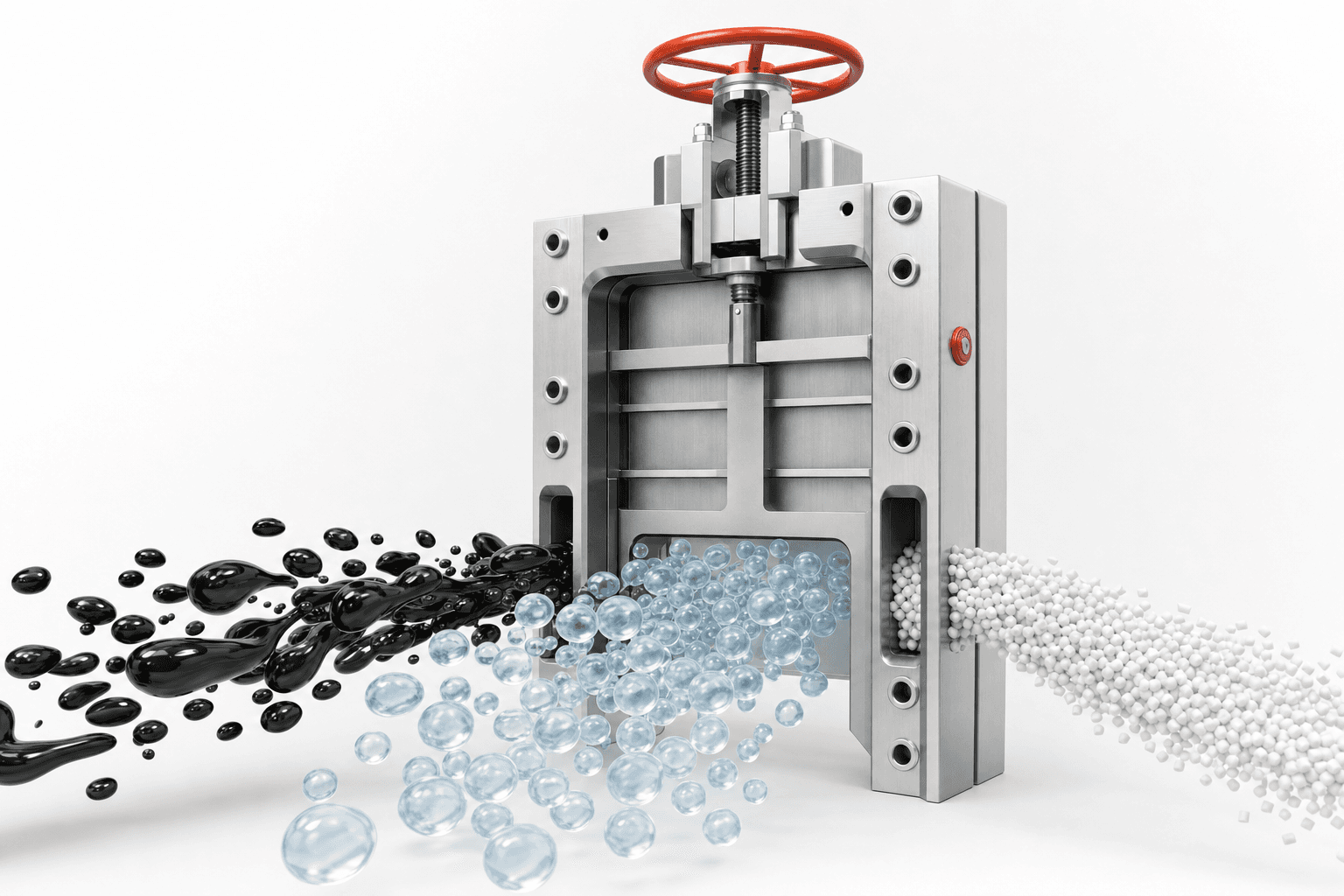
The first Iranian missile that hit Ras Laffan on February 28 did more than bruise a desert port. The strike was a small preview of the drone-and-missile warfare now redefining every battlefield. It knocked out the coolant that keeps the world’s most advanced machines alive. By the time headlines caught up to the oil spike two days later, a second and far stranger crisis was already in motion: semiconductor fabs, MRI suites, and satellite builders were bidding against one another for the same invisible gas.
The Strait of Hormuz carries 20% of global oil, 20% of global LNG, and 30% of globally traded petrochemical feedstocks. But it also carries -- or carried -- roughly one-third of the world’s refined helium, a non-substitutable input for chip manufacturing, medical imaging, and rocket propulsion. We have not seen a single chokepoint take down energy, noble gases, and plastics in one motion since the 1973 embargo.
My colleague George Valcarcel found a thousand-year-old version of this story in the supplier Constantinople turned away.
The uncomfortable truth: the oil shock peaks fast. Helium and plastics tighten slowly and stay tight for years. The calendar says the real shortages have not even arrived yet.
Three Blows from One Waterway
The Iran war did not deliver one disruption. It delivered three, stacked in sequence across February and March 2026.
Blow 1 -- Helium (February 28). Iranian drone strikes hit QatarEnergy’s Ras Laffan Industrial City, home to approximately 30% of global helium production. QatarEnergy declared force majeure on March 2 and halted all production. Follow-up missile strikes on March 18-19 caused what the company called “extensive” structural damage. Repair timeline: 3-5 years. The Ras Laffan closure removed approximately 2.1 billion cubic feet of annual helium capacity from global markets.
Blow 2 -- Oil (February 28). The Strait of Hormuz effectively closed to commercial shipping the same night. Approximately 10.5 million barrels per day of Gulf oil production went offline -- what the IEA called “the largest supply disruption in the history of the global oil market.” Brent crude jumped from roughly $70 pre-war to nearly $120 within days.
Blow 3 -- Petrochemicals and Metals (March-April). Missile strikes on SABIC’s Jubail petrochemical complex in Saudi Arabia -- which produces roughly 70% of global high-purity PPE resin for printed circuit boards -- followed in April. On March 28, Iranian attacks struck both Emirates Global Aluminium’s Al Taweelah smelter in Abu Dhabi and Aluminium Bahrain’s Alba facility, the world’s largest single-site aluminum smelter at 1.6 million tonnes per year. Alba had already declared force majeure on March 4 because it couldn’t ship metal through the closed strait.
Each blow is painful individually. Together, the timing creates a supply chain pile-up with no historical playbook.
The Disruption Arrives in Staggered Waves, on a Predictable Timetable
The disruption is not a single tsunami. It’s a staggered wave, and the timing determines who gets hit and when. Freight data, refinery run-rates, and specialty-gas call logs all point to a predictable cascade.
Week | Physical Event | Market Move | Real-World Impact Window |
|---|---|---|---|
0 (Feb 28) | Hormuz closed; Ras Laffan struck | Brent +$22 in 48 hours; helium spot trades pause | None yet -- ocean cargo still afloat |
2 | Force majeure notices land at customers | Qatar helium offers cease; petrochemical buyers scramble | Week 4: sourcing teams issue emergency RFQs; flat pricing still holds |
4 | First US SPR barrels load out (172M barrel release) | Retail gasoline tops $4/gal | Weeks 6-8: US summer driving season shock |
5 | 200 helium ISO containers marooned near Hormuz | Spot helium doubles (per Kornbluth) | Weeks 7-9: MRI service calls postponed; fabs cut non-critical R&D lots |
6 (Mar 28) | Alba and EGA aluminum smelters physically attacked | LME aluminum +6% intraday; surpasses €3,450/tonne | Weeks 9-12: auto alloy surcharges appear in Q4 contracts |
7 | SABIC Jubail complex offline | PCB resin quotes +40% | Week 10+: contract electronics makers push 3-week lead-time extensions |
9 | First Cape-of-Good-Hope oil tankers arrive | Brent eases to ~$110 | No relief -- added $3.50/bbl freight offset cancels price drop |
11+ | Stockpiled helium at customers runs dry | Contract helium escalators kick in | Samsung and SK Hynix report wafer-start cuts; MRI service disruptions widen |
The oil shock peaks and then plateaus. The helium and specialty-chemical shortages build for months and persist for years.
Helium: The Silent Bottleneck No One Hedged
Oil traders carry playbooks from 1991, 2003, and 2022. Helium buyers do not.
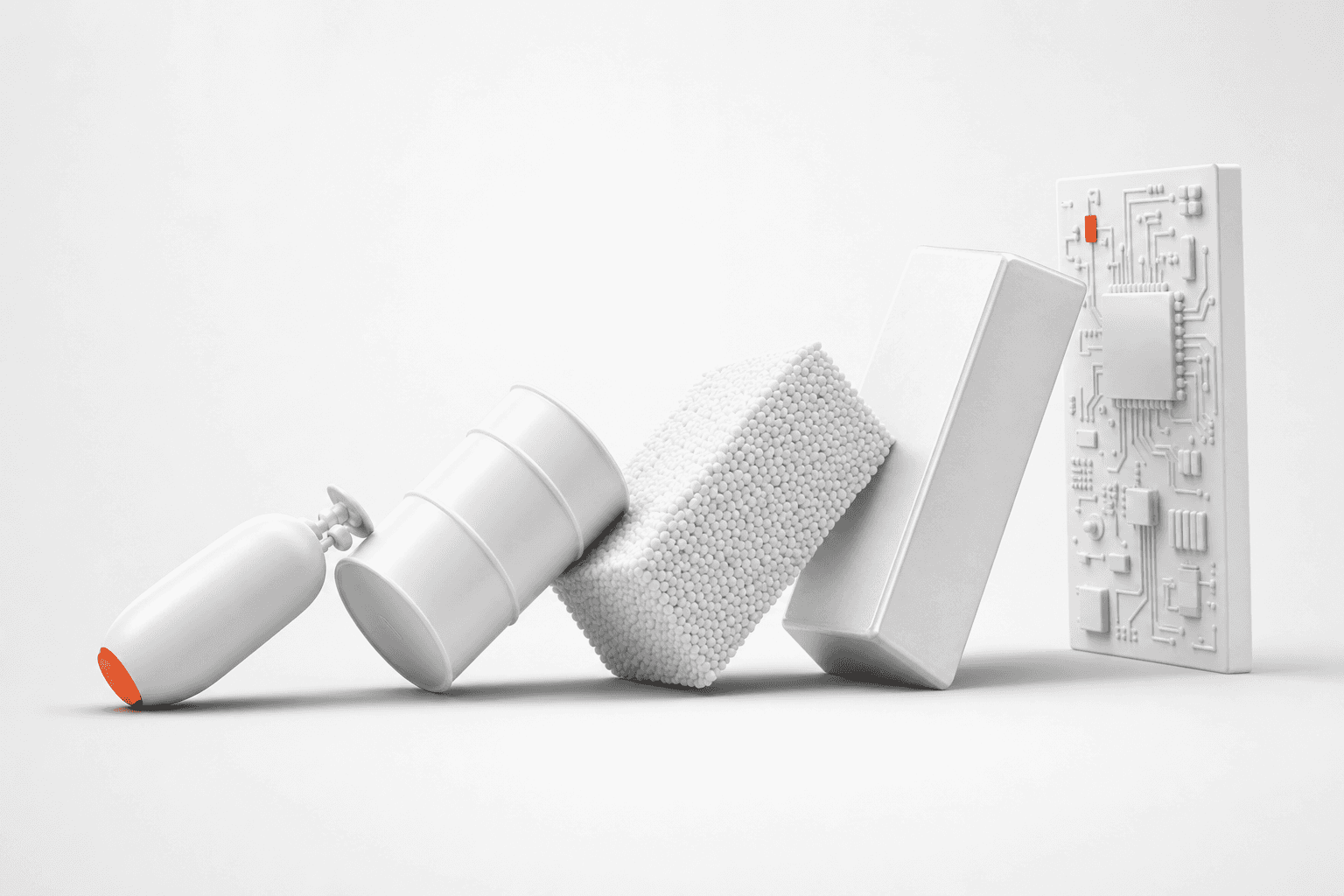
Ras Laffan’s twin helium liquefiers fed roughly 2.2 billion standard cubic feet per year of 5N-plus purity gas into the global market. No other single facility breaks 800 million. The United States still produces approximately 43% of global raw helium -- primarily from ExxonMobil’s LaBarge field in Wyoming -- but U.S. liquid conversion capacity is fully booked by existing contracts. Russia’s Amur Gas Processing Plant was supposed to be the great diversification play, but a 2023 fire delayed Phase 2 commissioning until at least 2027. The defunct U.S. Federal Helium Reserve in Amarillo, Texas auctioned its remaining stockpile in 2024. There is no strategic helium buffer anywhere in the world.
Spot helium prices doubled within two weeks of the disruption, according to Phil Kornbluth, president of Kornbluth Helium Consulting. Contract prices are following. Spot trades represent only about 2% of the market, but they signal where contract renewals are headed.
Why Helium Refuses to Be Substituted
Helium is not party balloons. It’s a non-substitutable input across three sectors that have no workaround:
Semiconductors. Sub-7nm logic nodes use helium as the carrier gas in low-k dielectric CVD and for back-side EUV wafer cooling. EUV lithography machines -- the $200M tools that make leading-edge chips -- use helium for thermal management of both the wafer stage and the laser-produced plasma chamber. Argon or nitrogen introduce plasma variability that kills yield. The affected chip categories span the full stack: every current AI accelerator, advanced DRAM, HBM (high-bandwidth memory for AI training), and leading-node NAND flash. South Korea imports 65% of its helium from Qatar. Fitch Ratings warned this makes Samsung and SK Hynix “particularly vulnerable.” SK Hynix has sent engineers to validate Guangdong Huate Gas’s 6N product in Huizhou, China, but new purification capacity cannot be built before 2027.
Medical imaging. Every 1.5T or 3.0T MRI magnet sits in a roughly 1,500-liter liquid helium bath at 4.2 Kelvin. Weekly top-offs of 10-15 liters prevent quench events that can permanently damage the magnet. Memorial Sloan Kettering’s radiology team reportedly locked in helium at “almost any price” through August but cannot secure supply beyond that. GE HealthCare’s MRI assembly line in Florence, South Carolina idled its cold-head test station for four days in mid-May waiting for a diverted tanker. Zero-boil-off MRI designs exist but still require initial fills and periodic top-ups, and retrofitting legacy magnets is rarely cost-effective.
Space and defense. Liquid rocket stages are purged and pressurized with gaseous helium. A single Falcon 9 flight consumes roughly 900 kg. Pentagon solid-rocket motor plants rely on helium for propellant cast-cure leak tests. Dual-use allocation fights between defense and semiconductor customers are already emerging.
The Helium Angle Nobody’s Talking About: EV Battery Packs
Most auto managers heard “helium” and assumed it was a chip-maker problem. Then their Tier 2 harness suppliers reminded them that every EV battery pack gets helium leak-tested for safety and warranty compliance. Helium’s small atomic size reveals micro-cracks that might let moisture or oxygen enter cells -- failures that risk thermal runaway and warranty claims years into the vehicle’s life.
Switching to hydrogen/argon blends would require new safety protocols, factory ventilation upgrades, and six-month regulatory re-qualification. Battery startups with aggressive SOP dates now face a choice: pay four-figure spot rates for bottled helium or delay launch.
Oil: The $110 Barrel and What Comes Next
Brent crude was trading around $70 per barrel before the war. As of May 19, 2026, it’s above $110. The April 7 ceasefire sent prices crashing 13% in a single day -- Brent briefly touched $95 -- but Iran re-closed the strait in late April and prices rebounded.
The coordinated response has been historic. The IEA organized a release of 400 million barrels from strategic reserves across member nations -- the largest in the agency’s 50-year history, more than double the volume released during the 2022 Ukraine crisis. The United States contributed 172 million barrels from the Strategic Petroleum Reserve, with delivery taking approximately 120 days. U.S. gasoline prices have risen from roughly $2.98 per gallon pre-war to above $4.50 by early May.
But SPR releases are a bridge, not a solution. At the current draw rate, the U.S. reserve hits its statutory minimum of 90 days of net imports by November 2026. Further releases after that require congressional action. The IMF estimates that if oil averages $85 or more this year -- versus the $75 pre-war forecast -- it could shave 0.3-0.4% off world GDP growth.
And then there’s the toll booth. Iran has begun charging what industry agents call “transit contributions” of $2.50-3.00 per barrel equivalent on ships passing through the strait under the fragile ceasefire. Shippers bake that cost into crude differentials and, more dangerously, into LNG and helium container rates. If Washington rejects the arrangement outright, the chaos of February could repeat with even less warning.
The Downstream Cascade
Petrochemicals and Plastics
More than 70% of Asia’s naphtha supply -- the primary feedstock for polyethylene, polypropylene, PVC, and other polymers -- transits the Strait of Hormuz. Asian petrochemical crackers in Singapore, Indonesia, and South Korea have declared force majeure or cut production rates. Market analysts estimate feedstock cost increases of 15-25%.
The SABIC Jubail strike crystallized the second-order risk. That complex produces approximately 70% of global high-purity polyphenylene ether (PPE) resin -- the material used as the base for printed circuit boards. With SABIC unable to deliver, PCB prices have surged up to 40% since March. That ripples into every electronics manufacturer on the planet.
Plastics make up roughly 30% of a modern vehicle by weight -- bumpers, dashboards, connectors, wire insulation, under-hood housings, tanks, seals. But it’s also adhesives, coatings, sealants, and foams that run through every stage of assembly. A Florida toy manufacturer, Aleni Brands, saw resin cost jumps of 10-15% within three weeks. A U.S. adhesive and wound-care company reported chemical input costs spiking approximately 20%.
The “Middle East plus one” concept is emerging -- analogous to the “China plus one” supply chain strategy that accelerated after COVID. But qualifying alternative resin grades takes months. There are no fast switches.
Aluminum
Gulf smelters produce low-carbon aluminum favored by automakers chasing ESG scorecards. Alba’s force majeure and EGA’s physical damage have removed a meaningful chunk of the region’s approximately 2.6 million tonnes of annual production. Aluminum prices jumped 6% on the attack news, surpassing €3,450 per tonne -- a four-year high.
Ford is reportedly negotiating for more Canadian billet at a $150 per tonne premium. That premium hasn’t hit Detroit assembly lines yet -- aluminum body panels sit six months ahead in OEM material planning -- but Q4 contracts will carry the increase. For aluminum-intensive programs -- Ford’s F-150, GM and Stellantis EV battery enclosures, lightweighting programs across the industry -- this is a direct cost hit that’s still propagating through the system.
The Tier 2/3 Blind Spot
OEMs generally know their Tier 1 suppliers. They have much less visibility into which resins, castings, coatings, gases, and metal inputs their Tier 2 and Tier 3 suppliers ultimately depend on from Gulf feedstocks or Gulf logistics. (For a deeper look at how sub-tier dependencies create hidden single points of failure across automotive supply chains, see our analysis of the convergence problem in dual sourcing.)
This is where surprise shortages come from. A Michigan injection molder doesn’t source from Qatar. But their resin supplier does. A Tier 2 electronics assembler doesn’t buy helium directly. But the chip they spec into a motor controller comes from a fab that can’t run without it.
According to Resilinc, more than 11,000 suppliers and 100,000 products could be affected by the Hormuz disruption, with potential revenue exposure approaching $460 billion. Post-COVID lean inventories make the buffer thinner than it was a decade ago.
The Ceasefire Question
Everything described above has a binary branch point: does the ceasefire hold, or doesn’t it?
The April 7 ceasefire was extended indefinitely on April 21 but has been fraying since. Both sides have fired shots in the strait. Trump called the ceasefire on “massive life support” on May 11 after rejecting an Iranian proposal. Iran’s foreign minister Abbas Araghchi said Tehran “cannot trust the Americans at all.” Iran has demanded formal sovereignty over the Strait of Hormuz -- including toll-collecting rights -- which Washington calls a non-starter.
Scenario A: Ceasefire holds, strait reopens by Q3. Oil settles to $85-95 by year-end. Petrochemical and aluminum flows resume within 4-6 weeks of reopening. Helium remains structurally short regardless -- Ras Laffan repairs take 3-5 years independent of geopolitics. Cape-of-Good-Hope oil tankers normalize but add a structural $3.50/bbl freight uplift.
Scenario B: Negotiations collapse. Oil tests $130-150. SPR reserves hit statutory minima by November. Petrochemical rationing intensifies. The semiconductor helium shortage constrains chip output for AI, automotive, and defense applications through 2027.
Scenario C: Frozen conflict. Neither peace nor escalation. This is the most likely near-term outcome and arguably the worst for planning. Iran continues charging transit tolls. Uncertainty persists. Companies can’t commit to either normalization or full contingency. The slow bleed of diverted supply chains extracts margin from every manufacturer in the chain.
What Procurement Leaders Should Be Doing Now
Map sub-tier exposure. The question isn’t “do we source from Iran?” -- it’s “which of our inputs depend on Gulf energy, chemicals, or shipping?” Most companies can’t answer that cleanly today. The companies that can will have a structural advantage in the next 6-12 months. Drag Tier 2 and Tier 3 BOM data into your visibility system now.
Buffer the small stuff. Resins, rubber compounds, coatings, sealants, electronics materials. A missing $2 part stops a $60,000 vehicle. Build targeted safety stock for high-risk, low-cost components before allocation hits.
Dual-source away from Hormuz. Shift marginal volume to North American and European alternatives. The U.S. petrochemical base runs on ethane, not naphtha -- an advantage, but only if alternatives are pre-qualified. Qualification timelines for new resin grades or new suppliers range from weeks to months depending on the category.
Lock in logistics. Even if your suppliers aren’t in the Gulf, routing, insurance, and carrier behavior will break the chain. Cape-of-Good-Hope detours add 2,400 nautical miles per tanker and a structural freight premium that isn’t going away soon.
Run real scenario planning. The companies that navigate this will be operating at the sub-tier level in real time -- mapping dependencies through an AI platform like LightSource or manually with their teams -- not reacting after the force majeure email arrives.
A Forward Look: The Next 30 Months
June 2026: Cape-of-Good-Hope oil tankers normalize but carry a structural $3.50/bbl freight uplift. U.S. gasoline stays above $4/gal through summer.
August 2026: First major fab publicly idles EUV lines to conserve helium -- Samsung’s Hwaseong cluster is the most exposed.
November 2026: U.S. SPR hits statutory minimum at current draw rate. Congressional action required for further releases.
December 2026: MRI OEMs move to 3-month allotment contracts. Smaller hospitals mothball older 1.5T units.
Q1 2027: Automotive battery launches face leak-test gas rationing. Early adopters shift to pressure-decay methods with inferior resolution.
2028-2029: QatarEnergy’s best-case rebuild window. If Ras Laffan liquefiers aren’t back, a structurally tighter helium market rewrites semiconductor capacity planning through 3nm.
The war may end long before this timeline plays out. The supply chain math does not care.
The Iran war is a stress test for every assumption procurement organizations have made about geographic concentration, just-in-time inventory, and supplier visibility. The helium problem won’t resolve with a ceasefire. The oil problem might. And the downstream cascade through petrochemicals, metals, and industrial gases will take 12-18 months to fully unwind even in the best-case scenario. The planning window is now.
Sources
AP News -- Iran War Threatens Global Helium Supply -- Ras Laffan damage, helium price doubling, semiconductor impact, South Korea 65% Qatar dependence
CNBC -- Iran War Threatens Helium Supply -- Overview of helium market disruption
Fortune -- Helium Forecast and Iran War -- Moody’s analysis of $650 billion economic exposure
S&P Global -- QatarEnergy Ras Laffan 3-5 Year Repair -- Repair timeline estimate
IEA via OilPrice.com -- 2026 Oil Deficit Forecast -- 3.9M bpd supply decline, 10.5M bpd offline
CNBC -- SPR Release of 172 Million Barrels -- Largest coordinated reserve release in IEA history
Tom’s Hardware -- Helium Shortage Threatens Chipmaking -- 200 helium containers stranded near Hormuz
PCGamer -- PCB Prices Up 40% -- SABIC Jubail PPE resin disruption
The National -- Alba and EGA Aluminum Facilities Attacked -- Gulf aluminum smelter damage
Fortune -- Iran War Plastic Shortage -- Petrochemical feedstock disruption and “Middle East plus one”
CNN -- Trump Says Ceasefire on ‘Life Support’ -- Ceasefire negotiations status
Dallas Fed -- Strait of Hormuz Economic Impact -- Economic modeling of Hormuz disruption
Z2Data -- Resilinc Supply Chain Impact -- 11,000+ suppliers, $460B exposure
Axios -- US SPR at Three-Decade Low -- Reserve depletion context
Frequently Asked Questions
How long will the helium shortage last?
The helium shortage will persist for years regardless of how the Iran war resolves. QatarEnergy has estimated 3-5 years to repair the damaged Ras Laffan facilities, which produced roughly 30% of global helium supply. The U.S. Federal Helium Reserve in Amarillo auctioned its remaining stockpile in 2024, so there is no strategic buffer. Expect structurally tight helium markets through at least 2029.
How does the helium shortage affect MRI machines and hospitals?
Every MRI scanner with a superconducting magnet -- the vast majority of clinical MRI units -- requires liquid helium to maintain operating temperatures near absolute zero. Without regular helium top-offs, the magnets risk “quenching,” which can cause permanent damage. Hospitals are already competing with semiconductor fabs for limited supply, and smaller facilities may be forced to mothball older MRI units if rationing intensifies.
What is the current price of oil and how has the Iran war affected it?
Brent crude is trading above $110 per barrel as of mid-May 2026, up from approximately $70 before the war -- a roughly 55% increase. The IEA coordinated the largest strategic reserve release in history (400 million barrels) to partially offset the shortage, but the Strait of Hormuz remains effectively closed and physical markets stay tight.
Why are PCB prices up 40% because of the Iran war?
Iranian strikes on SABIC’s Jubail petrochemical complex in Saudi Arabia knocked offline a facility producing approximately 70% of global high-purity polyphenylene ether (PPE) resin. PPE resin is the base material for fiberglass-reinforced printed circuit board laminates. With SABIC unable to deliver, PCB manufacturers have faced severe resin shortages, driving prices up roughly 40% since March 2026. This affects every electronics manufacturer, from consumer devices to automotive control units.
Could the ceasefire resolve the oil and helium crises?
A ceasefire would help oil prices -- the April 7 truce sent Brent down 13% in a single day. But the helium shortage is structural: Ras Laffan’s physical damage requires 3-5 years of repair regardless of geopolitics. Similarly, the SABIC Jubail and Gulf aluminum smelter damage will take months to years to restore. The oil market might normalize within weeks of a strait reopening, but the downstream chemical and helium shortages have their own, much longer timelines.
What should procurement leaders do to protect their supply chains?
Map sub-tier exposure to Gulf energy, chemicals, and shipping immediately. Build targeted safety stock for high-risk, low-cost components. Dual-source away from Hormuz-dependent supply chains, focusing on North American and European alternatives. Lock in logistics capacity before Cape-of-Good-Hope alternative routes get congested. And run scenario planning for ceasefire, escalation, and frozen-conflict outcomes -- the uncertain middle ground is the most likely near-term reality and the hardest to plan for.
The first Iranian missile that hit Ras Laffan on February 28 did more than bruise a desert port. The strike was a small preview of the drone-and-missile warfare now redefining every battlefield. It knocked out the coolant that keeps the world’s most advanced machines alive. By the time headlines caught up to the oil spike two days later, a second and far stranger crisis was already in motion: semiconductor fabs, MRI suites, and satellite builders were bidding against one another for the same invisible gas.
The Strait of Hormuz carries 20% of global oil, 20% of global LNG, and 30% of globally traded petrochemical feedstocks. But it also carries -- or carried -- roughly one-third of the world’s refined helium, a non-substitutable input for chip manufacturing, medical imaging, and rocket propulsion. We have not seen a single chokepoint take down energy, noble gases, and plastics in one motion since the 1973 embargo.
My colleague George Valcarcel found a thousand-year-old version of this story in the supplier Constantinople turned away.
The uncomfortable truth: the oil shock peaks fast. Helium and plastics tighten slowly and stay tight for years. The calendar says the real shortages have not even arrived yet.
Three Blows from One Waterway
The Iran war did not deliver one disruption. It delivered three, stacked in sequence across February and March 2026.
Blow 1 -- Helium (February 28). Iranian drone strikes hit QatarEnergy’s Ras Laffan Industrial City, home to approximately 30% of global helium production. QatarEnergy declared force majeure on March 2 and halted all production. Follow-up missile strikes on March 18-19 caused what the company called “extensive” structural damage. Repair timeline: 3-5 years. The Ras Laffan closure removed approximately 2.1 billion cubic feet of annual helium capacity from global markets.
Blow 2 -- Oil (February 28). The Strait of Hormuz effectively closed to commercial shipping the same night. Approximately 10.5 million barrels per day of Gulf oil production went offline -- what the IEA called “the largest supply disruption in the history of the global oil market.” Brent crude jumped from roughly $70 pre-war to nearly $120 within days.
Blow 3 -- Petrochemicals and Metals (March-April). Missile strikes on SABIC’s Jubail petrochemical complex in Saudi Arabia -- which produces roughly 70% of global high-purity PPE resin for printed circuit boards -- followed in April. On March 28, Iranian attacks struck both Emirates Global Aluminium’s Al Taweelah smelter in Abu Dhabi and Aluminium Bahrain’s Alba facility, the world’s largest single-site aluminum smelter at 1.6 million tonnes per year. Alba had already declared force majeure on March 4 because it couldn’t ship metal through the closed strait.
Each blow is painful individually. Together, the timing creates a supply chain pile-up with no historical playbook.
The Disruption Arrives in Staggered Waves, on a Predictable Timetable
The disruption is not a single tsunami. It’s a staggered wave, and the timing determines who gets hit and when. Freight data, refinery run-rates, and specialty-gas call logs all point to a predictable cascade.
Week | Physical Event | Market Move | Real-World Impact Window |
|---|---|---|---|
0 (Feb 28) | Hormuz closed; Ras Laffan struck | Brent +$22 in 48 hours; helium spot trades pause | None yet -- ocean cargo still afloat |
2 | Force majeure notices land at customers | Qatar helium offers cease; petrochemical buyers scramble | Week 4: sourcing teams issue emergency RFQs; flat pricing still holds |
4 | First US SPR barrels load out (172M barrel release) | Retail gasoline tops $4/gal | Weeks 6-8: US summer driving season shock |
5 | 200 helium ISO containers marooned near Hormuz | Spot helium doubles (per Kornbluth) | Weeks 7-9: MRI service calls postponed; fabs cut non-critical R&D lots |
6 (Mar 28) | Alba and EGA aluminum smelters physically attacked | LME aluminum +6% intraday; surpasses €3,450/tonne | Weeks 9-12: auto alloy surcharges appear in Q4 contracts |
7 | SABIC Jubail complex offline | PCB resin quotes +40% | Week 10+: contract electronics makers push 3-week lead-time extensions |
9 | First Cape-of-Good-Hope oil tankers arrive | Brent eases to ~$110 | No relief -- added $3.50/bbl freight offset cancels price drop |
11+ | Stockpiled helium at customers runs dry | Contract helium escalators kick in | Samsung and SK Hynix report wafer-start cuts; MRI service disruptions widen |
The oil shock peaks and then plateaus. The helium and specialty-chemical shortages build for months and persist for years.
Helium: The Silent Bottleneck No One Hedged
Oil traders carry playbooks from 1991, 2003, and 2022. Helium buyers do not.
Ras Laffan’s twin helium liquefiers fed roughly 2.2 billion standard cubic feet per year of 5N-plus purity gas into the global market. No other single facility breaks 800 million. The United States still produces approximately 43% of global raw helium -- primarily from ExxonMobil’s LaBarge field in Wyoming -- but U.S. liquid conversion capacity is fully booked by existing contracts. Russia’s Amur Gas Processing Plant was supposed to be the great diversification play, but a 2023 fire delayed Phase 2 commissioning until at least 2027. The defunct U.S. Federal Helium Reserve in Amarillo, Texas auctioned its remaining stockpile in 2024. There is no strategic helium buffer anywhere in the world.
Spot helium prices doubled within two weeks of the disruption, according to Phil Kornbluth, president of Kornbluth Helium Consulting. Contract prices are following. Spot trades represent only about 2% of the market, but they signal where contract renewals are headed.
Why Helium Refuses to Be Substituted
Helium is not party balloons. It’s a non-substitutable input across three sectors that have no workaround:
Semiconductors. Sub-7nm logic nodes use helium as the carrier gas in low-k dielectric CVD and for back-side EUV wafer cooling. EUV lithography machines -- the $200M tools that make leading-edge chips -- use helium for thermal management of both the wafer stage and the laser-produced plasma chamber. Argon or nitrogen introduce plasma variability that kills yield. The affected chip categories span the full stack: every current AI accelerator, advanced DRAM, HBM (high-bandwidth memory for AI training), and leading-node NAND flash. South Korea imports 65% of its helium from Qatar. Fitch Ratings warned this makes Samsung and SK Hynix “particularly vulnerable.” SK Hynix has sent engineers to validate Guangdong Huate Gas’s 6N product in Huizhou, China, but new purification capacity cannot be built before 2027.
Medical imaging. Every 1.5T or 3.0T MRI magnet sits in a roughly 1,500-liter liquid helium bath at 4.2 Kelvin. Weekly top-offs of 10-15 liters prevent quench events that can permanently damage the magnet. Memorial Sloan Kettering’s radiology team reportedly locked in helium at “almost any price” through August but cannot secure supply beyond that. GE HealthCare’s MRI assembly line in Florence, South Carolina idled its cold-head test station for four days in mid-May waiting for a diverted tanker. Zero-boil-off MRI designs exist but still require initial fills and periodic top-ups, and retrofitting legacy magnets is rarely cost-effective.
Space and defense. Liquid rocket stages are purged and pressurized with gaseous helium. A single Falcon 9 flight consumes roughly 900 kg. Pentagon solid-rocket motor plants rely on helium for propellant cast-cure leak tests. Dual-use allocation fights between defense and semiconductor customers are already emerging.
The Helium Angle Nobody’s Talking About: EV Battery Packs
Most auto managers heard “helium” and assumed it was a chip-maker problem. Then their Tier 2 harness suppliers reminded them that every EV battery pack gets helium leak-tested for safety and warranty compliance. Helium’s small atomic size reveals micro-cracks that might let moisture or oxygen enter cells -- failures that risk thermal runaway and warranty claims years into the vehicle’s life.
Switching to hydrogen/argon blends would require new safety protocols, factory ventilation upgrades, and six-month regulatory re-qualification. Battery startups with aggressive SOP dates now face a choice: pay four-figure spot rates for bottled helium or delay launch.
Oil: The $110 Barrel and What Comes Next
Brent crude was trading around $70 per barrel before the war. As of May 19, 2026, it’s above $110. The April 7 ceasefire sent prices crashing 13% in a single day -- Brent briefly touched $95 -- but Iran re-closed the strait in late April and prices rebounded.
The coordinated response has been historic. The IEA organized a release of 400 million barrels from strategic reserves across member nations -- the largest in the agency’s 50-year history, more than double the volume released during the 2022 Ukraine crisis. The United States contributed 172 million barrels from the Strategic Petroleum Reserve, with delivery taking approximately 120 days. U.S. gasoline prices have risen from roughly $2.98 per gallon pre-war to above $4.50 by early May.
But SPR releases are a bridge, not a solution. At the current draw rate, the U.S. reserve hits its statutory minimum of 90 days of net imports by November 2026. Further releases after that require congressional action. The IMF estimates that if oil averages $85 or more this year -- versus the $75 pre-war forecast -- it could shave 0.3-0.4% off world GDP growth.
And then there’s the toll booth. Iran has begun charging what industry agents call “transit contributions” of $2.50-3.00 per barrel equivalent on ships passing through the strait under the fragile ceasefire. Shippers bake that cost into crude differentials and, more dangerously, into LNG and helium container rates. If Washington rejects the arrangement outright, the chaos of February could repeat with even less warning.
The Downstream Cascade
Petrochemicals and Plastics
More than 70% of Asia’s naphtha supply -- the primary feedstock for polyethylene, polypropylene, PVC, and other polymers -- transits the Strait of Hormuz. Asian petrochemical crackers in Singapore, Indonesia, and South Korea have declared force majeure or cut production rates. Market analysts estimate feedstock cost increases of 15-25%.
The SABIC Jubail strike crystallized the second-order risk. That complex produces approximately 70% of global high-purity polyphenylene ether (PPE) resin -- the material used as the base for printed circuit boards. With SABIC unable to deliver, PCB prices have surged up to 40% since March. That ripples into every electronics manufacturer on the planet.
Plastics make up roughly 30% of a modern vehicle by weight -- bumpers, dashboards, connectors, wire insulation, under-hood housings, tanks, seals. But it’s also adhesives, coatings, sealants, and foams that run through every stage of assembly. A Florida toy manufacturer, Aleni Brands, saw resin cost jumps of 10-15% within three weeks. A U.S. adhesive and wound-care company reported chemical input costs spiking approximately 20%.
The “Middle East plus one” concept is emerging -- analogous to the “China plus one” supply chain strategy that accelerated after COVID. But qualifying alternative resin grades takes months. There are no fast switches.
Aluminum
Gulf smelters produce low-carbon aluminum favored by automakers chasing ESG scorecards. Alba’s force majeure and EGA’s physical damage have removed a meaningful chunk of the region’s approximately 2.6 million tonnes of annual production. Aluminum prices jumped 6% on the attack news, surpassing €3,450 per tonne -- a four-year high.
Ford is reportedly negotiating for more Canadian billet at a $150 per tonne premium. That premium hasn’t hit Detroit assembly lines yet -- aluminum body panels sit six months ahead in OEM material planning -- but Q4 contracts will carry the increase. For aluminum-intensive programs -- Ford’s F-150, GM and Stellantis EV battery enclosures, lightweighting programs across the industry -- this is a direct cost hit that’s still propagating through the system.
The Tier 2/3 Blind Spot
OEMs generally know their Tier 1 suppliers. They have much less visibility into which resins, castings, coatings, gases, and metal inputs their Tier 2 and Tier 3 suppliers ultimately depend on from Gulf feedstocks or Gulf logistics. (For a deeper look at how sub-tier dependencies create hidden single points of failure across automotive supply chains, see our analysis of the convergence problem in dual sourcing.)
This is where surprise shortages come from. A Michigan injection molder doesn’t source from Qatar. But their resin supplier does. A Tier 2 electronics assembler doesn’t buy helium directly. But the chip they spec into a motor controller comes from a fab that can’t run without it.
According to Resilinc, more than 11,000 suppliers and 100,000 products could be affected by the Hormuz disruption, with potential revenue exposure approaching $460 billion. Post-COVID lean inventories make the buffer thinner than it was a decade ago.
The Ceasefire Question
Everything described above has a binary branch point: does the ceasefire hold, or doesn’t it?
The April 7 ceasefire was extended indefinitely on April 21 but has been fraying since. Both sides have fired shots in the strait. Trump called the ceasefire on “massive life support” on May 11 after rejecting an Iranian proposal. Iran’s foreign minister Abbas Araghchi said Tehran “cannot trust the Americans at all.” Iran has demanded formal sovereignty over the Strait of Hormuz -- including toll-collecting rights -- which Washington calls a non-starter.
Scenario A: Ceasefire holds, strait reopens by Q3. Oil settles to $85-95 by year-end. Petrochemical and aluminum flows resume within 4-6 weeks of reopening. Helium remains structurally short regardless -- Ras Laffan repairs take 3-5 years independent of geopolitics. Cape-of-Good-Hope oil tankers normalize but add a structural $3.50/bbl freight uplift.
Scenario B: Negotiations collapse. Oil tests $130-150. SPR reserves hit statutory minima by November. Petrochemical rationing intensifies. The semiconductor helium shortage constrains chip output for AI, automotive, and defense applications through 2027.
Scenario C: Frozen conflict. Neither peace nor escalation. This is the most likely near-term outcome and arguably the worst for planning. Iran continues charging transit tolls. Uncertainty persists. Companies can’t commit to either normalization or full contingency. The slow bleed of diverted supply chains extracts margin from every manufacturer in the chain.
What Procurement Leaders Should Be Doing Now
Map sub-tier exposure. The question isn’t “do we source from Iran?” -- it’s “which of our inputs depend on Gulf energy, chemicals, or shipping?” Most companies can’t answer that cleanly today. The companies that can will have a structural advantage in the next 6-12 months. Drag Tier 2 and Tier 3 BOM data into your visibility system now.
Buffer the small stuff. Resins, rubber compounds, coatings, sealants, electronics materials. A missing $2 part stops a $60,000 vehicle. Build targeted safety stock for high-risk, low-cost components before allocation hits.
Dual-source away from Hormuz. Shift marginal volume to North American and European alternatives. The U.S. petrochemical base runs on ethane, not naphtha -- an advantage, but only if alternatives are pre-qualified. Qualification timelines for new resin grades or new suppliers range from weeks to months depending on the category.
Lock in logistics. Even if your suppliers aren’t in the Gulf, routing, insurance, and carrier behavior will break the chain. Cape-of-Good-Hope detours add 2,400 nautical miles per tanker and a structural freight premium that isn’t going away soon.
Run real scenario planning. The companies that navigate this will be operating at the sub-tier level in real time -- mapping dependencies through an AI platform like LightSource or manually with their teams -- not reacting after the force majeure email arrives.
A Forward Look: The Next 30 Months
June 2026: Cape-of-Good-Hope oil tankers normalize but carry a structural $3.50/bbl freight uplift. U.S. gasoline stays above $4/gal through summer.
August 2026: First major fab publicly idles EUV lines to conserve helium -- Samsung’s Hwaseong cluster is the most exposed.
November 2026: U.S. SPR hits statutory minimum at current draw rate. Congressional action required for further releases.
December 2026: MRI OEMs move to 3-month allotment contracts. Smaller hospitals mothball older 1.5T units.
Q1 2027: Automotive battery launches face leak-test gas rationing. Early adopters shift to pressure-decay methods with inferior resolution.
2028-2029: QatarEnergy’s best-case rebuild window. If Ras Laffan liquefiers aren’t back, a structurally tighter helium market rewrites semiconductor capacity planning through 3nm.
The war may end long before this timeline plays out. The supply chain math does not care.
The Iran war is a stress test for every assumption procurement organizations have made about geographic concentration, just-in-time inventory, and supplier visibility. The helium problem won’t resolve with a ceasefire. The oil problem might. And the downstream cascade through petrochemicals, metals, and industrial gases will take 12-18 months to fully unwind even in the best-case scenario. The planning window is now.
Sources
AP News -- Iran War Threatens Global Helium Supply -- Ras Laffan damage, helium price doubling, semiconductor impact, South Korea 65% Qatar dependence
CNBC -- Iran War Threatens Helium Supply -- Overview of helium market disruption
Fortune -- Helium Forecast and Iran War -- Moody’s analysis of $650 billion economic exposure
S&P Global -- QatarEnergy Ras Laffan 3-5 Year Repair -- Repair timeline estimate
IEA via OilPrice.com -- 2026 Oil Deficit Forecast -- 3.9M bpd supply decline, 10.5M bpd offline
CNBC -- SPR Release of 172 Million Barrels -- Largest coordinated reserve release in IEA history
Tom’s Hardware -- Helium Shortage Threatens Chipmaking -- 200 helium containers stranded near Hormuz
PCGamer -- PCB Prices Up 40% -- SABIC Jubail PPE resin disruption
The National -- Alba and EGA Aluminum Facilities Attacked -- Gulf aluminum smelter damage
Fortune -- Iran War Plastic Shortage -- Petrochemical feedstock disruption and “Middle East plus one”
CNN -- Trump Says Ceasefire on ‘Life Support’ -- Ceasefire negotiations status
Dallas Fed -- Strait of Hormuz Economic Impact -- Economic modeling of Hormuz disruption
Z2Data -- Resilinc Supply Chain Impact -- 11,000+ suppliers, $460B exposure
Axios -- US SPR at Three-Decade Low -- Reserve depletion context
Frequently Asked Questions
How long will the helium shortage last?
The helium shortage will persist for years regardless of how the Iran war resolves. QatarEnergy has estimated 3-5 years to repair the damaged Ras Laffan facilities, which produced roughly 30% of global helium supply. The U.S. Federal Helium Reserve in Amarillo auctioned its remaining stockpile in 2024, so there is no strategic buffer. Expect structurally tight helium markets through at least 2029.
How does the helium shortage affect MRI machines and hospitals?
Every MRI scanner with a superconducting magnet -- the vast majority of clinical MRI units -- requires liquid helium to maintain operating temperatures near absolute zero. Without regular helium top-offs, the magnets risk “quenching,” which can cause permanent damage. Hospitals are already competing with semiconductor fabs for limited supply, and smaller facilities may be forced to mothball older MRI units if rationing intensifies.
What is the current price of oil and how has the Iran war affected it?
Brent crude is trading above $110 per barrel as of mid-May 2026, up from approximately $70 before the war -- a roughly 55% increase. The IEA coordinated the largest strategic reserve release in history (400 million barrels) to partially offset the shortage, but the Strait of Hormuz remains effectively closed and physical markets stay tight.
Why are PCB prices up 40% because of the Iran war?
Iranian strikes on SABIC’s Jubail petrochemical complex in Saudi Arabia knocked offline a facility producing approximately 70% of global high-purity polyphenylene ether (PPE) resin. PPE resin is the base material for fiberglass-reinforced printed circuit board laminates. With SABIC unable to deliver, PCB manufacturers have faced severe resin shortages, driving prices up roughly 40% since March 2026. This affects every electronics manufacturer, from consumer devices to automotive control units.
Could the ceasefire resolve the oil and helium crises?
A ceasefire would help oil prices -- the April 7 truce sent Brent down 13% in a single day. But the helium shortage is structural: Ras Laffan’s physical damage requires 3-5 years of repair regardless of geopolitics. Similarly, the SABIC Jubail and Gulf aluminum smelter damage will take months to years to restore. The oil market might normalize within weeks of a strait reopening, but the downstream chemical and helium shortages have their own, much longer timelines.
What should procurement leaders do to protect their supply chains?
Map sub-tier exposure to Gulf energy, chemicals, and shipping immediately. Build targeted safety stock for high-risk, low-cost components. Dual-source away from Hormuz-dependent supply chains, focusing on North American and European alternatives. Lock in logistics capacity before Cape-of-Good-Hope alternative routes get congested. And run scenario planning for ceasefire, escalation, and frozen-conflict outcomes -- the uncertain middle ground is the most likely near-term reality and the hardest to plan for.
The first Iranian missile that hit Ras Laffan on February 28 did more than bruise a desert port. The strike was a small preview of the drone-and-missile warfare now redefining every battlefield. It knocked out the coolant that keeps the world’s most advanced machines alive. By the time headlines caught up to the oil spike two days later, a second and far stranger crisis was already in motion: semiconductor fabs, MRI suites, and satellite builders were bidding against one another for the same invisible gas.
The Strait of Hormuz carries 20% of global oil, 20% of global LNG, and 30% of globally traded petrochemical feedstocks. But it also carries -- or carried -- roughly one-third of the world’s refined helium, a non-substitutable input for chip manufacturing, medical imaging, and rocket propulsion. We have not seen a single chokepoint take down energy, noble gases, and plastics in one motion since the 1973 embargo.
My colleague George Valcarcel found a thousand-year-old version of this story in the supplier Constantinople turned away.
The uncomfortable truth: the oil shock peaks fast. Helium and plastics tighten slowly and stay tight for years. The calendar says the real shortages have not even arrived yet.
Three Blows from One Waterway
The Iran war did not deliver one disruption. It delivered three, stacked in sequence across February and March 2026.
Blow 1 -- Helium (February 28). Iranian drone strikes hit QatarEnergy’s Ras Laffan Industrial City, home to approximately 30% of global helium production. QatarEnergy declared force majeure on March 2 and halted all production. Follow-up missile strikes on March 18-19 caused what the company called “extensive” structural damage. Repair timeline: 3-5 years. The Ras Laffan closure removed approximately 2.1 billion cubic feet of annual helium capacity from global markets.
Blow 2 -- Oil (February 28). The Strait of Hormuz effectively closed to commercial shipping the same night. Approximately 10.5 million barrels per day of Gulf oil production went offline -- what the IEA called “the largest supply disruption in the history of the global oil market.” Brent crude jumped from roughly $70 pre-war to nearly $120 within days.
Blow 3 -- Petrochemicals and Metals (March-April). Missile strikes on SABIC’s Jubail petrochemical complex in Saudi Arabia -- which produces roughly 70% of global high-purity PPE resin for printed circuit boards -- followed in April. On March 28, Iranian attacks struck both Emirates Global Aluminium’s Al Taweelah smelter in Abu Dhabi and Aluminium Bahrain’s Alba facility, the world’s largest single-site aluminum smelter at 1.6 million tonnes per year. Alba had already declared force majeure on March 4 because it couldn’t ship metal through the closed strait.
Each blow is painful individually. Together, the timing creates a supply chain pile-up with no historical playbook.
The Disruption Arrives in Staggered Waves, on a Predictable Timetable
The disruption is not a single tsunami. It’s a staggered wave, and the timing determines who gets hit and when. Freight data, refinery run-rates, and specialty-gas call logs all point to a predictable cascade.
Week | Physical Event | Market Move | Real-World Impact Window |
|---|---|---|---|
0 (Feb 28) | Hormuz closed; Ras Laffan struck | Brent +$22 in 48 hours; helium spot trades pause | None yet -- ocean cargo still afloat |
2 | Force majeure notices land at customers | Qatar helium offers cease; petrochemical buyers scramble | Week 4: sourcing teams issue emergency RFQs; flat pricing still holds |
4 | First US SPR barrels load out (172M barrel release) | Retail gasoline tops $4/gal | Weeks 6-8: US summer driving season shock |
5 | 200 helium ISO containers marooned near Hormuz | Spot helium doubles (per Kornbluth) | Weeks 7-9: MRI service calls postponed; fabs cut non-critical R&D lots |
6 (Mar 28) | Alba and EGA aluminum smelters physically attacked | LME aluminum +6% intraday; surpasses €3,450/tonne | Weeks 9-12: auto alloy surcharges appear in Q4 contracts |
7 | SABIC Jubail complex offline | PCB resin quotes +40% | Week 10+: contract electronics makers push 3-week lead-time extensions |
9 | First Cape-of-Good-Hope oil tankers arrive | Brent eases to ~$110 | No relief -- added $3.50/bbl freight offset cancels price drop |
11+ | Stockpiled helium at customers runs dry | Contract helium escalators kick in | Samsung and SK Hynix report wafer-start cuts; MRI service disruptions widen |
The oil shock peaks and then plateaus. The helium and specialty-chemical shortages build for months and persist for years.
Helium: The Silent Bottleneck No One Hedged
Oil traders carry playbooks from 1991, 2003, and 2022. Helium buyers do not.
Ras Laffan’s twin helium liquefiers fed roughly 2.2 billion standard cubic feet per year of 5N-plus purity gas into the global market. No other single facility breaks 800 million. The United States still produces approximately 43% of global raw helium -- primarily from ExxonMobil’s LaBarge field in Wyoming -- but U.S. liquid conversion capacity is fully booked by existing contracts. Russia’s Amur Gas Processing Plant was supposed to be the great diversification play, but a 2023 fire delayed Phase 2 commissioning until at least 2027. The defunct U.S. Federal Helium Reserve in Amarillo, Texas auctioned its remaining stockpile in 2024. There is no strategic helium buffer anywhere in the world.
Spot helium prices doubled within two weeks of the disruption, according to Phil Kornbluth, president of Kornbluth Helium Consulting. Contract prices are following. Spot trades represent only about 2% of the market, but they signal where contract renewals are headed.
Why Helium Refuses to Be Substituted
Helium is not party balloons. It’s a non-substitutable input across three sectors that have no workaround:
Semiconductors. Sub-7nm logic nodes use helium as the carrier gas in low-k dielectric CVD and for back-side EUV wafer cooling. EUV lithography machines -- the $200M tools that make leading-edge chips -- use helium for thermal management of both the wafer stage and the laser-produced plasma chamber. Argon or nitrogen introduce plasma variability that kills yield. The affected chip categories span the full stack: every current AI accelerator, advanced DRAM, HBM (high-bandwidth memory for AI training), and leading-node NAND flash. South Korea imports 65% of its helium from Qatar. Fitch Ratings warned this makes Samsung and SK Hynix “particularly vulnerable.” SK Hynix has sent engineers to validate Guangdong Huate Gas’s 6N product in Huizhou, China, but new purification capacity cannot be built before 2027.
Medical imaging. Every 1.5T or 3.0T MRI magnet sits in a roughly 1,500-liter liquid helium bath at 4.2 Kelvin. Weekly top-offs of 10-15 liters prevent quench events that can permanently damage the magnet. Memorial Sloan Kettering’s radiology team reportedly locked in helium at “almost any price” through August but cannot secure supply beyond that. GE HealthCare’s MRI assembly line in Florence, South Carolina idled its cold-head test station for four days in mid-May waiting for a diverted tanker. Zero-boil-off MRI designs exist but still require initial fills and periodic top-ups, and retrofitting legacy magnets is rarely cost-effective.
Space and defense. Liquid rocket stages are purged and pressurized with gaseous helium. A single Falcon 9 flight consumes roughly 900 kg. Pentagon solid-rocket motor plants rely on helium for propellant cast-cure leak tests. Dual-use allocation fights between defense and semiconductor customers are already emerging.
The Helium Angle Nobody’s Talking About: EV Battery Packs
Most auto managers heard “helium” and assumed it was a chip-maker problem. Then their Tier 2 harness suppliers reminded them that every EV battery pack gets helium leak-tested for safety and warranty compliance. Helium’s small atomic size reveals micro-cracks that might let moisture or oxygen enter cells -- failures that risk thermal runaway and warranty claims years into the vehicle’s life.
Switching to hydrogen/argon blends would require new safety protocols, factory ventilation upgrades, and six-month regulatory re-qualification. Battery startups with aggressive SOP dates now face a choice: pay four-figure spot rates for bottled helium or delay launch.
Oil: The $110 Barrel and What Comes Next
Brent crude was trading around $70 per barrel before the war. As of May 19, 2026, it’s above $110. The April 7 ceasefire sent prices crashing 13% in a single day -- Brent briefly touched $95 -- but Iran re-closed the strait in late April and prices rebounded.
The coordinated response has been historic. The IEA organized a release of 400 million barrels from strategic reserves across member nations -- the largest in the agency’s 50-year history, more than double the volume released during the 2022 Ukraine crisis. The United States contributed 172 million barrels from the Strategic Petroleum Reserve, with delivery taking approximately 120 days. U.S. gasoline prices have risen from roughly $2.98 per gallon pre-war to above $4.50 by early May.
But SPR releases are a bridge, not a solution. At the current draw rate, the U.S. reserve hits its statutory minimum of 90 days of net imports by November 2026. Further releases after that require congressional action. The IMF estimates that if oil averages $85 or more this year -- versus the $75 pre-war forecast -- it could shave 0.3-0.4% off world GDP growth.
And then there’s the toll booth. Iran has begun charging what industry agents call “transit contributions” of $2.50-3.00 per barrel equivalent on ships passing through the strait under the fragile ceasefire. Shippers bake that cost into crude differentials and, more dangerously, into LNG and helium container rates. If Washington rejects the arrangement outright, the chaos of February could repeat with even less warning.
The Downstream Cascade
Petrochemicals and Plastics
More than 70% of Asia’s naphtha supply -- the primary feedstock for polyethylene, polypropylene, PVC, and other polymers -- transits the Strait of Hormuz. Asian petrochemical crackers in Singapore, Indonesia, and South Korea have declared force majeure or cut production rates. Market analysts estimate feedstock cost increases of 15-25%.
The SABIC Jubail strike crystallized the second-order risk. That complex produces approximately 70% of global high-purity polyphenylene ether (PPE) resin -- the material used as the base for printed circuit boards. With SABIC unable to deliver, PCB prices have surged up to 40% since March. That ripples into every electronics manufacturer on the planet.
Plastics make up roughly 30% of a modern vehicle by weight -- bumpers, dashboards, connectors, wire insulation, under-hood housings, tanks, seals. But it’s also adhesives, coatings, sealants, and foams that run through every stage of assembly. A Florida toy manufacturer, Aleni Brands, saw resin cost jumps of 10-15% within three weeks. A U.S. adhesive and wound-care company reported chemical input costs spiking approximately 20%.
The “Middle East plus one” concept is emerging -- analogous to the “China plus one” supply chain strategy that accelerated after COVID. But qualifying alternative resin grades takes months. There are no fast switches.
Aluminum
Gulf smelters produce low-carbon aluminum favored by automakers chasing ESG scorecards. Alba’s force majeure and EGA’s physical damage have removed a meaningful chunk of the region’s approximately 2.6 million tonnes of annual production. Aluminum prices jumped 6% on the attack news, surpassing €3,450 per tonne -- a four-year high.
Ford is reportedly negotiating for more Canadian billet at a $150 per tonne premium. That premium hasn’t hit Detroit assembly lines yet -- aluminum body panels sit six months ahead in OEM material planning -- but Q4 contracts will carry the increase. For aluminum-intensive programs -- Ford’s F-150, GM and Stellantis EV battery enclosures, lightweighting programs across the industry -- this is a direct cost hit that’s still propagating through the system.
The Tier 2/3 Blind Spot
OEMs generally know their Tier 1 suppliers. They have much less visibility into which resins, castings, coatings, gases, and metal inputs their Tier 2 and Tier 3 suppliers ultimately depend on from Gulf feedstocks or Gulf logistics. (For a deeper look at how sub-tier dependencies create hidden single points of failure across automotive supply chains, see our analysis of the convergence problem in dual sourcing.)
This is where surprise shortages come from. A Michigan injection molder doesn’t source from Qatar. But their resin supplier does. A Tier 2 electronics assembler doesn’t buy helium directly. But the chip they spec into a motor controller comes from a fab that can’t run without it.
According to Resilinc, more than 11,000 suppliers and 100,000 products could be affected by the Hormuz disruption, with potential revenue exposure approaching $460 billion. Post-COVID lean inventories make the buffer thinner than it was a decade ago.
The Ceasefire Question
Everything described above has a binary branch point: does the ceasefire hold, or doesn’t it?
The April 7 ceasefire was extended indefinitely on April 21 but has been fraying since. Both sides have fired shots in the strait. Trump called the ceasefire on “massive life support” on May 11 after rejecting an Iranian proposal. Iran’s foreign minister Abbas Araghchi said Tehran “cannot trust the Americans at all.” Iran has demanded formal sovereignty over the Strait of Hormuz -- including toll-collecting rights -- which Washington calls a non-starter.
Scenario A: Ceasefire holds, strait reopens by Q3. Oil settles to $85-95 by year-end. Petrochemical and aluminum flows resume within 4-6 weeks of reopening. Helium remains structurally short regardless -- Ras Laffan repairs take 3-5 years independent of geopolitics. Cape-of-Good-Hope oil tankers normalize but add a structural $3.50/bbl freight uplift.
Scenario B: Negotiations collapse. Oil tests $130-150. SPR reserves hit statutory minima by November. Petrochemical rationing intensifies. The semiconductor helium shortage constrains chip output for AI, automotive, and defense applications through 2027.
Scenario C: Frozen conflict. Neither peace nor escalation. This is the most likely near-term outcome and arguably the worst for planning. Iran continues charging transit tolls. Uncertainty persists. Companies can’t commit to either normalization or full contingency. The slow bleed of diverted supply chains extracts margin from every manufacturer in the chain.
What Procurement Leaders Should Be Doing Now
Map sub-tier exposure. The question isn’t “do we source from Iran?” -- it’s “which of our inputs depend on Gulf energy, chemicals, or shipping?” Most companies can’t answer that cleanly today. The companies that can will have a structural advantage in the next 6-12 months. Drag Tier 2 and Tier 3 BOM data into your visibility system now.
Buffer the small stuff. Resins, rubber compounds, coatings, sealants, electronics materials. A missing $2 part stops a $60,000 vehicle. Build targeted safety stock for high-risk, low-cost components before allocation hits.
Dual-source away from Hormuz. Shift marginal volume to North American and European alternatives. The U.S. petrochemical base runs on ethane, not naphtha -- an advantage, but only if alternatives are pre-qualified. Qualification timelines for new resin grades or new suppliers range from weeks to months depending on the category.
Lock in logistics. Even if your suppliers aren’t in the Gulf, routing, insurance, and carrier behavior will break the chain. Cape-of-Good-Hope detours add 2,400 nautical miles per tanker and a structural freight premium that isn’t going away soon.
Run real scenario planning. The companies that navigate this will be operating at the sub-tier level in real time -- mapping dependencies through an AI platform like LightSource or manually with their teams -- not reacting after the force majeure email arrives.
A Forward Look: The Next 30 Months
June 2026: Cape-of-Good-Hope oil tankers normalize but carry a structural $3.50/bbl freight uplift. U.S. gasoline stays above $4/gal through summer.
August 2026: First major fab publicly idles EUV lines to conserve helium -- Samsung’s Hwaseong cluster is the most exposed.
November 2026: U.S. SPR hits statutory minimum at current draw rate. Congressional action required for further releases.
December 2026: MRI OEMs move to 3-month allotment contracts. Smaller hospitals mothball older 1.5T units.
Q1 2027: Automotive battery launches face leak-test gas rationing. Early adopters shift to pressure-decay methods with inferior resolution.
2028-2029: QatarEnergy’s best-case rebuild window. If Ras Laffan liquefiers aren’t back, a structurally tighter helium market rewrites semiconductor capacity planning through 3nm.
The war may end long before this timeline plays out. The supply chain math does not care.
The Iran war is a stress test for every assumption procurement organizations have made about geographic concentration, just-in-time inventory, and supplier visibility. The helium problem won’t resolve with a ceasefire. The oil problem might. And the downstream cascade through petrochemicals, metals, and industrial gases will take 12-18 months to fully unwind even in the best-case scenario. The planning window is now.
Sources
AP News -- Iran War Threatens Global Helium Supply -- Ras Laffan damage, helium price doubling, semiconductor impact, South Korea 65% Qatar dependence
CNBC -- Iran War Threatens Helium Supply -- Overview of helium market disruption
Fortune -- Helium Forecast and Iran War -- Moody’s analysis of $650 billion economic exposure
S&P Global -- QatarEnergy Ras Laffan 3-5 Year Repair -- Repair timeline estimate
IEA via OilPrice.com -- 2026 Oil Deficit Forecast -- 3.9M bpd supply decline, 10.5M bpd offline
CNBC -- SPR Release of 172 Million Barrels -- Largest coordinated reserve release in IEA history
Tom’s Hardware -- Helium Shortage Threatens Chipmaking -- 200 helium containers stranded near Hormuz
PCGamer -- PCB Prices Up 40% -- SABIC Jubail PPE resin disruption
The National -- Alba and EGA Aluminum Facilities Attacked -- Gulf aluminum smelter damage
Fortune -- Iran War Plastic Shortage -- Petrochemical feedstock disruption and “Middle East plus one”
CNN -- Trump Says Ceasefire on ‘Life Support’ -- Ceasefire negotiations status
Dallas Fed -- Strait of Hormuz Economic Impact -- Economic modeling of Hormuz disruption
Z2Data -- Resilinc Supply Chain Impact -- 11,000+ suppliers, $460B exposure
Axios -- US SPR at Three-Decade Low -- Reserve depletion context
Frequently Asked Questions
How long will the helium shortage last?
The helium shortage will persist for years regardless of how the Iran war resolves. QatarEnergy has estimated 3-5 years to repair the damaged Ras Laffan facilities, which produced roughly 30% of global helium supply. The U.S. Federal Helium Reserve in Amarillo auctioned its remaining stockpile in 2024, so there is no strategic buffer. Expect structurally tight helium markets through at least 2029.
How does the helium shortage affect MRI machines and hospitals?
Every MRI scanner with a superconducting magnet -- the vast majority of clinical MRI units -- requires liquid helium to maintain operating temperatures near absolute zero. Without regular helium top-offs, the magnets risk “quenching,” which can cause permanent damage. Hospitals are already competing with semiconductor fabs for limited supply, and smaller facilities may be forced to mothball older MRI units if rationing intensifies.
What is the current price of oil and how has the Iran war affected it?
Brent crude is trading above $110 per barrel as of mid-May 2026, up from approximately $70 before the war -- a roughly 55% increase. The IEA coordinated the largest strategic reserve release in history (400 million barrels) to partially offset the shortage, but the Strait of Hormuz remains effectively closed and physical markets stay tight.
Why are PCB prices up 40% because of the Iran war?
Iranian strikes on SABIC’s Jubail petrochemical complex in Saudi Arabia knocked offline a facility producing approximately 70% of global high-purity polyphenylene ether (PPE) resin. PPE resin is the base material for fiberglass-reinforced printed circuit board laminates. With SABIC unable to deliver, PCB manufacturers have faced severe resin shortages, driving prices up roughly 40% since March 2026. This affects every electronics manufacturer, from consumer devices to automotive control units.
Could the ceasefire resolve the oil and helium crises?
A ceasefire would help oil prices -- the April 7 truce sent Brent down 13% in a single day. But the helium shortage is structural: Ras Laffan’s physical damage requires 3-5 years of repair regardless of geopolitics. Similarly, the SABIC Jubail and Gulf aluminum smelter damage will take months to years to restore. The oil market might normalize within weeks of a strait reopening, but the downstream chemical and helium shortages have their own, much longer timelines.
What should procurement leaders do to protect their supply chains?
Map sub-tier exposure to Gulf energy, chemicals, and shipping immediately. Build targeted safety stock for high-risk, low-cost components. Dual-source away from Hormuz-dependent supply chains, focusing on North American and European alternatives. Lock in logistics capacity before Cape-of-Good-Hope alternative routes get congested. And run scenario planning for ceasefire, escalation, and frozen-conflict outcomes -- the uncertain middle ground is the most likely near-term reality and the hardest to plan for.


Faster sourcing. Lower cost. Less chaos.
See how LightSource connects engineering, procurement, and suppliers in one operating system to help you launch faster at lower cost.
SOC 2
Kearney #1 2024
Gartner Cool Vendor
Procuretech 100
G2 Top Rated
Faster sourcing. Lower cost. Less chaos.
See how LightSource connects engineering, procurement, and suppliers in one operating system to help you launch faster at lower cost.
SOC 2
Kearney #1 2024
Gartner Cool Vendor
Procuretech 100
G2 Top Rated
Faster sourcing. Lower cost. Less chaos.
See how LightSource connects engineering, procurement, and suppliers in one operating system to help you launch faster at lower cost.
SOC 2
Kearney #1 2024
Gartner Cool Vendor
Procuretech 100
G2 Top Rated
Trusted by:
Trusted by:
Trusted by: