

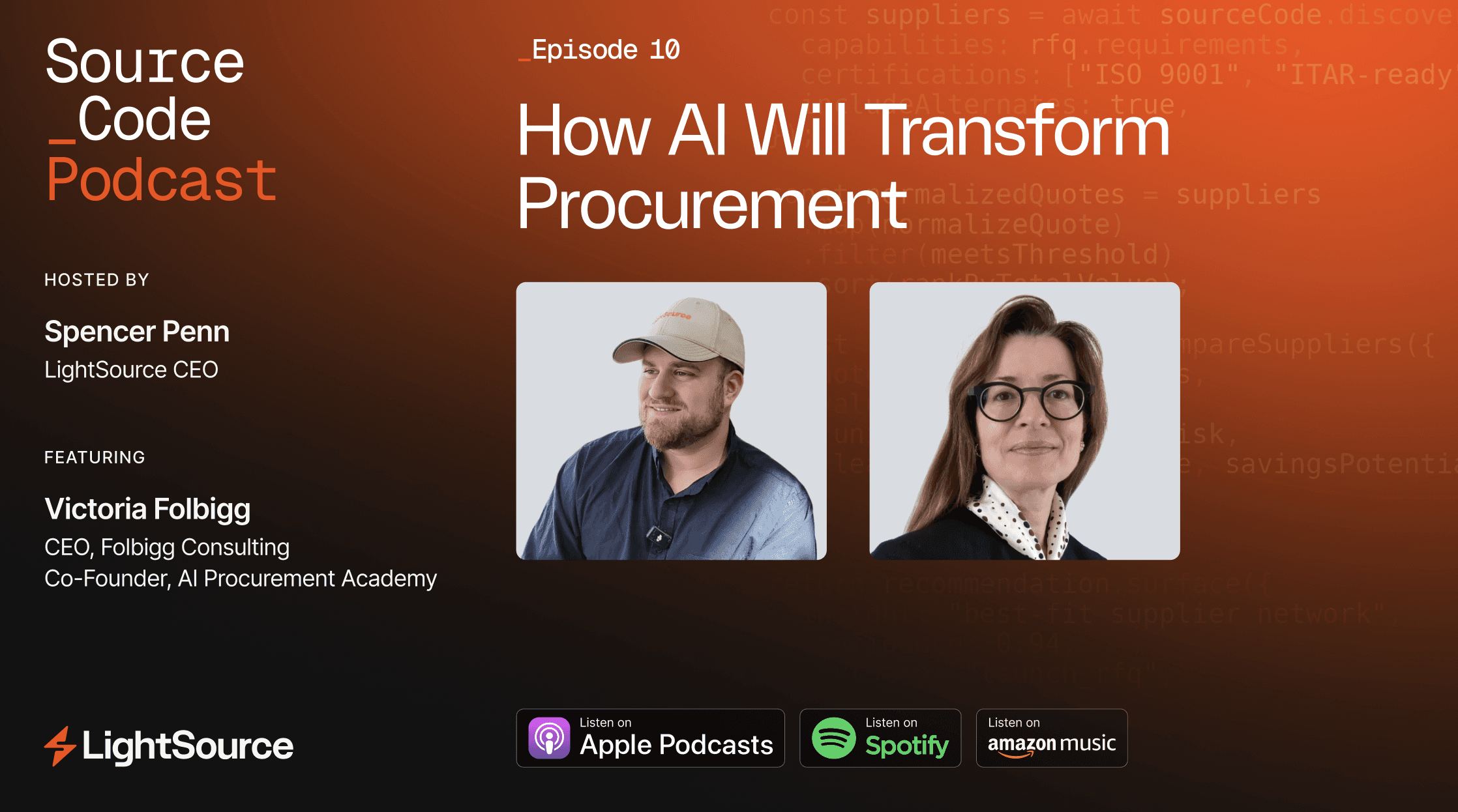
Guest: Victoria Folbigg, CEO of Folbigg Consulting; Co-founder of an AI Procurement Academy
Listen on Spotify | Listen on Apple Podcasts | Listen on Amazon Music
Most conversations about AI in procurement start with the technology and work backward to a use case. Victoria Folbigg starts with a question that tends to stop the room: “What’s your problem? Like, what problem are you trying to solve?” She is genuinely excited about the technology (“I am amazed by the technology,” she tells Spencer), but she is allergic to the reflex of sprinkling AI on everything and calling it a strategy. What she is actually building toward is stranger and more ambitious than another efficiency play: a procurement function that behaves less like a cost-cutting back office and more like a marketing department, one that profiles its own stakeholders with behavioral-science rigor and designs hyper-personalized ways for them to buy. “I think procurement that survives is going to be hyper-personalized,” she says. It’s a thesis born from three decades in the procurement universe and a healthy suspicion of anyone selling certainty about where the technology goes next.
Guest: Victoria Folbigg, CEO of Folbigg Consulting; Co-founder of an AI Procurement Academy
Over 28 years, Folbigg has moved through Procter & Gamble, Barclays, SAP Ariba, and more than a decade based in Singapore, spanning category management, systems implementation across dozens of countries, and executive education. She now runs Folbigg Consulting, curates executive forums and roundtables for procurement leaders, and has co-founded an AI Procurement Academy aimed at the individual practitioner rather than the enterprise. In this episode, she and Spencer trace a long arc: from buying seaweed and luxury packaging in a pre-internet world, through the noise and confusion of today’s AI training market, to a provocative vision of what procurement teams will need to look like to stay relevant.
How Victoria Accidentally Built a Career in Procurement
Folbigg didn’t set out to work in procurement; she backed into it, twice. After a business studies degree with languages in London, she discovered the hard way that the good graduate programs required applications a year in advance. “I came from a different country. I didn’t know the rules. Nobody was really there to guide me that much.” The boutique consulting gigs she landed weren’t enough. “I just can’t, because I needed a bigger work environment. I needed more stimulation.” So she went back to her father, “begged that he gives me one more year,” and did a master’s at Oxford designed for people who’d gone straight from university. That reset gave her the runway to apply properly to the graduate programs the second time around.
What pulled her toward procurement specifically was almost social. At a graduate fair, Procter & Gamble had recruiters from both finance and procurement, and she simply “enjoyed more speaking to the procurement folk.” At twenty, she says, you’re not evaluating a function; you’re looking for your tribe. Walking into P&G’s health and beauty care division outside London, surrounded by the perfumes, creams, and makeup pencils the company was making, sealed it: “I want to work here because I want to buy these things.”
Why Procter & Gamble Was the Perfect Place to Start
Nearly three decades later, Folbigg still believes P&G was one of the best places to learn the craft, and the reason is about people, not process. The team had range (“men and women, young and older experienced people”), and it was deliberately European and diverse enough that a newcomer could find a subset to identify with. She’s still in touch with a manager she met 28 years ago, an Irish woman who was a couple of years ahead of her.
Part of that was design. The people P&G sent to graduate events weren’t the directors of procurement; they were “people who are a couple of years older than the grads,” dynamic and sharp, the kind you could click with. “They curated it consciously or subconsciously really, really well.” The lesson embedded in that memory, that talent is drawn by the tribe it can see itself joining, reads as an early version of the stakeholder-centric thinking she’d later formalize.
The Packaging Lesson Every Brand Should Understand
Some of the most vivid stretches of the conversation are about what procurement looked like before search engines existed. Folbigg bought packaging for the health and beauty division, which meant being flown, sometimes by helicopter from Nice to Monaco, to premium packaging expos that felt less like conferences and more like champagne-soaked palaces. The lavishness was the point: suppliers were selling the promise of a luxury experience.
That taught her something she watched play out for years afterward. When procurement floated cost-saving ideas (strip the paper carton off a cream, or line the box with cheaper recycled paper instead of thick virgin stock), the pushback was immediate. “They want to feel the thick virgin paper. So it was all about experience even there.” She connects the thread straight to the present, pointing at the AirPods case on Spencer’s desk: the gentle, air-cushioned lid that closes without flopping is the same insight P&G was protecting decades ago. “Sometimes these lessons come back again and again,” she says; brands rediscover, or borrow, the same truths about unboxing and experience over and over.
The Biggest Problem With AI Training Today
Folbigg co-founded her AI Procurement Academy with Richard Reynolds, a fellow former CPO she has, tellingly, never met face to face, a fact she offers as a small illustration of how the internet has scrambled the old assumptions about how partners find each other. They moved from idea to MVP in roughly twenty weeks, driven by a frustration with the state of AI education for procurement.
The market, as she describes it, is polarized and mostly unhelpful. Consulting firms broadcast “the art of the possible” and promise 50 to 60 percent efficiency gains, while a widely cited MIT figure suggests 95 percent of efforts don’t get the ROI, “so a lot of confusion in the middle.” The training on offer tends toward two unworkable extremes: software-led sessions that steer you to one vendor’s outcome, or high-touch cohorts stuck on four-hour webinars, “just not the reality of most procurement.” Her answer is bite-size, 100 percent online courses you can listen to on a commute, backed by checklists and ebooks for people who learn in different ways. And crucially, they’re built for individuals, not corporations, especially the practitioners in regional hubs who get overlooked: “Maybe something amazing is happening at the headquarters, but the regional guys still don’t know what’s happening.”
The AI Mistakes Most People Still Make
The academy’s starting point isn’t the art of the possible; it’s demystification. “What I like to do is I like to actually say, but how do I do it? Answer the question: what does that mean for me? What should I do? What shouldn’t I do?” That means teaching prompting, but also teaching the character of the tools. ChatGPT is agreeable, she warns, so “if you put a certain question in with a small bias, it’ll reflect it back to you.” Different models are good at different jobs. And the confidentiality basics still trip people up constantly: “It’s amazing how often we still need to say, please don’t put supplier names in there. Please don’t put people’s names in there.”
Her framing is that you’re not working with a piece of tech so much as an augmented colleague: brilliant, fast, and fully capable of hallucinating. The skill is knowing how to minimize the hallucinations and where the human still has to stay in the loop.
Why AI Should Never Be the Starting Point
For all her enthusiasm, Folbigg reserves real irritation for “a certain type of either procurement or tech professionals who put AI on everything.” She’s tech-literate enough to name the alternative: “If robotic process automation is an answer, just for heaven’s sake, do that. RPA is really good for moving from one system to another system. Don’t say everything has to have AI sprinkled on top of it.”
Her sharpest scene is secondhand, from an industry conference: people wandering around because “my CEO said, or my CPO said, where are my AI projects?” Her response is the line that could serve as the episode’s thesis. “What’s your problem? What problem are you trying to solve? Let’s solve some cool problems here that we probably didn’t manage to solve because of scale, because of all the data that wasn’t read properly, or the insights that we couldn’t produce.” Spencer recognizes the pattern from the vendor side of the table: prospects arriving with “we want AI,” and when he asks what they want to achieve, “it’s like crickets, blank stares.” He reaches for the Henry Ford line (ask people what they want and they’ll say a faster horse) and lands on a rule he gives his own team: listen intently to customers’ problems, but ignore their ideas about the technology, because people ask for variants of what they’ve already seen.
How the EU AI Act Will Change Procurement
Folbigg brings a distinctly European vantage point that most procurement-AI conversations skip. Fresh off running a face-to-face executive forum in Amsterdam, she flags the EU AI Act as something that “is going to change the way Europe consumes AI,” and therefore something procurement has to reckon with on two fronts. One is the procurement systems themselves. The other is commercial: “How do you negotiate with a company that has AI? And how do you ask the right questions of the companies that have AI within their products and services?”
The wrinkle she highlights is that “hyper-personalized” AI can be exactly the kind of thing the regulation treats as high risk. Applicant tracking systems that profile candidates, for instance, may have to justify how they hold data, what their algorithms do, and why. “There’s a lot of stuff happening that procurement doesn’t have time to necessarily think about and distill,” she says, which is precisely the gap she wants her academy and her advisory work to fill. Her posture throughout is neither skeptic nor evangelist: “I am amazed by the technology, but I’m also not blindly jumping in because everybody is jumping in. I’m trying to figure out where the best use cases are.”
Where AI Already Earns Its Keep
Pushed on where AI genuinely helps procurement today, Folbigg gets specific and unromantic. Drafting supplier emails is the easy, table-stakes level: “ChatGPT can write emails better than I can.” The real value is in research and analysis over the data you already own. Feed a model your contract templates and the supplier’s paper and ask how it de-risks or exposes you, and “it’ll have an answer faster than you will, or any paralegal or legal. Is the answer 100 percent correct? No. Is that another opinion you can spar with? Totally, yes.” She sees large opportunities in contract lifecycle management, and in using AI as a plain-language query layer over robust data: “Show me my biggest supplier. Show me my biggest risk. Show me where I have the most late payments,” questions that used to require an analytics team and a development ticket.
But she’s equally precise about where it fails. AI-augmented ESG screening tools have handed her piles of false positives, flagging suppliers because a name appeared somewhere it shouldn’t have. For high-risk decisions built on scraped data, she won’t outsource judgment: “It still doesn’t understand language. It still doesn’t understand behavior to the level that we need.” She’s especially worried about small businesses and social enterprises with weak digital footprints, which a scrape-only, no-human-in-the-loop process quietly disadvantages. Even her enthusiasm for cataloging is contrarian: the point isn’t to let AI find things on the open web, it’s to steer buyers to the internal catalog first and enable zero-touch invoicing off clean base data. “AI is good or AI is bad is so last century. We need to be really specific about what it does.”
Why Hyper-Personalization Is Procurement’s Future
This is where Folbigg’s thinking gets most original. The teams that crack the next era, she argues, “will be using AI the way marketing and behavioral scientists use AI, but on their own stakeholders.” She’s working through a concept she calls the procurement influence engine, and the mandate is blunt: gather data “like the world depends on it.” Compliant and non-compliant suppliers, spend patterns by year and department and individual, budgets, KPIs, what a department’s intranet claims it does versus what its spend data proves it actually does.
The goal is to build a “spend cube” of each stakeholder the way a marketer builds a picture of a consumer, then design procurement strategies around real behavior rather than stated intent: “what they actually say and what they do, and I decipher.” Spencer pushes on the old objection that this requires pristine data, and Folbigg partly concedes the ground has shifted: the “garbage in, garbage out” era is ending because models tolerate messy language and can roll up a vendor’s five spellings into one clean report. But she holds the line where it counts: clean, catalogued base data still matters most for the high-stakes, hyper-focused use cases, not the casual ones.
The Teams Future CPOs Will Actually Build
Ask Folbigg whether AI augments or replaces procurement and she refuses the binary, then answers it anyway. Headcount may shrink, and roles will move: smaller category teams, bigger data-science and analytics teams. But wholesale replacement only happens under one condition: “You can replace people 100 percent if the role is SOP-based. If you write everything down and do everything by a process step, then totally, procurement can be replaced.” Anything reducible to standard operating procedures and supplier-selection codes, she concedes, “AI can do at scale and better than we do.”
Her challenge to the field is to become the opposite of that. The team of the future isn’t just “deep commercial experts”; it needs people who genuinely understand LLMs well enough to keep them from going rogue, and, the part she’s most excited about, psychologists and behavioral scientists. “At the end of the day, what you want to be doing is influencing your internal stakeholders to buy in the way that mostly benefits the organization.” She invokes the hostage-negotiator Chris Voss as the model: negotiation as applied psychology. If she were starting her CPO career over, she says, she’d master the pain points of her top three spend categories and unify them under “a shiny general workflow management layer,” because every department behaves differently and needs to be understood differently.
The Line That Decides It
The through-line of the conversation is a refusal to let AI be a slogan. Folbigg is thrilled by the technology and clear-eyed about its limits in the same breath, and the discipline she keeps returning to is the one she’d impose on any excited team: name the problem first. Solve for scale, for insight, for the data you couldn’t read before, not for the appearance of being modern. And then take the harder step of reinventing procurement as a genuinely commercial, human-centered function, because the alternative is to be automated away.
It’s not a tidy takeaway, which is probably why it’s the right one. Understand the technology deeply enough to know when not to use it. Gather data like it matters. Learn to influence people the way marketers do. And if your job can be fully written down as a set of steps, assume that’s exactly the part machines will take first, so make sure it isn’t the whole job. “If we are up for it as procurement,” she says, “we’re going to thrive. We’re going to be a commercial function.” The teams that get there won’t be the ones that adopted AI fastest. They’ll be the ones that figured out, stakeholder by stakeholder, what they were actually trying to solve.
Guest: Victoria Folbigg, CEO of Folbigg Consulting; Co-founder of an AI Procurement Academy
Listen on Spotify | Listen on Apple Podcasts | Listen on Amazon Music
Most conversations about AI in procurement start with the technology and work backward to a use case. Victoria Folbigg starts with a question that tends to stop the room: “What’s your problem? Like, what problem are you trying to solve?” She is genuinely excited about the technology (“I am amazed by the technology,” she tells Spencer), but she is allergic to the reflex of sprinkling AI on everything and calling it a strategy. What she is actually building toward is stranger and more ambitious than another efficiency play: a procurement function that behaves less like a cost-cutting back office and more like a marketing department, one that profiles its own stakeholders with behavioral-science rigor and designs hyper-personalized ways for them to buy. “I think procurement that survives is going to be hyper-personalized,” she says. It’s a thesis born from three decades in the procurement universe and a healthy suspicion of anyone selling certainty about where the technology goes next.
Guest: Victoria Folbigg, CEO of Folbigg Consulting; Co-founder of an AI Procurement Academy
Over 28 years, Folbigg has moved through Procter & Gamble, Barclays, SAP Ariba, and more than a decade based in Singapore, spanning category management, systems implementation across dozens of countries, and executive education. She now runs Folbigg Consulting, curates executive forums and roundtables for procurement leaders, and has co-founded an AI Procurement Academy aimed at the individual practitioner rather than the enterprise. In this episode, she and Spencer trace a long arc: from buying seaweed and luxury packaging in a pre-internet world, through the noise and confusion of today’s AI training market, to a provocative vision of what procurement teams will need to look like to stay relevant.
How Victoria Accidentally Built a Career in Procurement
Folbigg didn’t set out to work in procurement; she backed into it, twice. After a business studies degree with languages in London, she discovered the hard way that the good graduate programs required applications a year in advance. “I came from a different country. I didn’t know the rules. Nobody was really there to guide me that much.” The boutique consulting gigs she landed weren’t enough. “I just can’t, because I needed a bigger work environment. I needed more stimulation.” So she went back to her father, “begged that he gives me one more year,” and did a master’s at Oxford designed for people who’d gone straight from university. That reset gave her the runway to apply properly to the graduate programs the second time around.
What pulled her toward procurement specifically was almost social. At a graduate fair, Procter & Gamble had recruiters from both finance and procurement, and she simply “enjoyed more speaking to the procurement folk.” At twenty, she says, you’re not evaluating a function; you’re looking for your tribe. Walking into P&G’s health and beauty care division outside London, surrounded by the perfumes, creams, and makeup pencils the company was making, sealed it: “I want to work here because I want to buy these things.”
Why Procter & Gamble Was the Perfect Place to Start
Nearly three decades later, Folbigg still believes P&G was one of the best places to learn the craft, and the reason is about people, not process. The team had range (“men and women, young and older experienced people”), and it was deliberately European and diverse enough that a newcomer could find a subset to identify with. She’s still in touch with a manager she met 28 years ago, an Irish woman who was a couple of years ahead of her.
Part of that was design. The people P&G sent to graduate events weren’t the directors of procurement; they were “people who are a couple of years older than the grads,” dynamic and sharp, the kind you could click with. “They curated it consciously or subconsciously really, really well.” The lesson embedded in that memory, that talent is drawn by the tribe it can see itself joining, reads as an early version of the stakeholder-centric thinking she’d later formalize.
The Packaging Lesson Every Brand Should Understand
Some of the most vivid stretches of the conversation are about what procurement looked like before search engines existed. Folbigg bought packaging for the health and beauty division, which meant being flown, sometimes by helicopter from Nice to Monaco, to premium packaging expos that felt less like conferences and more like champagne-soaked palaces. The lavishness was the point: suppliers were selling the promise of a luxury experience.
That taught her something she watched play out for years afterward. When procurement floated cost-saving ideas (strip the paper carton off a cream, or line the box with cheaper recycled paper instead of thick virgin stock), the pushback was immediate. “They want to feel the thick virgin paper. So it was all about experience even there.” She connects the thread straight to the present, pointing at the AirPods case on Spencer’s desk: the gentle, air-cushioned lid that closes without flopping is the same insight P&G was protecting decades ago. “Sometimes these lessons come back again and again,” she says; brands rediscover, or borrow, the same truths about unboxing and experience over and over.
The Biggest Problem With AI Training Today
Folbigg co-founded her AI Procurement Academy with Richard Reynolds, a fellow former CPO she has, tellingly, never met face to face, a fact she offers as a small illustration of how the internet has scrambled the old assumptions about how partners find each other. They moved from idea to MVP in roughly twenty weeks, driven by a frustration with the state of AI education for procurement.
The market, as she describes it, is polarized and mostly unhelpful. Consulting firms broadcast “the art of the possible” and promise 50 to 60 percent efficiency gains, while a widely cited MIT figure suggests 95 percent of efforts don’t get the ROI, “so a lot of confusion in the middle.” The training on offer tends toward two unworkable extremes: software-led sessions that steer you to one vendor’s outcome, or high-touch cohorts stuck on four-hour webinars, “just not the reality of most procurement.” Her answer is bite-size, 100 percent online courses you can listen to on a commute, backed by checklists and ebooks for people who learn in different ways. And crucially, they’re built for individuals, not corporations, especially the practitioners in regional hubs who get overlooked: “Maybe something amazing is happening at the headquarters, but the regional guys still don’t know what’s happening.”
The AI Mistakes Most People Still Make
The academy’s starting point isn’t the art of the possible; it’s demystification. “What I like to do is I like to actually say, but how do I do it? Answer the question: what does that mean for me? What should I do? What shouldn’t I do?” That means teaching prompting, but also teaching the character of the tools. ChatGPT is agreeable, she warns, so “if you put a certain question in with a small bias, it’ll reflect it back to you.” Different models are good at different jobs. And the confidentiality basics still trip people up constantly: “It’s amazing how often we still need to say, please don’t put supplier names in there. Please don’t put people’s names in there.”
Her framing is that you’re not working with a piece of tech so much as an augmented colleague: brilliant, fast, and fully capable of hallucinating. The skill is knowing how to minimize the hallucinations and where the human still has to stay in the loop.
Why AI Should Never Be the Starting Point
For all her enthusiasm, Folbigg reserves real irritation for “a certain type of either procurement or tech professionals who put AI on everything.” She’s tech-literate enough to name the alternative: “If robotic process automation is an answer, just for heaven’s sake, do that. RPA is really good for moving from one system to another system. Don’t say everything has to have AI sprinkled on top of it.”
Her sharpest scene is secondhand, from an industry conference: people wandering around because “my CEO said, or my CPO said, where are my AI projects?” Her response is the line that could serve as the episode’s thesis. “What’s your problem? What problem are you trying to solve? Let’s solve some cool problems here that we probably didn’t manage to solve because of scale, because of all the data that wasn’t read properly, or the insights that we couldn’t produce.” Spencer recognizes the pattern from the vendor side of the table: prospects arriving with “we want AI,” and when he asks what they want to achieve, “it’s like crickets, blank stares.” He reaches for the Henry Ford line (ask people what they want and they’ll say a faster horse) and lands on a rule he gives his own team: listen intently to customers’ problems, but ignore their ideas about the technology, because people ask for variants of what they’ve already seen.
How the EU AI Act Will Change Procurement
Folbigg brings a distinctly European vantage point that most procurement-AI conversations skip. Fresh off running a face-to-face executive forum in Amsterdam, she flags the EU AI Act as something that “is going to change the way Europe consumes AI,” and therefore something procurement has to reckon with on two fronts. One is the procurement systems themselves. The other is commercial: “How do you negotiate with a company that has AI? And how do you ask the right questions of the companies that have AI within their products and services?”
The wrinkle she highlights is that “hyper-personalized” AI can be exactly the kind of thing the regulation treats as high risk. Applicant tracking systems that profile candidates, for instance, may have to justify how they hold data, what their algorithms do, and why. “There’s a lot of stuff happening that procurement doesn’t have time to necessarily think about and distill,” she says, which is precisely the gap she wants her academy and her advisory work to fill. Her posture throughout is neither skeptic nor evangelist: “I am amazed by the technology, but I’m also not blindly jumping in because everybody is jumping in. I’m trying to figure out where the best use cases are.”
Where AI Already Earns Its Keep
Pushed on where AI genuinely helps procurement today, Folbigg gets specific and unromantic. Drafting supplier emails is the easy, table-stakes level: “ChatGPT can write emails better than I can.” The real value is in research and analysis over the data you already own. Feed a model your contract templates and the supplier’s paper and ask how it de-risks or exposes you, and “it’ll have an answer faster than you will, or any paralegal or legal. Is the answer 100 percent correct? No. Is that another opinion you can spar with? Totally, yes.” She sees large opportunities in contract lifecycle management, and in using AI as a plain-language query layer over robust data: “Show me my biggest supplier. Show me my biggest risk. Show me where I have the most late payments,” questions that used to require an analytics team and a development ticket.
But she’s equally precise about where it fails. AI-augmented ESG screening tools have handed her piles of false positives, flagging suppliers because a name appeared somewhere it shouldn’t have. For high-risk decisions built on scraped data, she won’t outsource judgment: “It still doesn’t understand language. It still doesn’t understand behavior to the level that we need.” She’s especially worried about small businesses and social enterprises with weak digital footprints, which a scrape-only, no-human-in-the-loop process quietly disadvantages. Even her enthusiasm for cataloging is contrarian: the point isn’t to let AI find things on the open web, it’s to steer buyers to the internal catalog first and enable zero-touch invoicing off clean base data. “AI is good or AI is bad is so last century. We need to be really specific about what it does.”
Why Hyper-Personalization Is Procurement’s Future
This is where Folbigg’s thinking gets most original. The teams that crack the next era, she argues, “will be using AI the way marketing and behavioral scientists use AI, but on their own stakeholders.” She’s working through a concept she calls the procurement influence engine, and the mandate is blunt: gather data “like the world depends on it.” Compliant and non-compliant suppliers, spend patterns by year and department and individual, budgets, KPIs, what a department’s intranet claims it does versus what its spend data proves it actually does.
The goal is to build a “spend cube” of each stakeholder the way a marketer builds a picture of a consumer, then design procurement strategies around real behavior rather than stated intent: “what they actually say and what they do, and I decipher.” Spencer pushes on the old objection that this requires pristine data, and Folbigg partly concedes the ground has shifted: the “garbage in, garbage out” era is ending because models tolerate messy language and can roll up a vendor’s five spellings into one clean report. But she holds the line where it counts: clean, catalogued base data still matters most for the high-stakes, hyper-focused use cases, not the casual ones.
The Teams Future CPOs Will Actually Build
Ask Folbigg whether AI augments or replaces procurement and she refuses the binary, then answers it anyway. Headcount may shrink, and roles will move: smaller category teams, bigger data-science and analytics teams. But wholesale replacement only happens under one condition: “You can replace people 100 percent if the role is SOP-based. If you write everything down and do everything by a process step, then totally, procurement can be replaced.” Anything reducible to standard operating procedures and supplier-selection codes, she concedes, “AI can do at scale and better than we do.”
Her challenge to the field is to become the opposite of that. The team of the future isn’t just “deep commercial experts”; it needs people who genuinely understand LLMs well enough to keep them from going rogue, and, the part she’s most excited about, psychologists and behavioral scientists. “At the end of the day, what you want to be doing is influencing your internal stakeholders to buy in the way that mostly benefits the organization.” She invokes the hostage-negotiator Chris Voss as the model: negotiation as applied psychology. If she were starting her CPO career over, she says, she’d master the pain points of her top three spend categories and unify them under “a shiny general workflow management layer,” because every department behaves differently and needs to be understood differently.
The Line That Decides It
The through-line of the conversation is a refusal to let AI be a slogan. Folbigg is thrilled by the technology and clear-eyed about its limits in the same breath, and the discipline she keeps returning to is the one she’d impose on any excited team: name the problem first. Solve for scale, for insight, for the data you couldn’t read before, not for the appearance of being modern. And then take the harder step of reinventing procurement as a genuinely commercial, human-centered function, because the alternative is to be automated away.
It’s not a tidy takeaway, which is probably why it’s the right one. Understand the technology deeply enough to know when not to use it. Gather data like it matters. Learn to influence people the way marketers do. And if your job can be fully written down as a set of steps, assume that’s exactly the part machines will take first, so make sure it isn’t the whole job. “If we are up for it as procurement,” she says, “we’re going to thrive. We’re going to be a commercial function.” The teams that get there won’t be the ones that adopted AI fastest. They’ll be the ones that figured out, stakeholder by stakeholder, what they were actually trying to solve.
Guest: Victoria Folbigg, CEO of Folbigg Consulting; Co-founder of an AI Procurement Academy
Listen on Spotify | Listen on Apple Podcasts | Listen on Amazon Music
Most conversations about AI in procurement start with the technology and work backward to a use case. Victoria Folbigg starts with a question that tends to stop the room: “What’s your problem? Like, what problem are you trying to solve?” She is genuinely excited about the technology (“I am amazed by the technology,” she tells Spencer), but she is allergic to the reflex of sprinkling AI on everything and calling it a strategy. What she is actually building toward is stranger and more ambitious than another efficiency play: a procurement function that behaves less like a cost-cutting back office and more like a marketing department, one that profiles its own stakeholders with behavioral-science rigor and designs hyper-personalized ways for them to buy. “I think procurement that survives is going to be hyper-personalized,” she says. It’s a thesis born from three decades in the procurement universe and a healthy suspicion of anyone selling certainty about where the technology goes next.
Guest: Victoria Folbigg, CEO of Folbigg Consulting; Co-founder of an AI Procurement Academy
Over 28 years, Folbigg has moved through Procter & Gamble, Barclays, SAP Ariba, and more than a decade based in Singapore, spanning category management, systems implementation across dozens of countries, and executive education. She now runs Folbigg Consulting, curates executive forums and roundtables for procurement leaders, and has co-founded an AI Procurement Academy aimed at the individual practitioner rather than the enterprise. In this episode, she and Spencer trace a long arc: from buying seaweed and luxury packaging in a pre-internet world, through the noise and confusion of today’s AI training market, to a provocative vision of what procurement teams will need to look like to stay relevant.
How Victoria Accidentally Built a Career in Procurement
Folbigg didn’t set out to work in procurement; she backed into it, twice. After a business studies degree with languages in London, she discovered the hard way that the good graduate programs required applications a year in advance. “I came from a different country. I didn’t know the rules. Nobody was really there to guide me that much.” The boutique consulting gigs she landed weren’t enough. “I just can’t, because I needed a bigger work environment. I needed more stimulation.” So she went back to her father, “begged that he gives me one more year,” and did a master’s at Oxford designed for people who’d gone straight from university. That reset gave her the runway to apply properly to the graduate programs the second time around.
What pulled her toward procurement specifically was almost social. At a graduate fair, Procter & Gamble had recruiters from both finance and procurement, and she simply “enjoyed more speaking to the procurement folk.” At twenty, she says, you’re not evaluating a function; you’re looking for your tribe. Walking into P&G’s health and beauty care division outside London, surrounded by the perfumes, creams, and makeup pencils the company was making, sealed it: “I want to work here because I want to buy these things.”
Why Procter & Gamble Was the Perfect Place to Start
Nearly three decades later, Folbigg still believes P&G was one of the best places to learn the craft, and the reason is about people, not process. The team had range (“men and women, young and older experienced people”), and it was deliberately European and diverse enough that a newcomer could find a subset to identify with. She’s still in touch with a manager she met 28 years ago, an Irish woman who was a couple of years ahead of her.
Part of that was design. The people P&G sent to graduate events weren’t the directors of procurement; they were “people who are a couple of years older than the grads,” dynamic and sharp, the kind you could click with. “They curated it consciously or subconsciously really, really well.” The lesson embedded in that memory, that talent is drawn by the tribe it can see itself joining, reads as an early version of the stakeholder-centric thinking she’d later formalize.
The Packaging Lesson Every Brand Should Understand
Some of the most vivid stretches of the conversation are about what procurement looked like before search engines existed. Folbigg bought packaging for the health and beauty division, which meant being flown, sometimes by helicopter from Nice to Monaco, to premium packaging expos that felt less like conferences and more like champagne-soaked palaces. The lavishness was the point: suppliers were selling the promise of a luxury experience.
That taught her something she watched play out for years afterward. When procurement floated cost-saving ideas (strip the paper carton off a cream, or line the box with cheaper recycled paper instead of thick virgin stock), the pushback was immediate. “They want to feel the thick virgin paper. So it was all about experience even there.” She connects the thread straight to the present, pointing at the AirPods case on Spencer’s desk: the gentle, air-cushioned lid that closes without flopping is the same insight P&G was protecting decades ago. “Sometimes these lessons come back again and again,” she says; brands rediscover, or borrow, the same truths about unboxing and experience over and over.
The Biggest Problem With AI Training Today
Folbigg co-founded her AI Procurement Academy with Richard Reynolds, a fellow former CPO she has, tellingly, never met face to face, a fact she offers as a small illustration of how the internet has scrambled the old assumptions about how partners find each other. They moved from idea to MVP in roughly twenty weeks, driven by a frustration with the state of AI education for procurement.
The market, as she describes it, is polarized and mostly unhelpful. Consulting firms broadcast “the art of the possible” and promise 50 to 60 percent efficiency gains, while a widely cited MIT figure suggests 95 percent of efforts don’t get the ROI, “so a lot of confusion in the middle.” The training on offer tends toward two unworkable extremes: software-led sessions that steer you to one vendor’s outcome, or high-touch cohorts stuck on four-hour webinars, “just not the reality of most procurement.” Her answer is bite-size, 100 percent online courses you can listen to on a commute, backed by checklists and ebooks for people who learn in different ways. And crucially, they’re built for individuals, not corporations, especially the practitioners in regional hubs who get overlooked: “Maybe something amazing is happening at the headquarters, but the regional guys still don’t know what’s happening.”
The AI Mistakes Most People Still Make
The academy’s starting point isn’t the art of the possible; it’s demystification. “What I like to do is I like to actually say, but how do I do it? Answer the question: what does that mean for me? What should I do? What shouldn’t I do?” That means teaching prompting, but also teaching the character of the tools. ChatGPT is agreeable, she warns, so “if you put a certain question in with a small bias, it’ll reflect it back to you.” Different models are good at different jobs. And the confidentiality basics still trip people up constantly: “It’s amazing how often we still need to say, please don’t put supplier names in there. Please don’t put people’s names in there.”
Her framing is that you’re not working with a piece of tech so much as an augmented colleague: brilliant, fast, and fully capable of hallucinating. The skill is knowing how to minimize the hallucinations and where the human still has to stay in the loop.
Why AI Should Never Be the Starting Point
For all her enthusiasm, Folbigg reserves real irritation for “a certain type of either procurement or tech professionals who put AI on everything.” She’s tech-literate enough to name the alternative: “If robotic process automation is an answer, just for heaven’s sake, do that. RPA is really good for moving from one system to another system. Don’t say everything has to have AI sprinkled on top of it.”
Her sharpest scene is secondhand, from an industry conference: people wandering around because “my CEO said, or my CPO said, where are my AI projects?” Her response is the line that could serve as the episode’s thesis. “What’s your problem? What problem are you trying to solve? Let’s solve some cool problems here that we probably didn’t manage to solve because of scale, because of all the data that wasn’t read properly, or the insights that we couldn’t produce.” Spencer recognizes the pattern from the vendor side of the table: prospects arriving with “we want AI,” and when he asks what they want to achieve, “it’s like crickets, blank stares.” He reaches for the Henry Ford line (ask people what they want and they’ll say a faster horse) and lands on a rule he gives his own team: listen intently to customers’ problems, but ignore their ideas about the technology, because people ask for variants of what they’ve already seen.
How the EU AI Act Will Change Procurement
Folbigg brings a distinctly European vantage point that most procurement-AI conversations skip. Fresh off running a face-to-face executive forum in Amsterdam, she flags the EU AI Act as something that “is going to change the way Europe consumes AI,” and therefore something procurement has to reckon with on two fronts. One is the procurement systems themselves. The other is commercial: “How do you negotiate with a company that has AI? And how do you ask the right questions of the companies that have AI within their products and services?”
The wrinkle she highlights is that “hyper-personalized” AI can be exactly the kind of thing the regulation treats as high risk. Applicant tracking systems that profile candidates, for instance, may have to justify how they hold data, what their algorithms do, and why. “There’s a lot of stuff happening that procurement doesn’t have time to necessarily think about and distill,” she says, which is precisely the gap she wants her academy and her advisory work to fill. Her posture throughout is neither skeptic nor evangelist: “I am amazed by the technology, but I’m also not blindly jumping in because everybody is jumping in. I’m trying to figure out where the best use cases are.”
Where AI Already Earns Its Keep
Pushed on where AI genuinely helps procurement today, Folbigg gets specific and unromantic. Drafting supplier emails is the easy, table-stakes level: “ChatGPT can write emails better than I can.” The real value is in research and analysis over the data you already own. Feed a model your contract templates and the supplier’s paper and ask how it de-risks or exposes you, and “it’ll have an answer faster than you will, or any paralegal or legal. Is the answer 100 percent correct? No. Is that another opinion you can spar with? Totally, yes.” She sees large opportunities in contract lifecycle management, and in using AI as a plain-language query layer over robust data: “Show me my biggest supplier. Show me my biggest risk. Show me where I have the most late payments,” questions that used to require an analytics team and a development ticket.
But she’s equally precise about where it fails. AI-augmented ESG screening tools have handed her piles of false positives, flagging suppliers because a name appeared somewhere it shouldn’t have. For high-risk decisions built on scraped data, she won’t outsource judgment: “It still doesn’t understand language. It still doesn’t understand behavior to the level that we need.” She’s especially worried about small businesses and social enterprises with weak digital footprints, which a scrape-only, no-human-in-the-loop process quietly disadvantages. Even her enthusiasm for cataloging is contrarian: the point isn’t to let AI find things on the open web, it’s to steer buyers to the internal catalog first and enable zero-touch invoicing off clean base data. “AI is good or AI is bad is so last century. We need to be really specific about what it does.”
Why Hyper-Personalization Is Procurement’s Future
This is where Folbigg’s thinking gets most original. The teams that crack the next era, she argues, “will be using AI the way marketing and behavioral scientists use AI, but on their own stakeholders.” She’s working through a concept she calls the procurement influence engine, and the mandate is blunt: gather data “like the world depends on it.” Compliant and non-compliant suppliers, spend patterns by year and department and individual, budgets, KPIs, what a department’s intranet claims it does versus what its spend data proves it actually does.
The goal is to build a “spend cube” of each stakeholder the way a marketer builds a picture of a consumer, then design procurement strategies around real behavior rather than stated intent: “what they actually say and what they do, and I decipher.” Spencer pushes on the old objection that this requires pristine data, and Folbigg partly concedes the ground has shifted: the “garbage in, garbage out” era is ending because models tolerate messy language and can roll up a vendor’s five spellings into one clean report. But she holds the line where it counts: clean, catalogued base data still matters most for the high-stakes, hyper-focused use cases, not the casual ones.
The Teams Future CPOs Will Actually Build
Ask Folbigg whether AI augments or replaces procurement and she refuses the binary, then answers it anyway. Headcount may shrink, and roles will move: smaller category teams, bigger data-science and analytics teams. But wholesale replacement only happens under one condition: “You can replace people 100 percent if the role is SOP-based. If you write everything down and do everything by a process step, then totally, procurement can be replaced.” Anything reducible to standard operating procedures and supplier-selection codes, she concedes, “AI can do at scale and better than we do.”
Her challenge to the field is to become the opposite of that. The team of the future isn’t just “deep commercial experts”; it needs people who genuinely understand LLMs well enough to keep them from going rogue, and, the part she’s most excited about, psychologists and behavioral scientists. “At the end of the day, what you want to be doing is influencing your internal stakeholders to buy in the way that mostly benefits the organization.” She invokes the hostage-negotiator Chris Voss as the model: negotiation as applied psychology. If she were starting her CPO career over, she says, she’d master the pain points of her top three spend categories and unify them under “a shiny general workflow management layer,” because every department behaves differently and needs to be understood differently.
The Line That Decides It
The through-line of the conversation is a refusal to let AI be a slogan. Folbigg is thrilled by the technology and clear-eyed about its limits in the same breath, and the discipline she keeps returning to is the one she’d impose on any excited team: name the problem first. Solve for scale, for insight, for the data you couldn’t read before, not for the appearance of being modern. And then take the harder step of reinventing procurement as a genuinely commercial, human-centered function, because the alternative is to be automated away.
It’s not a tidy takeaway, which is probably why it’s the right one. Understand the technology deeply enough to know when not to use it. Gather data like it matters. Learn to influence people the way marketers do. And if your job can be fully written down as a set of steps, assume that’s exactly the part machines will take first, so make sure it isn’t the whole job. “If we are up for it as procurement,” she says, “we’re going to thrive. We’re going to be a commercial function.” The teams that get there won’t be the ones that adopted AI fastest. They’ll be the ones that figured out, stakeholder by stakeholder, what they were actually trying to solve.
Read more


Read more
Read more
Faster sourcing. Lower cost. Less chaos.
See how LightSource connects engineering, procurement, and suppliers in one operating system to help you launch faster at lower cost.
SOC 2
Kearney #1 2024
Gartner Cool Vendor
Procuretech 100
G2 Top Rated
Faster sourcing. Lower cost. Less chaos.
See how LightSource connects engineering, procurement, and suppliers in one operating system to help you launch faster at lower cost.
SOC 2
Kearney #1 2024
Gartner Cool Vendor
Procuretech 100
G2 Top Rated
Faster sourcing. Lower cost. Less chaos.
See how LightSource connects engineering, procurement, and suppliers in one operating system to help you launch faster at lower cost.
SOC 2
Kearney #1 2024
Gartner Cool Vendor
Procuretech 100
G2 Top Rated
Trusted by:
Trusted by:
Trusted by: