

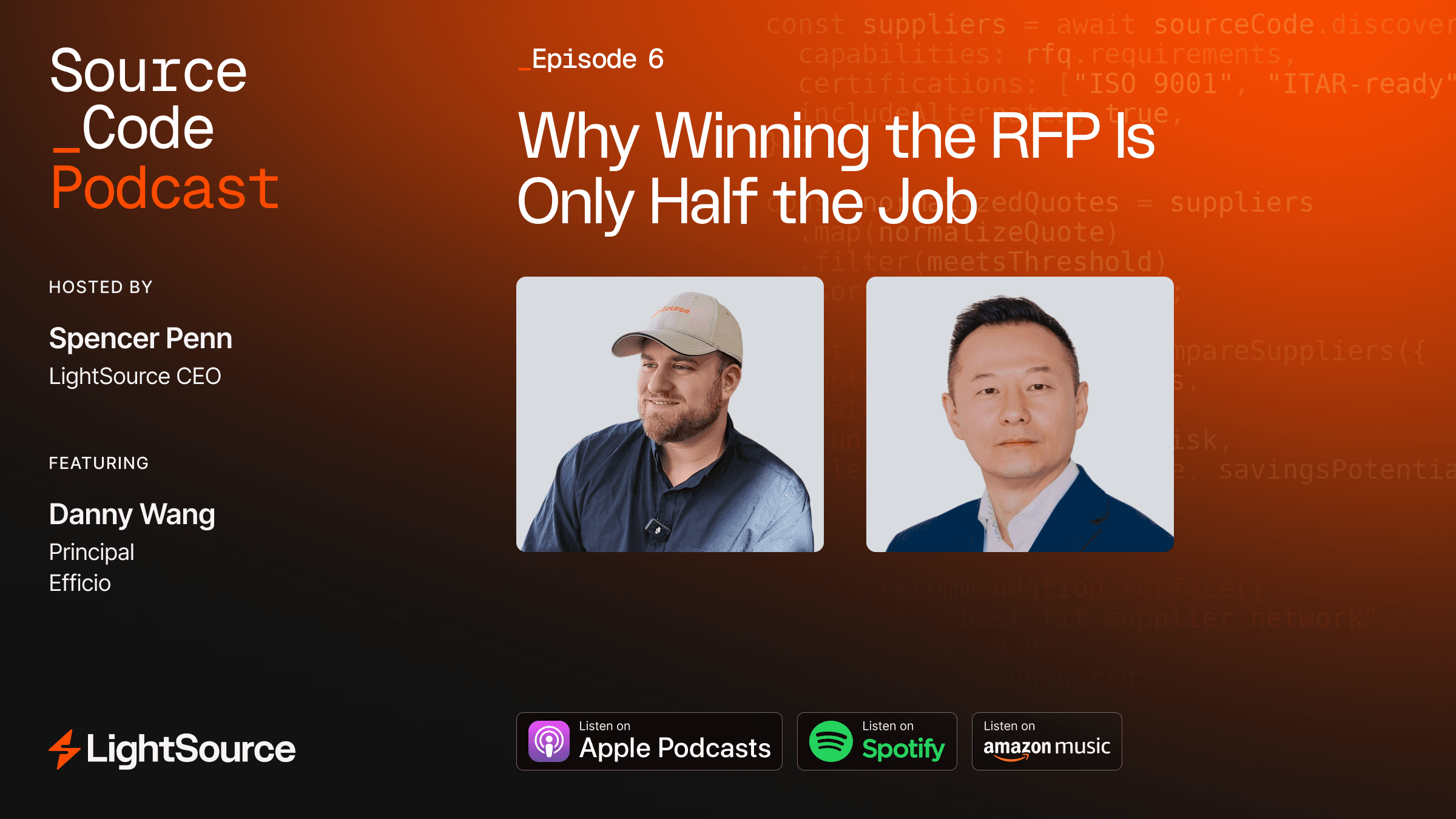
Guest: Danny Wang, Former SVP Sourcing & Procurement, Canada Goose; Director Strategic Sourcing, Walmart; Executive Director, Accor
Listen on Spotify | Listen on Apple Podcasts | Listen on Amazon Music
Most procurement people can name the moment they closed a great deal. Fewer can tell you what happened after, because after is where the job actually gets hard. Danny Wang spent a decade moving between Walmart, Canada Goose, and Accor, and he’s landed on a number for it: in hospitality, strategic sourcing, the RFP, the negotiation, the fantastic proposal, is 40% of the work. The other 60% is convincing every single property to actually sign on.
Danny didn’t study procurement. Almost nobody in his generation of Canadian practitioners did. He started in supplier engineering at a contract manufacturer, built commodity management chops without knowing the acronyms for what he was doing, got an MBA at Ivey to put a name to it, then spent five years at Accenture learning the formal version of a job he’d already been doing informally. From there: Walmart, Canada Goose, Accor, and now Efficio. In this episode, he talks about when to send someone to consulting bootcamp versus industry, why PowerPoint is where consulting engagements go to get bloated, what actually predicts whether a new supplier is any good, and why buyer power looks completely different depending on whether your logo says Walmart or Canada Goose.
You Don’t Study Procurement. You Fall Into It.
Danny’s path started in supplier engineering at a Canadian contract manufacturer doing OEM work. He was hired for the technical side, understanding supplier cost structures, how a supplier moves from new product introduction to full stability, and grew into commodity management almost by accident. The company needed someone who could pair that technical fluency with business judgment, so he built the fundamentals of sourcing without ever taking a class in it.
The MBA came later, not because he needed the knowledge, but because he needed the vocabulary. “You may have done it, but you don’t know how it’s reframed.” Higher education, in his telling, isn’t where you learn procurement. It’s where you learn to talk about what you already know in a way other people find credible.
Consulting Bootcamp or Industry Grind: Where Should a Career Start?
Danny’s view is deliberately not universal. If you’re straight out of school, join a reputable company known for sourcing and procurement first, so you build fundamentals without inheriting bad habits. Consulting comes after, once you already know what pragmatic looks like.
He’s watched the other path play out too: people who came up entirely inside consulting, mastered every template and every framework, and lost sight of the outcome. “I’ve done 90 hours of this work, where if I really understood the outcome of what the client wants, I only need to do probably 20.” That’s the trap. Analysis paralysis dressed up as rigor. His own advantage, he says, came from having implemented things before he ever advised on them: “When you implement something, you can see that not everything works out.” Roughly half of what he planned on paper didn’t survive contact with reality, and that failure rate is the actual education.
The PowerPoint Problem
Ask Danny where consultants over invest and the answer is immediate: the deck. He recalls a partner at Accenture telling him the quiet part out loud, that if you’re not implementing anything, not visiting the factory, the PowerPoint is the only thing the client will remember you by. So consultants pack it. Every finding, every branch of the analysis, every possible next step, because the deliverable has to justify the engagement.
Danny runs the opposite playbook. He uses slides to streamline communication, not to document everything he did. “I don’t care about… it shouldn’t take me more than two minutes to digest a slide.” If a client can’t understand it fast enough to resell it internally to their own boss, the slide has failed at its actual job.
The Filter That Beats a 100-Question RFI
When Canada Goose needed a new supplier, Danny didn’t start with an exhaustive RFI. He started with one question: who else does this supplier work with? If they’re already serving comparable, credible brands with a comparable product portfolio, that’s a stronger signal than almost anything a supplier will volunteer on paper. “If they’re supplying a high caliber customer, they’ll probably be a high caliber supplier.”
The paper trail only gets you to the next stage, though. A supplier can be technically accurate and still misleading, because they might be citing a customer relationship from five years ago. Danny’s actual verification step is blunter: go visit the factory. He’s blunt about why consultants often skip this step too, not because they don’t understand its value, but because their firms won’t fly someone to a plant for a single engagement. It doesn’t fit the fee structure. The best sourcing consultants he’s worked with are the ones from firms disciplined enough to still make that trip pay for itself.
Why ISO Certification Isn’t the Proxy You Think It Is
A lot of buyers treat an ISO 9000 stamp as a stand-in for due diligence. Danny pushes back on that with an analogy: “It’s like an engineering degree. You have 100 engineers. They all have an engineering degree. How would you say that one engineer is better than another?” ISO certifies that a company documents a process. It says nothing about the breadth of what they can do, whether they can handle ten product types or one, or whether they do design work at all.
That doesn’t make certification useless. It’s a bare minimum filter, evidence that a supplier has some paper trail of compliance. But it can’t replace a bespoke audit built around what a specific buyer actually needs, whether that’s quality level, technical depth, or dedicated capacity. No serious company, in his experience, relies on a generic standard alone.
Tier 2, Tier 3, and Why Suppliers Are Suddenly Willing to Talk
Sub-tier transparency used to be the thing suppliers guarded hardest, and Danny has felt that resistance firsthand in industries like automotive, where disclosing a tier two supplier risked a buyer going around them to negotiate directly. Apparel has moved past that friction faster than most sectors, for two reasons that aren’t really about trust: ESG-driven traceability requirements and tariff exposure.
Tariff calculation is the harder-edged of the two. You cannot price landed cost accurately, or claim a duty exception, without knowing exactly where raw materials originate and who adds value at each step. “How do you overcome tariffs? You’re going to have to know exactly the raw materials and where they’re coming from.” The practical answer to how much detail is fair to ask for isn’t unlimited. Danny frames it as a partnership problem: a tier one supplier will share what’s needed for compliance once there’s a long-term relationship and an understanding that the buyer isn’t trying to disintermediate them. Where the volume of documentation would otherwise be unmanageable, third-party certification and automated verification, already standard in food and apparel through organic and recyclable certifications, absorbs the burden instead of pushing it onto either party directly.
Buyer Power Looks Different at Every Logo
Danny’s read on Walmart versus Canada Goose isn’t the one you’d expect. Bigger company doesn’t mean more heavy-handed. It’s the opposite. “When you have the scale and you’re focused on speed and revenue turnover, you become very logical and pragmatic… I find with smaller companies, because they started to become too proudful, they say, I got the bigger hammer.”
Walmart Canada’s legal team, in his account, rarely needed to flex. They didn’t have to. “I’m telling you, I am the market.” Once a company is unambiguously the market, negotiating from ego stops being necessary, because the outcome isn’t in question. It’s the mid-sized, high-equity brands that sometimes over-index on posture, precisely because their leverage is less certain.
The 60% Nobody Puts in the Job Description
This is the number that gives the episode its title. Hospitality brands like Accor are almost entirely asset-light: they manage the flag and the operations, but individual properties are owned by separate entities, big REITs, wealthy individuals, family groups, each with their own preferences. A corporate sourcing deal isn’t self-executing the way it would be at a centrally managed retailer. “40% is your strategic sourcing, where you work with somebody, you come up with a fantastic proposal that’s going to drive a lot of value back to properties. Hospitality, 60% is deployment, or convincing every single property to agree to go on that corporate deal.”
Anything carrying the brand flag can be mandated. Everything else is a negotiation with an owner who may be deeply, personally invested in what their property feels like. Danny’s example: a Michelin-starred chef sourcing Wagyu from Snake River instead of a standardized frozen commodity beef isn’t a compliance failure. It’s the reason the restaurant has a Michelin star. The job isn’t to eliminate that variance. It’s to build a deal flexible enough to survive it, and Danny argues that constraint actually makes hospitality procurement teams sharper: they can’t just win the sourcing exercise, they have to think like the owner and the GM at every property they’re trying to convert.
The One Company He’d Still Love to Study
Asked which procurement organization he respects most and has never worked with, Danny didn’t hesitate: Costco. Bulk pricing explains part of the affordability, but not the consistent access to fresh produce at that price point, and not the fact that Costco is reportedly the largest liquor buyer in the world. It’s the one team he’d genuinely like to sit down with just to understand the mechanics.
Danny’s throughline across three very different employers is the same instinct that shows up in the ISO discussion and the supplier-filter discussion and the 40/60 split: don’t trust the artifact, verify the substance. A certificate, a slide deck, a signed corporate agreement, none of it means anything until someone has actually walked the factory floor or gotten the property owner to say yes.
Guest: Danny Wang, Former SVP Sourcing & Procurement, Canada Goose; Director Strategic Sourcing, Walmart; Executive Director, Accor
Listen on Spotify | Listen on Apple Podcasts | Listen on Amazon Music
Most procurement people can name the moment they closed a great deal. Fewer can tell you what happened after, because after is where the job actually gets hard. Danny Wang spent a decade moving between Walmart, Canada Goose, and Accor, and he’s landed on a number for it: in hospitality, strategic sourcing, the RFP, the negotiation, the fantastic proposal, is 40% of the work. The other 60% is convincing every single property to actually sign on.
Danny didn’t study procurement. Almost nobody in his generation of Canadian practitioners did. He started in supplier engineering at a contract manufacturer, built commodity management chops without knowing the acronyms for what he was doing, got an MBA at Ivey to put a name to it, then spent five years at Accenture learning the formal version of a job he’d already been doing informally. From there: Walmart, Canada Goose, Accor, and now Efficio. In this episode, he talks about when to send someone to consulting bootcamp versus industry, why PowerPoint is where consulting engagements go to get bloated, what actually predicts whether a new supplier is any good, and why buyer power looks completely different depending on whether your logo says Walmart or Canada Goose.
You Don’t Study Procurement. You Fall Into It.
Danny’s path started in supplier engineering at a Canadian contract manufacturer doing OEM work. He was hired for the technical side, understanding supplier cost structures, how a supplier moves from new product introduction to full stability, and grew into commodity management almost by accident. The company needed someone who could pair that technical fluency with business judgment, so he built the fundamentals of sourcing without ever taking a class in it.
The MBA came later, not because he needed the knowledge, but because he needed the vocabulary. “You may have done it, but you don’t know how it’s reframed.” Higher education, in his telling, isn’t where you learn procurement. It’s where you learn to talk about what you already know in a way other people find credible.
Consulting Bootcamp or Industry Grind: Where Should a Career Start?
Danny’s view is deliberately not universal. If you’re straight out of school, join a reputable company known for sourcing and procurement first, so you build fundamentals without inheriting bad habits. Consulting comes after, once you already know what pragmatic looks like.
He’s watched the other path play out too: people who came up entirely inside consulting, mastered every template and every framework, and lost sight of the outcome. “I’ve done 90 hours of this work, where if I really understood the outcome of what the client wants, I only need to do probably 20.” That’s the trap. Analysis paralysis dressed up as rigor. His own advantage, he says, came from having implemented things before he ever advised on them: “When you implement something, you can see that not everything works out.” Roughly half of what he planned on paper didn’t survive contact with reality, and that failure rate is the actual education.
The PowerPoint Problem
Ask Danny where consultants over invest and the answer is immediate: the deck. He recalls a partner at Accenture telling him the quiet part out loud, that if you’re not implementing anything, not visiting the factory, the PowerPoint is the only thing the client will remember you by. So consultants pack it. Every finding, every branch of the analysis, every possible next step, because the deliverable has to justify the engagement.
Danny runs the opposite playbook. He uses slides to streamline communication, not to document everything he did. “I don’t care about… it shouldn’t take me more than two minutes to digest a slide.” If a client can’t understand it fast enough to resell it internally to their own boss, the slide has failed at its actual job.
The Filter That Beats a 100-Question RFI
When Canada Goose needed a new supplier, Danny didn’t start with an exhaustive RFI. He started with one question: who else does this supplier work with? If they’re already serving comparable, credible brands with a comparable product portfolio, that’s a stronger signal than almost anything a supplier will volunteer on paper. “If they’re supplying a high caliber customer, they’ll probably be a high caliber supplier.”
The paper trail only gets you to the next stage, though. A supplier can be technically accurate and still misleading, because they might be citing a customer relationship from five years ago. Danny’s actual verification step is blunter: go visit the factory. He’s blunt about why consultants often skip this step too, not because they don’t understand its value, but because their firms won’t fly someone to a plant for a single engagement. It doesn’t fit the fee structure. The best sourcing consultants he’s worked with are the ones from firms disciplined enough to still make that trip pay for itself.
Why ISO Certification Isn’t the Proxy You Think It Is
A lot of buyers treat an ISO 9000 stamp as a stand-in for due diligence. Danny pushes back on that with an analogy: “It’s like an engineering degree. You have 100 engineers. They all have an engineering degree. How would you say that one engineer is better than another?” ISO certifies that a company documents a process. It says nothing about the breadth of what they can do, whether they can handle ten product types or one, or whether they do design work at all.
That doesn’t make certification useless. It’s a bare minimum filter, evidence that a supplier has some paper trail of compliance. But it can’t replace a bespoke audit built around what a specific buyer actually needs, whether that’s quality level, technical depth, or dedicated capacity. No serious company, in his experience, relies on a generic standard alone.
Tier 2, Tier 3, and Why Suppliers Are Suddenly Willing to Talk
Sub-tier transparency used to be the thing suppliers guarded hardest, and Danny has felt that resistance firsthand in industries like automotive, where disclosing a tier two supplier risked a buyer going around them to negotiate directly. Apparel has moved past that friction faster than most sectors, for two reasons that aren’t really about trust: ESG-driven traceability requirements and tariff exposure.
Tariff calculation is the harder-edged of the two. You cannot price landed cost accurately, or claim a duty exception, without knowing exactly where raw materials originate and who adds value at each step. “How do you overcome tariffs? You’re going to have to know exactly the raw materials and where they’re coming from.” The practical answer to how much detail is fair to ask for isn’t unlimited. Danny frames it as a partnership problem: a tier one supplier will share what’s needed for compliance once there’s a long-term relationship and an understanding that the buyer isn’t trying to disintermediate them. Where the volume of documentation would otherwise be unmanageable, third-party certification and automated verification, already standard in food and apparel through organic and recyclable certifications, absorbs the burden instead of pushing it onto either party directly.
Buyer Power Looks Different at Every Logo
Danny’s read on Walmart versus Canada Goose isn’t the one you’d expect. Bigger company doesn’t mean more heavy-handed. It’s the opposite. “When you have the scale and you’re focused on speed and revenue turnover, you become very logical and pragmatic… I find with smaller companies, because they started to become too proudful, they say, I got the bigger hammer.”
Walmart Canada’s legal team, in his account, rarely needed to flex. They didn’t have to. “I’m telling you, I am the market.” Once a company is unambiguously the market, negotiating from ego stops being necessary, because the outcome isn’t in question. It’s the mid-sized, high-equity brands that sometimes over-index on posture, precisely because their leverage is less certain.
The 60% Nobody Puts in the Job Description
This is the number that gives the episode its title. Hospitality brands like Accor are almost entirely asset-light: they manage the flag and the operations, but individual properties are owned by separate entities, big REITs, wealthy individuals, family groups, each with their own preferences. A corporate sourcing deal isn’t self-executing the way it would be at a centrally managed retailer. “40% is your strategic sourcing, where you work with somebody, you come up with a fantastic proposal that’s going to drive a lot of value back to properties. Hospitality, 60% is deployment, or convincing every single property to agree to go on that corporate deal.”
Anything carrying the brand flag can be mandated. Everything else is a negotiation with an owner who may be deeply, personally invested in what their property feels like. Danny’s example: a Michelin-starred chef sourcing Wagyu from Snake River instead of a standardized frozen commodity beef isn’t a compliance failure. It’s the reason the restaurant has a Michelin star. The job isn’t to eliminate that variance. It’s to build a deal flexible enough to survive it, and Danny argues that constraint actually makes hospitality procurement teams sharper: they can’t just win the sourcing exercise, they have to think like the owner and the GM at every property they’re trying to convert.
The One Company He’d Still Love to Study
Asked which procurement organization he respects most and has never worked with, Danny didn’t hesitate: Costco. Bulk pricing explains part of the affordability, but not the consistent access to fresh produce at that price point, and not the fact that Costco is reportedly the largest liquor buyer in the world. It’s the one team he’d genuinely like to sit down with just to understand the mechanics.
Danny’s throughline across three very different employers is the same instinct that shows up in the ISO discussion and the supplier-filter discussion and the 40/60 split: don’t trust the artifact, verify the substance. A certificate, a slide deck, a signed corporate agreement, none of it means anything until someone has actually walked the factory floor or gotten the property owner to say yes.
Guest: Danny Wang, Former SVP Sourcing & Procurement, Canada Goose; Director Strategic Sourcing, Walmart; Executive Director, Accor
Listen on Spotify | Listen on Apple Podcasts | Listen on Amazon Music
Most procurement people can name the moment they closed a great deal. Fewer can tell you what happened after, because after is where the job actually gets hard. Danny Wang spent a decade moving between Walmart, Canada Goose, and Accor, and he’s landed on a number for it: in hospitality, strategic sourcing, the RFP, the negotiation, the fantastic proposal, is 40% of the work. The other 60% is convincing every single property to actually sign on.
Danny didn’t study procurement. Almost nobody in his generation of Canadian practitioners did. He started in supplier engineering at a contract manufacturer, built commodity management chops without knowing the acronyms for what he was doing, got an MBA at Ivey to put a name to it, then spent five years at Accenture learning the formal version of a job he’d already been doing informally. From there: Walmart, Canada Goose, Accor, and now Efficio. In this episode, he talks about when to send someone to consulting bootcamp versus industry, why PowerPoint is where consulting engagements go to get bloated, what actually predicts whether a new supplier is any good, and why buyer power looks completely different depending on whether your logo says Walmart or Canada Goose.
You Don’t Study Procurement. You Fall Into It.
Danny’s path started in supplier engineering at a Canadian contract manufacturer doing OEM work. He was hired for the technical side, understanding supplier cost structures, how a supplier moves from new product introduction to full stability, and grew into commodity management almost by accident. The company needed someone who could pair that technical fluency with business judgment, so he built the fundamentals of sourcing without ever taking a class in it.
The MBA came later, not because he needed the knowledge, but because he needed the vocabulary. “You may have done it, but you don’t know how it’s reframed.” Higher education, in his telling, isn’t where you learn procurement. It’s where you learn to talk about what you already know in a way other people find credible.
Consulting Bootcamp or Industry Grind: Where Should a Career Start?
Danny’s view is deliberately not universal. If you’re straight out of school, join a reputable company known for sourcing and procurement first, so you build fundamentals without inheriting bad habits. Consulting comes after, once you already know what pragmatic looks like.
He’s watched the other path play out too: people who came up entirely inside consulting, mastered every template and every framework, and lost sight of the outcome. “I’ve done 90 hours of this work, where if I really understood the outcome of what the client wants, I only need to do probably 20.” That’s the trap. Analysis paralysis dressed up as rigor. His own advantage, he says, came from having implemented things before he ever advised on them: “When you implement something, you can see that not everything works out.” Roughly half of what he planned on paper didn’t survive contact with reality, and that failure rate is the actual education.
The PowerPoint Problem
Ask Danny where consultants over invest and the answer is immediate: the deck. He recalls a partner at Accenture telling him the quiet part out loud, that if you’re not implementing anything, not visiting the factory, the PowerPoint is the only thing the client will remember you by. So consultants pack it. Every finding, every branch of the analysis, every possible next step, because the deliverable has to justify the engagement.
Danny runs the opposite playbook. He uses slides to streamline communication, not to document everything he did. “I don’t care about… it shouldn’t take me more than two minutes to digest a slide.” If a client can’t understand it fast enough to resell it internally to their own boss, the slide has failed at its actual job.
The Filter That Beats a 100-Question RFI
When Canada Goose needed a new supplier, Danny didn’t start with an exhaustive RFI. He started with one question: who else does this supplier work with? If they’re already serving comparable, credible brands with a comparable product portfolio, that’s a stronger signal than almost anything a supplier will volunteer on paper. “If they’re supplying a high caliber customer, they’ll probably be a high caliber supplier.”
The paper trail only gets you to the next stage, though. A supplier can be technically accurate and still misleading, because they might be citing a customer relationship from five years ago. Danny’s actual verification step is blunter: go visit the factory. He’s blunt about why consultants often skip this step too, not because they don’t understand its value, but because their firms won’t fly someone to a plant for a single engagement. It doesn’t fit the fee structure. The best sourcing consultants he’s worked with are the ones from firms disciplined enough to still make that trip pay for itself.
Why ISO Certification Isn’t the Proxy You Think It Is
A lot of buyers treat an ISO 9000 stamp as a stand-in for due diligence. Danny pushes back on that with an analogy: “It’s like an engineering degree. You have 100 engineers. They all have an engineering degree. How would you say that one engineer is better than another?” ISO certifies that a company documents a process. It says nothing about the breadth of what they can do, whether they can handle ten product types or one, or whether they do design work at all.
That doesn’t make certification useless. It’s a bare minimum filter, evidence that a supplier has some paper trail of compliance. But it can’t replace a bespoke audit built around what a specific buyer actually needs, whether that’s quality level, technical depth, or dedicated capacity. No serious company, in his experience, relies on a generic standard alone.
Tier 2, Tier 3, and Why Suppliers Are Suddenly Willing to Talk
Sub-tier transparency used to be the thing suppliers guarded hardest, and Danny has felt that resistance firsthand in industries like automotive, where disclosing a tier two supplier risked a buyer going around them to negotiate directly. Apparel has moved past that friction faster than most sectors, for two reasons that aren’t really about trust: ESG-driven traceability requirements and tariff exposure.
Tariff calculation is the harder-edged of the two. You cannot price landed cost accurately, or claim a duty exception, without knowing exactly where raw materials originate and who adds value at each step. “How do you overcome tariffs? You’re going to have to know exactly the raw materials and where they’re coming from.” The practical answer to how much detail is fair to ask for isn’t unlimited. Danny frames it as a partnership problem: a tier one supplier will share what’s needed for compliance once there’s a long-term relationship and an understanding that the buyer isn’t trying to disintermediate them. Where the volume of documentation would otherwise be unmanageable, third-party certification and automated verification, already standard in food and apparel through organic and recyclable certifications, absorbs the burden instead of pushing it onto either party directly.
Buyer Power Looks Different at Every Logo
Danny’s read on Walmart versus Canada Goose isn’t the one you’d expect. Bigger company doesn’t mean more heavy-handed. It’s the opposite. “When you have the scale and you’re focused on speed and revenue turnover, you become very logical and pragmatic… I find with smaller companies, because they started to become too proudful, they say, I got the bigger hammer.”
Walmart Canada’s legal team, in his account, rarely needed to flex. They didn’t have to. “I’m telling you, I am the market.” Once a company is unambiguously the market, negotiating from ego stops being necessary, because the outcome isn’t in question. It’s the mid-sized, high-equity brands that sometimes over-index on posture, precisely because their leverage is less certain.
The 60% Nobody Puts in the Job Description
This is the number that gives the episode its title. Hospitality brands like Accor are almost entirely asset-light: they manage the flag and the operations, but individual properties are owned by separate entities, big REITs, wealthy individuals, family groups, each with their own preferences. A corporate sourcing deal isn’t self-executing the way it would be at a centrally managed retailer. “40% is your strategic sourcing, where you work with somebody, you come up with a fantastic proposal that’s going to drive a lot of value back to properties. Hospitality, 60% is deployment, or convincing every single property to agree to go on that corporate deal.”
Anything carrying the brand flag can be mandated. Everything else is a negotiation with an owner who may be deeply, personally invested in what their property feels like. Danny’s example: a Michelin-starred chef sourcing Wagyu from Snake River instead of a standardized frozen commodity beef isn’t a compliance failure. It’s the reason the restaurant has a Michelin star. The job isn’t to eliminate that variance. It’s to build a deal flexible enough to survive it, and Danny argues that constraint actually makes hospitality procurement teams sharper: they can’t just win the sourcing exercise, they have to think like the owner and the GM at every property they’re trying to convert.
The One Company He’d Still Love to Study
Asked which procurement organization he respects most and has never worked with, Danny didn’t hesitate: Costco. Bulk pricing explains part of the affordability, but not the consistent access to fresh produce at that price point, and not the fact that Costco is reportedly the largest liquor buyer in the world. It’s the one team he’d genuinely like to sit down with just to understand the mechanics.
Danny’s throughline across three very different employers is the same instinct that shows up in the ISO discussion and the supplier-filter discussion and the 40/60 split: don’t trust the artifact, verify the substance. A certificate, a slide deck, a signed corporate agreement, none of it means anything until someone has actually walked the factory floor or gotten the property owner to say yes.


Faster sourcing. Lower cost. Less chaos.
See how LightSource connects engineering, procurement, and suppliers in one operating system to help you launch faster at lower cost.
SOC 2
Kearney #1 2024
Gartner Cool Vendor
Procuretech 100
G2 Top Rated
Faster sourcing. Lower cost. Less chaos.
See how LightSource connects engineering, procurement, and suppliers in one operating system to help you launch faster at lower cost.
SOC 2
Kearney #1 2024
Gartner Cool Vendor
Procuretech 100
G2 Top Rated
Faster sourcing. Lower cost. Less chaos.
See how LightSource connects engineering, procurement, and suppliers in one operating system to help you launch faster at lower cost.
SOC 2
Kearney #1 2024
Gartner Cool Vendor
Procuretech 100
G2 Top Rated
Trusted by:
Trusted by:
Trusted by: