

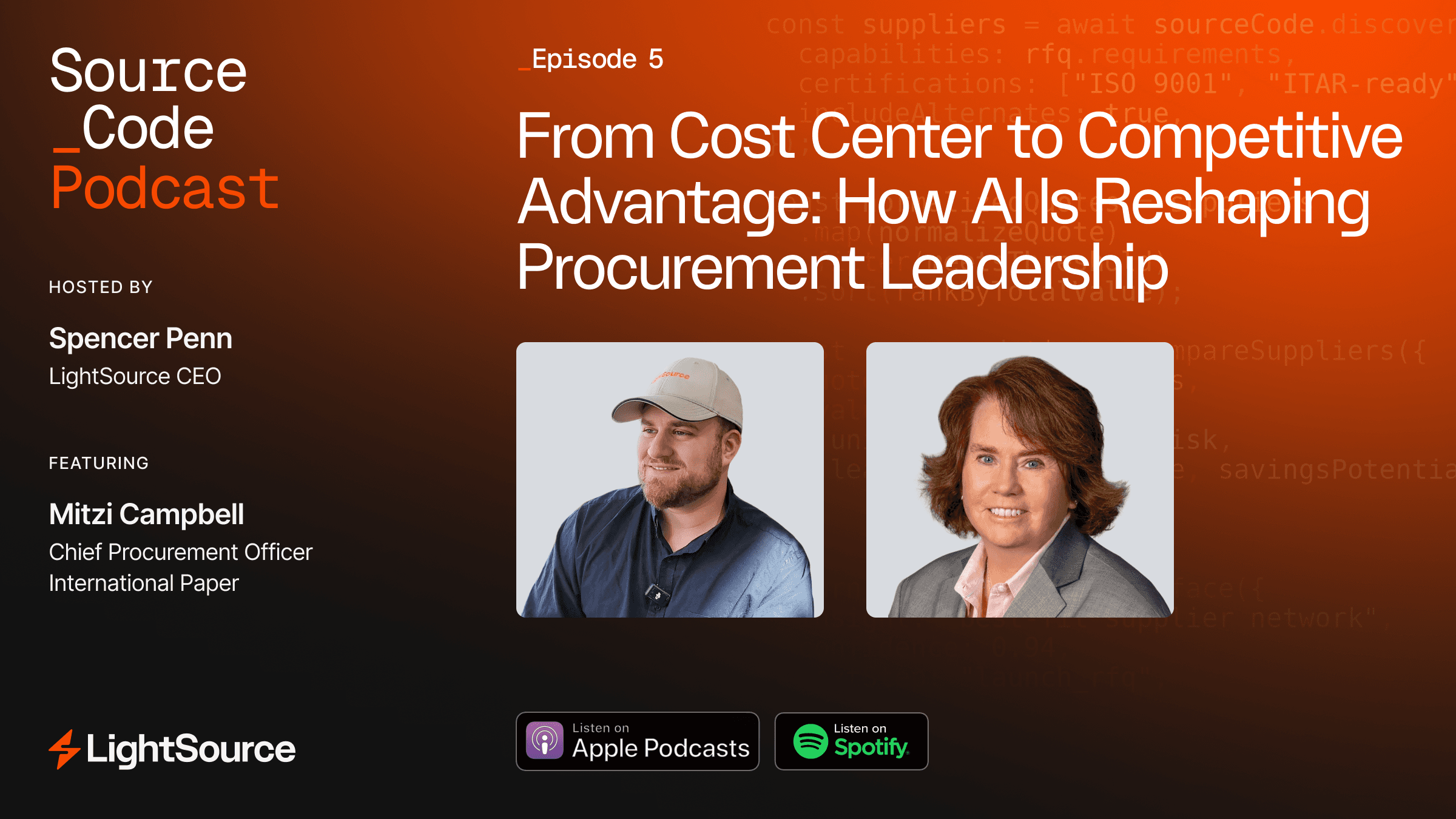
Guest: Mitzi Campbell, Chief Procurement Officer at International Paper
Listen on Spotify | Listen on Apple Podcasts | Listen on Amazon Music
During the worst of the 2020–2022 supply chain crisis, something predictable happened: companies with strong supplier relationships got product. Companies without them did not. That’s not a complicated lesson. But as Mitzi Campbell tells it, most procurement organizations still haven’t fully internalized what it means for how they hire, develop, and structure their teams.
Mitzi is the Chief Procurement Officer at International Paper, with over 30 years in procurement across both industry and consulting, including stints at A.T. Kearney and Accenture during their EDS years. She started her career at Allen Bradley buying boxes, and now runs procurement for one of the largest paper and packaging companies in the world. In this episode, she laid out what actually separates a category manager from a future CPO, why the desk-bound professional is at genuine risk from AI, and how enterprise procurement leaders are navigating the AI adoption question inside large, IT-cautious organizations.
The Question Every Young Procurement Professional Keeps Asking
At industry events like DPW in Amsterdam, procurement summits, and supply chain conferences, the same conversation keeps coming up. A 24-year-old category manager wants to know how to get to CPO. And they’re not wrong to think hard about the path, because unlike in sales, procurement doesn’t offer an obvious scoreboard. You can’t point to a number that proves you outperformed.
Mitzi’s answer starts with fundamentals: know strategic sourcing inside and out. Understand when to run a competitive bid and when a direct negotiation is the smarter play. Know how to do the analysis. But she’s quick to add that technical competence is table stakes, not differentiator. The thing that actually determines trajectory in procurement is something that doesn’t appear on any RFP template.
“If you like to sit behind a desk and not go out and engage with people, it’s going to be a struggle.” That’s the version she delivers directly. The longer version is that procurement changed after 2020. What the supply chain crisis exposed wasn’t a sourcing methodology problem. It was a relationship problem. The professionals who got product were the ones whose suppliers picked up the phone.
The Career Mistake That Keeps You Invisible
There is a version of a procurement career where you become excellent at the process and invisible to the business. You run clean sourcing events, you save money, you hit your KPIs, and you never get tapped for the strategic work because no one in the organization knows you well enough to think of you.
Mitzi describes this as a balance problem, not a personality problem. The skill set needed to become a CPO isn’t a single thing. It’s the combination of analytical rigor and human engagement. Most procurement training addresses the first. Almost none addresses the second.
This matters more now than it did even a decade ago. As AI takes over more of the analytical and transactional work (market data synthesis, spend categorization, reporting), the human capacity for judgment and relationship becomes the scarcer, more differentiated skill. The professionals who spent their careers optimizing the parts of procurement that AI will handle well are exactly the ones most exposed.
Can Introverts Win? Here’s the Honest Answer
Mitzi identifies as a functional introvert, which she notes surprises people who have seen her present to CEOs. The path from anxious-about-small-talk to comfortable-in-any-boardroom was not Toastmasters, which she describes as something that would have caused her enough angst she might have quit rather than attend.
What worked was a different kind of self-knowledge. She’s a certified Clifton Strengths coach, and she frames her development through that lens: understanding how you’re wired, what actually drains you, and then finding the version of relationship-building that maps to your strengths rather than fighting them.
For Mitzi, that’s one-on-one. She doesn’t love large conferences. She excels in direct conversation. That’s not a consolation prize for introversion. It’s actually a more durable form of influence in procurement, where the relationships that matter most tend to be deep and bilateral rather than wide and surface-level. Her advice for a 24-year-old introvert is to start there: understand your themes, figure out how to activate them, and stop trying to become a different personality type.
The 50% Prediction That Landed Hard
At a dinner a few months ago, someone from Anthropic, one of the leading foundation model companies, made a claim that stayed with Mitzi: 50% of white collar jobs will be automated in the next three years. Not eventually. Not someday. Three years.
When she pushed on how conservative that estimate was, the answer was that it represents roughly the median view among people working closest to the technology. Not the optimists. The median.
The follow-up question is the important one: which 50%? And the answer is a simple litmus test. If your entire job can be done from behind a computer screen, it’s gone. What these models are good at is taking information, processing it, and acting on it. What they can’t do, at least not yet, is anything that requires operating in the physical world, navigating genuine human complexity, or building trust over time with another person.
Procurement has both kinds of work. The desk-bound transactional work (data entry, report generation, spend categorization, RFP formatting) sits squarely in the first category. The supplier negotiation, the internal stakeholder relationship, the judgment call in a supply disruption: those sit in the second.
“I promise you that computer’s just as good” as a desk-bound professional, Mitzi said. And then added: “I don’t know how to code at all, but guess what? My AI solution knows how. I have written more code in the last year and a half than I ever have in my life.”
The Skills That Don’t Expire
Mitzi draws the through-line back to 2016–2017, when the conversation in procurement consulting was about RPA. Back then, the answer was the same as it is now: regardless of what a computer can do, the people who engage on a human level will remain necessary. Not because the technology won’t get better, but because the complexity of human organizations keeps pace.
The skills she calls out are not exotic: critical thinking, relationship building, and the ability to take what AI surfaces and apply human judgment to it. Not every decision will require that. Many decisions are clean enough that the AI should just make them. But the ones that matter, the ones with real business consequences, still require someone who can hold a conversation, read a room, and take responsibility for an outcome.
The supply chain crisis is the proof point she keeps returning to, because it’s not theoretical. The people with relationships got product. The people without them didn’t. AI will make the analytical parts of procurement faster and cheaper. It will not change that equation.
How Top CPOs Are Actually Rolling Out AI
The practical reality of AI adoption inside large enterprises is messier than the conference presentations suggest. Mitzi runs procurement at a company that is, like most large corporates, a Microsoft house. Copilot is the sanctioned tool. And she acknowledges what most enterprise users acknowledge: it feels a step behind the frontier models.
Her approach is pragmatic. She tells her team to use AI, any of it, however they can. Personal subscriptions for work done outside company data. Copilot for anything inside the enterprise perimeter. If someone on her team isn’t using AI at all, she considers that a problem worth understanding.
The constraint isn’t philosophy. It’s data governance. The standard enterprise IT position (don’t put company data into an unsanctioned tool) is a reasonable one, even if it limits what you can do. Mitzi is working with her CIO and cybersecurity team to get additional licenses stood up through the right processes. In the meantime, a significant amount of productivity is being captured through tools like Power Query, where she uses AI to write code she doesn’t know how to write.
“When I get those OpenAI invoices every month, it’s the only invoice where I go: can it be higher?” That’s not a throwaway line. It reflects a real view about leverage: if her team is using AI, they are extending themselves by orders of magnitude. The cost of the tool is not the concern. The cost of not using it is.
If You’re Not Using It, You’re Already Behind
The enterprise AI rollout story is one of competing pressures. Procurement teams want to move fast. IT and cybersecurity need process. Legal has questions. The result is that many organizations are several months, or longer, behind where their most capable people could be working.
Mitzi’s practical guidance is to not wait for the perfect sanctioned solution. Use what you can, within the rules that exist, and push from the inside for the infrastructure that allows broader adoption. The teams building real AI fluency now, not waiting for a fully governed enterprise rollout, are the ones that will have the skills and institutional knowledge to lead when the broader infrastructure catches up.
The desk test applies internally too. If a procurement professional’s primary contribution is information processing and document production, the window to develop a different kind of value is not unlimited.
Guest: Mitzi Campbell, Chief Procurement Officer at International Paper
Listen on Spotify | Listen on Apple Podcasts | Listen on Amazon Music
During the worst of the 2020–2022 supply chain crisis, something predictable happened: companies with strong supplier relationships got product. Companies without them did not. That’s not a complicated lesson. But as Mitzi Campbell tells it, most procurement organizations still haven’t fully internalized what it means for how they hire, develop, and structure their teams.
Mitzi is the Chief Procurement Officer at International Paper, with over 30 years in procurement across both industry and consulting, including stints at A.T. Kearney and Accenture during their EDS years. She started her career at Allen Bradley buying boxes, and now runs procurement for one of the largest paper and packaging companies in the world. In this episode, she laid out what actually separates a category manager from a future CPO, why the desk-bound professional is at genuine risk from AI, and how enterprise procurement leaders are navigating the AI adoption question inside large, IT-cautious organizations.
The Question Every Young Procurement Professional Keeps Asking
At industry events like DPW in Amsterdam, procurement summits, and supply chain conferences, the same conversation keeps coming up. A 24-year-old category manager wants to know how to get to CPO. And they’re not wrong to think hard about the path, because unlike in sales, procurement doesn’t offer an obvious scoreboard. You can’t point to a number that proves you outperformed.
Mitzi’s answer starts with fundamentals: know strategic sourcing inside and out. Understand when to run a competitive bid and when a direct negotiation is the smarter play. Know how to do the analysis. But she’s quick to add that technical competence is table stakes, not differentiator. The thing that actually determines trajectory in procurement is something that doesn’t appear on any RFP template.
“If you like to sit behind a desk and not go out and engage with people, it’s going to be a struggle.” That’s the version she delivers directly. The longer version is that procurement changed after 2020. What the supply chain crisis exposed wasn’t a sourcing methodology problem. It was a relationship problem. The professionals who got product were the ones whose suppliers picked up the phone.
The Career Mistake That Keeps You Invisible
There is a version of a procurement career where you become excellent at the process and invisible to the business. You run clean sourcing events, you save money, you hit your KPIs, and you never get tapped for the strategic work because no one in the organization knows you well enough to think of you.
Mitzi describes this as a balance problem, not a personality problem. The skill set needed to become a CPO isn’t a single thing. It’s the combination of analytical rigor and human engagement. Most procurement training addresses the first. Almost none addresses the second.
This matters more now than it did even a decade ago. As AI takes over more of the analytical and transactional work (market data synthesis, spend categorization, reporting), the human capacity for judgment and relationship becomes the scarcer, more differentiated skill. The professionals who spent their careers optimizing the parts of procurement that AI will handle well are exactly the ones most exposed.
Can Introverts Win? Here’s the Honest Answer
Mitzi identifies as a functional introvert, which she notes surprises people who have seen her present to CEOs. The path from anxious-about-small-talk to comfortable-in-any-boardroom was not Toastmasters, which she describes as something that would have caused her enough angst she might have quit rather than attend.
What worked was a different kind of self-knowledge. She’s a certified Clifton Strengths coach, and she frames her development through that lens: understanding how you’re wired, what actually drains you, and then finding the version of relationship-building that maps to your strengths rather than fighting them.
For Mitzi, that’s one-on-one. She doesn’t love large conferences. She excels in direct conversation. That’s not a consolation prize for introversion. It’s actually a more durable form of influence in procurement, where the relationships that matter most tend to be deep and bilateral rather than wide and surface-level. Her advice for a 24-year-old introvert is to start there: understand your themes, figure out how to activate them, and stop trying to become a different personality type.
The 50% Prediction That Landed Hard
At a dinner a few months ago, someone from Anthropic, one of the leading foundation model companies, made a claim that stayed with Mitzi: 50% of white collar jobs will be automated in the next three years. Not eventually. Not someday. Three years.
When she pushed on how conservative that estimate was, the answer was that it represents roughly the median view among people working closest to the technology. Not the optimists. The median.
The follow-up question is the important one: which 50%? And the answer is a simple litmus test. If your entire job can be done from behind a computer screen, it’s gone. What these models are good at is taking information, processing it, and acting on it. What they can’t do, at least not yet, is anything that requires operating in the physical world, navigating genuine human complexity, or building trust over time with another person.
Procurement has both kinds of work. The desk-bound transactional work (data entry, report generation, spend categorization, RFP formatting) sits squarely in the first category. The supplier negotiation, the internal stakeholder relationship, the judgment call in a supply disruption: those sit in the second.
“I promise you that computer’s just as good” as a desk-bound professional, Mitzi said. And then added: “I don’t know how to code at all, but guess what? My AI solution knows how. I have written more code in the last year and a half than I ever have in my life.”
The Skills That Don’t Expire
Mitzi draws the through-line back to 2016–2017, when the conversation in procurement consulting was about RPA. Back then, the answer was the same as it is now: regardless of what a computer can do, the people who engage on a human level will remain necessary. Not because the technology won’t get better, but because the complexity of human organizations keeps pace.
The skills she calls out are not exotic: critical thinking, relationship building, and the ability to take what AI surfaces and apply human judgment to it. Not every decision will require that. Many decisions are clean enough that the AI should just make them. But the ones that matter, the ones with real business consequences, still require someone who can hold a conversation, read a room, and take responsibility for an outcome.
The supply chain crisis is the proof point she keeps returning to, because it’s not theoretical. The people with relationships got product. The people without them didn’t. AI will make the analytical parts of procurement faster and cheaper. It will not change that equation.
How Top CPOs Are Actually Rolling Out AI
The practical reality of AI adoption inside large enterprises is messier than the conference presentations suggest. Mitzi runs procurement at a company that is, like most large corporates, a Microsoft house. Copilot is the sanctioned tool. And she acknowledges what most enterprise users acknowledge: it feels a step behind the frontier models.
Her approach is pragmatic. She tells her team to use AI, any of it, however they can. Personal subscriptions for work done outside company data. Copilot for anything inside the enterprise perimeter. If someone on her team isn’t using AI at all, she considers that a problem worth understanding.
The constraint isn’t philosophy. It’s data governance. The standard enterprise IT position (don’t put company data into an unsanctioned tool) is a reasonable one, even if it limits what you can do. Mitzi is working with her CIO and cybersecurity team to get additional licenses stood up through the right processes. In the meantime, a significant amount of productivity is being captured through tools like Power Query, where she uses AI to write code she doesn’t know how to write.
“When I get those OpenAI invoices every month, it’s the only invoice where I go: can it be higher?” That’s not a throwaway line. It reflects a real view about leverage: if her team is using AI, they are extending themselves by orders of magnitude. The cost of the tool is not the concern. The cost of not using it is.
If You’re Not Using It, You’re Already Behind
The enterprise AI rollout story is one of competing pressures. Procurement teams want to move fast. IT and cybersecurity need process. Legal has questions. The result is that many organizations are several months, or longer, behind where their most capable people could be working.
Mitzi’s practical guidance is to not wait for the perfect sanctioned solution. Use what you can, within the rules that exist, and push from the inside for the infrastructure that allows broader adoption. The teams building real AI fluency now, not waiting for a fully governed enterprise rollout, are the ones that will have the skills and institutional knowledge to lead when the broader infrastructure catches up.
The desk test applies internally too. If a procurement professional’s primary contribution is information processing and document production, the window to develop a different kind of value is not unlimited.
Guest: Mitzi Campbell, Chief Procurement Officer at International Paper
Listen on Spotify | Listen on Apple Podcasts | Listen on Amazon Music
During the worst of the 2020–2022 supply chain crisis, something predictable happened: companies with strong supplier relationships got product. Companies without them did not. That’s not a complicated lesson. But as Mitzi Campbell tells it, most procurement organizations still haven’t fully internalized what it means for how they hire, develop, and structure their teams.
Mitzi is the Chief Procurement Officer at International Paper, with over 30 years in procurement across both industry and consulting, including stints at A.T. Kearney and Accenture during their EDS years. She started her career at Allen Bradley buying boxes, and now runs procurement for one of the largest paper and packaging companies in the world. In this episode, she laid out what actually separates a category manager from a future CPO, why the desk-bound professional is at genuine risk from AI, and how enterprise procurement leaders are navigating the AI adoption question inside large, IT-cautious organizations.
The Question Every Young Procurement Professional Keeps Asking
At industry events like DPW in Amsterdam, procurement summits, and supply chain conferences, the same conversation keeps coming up. A 24-year-old category manager wants to know how to get to CPO. And they’re not wrong to think hard about the path, because unlike in sales, procurement doesn’t offer an obvious scoreboard. You can’t point to a number that proves you outperformed.
Mitzi’s answer starts with fundamentals: know strategic sourcing inside and out. Understand when to run a competitive bid and when a direct negotiation is the smarter play. Know how to do the analysis. But she’s quick to add that technical competence is table stakes, not differentiator. The thing that actually determines trajectory in procurement is something that doesn’t appear on any RFP template.
“If you like to sit behind a desk and not go out and engage with people, it’s going to be a struggle.” That’s the version she delivers directly. The longer version is that procurement changed after 2020. What the supply chain crisis exposed wasn’t a sourcing methodology problem. It was a relationship problem. The professionals who got product were the ones whose suppliers picked up the phone.
The Career Mistake That Keeps You Invisible
There is a version of a procurement career where you become excellent at the process and invisible to the business. You run clean sourcing events, you save money, you hit your KPIs, and you never get tapped for the strategic work because no one in the organization knows you well enough to think of you.
Mitzi describes this as a balance problem, not a personality problem. The skill set needed to become a CPO isn’t a single thing. It’s the combination of analytical rigor and human engagement. Most procurement training addresses the first. Almost none addresses the second.
This matters more now than it did even a decade ago. As AI takes over more of the analytical and transactional work (market data synthesis, spend categorization, reporting), the human capacity for judgment and relationship becomes the scarcer, more differentiated skill. The professionals who spent their careers optimizing the parts of procurement that AI will handle well are exactly the ones most exposed.
Can Introverts Win? Here’s the Honest Answer
Mitzi identifies as a functional introvert, which she notes surprises people who have seen her present to CEOs. The path from anxious-about-small-talk to comfortable-in-any-boardroom was not Toastmasters, which she describes as something that would have caused her enough angst she might have quit rather than attend.
What worked was a different kind of self-knowledge. She’s a certified Clifton Strengths coach, and she frames her development through that lens: understanding how you’re wired, what actually drains you, and then finding the version of relationship-building that maps to your strengths rather than fighting them.
For Mitzi, that’s one-on-one. She doesn’t love large conferences. She excels in direct conversation. That’s not a consolation prize for introversion. It’s actually a more durable form of influence in procurement, where the relationships that matter most tend to be deep and bilateral rather than wide and surface-level. Her advice for a 24-year-old introvert is to start there: understand your themes, figure out how to activate them, and stop trying to become a different personality type.
The 50% Prediction That Landed Hard
At a dinner a few months ago, someone from Anthropic, one of the leading foundation model companies, made a claim that stayed with Mitzi: 50% of white collar jobs will be automated in the next three years. Not eventually. Not someday. Three years.
When she pushed on how conservative that estimate was, the answer was that it represents roughly the median view among people working closest to the technology. Not the optimists. The median.
The follow-up question is the important one: which 50%? And the answer is a simple litmus test. If your entire job can be done from behind a computer screen, it’s gone. What these models are good at is taking information, processing it, and acting on it. What they can’t do, at least not yet, is anything that requires operating in the physical world, navigating genuine human complexity, or building trust over time with another person.
Procurement has both kinds of work. The desk-bound transactional work (data entry, report generation, spend categorization, RFP formatting) sits squarely in the first category. The supplier negotiation, the internal stakeholder relationship, the judgment call in a supply disruption: those sit in the second.
“I promise you that computer’s just as good” as a desk-bound professional, Mitzi said. And then added: “I don’t know how to code at all, but guess what? My AI solution knows how. I have written more code in the last year and a half than I ever have in my life.”
The Skills That Don’t Expire
Mitzi draws the through-line back to 2016–2017, when the conversation in procurement consulting was about RPA. Back then, the answer was the same as it is now: regardless of what a computer can do, the people who engage on a human level will remain necessary. Not because the technology won’t get better, but because the complexity of human organizations keeps pace.
The skills she calls out are not exotic: critical thinking, relationship building, and the ability to take what AI surfaces and apply human judgment to it. Not every decision will require that. Many decisions are clean enough that the AI should just make them. But the ones that matter, the ones with real business consequences, still require someone who can hold a conversation, read a room, and take responsibility for an outcome.
The supply chain crisis is the proof point she keeps returning to, because it’s not theoretical. The people with relationships got product. The people without them didn’t. AI will make the analytical parts of procurement faster and cheaper. It will not change that equation.
How Top CPOs Are Actually Rolling Out AI
The practical reality of AI adoption inside large enterprises is messier than the conference presentations suggest. Mitzi runs procurement at a company that is, like most large corporates, a Microsoft house. Copilot is the sanctioned tool. And she acknowledges what most enterprise users acknowledge: it feels a step behind the frontier models.
Her approach is pragmatic. She tells her team to use AI, any of it, however they can. Personal subscriptions for work done outside company data. Copilot for anything inside the enterprise perimeter. If someone on her team isn’t using AI at all, she considers that a problem worth understanding.
The constraint isn’t philosophy. It’s data governance. The standard enterprise IT position (don’t put company data into an unsanctioned tool) is a reasonable one, even if it limits what you can do. Mitzi is working with her CIO and cybersecurity team to get additional licenses stood up through the right processes. In the meantime, a significant amount of productivity is being captured through tools like Power Query, where she uses AI to write code she doesn’t know how to write.
“When I get those OpenAI invoices every month, it’s the only invoice where I go: can it be higher?” That’s not a throwaway line. It reflects a real view about leverage: if her team is using AI, they are extending themselves by orders of magnitude. The cost of the tool is not the concern. The cost of not using it is.
If You’re Not Using It, You’re Already Behind
The enterprise AI rollout story is one of competing pressures. Procurement teams want to move fast. IT and cybersecurity need process. Legal has questions. The result is that many organizations are several months, or longer, behind where their most capable people could be working.
Mitzi’s practical guidance is to not wait for the perfect sanctioned solution. Use what you can, within the rules that exist, and push from the inside for the infrastructure that allows broader adoption. The teams building real AI fluency now, not waiting for a fully governed enterprise rollout, are the ones that will have the skills and institutional knowledge to lead when the broader infrastructure catches up.
The desk test applies internally too. If a procurement professional’s primary contribution is information processing and document production, the window to develop a different kind of value is not unlimited.
Read more


Read more
Read more
Faster sourcing. Lower cost. Less chaos.
See how LightSource connects engineering, procurement, and suppliers in one operating system to help you launch faster at lower cost.
SOC 2
Kearney #1 2024
Gartner Cool Vendor
Procuretech 100
G2 Top Rated
Faster sourcing. Lower cost. Less chaos.
See how LightSource connects engineering, procurement, and suppliers in one operating system to help you launch faster at lower cost.
SOC 2
Kearney #1 2024
Gartner Cool Vendor
Procuretech 100
G2 Top Rated
Faster sourcing. Lower cost. Less chaos.
See how LightSource connects engineering, procurement, and suppliers in one operating system to help you launch faster at lower cost.
SOC 2
Kearney #1 2024
Gartner Cool Vendor
Procuretech 100
G2 Top Rated
Trusted by:
Trusted by:
Trusted by: