
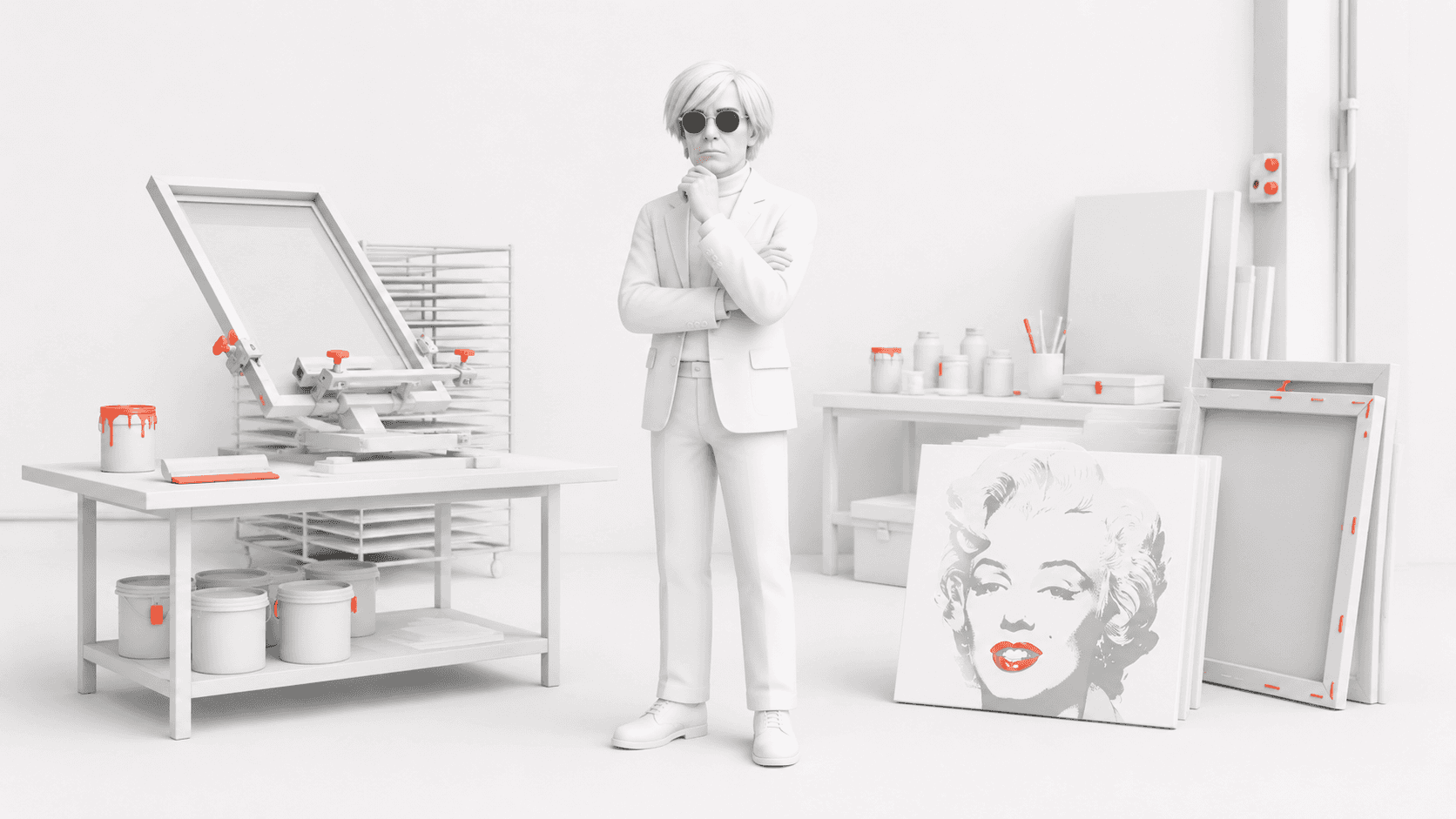
Andy Warhol didn’t paint most of the paintings that made him famous.
That sentence is unfair to Warhol but it’s also literally true, and the gap between those two facts is the most useful frame anyone in software has for thinking about AI right now.
The Factory
In 1963, Warhol moved into a former hat factory at 231 East 47th Street in Midtown Manhattan. His archivist Billy Name covered the walls and ceiling in aluminum foil and silver paint. Warhol called the space the Factory, and the name was deliberate -- it smacked of manual labor, assembly lines, and industrial production, exactly the associations the rest of the New York art world worked hardest to avoid. While one person was making a silkscreen, somebody else would be filming a screen test, and somebody else was answering the phone, and the Velvet Underground was rehearsing in the corner. Every day something new.
The Silver Factory ran from 1963 to 1967. Warhol moved to the Decker Building at 33 Union Square West after the original space was demolished, then to 860 Broadway in 1973, then to East 33rd Street in 1984. Across all four locations, the operating model was the same. Warhol selected the image. Warhol approved the colors. Warhol signed the canvas. The actual silkscreen pulls, the canvas stretching, the photographic transfers, the editioning -- those were done by an army of assistants, collaborators, hangers-on, and Superstars who circulated through the studio. Gerard Malanga did the screen pulls for the early Marilyns. Billy Name shot the photographs. Brigid Berlin handled correspondence and produced her own work alongside Warhol’s. Pat Hackett ghost-wrote his diaries. The Factory wasn’t a metaphor. It was a literal production line for art.
“I think everybody should be a machine. I think everybody should like everybody.” -- Andy Warhol, 1963
Critics hated this. The art world in 1965 was still operating on the romantic premise that the value of a painting was inseparable from the artist’s hand touching the canvas. Warhol’s response was to make the production process itself part of the work. The Brillo boxes, the Campbell’s Soup cans, the silkscreened Marilyns and Lizzes and Jackies -- the point was that mechanical reproduction had become the medium. What mattered wasn’t who pulled the screen. What mattered was who decided what went on it.

Vision, Brand, and Distribution
The thing Warhol actually did, which his assistants couldn’t do for him, was three things: vision, brand, and distribution.
Vision is the easy one to point at. Warhol decided what got made. He chose the Marilyn photograph, the soup can label, the dollar sign motif, the celebrity portrait commissions. Most of his assistants were technically capable of pulling a screen, but none of them would have decided to silkscreen 32 Campbell’s Soup cans for a Los Angeles gallery show in 1962. The taste was Warhol’s. Everything else was execution.
Brand is harder to articulate but more important. Warhol cultivated an enigmatic public persona -- the silver wig, the deadpan interview answers, the studied passivity -- that made his name a luxury good independent of any individual painting. The Factory parties, the Studio 54 appearances, the Interview magazine launch in 1969, the friendships with Truman Capote and Mick Jagger and Jean-Michel Basquiat. By the late 1970s, a Warhol portrait commission cost $25,000 (roughly $130,000 in today’s dollars) not because the painting was technically better than what a hundred other portraitists in New York could produce, but because the name on the back was Warhol’s.
Distribution is the part that gets ignored. Warhol traveled in elite, wealthy circles deliberately. The collectors, the curators, the museum directors, the magazine editors -- the people who decide what becomes culturally permanent -- all knew him personally, and most of them socialized with him. He didn’t just make the work. He placed it. The Factory’s outputs found their audience because Warhol had built the channel before he produced the inventory.
His collaborators handled the production. Warhol handled the three things that actually compound over time.
What This Has to Do With AI
Anyone who has spent the last two years using AI coding tools, or AI image tools, or any of the agentic systems that have shipped since late 2024, has experienced something similar. It is now straightforward to produce at a volume that would have been unthinkable three years ago.
A reasonably skilled engineer with Claude Code or Cursor can now produce in a weekend what would have taken a team a quarter to ship in 2022. A designer with the right model stack can generate a thousand variations of a logo before lunch. A founder with no coding background can ship a working prototype before deciding whether the prototype is worth shipping. The ratio of output to input has changed by roughly an order of magnitude, and the rate of change is still accelerating.
The Warhol lesson is that production capacity alone is not a competitive advantage. It is table stakes. Everyone has access to the same multiplier. What separates the people who build durable things from the people who flood the world with disposable output is the same thing that separated Warhol from the hundred other artists who could have run a Factory in 1965 and didn’t.
It comes back to vision, brand, and distribution.
Vision is taste -- the ability to look at a thousand AI-generated outputs and identify the one worth shipping. Most of what AI produces is mediocre, in the same way most of what a Factory assistant produced under minimal direction would have been mediocre. The hard part was never the printing. The hard part was deciding what to print.
Brand is what earns trust. A working piece of software shipped by a company nobody knows is worth less than the same software shipped by a company with a track record. AI hasn’t changed this. If anything, it has made brand more important, because the supply of plausible-looking software has gone up and the difficulty of telling good from bad has gone up with it.
Distribution is where most AI-era startups will die. The same tools that let a small team build fast also let ten thousand other small teams build fast. The moat is the relationship with the customer, the channel into the procurement org, the integration with the systems the customer already runs. Warhol’s collectors weren’t just buying paintings. They were buying access to a world that Warhol had spent years constructing. Enterprise software customers are doing something similar -- they’re buying a relationship with a vendor who has demonstrated it can get a working prototype across the hard mile between demo and production.
Not Everything That Can Get Made Is Worth Making
There’s a second Warhol lesson that the AI conversation hasn’t fully absorbed. The Factory produced an enormous amount of work that was, frankly, not good. The films were uneven. The portraits commissioned by minor European nobility in the 1980s are not the soup cans. Warhol himself acknowledged that a lot of what came out of the studio was throwaway. The Factory was a production system, and production systems produce waste.
“Being good in business is the most fascinating kind of art. Making money is art and working is art and good business is the best art.” -- Andy Warhol
Warhol’s reputation was built on the 5 percent that mattered, not the 95 percent that didn’t. The Factory’s value as a system was that it produced enough volume to find the 5 percent at all. The editing -- deciding what to push into the market and what to bury in a closet -- is what distinguishes a great artist from a prolific one.
Software works the same way. Agentic coding can produce thousands of plausible-looking pull requests. Image models can produce millions of mockups. Anyone running an AI-augmented engineering team right now is buried in output, and the question of which output is worth shipping has gotten harder, not easier. The team that wins is the one that builds the editing function around the production function -- the testing infrastructure, the production hardening, the deployment pipeline, the customer feedback loop that tells you whether what you shipped actually works.
The Software Factory
Which brings us to LightSource.
Every agentic coding tool currently on the market is a prototyping engine. The output is impressive. The output is also, almost without exception, not production-grade. It hasn’t been tested across the edge cases that real enterprise customers will hit. It hasn’t been hardened against the integration failures that show up at scale. It hasn’t been deployed against the regulatory, security, and procurement requirements that Fortune 500 companies require before they sign a contract.
This gap -- between prototype and production -- is real, and it is where most AI-native companies will get stuck.
LightSource was built to close that gap for direct materials procurement. Every workflow in the platform has been pressure-tested across hundreds of buyers, hundreds of supplier interactions, dozens of enterprise customers spanning automotive, aerospace, industrial, and consumer manufacturing. The agentic systems inside LightSource are not weekend prototypes. They’ve been refined through the kind of sustained, high-iteration, high-feedback work that characterized the Factory at its best -- direction set at the top, production handled by a team that has done it enough times to know where things break.
Warhol’s collaborators could have left the Factory at any point and started their own studios. Some of them did. None of them became Warhol. Not because Warhol was more technically skilled, but because running the Factory was a fundamentally different job than working in the Factory, and most of the people who worked there either didn’t want that job or weren’t suited to it.
Agentic coding has made it possible for almost anyone to work in the Factory. The companies that will matter over the next decade are the ones that figure out how to run one.
That’s what Warhol can tell us about AI.
Andy Warhol didn’t paint most of the paintings that made him famous.
That sentence is unfair to Warhol but it’s also literally true, and the gap between those two facts is the most useful frame anyone in software has for thinking about AI right now.
The Factory
In 1963, Warhol moved into a former hat factory at 231 East 47th Street in Midtown Manhattan. His archivist Billy Name covered the walls and ceiling in aluminum foil and silver paint. Warhol called the space the Factory, and the name was deliberate -- it smacked of manual labor, assembly lines, and industrial production, exactly the associations the rest of the New York art world worked hardest to avoid. While one person was making a silkscreen, somebody else would be filming a screen test, and somebody else was answering the phone, and the Velvet Underground was rehearsing in the corner. Every day something new.
The Silver Factory ran from 1963 to 1967. Warhol moved to the Decker Building at 33 Union Square West after the original space was demolished, then to 860 Broadway in 1973, then to East 33rd Street in 1984. Across all four locations, the operating model was the same. Warhol selected the image. Warhol approved the colors. Warhol signed the canvas. The actual silkscreen pulls, the canvas stretching, the photographic transfers, the editioning -- those were done by an army of assistants, collaborators, hangers-on, and Superstars who circulated through the studio. Gerard Malanga did the screen pulls for the early Marilyns. Billy Name shot the photographs. Brigid Berlin handled correspondence and produced her own work alongside Warhol’s. Pat Hackett ghost-wrote his diaries. The Factory wasn’t a metaphor. It was a literal production line for art.
“I think everybody should be a machine. I think everybody should like everybody.” -- Andy Warhol, 1963
Critics hated this. The art world in 1965 was still operating on the romantic premise that the value of a painting was inseparable from the artist’s hand touching the canvas. Warhol’s response was to make the production process itself part of the work. The Brillo boxes, the Campbell’s Soup cans, the silkscreened Marilyns and Lizzes and Jackies -- the point was that mechanical reproduction had become the medium. What mattered wasn’t who pulled the screen. What mattered was who decided what went on it.
Vision, Brand, and Distribution
The thing Warhol actually did, which his assistants couldn’t do for him, was three things: vision, brand, and distribution.
Vision is the easy one to point at. Warhol decided what got made. He chose the Marilyn photograph, the soup can label, the dollar sign motif, the celebrity portrait commissions. Most of his assistants were technically capable of pulling a screen, but none of them would have decided to silkscreen 32 Campbell’s Soup cans for a Los Angeles gallery show in 1962. The taste was Warhol’s. Everything else was execution.
Brand is harder to articulate but more important. Warhol cultivated an enigmatic public persona -- the silver wig, the deadpan interview answers, the studied passivity -- that made his name a luxury good independent of any individual painting. The Factory parties, the Studio 54 appearances, the Interview magazine launch in 1969, the friendships with Truman Capote and Mick Jagger and Jean-Michel Basquiat. By the late 1970s, a Warhol portrait commission cost $25,000 (roughly $130,000 in today’s dollars) not because the painting was technically better than what a hundred other portraitists in New York could produce, but because the name on the back was Warhol’s.
Distribution is the part that gets ignored. Warhol traveled in elite, wealthy circles deliberately. The collectors, the curators, the museum directors, the magazine editors -- the people who decide what becomes culturally permanent -- all knew him personally, and most of them socialized with him. He didn’t just make the work. He placed it. The Factory’s outputs found their audience because Warhol had built the channel before he produced the inventory.
His collaborators handled the production. Warhol handled the three things that actually compound over time.
What This Has to Do With AI
Anyone who has spent the last two years using AI coding tools, or AI image tools, or any of the agentic systems that have shipped since late 2024, has experienced something similar. It is now straightforward to produce at a volume that would have been unthinkable three years ago.
A reasonably skilled engineer with Claude Code or Cursor can now produce in a weekend what would have taken a team a quarter to ship in 2022. A designer with the right model stack can generate a thousand variations of a logo before lunch. A founder with no coding background can ship a working prototype before deciding whether the prototype is worth shipping. The ratio of output to input has changed by roughly an order of magnitude, and the rate of change is still accelerating.
The Warhol lesson is that production capacity alone is not a competitive advantage. It is table stakes. Everyone has access to the same multiplier. What separates the people who build durable things from the people who flood the world with disposable output is the same thing that separated Warhol from the hundred other artists who could have run a Factory in 1965 and didn’t.
It comes back to vision, brand, and distribution.
Vision is taste -- the ability to look at a thousand AI-generated outputs and identify the one worth shipping. Most of what AI produces is mediocre, in the same way most of what a Factory assistant produced under minimal direction would have been mediocre. The hard part was never the printing. The hard part was deciding what to print.
Brand is what earns trust. A working piece of software shipped by a company nobody knows is worth less than the same software shipped by a company with a track record. AI hasn’t changed this. If anything, it has made brand more important, because the supply of plausible-looking software has gone up and the difficulty of telling good from bad has gone up with it.
Distribution is where most AI-era startups will die. The same tools that let a small team build fast also let ten thousand other small teams build fast. The moat is the relationship with the customer, the channel into the procurement org, the integration with the systems the customer already runs. Warhol’s collectors weren’t just buying paintings. They were buying access to a world that Warhol had spent years constructing. Enterprise software customers are doing something similar -- they’re buying a relationship with a vendor who has demonstrated it can get a working prototype across the hard mile between demo and production.
Not Everything That Can Get Made Is Worth Making
There’s a second Warhol lesson that the AI conversation hasn’t fully absorbed. The Factory produced an enormous amount of work that was, frankly, not good. The films were uneven. The portraits commissioned by minor European nobility in the 1980s are not the soup cans. Warhol himself acknowledged that a lot of what came out of the studio was throwaway. The Factory was a production system, and production systems produce waste.
“Being good in business is the most fascinating kind of art. Making money is art and working is art and good business is the best art.” -- Andy Warhol
Warhol’s reputation was built on the 5 percent that mattered, not the 95 percent that didn’t. The Factory’s value as a system was that it produced enough volume to find the 5 percent at all. The editing -- deciding what to push into the market and what to bury in a closet -- is what distinguishes a great artist from a prolific one.
Software works the same way. Agentic coding can produce thousands of plausible-looking pull requests. Image models can produce millions of mockups. Anyone running an AI-augmented engineering team right now is buried in output, and the question of which output is worth shipping has gotten harder, not easier. The team that wins is the one that builds the editing function around the production function -- the testing infrastructure, the production hardening, the deployment pipeline, the customer feedback loop that tells you whether what you shipped actually works.
The Software Factory
Which brings us to LightSource.
Every agentic coding tool currently on the market is a prototyping engine. The output is impressive. The output is also, almost without exception, not production-grade. It hasn’t been tested across the edge cases that real enterprise customers will hit. It hasn’t been hardened against the integration failures that show up at scale. It hasn’t been deployed against the regulatory, security, and procurement requirements that Fortune 500 companies require before they sign a contract.
This gap -- between prototype and production -- is real, and it is where most AI-native companies will get stuck.
LightSource was built to close that gap for direct materials procurement. Every workflow in the platform has been pressure-tested across hundreds of buyers, hundreds of supplier interactions, dozens of enterprise customers spanning automotive, aerospace, industrial, and consumer manufacturing. The agentic systems inside LightSource are not weekend prototypes. They’ve been refined through the kind of sustained, high-iteration, high-feedback work that characterized the Factory at its best -- direction set at the top, production handled by a team that has done it enough times to know where things break.
Warhol’s collaborators could have left the Factory at any point and started their own studios. Some of them did. None of them became Warhol. Not because Warhol was more technically skilled, but because running the Factory was a fundamentally different job than working in the Factory, and most of the people who worked there either didn’t want that job or weren’t suited to it.
Agentic coding has made it possible for almost anyone to work in the Factory. The companies that will matter over the next decade are the ones that figure out how to run one.
That’s what Warhol can tell us about AI.
Andy Warhol didn’t paint most of the paintings that made him famous.
That sentence is unfair to Warhol but it’s also literally true, and the gap between those two facts is the most useful frame anyone in software has for thinking about AI right now.
The Factory
In 1963, Warhol moved into a former hat factory at 231 East 47th Street in Midtown Manhattan. His archivist Billy Name covered the walls and ceiling in aluminum foil and silver paint. Warhol called the space the Factory, and the name was deliberate -- it smacked of manual labor, assembly lines, and industrial production, exactly the associations the rest of the New York art world worked hardest to avoid. While one person was making a silkscreen, somebody else would be filming a screen test, and somebody else was answering the phone, and the Velvet Underground was rehearsing in the corner. Every day something new.
The Silver Factory ran from 1963 to 1967. Warhol moved to the Decker Building at 33 Union Square West after the original space was demolished, then to 860 Broadway in 1973, then to East 33rd Street in 1984. Across all four locations, the operating model was the same. Warhol selected the image. Warhol approved the colors. Warhol signed the canvas. The actual silkscreen pulls, the canvas stretching, the photographic transfers, the editioning -- those were done by an army of assistants, collaborators, hangers-on, and Superstars who circulated through the studio. Gerard Malanga did the screen pulls for the early Marilyns. Billy Name shot the photographs. Brigid Berlin handled correspondence and produced her own work alongside Warhol’s. Pat Hackett ghost-wrote his diaries. The Factory wasn’t a metaphor. It was a literal production line for art.
“I think everybody should be a machine. I think everybody should like everybody.” -- Andy Warhol, 1963
Critics hated this. The art world in 1965 was still operating on the romantic premise that the value of a painting was inseparable from the artist’s hand touching the canvas. Warhol’s response was to make the production process itself part of the work. The Brillo boxes, the Campbell’s Soup cans, the silkscreened Marilyns and Lizzes and Jackies -- the point was that mechanical reproduction had become the medium. What mattered wasn’t who pulled the screen. What mattered was who decided what went on it.
Vision, Brand, and Distribution
The thing Warhol actually did, which his assistants couldn’t do for him, was three things: vision, brand, and distribution.
Vision is the easy one to point at. Warhol decided what got made. He chose the Marilyn photograph, the soup can label, the dollar sign motif, the celebrity portrait commissions. Most of his assistants were technically capable of pulling a screen, but none of them would have decided to silkscreen 32 Campbell’s Soup cans for a Los Angeles gallery show in 1962. The taste was Warhol’s. Everything else was execution.
Brand is harder to articulate but more important. Warhol cultivated an enigmatic public persona -- the silver wig, the deadpan interview answers, the studied passivity -- that made his name a luxury good independent of any individual painting. The Factory parties, the Studio 54 appearances, the Interview magazine launch in 1969, the friendships with Truman Capote and Mick Jagger and Jean-Michel Basquiat. By the late 1970s, a Warhol portrait commission cost $25,000 (roughly $130,000 in today’s dollars) not because the painting was technically better than what a hundred other portraitists in New York could produce, but because the name on the back was Warhol’s.
Distribution is the part that gets ignored. Warhol traveled in elite, wealthy circles deliberately. The collectors, the curators, the museum directors, the magazine editors -- the people who decide what becomes culturally permanent -- all knew him personally, and most of them socialized with him. He didn’t just make the work. He placed it. The Factory’s outputs found their audience because Warhol had built the channel before he produced the inventory.
His collaborators handled the production. Warhol handled the three things that actually compound over time.
What This Has to Do With AI
Anyone who has spent the last two years using AI coding tools, or AI image tools, or any of the agentic systems that have shipped since late 2024, has experienced something similar. It is now straightforward to produce at a volume that would have been unthinkable three years ago.
A reasonably skilled engineer with Claude Code or Cursor can now produce in a weekend what would have taken a team a quarter to ship in 2022. A designer with the right model stack can generate a thousand variations of a logo before lunch. A founder with no coding background can ship a working prototype before deciding whether the prototype is worth shipping. The ratio of output to input has changed by roughly an order of magnitude, and the rate of change is still accelerating.
The Warhol lesson is that production capacity alone is not a competitive advantage. It is table stakes. Everyone has access to the same multiplier. What separates the people who build durable things from the people who flood the world with disposable output is the same thing that separated Warhol from the hundred other artists who could have run a Factory in 1965 and didn’t.
It comes back to vision, brand, and distribution.
Vision is taste -- the ability to look at a thousand AI-generated outputs and identify the one worth shipping. Most of what AI produces is mediocre, in the same way most of what a Factory assistant produced under minimal direction would have been mediocre. The hard part was never the printing. The hard part was deciding what to print.
Brand is what earns trust. A working piece of software shipped by a company nobody knows is worth less than the same software shipped by a company with a track record. AI hasn’t changed this. If anything, it has made brand more important, because the supply of plausible-looking software has gone up and the difficulty of telling good from bad has gone up with it.
Distribution is where most AI-era startups will die. The same tools that let a small team build fast also let ten thousand other small teams build fast. The moat is the relationship with the customer, the channel into the procurement org, the integration with the systems the customer already runs. Warhol’s collectors weren’t just buying paintings. They were buying access to a world that Warhol had spent years constructing. Enterprise software customers are doing something similar -- they’re buying a relationship with a vendor who has demonstrated it can get a working prototype across the hard mile between demo and production.
Not Everything That Can Get Made Is Worth Making
There’s a second Warhol lesson that the AI conversation hasn’t fully absorbed. The Factory produced an enormous amount of work that was, frankly, not good. The films were uneven. The portraits commissioned by minor European nobility in the 1980s are not the soup cans. Warhol himself acknowledged that a lot of what came out of the studio was throwaway. The Factory was a production system, and production systems produce waste.
“Being good in business is the most fascinating kind of art. Making money is art and working is art and good business is the best art.” -- Andy Warhol
Warhol’s reputation was built on the 5 percent that mattered, not the 95 percent that didn’t. The Factory’s value as a system was that it produced enough volume to find the 5 percent at all. The editing -- deciding what to push into the market and what to bury in a closet -- is what distinguishes a great artist from a prolific one.
Software works the same way. Agentic coding can produce thousands of plausible-looking pull requests. Image models can produce millions of mockups. Anyone running an AI-augmented engineering team right now is buried in output, and the question of which output is worth shipping has gotten harder, not easier. The team that wins is the one that builds the editing function around the production function -- the testing infrastructure, the production hardening, the deployment pipeline, the customer feedback loop that tells you whether what you shipped actually works.
The Software Factory
Which brings us to LightSource.
Every agentic coding tool currently on the market is a prototyping engine. The output is impressive. The output is also, almost without exception, not production-grade. It hasn’t been tested across the edge cases that real enterprise customers will hit. It hasn’t been hardened against the integration failures that show up at scale. It hasn’t been deployed against the regulatory, security, and procurement requirements that Fortune 500 companies require before they sign a contract.
This gap -- between prototype and production -- is real, and it is where most AI-native companies will get stuck.
LightSource was built to close that gap for direct materials procurement. Every workflow in the platform has been pressure-tested across hundreds of buyers, hundreds of supplier interactions, dozens of enterprise customers spanning automotive, aerospace, industrial, and consumer manufacturing. The agentic systems inside LightSource are not weekend prototypes. They’ve been refined through the kind of sustained, high-iteration, high-feedback work that characterized the Factory at its best -- direction set at the top, production handled by a team that has done it enough times to know where things break.
Warhol’s collaborators could have left the Factory at any point and started their own studios. Some of them did. None of them became Warhol. Not because Warhol was more technically skilled, but because running the Factory was a fundamentally different job than working in the Factory, and most of the people who worked there either didn’t want that job or weren’t suited to it.
Agentic coding has made it possible for almost anyone to work in the Factory. The companies that will matter over the next decade are the ones that figure out how to run one.
That’s what Warhol can tell us about AI.
Read more


Read more
Read more
Faster sourcing. Lower cost. Less chaos.
See how LightSource connects engineering, procurement, and suppliers in one operating system to help you launch faster at lower cost.
SOC 2
Kearney #1 2024
Gartner Cool Vendor
Procuretech 100
G2 Top Rated
Faster sourcing. Lower cost. Less chaos.
See how LightSource connects engineering, procurement, and suppliers in one operating system to help you launch faster at lower cost.
SOC 2
Kearney #1 2024
Gartner Cool Vendor
Procuretech 100
G2 Top Rated
Faster sourcing. Lower cost. Less chaos.
See how LightSource connects engineering, procurement, and suppliers in one operating system to help you launch faster at lower cost.
SOC 2
Kearney #1 2024
Gartner Cool Vendor
Procuretech 100
G2 Top Rated
Trusted by:
Trusted by:
Trusted by: