

If you're evaluating procurement software in 2026, you've almost certainly looked at Coupa. They're a Gartner Magic Quadrant Leader for Source-to-Pay, they crossed $1 billion in ARR in 2024, and they serve many of the world's largest enterprises. For a lot of procurement teams, Coupa is the default on the shortlist.
LightSource is a different kind of platform solving a different kind of problem. Understanding where each fits -- and where they don't -- requires understanding what you're actually buying when you buy procurement software, and what kind of spend you're trying to manage.
The Fundamental Split: Direct vs. Indirect
All company spend flows into two rivers. Indirect spend is what the company consumes to operate -- travel, office supplies, IT, marketing, laptops, consulting. Direct spend is what goes into the product -- sheet metal, semiconductors, castings, chemicals, PCB assemblies, seat leather, glass.
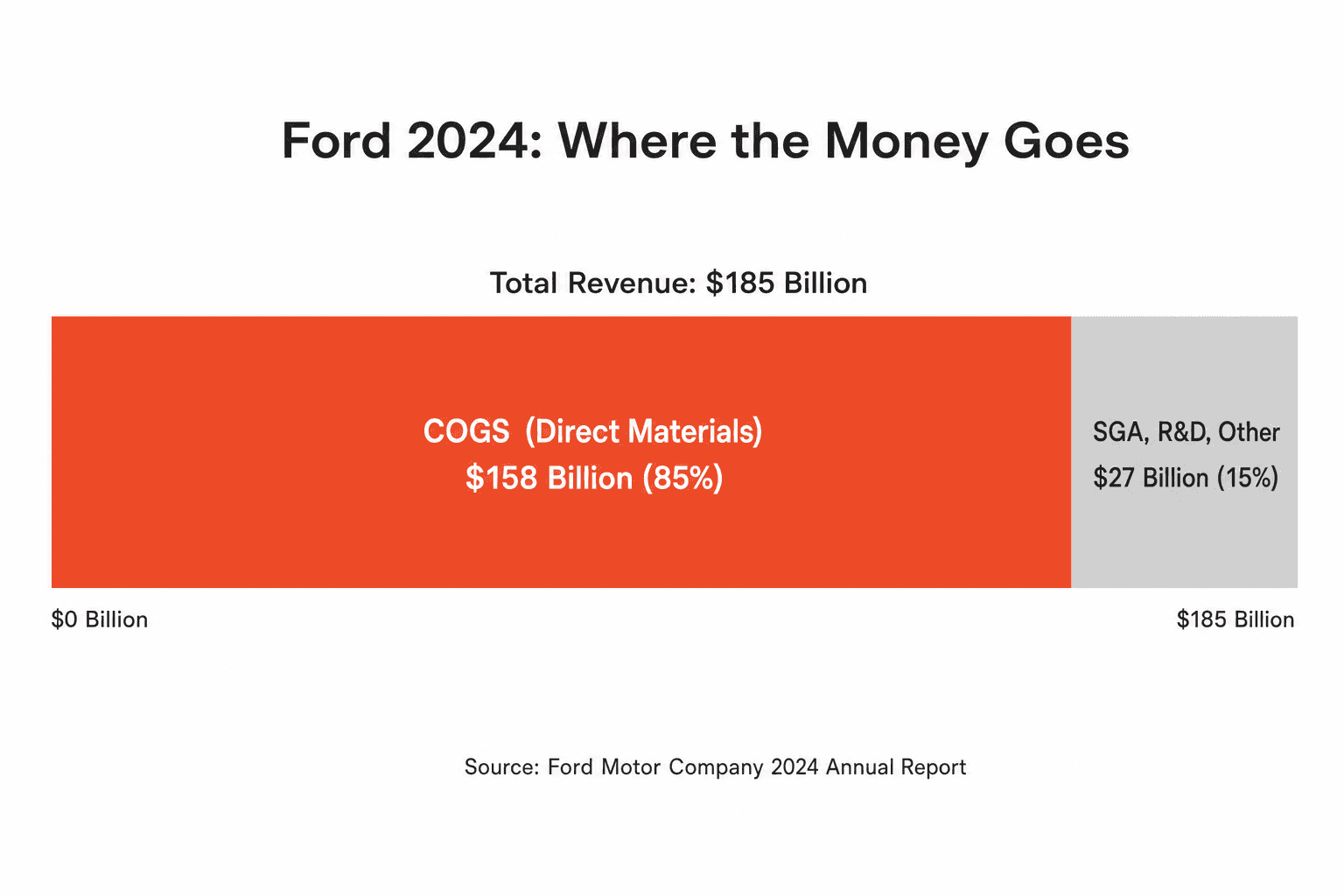
For most manufacturers, direct materials represent 70-80% of total product cost. It maps to COGS on the income statement. Look at Ford's 2024 financials: $185 billion in revenue, $158 billion in cost of goods sold. The flow from COGS to vehicle revenue is virtually the entire story. Everything else in the income statement is a rounding error by comparison.
And yet, procurement technology has historically focused on indirect. The early systems -- Ariba, Coupa, SAP -- were built around purchase orders, catalogs, approval workflows, and invoice matching. These are the workflows of indirect: an employee requests something, a manager approves it, a PO gets issued, an invoice gets matched, and a payment goes out. Procure-to-Pay.
Direct materials procurement looks nothing like that.
What Makes Direct Different
Direct materials sourcing is a technical discipline, not a purchasing transaction. The buyer isn't choosing from a catalog. They're working with engineering drawings, bills of materials, material specifications, tolerance requirements, tooling plans, and supplier qualification data. The sourcing decision happens months or years before production, during the NPI phase, and it gets revisited every time a design changes or a supplier issue surfaces.
The data model is fundamentally different from indirect. A direct materials RFQ might include:
A 200-line BOM with parent-child assembly structure
Engineering drawings in PDF or STEP format
Material specifications that suppliers need to quote against
Tooling requirements with amortization schedules
Quality requirements (PPAP, APQP, ISIR)
Multiple revision cycles as engineering updates the design
Should-cost models that benchmark supplier pricing against material, labor, and overhead costs
None of this maps cleanly to a P2P workflow. A catalog-based system can't handle a multi-round technical RFQ where suppliers are quoting against drawings that are changing in real time. An approval workflow designed for purchase orders doesn't help when the procurement team needs to compare 12 suppliers across 50 line items with different units of measure, incoterms, tooling assumptions, and payment terms.
This is why direct materials has been managed with spreadsheets and email for so long. Not because procurement teams don't want better tools -- but because the tools that existed were built for a different problem.
Where Coupa Is Strong
Coupa is a genuine market leader in procure-to-pay and business spend management. Being fair about this matters, because an honest comparison is more useful than a sales pitch.
Broad S2P platform. Coupa covers procurement, sourcing, contract management, invoicing, expense tracking, and supplier collaboration in a single platform. For enterprises that want one system for all spend types, this breadth is a real advantage.
AP automation and spend visibility. Coupa's accounts payable automation, electronic invoicing, and spend analysis capabilities are mature. If your primary pain is invoice processing, payment terms optimization, or getting visibility into what the company is spending across categories, Coupa does this well.
Supplier network and data. Coupa's platform processes over $8 trillion in cumulative transactional spend. That data feeds community intelligence -- benchmarks, risk signals, and supplier recommendations across their customer base.
Enterprise credibility. Coupa serves many Fortune 500 companies. For a CPO who needs to justify a platform decision to the board, Coupa's brand recognition and Gartner positioning reduce perceived risk.
ERP integrations. Years of enterprise deployments mean Coupa has deep integration experience with SAP, Oracle, and other major ERPs.
Where Coupa Struggles
Direct materials is a bolt-on, not the core. Coupa's architecture was built around indirect procurement workflows -- catalogs, POs, invoice matching. Direct materials capabilities have been added over time, but the underlying data model wasn't designed for BOMs, engineering drawings, revision management, or technical RFQs. Users evaluating Coupa for direct sourcing consistently note this gap.
Implementation complexity. Coupa deployments at enterprise scale typically take 6-12 months and often require external consultants. On G2, Coupa underperforms competitors on ease of setup. For companies that need to move fast -- particularly those running aggressive NPI timelines -- this is a real constraint.
User experience. Gartner Peer Insights and G2 reviews consistently flag the learning curve. The platform is feature-rich but not intuitive. Supplier-side usability is a recurring complaint -- and in direct materials, supplier adoption is critical because the sourcing process is collaborative.
Cost. Base packages start around $2,500/month, and enterprise deployments scale significantly from there. For mid-market manufacturers, the total cost of ownership including implementation, training, and ongoing administration can be difficult to justify.
What LightSource Does Differently
LightSource is not a P2P system. It's a Spec-to-Scale platform -- purpose-built for the lifecycle of taking a product from specification through sourcing, into supply, and through production at scale. The three phases:
Spec to Source: from engineering spec to supplier engagement, RFQ, and award
Source to Supply: from sourcing intent to supplier industrialization and NPI readiness
Supply to Scale: from SOP through continuous supply management and resilience
This is the operating system for direct materials teams at manufacturers. It handles the messy, technical, revision-heavy work that indirect-focused platforms were never designed for.
AI-native architecture. LightSource was built with AI at the core, not added as a feature layer. The system reads engineering drawings, extracts BOM structures from PDFs, normalizes supplier quotes across different formats and units of measure, and generates cost models from part geometry and material specifications. This isn't a chatbot on top of a database. It's AI doing the actual work of structuring the messy, unstructured data that defines direct materials sourcing.
Speed to value. LightSource deploys in 30 days -- not 12-18 months. There's no army of consultants required. (Our deployment team is, admittedly, largely ex-consultants -- our Director of Deployment has written about how the job changed when go-live and ROI collapsed into one phase.) Customers are live and running sourcing events within a month of signing, with supplier onboarding taking under 30 minutes. For a manufacturer running an NPI program on an aggressive timeline, this difference compounds -- a 6-month implementation means you miss the sourcing window for the current program.
Purpose-built for how direct teams actually work. The platform handles multi-round technical RFQs, BOM-level cost tracking, supplier scorecarding tied to part-level performance, and real-time collaboration between buyers, engineers, and suppliers. AI normalizes bids on arrival -- line by line -- so hidden margin surfaces before the award decision. Spec changes propagate automatically to suppliers, eliminating the two-week reset cycle when engineering updates a drawing. The result: customers report 45% faster sourcing cycles and 3-8% reduction in direct spend in year one, with 85%+ supplier response rates across 20,000+ suppliers on the platform.
Companies including Amazon, Canada Goose, BRP, Shure, Conair, and Medtronic use LightSource for direct materials sourcing.
The Decision Framework
The right platform depends on what problem you're solving. The table below puts the key differences side by side.
Head-to-Head Comparison
LightSource | Coupa | |
|---|---|---|
Built for | Direct materials, NPI velocity | Indirect spend, procure-to-pay |
Architecture | AI-native, purpose-built for direct | P2P platform with sourcing bolted on |
Primary users | Buyers, engineers, suppliers collaborating on BOMs and RFQs | Procurement ops, AP teams, category managers |
Target customer | Challenger manufacturers, high NPI velocity | Large enterprise, broad spend management |
Implementation | 30 days | 6-12 months (often with consultants) |
Cost | $ | $$$ |
Supplier network | 20K+ suppliers, free access, 85%+ response rate | Large supplier network, paid supplier access |
Key proof points | 45% faster sourcing cycles, 3-8% spend reduction Y1, 107x ROI | $8T cumulative spend data, $1B+ ARR, Gartner MQ Leader |
Gartner / analyst | Cool Vendor 2025, Spend Matters Validated | MQ Leader for S2P 2025 |
Capability Comparison
Capability | LightSource | Coupa |
|---|---|---|
Technical RFQ (drawings, BOMs, specs) | 🟢 Strong | 🔴 Limited |
BOM cost management | 🟢 Strong | 🔴 Limited |
Should-cost / cost modeling | 🟢 Strong | 🟡 Moderate |
AI bid normalization | 🟢 Strong | 🔴 Limited |
Supplier qualification (PPAP, APQP) | 🟢 Strong | 🔴 Limited |
Multi-round negotiations | 🟢 Strong | 🟡 Moderate |
NPI sourcing workflows | 🟢 Strong | 🔴 Limited |
AP automation / invoice matching | ⬜ Not offered | 🟢 Strong |
Catalog purchasing (indirect) | ⬜ Not offered | 🟢 Strong |
Expense management | ⬜ Not offered | 🟢 Strong |
Spend analytics (all categories) | 🟡 Direct materials only | 🟢 Strong |
ERP integration depth | 🟡 Growing | 🟢 Strong |
Supplier risk monitoring | 🟡 Moderate | 🟢 Strong |
The pattern is clear: Coupa is green across the full P2P spectrum for indirect spend. LightSource is green on the technical sourcing workflows specific to direct materials. They are not substitutes -- they are complements.
When to Choose What
Choose Coupa if:
Your primary spend is indirect (IT, facilities, marketing, MRO)
You need a unified P2P backbone for requisition-to-payment
AP automation and invoice matching are your biggest pain points
You want one platform for all spend categories and are willing to accept trade-offs on direct materials depth
You have the budget and timeline for a 6-12 month enterprise implementation
Choose LightSource if:
Your primary spend is direct materials (components, assemblies, raw materials)
You need to run technical RFQs against engineering drawings and BOMs
You're in NPI and need to source parts on an aggressive timeline
You need cost decisions made when engineering specs are still changing -- not months later
You want to be live and sourcing in 30 days, not 12-18 months
Use both if:
You're a large manufacturer with significant indirect AND direct spend
Coupa handles the P2P backbone for indirect purchasing
LightSource handles the Spec-to-Scale workflow for direct materials
They serve different teams solving different problems -- this is not a redundancy
The 60-day test is useful here. If what you need in 60 days is AP controls and spend dashboards, Coupa is the faster path. If what you need in 60 days is live technical RFQs and cleaner supplier award decisions on direct materials, LightSource is the faster path.
The Bigger Picture
The procurement software market has spent 20 years digitizing indirect spend. Catalogs, POs, invoices -- these are well-served. Meanwhile, the largest cost bucket for any manufacturer -- direct materials, 70-80% of COGS -- has been running on Excel and email.
That gap is closing. The question for procurement leaders isn't "Coupa or LightSource?" in the abstract. It's "what kind of spend is causing the most pain, and what kind of platform was built to solve it?"
For indirect, the market has mature options. Coupa is one of the strongest.
For direct materials, the category is newer -- and LightSource was built specifically for it.
Sources
Coupa Named a Leader in the 2025 Gartner Magic Quadrant for Source-to-Pay Suites -- Coupa's Gartner positioning and capabilities overview
Coupa Reviews 2026 | Gartner Peer Insights -- Gartner Peer Insights user reviews and ratings
Top 7 Coupa Alternatives for S2P in 2026 -- Competitive landscape and market positioning
The "New" Coupa: Post-Acquisition Assessment -- Spend Matters on Coupa post-Thoma Bravo acquisition
Coupa Procurement Market Share -- 6sense on Coupa's 13.81% market share in procurement
CPO Strategy: LightSource Spec-to-Scale -- The Spec-to-Scale framework for direct materials procurement
Coupa Reviews on G2 -- G2 ratings on ease of use, setup, support, and product direction
Frequently Asked Questions
Is Coupa good for direct materials procurement?
Coupa offers some direct materials capabilities, but its architecture was built around indirect procurement workflows -- catalogs, purchase orders, and invoice matching. Manufacturers with complex direct materials needs (engineering drawings, BOMs, multi-round technical RFQs, tooling amortization) typically find that Coupa's direct materials features are less mature than its indirect and P2P capabilities. For companies where direct materials is the primary spend category, a purpose-built platform like LightSource is usually a better fit.
Can I use both Coupa and LightSource?
Yes. Many manufacturers run Coupa for indirect spend (P2P backbone, AP automation, expense management) and LightSource for direct materials sourcing (Spec-to-Scale). The two platforms serve different teams and different workflows. This is a complementary architecture, not a redundancy.
How long does it take to implement Coupa vs. LightSource?
Coupa enterprise implementations typically take 6-12 months and often require external consultants. LightSource deploys in weeks. For manufacturers running NPI programs on aggressive timelines, the implementation speed difference is significant -- a 6-month implementation can mean missing the sourcing window for a current program.
What is Spec-to-Scale?
Spec-to-Scale (S2S) is the lifecycle of taking a product from engineering specification through sourcing, into supply, and through production at scale. It covers three phases: Spec-to-Source (spec definition to supplier engagement), Source-to-Supply (sourcing to industrialization), and Supply-to-Scale (SOP to continuous supply management). LightSource is built around this framework, which is specific to direct materials procurement.
What's the difference between P2P and S2S?
Procure-to-Pay (P2P) covers the transactional procurement cycle: requisition, purchase order, receipt, invoice, payment. It's optimized for indirect spend. Spec-to-Scale (S2S) covers the full lifecycle of direct materials procurement: from engineering specifications through sourcing, supplier qualification, and production readiness. P2P asks "how do we buy efficiently?" S2S asks "how do we get the right parts, from the right suppliers, at the right cost, on time for production?"
How do supplier networks compare between Coupa and LightSource?
Coupa's Supplier Network has more than 10 million suppliers, with the vast majority focused on indirect goods and services. LightSource's network has 20,000-plus suppliers focused on direct materials manufacturing -- fabricators, machine shops, electronics manufacturers, contract assemblers, and tier 2/3 component suppliers. The networks overlap minimally because they serve different procurement workflows. For direct materials, fewer-but-relevant beats larger-but-broad.
Can LightSource integrate with my ERP (SAP, Oracle, NetSuite)?
Yes. LightSource supports bidirectional integrations with major ERP systems including SAP, Oracle, NetSuite, and Microsoft Dynamics. BOMs, items, and supplier records sync from the ERP into LightSource; awarded suppliers, prices, and contracts can sync back. Most integrations go live in two to four weeks using standard connectors, with custom field mapping for company-specific master data.
If you're evaluating procurement software in 2026, you've almost certainly looked at Coupa. They're a Gartner Magic Quadrant Leader for Source-to-Pay, they crossed $1 billion in ARR in 2024, and they serve many of the world's largest enterprises. For a lot of procurement teams, Coupa is the default on the shortlist.
LightSource is a different kind of platform solving a different kind of problem. Understanding where each fits -- and where they don't -- requires understanding what you're actually buying when you buy procurement software, and what kind of spend you're trying to manage.
The Fundamental Split: Direct vs. Indirect
All company spend flows into two rivers. Indirect spend is what the company consumes to operate -- travel, office supplies, IT, marketing, laptops, consulting. Direct spend is what goes into the product -- sheet metal, semiconductors, castings, chemicals, PCB assemblies, seat leather, glass.
For most manufacturers, direct materials represent 70-80% of total product cost. It maps to COGS on the income statement. Look at Ford's 2024 financials: $185 billion in revenue, $158 billion in cost of goods sold. The flow from COGS to vehicle revenue is virtually the entire story. Everything else in the income statement is a rounding error by comparison.
And yet, procurement technology has historically focused on indirect. The early systems -- Ariba, Coupa, SAP -- were built around purchase orders, catalogs, approval workflows, and invoice matching. These are the workflows of indirect: an employee requests something, a manager approves it, a PO gets issued, an invoice gets matched, and a payment goes out. Procure-to-Pay.
Direct materials procurement looks nothing like that.
What Makes Direct Different
Direct materials sourcing is a technical discipline, not a purchasing transaction. The buyer isn't choosing from a catalog. They're working with engineering drawings, bills of materials, material specifications, tolerance requirements, tooling plans, and supplier qualification data. The sourcing decision happens months or years before production, during the NPI phase, and it gets revisited every time a design changes or a supplier issue surfaces.
The data model is fundamentally different from indirect. A direct materials RFQ might include:
A 200-line BOM with parent-child assembly structure
Engineering drawings in PDF or STEP format
Material specifications that suppliers need to quote against
Tooling requirements with amortization schedules
Quality requirements (PPAP, APQP, ISIR)
Multiple revision cycles as engineering updates the design
Should-cost models that benchmark supplier pricing against material, labor, and overhead costs
None of this maps cleanly to a P2P workflow. A catalog-based system can't handle a multi-round technical RFQ where suppliers are quoting against drawings that are changing in real time. An approval workflow designed for purchase orders doesn't help when the procurement team needs to compare 12 suppliers across 50 line items with different units of measure, incoterms, tooling assumptions, and payment terms.
This is why direct materials has been managed with spreadsheets and email for so long. Not because procurement teams don't want better tools -- but because the tools that existed were built for a different problem.
Where Coupa Is Strong
Coupa is a genuine market leader in procure-to-pay and business spend management. Being fair about this matters, because an honest comparison is more useful than a sales pitch.
Broad S2P platform. Coupa covers procurement, sourcing, contract management, invoicing, expense tracking, and supplier collaboration in a single platform. For enterprises that want one system for all spend types, this breadth is a real advantage.
AP automation and spend visibility. Coupa's accounts payable automation, electronic invoicing, and spend analysis capabilities are mature. If your primary pain is invoice processing, payment terms optimization, or getting visibility into what the company is spending across categories, Coupa does this well.
Supplier network and data. Coupa's platform processes over $8 trillion in cumulative transactional spend. That data feeds community intelligence -- benchmarks, risk signals, and supplier recommendations across their customer base.
Enterprise credibility. Coupa serves many Fortune 500 companies. For a CPO who needs to justify a platform decision to the board, Coupa's brand recognition and Gartner positioning reduce perceived risk.
ERP integrations. Years of enterprise deployments mean Coupa has deep integration experience with SAP, Oracle, and other major ERPs.
Where Coupa Struggles
Direct materials is a bolt-on, not the core. Coupa's architecture was built around indirect procurement workflows -- catalogs, POs, invoice matching. Direct materials capabilities have been added over time, but the underlying data model wasn't designed for BOMs, engineering drawings, revision management, or technical RFQs. Users evaluating Coupa for direct sourcing consistently note this gap.
Implementation complexity. Coupa deployments at enterprise scale typically take 6-12 months and often require external consultants. On G2, Coupa underperforms competitors on ease of setup. For companies that need to move fast -- particularly those running aggressive NPI timelines -- this is a real constraint.
User experience. Gartner Peer Insights and G2 reviews consistently flag the learning curve. The platform is feature-rich but not intuitive. Supplier-side usability is a recurring complaint -- and in direct materials, supplier adoption is critical because the sourcing process is collaborative.
Cost. Base packages start around $2,500/month, and enterprise deployments scale significantly from there. For mid-market manufacturers, the total cost of ownership including implementation, training, and ongoing administration can be difficult to justify.
What LightSource Does Differently
LightSource is not a P2P system. It's a Spec-to-Scale platform -- purpose-built for the lifecycle of taking a product from specification through sourcing, into supply, and through production at scale. The three phases:
Spec to Source: from engineering spec to supplier engagement, RFQ, and award
Source to Supply: from sourcing intent to supplier industrialization and NPI readiness
Supply to Scale: from SOP through continuous supply management and resilience
This is the operating system for direct materials teams at manufacturers. It handles the messy, technical, revision-heavy work that indirect-focused platforms were never designed for.
AI-native architecture. LightSource was built with AI at the core, not added as a feature layer. The system reads engineering drawings, extracts BOM structures from PDFs, normalizes supplier quotes across different formats and units of measure, and generates cost models from part geometry and material specifications. This isn't a chatbot on top of a database. It's AI doing the actual work of structuring the messy, unstructured data that defines direct materials sourcing.
Speed to value. LightSource deploys in 30 days -- not 12-18 months. There's no army of consultants required. (Our deployment team is, admittedly, largely ex-consultants -- our Director of Deployment has written about how the job changed when go-live and ROI collapsed into one phase.) Customers are live and running sourcing events within a month of signing, with supplier onboarding taking under 30 minutes. For a manufacturer running an NPI program on an aggressive timeline, this difference compounds -- a 6-month implementation means you miss the sourcing window for the current program.
Purpose-built for how direct teams actually work. The platform handles multi-round technical RFQs, BOM-level cost tracking, supplier scorecarding tied to part-level performance, and real-time collaboration between buyers, engineers, and suppliers. AI normalizes bids on arrival -- line by line -- so hidden margin surfaces before the award decision. Spec changes propagate automatically to suppliers, eliminating the two-week reset cycle when engineering updates a drawing. The result: customers report 45% faster sourcing cycles and 3-8% reduction in direct spend in year one, with 85%+ supplier response rates across 20,000+ suppliers on the platform.
Companies including Amazon, Canada Goose, BRP, Shure, Conair, and Medtronic use LightSource for direct materials sourcing.
The Decision Framework
The right platform depends on what problem you're solving. The table below puts the key differences side by side.
Head-to-Head Comparison
LightSource | Coupa | |
|---|---|---|
Built for | Direct materials, NPI velocity | Indirect spend, procure-to-pay |
Architecture | AI-native, purpose-built for direct | P2P platform with sourcing bolted on |
Primary users | Buyers, engineers, suppliers collaborating on BOMs and RFQs | Procurement ops, AP teams, category managers |
Target customer | Challenger manufacturers, high NPI velocity | Large enterprise, broad spend management |
Implementation | 30 days | 6-12 months (often with consultants) |
Cost | $ | $$$ |
Supplier network | 20K+ suppliers, free access, 85%+ response rate | Large supplier network, paid supplier access |
Key proof points | 45% faster sourcing cycles, 3-8% spend reduction Y1, 107x ROI | $8T cumulative spend data, $1B+ ARR, Gartner MQ Leader |
Gartner / analyst | Cool Vendor 2025, Spend Matters Validated | MQ Leader for S2P 2025 |
Capability Comparison
Capability | LightSource | Coupa |
|---|---|---|
Technical RFQ (drawings, BOMs, specs) | 🟢 Strong | 🔴 Limited |
BOM cost management | 🟢 Strong | 🔴 Limited |
Should-cost / cost modeling | 🟢 Strong | 🟡 Moderate |
AI bid normalization | 🟢 Strong | 🔴 Limited |
Supplier qualification (PPAP, APQP) | 🟢 Strong | 🔴 Limited |
Multi-round negotiations | 🟢 Strong | 🟡 Moderate |
NPI sourcing workflows | 🟢 Strong | 🔴 Limited |
AP automation / invoice matching | ⬜ Not offered | 🟢 Strong |
Catalog purchasing (indirect) | ⬜ Not offered | 🟢 Strong |
Expense management | ⬜ Not offered | 🟢 Strong |
Spend analytics (all categories) | 🟡 Direct materials only | 🟢 Strong |
ERP integration depth | 🟡 Growing | 🟢 Strong |
Supplier risk monitoring | 🟡 Moderate | 🟢 Strong |
The pattern is clear: Coupa is green across the full P2P spectrum for indirect spend. LightSource is green on the technical sourcing workflows specific to direct materials. They are not substitutes -- they are complements.
When to Choose What
Choose Coupa if:
Your primary spend is indirect (IT, facilities, marketing, MRO)
You need a unified P2P backbone for requisition-to-payment
AP automation and invoice matching are your biggest pain points
You want one platform for all spend categories and are willing to accept trade-offs on direct materials depth
You have the budget and timeline for a 6-12 month enterprise implementation
Choose LightSource if:
Your primary spend is direct materials (components, assemblies, raw materials)
You need to run technical RFQs against engineering drawings and BOMs
You're in NPI and need to source parts on an aggressive timeline
You need cost decisions made when engineering specs are still changing -- not months later
You want to be live and sourcing in 30 days, not 12-18 months
Use both if:
You're a large manufacturer with significant indirect AND direct spend
Coupa handles the P2P backbone for indirect purchasing
LightSource handles the Spec-to-Scale workflow for direct materials
They serve different teams solving different problems -- this is not a redundancy
The 60-day test is useful here. If what you need in 60 days is AP controls and spend dashboards, Coupa is the faster path. If what you need in 60 days is live technical RFQs and cleaner supplier award decisions on direct materials, LightSource is the faster path.
The Bigger Picture
The procurement software market has spent 20 years digitizing indirect spend. Catalogs, POs, invoices -- these are well-served. Meanwhile, the largest cost bucket for any manufacturer -- direct materials, 70-80% of COGS -- has been running on Excel and email.
That gap is closing. The question for procurement leaders isn't "Coupa or LightSource?" in the abstract. It's "what kind of spend is causing the most pain, and what kind of platform was built to solve it?"
For indirect, the market has mature options. Coupa is one of the strongest.
For direct materials, the category is newer -- and LightSource was built specifically for it.
Sources
Coupa Named a Leader in the 2025 Gartner Magic Quadrant for Source-to-Pay Suites -- Coupa's Gartner positioning and capabilities overview
Coupa Reviews 2026 | Gartner Peer Insights -- Gartner Peer Insights user reviews and ratings
Top 7 Coupa Alternatives for S2P in 2026 -- Competitive landscape and market positioning
The "New" Coupa: Post-Acquisition Assessment -- Spend Matters on Coupa post-Thoma Bravo acquisition
Coupa Procurement Market Share -- 6sense on Coupa's 13.81% market share in procurement
CPO Strategy: LightSource Spec-to-Scale -- The Spec-to-Scale framework for direct materials procurement
Coupa Reviews on G2 -- G2 ratings on ease of use, setup, support, and product direction
Frequently Asked Questions
Is Coupa good for direct materials procurement?
Coupa offers some direct materials capabilities, but its architecture was built around indirect procurement workflows -- catalogs, purchase orders, and invoice matching. Manufacturers with complex direct materials needs (engineering drawings, BOMs, multi-round technical RFQs, tooling amortization) typically find that Coupa's direct materials features are less mature than its indirect and P2P capabilities. For companies where direct materials is the primary spend category, a purpose-built platform like LightSource is usually a better fit.
Can I use both Coupa and LightSource?
Yes. Many manufacturers run Coupa for indirect spend (P2P backbone, AP automation, expense management) and LightSource for direct materials sourcing (Spec-to-Scale). The two platforms serve different teams and different workflows. This is a complementary architecture, not a redundancy.
How long does it take to implement Coupa vs. LightSource?
Coupa enterprise implementations typically take 6-12 months and often require external consultants. LightSource deploys in weeks. For manufacturers running NPI programs on aggressive timelines, the implementation speed difference is significant -- a 6-month implementation can mean missing the sourcing window for a current program.
What is Spec-to-Scale?
Spec-to-Scale (S2S) is the lifecycle of taking a product from engineering specification through sourcing, into supply, and through production at scale. It covers three phases: Spec-to-Source (spec definition to supplier engagement), Source-to-Supply (sourcing to industrialization), and Supply-to-Scale (SOP to continuous supply management). LightSource is built around this framework, which is specific to direct materials procurement.
What's the difference between P2P and S2S?
Procure-to-Pay (P2P) covers the transactional procurement cycle: requisition, purchase order, receipt, invoice, payment. It's optimized for indirect spend. Spec-to-Scale (S2S) covers the full lifecycle of direct materials procurement: from engineering specifications through sourcing, supplier qualification, and production readiness. P2P asks "how do we buy efficiently?" S2S asks "how do we get the right parts, from the right suppliers, at the right cost, on time for production?"
How do supplier networks compare between Coupa and LightSource?
Coupa's Supplier Network has more than 10 million suppliers, with the vast majority focused on indirect goods and services. LightSource's network has 20,000-plus suppliers focused on direct materials manufacturing -- fabricators, machine shops, electronics manufacturers, contract assemblers, and tier 2/3 component suppliers. The networks overlap minimally because they serve different procurement workflows. For direct materials, fewer-but-relevant beats larger-but-broad.
Can LightSource integrate with my ERP (SAP, Oracle, NetSuite)?
Yes. LightSource supports bidirectional integrations with major ERP systems including SAP, Oracle, NetSuite, and Microsoft Dynamics. BOMs, items, and supplier records sync from the ERP into LightSource; awarded suppliers, prices, and contracts can sync back. Most integrations go live in two to four weeks using standard connectors, with custom field mapping for company-specific master data.
If you're evaluating procurement software in 2026, you've almost certainly looked at Coupa. They're a Gartner Magic Quadrant Leader for Source-to-Pay, they crossed $1 billion in ARR in 2024, and they serve many of the world's largest enterprises. For a lot of procurement teams, Coupa is the default on the shortlist.
LightSource is a different kind of platform solving a different kind of problem. Understanding where each fits -- and where they don't -- requires understanding what you're actually buying when you buy procurement software, and what kind of spend you're trying to manage.
The Fundamental Split: Direct vs. Indirect
All company spend flows into two rivers. Indirect spend is what the company consumes to operate -- travel, office supplies, IT, marketing, laptops, consulting. Direct spend is what goes into the product -- sheet metal, semiconductors, castings, chemicals, PCB assemblies, seat leather, glass.
For most manufacturers, direct materials represent 70-80% of total product cost. It maps to COGS on the income statement. Look at Ford's 2024 financials: $185 billion in revenue, $158 billion in cost of goods sold. The flow from COGS to vehicle revenue is virtually the entire story. Everything else in the income statement is a rounding error by comparison.
And yet, procurement technology has historically focused on indirect. The early systems -- Ariba, Coupa, SAP -- were built around purchase orders, catalogs, approval workflows, and invoice matching. These are the workflows of indirect: an employee requests something, a manager approves it, a PO gets issued, an invoice gets matched, and a payment goes out. Procure-to-Pay.
Direct materials procurement looks nothing like that.
What Makes Direct Different
Direct materials sourcing is a technical discipline, not a purchasing transaction. The buyer isn't choosing from a catalog. They're working with engineering drawings, bills of materials, material specifications, tolerance requirements, tooling plans, and supplier qualification data. The sourcing decision happens months or years before production, during the NPI phase, and it gets revisited every time a design changes or a supplier issue surfaces.
The data model is fundamentally different from indirect. A direct materials RFQ might include:
A 200-line BOM with parent-child assembly structure
Engineering drawings in PDF or STEP format
Material specifications that suppliers need to quote against
Tooling requirements with amortization schedules
Quality requirements (PPAP, APQP, ISIR)
Multiple revision cycles as engineering updates the design
Should-cost models that benchmark supplier pricing against material, labor, and overhead costs
None of this maps cleanly to a P2P workflow. A catalog-based system can't handle a multi-round technical RFQ where suppliers are quoting against drawings that are changing in real time. An approval workflow designed for purchase orders doesn't help when the procurement team needs to compare 12 suppliers across 50 line items with different units of measure, incoterms, tooling assumptions, and payment terms.
This is why direct materials has been managed with spreadsheets and email for so long. Not because procurement teams don't want better tools -- but because the tools that existed were built for a different problem.
Where Coupa Is Strong
Coupa is a genuine market leader in procure-to-pay and business spend management. Being fair about this matters, because an honest comparison is more useful than a sales pitch.
Broad S2P platform. Coupa covers procurement, sourcing, contract management, invoicing, expense tracking, and supplier collaboration in a single platform. For enterprises that want one system for all spend types, this breadth is a real advantage.
AP automation and spend visibility. Coupa's accounts payable automation, electronic invoicing, and spend analysis capabilities are mature. If your primary pain is invoice processing, payment terms optimization, or getting visibility into what the company is spending across categories, Coupa does this well.
Supplier network and data. Coupa's platform processes over $8 trillion in cumulative transactional spend. That data feeds community intelligence -- benchmarks, risk signals, and supplier recommendations across their customer base.
Enterprise credibility. Coupa serves many Fortune 500 companies. For a CPO who needs to justify a platform decision to the board, Coupa's brand recognition and Gartner positioning reduce perceived risk.
ERP integrations. Years of enterprise deployments mean Coupa has deep integration experience with SAP, Oracle, and other major ERPs.
Where Coupa Struggles
Direct materials is a bolt-on, not the core. Coupa's architecture was built around indirect procurement workflows -- catalogs, POs, invoice matching. Direct materials capabilities have been added over time, but the underlying data model wasn't designed for BOMs, engineering drawings, revision management, or technical RFQs. Users evaluating Coupa for direct sourcing consistently note this gap.
Implementation complexity. Coupa deployments at enterprise scale typically take 6-12 months and often require external consultants. On G2, Coupa underperforms competitors on ease of setup. For companies that need to move fast -- particularly those running aggressive NPI timelines -- this is a real constraint.
User experience. Gartner Peer Insights and G2 reviews consistently flag the learning curve. The platform is feature-rich but not intuitive. Supplier-side usability is a recurring complaint -- and in direct materials, supplier adoption is critical because the sourcing process is collaborative.
Cost. Base packages start around $2,500/month, and enterprise deployments scale significantly from there. For mid-market manufacturers, the total cost of ownership including implementation, training, and ongoing administration can be difficult to justify.
What LightSource Does Differently
LightSource is not a P2P system. It's a Spec-to-Scale platform -- purpose-built for the lifecycle of taking a product from specification through sourcing, into supply, and through production at scale. The three phases:
Spec to Source: from engineering spec to supplier engagement, RFQ, and award
Source to Supply: from sourcing intent to supplier industrialization and NPI readiness
Supply to Scale: from SOP through continuous supply management and resilience
This is the operating system for direct materials teams at manufacturers. It handles the messy, technical, revision-heavy work that indirect-focused platforms were never designed for.
AI-native architecture. LightSource was built with AI at the core, not added as a feature layer. The system reads engineering drawings, extracts BOM structures from PDFs, normalizes supplier quotes across different formats and units of measure, and generates cost models from part geometry and material specifications. This isn't a chatbot on top of a database. It's AI doing the actual work of structuring the messy, unstructured data that defines direct materials sourcing.
Speed to value. LightSource deploys in 30 days -- not 12-18 months. There's no army of consultants required. (Our deployment team is, admittedly, largely ex-consultants -- our Director of Deployment has written about how the job changed when go-live and ROI collapsed into one phase.) Customers are live and running sourcing events within a month of signing, with supplier onboarding taking under 30 minutes. For a manufacturer running an NPI program on an aggressive timeline, this difference compounds -- a 6-month implementation means you miss the sourcing window for the current program.
Purpose-built for how direct teams actually work. The platform handles multi-round technical RFQs, BOM-level cost tracking, supplier scorecarding tied to part-level performance, and real-time collaboration between buyers, engineers, and suppliers. AI normalizes bids on arrival -- line by line -- so hidden margin surfaces before the award decision. Spec changes propagate automatically to suppliers, eliminating the two-week reset cycle when engineering updates a drawing. The result: customers report 45% faster sourcing cycles and 3-8% reduction in direct spend in year one, with 85%+ supplier response rates across 20,000+ suppliers on the platform.
Companies including Amazon, Canada Goose, BRP, Shure, Conair, and Medtronic use LightSource for direct materials sourcing.
The Decision Framework
The right platform depends on what problem you're solving. The table below puts the key differences side by side.
Head-to-Head Comparison
LightSource | Coupa | |
|---|---|---|
Built for | Direct materials, NPI velocity | Indirect spend, procure-to-pay |
Architecture | AI-native, purpose-built for direct | P2P platform with sourcing bolted on |
Primary users | Buyers, engineers, suppliers collaborating on BOMs and RFQs | Procurement ops, AP teams, category managers |
Target customer | Challenger manufacturers, high NPI velocity | Large enterprise, broad spend management |
Implementation | 30 days | 6-12 months (often with consultants) |
Cost | $ | $$$ |
Supplier network | 20K+ suppliers, free access, 85%+ response rate | Large supplier network, paid supplier access |
Key proof points | 45% faster sourcing cycles, 3-8% spend reduction Y1, 107x ROI | $8T cumulative spend data, $1B+ ARR, Gartner MQ Leader |
Gartner / analyst | Cool Vendor 2025, Spend Matters Validated | MQ Leader for S2P 2025 |
Capability Comparison
Capability | LightSource | Coupa |
|---|---|---|
Technical RFQ (drawings, BOMs, specs) | 🟢 Strong | 🔴 Limited |
BOM cost management | 🟢 Strong | 🔴 Limited |
Should-cost / cost modeling | 🟢 Strong | 🟡 Moderate |
AI bid normalization | 🟢 Strong | 🔴 Limited |
Supplier qualification (PPAP, APQP) | 🟢 Strong | 🔴 Limited |
Multi-round negotiations | 🟢 Strong | 🟡 Moderate |
NPI sourcing workflows | 🟢 Strong | 🔴 Limited |
AP automation / invoice matching | ⬜ Not offered | 🟢 Strong |
Catalog purchasing (indirect) | ⬜ Not offered | 🟢 Strong |
Expense management | ⬜ Not offered | 🟢 Strong |
Spend analytics (all categories) | 🟡 Direct materials only | 🟢 Strong |
ERP integration depth | 🟡 Growing | 🟢 Strong |
Supplier risk monitoring | 🟡 Moderate | 🟢 Strong |
The pattern is clear: Coupa is green across the full P2P spectrum for indirect spend. LightSource is green on the technical sourcing workflows specific to direct materials. They are not substitutes -- they are complements.
When to Choose What
Choose Coupa if:
Your primary spend is indirect (IT, facilities, marketing, MRO)
You need a unified P2P backbone for requisition-to-payment
AP automation and invoice matching are your biggest pain points
You want one platform for all spend categories and are willing to accept trade-offs on direct materials depth
You have the budget and timeline for a 6-12 month enterprise implementation
Choose LightSource if:
Your primary spend is direct materials (components, assemblies, raw materials)
You need to run technical RFQs against engineering drawings and BOMs
You're in NPI and need to source parts on an aggressive timeline
You need cost decisions made when engineering specs are still changing -- not months later
You want to be live and sourcing in 30 days, not 12-18 months
Use both if:
You're a large manufacturer with significant indirect AND direct spend
Coupa handles the P2P backbone for indirect purchasing
LightSource handles the Spec-to-Scale workflow for direct materials
They serve different teams solving different problems -- this is not a redundancy
The 60-day test is useful here. If what you need in 60 days is AP controls and spend dashboards, Coupa is the faster path. If what you need in 60 days is live technical RFQs and cleaner supplier award decisions on direct materials, LightSource is the faster path.
The Bigger Picture
The procurement software market has spent 20 years digitizing indirect spend. Catalogs, POs, invoices -- these are well-served. Meanwhile, the largest cost bucket for any manufacturer -- direct materials, 70-80% of COGS -- has been running on Excel and email.
That gap is closing. The question for procurement leaders isn't "Coupa or LightSource?" in the abstract. It's "what kind of spend is causing the most pain, and what kind of platform was built to solve it?"
For indirect, the market has mature options. Coupa is one of the strongest.
For direct materials, the category is newer -- and LightSource was built specifically for it.
Sources
Coupa Named a Leader in the 2025 Gartner Magic Quadrant for Source-to-Pay Suites -- Coupa's Gartner positioning and capabilities overview
Coupa Reviews 2026 | Gartner Peer Insights -- Gartner Peer Insights user reviews and ratings
Top 7 Coupa Alternatives for S2P in 2026 -- Competitive landscape and market positioning
The "New" Coupa: Post-Acquisition Assessment -- Spend Matters on Coupa post-Thoma Bravo acquisition
Coupa Procurement Market Share -- 6sense on Coupa's 13.81% market share in procurement
CPO Strategy: LightSource Spec-to-Scale -- The Spec-to-Scale framework for direct materials procurement
Coupa Reviews on G2 -- G2 ratings on ease of use, setup, support, and product direction
Frequently Asked Questions
Is Coupa good for direct materials procurement?
Coupa offers some direct materials capabilities, but its architecture was built around indirect procurement workflows -- catalogs, purchase orders, and invoice matching. Manufacturers with complex direct materials needs (engineering drawings, BOMs, multi-round technical RFQs, tooling amortization) typically find that Coupa's direct materials features are less mature than its indirect and P2P capabilities. For companies where direct materials is the primary spend category, a purpose-built platform like LightSource is usually a better fit.
Can I use both Coupa and LightSource?
Yes. Many manufacturers run Coupa for indirect spend (P2P backbone, AP automation, expense management) and LightSource for direct materials sourcing (Spec-to-Scale). The two platforms serve different teams and different workflows. This is a complementary architecture, not a redundancy.
How long does it take to implement Coupa vs. LightSource?
Coupa enterprise implementations typically take 6-12 months and often require external consultants. LightSource deploys in weeks. For manufacturers running NPI programs on aggressive timelines, the implementation speed difference is significant -- a 6-month implementation can mean missing the sourcing window for a current program.
What is Spec-to-Scale?
Spec-to-Scale (S2S) is the lifecycle of taking a product from engineering specification through sourcing, into supply, and through production at scale. It covers three phases: Spec-to-Source (spec definition to supplier engagement), Source-to-Supply (sourcing to industrialization), and Supply-to-Scale (SOP to continuous supply management). LightSource is built around this framework, which is specific to direct materials procurement.
What's the difference between P2P and S2S?
Procure-to-Pay (P2P) covers the transactional procurement cycle: requisition, purchase order, receipt, invoice, payment. It's optimized for indirect spend. Spec-to-Scale (S2S) covers the full lifecycle of direct materials procurement: from engineering specifications through sourcing, supplier qualification, and production readiness. P2P asks "how do we buy efficiently?" S2S asks "how do we get the right parts, from the right suppliers, at the right cost, on time for production?"
How do supplier networks compare between Coupa and LightSource?
Coupa's Supplier Network has more than 10 million suppliers, with the vast majority focused on indirect goods and services. LightSource's network has 20,000-plus suppliers focused on direct materials manufacturing -- fabricators, machine shops, electronics manufacturers, contract assemblers, and tier 2/3 component suppliers. The networks overlap minimally because they serve different procurement workflows. For direct materials, fewer-but-relevant beats larger-but-broad.
Can LightSource integrate with my ERP (SAP, Oracle, NetSuite)?
Yes. LightSource supports bidirectional integrations with major ERP systems including SAP, Oracle, NetSuite, and Microsoft Dynamics. BOMs, items, and supplier records sync from the ERP into LightSource; awarded suppliers, prices, and contracts can sync back. Most integrations go live in two to four weeks using standard connectors, with custom field mapping for company-specific master data.
Read more


Read more
Read more
Faster sourcing. Lower cost. Less chaos.
See how LightSource connects engineering, procurement, and suppliers in one operating system to help you launch faster at lower cost.
SOC 2
Kearney #1 2024
Gartner Cool Vendor
Procuretech 100
G2 Top Rated
Faster sourcing. Lower cost. Less chaos.
See how LightSource connects engineering, procurement, and suppliers in one operating system to help you launch faster at lower cost.
SOC 2
Kearney #1 2024
Gartner Cool Vendor
Procuretech 100
G2 Top Rated
Faster sourcing. Lower cost. Less chaos.
See how LightSource connects engineering, procurement, and suppliers in one operating system to help you launch faster at lower cost.
SOC 2
Kearney #1 2024
Gartner Cool Vendor
Procuretech 100
G2 Top Rated
Trusted by:
Trusted by:
Trusted by: