

When you drive from Detroit into Canada, you drive south. Windsor, Ontario sits below Detroit on the map, across the Detroit River, which is why a corner of Michigan is the rare piece of America with Canadian territory to its south. On July 27 of this year, the Gordie Howe International Bridge opened across that river after more than a decade of planning and construction -- a second span for the busiest commercial border crossing in North America, built because the two countries expected trade between them to keep growing.
Six weeks later, the United States put a 50% tariff on roughly $20 billion of Canadian goods. Canada matched it dollar for dollar. Somewhere in between, the White House issued an executive order renaming Lake Ontario.
I want to look at this from the supply chain seat rather than the political one: what actually changed this month, why the industrial integration between these two countries runs deeper than most people realize, what Canada is doing about its concentration problem, and what procurement teams on both sides of the border can do while the politics play out.
The Escalation: From Collapsed Talks to Dollar-for-Dollar Tariffs in Three Weeks
The sequence matters, because each step changed the kind of problem manufacturers are managing -- and each raised the part-level cost question I take up in Blueprints Into Paychecks.
Trade talks between Ottawa and Washington collapsed late on August 21, and new US tariffs of 50% took effect on roughly $20 billion of Canadian goods. Prime Minister Mark Carney published his response as a formal statement on X the same night. Two lines from it are worth reading closely: "We have recognised from the beginning that America has changed... Putting tariffs on its closest allies and charging for access to its vast market." And later: "Canada has what the world wants. And we will not allow any nation to determine our future." Asked about the collapse at a press conference the next day, he was blunter: "You're at war when you get attacked. We got attacked."
On August 25, Canada announced it would match the US tariffs dollar for dollar, rate for rate, alongside C$7.5 billion in new support for affected workers and businesses.
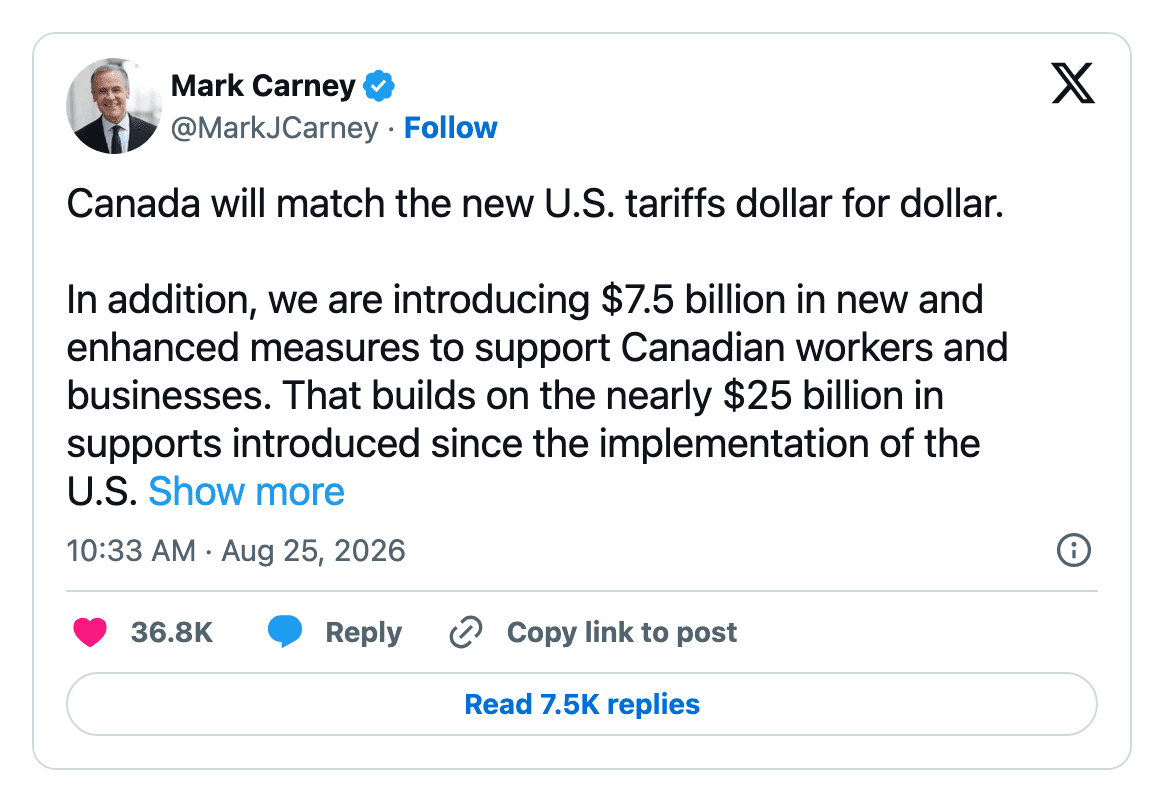
Canadian PM Mark Carney's response on X: a clear tit-for-tat strategy, matching the US tariffs dollar for dollar (Aug 25, 2026)
Two days later came the executive order directing US federal agencies to refer to Lake Ontario as "Lake America." Carney's response was that the name "is more than 400 years old, pre-dating both the Confederation of Canada and the Declaration of Independence of the United States of America." Ontario Premier Doug Ford put up a giant "Lake Ontario" sign on the waterfront and predicted the name would outlast the presidency. Illinois Governor JB Pritzker proposed renaming Lake Michigan "Lake Illinois" and annexing Green Bay. A week later, Carney told reporters that talks could resume when Washington decided to "stop doing memes, stop throwing shade... and start being serious."
It would be easy to file the lake episode under comedy, and Canadians largely did. But manufacturers making ten-year tooling and plant decisions read symbols as information. A government willing to spend political capital renaming a lake is signaling something about how it views the relationship, and that signal gets priced into every cross-border investment case that crosses a CFO's desk this quarter.
The measures themselves kept arriving on schedule:
Date | Measure | Scope |
|---|---|---|
Aug 22 | US 50% tariffs | ~$20B of Canadian goods |
Sep 8 | Canada 15-50% surtaxes | 700+ US products, C$27.6B |
Sep 29 | US import bans | Some dairy, motorcycles, most alcohol |
Jan 1 | US 50% auto tariffs (planned) | Canadian cars and parts |
Canada's September 8 package applies surtaxes of 15%, 25%, or 50% to more than 700 US products covering C$27.6 billion of imports -- steel, dairy, appliances, agricultural equipment, pulp and paper, electronics. The US response, effective September 29, moved from tariffs to outright import bans on some Canadian dairy, motorcycles, and most alcoholic beverages. And the administration has said tariffs on Canadian cars and parts will rise to 50% on January 1, 2027.
A tariff and an import ban are different problems. A tariff is a cost that can be modeled, passed through, engineered around, or absorbed. A ban has to be managed as a supply interruption instead -- allocation, rerouting, substitution, customer communication. The September 29 bans are small in dollar terms, but they moved the escalation into a category that supply chain teams treat much more seriously, because the response toolkit is thinner.
There was also one signal worth noting on the de-escalation side. On September 10, Carney described the latest US measures as "relatively modest" and suggested Canada might hold off on further retaliation. For manufacturers reading the tea leaves, that restraint matters as much as the tariff schedule: Ottawa is defending its position without trying to turn every headline into another round.
The Auto Pact Turned Two National Industries Into One
The integration being taxed here was built deliberately, and it is older than most of the people managing it.
In January 1965, Lester Pearson and Lyndon Johnson signed the Canada-US Automotive Products Agreement, removing duties on vehicles and original-equipment parts traded between the two countries. Two-way automotive trade grew from $716 million in 1964 to $51.5 billion by 1987, and the pact's real legacy was structural: it stopped making sense to talk about a Canadian auto industry and an American one. There is one North American auto industry, and it happens to have a border running through the middle of it. The industrial partnership goes back further still -- to the Hyde Park Declaration of 1941, when the two countries pooled war production, and NORAD in 1958, when they pooled continental air defense.
The practical consequence today: an engine, transmission, or seat assembly can cross the Michigan-Ontario border up to eight times before it ends up in a finished vehicle. Stampings go south, machined assemblies come north, modules go south again. The Windsor-Detroit corridor alone carries roughly 30% of Canada-US truck trade -- more than $274 million in goods every day. Under USMCA, vehicles need 75% North American content to qualify for duty-free treatment, a rule that assumed the three countries were building things together indefinitely.
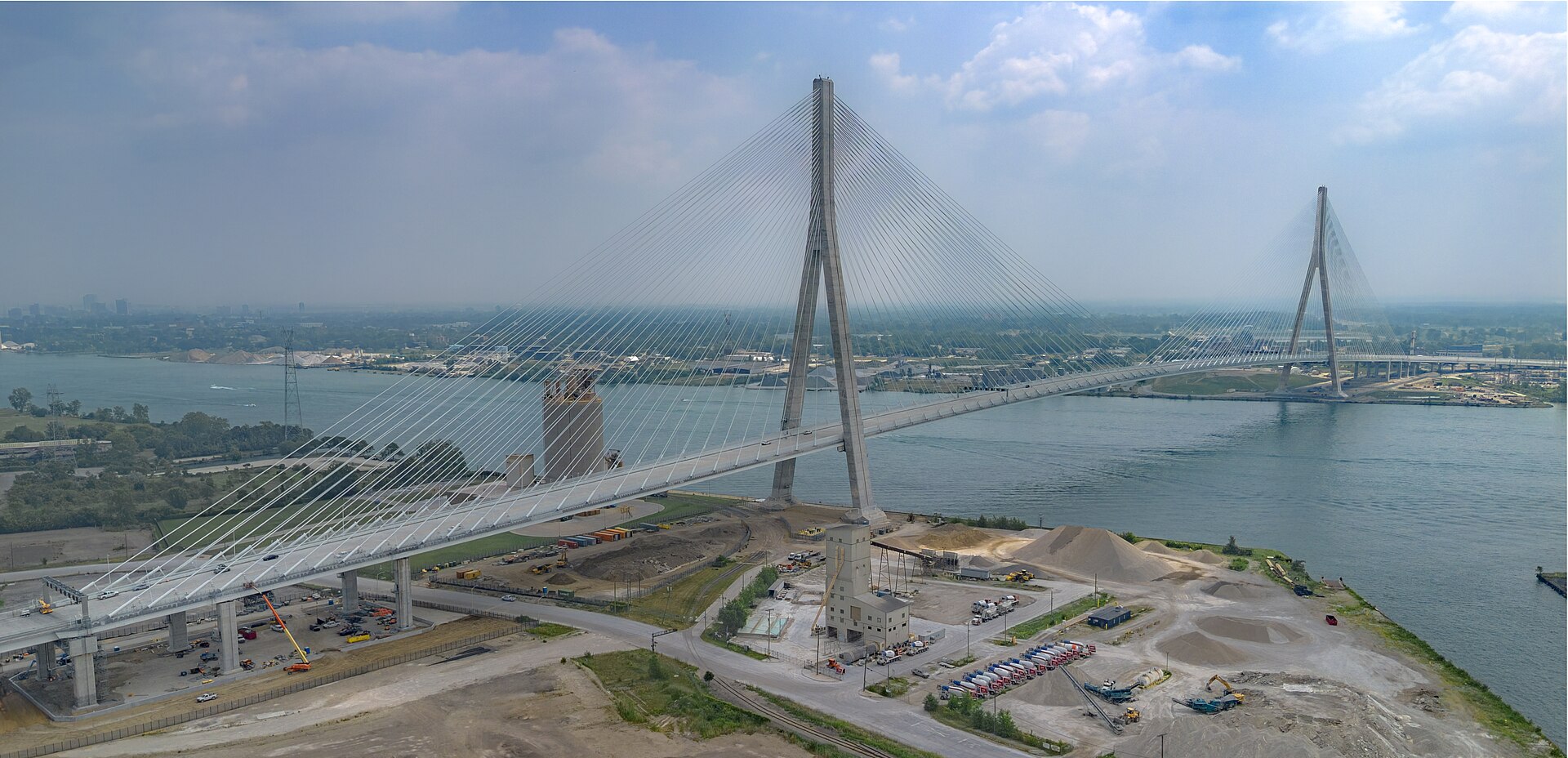
The Gordie Howe International Bridge, opened July 27, 2026 -- a second span for the corridor that carries about 30% of Canada-US truck trade. Photo: Wikimedia Commons (CC0)
A tariff schedule reads each of those border crossings as a taxable event, while a production system reads them as ordinary manufacturing steps, and the gap between those two readings is where the damage accumulates -- the tax compounds with every crossing unless duty relief is claimed correctly at each stage. Having spent years at Tesla watching how long it takes to qualify a new supplier for a safety-critical part -- months of PPAP samples, audits, and validation builds, sometimes years for complex assemblies -- I can say the political and industrial timelines have nothing to do with each other: tariff schedules change in weeks, while supply chains change in years.
What America Buys From Canada Would Be Hard to Replace Quickly
The auto corridor is the most visible integration, but the dependency runs through the least glamorous rows of the American BOM.
Canada supplies about 60% of US crude oil imports, 85% of US electricity imports, and more than 99% of US natural gas imports. It supplied 56% of US aluminum imports from 2021 to 2024 -- nine of Canada's ten smelters sit in Quebec, running on hydropower the US cannot replicate without building dams -- and roughly 80% of the potash American farmers put on their fields. About 85% of US softwood lumber imports come from Canadian mills.
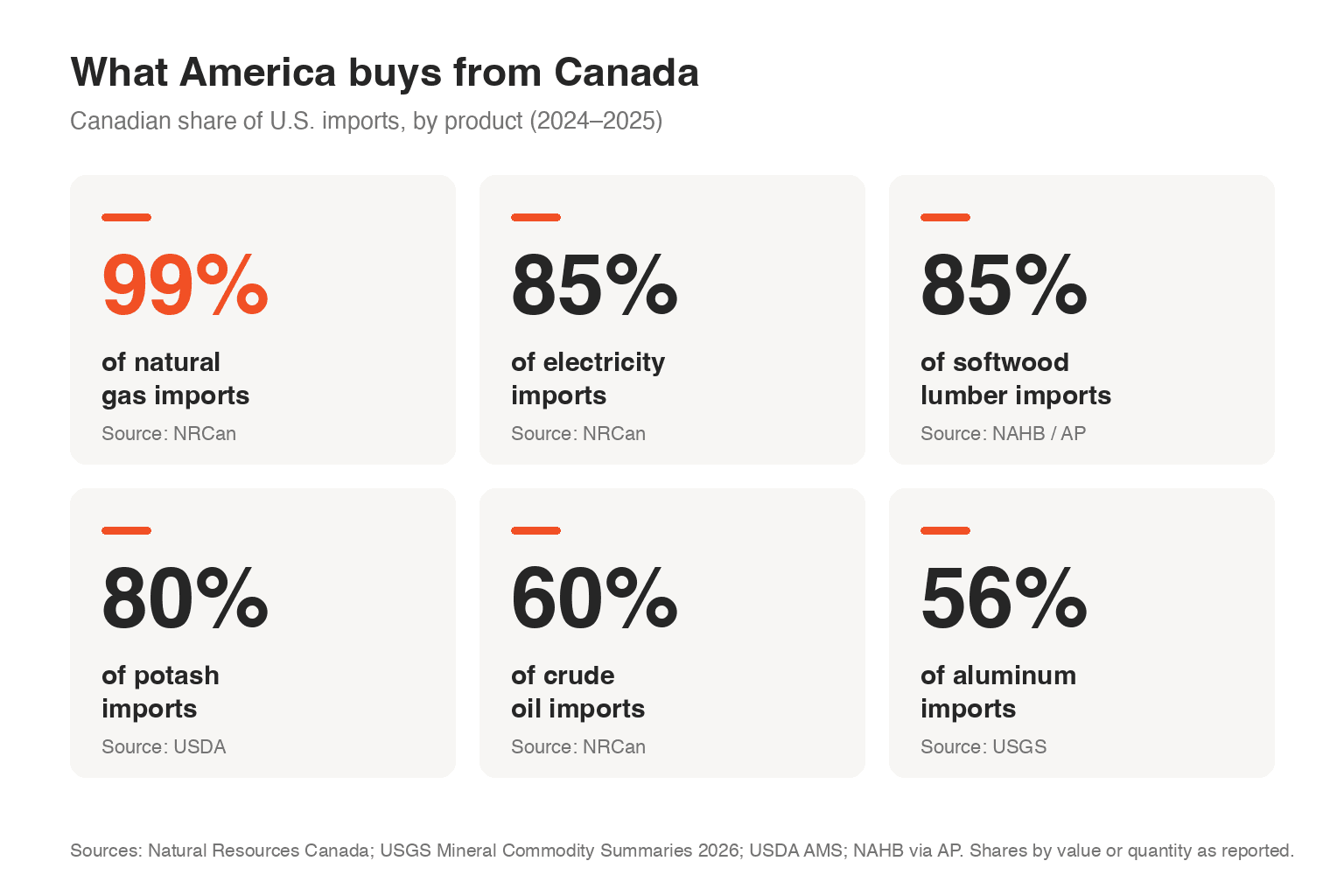
Canada's share of what the US imports, by product -- Sources: Natural Resources Canada, USGS, USDA, NAHB via AP (2024-2025)
None of these are commodities a buyer re-sources in a quarter. Aluminum smelting capacity takes years to permit and build and needs cheap electricity to pencil. Potash comes from a handful of geological deposits, and Saskatchewan holds the largest. Refineries in the Midwest are configured for Canadian heavy crude specifically. The same facts explain why Ottawa has used these pressure points sparingly: every one of them has a domestic blast radius, and restricting oil, aluminum, or potash flows would hurt Alberta producers, Quebec smelters, and Saskatchewan miners before it changed anyone's mind in Washington. When analysts at RBC estimated that the August tariff package directly touches only about 0.4% of Canada's GDP, because roughly 95% of Canadian exports to the US still move under USMCA carve-outs, they were describing the same fact from the other side: the integrated system is still mostly functioning, because neither country can actually afford to switch it off.
That carve-out number deserves emphasis, because it is the most underreported fact in this story. As of August, an estimated 82.3% of Canadian export value still enters the US duty-free under USMCA compliance. The escalation is real and the trajectory is bad, but the day-to-day reality for most cross-border shipments is that origin certification -- paperwork -- is what separates a 0% rate from a 50% one. My colleague Renette Youssef wrote about this dynamic after the IEEPA ruling: the legal ground under tariff policy keeps shifting, and treating any single ruling or carve-out as permanent is how teams get caught.
Canada Is Already Building Its Next Alliances
While the tariff schedule escalated, Canadian diplomacy pointed somewhere else entirely.
This week -- September 15, as I write this -- Carney is in Europe, where he will address the European Parliament and pitch what Canadian officials call a "unique security and economic alliance" with the EU. Officials have explicitly rejected the "associate membership" label; the substance under discussion includes trade, defense, and mobility arrangements that would let Canadians live and work in Europe more freely. Canada-EU trade reached about C$147 billion in 2025, making the EU Canada's second-largest trading partner, at roughly a sixth the scale of the US relationship.
The defense piece moved first, and it moved fast. Canada signed a Security and Defence Partnership with the EU in June 2025, and by February 2026 it had become the first non-European country to join SAFE, the EU's €150 billion joint defense procurement program -- meaning Canadian defense manufacturers now bid into European programs on preferential terms. A Canada-Germany partnership covering supply chains, raw materials, and energy followed at the 2026 NATO summit. Canada also sent its largest-ever trade mission to Japan in June, shipped its first LNG cargo from Kitimat in July 2025, and is using the Trans Mountain pipeline expansion to send crude to Pacific markets -- one reason US imports of Canadian crude fell 4% in 2025. At home, the One Canadian Economy Act is dismantling interprovincial trade barriers that have quietly taxed Canadian commerce for a century.
Anyone who has managed a supplier with dangerous customer concentration will recognize this playbook. Canada sends roughly 68-76% of its exports to one customer. No responsible operator walks away from a customer like that, and Ottawa is not trying to -- Carney has been explicit that Europe complements rather than replaces the US relationship. What Canada is doing is what any good supplier does after a brutal QBR with a dominant customer: keep serving the account, and quietly make sure the next contract negotiation happens from a position with more options. The difference is that this time the diversification is happening at the speed of national policy, with defense procurement -- the stickiest, longest-duration kind -- leading the way.
What This Does to Sourcing Decisions
For procurement and supply chain teams, the last three weeks are less about any single tariff line and more about a regime change: political risk between allies now has to be priced like political risk anywhere else. The wrong response is redesigning a supply network off headlines before doing line-level exposure work -- most SKUs are not equally exposed, and many are not exposed at all. In practice, five moves matter.
Treat origin certification as a profit center. With USMCA carve-outs still exempting most compliant goods, the difference between documented and undocumented certificates of origin is now the difference between 0% and 50%. Regional value content calculations that used to be an annual compliance chore need to be current, defensible, and attached to every part.
Map exposure at the HTS line level. Canada's surtaxes are assigned by tariff classification and origin, at 15%, 25%, or 50% depending on the product. Ship-from and origin are different things: a product shipped from a US warehouse is not automatically US-origin, and a Canadian supplier may be selling goods with substantial US content, so the surtax math turns on origin evidence rather than the return address. Teams that know their classification data can quantify exposure in hours; teams that do not are estimating. We wrote a full guide to HTS codes and built automatic classification into our product for exactly this situation.
Claim the relief that exists. CBSA confirmed that Canada's Duties Relief and Duty Drawback Programs apply to the new surtaxes -- if you import US inputs into Canada and re-export the finished goods, much of that money is recoverable. The mechanics are unglamorous and the deadlines are real; I wrote a practical guide to duty drawback earlier this year. Bonded warehouses and foreign trade zones belong in the same conversation.
Plan for bans, at least on paper. The September 29 import exclusions affect a narrow product list, but they establish that this dispute can produce supply interruptions rather than just cost increases. A total landed cost model handles a tariff; only an allocation and substitution plan handles a ban.
Dual-source selectively, with honest math. My colleague Andy Hunt has written about the convergence problem in dual sourcing -- adding a second source that shares the same upstream dependency buys less resilience than it appears to. That logic cuts hard here: for Canadian aluminum, potash, or heavy crude, the second source often does not exist at scale, and pretending otherwise in a risk review helps no one. Where genuine dual sourcing is possible -- fabricated components, some electronics, discretionary categories -- the qualification clock should have started weeks ago.
Contracts deserve the same review as parts. Incoterms, duty responsibility, change-in-law clauses, and price-adjustment rights are what decide who actually pays when a 50% duty appears in the middle of a program year, and most of those clauses were negotiated in an era when nobody thought to stress-test them against a trade war between allies.
Our Canadian Customers Are Handling This Better Than the Politics Deserve
Valcourt, Quebec is a town of about 2,300 people where Joseph-Armand Bombardier built his first successful snowmobile in 1937. Today it is the headquarters of BRP, which makes Ski-Doo snowmobiles, Sea-Doo watercraft, and Can-Am vehicles there and sells most of them to Americans. BRP spent the spring staring at a potential C$500 million tariff exposure and suspended its guidance. By early September, Bloomberg's headline was that BRP "weathers tariffs, boosts outlook" -- disciplined mitigation brought the expected net impact down to roughly C$200 million. Then the September 29 exclusions pulled its Valcourt-built Can-Am Spyder and Canyon three-wheelers out of the US market entirely. The company's response, characteristically, was that the fiscal-year impact should be limited because most of the season's production had already shipped.
That detail carries a general lesson: the same policy can be a minor financial event or a major customer crisis depending on where it lands in the production and sales calendar. A seasonal product late in its delivery cycle has a completely different exposure than a high-runner component feeding a daily assembly schedule. This is what operating through the escalation actually looks like -- teams re-planning, week after week, when they learn on a Tuesday that a product line they have built for years cannot enter their largest market after the 29th.

LightSource VP of Sales Sam Tearle and Deployment Strategist Beata on site in Valcourt, Quebec, supporting the BRP team
Two of our team members, Sam Tearle and Beata, were in Valcourt recently working with the BRP team -- the photo above is from that trip. I want to say plainly how much we cherish our Canadian customers. From BRP in Valcourt to Canada Goose in Toronto, they are some of the most capable manufacturing organizations we work with, and they are navigating a policy environment this year that none of them created. Watching their sourcing teams work through tariff schedule changes in real time -- recalculating landed costs, re-checking origin documentation, rerunning award scenarios -- has been a lesson in professionalism under absurd circumstances. Sam has written before about consolidating your data rather than your software, and this is the season that argument was built for: the teams handling this well are the ones whose cost, origin, and classification data lives in one place, attached to the BOM, where a policy change can be translated into a dollar figure the same afternoon.
That is the role LightSource plays for cross-border manufacturers: keeping landed cost, tariff exposure, and supplier data connected to the BOM so that when a surtax schedule changes on a Tuesday, the cost picture is current by Wednesday. Our customers on both sides of this border are re-quoting parts and re-running scenarios weekly right now. That cadence is the new normal, and it rewards teams whose data is ready for it.
Sixty years ago, two countries decided their auto industries should function as one, and then built exactly that. The bridges, the tooling, the supplier networks, and the careers followed. Three weeks of tariff schedules have not undone sixty years of physical integration, and the 82% of trade still moving duty-free suggests the system is bending rather than breaking. But something has changed that will outlast this news cycle: the assumption that integration between allies is politically risk-free has been retired, on both sides of the river. Every manufacturer with a cross-border BOM is now pricing that. The Gordie Howe Bridge, meanwhile, is open, six lanes, built for a century of traffic. What crosses it -- and at what tariff rate -- is now a live question in a way its planners never imagined.
Sources
Canada Department of Finance -- countermeasures announcement, Aug 25, 2026 -- dollar-for-dollar package and C$7.5B in support measures
Canada Department of Finance -- complete list of US products subject to counter-tariffs -- the 700+ product list effective Sept 8, 2026
CBSA Customs Notice 26-23 -- 15/25/50% surtax mechanics; duties relief and duty drawback availability
Axios -- US-Canada trade talks collapse, Aug 22, 2026 -- 50% US tariffs on ~$20B of Canadian goods
AP -- US import bans effective Sept 29, 2026 -- dairy, motorcycle, and alcohol exclusions
Le Monde -- Canada reduces economic dependence on the US, Sept 15, 2026 -- Jan 1, 2027 50% auto tariff plans
NPR -- Carney press conference, Aug 22, 2026 -- "You're at war when you get attacked"
CBC -- Lake Ontario executive order -- Canadian officials' responses
Government of Canada treaty database -- 1965 Automotive Products Agreement
USITC -- US-Canada FTA review -- Auto Pact trade growth, $716M (1964) to $51.5B (1987)
TIME -- Canada's economic dependence on the US -- auto parts crossing the border up to eight times
CBSA -- Gordie Howe International Bridge port of entry -- corridor trade statistics
Natural Resources Canada -- energy, aluminum, and potash facts -- Canadian shares of US energy and materials imports
USGS Mineral Commodity Summaries 2026 -- aluminum import sourcing
USDA Grain Transportation Report, April 2025 -- 80% of US potash imports from Canada
AP -- softwood lumber -- Canada supplies ~85% of US softwood lumber imports
AP -- RBC estimate of tariff package scope -- ~0.4% of Canadian GDP directly affected
Global Trade Alert -- Section 338 Canada analysis -- 82.3% of Canadian export value still duty-free
AP -- Canada-EU "unique alliance" -- Carney's September 2026 Europe push
Council of the EU -- Canada joins SAFE -- first non-European participant in the €150B program
Global Affairs Canada -- CUSMA joint review -- the agreement remains in force to 2036
Frequently Asked Questions
What are Canada's retaliatory tariffs on US goods in 2026?
Effective September 8, 2026, Canada applies surtaxes of 15%, 25%, or 50% to more than 700 US-origin products covering C$27.6 billion in annual imports, including steel, dairy, appliances, agricultural equipment, pulp and paper, and electronics. The package was designed to match new US tariffs of 50% on roughly $20 billion of Canadian goods dollar for dollar. Canada's Duties Relief and Duty Drawback Programs remain available for the new surtaxes.
Is most US-Canada trade still tariff-free?
Yes. As of August 2026, an estimated 82% of Canadian export value still enters the US duty-free under USMCA (CUSMA) compliance carve-outs, and the agreement itself remains in force until 2036. The practical implication for manufacturers is that documented USMCA origin certification is often the difference between a 0% and a 50% duty rate on the same part.
How many times do auto parts cross the US-Canada border during manufacturing?
Parts and assemblies in the Michigan-Ontario auto corridor can cross the border up to eight times before final vehicle assembly -- stampings, machining, module assembly, and final integration frequently happen on alternating sides of the Detroit River. This integration dates to the 1965 Auto Pact, which removed duties on vehicles and original-equipment parts and grew two-way auto trade from $716 million in 1964 to $51.5 billion by 1987.
What is Canada doing to reduce its dependence on US trade?
Canada is pursuing a "unique security and economic alliance" with the European Union, became the first non-European participant in the EU's €150 billion SAFE defense procurement program in February 2026, signed a partnership agreement with Germany covering supply chains and raw materials, sent its largest-ever trade mission to Japan, began LNG exports from Kitimat in 2025, and is removing interprovincial trade barriers through the One Canadian Economy Act. Canadian officials describe these moves as diversification rather than replacement -- roughly 70% of Canadian exports still go to the US.
What should procurement teams do about the US-Canada tariff escalation?
Five moves matter most: keep USMCA origin certification current and documented on every part, since compliant goods still largely cross duty-free; map tariff exposure at the HTS classification line level; claim available duty drawback and duties relief on re-exported goods; build allocation plans for import bans, not just cost models for tariffs; and pursue dual sourcing only where a genuinely independent second source exists.
Why is Detroit north of Canada?
Windsor, Ontario sits on the south bank of the Detroit River, directly across from Detroit, Michigan -- so crossing from Detroit into Canada means traveling south. The quirk exists because the border follows the river through the Great Lakes rather than a straight line of latitude. The Detroit-Windsor crossing is the busiest commercial land border in North America, served by the Ambassador Bridge since 1929 and the Gordie Howe International Bridge since July 2026.
When you drive from Detroit into Canada, you drive south. Windsor, Ontario sits below Detroit on the map, across the Detroit River, which is why a corner of Michigan is the rare piece of America with Canadian territory to its south. On July 27 of this year, the Gordie Howe International Bridge opened across that river after more than a decade of planning and construction -- a second span for the busiest commercial border crossing in North America, built because the two countries expected trade between them to keep growing.
Six weeks later, the United States put a 50% tariff on roughly $20 billion of Canadian goods. Canada matched it dollar for dollar. Somewhere in between, the White House issued an executive order renaming Lake Ontario.
I want to look at this from the supply chain seat rather than the political one: what actually changed this month, why the industrial integration between these two countries runs deeper than most people realize, what Canada is doing about its concentration problem, and what procurement teams on both sides of the border can do while the politics play out.
The Escalation: From Collapsed Talks to Dollar-for-Dollar Tariffs in Three Weeks
The sequence matters, because each step changed the kind of problem manufacturers are managing -- and each raised the part-level cost question I take up in Blueprints Into Paychecks.
Trade talks between Ottawa and Washington collapsed late on August 21, and new US tariffs of 50% took effect on roughly $20 billion of Canadian goods. Prime Minister Mark Carney published his response as a formal statement on X the same night. Two lines from it are worth reading closely: "We have recognised from the beginning that America has changed... Putting tariffs on its closest allies and charging for access to its vast market." And later: "Canada has what the world wants. And we will not allow any nation to determine our future." Asked about the collapse at a press conference the next day, he was blunter: "You're at war when you get attacked. We got attacked."
On August 25, Canada announced it would match the US tariffs dollar for dollar, rate for rate, alongside C$7.5 billion in new support for affected workers and businesses.
Canadian PM Mark Carney's response on X: a clear tit-for-tat strategy, matching the US tariffs dollar for dollar (Aug 25, 2026)
Two days later came the executive order directing US federal agencies to refer to Lake Ontario as "Lake America." Carney's response was that the name "is more than 400 years old, pre-dating both the Confederation of Canada and the Declaration of Independence of the United States of America." Ontario Premier Doug Ford put up a giant "Lake Ontario" sign on the waterfront and predicted the name would outlast the presidency. Illinois Governor JB Pritzker proposed renaming Lake Michigan "Lake Illinois" and annexing Green Bay. A week later, Carney told reporters that talks could resume when Washington decided to "stop doing memes, stop throwing shade... and start being serious."
It would be easy to file the lake episode under comedy, and Canadians largely did. But manufacturers making ten-year tooling and plant decisions read symbols as information. A government willing to spend political capital renaming a lake is signaling something about how it views the relationship, and that signal gets priced into every cross-border investment case that crosses a CFO's desk this quarter.
The measures themselves kept arriving on schedule:
Date | Measure | Scope |
|---|---|---|
Aug 22 | US 50% tariffs | ~$20B of Canadian goods |
Sep 8 | Canada 15-50% surtaxes | 700+ US products, C$27.6B |
Sep 29 | US import bans | Some dairy, motorcycles, most alcohol |
Jan 1 | US 50% auto tariffs (planned) | Canadian cars and parts |
Canada's September 8 package applies surtaxes of 15%, 25%, or 50% to more than 700 US products covering C$27.6 billion of imports -- steel, dairy, appliances, agricultural equipment, pulp and paper, electronics. The US response, effective September 29, moved from tariffs to outright import bans on some Canadian dairy, motorcycles, and most alcoholic beverages. And the administration has said tariffs on Canadian cars and parts will rise to 50% on January 1, 2027.
A tariff and an import ban are different problems. A tariff is a cost that can be modeled, passed through, engineered around, or absorbed. A ban has to be managed as a supply interruption instead -- allocation, rerouting, substitution, customer communication. The September 29 bans are small in dollar terms, but they moved the escalation into a category that supply chain teams treat much more seriously, because the response toolkit is thinner.
There was also one signal worth noting on the de-escalation side. On September 10, Carney described the latest US measures as "relatively modest" and suggested Canada might hold off on further retaliation. For manufacturers reading the tea leaves, that restraint matters as much as the tariff schedule: Ottawa is defending its position without trying to turn every headline into another round.
The Auto Pact Turned Two National Industries Into One
The integration being taxed here was built deliberately, and it is older than most of the people managing it.
In January 1965, Lester Pearson and Lyndon Johnson signed the Canada-US Automotive Products Agreement, removing duties on vehicles and original-equipment parts traded between the two countries. Two-way automotive trade grew from $716 million in 1964 to $51.5 billion by 1987, and the pact's real legacy was structural: it stopped making sense to talk about a Canadian auto industry and an American one. There is one North American auto industry, and it happens to have a border running through the middle of it. The industrial partnership goes back further still -- to the Hyde Park Declaration of 1941, when the two countries pooled war production, and NORAD in 1958, when they pooled continental air defense.
The practical consequence today: an engine, transmission, or seat assembly can cross the Michigan-Ontario border up to eight times before it ends up in a finished vehicle. Stampings go south, machined assemblies come north, modules go south again. The Windsor-Detroit corridor alone carries roughly 30% of Canada-US truck trade -- more than $274 million in goods every day. Under USMCA, vehicles need 75% North American content to qualify for duty-free treatment, a rule that assumed the three countries were building things together indefinitely.
The Gordie Howe International Bridge, opened July 27, 2026 -- a second span for the corridor that carries about 30% of Canada-US truck trade. Photo: Wikimedia Commons (CC0)
A tariff schedule reads each of those border crossings as a taxable event, while a production system reads them as ordinary manufacturing steps, and the gap between those two readings is where the damage accumulates -- the tax compounds with every crossing unless duty relief is claimed correctly at each stage. Having spent years at Tesla watching how long it takes to qualify a new supplier for a safety-critical part -- months of PPAP samples, audits, and validation builds, sometimes years for complex assemblies -- I can say the political and industrial timelines have nothing to do with each other: tariff schedules change in weeks, while supply chains change in years.
What America Buys From Canada Would Be Hard to Replace Quickly
The auto corridor is the most visible integration, but the dependency runs through the least glamorous rows of the American BOM.
Canada supplies about 60% of US crude oil imports, 85% of US electricity imports, and more than 99% of US natural gas imports. It supplied 56% of US aluminum imports from 2021 to 2024 -- nine of Canada's ten smelters sit in Quebec, running on hydropower the US cannot replicate without building dams -- and roughly 80% of the potash American farmers put on their fields. About 85% of US softwood lumber imports come from Canadian mills.
Canada's share of what the US imports, by product -- Sources: Natural Resources Canada, USGS, USDA, NAHB via AP (2024-2025)
None of these are commodities a buyer re-sources in a quarter. Aluminum smelting capacity takes years to permit and build and needs cheap electricity to pencil. Potash comes from a handful of geological deposits, and Saskatchewan holds the largest. Refineries in the Midwest are configured for Canadian heavy crude specifically. The same facts explain why Ottawa has used these pressure points sparingly: every one of them has a domestic blast radius, and restricting oil, aluminum, or potash flows would hurt Alberta producers, Quebec smelters, and Saskatchewan miners before it changed anyone's mind in Washington. When analysts at RBC estimated that the August tariff package directly touches only about 0.4% of Canada's GDP, because roughly 95% of Canadian exports to the US still move under USMCA carve-outs, they were describing the same fact from the other side: the integrated system is still mostly functioning, because neither country can actually afford to switch it off.
That carve-out number deserves emphasis, because it is the most underreported fact in this story. As of August, an estimated 82.3% of Canadian export value still enters the US duty-free under USMCA compliance. The escalation is real and the trajectory is bad, but the day-to-day reality for most cross-border shipments is that origin certification -- paperwork -- is what separates a 0% rate from a 50% one. My colleague Renette Youssef wrote about this dynamic after the IEEPA ruling: the legal ground under tariff policy keeps shifting, and treating any single ruling or carve-out as permanent is how teams get caught.
Canada Is Already Building Its Next Alliances
While the tariff schedule escalated, Canadian diplomacy pointed somewhere else entirely.
This week -- September 15, as I write this -- Carney is in Europe, where he will address the European Parliament and pitch what Canadian officials call a "unique security and economic alliance" with the EU. Officials have explicitly rejected the "associate membership" label; the substance under discussion includes trade, defense, and mobility arrangements that would let Canadians live and work in Europe more freely. Canada-EU trade reached about C$147 billion in 2025, making the EU Canada's second-largest trading partner, at roughly a sixth the scale of the US relationship.
The defense piece moved first, and it moved fast. Canada signed a Security and Defence Partnership with the EU in June 2025, and by February 2026 it had become the first non-European country to join SAFE, the EU's €150 billion joint defense procurement program -- meaning Canadian defense manufacturers now bid into European programs on preferential terms. A Canada-Germany partnership covering supply chains, raw materials, and energy followed at the 2026 NATO summit. Canada also sent its largest-ever trade mission to Japan in June, shipped its first LNG cargo from Kitimat in July 2025, and is using the Trans Mountain pipeline expansion to send crude to Pacific markets -- one reason US imports of Canadian crude fell 4% in 2025. At home, the One Canadian Economy Act is dismantling interprovincial trade barriers that have quietly taxed Canadian commerce for a century.
Anyone who has managed a supplier with dangerous customer concentration will recognize this playbook. Canada sends roughly 68-76% of its exports to one customer. No responsible operator walks away from a customer like that, and Ottawa is not trying to -- Carney has been explicit that Europe complements rather than replaces the US relationship. What Canada is doing is what any good supplier does after a brutal QBR with a dominant customer: keep serving the account, and quietly make sure the next contract negotiation happens from a position with more options. The difference is that this time the diversification is happening at the speed of national policy, with defense procurement -- the stickiest, longest-duration kind -- leading the way.
What This Does to Sourcing Decisions
For procurement and supply chain teams, the last three weeks are less about any single tariff line and more about a regime change: political risk between allies now has to be priced like political risk anywhere else. The wrong response is redesigning a supply network off headlines before doing line-level exposure work -- most SKUs are not equally exposed, and many are not exposed at all. In practice, five moves matter.
Treat origin certification as a profit center. With USMCA carve-outs still exempting most compliant goods, the difference between documented and undocumented certificates of origin is now the difference between 0% and 50%. Regional value content calculations that used to be an annual compliance chore need to be current, defensible, and attached to every part.
Map exposure at the HTS line level. Canada's surtaxes are assigned by tariff classification and origin, at 15%, 25%, or 50% depending on the product. Ship-from and origin are different things: a product shipped from a US warehouse is not automatically US-origin, and a Canadian supplier may be selling goods with substantial US content, so the surtax math turns on origin evidence rather than the return address. Teams that know their classification data can quantify exposure in hours; teams that do not are estimating. We wrote a full guide to HTS codes and built automatic classification into our product for exactly this situation.
Claim the relief that exists. CBSA confirmed that Canada's Duties Relief and Duty Drawback Programs apply to the new surtaxes -- if you import US inputs into Canada and re-export the finished goods, much of that money is recoverable. The mechanics are unglamorous and the deadlines are real; I wrote a practical guide to duty drawback earlier this year. Bonded warehouses and foreign trade zones belong in the same conversation.
Plan for bans, at least on paper. The September 29 import exclusions affect a narrow product list, but they establish that this dispute can produce supply interruptions rather than just cost increases. A total landed cost model handles a tariff; only an allocation and substitution plan handles a ban.
Dual-source selectively, with honest math. My colleague Andy Hunt has written about the convergence problem in dual sourcing -- adding a second source that shares the same upstream dependency buys less resilience than it appears to. That logic cuts hard here: for Canadian aluminum, potash, or heavy crude, the second source often does not exist at scale, and pretending otherwise in a risk review helps no one. Where genuine dual sourcing is possible -- fabricated components, some electronics, discretionary categories -- the qualification clock should have started weeks ago.
Contracts deserve the same review as parts. Incoterms, duty responsibility, change-in-law clauses, and price-adjustment rights are what decide who actually pays when a 50% duty appears in the middle of a program year, and most of those clauses were negotiated in an era when nobody thought to stress-test them against a trade war between allies.
Our Canadian Customers Are Handling This Better Than the Politics Deserve
Valcourt, Quebec is a town of about 2,300 people where Joseph-Armand Bombardier built his first successful snowmobile in 1937. Today it is the headquarters of BRP, which makes Ski-Doo snowmobiles, Sea-Doo watercraft, and Can-Am vehicles there and sells most of them to Americans. BRP spent the spring staring at a potential C$500 million tariff exposure and suspended its guidance. By early September, Bloomberg's headline was that BRP "weathers tariffs, boosts outlook" -- disciplined mitigation brought the expected net impact down to roughly C$200 million. Then the September 29 exclusions pulled its Valcourt-built Can-Am Spyder and Canyon three-wheelers out of the US market entirely. The company's response, characteristically, was that the fiscal-year impact should be limited because most of the season's production had already shipped.
That detail carries a general lesson: the same policy can be a minor financial event or a major customer crisis depending on where it lands in the production and sales calendar. A seasonal product late in its delivery cycle has a completely different exposure than a high-runner component feeding a daily assembly schedule. This is what operating through the escalation actually looks like -- teams re-planning, week after week, when they learn on a Tuesday that a product line they have built for years cannot enter their largest market after the 29th.
LightSource VP of Sales Sam Tearle and Deployment Strategist Beata on site in Valcourt, Quebec, supporting the BRP team
Two of our team members, Sam Tearle and Beata, were in Valcourt recently working with the BRP team -- the photo above is from that trip. I want to say plainly how much we cherish our Canadian customers. From BRP in Valcourt to Canada Goose in Toronto, they are some of the most capable manufacturing organizations we work with, and they are navigating a policy environment this year that none of them created. Watching their sourcing teams work through tariff schedule changes in real time -- recalculating landed costs, re-checking origin documentation, rerunning award scenarios -- has been a lesson in professionalism under absurd circumstances. Sam has written before about consolidating your data rather than your software, and this is the season that argument was built for: the teams handling this well are the ones whose cost, origin, and classification data lives in one place, attached to the BOM, where a policy change can be translated into a dollar figure the same afternoon.
That is the role LightSource plays for cross-border manufacturers: keeping landed cost, tariff exposure, and supplier data connected to the BOM so that when a surtax schedule changes on a Tuesday, the cost picture is current by Wednesday. Our customers on both sides of this border are re-quoting parts and re-running scenarios weekly right now. That cadence is the new normal, and it rewards teams whose data is ready for it.
Sixty years ago, two countries decided their auto industries should function as one, and then built exactly that. The bridges, the tooling, the supplier networks, and the careers followed. Three weeks of tariff schedules have not undone sixty years of physical integration, and the 82% of trade still moving duty-free suggests the system is bending rather than breaking. But something has changed that will outlast this news cycle: the assumption that integration between allies is politically risk-free has been retired, on both sides of the river. Every manufacturer with a cross-border BOM is now pricing that. The Gordie Howe Bridge, meanwhile, is open, six lanes, built for a century of traffic. What crosses it -- and at what tariff rate -- is now a live question in a way its planners never imagined.
Sources
Canada Department of Finance -- countermeasures announcement, Aug 25, 2026 -- dollar-for-dollar package and C$7.5B in support measures
Canada Department of Finance -- complete list of US products subject to counter-tariffs -- the 700+ product list effective Sept 8, 2026
CBSA Customs Notice 26-23 -- 15/25/50% surtax mechanics; duties relief and duty drawback availability
Axios -- US-Canada trade talks collapse, Aug 22, 2026 -- 50% US tariffs on ~$20B of Canadian goods
AP -- US import bans effective Sept 29, 2026 -- dairy, motorcycle, and alcohol exclusions
Le Monde -- Canada reduces economic dependence on the US, Sept 15, 2026 -- Jan 1, 2027 50% auto tariff plans
NPR -- Carney press conference, Aug 22, 2026 -- "You're at war when you get attacked"
CBC -- Lake Ontario executive order -- Canadian officials' responses
Government of Canada treaty database -- 1965 Automotive Products Agreement
USITC -- US-Canada FTA review -- Auto Pact trade growth, $716M (1964) to $51.5B (1987)
TIME -- Canada's economic dependence on the US -- auto parts crossing the border up to eight times
CBSA -- Gordie Howe International Bridge port of entry -- corridor trade statistics
Natural Resources Canada -- energy, aluminum, and potash facts -- Canadian shares of US energy and materials imports
USGS Mineral Commodity Summaries 2026 -- aluminum import sourcing
USDA Grain Transportation Report, April 2025 -- 80% of US potash imports from Canada
AP -- softwood lumber -- Canada supplies ~85% of US softwood lumber imports
AP -- RBC estimate of tariff package scope -- ~0.4% of Canadian GDP directly affected
Global Trade Alert -- Section 338 Canada analysis -- 82.3% of Canadian export value still duty-free
AP -- Canada-EU "unique alliance" -- Carney's September 2026 Europe push
Council of the EU -- Canada joins SAFE -- first non-European participant in the €150B program
Global Affairs Canada -- CUSMA joint review -- the agreement remains in force to 2036
Frequently Asked Questions
What are Canada's retaliatory tariffs on US goods in 2026?
Effective September 8, 2026, Canada applies surtaxes of 15%, 25%, or 50% to more than 700 US-origin products covering C$27.6 billion in annual imports, including steel, dairy, appliances, agricultural equipment, pulp and paper, and electronics. The package was designed to match new US tariffs of 50% on roughly $20 billion of Canadian goods dollar for dollar. Canada's Duties Relief and Duty Drawback Programs remain available for the new surtaxes.
Is most US-Canada trade still tariff-free?
Yes. As of August 2026, an estimated 82% of Canadian export value still enters the US duty-free under USMCA (CUSMA) compliance carve-outs, and the agreement itself remains in force until 2036. The practical implication for manufacturers is that documented USMCA origin certification is often the difference between a 0% and a 50% duty rate on the same part.
How many times do auto parts cross the US-Canada border during manufacturing?
Parts and assemblies in the Michigan-Ontario auto corridor can cross the border up to eight times before final vehicle assembly -- stampings, machining, module assembly, and final integration frequently happen on alternating sides of the Detroit River. This integration dates to the 1965 Auto Pact, which removed duties on vehicles and original-equipment parts and grew two-way auto trade from $716 million in 1964 to $51.5 billion by 1987.
What is Canada doing to reduce its dependence on US trade?
Canada is pursuing a "unique security and economic alliance" with the European Union, became the first non-European participant in the EU's €150 billion SAFE defense procurement program in February 2026, signed a partnership agreement with Germany covering supply chains and raw materials, sent its largest-ever trade mission to Japan, began LNG exports from Kitimat in 2025, and is removing interprovincial trade barriers through the One Canadian Economy Act. Canadian officials describe these moves as diversification rather than replacement -- roughly 70% of Canadian exports still go to the US.
What should procurement teams do about the US-Canada tariff escalation?
Five moves matter most: keep USMCA origin certification current and documented on every part, since compliant goods still largely cross duty-free; map tariff exposure at the HTS classification line level; claim available duty drawback and duties relief on re-exported goods; build allocation plans for import bans, not just cost models for tariffs; and pursue dual sourcing only where a genuinely independent second source exists.
Why is Detroit north of Canada?
Windsor, Ontario sits on the south bank of the Detroit River, directly across from Detroit, Michigan -- so crossing from Detroit into Canada means traveling south. The quirk exists because the border follows the river through the Great Lakes rather than a straight line of latitude. The Detroit-Windsor crossing is the busiest commercial land border in North America, served by the Ambassador Bridge since 1929 and the Gordie Howe International Bridge since July 2026.
When you drive from Detroit into Canada, you drive south. Windsor, Ontario sits below Detroit on the map, across the Detroit River, which is why a corner of Michigan is the rare piece of America with Canadian territory to its south. On July 27 of this year, the Gordie Howe International Bridge opened across that river after more than a decade of planning and construction -- a second span for the busiest commercial border crossing in North America, built because the two countries expected trade between them to keep growing.
Six weeks later, the United States put a 50% tariff on roughly $20 billion of Canadian goods. Canada matched it dollar for dollar. Somewhere in between, the White House issued an executive order renaming Lake Ontario.
I want to look at this from the supply chain seat rather than the political one: what actually changed this month, why the industrial integration between these two countries runs deeper than most people realize, what Canada is doing about its concentration problem, and what procurement teams on both sides of the border can do while the politics play out.
The Escalation: From Collapsed Talks to Dollar-for-Dollar Tariffs in Three Weeks
The sequence matters, because each step changed the kind of problem manufacturers are managing -- and each raised the part-level cost question I take up in Blueprints Into Paychecks.
Trade talks between Ottawa and Washington collapsed late on August 21, and new US tariffs of 50% took effect on roughly $20 billion of Canadian goods. Prime Minister Mark Carney published his response as a formal statement on X the same night. Two lines from it are worth reading closely: "We have recognised from the beginning that America has changed... Putting tariffs on its closest allies and charging for access to its vast market." And later: "Canada has what the world wants. And we will not allow any nation to determine our future." Asked about the collapse at a press conference the next day, he was blunter: "You're at war when you get attacked. We got attacked."
On August 25, Canada announced it would match the US tariffs dollar for dollar, rate for rate, alongside C$7.5 billion in new support for affected workers and businesses.
Canadian PM Mark Carney's response on X: a clear tit-for-tat strategy, matching the US tariffs dollar for dollar (Aug 25, 2026)
Two days later came the executive order directing US federal agencies to refer to Lake Ontario as "Lake America." Carney's response was that the name "is more than 400 years old, pre-dating both the Confederation of Canada and the Declaration of Independence of the United States of America." Ontario Premier Doug Ford put up a giant "Lake Ontario" sign on the waterfront and predicted the name would outlast the presidency. Illinois Governor JB Pritzker proposed renaming Lake Michigan "Lake Illinois" and annexing Green Bay. A week later, Carney told reporters that talks could resume when Washington decided to "stop doing memes, stop throwing shade... and start being serious."
It would be easy to file the lake episode under comedy, and Canadians largely did. But manufacturers making ten-year tooling and plant decisions read symbols as information. A government willing to spend political capital renaming a lake is signaling something about how it views the relationship, and that signal gets priced into every cross-border investment case that crosses a CFO's desk this quarter.
The measures themselves kept arriving on schedule:
Date | Measure | Scope |
|---|---|---|
Aug 22 | US 50% tariffs | ~$20B of Canadian goods |
Sep 8 | Canada 15-50% surtaxes | 700+ US products, C$27.6B |
Sep 29 | US import bans | Some dairy, motorcycles, most alcohol |
Jan 1 | US 50% auto tariffs (planned) | Canadian cars and parts |
Canada's September 8 package applies surtaxes of 15%, 25%, or 50% to more than 700 US products covering C$27.6 billion of imports -- steel, dairy, appliances, agricultural equipment, pulp and paper, electronics. The US response, effective September 29, moved from tariffs to outright import bans on some Canadian dairy, motorcycles, and most alcoholic beverages. And the administration has said tariffs on Canadian cars and parts will rise to 50% on January 1, 2027.
A tariff and an import ban are different problems. A tariff is a cost that can be modeled, passed through, engineered around, or absorbed. A ban has to be managed as a supply interruption instead -- allocation, rerouting, substitution, customer communication. The September 29 bans are small in dollar terms, but they moved the escalation into a category that supply chain teams treat much more seriously, because the response toolkit is thinner.
There was also one signal worth noting on the de-escalation side. On September 10, Carney described the latest US measures as "relatively modest" and suggested Canada might hold off on further retaliation. For manufacturers reading the tea leaves, that restraint matters as much as the tariff schedule: Ottawa is defending its position without trying to turn every headline into another round.
The Auto Pact Turned Two National Industries Into One
The integration being taxed here was built deliberately, and it is older than most of the people managing it.
In January 1965, Lester Pearson and Lyndon Johnson signed the Canada-US Automotive Products Agreement, removing duties on vehicles and original-equipment parts traded between the two countries. Two-way automotive trade grew from $716 million in 1964 to $51.5 billion by 1987, and the pact's real legacy was structural: it stopped making sense to talk about a Canadian auto industry and an American one. There is one North American auto industry, and it happens to have a border running through the middle of it. The industrial partnership goes back further still -- to the Hyde Park Declaration of 1941, when the two countries pooled war production, and NORAD in 1958, when they pooled continental air defense.
The practical consequence today: an engine, transmission, or seat assembly can cross the Michigan-Ontario border up to eight times before it ends up in a finished vehicle. Stampings go south, machined assemblies come north, modules go south again. The Windsor-Detroit corridor alone carries roughly 30% of Canada-US truck trade -- more than $274 million in goods every day. Under USMCA, vehicles need 75% North American content to qualify for duty-free treatment, a rule that assumed the three countries were building things together indefinitely.
The Gordie Howe International Bridge, opened July 27, 2026 -- a second span for the corridor that carries about 30% of Canada-US truck trade. Photo: Wikimedia Commons (CC0)
A tariff schedule reads each of those border crossings as a taxable event, while a production system reads them as ordinary manufacturing steps, and the gap between those two readings is where the damage accumulates -- the tax compounds with every crossing unless duty relief is claimed correctly at each stage. Having spent years at Tesla watching how long it takes to qualify a new supplier for a safety-critical part -- months of PPAP samples, audits, and validation builds, sometimes years for complex assemblies -- I can say the political and industrial timelines have nothing to do with each other: tariff schedules change in weeks, while supply chains change in years.
What America Buys From Canada Would Be Hard to Replace Quickly
The auto corridor is the most visible integration, but the dependency runs through the least glamorous rows of the American BOM.
Canada supplies about 60% of US crude oil imports, 85% of US electricity imports, and more than 99% of US natural gas imports. It supplied 56% of US aluminum imports from 2021 to 2024 -- nine of Canada's ten smelters sit in Quebec, running on hydropower the US cannot replicate without building dams -- and roughly 80% of the potash American farmers put on their fields. About 85% of US softwood lumber imports come from Canadian mills.
Canada's share of what the US imports, by product -- Sources: Natural Resources Canada, USGS, USDA, NAHB via AP (2024-2025)
None of these are commodities a buyer re-sources in a quarter. Aluminum smelting capacity takes years to permit and build and needs cheap electricity to pencil. Potash comes from a handful of geological deposits, and Saskatchewan holds the largest. Refineries in the Midwest are configured for Canadian heavy crude specifically. The same facts explain why Ottawa has used these pressure points sparingly: every one of them has a domestic blast radius, and restricting oil, aluminum, or potash flows would hurt Alberta producers, Quebec smelters, and Saskatchewan miners before it changed anyone's mind in Washington. When analysts at RBC estimated that the August tariff package directly touches only about 0.4% of Canada's GDP, because roughly 95% of Canadian exports to the US still move under USMCA carve-outs, they were describing the same fact from the other side: the integrated system is still mostly functioning, because neither country can actually afford to switch it off.
That carve-out number deserves emphasis, because it is the most underreported fact in this story. As of August, an estimated 82.3% of Canadian export value still enters the US duty-free under USMCA compliance. The escalation is real and the trajectory is bad, but the day-to-day reality for most cross-border shipments is that origin certification -- paperwork -- is what separates a 0% rate from a 50% one. My colleague Renette Youssef wrote about this dynamic after the IEEPA ruling: the legal ground under tariff policy keeps shifting, and treating any single ruling or carve-out as permanent is how teams get caught.
Canada Is Already Building Its Next Alliances
While the tariff schedule escalated, Canadian diplomacy pointed somewhere else entirely.
This week -- September 15, as I write this -- Carney is in Europe, where he will address the European Parliament and pitch what Canadian officials call a "unique security and economic alliance" with the EU. Officials have explicitly rejected the "associate membership" label; the substance under discussion includes trade, defense, and mobility arrangements that would let Canadians live and work in Europe more freely. Canada-EU trade reached about C$147 billion in 2025, making the EU Canada's second-largest trading partner, at roughly a sixth the scale of the US relationship.
The defense piece moved first, and it moved fast. Canada signed a Security and Defence Partnership with the EU in June 2025, and by February 2026 it had become the first non-European country to join SAFE, the EU's €150 billion joint defense procurement program -- meaning Canadian defense manufacturers now bid into European programs on preferential terms. A Canada-Germany partnership covering supply chains, raw materials, and energy followed at the 2026 NATO summit. Canada also sent its largest-ever trade mission to Japan in June, shipped its first LNG cargo from Kitimat in July 2025, and is using the Trans Mountain pipeline expansion to send crude to Pacific markets -- one reason US imports of Canadian crude fell 4% in 2025. At home, the One Canadian Economy Act is dismantling interprovincial trade barriers that have quietly taxed Canadian commerce for a century.
Anyone who has managed a supplier with dangerous customer concentration will recognize this playbook. Canada sends roughly 68-76% of its exports to one customer. No responsible operator walks away from a customer like that, and Ottawa is not trying to -- Carney has been explicit that Europe complements rather than replaces the US relationship. What Canada is doing is what any good supplier does after a brutal QBR with a dominant customer: keep serving the account, and quietly make sure the next contract negotiation happens from a position with more options. The difference is that this time the diversification is happening at the speed of national policy, with defense procurement -- the stickiest, longest-duration kind -- leading the way.
What This Does to Sourcing Decisions
For procurement and supply chain teams, the last three weeks are less about any single tariff line and more about a regime change: political risk between allies now has to be priced like political risk anywhere else. The wrong response is redesigning a supply network off headlines before doing line-level exposure work -- most SKUs are not equally exposed, and many are not exposed at all. In practice, five moves matter.
Treat origin certification as a profit center. With USMCA carve-outs still exempting most compliant goods, the difference between documented and undocumented certificates of origin is now the difference between 0% and 50%. Regional value content calculations that used to be an annual compliance chore need to be current, defensible, and attached to every part.
Map exposure at the HTS line level. Canada's surtaxes are assigned by tariff classification and origin, at 15%, 25%, or 50% depending on the product. Ship-from and origin are different things: a product shipped from a US warehouse is not automatically US-origin, and a Canadian supplier may be selling goods with substantial US content, so the surtax math turns on origin evidence rather than the return address. Teams that know their classification data can quantify exposure in hours; teams that do not are estimating. We wrote a full guide to HTS codes and built automatic classification into our product for exactly this situation.
Claim the relief that exists. CBSA confirmed that Canada's Duties Relief and Duty Drawback Programs apply to the new surtaxes -- if you import US inputs into Canada and re-export the finished goods, much of that money is recoverable. The mechanics are unglamorous and the deadlines are real; I wrote a practical guide to duty drawback earlier this year. Bonded warehouses and foreign trade zones belong in the same conversation.
Plan for bans, at least on paper. The September 29 import exclusions affect a narrow product list, but they establish that this dispute can produce supply interruptions rather than just cost increases. A total landed cost model handles a tariff; only an allocation and substitution plan handles a ban.
Dual-source selectively, with honest math. My colleague Andy Hunt has written about the convergence problem in dual sourcing -- adding a second source that shares the same upstream dependency buys less resilience than it appears to. That logic cuts hard here: for Canadian aluminum, potash, or heavy crude, the second source often does not exist at scale, and pretending otherwise in a risk review helps no one. Where genuine dual sourcing is possible -- fabricated components, some electronics, discretionary categories -- the qualification clock should have started weeks ago.
Contracts deserve the same review as parts. Incoterms, duty responsibility, change-in-law clauses, and price-adjustment rights are what decide who actually pays when a 50% duty appears in the middle of a program year, and most of those clauses were negotiated in an era when nobody thought to stress-test them against a trade war between allies.
Our Canadian Customers Are Handling This Better Than the Politics Deserve
Valcourt, Quebec is a town of about 2,300 people where Joseph-Armand Bombardier built his first successful snowmobile in 1937. Today it is the headquarters of BRP, which makes Ski-Doo snowmobiles, Sea-Doo watercraft, and Can-Am vehicles there and sells most of them to Americans. BRP spent the spring staring at a potential C$500 million tariff exposure and suspended its guidance. By early September, Bloomberg's headline was that BRP "weathers tariffs, boosts outlook" -- disciplined mitigation brought the expected net impact down to roughly C$200 million. Then the September 29 exclusions pulled its Valcourt-built Can-Am Spyder and Canyon three-wheelers out of the US market entirely. The company's response, characteristically, was that the fiscal-year impact should be limited because most of the season's production had already shipped.
That detail carries a general lesson: the same policy can be a minor financial event or a major customer crisis depending on where it lands in the production and sales calendar. A seasonal product late in its delivery cycle has a completely different exposure than a high-runner component feeding a daily assembly schedule. This is what operating through the escalation actually looks like -- teams re-planning, week after week, when they learn on a Tuesday that a product line they have built for years cannot enter their largest market after the 29th.
LightSource VP of Sales Sam Tearle and Deployment Strategist Beata on site in Valcourt, Quebec, supporting the BRP team
Two of our team members, Sam Tearle and Beata, were in Valcourt recently working with the BRP team -- the photo above is from that trip. I want to say plainly how much we cherish our Canadian customers. From BRP in Valcourt to Canada Goose in Toronto, they are some of the most capable manufacturing organizations we work with, and they are navigating a policy environment this year that none of them created. Watching their sourcing teams work through tariff schedule changes in real time -- recalculating landed costs, re-checking origin documentation, rerunning award scenarios -- has been a lesson in professionalism under absurd circumstances. Sam has written before about consolidating your data rather than your software, and this is the season that argument was built for: the teams handling this well are the ones whose cost, origin, and classification data lives in one place, attached to the BOM, where a policy change can be translated into a dollar figure the same afternoon.
That is the role LightSource plays for cross-border manufacturers: keeping landed cost, tariff exposure, and supplier data connected to the BOM so that when a surtax schedule changes on a Tuesday, the cost picture is current by Wednesday. Our customers on both sides of this border are re-quoting parts and re-running scenarios weekly right now. That cadence is the new normal, and it rewards teams whose data is ready for it.
Sixty years ago, two countries decided their auto industries should function as one, and then built exactly that. The bridges, the tooling, the supplier networks, and the careers followed. Three weeks of tariff schedules have not undone sixty years of physical integration, and the 82% of trade still moving duty-free suggests the system is bending rather than breaking. But something has changed that will outlast this news cycle: the assumption that integration between allies is politically risk-free has been retired, on both sides of the river. Every manufacturer with a cross-border BOM is now pricing that. The Gordie Howe Bridge, meanwhile, is open, six lanes, built for a century of traffic. What crosses it -- and at what tariff rate -- is now a live question in a way its planners never imagined.
Sources
Canada Department of Finance -- countermeasures announcement, Aug 25, 2026 -- dollar-for-dollar package and C$7.5B in support measures
Canada Department of Finance -- complete list of US products subject to counter-tariffs -- the 700+ product list effective Sept 8, 2026
CBSA Customs Notice 26-23 -- 15/25/50% surtax mechanics; duties relief and duty drawback availability
Axios -- US-Canada trade talks collapse, Aug 22, 2026 -- 50% US tariffs on ~$20B of Canadian goods
AP -- US import bans effective Sept 29, 2026 -- dairy, motorcycle, and alcohol exclusions
Le Monde -- Canada reduces economic dependence on the US, Sept 15, 2026 -- Jan 1, 2027 50% auto tariff plans
NPR -- Carney press conference, Aug 22, 2026 -- "You're at war when you get attacked"
CBC -- Lake Ontario executive order -- Canadian officials' responses
Government of Canada treaty database -- 1965 Automotive Products Agreement
USITC -- US-Canada FTA review -- Auto Pact trade growth, $716M (1964) to $51.5B (1987)
TIME -- Canada's economic dependence on the US -- auto parts crossing the border up to eight times
CBSA -- Gordie Howe International Bridge port of entry -- corridor trade statistics
Natural Resources Canada -- energy, aluminum, and potash facts -- Canadian shares of US energy and materials imports
USGS Mineral Commodity Summaries 2026 -- aluminum import sourcing
USDA Grain Transportation Report, April 2025 -- 80% of US potash imports from Canada
AP -- softwood lumber -- Canada supplies ~85% of US softwood lumber imports
AP -- RBC estimate of tariff package scope -- ~0.4% of Canadian GDP directly affected
Global Trade Alert -- Section 338 Canada analysis -- 82.3% of Canadian export value still duty-free
AP -- Canada-EU "unique alliance" -- Carney's September 2026 Europe push
Council of the EU -- Canada joins SAFE -- first non-European participant in the €150B program
Global Affairs Canada -- CUSMA joint review -- the agreement remains in force to 2036
Frequently Asked Questions
What are Canada's retaliatory tariffs on US goods in 2026?
Effective September 8, 2026, Canada applies surtaxes of 15%, 25%, or 50% to more than 700 US-origin products covering C$27.6 billion in annual imports, including steel, dairy, appliances, agricultural equipment, pulp and paper, and electronics. The package was designed to match new US tariffs of 50% on roughly $20 billion of Canadian goods dollar for dollar. Canada's Duties Relief and Duty Drawback Programs remain available for the new surtaxes.
Is most US-Canada trade still tariff-free?
Yes. As of August 2026, an estimated 82% of Canadian export value still enters the US duty-free under USMCA (CUSMA) compliance carve-outs, and the agreement itself remains in force until 2036. The practical implication for manufacturers is that documented USMCA origin certification is often the difference between a 0% and a 50% duty rate on the same part.
How many times do auto parts cross the US-Canada border during manufacturing?
Parts and assemblies in the Michigan-Ontario auto corridor can cross the border up to eight times before final vehicle assembly -- stampings, machining, module assembly, and final integration frequently happen on alternating sides of the Detroit River. This integration dates to the 1965 Auto Pact, which removed duties on vehicles and original-equipment parts and grew two-way auto trade from $716 million in 1964 to $51.5 billion by 1987.
What is Canada doing to reduce its dependence on US trade?
Canada is pursuing a "unique security and economic alliance" with the European Union, became the first non-European participant in the EU's €150 billion SAFE defense procurement program in February 2026, signed a partnership agreement with Germany covering supply chains and raw materials, sent its largest-ever trade mission to Japan, began LNG exports from Kitimat in 2025, and is removing interprovincial trade barriers through the One Canadian Economy Act. Canadian officials describe these moves as diversification rather than replacement -- roughly 70% of Canadian exports still go to the US.
What should procurement teams do about the US-Canada tariff escalation?
Five moves matter most: keep USMCA origin certification current and documented on every part, since compliant goods still largely cross duty-free; map tariff exposure at the HTS classification line level; claim available duty drawback and duties relief on re-exported goods; build allocation plans for import bans, not just cost models for tariffs; and pursue dual sourcing only where a genuinely independent second source exists.
Why is Detroit north of Canada?
Windsor, Ontario sits on the south bank of the Detroit River, directly across from Detroit, Michigan -- so crossing from Detroit into Canada means traveling south. The quirk exists because the border follows the river through the Great Lakes rather than a straight line of latitude. The Detroit-Windsor crossing is the busiest commercial land border in North America, served by the Ambassador Bridge since 1929 and the Gordie Howe International Bridge since July 2026.


Faster sourcing. Lower cost. Less chaos.
See how LightSource connects engineering, procurement, and suppliers in one operating system to help you launch faster at lower cost.
SOC 2
Kearney #1 2024
Gartner Cool Vendor
Procuretech 100
G2 Top Rated
Faster sourcing. Lower cost. Less chaos.
See how LightSource connects engineering, procurement, and suppliers in one operating system to help you launch faster at lower cost.
SOC 2
Kearney #1 2024
Gartner Cool Vendor
Procuretech 100
G2 Top Rated
Faster sourcing. Lower cost. Less chaos.
See how LightSource connects engineering, procurement, and suppliers in one operating system to help you launch faster at lower cost.
SOC 2
Kearney #1 2024
Gartner Cool Vendor
Procuretech 100
G2 Top Rated
Trusted by:
Trusted by:
Trusted by: