

I learned control systems more or less by accident. During my first masters at Penn -- robotics engineering -- I took a controls course with Dr. Bruce Kothmann, mostly because it fit my schedule. I did not know what control theory was when I enrolled. By the end of the semester it had, weirdly and nerd-ily, changed how I look at almost everything: thermostats, markets, org charts, my own bad habits. Once you can see feedback loops, you cannot stop seeing them.
Years of vehicle programs at Tesla and Waymo only made it worse, because a car is just control loops wearing a body. And now that I spend my days in procurement, I keep seeing the same thing, everywhere, in reverse: a function with a target, a system that drifts, a delay between action and effect -- running with the loop wide open.
So this post is the nerdy detour I wish someone had given every procurement leader. What a control loop actually is, using nothing more exotic than cruise control. Why spend management is structurally the same problem. And what it would mean -- practically, with today's tools -- to finally close the loop.
First, the cruise control
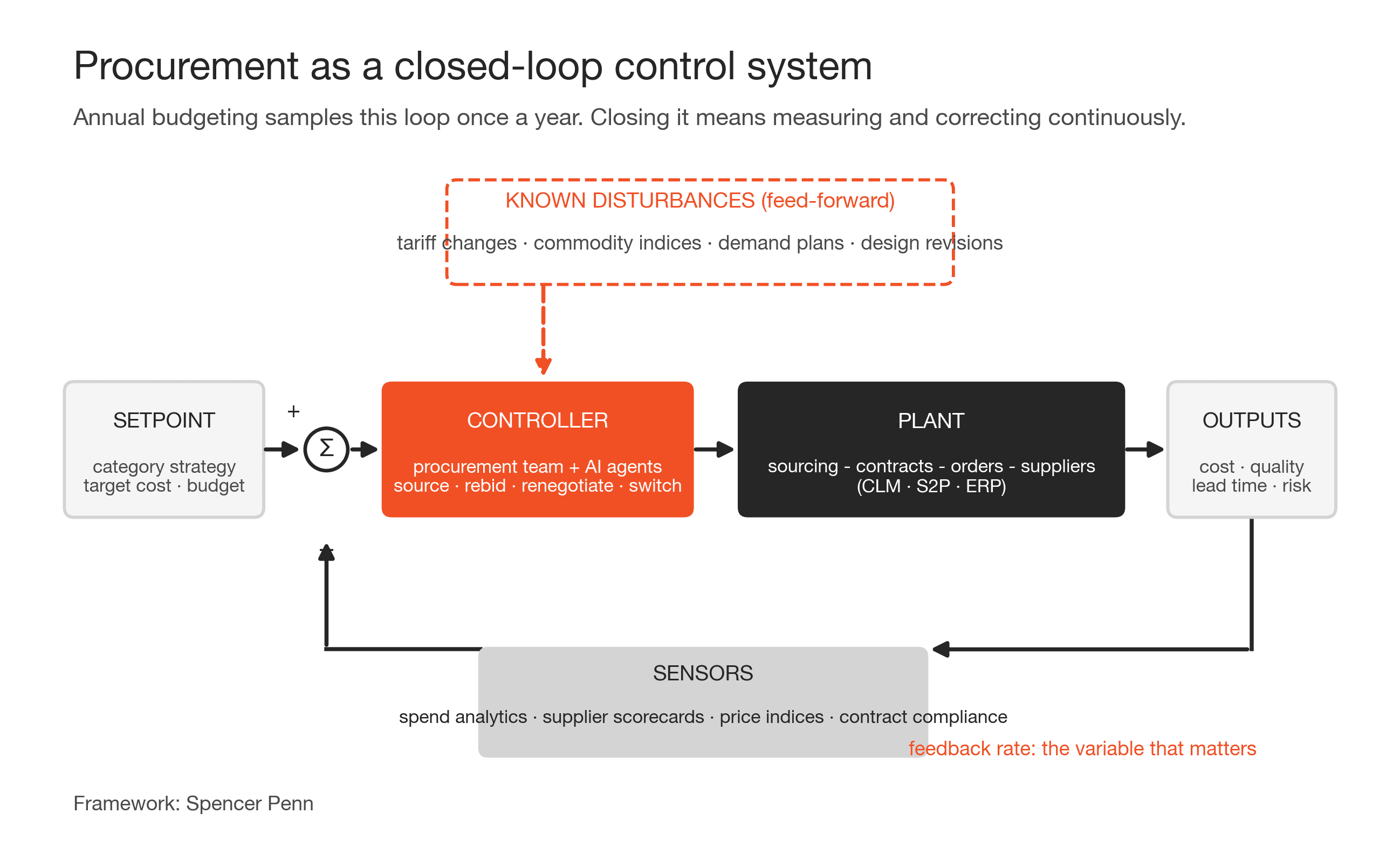
Strip the jargon and a closed-loop controller is four parts.
You have a setpoint: the speed you want, say 70 mph. You have the plant -- the engineering term for the machinery that does the work; here, the engine and drivetrain. You have a sensor measuring what actually happened: the speedometer. And you have a controller that compares actual to target and adjusts the throttle.
Now drive up a hill. The car slows. The gap between 70 and reality -- engineers call it the error -- grows, and the controller responds. How it responds is the famous part. In 1922, an engineer named Nicolas Minorsky watched Navy helmsmen hold warships on course and wrote down what their hands were doing. They corrected in proportion to three things:
How far off you are. Big error, big correction. (The P in PID: proportional.)
How long you have been off. A small drift that persists eventually deserves action. (I: integral.)
How fast the gap is changing. If you are falling behind quickly, react before it gets bad. (D: derivative.)
That is the whole trick, and it is ancient: James Watt's flyball governor was doing the proportional part in spinning brass in 1788. One more idea completes the toolkit: feed-forward. If you can see the hill coming, you do not have to wait for the car to slow -- you add throttle in advance. Correcting for a disturbance before it shows up as error is the cheapest correction there is.
Four parts, three reflexes, one trick for known disturbances. Hold that in your head; the rest of this post is just that loop, relabeled.
The same loop keeps winning, far from machines
Before mapping it onto procurement, it is worth seeing how far this construct travels, because the wins are not subtle.
Medicine closed a loop and changed lives: hybrid closed-loop insulin systems -- a glucose sensor, a control algorithm, a pump -- raised patients' time in healthy glucose range from 61% to 71% in a six-month randomized trial, while the control group managing manually did not move at all. Same pancreas-replacement job patients had done by hand for decades; the only change was sampling faster and correcting continuously.
Central banking closed a loop and tamed inflation: New Zealand's central bank became the world's first formal inflation targeter in 1990 -- a public setpoint, a monthly error signal, rate corrections -- and within a few years nearly every major central bank had copied the design. Toyota closed a loop on the factory floor decades earlier: the andon cord means any worker can stop the line the moment a defect appears -- detect now, fix now, rather than discover a batch of failures at final inspection.
(One disambiguation before procurement people object: this is closed-loop in the control-engineering sense. It has nothing to do with the circular-economy term "closed-loop supply chain," which is about recycling materials.)
Procurement runs on dead reckoning
Now map your own function onto the four parts, honestly.
The setpoint exists: category strategies, target costs, the annual budget. The plant exists, and it is enormous -- sourcing events, supplier discovery, SRM, contracts, orders, payments, the whole S2P-plus-ERP machine that actually buys things.
Now the sensors. Where does actual show up? The spend cube, refreshed monthly or quarterly. Supplier scorecards, assembled annually. Contract compliance, checked by occasional audit. And the comparator -- the moment someone formally holds actual against target -- runs essentially once a year, at budget season.
Navigation has an old name for operating like this: dead reckoning. Estimate your position from a known starting point, your speed, and your heading -- and hope. It works briefly. The errors do not announce themselves; they accumulate quietly until you get an external fix. In procurement, the external fix is the year-end variance review, which is to say: the drift is discovered precisely when nothing can be done about it.
The cost of the open loop is not hypothetical. McKinsey found the average procurement savings pipeline loses roughly a third of its estimated value in planning and another fifth in execution -- nearly half of projected savings never reach the P&L. Compliance failures alone leak about 2% of spend. And the sensor wiring is the named culprit: in Deloitte's 2025 Global CPO Survey, 57% of CPOs cited siloed working practices as a top barrier to value delivery. None of this drift is visible in the week it happens. That is the definition of an open loop.
What closing the loop actually means
Here is the encouraging part: you do not need new theory. You need wiring. Three pieces of the loop were genuinely hard until recently, and AI changes each one.
The sensors. Procurement's raw signals -- quotes, invoices, contracts, supplier emails -- are messy and unstructured, which is why spend analytics has always lagged reality by months. AI normalization turns that exhaust into clean, continuous signals. In one McKinsey-documented proof of concept, an AI invoice-to-contract reconciliation tool surfaced more than $10 million of leakage at a global pharmaceutical company in four weeks. Four weeks. The leakage was always there; nobody had a sensor pointed at it.
The actuators. Some corrections can now execute themselves. In Walmart Canada's pilot, documented by Harvard Business Review, an automated negotiation chatbot closed agreements with 64% of participating tail suppliers -- 68% as the program expanded -- at an average 1.5% saving plus extended payment terms. Read that carefully: these were negotiations no human team had bandwidth to run at all. The actuator did not replace anyone; it acted where there was previously no action.
The wiring itself. Gartner's 2026 Source-to-Pay evaluation added intake and orchestration as a tracked capability -- the analyst version of admitting the real problem is connecting the loop end to end. And that reframes the eternal suites-versus-best-of-breed debate into a question you can actually answer: it is not how many vendors you run, it is how much latency each handoff adds. A suite buys integrated wiring with weaker components. Best-of-breed buys stronger components with an integration tax on every segment. Minimize loop latency first; argue about logos second.
One design rule ties the room together: decide the actuator for each signal before buying more sensors. A detected off-contract purchase should trigger something specific -- a preferred-supplier nudge, an exception queue, a blocked order. A sensor without an actuator is an alarm, not a loop. Procurement has plenty of alarms.
The feedback ladder
If the full vision feels far away, good news: loop closure is not binary. It is a ladder, and every rung pays for itself.
Rung | Correction cadence | What you can catch | What it requires |
|---|---|---|---|
1. Dead reckoning | Annual | Last year's drift, after the fact | A budget and a prayer |
2. Quarterly review | Quarterly | Category-level drift, a quarter late | A refreshed spend cube |
3. Monthly pulse | Monthly | Price creep, maverick spend while it is small | Normalized spend + supplier data |
4. Continuous monitoring | Daily / live | Contract leakage, price variance, compliance gaps as they occur | AI-normalized signals wired to alerts |
5. Closed loop with agents | Live, with bounded autonomy | Drift corrected without waiting for a human, inside guardrails | All of the above + permissions + deadbands |
The chart below is the same idea drawn as a picture: identical cost pressure, three different correction cadences, and the only variable that matters is how often you sample and correct.
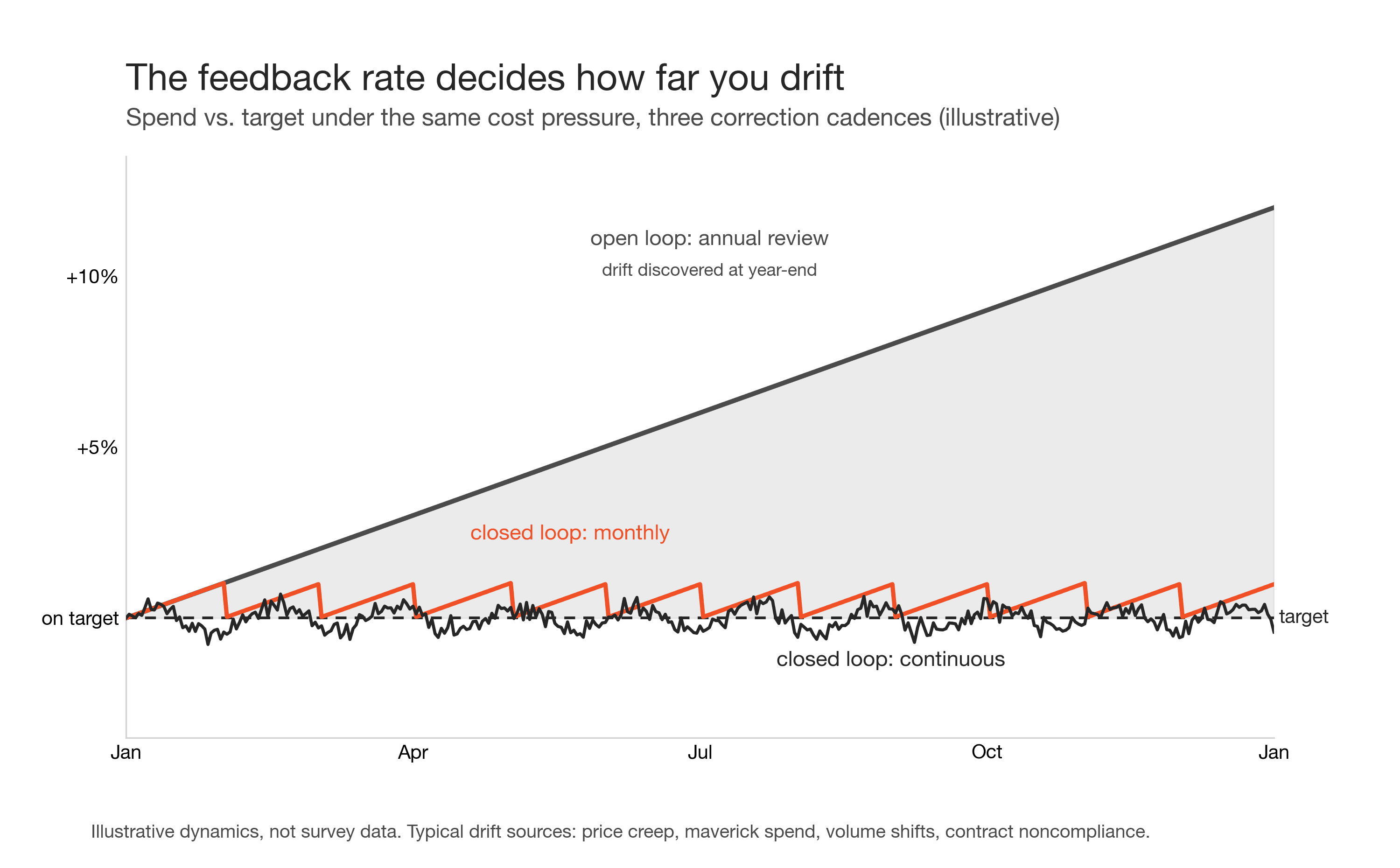
Most companies should aspire to rung 4 before debating rung 5. Which brings us to the failure modes, because control engineering is equally instructive about what goes wrong.
Tuning the loop, not just closing it
Garbage sensors make wild controllers. A loop that acts on bad data does not fail safely -- it oscillates. MIT's 2025 enterprise AI study found 95% of generative AI pilots produced no measurable P&L impact, and its diagnosis was striking in control terms: tools that never retain feedback or learn. Open-loop tools, sold as automation. Fix the data foundation before anything gets write access.
High gain without damping is thrash. The May 6, 2010 flash crash -- algorithms reacting to one another at machine speed, nearly 1,000 Dow points gone in minutes -- is the canonical fast-loop disaster. Procurement's version is the agent that rebids a category on every price twitch: high-frequency trading against your own supply base, burning supplier trust for basis points. Engineers solve this with deadbands -- thresholds below which the controller deliberately does nothing. So should you. Gartner's forecast that over 40% of agentic AI projects will be canceled by end of 2027 on cost and risk-control grounds is, in part, a tuning-failure forecast.
Optimizing the sensor instead of the system. Goodhart's law: when a measure becomes a target, it stops being a good measure. A loop tuned only to purchase-price variance will optimize purchase-price variance -- through bulk buys that balloon inventory, or supplier squeezes that resurface as quality escapes. Real procurement is multivariate -- cost, quality, lead time, risk -- and the setpoints have to be too.
And the annual budget will fight back -- for organizational reasons, not informational ones. Board calendars, accountability rhythms, the comfort of a fixed number. It can be done differently: Handelsbanken abolished budgets in 1970 and ran on continuous relative targets for half a century. You need not go that far. Keeping the annual setpoint while correcting monthly is still a closed loop -- and a politically achievable one.
A Closed Loop in Practice: Spec Changes In, Re-Quotes Out in Days
At LightSource, this loop is roughly the product thesis: our customers -- mostly challenger manufacturers running fast NPI cycles -- consolidate quotes, BOM costs, and supplier data into one live system, so a spec change or a tariff announcement shows up as a signal they can act on in days, with a re-quote as the actuator. The feed-forward path in the diagram is not theoretical for them; it is Tuesday.
But the loop matters more than any tool. Start by shortening one cycle: continuous compliance monitoring on your 20 biggest contracts, or a weekly spend refresh with defined action thresholds on three volatile categories. Prove the cycle -- measure, compare, correct, verify -- on a small surface, and widen it as trust builds. (And the human half of this story -- who runs these loops, what AI changes, and what happens to the org chart -- is the subject of the companion post, Fluency First.)
Dr. Kothmann's course gave me a lens I never gave back: the world divides into systems that look up at their heading often enough to correct, and systems that find out where they are once a year. Watt's governor added no horsepower to the steam engine. It made the engine usable. That is what loop closure offers spend management -- not more force, but a function that finally holds its heading.
Sources
Minorsky, "Directional Stability of Automatically Steered Bodies" (1922), Caltech-hosted PDF -- the origin of PID control, from observing helmsmen
Brown et al., Six-Month Randomized Trial of Closed-Loop Control in Type 1 Diabetes, NEJM 2019 (open access via PMC) -- time-in-range 61% to 71% vs. flat control
Reserve Bank of New Zealand: Inflation targeting in New Zealand -- first formal inflation-targeting framework, February 1990
McKinsey: Aim higher and move faster for successful procurement-led transformation -- ~1/3 of savings value lost in planning, ~20% in execution
McKinsey: Mitigating procurement value leakage with generative AI (2025) -- compliance failures leak ~2% of spend; $10M of leakage found in a 4-week AI reconciliation POC
Deloitte, 2025 Global Chief Procurement Officer Survey -- 57% cite siloed working practices as a top barrier
Harvard Business Review: How Walmart Automated Supplier Negotiations (Nov. 2022) -- chatbot closed with 64% of pilot suppliers (68% at scale), avg. 1.5% savings plus extended payment terms
Pure Procurement: Gartner's 2026 Source-to-Pay Magic Quadrant breakdown -- intake & orchestration added as a tracked capability
MIT NANDA, The GenAI Divide: State of AI in Business 2025 (report PDF) -- 95% of pilots show no P&L impact; the "learning gap"
SEC/CFTC, Findings Regarding the Market Events of May 6, 2010 -- the flash crash
Svenska Handelsbanken: Accomplishing Radical Decentralization Through Beyond Budgeting (academic case study) -- budgets abolished in 1970
Frequently Asked Questions
What is closed-loop procurement?
Closed-loop procurement applies control-engineering feedback to spend management: continuous measurement of actual spend and supplier performance (sensors), compared against category strategies and budgets (setpoints), driving timely corrections (controller and actuators) in the sourcing and purchasing systems (the plant). It is unrelated to the circular-economy term "closed-loop supply chain," which refers to recycling materials back into production.
What do the P, I, and D of a PID controller mean for spend management?
Proportional means correcting in proportion to today's variance -- a big price drift gets a big response. Integral means responding to accumulated variance -- small leaks that have persisted for months deserve action even if each month looks tolerable. Derivative means reacting to the rate of change -- a category whose costs are accelerating warrants intervention before the absolute number looks alarming.
How is feed-forward different from feedback in procurement?
Feedback corrects errors after they appear in the data; feed-forward acts on disturbances you can see coming. A published tariff schedule, a commodity index move, or a demand plan change is a known disturbance: renegotiating, re-sourcing, or forward-buying before it hits the P&L is feed-forward control. Organizations that only do feedback are always paying for one cycle of damage.
How often should spend data refresh?
Match the refresh rate to how fast each category can drift: weekly or continuous for volatile, high-stakes categories; monthly for most direct materials; quarterly may suffice for stable tail spend. The control-engineering rule is that you cannot correct faster than you sample -- an annual budget reconciliation caps your correction rate at once a year, regardless of how good the rest of your tooling is.
Should AI agents act autonomously in a closed-loop procurement system?
Only within deliberately narrow bounds. Give agents read access broadly, write-with-approval for most corrections, and reserve fully autonomous action for low-risk, thresholded moves like replenishment inside a min-max policy. Add deadbands -- variance thresholds below which no action fires -- to prevent over-correction, and keep payments and supplier master data changes behind a human.
What is the first step toward closing the loop?
Instrument one loop end to end rather than buying a platform first. Put continuous compliance monitoring on your 20 largest contracts, or a weekly spend refresh with defined action thresholds on two or three volatile categories. The goal is to prove the cycle -- measure, compare, correct, verify -- on a small surface, then widen it as data quality and trust improve.
I learned control systems more or less by accident. During my first masters at Penn -- robotics engineering -- I took a controls course with Dr. Bruce Kothmann, mostly because it fit my schedule. I did not know what control theory was when I enrolled. By the end of the semester it had, weirdly and nerd-ily, changed how I look at almost everything: thermostats, markets, org charts, my own bad habits. Once you can see feedback loops, you cannot stop seeing them.
Years of vehicle programs at Tesla and Waymo only made it worse, because a car is just control loops wearing a body. And now that I spend my days in procurement, I keep seeing the same thing, everywhere, in reverse: a function with a target, a system that drifts, a delay between action and effect -- running with the loop wide open.
So this post is the nerdy detour I wish someone had given every procurement leader. What a control loop actually is, using nothing more exotic than cruise control. Why spend management is structurally the same problem. And what it would mean -- practically, with today's tools -- to finally close the loop.
First, the cruise control
Strip the jargon and a closed-loop controller is four parts.
You have a setpoint: the speed you want, say 70 mph. You have the plant -- the engineering term for the machinery that does the work; here, the engine and drivetrain. You have a sensor measuring what actually happened: the speedometer. And you have a controller that compares actual to target and adjusts the throttle.
Now drive up a hill. The car slows. The gap between 70 and reality -- engineers call it the error -- grows, and the controller responds. How it responds is the famous part. In 1922, an engineer named Nicolas Minorsky watched Navy helmsmen hold warships on course and wrote down what their hands were doing. They corrected in proportion to three things:
How far off you are. Big error, big correction. (The P in PID: proportional.)
How long you have been off. A small drift that persists eventually deserves action. (I: integral.)
How fast the gap is changing. If you are falling behind quickly, react before it gets bad. (D: derivative.)
That is the whole trick, and it is ancient: James Watt's flyball governor was doing the proportional part in spinning brass in 1788. One more idea completes the toolkit: feed-forward. If you can see the hill coming, you do not have to wait for the car to slow -- you add throttle in advance. Correcting for a disturbance before it shows up as error is the cheapest correction there is.
Four parts, three reflexes, one trick for known disturbances. Hold that in your head; the rest of this post is just that loop, relabeled.
The same loop keeps winning, far from machines
Before mapping it onto procurement, it is worth seeing how far this construct travels, because the wins are not subtle.
Medicine closed a loop and changed lives: hybrid closed-loop insulin systems -- a glucose sensor, a control algorithm, a pump -- raised patients' time in healthy glucose range from 61% to 71% in a six-month randomized trial, while the control group managing manually did not move at all. Same pancreas-replacement job patients had done by hand for decades; the only change was sampling faster and correcting continuously.
Central banking closed a loop and tamed inflation: New Zealand's central bank became the world's first formal inflation targeter in 1990 -- a public setpoint, a monthly error signal, rate corrections -- and within a few years nearly every major central bank had copied the design. Toyota closed a loop on the factory floor decades earlier: the andon cord means any worker can stop the line the moment a defect appears -- detect now, fix now, rather than discover a batch of failures at final inspection.
(One disambiguation before procurement people object: this is closed-loop in the control-engineering sense. It has nothing to do with the circular-economy term "closed-loop supply chain," which is about recycling materials.)
Procurement runs on dead reckoning
Now map your own function onto the four parts, honestly.
The setpoint exists: category strategies, target costs, the annual budget. The plant exists, and it is enormous -- sourcing events, supplier discovery, SRM, contracts, orders, payments, the whole S2P-plus-ERP machine that actually buys things.
Now the sensors. Where does actual show up? The spend cube, refreshed monthly or quarterly. Supplier scorecards, assembled annually. Contract compliance, checked by occasional audit. And the comparator -- the moment someone formally holds actual against target -- runs essentially once a year, at budget season.
Navigation has an old name for operating like this: dead reckoning. Estimate your position from a known starting point, your speed, and your heading -- and hope. It works briefly. The errors do not announce themselves; they accumulate quietly until you get an external fix. In procurement, the external fix is the year-end variance review, which is to say: the drift is discovered precisely when nothing can be done about it.
The cost of the open loop is not hypothetical. McKinsey found the average procurement savings pipeline loses roughly a third of its estimated value in planning and another fifth in execution -- nearly half of projected savings never reach the P&L. Compliance failures alone leak about 2% of spend. And the sensor wiring is the named culprit: in Deloitte's 2025 Global CPO Survey, 57% of CPOs cited siloed working practices as a top barrier to value delivery. None of this drift is visible in the week it happens. That is the definition of an open loop.
What closing the loop actually means
Here is the encouraging part: you do not need new theory. You need wiring. Three pieces of the loop were genuinely hard until recently, and AI changes each one.
The sensors. Procurement's raw signals -- quotes, invoices, contracts, supplier emails -- are messy and unstructured, which is why spend analytics has always lagged reality by months. AI normalization turns that exhaust into clean, continuous signals. In one McKinsey-documented proof of concept, an AI invoice-to-contract reconciliation tool surfaced more than $10 million of leakage at a global pharmaceutical company in four weeks. Four weeks. The leakage was always there; nobody had a sensor pointed at it.
The actuators. Some corrections can now execute themselves. In Walmart Canada's pilot, documented by Harvard Business Review, an automated negotiation chatbot closed agreements with 64% of participating tail suppliers -- 68% as the program expanded -- at an average 1.5% saving plus extended payment terms. Read that carefully: these were negotiations no human team had bandwidth to run at all. The actuator did not replace anyone; it acted where there was previously no action.
The wiring itself. Gartner's 2026 Source-to-Pay evaluation added intake and orchestration as a tracked capability -- the analyst version of admitting the real problem is connecting the loop end to end. And that reframes the eternal suites-versus-best-of-breed debate into a question you can actually answer: it is not how many vendors you run, it is how much latency each handoff adds. A suite buys integrated wiring with weaker components. Best-of-breed buys stronger components with an integration tax on every segment. Minimize loop latency first; argue about logos second.
One design rule ties the room together: decide the actuator for each signal before buying more sensors. A detected off-contract purchase should trigger something specific -- a preferred-supplier nudge, an exception queue, a blocked order. A sensor without an actuator is an alarm, not a loop. Procurement has plenty of alarms.
The feedback ladder
If the full vision feels far away, good news: loop closure is not binary. It is a ladder, and every rung pays for itself.
Rung | Correction cadence | What you can catch | What it requires |
|---|---|---|---|
1. Dead reckoning | Annual | Last year's drift, after the fact | A budget and a prayer |
2. Quarterly review | Quarterly | Category-level drift, a quarter late | A refreshed spend cube |
3. Monthly pulse | Monthly | Price creep, maverick spend while it is small | Normalized spend + supplier data |
4. Continuous monitoring | Daily / live | Contract leakage, price variance, compliance gaps as they occur | AI-normalized signals wired to alerts |
5. Closed loop with agents | Live, with bounded autonomy | Drift corrected without waiting for a human, inside guardrails | All of the above + permissions + deadbands |
The chart below is the same idea drawn as a picture: identical cost pressure, three different correction cadences, and the only variable that matters is how often you sample and correct.
Most companies should aspire to rung 4 before debating rung 5. Which brings us to the failure modes, because control engineering is equally instructive about what goes wrong.
Tuning the loop, not just closing it
Garbage sensors make wild controllers. A loop that acts on bad data does not fail safely -- it oscillates. MIT's 2025 enterprise AI study found 95% of generative AI pilots produced no measurable P&L impact, and its diagnosis was striking in control terms: tools that never retain feedback or learn. Open-loop tools, sold as automation. Fix the data foundation before anything gets write access.
High gain without damping is thrash. The May 6, 2010 flash crash -- algorithms reacting to one another at machine speed, nearly 1,000 Dow points gone in minutes -- is the canonical fast-loop disaster. Procurement's version is the agent that rebids a category on every price twitch: high-frequency trading against your own supply base, burning supplier trust for basis points. Engineers solve this with deadbands -- thresholds below which the controller deliberately does nothing. So should you. Gartner's forecast that over 40% of agentic AI projects will be canceled by end of 2027 on cost and risk-control grounds is, in part, a tuning-failure forecast.
Optimizing the sensor instead of the system. Goodhart's law: when a measure becomes a target, it stops being a good measure. A loop tuned only to purchase-price variance will optimize purchase-price variance -- through bulk buys that balloon inventory, or supplier squeezes that resurface as quality escapes. Real procurement is multivariate -- cost, quality, lead time, risk -- and the setpoints have to be too.
And the annual budget will fight back -- for organizational reasons, not informational ones. Board calendars, accountability rhythms, the comfort of a fixed number. It can be done differently: Handelsbanken abolished budgets in 1970 and ran on continuous relative targets for half a century. You need not go that far. Keeping the annual setpoint while correcting monthly is still a closed loop -- and a politically achievable one.
A Closed Loop in Practice: Spec Changes In, Re-Quotes Out in Days
At LightSource, this loop is roughly the product thesis: our customers -- mostly challenger manufacturers running fast NPI cycles -- consolidate quotes, BOM costs, and supplier data into one live system, so a spec change or a tariff announcement shows up as a signal they can act on in days, with a re-quote as the actuator. The feed-forward path in the diagram is not theoretical for them; it is Tuesday.
But the loop matters more than any tool. Start by shortening one cycle: continuous compliance monitoring on your 20 biggest contracts, or a weekly spend refresh with defined action thresholds on three volatile categories. Prove the cycle -- measure, compare, correct, verify -- on a small surface, and widen it as trust builds. (And the human half of this story -- who runs these loops, what AI changes, and what happens to the org chart -- is the subject of the companion post, Fluency First.)
Dr. Kothmann's course gave me a lens I never gave back: the world divides into systems that look up at their heading often enough to correct, and systems that find out where they are once a year. Watt's governor added no horsepower to the steam engine. It made the engine usable. That is what loop closure offers spend management -- not more force, but a function that finally holds its heading.
Sources
Minorsky, "Directional Stability of Automatically Steered Bodies" (1922), Caltech-hosted PDF -- the origin of PID control, from observing helmsmen
Brown et al., Six-Month Randomized Trial of Closed-Loop Control in Type 1 Diabetes, NEJM 2019 (open access via PMC) -- time-in-range 61% to 71% vs. flat control
Reserve Bank of New Zealand: Inflation targeting in New Zealand -- first formal inflation-targeting framework, February 1990
McKinsey: Aim higher and move faster for successful procurement-led transformation -- ~1/3 of savings value lost in planning, ~20% in execution
McKinsey: Mitigating procurement value leakage with generative AI (2025) -- compliance failures leak ~2% of spend; $10M of leakage found in a 4-week AI reconciliation POC
Deloitte, 2025 Global Chief Procurement Officer Survey -- 57% cite siloed working practices as a top barrier
Harvard Business Review: How Walmart Automated Supplier Negotiations (Nov. 2022) -- chatbot closed with 64% of pilot suppliers (68% at scale), avg. 1.5% savings plus extended payment terms
Pure Procurement: Gartner's 2026 Source-to-Pay Magic Quadrant breakdown -- intake & orchestration added as a tracked capability
MIT NANDA, The GenAI Divide: State of AI in Business 2025 (report PDF) -- 95% of pilots show no P&L impact; the "learning gap"
SEC/CFTC, Findings Regarding the Market Events of May 6, 2010 -- the flash crash
Svenska Handelsbanken: Accomplishing Radical Decentralization Through Beyond Budgeting (academic case study) -- budgets abolished in 1970
Frequently Asked Questions
What is closed-loop procurement?
Closed-loop procurement applies control-engineering feedback to spend management: continuous measurement of actual spend and supplier performance (sensors), compared against category strategies and budgets (setpoints), driving timely corrections (controller and actuators) in the sourcing and purchasing systems (the plant). It is unrelated to the circular-economy term "closed-loop supply chain," which refers to recycling materials back into production.
What do the P, I, and D of a PID controller mean for spend management?
Proportional means correcting in proportion to today's variance -- a big price drift gets a big response. Integral means responding to accumulated variance -- small leaks that have persisted for months deserve action even if each month looks tolerable. Derivative means reacting to the rate of change -- a category whose costs are accelerating warrants intervention before the absolute number looks alarming.
How is feed-forward different from feedback in procurement?
Feedback corrects errors after they appear in the data; feed-forward acts on disturbances you can see coming. A published tariff schedule, a commodity index move, or a demand plan change is a known disturbance: renegotiating, re-sourcing, or forward-buying before it hits the P&L is feed-forward control. Organizations that only do feedback are always paying for one cycle of damage.
How often should spend data refresh?
Match the refresh rate to how fast each category can drift: weekly or continuous for volatile, high-stakes categories; monthly for most direct materials; quarterly may suffice for stable tail spend. The control-engineering rule is that you cannot correct faster than you sample -- an annual budget reconciliation caps your correction rate at once a year, regardless of how good the rest of your tooling is.
Should AI agents act autonomously in a closed-loop procurement system?
Only within deliberately narrow bounds. Give agents read access broadly, write-with-approval for most corrections, and reserve fully autonomous action for low-risk, thresholded moves like replenishment inside a min-max policy. Add deadbands -- variance thresholds below which no action fires -- to prevent over-correction, and keep payments and supplier master data changes behind a human.
What is the first step toward closing the loop?
Instrument one loop end to end rather than buying a platform first. Put continuous compliance monitoring on your 20 largest contracts, or a weekly spend refresh with defined action thresholds on two or three volatile categories. The goal is to prove the cycle -- measure, compare, correct, verify -- on a small surface, then widen it as data quality and trust improve.
I learned control systems more or less by accident. During my first masters at Penn -- robotics engineering -- I took a controls course with Dr. Bruce Kothmann, mostly because it fit my schedule. I did not know what control theory was when I enrolled. By the end of the semester it had, weirdly and nerd-ily, changed how I look at almost everything: thermostats, markets, org charts, my own bad habits. Once you can see feedback loops, you cannot stop seeing them.
Years of vehicle programs at Tesla and Waymo only made it worse, because a car is just control loops wearing a body. And now that I spend my days in procurement, I keep seeing the same thing, everywhere, in reverse: a function with a target, a system that drifts, a delay between action and effect -- running with the loop wide open.
So this post is the nerdy detour I wish someone had given every procurement leader. What a control loop actually is, using nothing more exotic than cruise control. Why spend management is structurally the same problem. And what it would mean -- practically, with today's tools -- to finally close the loop.
First, the cruise control
Strip the jargon and a closed-loop controller is four parts.
You have a setpoint: the speed you want, say 70 mph. You have the plant -- the engineering term for the machinery that does the work; here, the engine and drivetrain. You have a sensor measuring what actually happened: the speedometer. And you have a controller that compares actual to target and adjusts the throttle.
Now drive up a hill. The car slows. The gap between 70 and reality -- engineers call it the error -- grows, and the controller responds. How it responds is the famous part. In 1922, an engineer named Nicolas Minorsky watched Navy helmsmen hold warships on course and wrote down what their hands were doing. They corrected in proportion to three things:
How far off you are. Big error, big correction. (The P in PID: proportional.)
How long you have been off. A small drift that persists eventually deserves action. (I: integral.)
How fast the gap is changing. If you are falling behind quickly, react before it gets bad. (D: derivative.)
That is the whole trick, and it is ancient: James Watt's flyball governor was doing the proportional part in spinning brass in 1788. One more idea completes the toolkit: feed-forward. If you can see the hill coming, you do not have to wait for the car to slow -- you add throttle in advance. Correcting for a disturbance before it shows up as error is the cheapest correction there is.
Four parts, three reflexes, one trick for known disturbances. Hold that in your head; the rest of this post is just that loop, relabeled.
The same loop keeps winning, far from machines
Before mapping it onto procurement, it is worth seeing how far this construct travels, because the wins are not subtle.
Medicine closed a loop and changed lives: hybrid closed-loop insulin systems -- a glucose sensor, a control algorithm, a pump -- raised patients' time in healthy glucose range from 61% to 71% in a six-month randomized trial, while the control group managing manually did not move at all. Same pancreas-replacement job patients had done by hand for decades; the only change was sampling faster and correcting continuously.
Central banking closed a loop and tamed inflation: New Zealand's central bank became the world's first formal inflation targeter in 1990 -- a public setpoint, a monthly error signal, rate corrections -- and within a few years nearly every major central bank had copied the design. Toyota closed a loop on the factory floor decades earlier: the andon cord means any worker can stop the line the moment a defect appears -- detect now, fix now, rather than discover a batch of failures at final inspection.
(One disambiguation before procurement people object: this is closed-loop in the control-engineering sense. It has nothing to do with the circular-economy term "closed-loop supply chain," which is about recycling materials.)
Procurement runs on dead reckoning
Now map your own function onto the four parts, honestly.
The setpoint exists: category strategies, target costs, the annual budget. The plant exists, and it is enormous -- sourcing events, supplier discovery, SRM, contracts, orders, payments, the whole S2P-plus-ERP machine that actually buys things.
Now the sensors. Where does actual show up? The spend cube, refreshed monthly or quarterly. Supplier scorecards, assembled annually. Contract compliance, checked by occasional audit. And the comparator -- the moment someone formally holds actual against target -- runs essentially once a year, at budget season.
Navigation has an old name for operating like this: dead reckoning. Estimate your position from a known starting point, your speed, and your heading -- and hope. It works briefly. The errors do not announce themselves; they accumulate quietly until you get an external fix. In procurement, the external fix is the year-end variance review, which is to say: the drift is discovered precisely when nothing can be done about it.
The cost of the open loop is not hypothetical. McKinsey found the average procurement savings pipeline loses roughly a third of its estimated value in planning and another fifth in execution -- nearly half of projected savings never reach the P&L. Compliance failures alone leak about 2% of spend. And the sensor wiring is the named culprit: in Deloitte's 2025 Global CPO Survey, 57% of CPOs cited siloed working practices as a top barrier to value delivery. None of this drift is visible in the week it happens. That is the definition of an open loop.
What closing the loop actually means
Here is the encouraging part: you do not need new theory. You need wiring. Three pieces of the loop were genuinely hard until recently, and AI changes each one.
The sensors. Procurement's raw signals -- quotes, invoices, contracts, supplier emails -- are messy and unstructured, which is why spend analytics has always lagged reality by months. AI normalization turns that exhaust into clean, continuous signals. In one McKinsey-documented proof of concept, an AI invoice-to-contract reconciliation tool surfaced more than $10 million of leakage at a global pharmaceutical company in four weeks. Four weeks. The leakage was always there; nobody had a sensor pointed at it.
The actuators. Some corrections can now execute themselves. In Walmart Canada's pilot, documented by Harvard Business Review, an automated negotiation chatbot closed agreements with 64% of participating tail suppliers -- 68% as the program expanded -- at an average 1.5% saving plus extended payment terms. Read that carefully: these were negotiations no human team had bandwidth to run at all. The actuator did not replace anyone; it acted where there was previously no action.
The wiring itself. Gartner's 2026 Source-to-Pay evaluation added intake and orchestration as a tracked capability -- the analyst version of admitting the real problem is connecting the loop end to end. And that reframes the eternal suites-versus-best-of-breed debate into a question you can actually answer: it is not how many vendors you run, it is how much latency each handoff adds. A suite buys integrated wiring with weaker components. Best-of-breed buys stronger components with an integration tax on every segment. Minimize loop latency first; argue about logos second.
One design rule ties the room together: decide the actuator for each signal before buying more sensors. A detected off-contract purchase should trigger something specific -- a preferred-supplier nudge, an exception queue, a blocked order. A sensor without an actuator is an alarm, not a loop. Procurement has plenty of alarms.
The feedback ladder
If the full vision feels far away, good news: loop closure is not binary. It is a ladder, and every rung pays for itself.
Rung | Correction cadence | What you can catch | What it requires |
|---|---|---|---|
1. Dead reckoning | Annual | Last year's drift, after the fact | A budget and a prayer |
2. Quarterly review | Quarterly | Category-level drift, a quarter late | A refreshed spend cube |
3. Monthly pulse | Monthly | Price creep, maverick spend while it is small | Normalized spend + supplier data |
4. Continuous monitoring | Daily / live | Contract leakage, price variance, compliance gaps as they occur | AI-normalized signals wired to alerts |
5. Closed loop with agents | Live, with bounded autonomy | Drift corrected without waiting for a human, inside guardrails | All of the above + permissions + deadbands |
The chart below is the same idea drawn as a picture: identical cost pressure, three different correction cadences, and the only variable that matters is how often you sample and correct.
Most companies should aspire to rung 4 before debating rung 5. Which brings us to the failure modes, because control engineering is equally instructive about what goes wrong.
Tuning the loop, not just closing it
Garbage sensors make wild controllers. A loop that acts on bad data does not fail safely -- it oscillates. MIT's 2025 enterprise AI study found 95% of generative AI pilots produced no measurable P&L impact, and its diagnosis was striking in control terms: tools that never retain feedback or learn. Open-loop tools, sold as automation. Fix the data foundation before anything gets write access.
High gain without damping is thrash. The May 6, 2010 flash crash -- algorithms reacting to one another at machine speed, nearly 1,000 Dow points gone in minutes -- is the canonical fast-loop disaster. Procurement's version is the agent that rebids a category on every price twitch: high-frequency trading against your own supply base, burning supplier trust for basis points. Engineers solve this with deadbands -- thresholds below which the controller deliberately does nothing. So should you. Gartner's forecast that over 40% of agentic AI projects will be canceled by end of 2027 on cost and risk-control grounds is, in part, a tuning-failure forecast.
Optimizing the sensor instead of the system. Goodhart's law: when a measure becomes a target, it stops being a good measure. A loop tuned only to purchase-price variance will optimize purchase-price variance -- through bulk buys that balloon inventory, or supplier squeezes that resurface as quality escapes. Real procurement is multivariate -- cost, quality, lead time, risk -- and the setpoints have to be too.
And the annual budget will fight back -- for organizational reasons, not informational ones. Board calendars, accountability rhythms, the comfort of a fixed number. It can be done differently: Handelsbanken abolished budgets in 1970 and ran on continuous relative targets for half a century. You need not go that far. Keeping the annual setpoint while correcting monthly is still a closed loop -- and a politically achievable one.
A Closed Loop in Practice: Spec Changes In, Re-Quotes Out in Days
At LightSource, this loop is roughly the product thesis: our customers -- mostly challenger manufacturers running fast NPI cycles -- consolidate quotes, BOM costs, and supplier data into one live system, so a spec change or a tariff announcement shows up as a signal they can act on in days, with a re-quote as the actuator. The feed-forward path in the diagram is not theoretical for them; it is Tuesday.
But the loop matters more than any tool. Start by shortening one cycle: continuous compliance monitoring on your 20 biggest contracts, or a weekly spend refresh with defined action thresholds on three volatile categories. Prove the cycle -- measure, compare, correct, verify -- on a small surface, and widen it as trust builds. (And the human half of this story -- who runs these loops, what AI changes, and what happens to the org chart -- is the subject of the companion post, Fluency First.)
Dr. Kothmann's course gave me a lens I never gave back: the world divides into systems that look up at their heading often enough to correct, and systems that find out where they are once a year. Watt's governor added no horsepower to the steam engine. It made the engine usable. That is what loop closure offers spend management -- not more force, but a function that finally holds its heading.
Sources
Minorsky, "Directional Stability of Automatically Steered Bodies" (1922), Caltech-hosted PDF -- the origin of PID control, from observing helmsmen
Brown et al., Six-Month Randomized Trial of Closed-Loop Control in Type 1 Diabetes, NEJM 2019 (open access via PMC) -- time-in-range 61% to 71% vs. flat control
Reserve Bank of New Zealand: Inflation targeting in New Zealand -- first formal inflation-targeting framework, February 1990
McKinsey: Aim higher and move faster for successful procurement-led transformation -- ~1/3 of savings value lost in planning, ~20% in execution
McKinsey: Mitigating procurement value leakage with generative AI (2025) -- compliance failures leak ~2% of spend; $10M of leakage found in a 4-week AI reconciliation POC
Deloitte, 2025 Global Chief Procurement Officer Survey -- 57% cite siloed working practices as a top barrier
Harvard Business Review: How Walmart Automated Supplier Negotiations (Nov. 2022) -- chatbot closed with 64% of pilot suppliers (68% at scale), avg. 1.5% savings plus extended payment terms
Pure Procurement: Gartner's 2026 Source-to-Pay Magic Quadrant breakdown -- intake & orchestration added as a tracked capability
MIT NANDA, The GenAI Divide: State of AI in Business 2025 (report PDF) -- 95% of pilots show no P&L impact; the "learning gap"
SEC/CFTC, Findings Regarding the Market Events of May 6, 2010 -- the flash crash
Svenska Handelsbanken: Accomplishing Radical Decentralization Through Beyond Budgeting (academic case study) -- budgets abolished in 1970
Frequently Asked Questions
What is closed-loop procurement?
Closed-loop procurement applies control-engineering feedback to spend management: continuous measurement of actual spend and supplier performance (sensors), compared against category strategies and budgets (setpoints), driving timely corrections (controller and actuators) in the sourcing and purchasing systems (the plant). It is unrelated to the circular-economy term "closed-loop supply chain," which refers to recycling materials back into production.
What do the P, I, and D of a PID controller mean for spend management?
Proportional means correcting in proportion to today's variance -- a big price drift gets a big response. Integral means responding to accumulated variance -- small leaks that have persisted for months deserve action even if each month looks tolerable. Derivative means reacting to the rate of change -- a category whose costs are accelerating warrants intervention before the absolute number looks alarming.
How is feed-forward different from feedback in procurement?
Feedback corrects errors after they appear in the data; feed-forward acts on disturbances you can see coming. A published tariff schedule, a commodity index move, or a demand plan change is a known disturbance: renegotiating, re-sourcing, or forward-buying before it hits the P&L is feed-forward control. Organizations that only do feedback are always paying for one cycle of damage.
How often should spend data refresh?
Match the refresh rate to how fast each category can drift: weekly or continuous for volatile, high-stakes categories; monthly for most direct materials; quarterly may suffice for stable tail spend. The control-engineering rule is that you cannot correct faster than you sample -- an annual budget reconciliation caps your correction rate at once a year, regardless of how good the rest of your tooling is.
Should AI agents act autonomously in a closed-loop procurement system?
Only within deliberately narrow bounds. Give agents read access broadly, write-with-approval for most corrections, and reserve fully autonomous action for low-risk, thresholded moves like replenishment inside a min-max policy. Add deadbands -- variance thresholds below which no action fires -- to prevent over-correction, and keep payments and supplier master data changes behind a human.
What is the first step toward closing the loop?
Instrument one loop end to end rather than buying a platform first. Put continuous compliance monitoring on your 20 largest contracts, or a weekly spend refresh with defined action thresholds on two or three volatile categories. The goal is to prove the cycle -- measure, compare, correct, verify -- on a small surface, then widen it as data quality and trust improve.


Faster sourcing. Lower cost. Less chaos.
See how LightSource connects engineering, procurement, and suppliers in one operating system to help you launch faster at lower cost.
SOC 2
Kearney #1 2024
Gartner Cool Vendor
Procuretech 100
G2 Top Rated
Faster sourcing. Lower cost. Less chaos.
See how LightSource connects engineering, procurement, and suppliers in one operating system to help you launch faster at lower cost.
SOC 2
Kearney #1 2024
Gartner Cool Vendor
Procuretech 100
G2 Top Rated
Faster sourcing. Lower cost. Less chaos.
See how LightSource connects engineering, procurement, and suppliers in one operating system to help you launch faster at lower cost.
SOC 2
Kearney #1 2024
Gartner Cool Vendor
Procuretech 100
G2 Top Rated
Trusted by:
Trusted by:
Trusted by: