

What Is an e-Auction, and Why Does Format Matter?
An e-auction is a real-time, competitive bidding event conducted on a digital platform. Suppliers submit prices (or scores) against a defined specification within a fixed time window. The “e” is just the medium -- the mechanics underneath vary dramatically.
The format you choose determines three things: how aggressively suppliers compete, how much information flows between parties, and whether the outcome optimizes for price alone or for price-plus-value. Get the format wrong and you either leave money on the table or you destroy a supplier relationship you needed intact.
Let’s say you’re a procurement manager at a mid-size manufacturer. You’ve got six sourcing events this quarter -- raw aluminum extrusions, PCB assemblies, logistics freight lanes, MRO consumables, a custom tooling package, and a capital equipment purchase. Using the same auction format for all six is a mistake. Here’s why.
The English Reverse Auction
The English reverse auction is the workhorse. It’s what most people picture when they hear “e-auction.” Suppliers see the leading bid (or their rank) and can submit lower bids in real-time until the clock runs out. Extensions trigger when new bids arrive in the final minutes.
How it works: Buyers set a starting price (usually based on incumbent pricing or a should-cost model). Suppliers bid downward. Everyone sees the current best price (or at minimum their rank). The auction extends if bids come in near the deadline -- preventing sniping.
Where it works best:
Commodity materials with 4+ qualified suppliers
Items where spec is locked and price is the primary differentiator
Categories where suppliers have real competitive tension (they know they’re replaceable)
Annual re-bids on established categories
Where it fails:
Custom or engineered components where switching costs are high
Categories with fewer than 3 suppliers (the “auction” becomes a negotiation with an audience)
Situations where you need suppliers to invest in tooling, NRE, or co-development
Back at Tesla, English reverse auctions worked well for standard commodity buys -- things like fasteners, packaging materials, wire harnesses with established specs. The key was having enough qualified suppliers that the competitive pressure was real. With fewer than four bidders, the format often produced mediocre results because suppliers could sense the thin competition.
The Dutch Auction (Descending Clock)
A Dutch auction starts high and ticks downward. The first supplier to accept the current price wins. It’s named after the Dutch flower markets in Aalsmeer, where millions of cut flowers have been sold this way since 1911.
How it works: The buyer sets a high starting price (above market) and a decrement schedule -- say, dropping $0.50 per unit every 30 seconds. Suppliers watch the price fall. The first to hit “accept” wins the lot at that price. Once someone accepts, it’s over. No second chances.
Where it works best:
Perishable goods or time-sensitive allocations (the original flower market use case)
Situations where speed of award matters more than finding the absolute floor price
Multi-lot events where you’re splitting volume across winners (first acceptor gets lot 1, second gets lot 2, etc.)
Categories where suppliers have similar cost structures and the market price is well-understood
Where it fails:
Complex specifications where suppliers need time to evaluate
High-value strategic buys where you want maximum competitive extraction
Categories where supplier cost structures vary widely (the low-cost producer waits while expensive suppliers accept early)
The Dutch auction’s genius is psychological. Unlike the English reverse where suppliers can always bid lower, the Dutch format creates a fear of loss -- “if I don’t accept now, someone else will.” This urgency produces faster awards but typically at a higher final price than an English reverse would achieve. The trade-off is speed and certainty vs. maximum savings.
The Japanese Auction (Ascending Elimination)
The Japanese auction -- sometimes called a “clock auction” or “ascending exit” -- is the inverse of the Dutch format but applied to procurement. The price starts high and decreases in fixed steps. At each step, suppliers must actively confirm they’re still willing to supply at that price. Anyone who doesn’t confirm is eliminated. The auction continues until only one supplier remains.
How it works: Starting price is set above market (say, the incumbent’s current price). The system drops the price by a fixed decrement -- maybe 2% per round. After each drop, every participating supplier must click “I accept this price” within a time window. If they don’t confirm, they’re out permanently. The last supplier standing wins at the final confirmed price.
Where it works best:
Categories where you want to understand each supplier’s walk-away point
Situations where visibility into the competitive landscape matters more than absolute lowest price
Strategic categories where knowing how close your backup suppliers are to the winner’s price helps future negotiations
Events with 5-8 suppliers where you want clean, step-by-step elimination
Where it fails:
Very large supplier pools (too many rounds, too slow)
Simple commodities where the English reverse is faster and achieves similar results
Situations where suppliers collude easily (the transparent elimination makes coordination possible)
The Japanese auction’s real value is intelligence. When supplier #3 drops out at $14.20 and supplier #2 drops out at $13.80 and the winner holds at $13.50, you now know the market’s cost distribution. That data is gold for your next negotiation cycle -- you know exactly how much leverage you have and where the floor actually is.
The Sealed-Bid (First-Price) Auction
The sealed-bid auction is the simplest format and the most familiar from public-sector procurement. Each supplier submits one bid. No one sees anyone else’s bid. The lowest price wins.
How it works: Suppliers receive the RFQ package with a deadline. They submit exactly one bid -- no revisions, no visibility into competing offers. After the deadline, bids are opened simultaneously. Lowest compliant bid wins.
Where it works best:
Government and public-sector procurement (often legally mandated)
Situations where you want to prevent gaming and last-second sniping
First-round events to establish baseline pricing before a live auction
Categories where supplier relationships are sensitive and you don’t want visible head-to-head competition
High-value capital equipment where the bid preparation cost is significant
Where it fails:
Categories where iterative competition would drive deeper savings
Situations where suppliers are uncertain about the competitive landscape (they pad bids defensively)
Repeat events where suppliers learn each other’s patterns
The sealed-bid format is simple but leaves money on the table in competitive markets. Suppliers can’t see what their competitors bid, so they price based on their own cost-plus-margin target rather than competitive pressure. Research from the University of Arizona’s eSourcing lab found that multi-round formats (English reverse, Japanese) typically produce 3-8% lower final prices than sealed-bid events for commodity categories with 4+ bidders.
The Vickrey (Second-Price Sealed-Bid) Auction
The Vickrey auction is elegant in theory and rare in practice. Suppliers submit sealed bids, but the winner pays the second-lowest price, not their own bid.
How it works: Same submission mechanics as a sealed-bid auction -- one bid, no visibility. But the winner doesn’t pay what they bid. They pay the next-lowest bid. If Supplier A bids $10.00, Supplier B bids $10.50, and Supplier C bids $11.00, Supplier A wins but pays $10.50.
Where it works best:
Academic settings and game theory courses (it’s theoretically optimal -- suppliers bid their true cost with no strategic padding)
Some government spectrum auctions (the FCC used Vickrey elements in the 1994 broadband PCS auctions)
Situations where you want suppliers to reveal true costs without fear of leaving margin on the table
Where it fails:
Nearly all commercial procurement (suppliers don’t trust the mechanism -- “why would I bid my true cost if I’m going to pay more anyway?”)
Multi-attribute evaluations (the second-price logic breaks down when price isn’t the only criterion)
Repeat events (suppliers learn to game it by submitting artificially low bids to set the second price)
In practice, Vickrey auctions are almost never used in direct materials procurement. They’re worth understanding because the underlying principle -- that the optimal strategy is truthful bidding -- informs why formats like the Japanese auction (which reveals similar information through elimination) are more practical alternatives.
The Brazilian Auction (Rank-Based Compression)
The Brazilian auction -- also called “compulsory improvement” or “rank auction” -- is less common in North America but widely used in Latin American public procurement and increasingly in European sourcing. It compresses bids toward the leader through forced improvement rounds.
How it works: After an initial sealed-bid round, the system ranks suppliers by price. Then, starting from the worst-ranked supplier, each bidder gets a fixed time window (often 3 minutes) to submit an improved bid. The process iterates in rank order until no supplier can improve further, or a maximum number of rounds is reached. Some variants require each new bid to beat the current leader by a minimum margin.
Where it works best:
Categories where the initial bid spread is wide and you want to compress it
Situations where you want to give every supplier a fair shot (even the initially expensive ones)
Public-sector procurement in Brazil, Argentina, and other Latin American markets (where it’s called “pregao eletronico” and is legally mandated for many government purchases)
Events where you expect significant strategic padding in first bids
Where it fails:
Categories where the initial bids are already tight (the rounds add time without value)
Situations with fewer than 4 suppliers (too few rounds to generate compression)
Markets where the format is unfamiliar and suppliers don’t trust the sequential reveal
The Multi-Attribute (Weighted Score) Auction
A multi-attribute auction doesn’t optimize for price alone. Instead, each bid is scored on multiple dimensions -- price, lead time, quality metrics, sustainability, payment terms -- with predetermined weights. The “winning bid” is the one with the best composite score, not necessarily the lowest price.
How it works: The buyer defines scoring criteria and weights before the event (e.g., 60% price, 20% lead time, 10% quality certification level, 10% sustainability score). Suppliers bid on each dimension simultaneously. The platform calculates a real-time composite score. Suppliers can see their rank (or score gap) and improve on any dimension -- dropping price, shortening lead time, or adding certifications.
Where it works best:
Engineered or custom components where total cost of ownership matters more than unit price
Categories where lead time, quality, or delivery reliability are non-negotiable constraints
Strategic relationships where you’re selecting a long-term partner, not just a price point
Categories where the cheapest option is rarely the best option (electronics, precision machining, specialty chemicals)
Where it fails:
Pure commodities where price is genuinely the only differentiator
Situations where suppliers don’t trust the weighting (they suspect you’ll override scores to pick a preferred vendor)
Events with too many attributes (more than 5-6 dimensions confuse suppliers and reduce bid aggressiveness)
This format is where procurement platforms earn their keep. Running a multi-attribute auction on spreadsheets is operationally nightmarish -- you’re normalizing scores across dimensions, recalculating ranks in real-time, and communicating composite positions to 6+ suppliers simultaneously. The platform does this automatically.
The Reverse Auction with Lots (Portfolio Bidding)
Many real sourcing events aren’t single-item buys. They’re portfolio events -- awarding 15-50 line items across multiple suppliers, optimizing for total portfolio cost rather than line-by-line winners.
How it works: The buyer bundles related items into lots (or leaves them unbundled for maximum flexibility). Suppliers bid on individual items or bundles. The platform runs optimization algorithms to find the lowest-cost allocation across all items and all suppliers, subject to constraints (no single supplier gets more than 40% of volume, minimum 2 sources per category, etc.).
Where it works best:
Annual category re-bids with 20+ SKUs
Situations where bundle discounts are real (a supplier’s price for 10 items together is lower than 10 individual awards)
Complex allocation decisions where manual optimization isn’t feasible
Direct materials sourcing events where you’re splitting a BOM across multiple suppliers
Where it fails:
Single-item buys (no portfolio to optimize)
Categories where every line item has a different supplier base
Situations where constraints are so tight that optimization adds no value
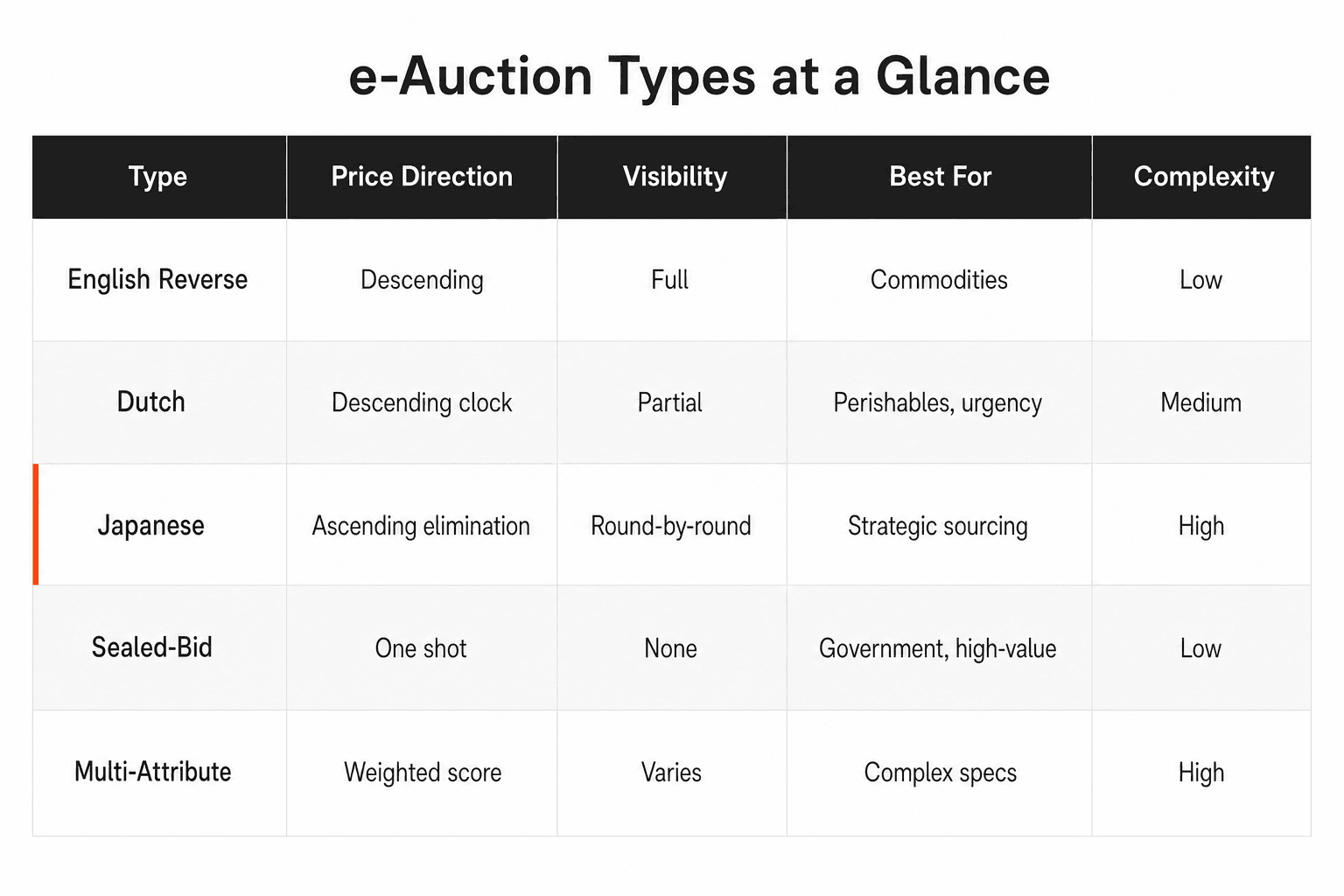
Comparison Table: e-Auction Types at a Glance
Dimension | English Reverse | Dutch (Descending) | Japanese (Ascending Exit) | Sealed-Bid | Vickrey (2nd Price) | Brazilian (Rank Compression) | Multi-Attribute | Portfolio/Lot |
|---|---|---|---|---|---|---|---|---|
Direction | Price goes down | Price goes down (auto) | Price goes down (steps) | One-shot | One-shot | Sequential improvement | Score goes up | Price/cost goes down |
Visibility | Current best price visible | Current price visible to all | Who’s still in visible | Fully blind | Fully blind | Rank visible after each round | Rank/score gap visible | Item-level and total visible |
Typical duration | 30-60 min | 5-15 min | 45-90 min | 1-2 weeks (bid prep) | 1-2 weeks | 1-3 hours | 30-60 min | 1-4 hours |
Ideal supplier count | 4-8 | 3-6 | 5-8 | 3+ | 3+ | 4-10 | 3-6 | 5-15 |
Primary metric | Lowest price | First acceptance price | Last-standing price | Lowest bid | 2nd-lowest bid | Compressed best price | Best weighted score | Lowest total portfolio cost |
Price discovery | 🟢 Strong | 🟡 Moderate | 🟢 Strong | 🔴 Limited | 🔴 Limited | 🟢 Strong | 🟡 Moderate | 🟢 Strong |
Speed to award | 🟡 Moderate | 🟢 Fast | 🔴 Slow | 🟡 Moderate | 🟡 Moderate | 🟡 Moderate | 🟡 Moderate | 🔴 Slow |
Savings potential | 🟢 High (3-12%) | 🟡 Moderate (2-5%) | 🟢 High (5-15%) | 🟡 Moderate (baseline) | 🟡 Moderate | 🟢 High (5-10%) | 🟢 High (TCO-based) | 🟢 High (portfolio optimization) |
Supplier relationship risk | 🟡 Moderate | 🟢 Low | 🟡 Moderate | 🟢 Low | 🟢 Low | 🟡 Moderate | 🟢 Low | 🟡 Moderate |
Complexity to run | 🟢 Low | 🟢 Low | 🟡 Moderate | 🟢 Low | 🟡 Moderate (trust issue) | 🟡 Moderate | 🔴 High | 🔴 High |
Collusion resistance | 🟡 Moderate | 🟢 Strong | 🔴 Weak | 🟢 Strong | 🟢 Strong | 🟡 Moderate | 🟡 Moderate | 🟢 Strong |
Best for | Commodity re-bids | Time-sensitive allocation | Strategic intelligence | Public sector, first rounds | Academic/theory | LatAm public procurement | Engineered/custom parts | Annual category reviews |
Stoplight Capability Grid: Pros and Cons
Capability | English Reverse | Dutch | Japanese | Sealed-Bid | Brazilian | Multi-Attribute | Portfolio |
|---|---|---|---|---|---|---|---|
Drives lowest absolute price | 🟢 | 🟡 | 🟢 | 🟡 | 🟢 | 🟡 | 🟢 |
Preserves supplier relationships | 🟡 | 🟢 | 🟡 | 🟢 | 🟡 | 🟢 | 🟡 |
Reveals market cost structure | 🟡 | 🔴 | 🟢 | 🔴 | 🟡 | 🟡 | 🟢 |
Works with few suppliers (<4) | 🔴 | 🟡 | 🔴 | 🟢 | 🔴 | 🟢 | 🔴 |
Speed of execution | 🟡 | 🟢 | 🔴 | 🟡 | 🟡 | 🟡 | 🔴 |
Handles complex specs | 🔴 | 🔴 | 🔴 | 🟡 | 🔴 | 🟢 | 🟢 |
Resistant to sniping/gaming | 🟡 | 🟢 | 🟢 | 🟢 | 🟡 | 🟡 | 🟢 |
Easy for suppliers to participate | 🟢 | 🟢 | 🟡 | 🟢 | 🟡 | 🟡 | 🔴 |
Produces actionable cost intelligence | 🟡 | 🔴 | 🟢 | 🔴 | 🟡 | 🟡 | 🟢 |
Works for multi-year strategic awards | 🔴 | 🔴 | 🟡 | 🟡 | 🔴 | 🟢 | 🟡 |
Scalable to 10+ lots | 🔴 | 🔴 | 🔴 | 🟡 | 🔴 | 🔴 | 🟢 |
Regulatory/public-sector compliant | 🟡 | 🔴 | 🔴 | 🟢 | 🟢 | 🟡 | 🟡 |
Key: 🟢 Strong fit / clear advantage | 🟡 Moderate / depends on context | 🔴 Poor fit / significant limitation
Category Viability Matrix: Which Auction Type Works Where?
This table maps common procurement categories against auction types. Use it as a starting framework -- your specific market conditions, supplier count, and strategic priorities should inform the final choice.
Category | English Reverse | Dutch | Japanese | Sealed-Bid | Brazilian | Multi-Attribute | Portfolio |
|---|---|---|---|---|---|---|---|
Raw metals (aluminum, steel, copper) | 🟢 | 🟡 | 🟢 | 🟡 | 🟡 | 🔴 | 🟢 |
Injection molding / die casting | 🟡 | 🔴 | 🟡 | 🟡 | 🔴 | 🟢 | 🟢 |
PCB assemblies (PCBA) | 🟡 | 🔴 | 🟡 | 🟡 | 🔴 | 🟢 | 🟢 |
Fasteners and hardware | 🟢 | 🟡 | 🟡 | 🟡 | 🟡 | 🔴 | 🟢 |
Packaging materials | 🟢 | 🟢 | 🟡 | 🟡 | 🟡 | 🔴 | 🟢 |
Freight and logistics lanes | 🟢 | 🟡 | 🟡 | 🟡 | 🟡 | 🟡 | 🟢 |
MRO / consumables | 🟢 | 🟢 | 🔴 | 🟡 | 🟡 | 🔴 | 🟢 |
Custom tooling / fixtures | 🔴 | 🔴 | 🔴 | 🟡 | 🔴 | 🟢 | 🔴 |
Capital equipment | 🔴 | 🔴 | 🔴 | 🟢 | 🔴 | 🟢 | 🔴 |
Specialty chemicals | 🟡 | 🔴 | 🟡 | 🟡 | 🔴 | 🟢 | 🟡 |
Wire harnesses / cables | 🟢 | 🟡 | 🟡 | 🟡 | 🟡 | 🟡 | 🟢 |
Machined components (CNC) | 🟡 | 🔴 | 🟡 | 🟡 | 🔴 | 🟢 | 🟢 |
Castings and forgings | 🟡 | 🔴 | 🟢 | 🟡 | 🔴 | 🟡 | 🟢 |
Office supplies / indirect | 🟢 | 🟢 | 🔴 | 🟡 | 🟢 | 🔴 | 🟢 |
IT hardware / servers | 🟡 | 🔴 | 🔴 | 🟢 | 🔴 | 🟢 | 🟡 |
Construction / facilities | 🔴 | 🔴 | 🔴 | 🟢 | 🟡 | 🟢 | 🔴 |
Energy / utilities | 🟡 | 🟢 | 🟡 | 🟡 | 🟡 | 🟡 | 🟢 |
Temp labor / staffing | 🟡 | 🟡 | 🔴 | 🟡 | 🟡 | 🟢 | 🔴 |
Contract manufacturing (full assembly) | 🔴 | 🔴 | 🔴 | 🟡 | 🔴 | 🟢 | 🔴 |
Perishable goods / food ingredients | 🟡 | 🟢 | 🔴 | 🔴 | 🔴 | 🟡 | 🟡 |
Reading the matrix:
🟢 = Strong fit. This auction type reliably produces good outcomes for this category.
🟡 = Viable with conditions. Works if supplier count is sufficient, specs are clear, or other prerequisites are met.
🔴 = Poor fit. Either the category dynamics don’t suit the format, or the format actively destroys value here.
Pattern to notice: Commodity categories (raw metals, fasteners, packaging, MRO) cluster green on English Reverse and Portfolio formats. Engineered or custom categories (tooling, capital equipment, contract manufacturing) cluster green on Multi-Attribute and Sealed-Bid. Dutch auctions work best for time-sensitive or perishable categories. Japanese auctions shine wherever market intelligence has long-term strategic value.
How to Choose: A Decision Framework
If you’re looking at a sourcing event and asking “which format?” -- start with these four questions:
How many qualified suppliers do you have? Fewer than 3 = sealed-bid or multi-attribute (auctions need competition). 4-8 = English reverse or Japanese. 8+ = portfolio or Brazilian.
Is price the primary award criterion, or is it one of several? Price-only = reverse, Dutch, or Japanese. Price-plus-quality-plus-lead-time = multi-attribute.
How standardized is the spec? Locked spec with no ambiguity = any auction format works. Custom or evolving spec = multi-attribute or sealed-bid (don’t auction what isn’t fully defined).
What’s your strategic priority -- savings today or intelligence for tomorrow? Maximum savings now = English reverse. Market intelligence for future negotiations = Japanese. Relationship preservation = sealed-bid or multi-attribute.
The format is a tool, not a religion. Many sophisticated procurement teams use a staged approach: sealed-bid to establish baseline, then English reverse or Japanese to compress further. The first round reveals who’s competitive. The second round extracts the value.
Sources
Beall et al., “The Role of Reverse Auctions in Strategic Sourcing,” CAPS Research -- foundational study on reverse auction savings rates (5-20% typical range)
Jap, S.D., “Online Reverse Auctions: Issues, Themes, and Prospects,” Journal of the Academy of Marketing Science, 2002 -- impact of auction format on supplier relationships
Kaufmann & Carter, “International Supply Chain Management,” Journal of Supply Chain Management, 2006 -- multi-attribute auction effectiveness data
Brazilian Federal Law 10.520/2002 (Pregao Eletronico) -- legal framework for Brazilian electronic auction format
Klemperer, P., “Auction Theory: A Guide to the Literature,” Journal of Economic Surveys, 1999 -- Vickrey and Dutch auction game-theoretic foundations
University of Arizona INFORMS eSourcing Research -- comparative data on auction format performance (3-8% advantage for multi-round formats)
Aalsmeer Flower Auction (Royal FloraHolland) -- history and mechanics of the Dutch auction clock system
Frequently Asked Questions
What is the most common type of e-auction in procurement?
The English reverse auction is by far the most common format in commercial procurement. Estimates from sourcing platform data suggest 70-80% of all procurement auctions use this format. Its popularity comes from simplicity -- suppliers understand it intuitively, platforms support it natively, and it produces consistent savings for commodity categories with sufficient competition.
How much can you save with an e-auction compared to traditional negotiation?
Typical savings from e-auctions range from 5-20% over incumbent pricing, depending on category, supplier count, and market conditions. Commodity categories with 5+ bidders tend toward the higher end. Engineered components and categories with fewer suppliers typically see 3-8%. The format matters -- multi-round formats (English reverse, Japanese) consistently outperform single-round sealed-bid events by 3-8 percentage points in competitive markets.
Can you use e-auctions for services, not just materials?
Yes, but with constraints. Services with clearly defined scope and measurable outputs (janitorial services, freight lanes, temp staffing with hourly rates) auction well using English reverse or multi-attribute formats. Complex professional services (consulting, engineering design, legal) are poor auction candidates because the scope is ambiguous and quality variation between providers is extreme.
What is the minimum number of suppliers needed for an effective e-auction?
Three is the absolute minimum for any competitive auction format, but four to six is where real competitive dynamics begin. With only two suppliers, the “auction” is really a negotiation with forced transparency -- and suppliers know it. Research consistently shows diminishing marginal returns above 6-8 suppliers (the incremental savings from supplier #7 vs. #8 are minimal, while event complexity increases).
How does a Japanese auction differ from an English reverse auction?
Both drive price downward, but the mechanics differ fundamentally. In an English reverse, suppliers actively submit lower bids at their own pace. In a Japanese auction, the system drops the price in fixed steps, and suppliers passively confirm whether they’ll still participate at each price point. The Japanese format reveals each supplier’s walk-away price through elimination, giving the buyer a map of the market’s cost structure -- intelligence that an English reverse doesn’t produce as cleanly.
When should you NOT use an e-auction?
Avoid auctions when: you have fewer than 3 qualified suppliers, the specification isn’t finalized, the relationship is more important than the price outcome (e.g., co-development partnerships), the category requires significant supplier investment in tooling or NRE, or the item is sole-sourced. In these cases, structured negotiation, competitive dialogue, or multi-attribute evaluation without real-time bidding is more appropriate.
What Is an e-Auction, and Why Does Format Matter?
An e-auction is a real-time, competitive bidding event conducted on a digital platform. Suppliers submit prices (or scores) against a defined specification within a fixed time window. The “e” is just the medium -- the mechanics underneath vary dramatically.
The format you choose determines three things: how aggressively suppliers compete, how much information flows between parties, and whether the outcome optimizes for price alone or for price-plus-value. Get the format wrong and you either leave money on the table or you destroy a supplier relationship you needed intact.
Let’s say you’re a procurement manager at a mid-size manufacturer. You’ve got six sourcing events this quarter -- raw aluminum extrusions, PCB assemblies, logistics freight lanes, MRO consumables, a custom tooling package, and a capital equipment purchase. Using the same auction format for all six is a mistake. Here’s why.
The English Reverse Auction
The English reverse auction is the workhorse. It’s what most people picture when they hear “e-auction.” Suppliers see the leading bid (or their rank) and can submit lower bids in real-time until the clock runs out. Extensions trigger when new bids arrive in the final minutes.
How it works: Buyers set a starting price (usually based on incumbent pricing or a should-cost model). Suppliers bid downward. Everyone sees the current best price (or at minimum their rank). The auction extends if bids come in near the deadline -- preventing sniping.
Where it works best:
Commodity materials with 4+ qualified suppliers
Items where spec is locked and price is the primary differentiator
Categories where suppliers have real competitive tension (they know they’re replaceable)
Annual re-bids on established categories
Where it fails:
Custom or engineered components where switching costs are high
Categories with fewer than 3 suppliers (the “auction” becomes a negotiation with an audience)
Situations where you need suppliers to invest in tooling, NRE, or co-development
Back at Tesla, English reverse auctions worked well for standard commodity buys -- things like fasteners, packaging materials, wire harnesses with established specs. The key was having enough qualified suppliers that the competitive pressure was real. With fewer than four bidders, the format often produced mediocre results because suppliers could sense the thin competition.
The Dutch Auction (Descending Clock)
A Dutch auction starts high and ticks downward. The first supplier to accept the current price wins. It’s named after the Dutch flower markets in Aalsmeer, where millions of cut flowers have been sold this way since 1911.
How it works: The buyer sets a high starting price (above market) and a decrement schedule -- say, dropping $0.50 per unit every 30 seconds. Suppliers watch the price fall. The first to hit “accept” wins the lot at that price. Once someone accepts, it’s over. No second chances.
Where it works best:
Perishable goods or time-sensitive allocations (the original flower market use case)
Situations where speed of award matters more than finding the absolute floor price
Multi-lot events where you’re splitting volume across winners (first acceptor gets lot 1, second gets lot 2, etc.)
Categories where suppliers have similar cost structures and the market price is well-understood
Where it fails:
Complex specifications where suppliers need time to evaluate
High-value strategic buys where you want maximum competitive extraction
Categories where supplier cost structures vary widely (the low-cost producer waits while expensive suppliers accept early)
The Dutch auction’s genius is psychological. Unlike the English reverse where suppliers can always bid lower, the Dutch format creates a fear of loss -- “if I don’t accept now, someone else will.” This urgency produces faster awards but typically at a higher final price than an English reverse would achieve. The trade-off is speed and certainty vs. maximum savings.
The Japanese Auction (Ascending Elimination)
The Japanese auction -- sometimes called a “clock auction” or “ascending exit” -- is the inverse of the Dutch format but applied to procurement. The price starts high and decreases in fixed steps. At each step, suppliers must actively confirm they’re still willing to supply at that price. Anyone who doesn’t confirm is eliminated. The auction continues until only one supplier remains.
How it works: Starting price is set above market (say, the incumbent’s current price). The system drops the price by a fixed decrement -- maybe 2% per round. After each drop, every participating supplier must click “I accept this price” within a time window. If they don’t confirm, they’re out permanently. The last supplier standing wins at the final confirmed price.
Where it works best:
Categories where you want to understand each supplier’s walk-away point
Situations where visibility into the competitive landscape matters more than absolute lowest price
Strategic categories where knowing how close your backup suppliers are to the winner’s price helps future negotiations
Events with 5-8 suppliers where you want clean, step-by-step elimination
Where it fails:
Very large supplier pools (too many rounds, too slow)
Simple commodities where the English reverse is faster and achieves similar results
Situations where suppliers collude easily (the transparent elimination makes coordination possible)
The Japanese auction’s real value is intelligence. When supplier #3 drops out at $14.20 and supplier #2 drops out at $13.80 and the winner holds at $13.50, you now know the market’s cost distribution. That data is gold for your next negotiation cycle -- you know exactly how much leverage you have and where the floor actually is.
The Sealed-Bid (First-Price) Auction
The sealed-bid auction is the simplest format and the most familiar from public-sector procurement. Each supplier submits one bid. No one sees anyone else’s bid. The lowest price wins.
How it works: Suppliers receive the RFQ package with a deadline. They submit exactly one bid -- no revisions, no visibility into competing offers. After the deadline, bids are opened simultaneously. Lowest compliant bid wins.
Where it works best:
Government and public-sector procurement (often legally mandated)
Situations where you want to prevent gaming and last-second sniping
First-round events to establish baseline pricing before a live auction
Categories where supplier relationships are sensitive and you don’t want visible head-to-head competition
High-value capital equipment where the bid preparation cost is significant
Where it fails:
Categories where iterative competition would drive deeper savings
Situations where suppliers are uncertain about the competitive landscape (they pad bids defensively)
Repeat events where suppliers learn each other’s patterns
The sealed-bid format is simple but leaves money on the table in competitive markets. Suppliers can’t see what their competitors bid, so they price based on their own cost-plus-margin target rather than competitive pressure. Research from the University of Arizona’s eSourcing lab found that multi-round formats (English reverse, Japanese) typically produce 3-8% lower final prices than sealed-bid events for commodity categories with 4+ bidders.
The Vickrey (Second-Price Sealed-Bid) Auction
The Vickrey auction is elegant in theory and rare in practice. Suppliers submit sealed bids, but the winner pays the second-lowest price, not their own bid.
How it works: Same submission mechanics as a sealed-bid auction -- one bid, no visibility. But the winner doesn’t pay what they bid. They pay the next-lowest bid. If Supplier A bids $10.00, Supplier B bids $10.50, and Supplier C bids $11.00, Supplier A wins but pays $10.50.
Where it works best:
Academic settings and game theory courses (it’s theoretically optimal -- suppliers bid their true cost with no strategic padding)
Some government spectrum auctions (the FCC used Vickrey elements in the 1994 broadband PCS auctions)
Situations where you want suppliers to reveal true costs without fear of leaving margin on the table
Where it fails:
Nearly all commercial procurement (suppliers don’t trust the mechanism -- “why would I bid my true cost if I’m going to pay more anyway?”)
Multi-attribute evaluations (the second-price logic breaks down when price isn’t the only criterion)
Repeat events (suppliers learn to game it by submitting artificially low bids to set the second price)
In practice, Vickrey auctions are almost never used in direct materials procurement. They’re worth understanding because the underlying principle -- that the optimal strategy is truthful bidding -- informs why formats like the Japanese auction (which reveals similar information through elimination) are more practical alternatives.
The Brazilian Auction (Rank-Based Compression)
The Brazilian auction -- also called “compulsory improvement” or “rank auction” -- is less common in North America but widely used in Latin American public procurement and increasingly in European sourcing. It compresses bids toward the leader through forced improvement rounds.
How it works: After an initial sealed-bid round, the system ranks suppliers by price. Then, starting from the worst-ranked supplier, each bidder gets a fixed time window (often 3 minutes) to submit an improved bid. The process iterates in rank order until no supplier can improve further, or a maximum number of rounds is reached. Some variants require each new bid to beat the current leader by a minimum margin.
Where it works best:
Categories where the initial bid spread is wide and you want to compress it
Situations where you want to give every supplier a fair shot (even the initially expensive ones)
Public-sector procurement in Brazil, Argentina, and other Latin American markets (where it’s called “pregao eletronico” and is legally mandated for many government purchases)
Events where you expect significant strategic padding in first bids
Where it fails:
Categories where the initial bids are already tight (the rounds add time without value)
Situations with fewer than 4 suppliers (too few rounds to generate compression)
Markets where the format is unfamiliar and suppliers don’t trust the sequential reveal
The Multi-Attribute (Weighted Score) Auction
A multi-attribute auction doesn’t optimize for price alone. Instead, each bid is scored on multiple dimensions -- price, lead time, quality metrics, sustainability, payment terms -- with predetermined weights. The “winning bid” is the one with the best composite score, not necessarily the lowest price.
How it works: The buyer defines scoring criteria and weights before the event (e.g., 60% price, 20% lead time, 10% quality certification level, 10% sustainability score). Suppliers bid on each dimension simultaneously. The platform calculates a real-time composite score. Suppliers can see their rank (or score gap) and improve on any dimension -- dropping price, shortening lead time, or adding certifications.
Where it works best:
Engineered or custom components where total cost of ownership matters more than unit price
Categories where lead time, quality, or delivery reliability are non-negotiable constraints
Strategic relationships where you’re selecting a long-term partner, not just a price point
Categories where the cheapest option is rarely the best option (electronics, precision machining, specialty chemicals)
Where it fails:
Pure commodities where price is genuinely the only differentiator
Situations where suppliers don’t trust the weighting (they suspect you’ll override scores to pick a preferred vendor)
Events with too many attributes (more than 5-6 dimensions confuse suppliers and reduce bid aggressiveness)
This format is where procurement platforms earn their keep. Running a multi-attribute auction on spreadsheets is operationally nightmarish -- you’re normalizing scores across dimensions, recalculating ranks in real-time, and communicating composite positions to 6+ suppliers simultaneously. The platform does this automatically.
The Reverse Auction with Lots (Portfolio Bidding)
Many real sourcing events aren’t single-item buys. They’re portfolio events -- awarding 15-50 line items across multiple suppliers, optimizing for total portfolio cost rather than line-by-line winners.
How it works: The buyer bundles related items into lots (or leaves them unbundled for maximum flexibility). Suppliers bid on individual items or bundles. The platform runs optimization algorithms to find the lowest-cost allocation across all items and all suppliers, subject to constraints (no single supplier gets more than 40% of volume, minimum 2 sources per category, etc.).
Where it works best:
Annual category re-bids with 20+ SKUs
Situations where bundle discounts are real (a supplier’s price for 10 items together is lower than 10 individual awards)
Complex allocation decisions where manual optimization isn’t feasible
Direct materials sourcing events where you’re splitting a BOM across multiple suppliers
Where it fails:
Single-item buys (no portfolio to optimize)
Categories where every line item has a different supplier base
Situations where constraints are so tight that optimization adds no value
Comparison Table: e-Auction Types at a Glance
Dimension | English Reverse | Dutch (Descending) | Japanese (Ascending Exit) | Sealed-Bid | Vickrey (2nd Price) | Brazilian (Rank Compression) | Multi-Attribute | Portfolio/Lot |
|---|---|---|---|---|---|---|---|---|
Direction | Price goes down | Price goes down (auto) | Price goes down (steps) | One-shot | One-shot | Sequential improvement | Score goes up | Price/cost goes down |
Visibility | Current best price visible | Current price visible to all | Who’s still in visible | Fully blind | Fully blind | Rank visible after each round | Rank/score gap visible | Item-level and total visible |
Typical duration | 30-60 min | 5-15 min | 45-90 min | 1-2 weeks (bid prep) | 1-2 weeks | 1-3 hours | 30-60 min | 1-4 hours |
Ideal supplier count | 4-8 | 3-6 | 5-8 | 3+ | 3+ | 4-10 | 3-6 | 5-15 |
Primary metric | Lowest price | First acceptance price | Last-standing price | Lowest bid | 2nd-lowest bid | Compressed best price | Best weighted score | Lowest total portfolio cost |
Price discovery | 🟢 Strong | 🟡 Moderate | 🟢 Strong | 🔴 Limited | 🔴 Limited | 🟢 Strong | 🟡 Moderate | 🟢 Strong |
Speed to award | 🟡 Moderate | 🟢 Fast | 🔴 Slow | 🟡 Moderate | 🟡 Moderate | 🟡 Moderate | 🟡 Moderate | 🔴 Slow |
Savings potential | 🟢 High (3-12%) | 🟡 Moderate (2-5%) | 🟢 High (5-15%) | 🟡 Moderate (baseline) | 🟡 Moderate | 🟢 High (5-10%) | 🟢 High (TCO-based) | 🟢 High (portfolio optimization) |
Supplier relationship risk | 🟡 Moderate | 🟢 Low | 🟡 Moderate | 🟢 Low | 🟢 Low | 🟡 Moderate | 🟢 Low | 🟡 Moderate |
Complexity to run | 🟢 Low | 🟢 Low | 🟡 Moderate | 🟢 Low | 🟡 Moderate (trust issue) | 🟡 Moderate | 🔴 High | 🔴 High |
Collusion resistance | 🟡 Moderate | 🟢 Strong | 🔴 Weak | 🟢 Strong | 🟢 Strong | 🟡 Moderate | 🟡 Moderate | 🟢 Strong |
Best for | Commodity re-bids | Time-sensitive allocation | Strategic intelligence | Public sector, first rounds | Academic/theory | LatAm public procurement | Engineered/custom parts | Annual category reviews |
Stoplight Capability Grid: Pros and Cons
Capability | English Reverse | Dutch | Japanese | Sealed-Bid | Brazilian | Multi-Attribute | Portfolio |
|---|---|---|---|---|---|---|---|
Drives lowest absolute price | 🟢 | 🟡 | 🟢 | 🟡 | 🟢 | 🟡 | 🟢 |
Preserves supplier relationships | 🟡 | 🟢 | 🟡 | 🟢 | 🟡 | 🟢 | 🟡 |
Reveals market cost structure | 🟡 | 🔴 | 🟢 | 🔴 | 🟡 | 🟡 | 🟢 |
Works with few suppliers (<4) | 🔴 | 🟡 | 🔴 | 🟢 | 🔴 | 🟢 | 🔴 |
Speed of execution | 🟡 | 🟢 | 🔴 | 🟡 | 🟡 | 🟡 | 🔴 |
Handles complex specs | 🔴 | 🔴 | 🔴 | 🟡 | 🔴 | 🟢 | 🟢 |
Resistant to sniping/gaming | 🟡 | 🟢 | 🟢 | 🟢 | 🟡 | 🟡 | 🟢 |
Easy for suppliers to participate | 🟢 | 🟢 | 🟡 | 🟢 | 🟡 | 🟡 | 🔴 |
Produces actionable cost intelligence | 🟡 | 🔴 | 🟢 | 🔴 | 🟡 | 🟡 | 🟢 |
Works for multi-year strategic awards | 🔴 | 🔴 | 🟡 | 🟡 | 🔴 | 🟢 | 🟡 |
Scalable to 10+ lots | 🔴 | 🔴 | 🔴 | 🟡 | 🔴 | 🔴 | 🟢 |
Regulatory/public-sector compliant | 🟡 | 🔴 | 🔴 | 🟢 | 🟢 | 🟡 | 🟡 |
Key: 🟢 Strong fit / clear advantage | 🟡 Moderate / depends on context | 🔴 Poor fit / significant limitation
Category Viability Matrix: Which Auction Type Works Where?
This table maps common procurement categories against auction types. Use it as a starting framework -- your specific market conditions, supplier count, and strategic priorities should inform the final choice.
Category | English Reverse | Dutch | Japanese | Sealed-Bid | Brazilian | Multi-Attribute | Portfolio |
|---|---|---|---|---|---|---|---|
Raw metals (aluminum, steel, copper) | 🟢 | 🟡 | 🟢 | 🟡 | 🟡 | 🔴 | 🟢 |
Injection molding / die casting | 🟡 | 🔴 | 🟡 | 🟡 | 🔴 | 🟢 | 🟢 |
PCB assemblies (PCBA) | 🟡 | 🔴 | 🟡 | 🟡 | 🔴 | 🟢 | 🟢 |
Fasteners and hardware | 🟢 | 🟡 | 🟡 | 🟡 | 🟡 | 🔴 | 🟢 |
Packaging materials | 🟢 | 🟢 | 🟡 | 🟡 | 🟡 | 🔴 | 🟢 |
Freight and logistics lanes | 🟢 | 🟡 | 🟡 | 🟡 | 🟡 | 🟡 | 🟢 |
MRO / consumables | 🟢 | 🟢 | 🔴 | 🟡 | 🟡 | 🔴 | 🟢 |
Custom tooling / fixtures | 🔴 | 🔴 | 🔴 | 🟡 | 🔴 | 🟢 | 🔴 |
Capital equipment | 🔴 | 🔴 | 🔴 | 🟢 | 🔴 | 🟢 | 🔴 |
Specialty chemicals | 🟡 | 🔴 | 🟡 | 🟡 | 🔴 | 🟢 | 🟡 |
Wire harnesses / cables | 🟢 | 🟡 | 🟡 | 🟡 | 🟡 | 🟡 | 🟢 |
Machined components (CNC) | 🟡 | 🔴 | 🟡 | 🟡 | 🔴 | 🟢 | 🟢 |
Castings and forgings | 🟡 | 🔴 | 🟢 | 🟡 | 🔴 | 🟡 | 🟢 |
Office supplies / indirect | 🟢 | 🟢 | 🔴 | 🟡 | 🟢 | 🔴 | 🟢 |
IT hardware / servers | 🟡 | 🔴 | 🔴 | 🟢 | 🔴 | 🟢 | 🟡 |
Construction / facilities | 🔴 | 🔴 | 🔴 | 🟢 | 🟡 | 🟢 | 🔴 |
Energy / utilities | 🟡 | 🟢 | 🟡 | 🟡 | 🟡 | 🟡 | 🟢 |
Temp labor / staffing | 🟡 | 🟡 | 🔴 | 🟡 | 🟡 | 🟢 | 🔴 |
Contract manufacturing (full assembly) | 🔴 | 🔴 | 🔴 | 🟡 | 🔴 | 🟢 | 🔴 |
Perishable goods / food ingredients | 🟡 | 🟢 | 🔴 | 🔴 | 🔴 | 🟡 | 🟡 |
Reading the matrix:
🟢 = Strong fit. This auction type reliably produces good outcomes for this category.
🟡 = Viable with conditions. Works if supplier count is sufficient, specs are clear, or other prerequisites are met.
🔴 = Poor fit. Either the category dynamics don’t suit the format, or the format actively destroys value here.
Pattern to notice: Commodity categories (raw metals, fasteners, packaging, MRO) cluster green on English Reverse and Portfolio formats. Engineered or custom categories (tooling, capital equipment, contract manufacturing) cluster green on Multi-Attribute and Sealed-Bid. Dutch auctions work best for time-sensitive or perishable categories. Japanese auctions shine wherever market intelligence has long-term strategic value.
How to Choose: A Decision Framework
If you’re looking at a sourcing event and asking “which format?” -- start with these four questions:
How many qualified suppliers do you have? Fewer than 3 = sealed-bid or multi-attribute (auctions need competition). 4-8 = English reverse or Japanese. 8+ = portfolio or Brazilian.
Is price the primary award criterion, or is it one of several? Price-only = reverse, Dutch, or Japanese. Price-plus-quality-plus-lead-time = multi-attribute.
How standardized is the spec? Locked spec with no ambiguity = any auction format works. Custom or evolving spec = multi-attribute or sealed-bid (don’t auction what isn’t fully defined).
What’s your strategic priority -- savings today or intelligence for tomorrow? Maximum savings now = English reverse. Market intelligence for future negotiations = Japanese. Relationship preservation = sealed-bid or multi-attribute.
The format is a tool, not a religion. Many sophisticated procurement teams use a staged approach: sealed-bid to establish baseline, then English reverse or Japanese to compress further. The first round reveals who’s competitive. The second round extracts the value.
Sources
Beall et al., “The Role of Reverse Auctions in Strategic Sourcing,” CAPS Research -- foundational study on reverse auction savings rates (5-20% typical range)
Jap, S.D., “Online Reverse Auctions: Issues, Themes, and Prospects,” Journal of the Academy of Marketing Science, 2002 -- impact of auction format on supplier relationships
Kaufmann & Carter, “International Supply Chain Management,” Journal of Supply Chain Management, 2006 -- multi-attribute auction effectiveness data
Brazilian Federal Law 10.520/2002 (Pregao Eletronico) -- legal framework for Brazilian electronic auction format
Klemperer, P., “Auction Theory: A Guide to the Literature,” Journal of Economic Surveys, 1999 -- Vickrey and Dutch auction game-theoretic foundations
University of Arizona INFORMS eSourcing Research -- comparative data on auction format performance (3-8% advantage for multi-round formats)
Aalsmeer Flower Auction (Royal FloraHolland) -- history and mechanics of the Dutch auction clock system
Frequently Asked Questions
What is the most common type of e-auction in procurement?
The English reverse auction is by far the most common format in commercial procurement. Estimates from sourcing platform data suggest 70-80% of all procurement auctions use this format. Its popularity comes from simplicity -- suppliers understand it intuitively, platforms support it natively, and it produces consistent savings for commodity categories with sufficient competition.
How much can you save with an e-auction compared to traditional negotiation?
Typical savings from e-auctions range from 5-20% over incumbent pricing, depending on category, supplier count, and market conditions. Commodity categories with 5+ bidders tend toward the higher end. Engineered components and categories with fewer suppliers typically see 3-8%. The format matters -- multi-round formats (English reverse, Japanese) consistently outperform single-round sealed-bid events by 3-8 percentage points in competitive markets.
Can you use e-auctions for services, not just materials?
Yes, but with constraints. Services with clearly defined scope and measurable outputs (janitorial services, freight lanes, temp staffing with hourly rates) auction well using English reverse or multi-attribute formats. Complex professional services (consulting, engineering design, legal) are poor auction candidates because the scope is ambiguous and quality variation between providers is extreme.
What is the minimum number of suppliers needed for an effective e-auction?
Three is the absolute minimum for any competitive auction format, but four to six is where real competitive dynamics begin. With only two suppliers, the “auction” is really a negotiation with forced transparency -- and suppliers know it. Research consistently shows diminishing marginal returns above 6-8 suppliers (the incremental savings from supplier #7 vs. #8 are minimal, while event complexity increases).
How does a Japanese auction differ from an English reverse auction?
Both drive price downward, but the mechanics differ fundamentally. In an English reverse, suppliers actively submit lower bids at their own pace. In a Japanese auction, the system drops the price in fixed steps, and suppliers passively confirm whether they’ll still participate at each price point. The Japanese format reveals each supplier’s walk-away price through elimination, giving the buyer a map of the market’s cost structure -- intelligence that an English reverse doesn’t produce as cleanly.
When should you NOT use an e-auction?
Avoid auctions when: you have fewer than 3 qualified suppliers, the specification isn’t finalized, the relationship is more important than the price outcome (e.g., co-development partnerships), the category requires significant supplier investment in tooling or NRE, or the item is sole-sourced. In these cases, structured negotiation, competitive dialogue, or multi-attribute evaluation without real-time bidding is more appropriate.
What Is an e-Auction, and Why Does Format Matter?
An e-auction is a real-time, competitive bidding event conducted on a digital platform. Suppliers submit prices (or scores) against a defined specification within a fixed time window. The “e” is just the medium -- the mechanics underneath vary dramatically.
The format you choose determines three things: how aggressively suppliers compete, how much information flows between parties, and whether the outcome optimizes for price alone or for price-plus-value. Get the format wrong and you either leave money on the table or you destroy a supplier relationship you needed intact.
Let’s say you’re a procurement manager at a mid-size manufacturer. You’ve got six sourcing events this quarter -- raw aluminum extrusions, PCB assemblies, logistics freight lanes, MRO consumables, a custom tooling package, and a capital equipment purchase. Using the same auction format for all six is a mistake. Here’s why.
The English Reverse Auction
The English reverse auction is the workhorse. It’s what most people picture when they hear “e-auction.” Suppliers see the leading bid (or their rank) and can submit lower bids in real-time until the clock runs out. Extensions trigger when new bids arrive in the final minutes.
How it works: Buyers set a starting price (usually based on incumbent pricing or a should-cost model). Suppliers bid downward. Everyone sees the current best price (or at minimum their rank). The auction extends if bids come in near the deadline -- preventing sniping.
Where it works best:
Commodity materials with 4+ qualified suppliers
Items where spec is locked and price is the primary differentiator
Categories where suppliers have real competitive tension (they know they’re replaceable)
Annual re-bids on established categories
Where it fails:
Custom or engineered components where switching costs are high
Categories with fewer than 3 suppliers (the “auction” becomes a negotiation with an audience)
Situations where you need suppliers to invest in tooling, NRE, or co-development
Back at Tesla, English reverse auctions worked well for standard commodity buys -- things like fasteners, packaging materials, wire harnesses with established specs. The key was having enough qualified suppliers that the competitive pressure was real. With fewer than four bidders, the format often produced mediocre results because suppliers could sense the thin competition.
The Dutch Auction (Descending Clock)
A Dutch auction starts high and ticks downward. The first supplier to accept the current price wins. It’s named after the Dutch flower markets in Aalsmeer, where millions of cut flowers have been sold this way since 1911.
How it works: The buyer sets a high starting price (above market) and a decrement schedule -- say, dropping $0.50 per unit every 30 seconds. Suppliers watch the price fall. The first to hit “accept” wins the lot at that price. Once someone accepts, it’s over. No second chances.
Where it works best:
Perishable goods or time-sensitive allocations (the original flower market use case)
Situations where speed of award matters more than finding the absolute floor price
Multi-lot events where you’re splitting volume across winners (first acceptor gets lot 1, second gets lot 2, etc.)
Categories where suppliers have similar cost structures and the market price is well-understood
Where it fails:
Complex specifications where suppliers need time to evaluate
High-value strategic buys where you want maximum competitive extraction
Categories where supplier cost structures vary widely (the low-cost producer waits while expensive suppliers accept early)
The Dutch auction’s genius is psychological. Unlike the English reverse where suppliers can always bid lower, the Dutch format creates a fear of loss -- “if I don’t accept now, someone else will.” This urgency produces faster awards but typically at a higher final price than an English reverse would achieve. The trade-off is speed and certainty vs. maximum savings.
The Japanese Auction (Ascending Elimination)
The Japanese auction -- sometimes called a “clock auction” or “ascending exit” -- is the inverse of the Dutch format but applied to procurement. The price starts high and decreases in fixed steps. At each step, suppliers must actively confirm they’re still willing to supply at that price. Anyone who doesn’t confirm is eliminated. The auction continues until only one supplier remains.
How it works: Starting price is set above market (say, the incumbent’s current price). The system drops the price by a fixed decrement -- maybe 2% per round. After each drop, every participating supplier must click “I accept this price” within a time window. If they don’t confirm, they’re out permanently. The last supplier standing wins at the final confirmed price.
Where it works best:
Categories where you want to understand each supplier’s walk-away point
Situations where visibility into the competitive landscape matters more than absolute lowest price
Strategic categories where knowing how close your backup suppliers are to the winner’s price helps future negotiations
Events with 5-8 suppliers where you want clean, step-by-step elimination
Where it fails:
Very large supplier pools (too many rounds, too slow)
Simple commodities where the English reverse is faster and achieves similar results
Situations where suppliers collude easily (the transparent elimination makes coordination possible)
The Japanese auction’s real value is intelligence. When supplier #3 drops out at $14.20 and supplier #2 drops out at $13.80 and the winner holds at $13.50, you now know the market’s cost distribution. That data is gold for your next negotiation cycle -- you know exactly how much leverage you have and where the floor actually is.
The Sealed-Bid (First-Price) Auction
The sealed-bid auction is the simplest format and the most familiar from public-sector procurement. Each supplier submits one bid. No one sees anyone else’s bid. The lowest price wins.
How it works: Suppliers receive the RFQ package with a deadline. They submit exactly one bid -- no revisions, no visibility into competing offers. After the deadline, bids are opened simultaneously. Lowest compliant bid wins.
Where it works best:
Government and public-sector procurement (often legally mandated)
Situations where you want to prevent gaming and last-second sniping
First-round events to establish baseline pricing before a live auction
Categories where supplier relationships are sensitive and you don’t want visible head-to-head competition
High-value capital equipment where the bid preparation cost is significant
Where it fails:
Categories where iterative competition would drive deeper savings
Situations where suppliers are uncertain about the competitive landscape (they pad bids defensively)
Repeat events where suppliers learn each other’s patterns
The sealed-bid format is simple but leaves money on the table in competitive markets. Suppliers can’t see what their competitors bid, so they price based on their own cost-plus-margin target rather than competitive pressure. Research from the University of Arizona’s eSourcing lab found that multi-round formats (English reverse, Japanese) typically produce 3-8% lower final prices than sealed-bid events for commodity categories with 4+ bidders.
The Vickrey (Second-Price Sealed-Bid) Auction
The Vickrey auction is elegant in theory and rare in practice. Suppliers submit sealed bids, but the winner pays the second-lowest price, not their own bid.
How it works: Same submission mechanics as a sealed-bid auction -- one bid, no visibility. But the winner doesn’t pay what they bid. They pay the next-lowest bid. If Supplier A bids $10.00, Supplier B bids $10.50, and Supplier C bids $11.00, Supplier A wins but pays $10.50.
Where it works best:
Academic settings and game theory courses (it’s theoretically optimal -- suppliers bid their true cost with no strategic padding)
Some government spectrum auctions (the FCC used Vickrey elements in the 1994 broadband PCS auctions)
Situations where you want suppliers to reveal true costs without fear of leaving margin on the table
Where it fails:
Nearly all commercial procurement (suppliers don’t trust the mechanism -- “why would I bid my true cost if I’m going to pay more anyway?”)
Multi-attribute evaluations (the second-price logic breaks down when price isn’t the only criterion)
Repeat events (suppliers learn to game it by submitting artificially low bids to set the second price)
In practice, Vickrey auctions are almost never used in direct materials procurement. They’re worth understanding because the underlying principle -- that the optimal strategy is truthful bidding -- informs why formats like the Japanese auction (which reveals similar information through elimination) are more practical alternatives.
The Brazilian Auction (Rank-Based Compression)
The Brazilian auction -- also called “compulsory improvement” or “rank auction” -- is less common in North America but widely used in Latin American public procurement and increasingly in European sourcing. It compresses bids toward the leader through forced improvement rounds.
How it works: After an initial sealed-bid round, the system ranks suppliers by price. Then, starting from the worst-ranked supplier, each bidder gets a fixed time window (often 3 minutes) to submit an improved bid. The process iterates in rank order until no supplier can improve further, or a maximum number of rounds is reached. Some variants require each new bid to beat the current leader by a minimum margin.
Where it works best:
Categories where the initial bid spread is wide and you want to compress it
Situations where you want to give every supplier a fair shot (even the initially expensive ones)
Public-sector procurement in Brazil, Argentina, and other Latin American markets (where it’s called “pregao eletronico” and is legally mandated for many government purchases)
Events where you expect significant strategic padding in first bids
Where it fails:
Categories where the initial bids are already tight (the rounds add time without value)
Situations with fewer than 4 suppliers (too few rounds to generate compression)
Markets where the format is unfamiliar and suppliers don’t trust the sequential reveal
The Multi-Attribute (Weighted Score) Auction
A multi-attribute auction doesn’t optimize for price alone. Instead, each bid is scored on multiple dimensions -- price, lead time, quality metrics, sustainability, payment terms -- with predetermined weights. The “winning bid” is the one with the best composite score, not necessarily the lowest price.
How it works: The buyer defines scoring criteria and weights before the event (e.g., 60% price, 20% lead time, 10% quality certification level, 10% sustainability score). Suppliers bid on each dimension simultaneously. The platform calculates a real-time composite score. Suppliers can see their rank (or score gap) and improve on any dimension -- dropping price, shortening lead time, or adding certifications.
Where it works best:
Engineered or custom components where total cost of ownership matters more than unit price
Categories where lead time, quality, or delivery reliability are non-negotiable constraints
Strategic relationships where you’re selecting a long-term partner, not just a price point
Categories where the cheapest option is rarely the best option (electronics, precision machining, specialty chemicals)
Where it fails:
Pure commodities where price is genuinely the only differentiator
Situations where suppliers don’t trust the weighting (they suspect you’ll override scores to pick a preferred vendor)
Events with too many attributes (more than 5-6 dimensions confuse suppliers and reduce bid aggressiveness)
This format is where procurement platforms earn their keep. Running a multi-attribute auction on spreadsheets is operationally nightmarish -- you’re normalizing scores across dimensions, recalculating ranks in real-time, and communicating composite positions to 6+ suppliers simultaneously. The platform does this automatically.
The Reverse Auction with Lots (Portfolio Bidding)
Many real sourcing events aren’t single-item buys. They’re portfolio events -- awarding 15-50 line items across multiple suppliers, optimizing for total portfolio cost rather than line-by-line winners.
How it works: The buyer bundles related items into lots (or leaves them unbundled for maximum flexibility). Suppliers bid on individual items or bundles. The platform runs optimization algorithms to find the lowest-cost allocation across all items and all suppliers, subject to constraints (no single supplier gets more than 40% of volume, minimum 2 sources per category, etc.).
Where it works best:
Annual category re-bids with 20+ SKUs
Situations where bundle discounts are real (a supplier’s price for 10 items together is lower than 10 individual awards)
Complex allocation decisions where manual optimization isn’t feasible
Direct materials sourcing events where you’re splitting a BOM across multiple suppliers
Where it fails:
Single-item buys (no portfolio to optimize)
Categories where every line item has a different supplier base
Situations where constraints are so tight that optimization adds no value
Comparison Table: e-Auction Types at a Glance
Dimension | English Reverse | Dutch (Descending) | Japanese (Ascending Exit) | Sealed-Bid | Vickrey (2nd Price) | Brazilian (Rank Compression) | Multi-Attribute | Portfolio/Lot |
|---|---|---|---|---|---|---|---|---|
Direction | Price goes down | Price goes down (auto) | Price goes down (steps) | One-shot | One-shot | Sequential improvement | Score goes up | Price/cost goes down |
Visibility | Current best price visible | Current price visible to all | Who’s still in visible | Fully blind | Fully blind | Rank visible after each round | Rank/score gap visible | Item-level and total visible |
Typical duration | 30-60 min | 5-15 min | 45-90 min | 1-2 weeks (bid prep) | 1-2 weeks | 1-3 hours | 30-60 min | 1-4 hours |
Ideal supplier count | 4-8 | 3-6 | 5-8 | 3+ | 3+ | 4-10 | 3-6 | 5-15 |
Primary metric | Lowest price | First acceptance price | Last-standing price | Lowest bid | 2nd-lowest bid | Compressed best price | Best weighted score | Lowest total portfolio cost |
Price discovery | 🟢 Strong | 🟡 Moderate | 🟢 Strong | 🔴 Limited | 🔴 Limited | 🟢 Strong | 🟡 Moderate | 🟢 Strong |
Speed to award | 🟡 Moderate | 🟢 Fast | 🔴 Slow | 🟡 Moderate | 🟡 Moderate | 🟡 Moderate | 🟡 Moderate | 🔴 Slow |
Savings potential | 🟢 High (3-12%) | 🟡 Moderate (2-5%) | 🟢 High (5-15%) | 🟡 Moderate (baseline) | 🟡 Moderate | 🟢 High (5-10%) | 🟢 High (TCO-based) | 🟢 High (portfolio optimization) |
Supplier relationship risk | 🟡 Moderate | 🟢 Low | 🟡 Moderate | 🟢 Low | 🟢 Low | 🟡 Moderate | 🟢 Low | 🟡 Moderate |
Complexity to run | 🟢 Low | 🟢 Low | 🟡 Moderate | 🟢 Low | 🟡 Moderate (trust issue) | 🟡 Moderate | 🔴 High | 🔴 High |
Collusion resistance | 🟡 Moderate | 🟢 Strong | 🔴 Weak | 🟢 Strong | 🟢 Strong | 🟡 Moderate | 🟡 Moderate | 🟢 Strong |
Best for | Commodity re-bids | Time-sensitive allocation | Strategic intelligence | Public sector, first rounds | Academic/theory | LatAm public procurement | Engineered/custom parts | Annual category reviews |
Stoplight Capability Grid: Pros and Cons
Capability | English Reverse | Dutch | Japanese | Sealed-Bid | Brazilian | Multi-Attribute | Portfolio |
|---|---|---|---|---|---|---|---|
Drives lowest absolute price | 🟢 | 🟡 | 🟢 | 🟡 | 🟢 | 🟡 | 🟢 |
Preserves supplier relationships | 🟡 | 🟢 | 🟡 | 🟢 | 🟡 | 🟢 | 🟡 |
Reveals market cost structure | 🟡 | 🔴 | 🟢 | 🔴 | 🟡 | 🟡 | 🟢 |
Works with few suppliers (<4) | 🔴 | 🟡 | 🔴 | 🟢 | 🔴 | 🟢 | 🔴 |
Speed of execution | 🟡 | 🟢 | 🔴 | 🟡 | 🟡 | 🟡 | 🔴 |
Handles complex specs | 🔴 | 🔴 | 🔴 | 🟡 | 🔴 | 🟢 | 🟢 |
Resistant to sniping/gaming | 🟡 | 🟢 | 🟢 | 🟢 | 🟡 | 🟡 | 🟢 |
Easy for suppliers to participate | 🟢 | 🟢 | 🟡 | 🟢 | 🟡 | 🟡 | 🔴 |
Produces actionable cost intelligence | 🟡 | 🔴 | 🟢 | 🔴 | 🟡 | 🟡 | 🟢 |
Works for multi-year strategic awards | 🔴 | 🔴 | 🟡 | 🟡 | 🔴 | 🟢 | 🟡 |
Scalable to 10+ lots | 🔴 | 🔴 | 🔴 | 🟡 | 🔴 | 🔴 | 🟢 |
Regulatory/public-sector compliant | 🟡 | 🔴 | 🔴 | 🟢 | 🟢 | 🟡 | 🟡 |
Key: 🟢 Strong fit / clear advantage | 🟡 Moderate / depends on context | 🔴 Poor fit / significant limitation
Category Viability Matrix: Which Auction Type Works Where?
This table maps common procurement categories against auction types. Use it as a starting framework -- your specific market conditions, supplier count, and strategic priorities should inform the final choice.
Category | English Reverse | Dutch | Japanese | Sealed-Bid | Brazilian | Multi-Attribute | Portfolio |
|---|---|---|---|---|---|---|---|
Raw metals (aluminum, steel, copper) | 🟢 | 🟡 | 🟢 | 🟡 | 🟡 | 🔴 | 🟢 |
Injection molding / die casting | 🟡 | 🔴 | 🟡 | 🟡 | 🔴 | 🟢 | 🟢 |
PCB assemblies (PCBA) | 🟡 | 🔴 | 🟡 | 🟡 | 🔴 | 🟢 | 🟢 |
Fasteners and hardware | 🟢 | 🟡 | 🟡 | 🟡 | 🟡 | 🔴 | 🟢 |
Packaging materials | 🟢 | 🟢 | 🟡 | 🟡 | 🟡 | 🔴 | 🟢 |
Freight and logistics lanes | 🟢 | 🟡 | 🟡 | 🟡 | 🟡 | 🟡 | 🟢 |
MRO / consumables | 🟢 | 🟢 | 🔴 | 🟡 | 🟡 | 🔴 | 🟢 |
Custom tooling / fixtures | 🔴 | 🔴 | 🔴 | 🟡 | 🔴 | 🟢 | 🔴 |
Capital equipment | 🔴 | 🔴 | 🔴 | 🟢 | 🔴 | 🟢 | 🔴 |
Specialty chemicals | 🟡 | 🔴 | 🟡 | 🟡 | 🔴 | 🟢 | 🟡 |
Wire harnesses / cables | 🟢 | 🟡 | 🟡 | 🟡 | 🟡 | 🟡 | 🟢 |
Machined components (CNC) | 🟡 | 🔴 | 🟡 | 🟡 | 🔴 | 🟢 | 🟢 |
Castings and forgings | 🟡 | 🔴 | 🟢 | 🟡 | 🔴 | 🟡 | 🟢 |
Office supplies / indirect | 🟢 | 🟢 | 🔴 | 🟡 | 🟢 | 🔴 | 🟢 |
IT hardware / servers | 🟡 | 🔴 | 🔴 | 🟢 | 🔴 | 🟢 | 🟡 |
Construction / facilities | 🔴 | 🔴 | 🔴 | 🟢 | 🟡 | 🟢 | 🔴 |
Energy / utilities | 🟡 | 🟢 | 🟡 | 🟡 | 🟡 | 🟡 | 🟢 |
Temp labor / staffing | 🟡 | 🟡 | 🔴 | 🟡 | 🟡 | 🟢 | 🔴 |
Contract manufacturing (full assembly) | 🔴 | 🔴 | 🔴 | 🟡 | 🔴 | 🟢 | 🔴 |
Perishable goods / food ingredients | 🟡 | 🟢 | 🔴 | 🔴 | 🔴 | 🟡 | 🟡 |
Reading the matrix:
🟢 = Strong fit. This auction type reliably produces good outcomes for this category.
🟡 = Viable with conditions. Works if supplier count is sufficient, specs are clear, or other prerequisites are met.
🔴 = Poor fit. Either the category dynamics don’t suit the format, or the format actively destroys value here.
Pattern to notice: Commodity categories (raw metals, fasteners, packaging, MRO) cluster green on English Reverse and Portfolio formats. Engineered or custom categories (tooling, capital equipment, contract manufacturing) cluster green on Multi-Attribute and Sealed-Bid. Dutch auctions work best for time-sensitive or perishable categories. Japanese auctions shine wherever market intelligence has long-term strategic value.
How to Choose: A Decision Framework
If you’re looking at a sourcing event and asking “which format?” -- start with these four questions:
How many qualified suppliers do you have? Fewer than 3 = sealed-bid or multi-attribute (auctions need competition). 4-8 = English reverse or Japanese. 8+ = portfolio or Brazilian.
Is price the primary award criterion, or is it one of several? Price-only = reverse, Dutch, or Japanese. Price-plus-quality-plus-lead-time = multi-attribute.
How standardized is the spec? Locked spec with no ambiguity = any auction format works. Custom or evolving spec = multi-attribute or sealed-bid (don’t auction what isn’t fully defined).
What’s your strategic priority -- savings today or intelligence for tomorrow? Maximum savings now = English reverse. Market intelligence for future negotiations = Japanese. Relationship preservation = sealed-bid or multi-attribute.
The format is a tool, not a religion. Many sophisticated procurement teams use a staged approach: sealed-bid to establish baseline, then English reverse or Japanese to compress further. The first round reveals who’s competitive. The second round extracts the value.
Sources
Beall et al., “The Role of Reverse Auctions in Strategic Sourcing,” CAPS Research -- foundational study on reverse auction savings rates (5-20% typical range)
Jap, S.D., “Online Reverse Auctions: Issues, Themes, and Prospects,” Journal of the Academy of Marketing Science, 2002 -- impact of auction format on supplier relationships
Kaufmann & Carter, “International Supply Chain Management,” Journal of Supply Chain Management, 2006 -- multi-attribute auction effectiveness data
Brazilian Federal Law 10.520/2002 (Pregao Eletronico) -- legal framework for Brazilian electronic auction format
Klemperer, P., “Auction Theory: A Guide to the Literature,” Journal of Economic Surveys, 1999 -- Vickrey and Dutch auction game-theoretic foundations
University of Arizona INFORMS eSourcing Research -- comparative data on auction format performance (3-8% advantage for multi-round formats)
Aalsmeer Flower Auction (Royal FloraHolland) -- history and mechanics of the Dutch auction clock system
Frequently Asked Questions
What is the most common type of e-auction in procurement?
The English reverse auction is by far the most common format in commercial procurement. Estimates from sourcing platform data suggest 70-80% of all procurement auctions use this format. Its popularity comes from simplicity -- suppliers understand it intuitively, platforms support it natively, and it produces consistent savings for commodity categories with sufficient competition.
How much can you save with an e-auction compared to traditional negotiation?
Typical savings from e-auctions range from 5-20% over incumbent pricing, depending on category, supplier count, and market conditions. Commodity categories with 5+ bidders tend toward the higher end. Engineered components and categories with fewer suppliers typically see 3-8%. The format matters -- multi-round formats (English reverse, Japanese) consistently outperform single-round sealed-bid events by 3-8 percentage points in competitive markets.
Can you use e-auctions for services, not just materials?
Yes, but with constraints. Services with clearly defined scope and measurable outputs (janitorial services, freight lanes, temp staffing with hourly rates) auction well using English reverse or multi-attribute formats. Complex professional services (consulting, engineering design, legal) are poor auction candidates because the scope is ambiguous and quality variation between providers is extreme.
What is the minimum number of suppliers needed for an effective e-auction?
Three is the absolute minimum for any competitive auction format, but four to six is where real competitive dynamics begin. With only two suppliers, the “auction” is really a negotiation with forced transparency -- and suppliers know it. Research consistently shows diminishing marginal returns above 6-8 suppliers (the incremental savings from supplier #7 vs. #8 are minimal, while event complexity increases).
How does a Japanese auction differ from an English reverse auction?
Both drive price downward, but the mechanics differ fundamentally. In an English reverse, suppliers actively submit lower bids at their own pace. In a Japanese auction, the system drops the price in fixed steps, and suppliers passively confirm whether they’ll still participate at each price point. The Japanese format reveals each supplier’s walk-away price through elimination, giving the buyer a map of the market’s cost structure -- intelligence that an English reverse doesn’t produce as cleanly.
When should you NOT use an e-auction?
Avoid auctions when: you have fewer than 3 qualified suppliers, the specification isn’t finalized, the relationship is more important than the price outcome (e.g., co-development partnerships), the category requires significant supplier investment in tooling or NRE, or the item is sole-sourced. In these cases, structured negotiation, competitive dialogue, or multi-attribute evaluation without real-time bidding is more appropriate.
Read more


Read more
Read more
Faster sourcing. Lower cost. Less chaos.
See how LightSource connects engineering, procurement, and suppliers in one operating system to help you launch faster at lower cost.
SOC 2
Kearney #1 2024
Gartner Cool Vendor
Procuretech 100
G2 Top Rated
Faster sourcing. Lower cost. Less chaos.
See how LightSource connects engineering, procurement, and suppliers in one operating system to help you launch faster at lower cost.
SOC 2
Kearney #1 2024
Gartner Cool Vendor
Procuretech 100
G2 Top Rated
Faster sourcing. Lower cost. Less chaos.
See how LightSource connects engineering, procurement, and suppliers in one operating system to help you launch faster at lower cost.
SOC 2
Kearney #1 2024
Gartner Cool Vendor
Procuretech 100
G2 Top Rated
Trusted by:
Trusted by:
Trusted by: