

In February 2020 I was booked on a Delta flight to Dongguan, China, to run user acceptance testing for a procurement system. I was a Deloitte analyst two years out of an industrial engineering degree, and the project was the kind you hope for early in a consulting career: a global source-to-pay deployment for Molex, the Koch Industries electronics manufacturer, spanning the US, China, and the rest of APAC, on a five-month clock that most people in our practice considered somewhere between ambitious and unwise.
The flight never happened. On a prep call in late January, one of our China teammates mentioned quietly that "the US flu is getting really bad here." None of us understood yet what we were hearing. On January 31, Delta announced it was suspending all flying between the US and China, and my UAT trip turned into weeks of late-evening testing and training sessions run across three regions' time zones, whoever was awake carrying the session. We hit the go-live date anyway, mid-pandemic. At the time, we were told it was the fastest global Coupa deployment Deloitte had ever done. The firm celebrated it. There was a team party. It had a theme, and the theme was "Coupa Cabana."
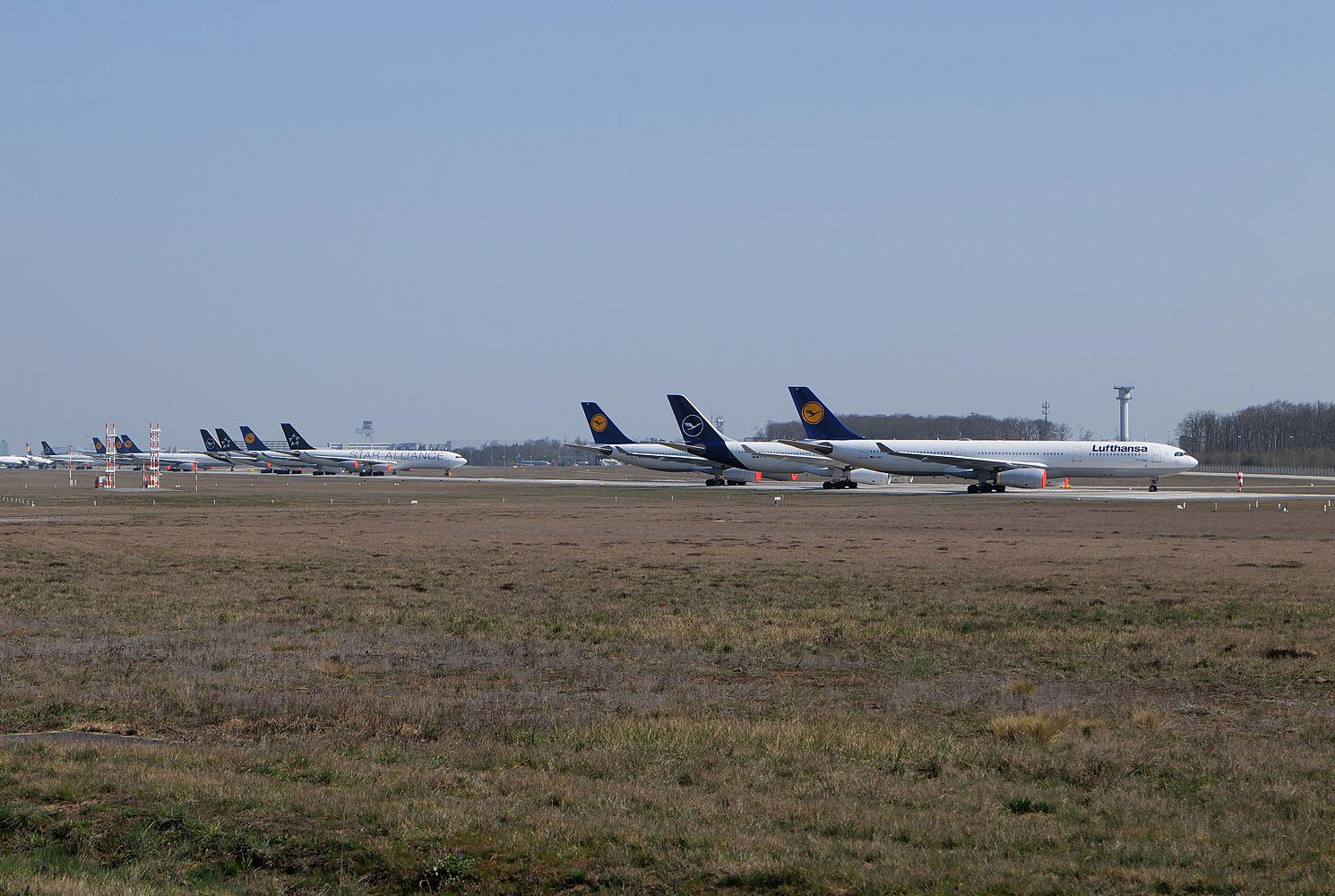
Lufthansa aircraft parked on Frankfurt's closed Runway Northwest, March 27, 2020 -- the season the whole industry's calendar stopped, and ours somehow did not. Photo: Wikimedia Commons (CC0).
I have been thinking about that project a lot this summer, because a year and a half into running deployment at LightSource, the number that made us briefly famous inside a Big Four practice now reads as a failure mode. Five months from kickoff to a working system is the kind of timeline that gets a customer asking what went wrong. That inversion is worth taking apart, because the interesting part is not that software got faster to install. It is that two things I spent seven years treating as separate problems -- getting a system deployed and getting value out of it -- have collapsed into one.
Consulting Split the Job in Two: Deployment, Then Value
My consulting years split cleanly along that seam, which is part of why I notice it.
At Deloitte, the job was deployment and adoption. Get the system live, integrated, and used: data migrated, workflows configured, suppliers onboarded, training delivered, hypercare survived. The implicit contract was that value would follow from a well-adopted system, and the hard lesson -- the one every implementation consultant learns on some project or another -- was that an unadopted system is not an efficient one, just a faster way to fail. You can hit every milestone, exit hypercare on schedule, and hand the client a system their buyers quietly route around six months later.
At McKinsey, the engagements inverted. The system was usually already live -- sometimes for years -- and the question was why the value had not shown up. This is an enormous category of work, and the research explains why it exists: McKinsey's own studies found that roughly 70% of transformations fail to achieve their goals, and that large companies capture, on average, only 31% of the expected revenue lift and 25% of the expected cost savings from their digital transformations. Somebody has to go find the other 70%. For two years in Chicago, that was my job: standing in front of steering committees explaining that the software was fine, the process had moved on without it, and the value case everyone approved two years ago described an organization that no longer existed. The craft of that work was separating activity from outcome -- baselines, benefit trees, named savings owners, leakage tracking -- and asking of every promised dollar whether it had been identified, approved, implemented, or actually realized. A sourcing event completed in a tool is activity. An award that survives into pricing and compliance is value.
Both chapters were teaching the same fact. In neither of them was technology readiness the constraint. The Deloitte projects did not stall because the system could not go live; they stalled where people declined to change how they worked. The McKinsey engagements did not exist because the software was broken; they existed because live and valuable are different states, separated by trust and behavior. The industry had simply organized itself around treating those as two engagements, sold separately, often years apart.
The 2026 AI Value Gap Is Mostly an Adoption Problem
The reason I am writing this down now is that the entire enterprise software industry is re-learning that fact in public, at AI prices.
The 2026 numbers are a genre unto themselves. IDC projects enterprise AI spending will hit $409 billion this year, up 53%, while its own FutureScape research projects that nearly 50% of AI-driven use cases will miss their ROI targets. Forrester predicts enterprises will defer a quarter of their planned 2026 AI spend into 2027 as CFO rigor arrives, noting only 15% of AI decision-makers report any EBITDA lift. IBM's CEO study found just 25% of AI initiatives have delivered their expected ROI. MIT's Project NANDA report -- the one that briefly ruined every AI vendor's August in 2025 -- put it most bluntly: 95% of enterprise GenAI pilots were producing zero measurable P&L impact. Our CEO Spencer Penn later took the deployment version of that argument to the main stage at MEMA's Commercial Vehicle Outlook Conference. Gartner expects over 40% of agentic AI projects to be canceled by the end of 2027. There are greener readings -- Morgan Stanley counts the share of S&P 500 companies reporting measurable AI benefits rising from 14% to about 25% over the past year -- but even the optimistic curve says three-quarters of the largest companies on earth cannot yet point to a number.

Five studies, five denominators, one pattern. Chart: LightSource, from IDC, Gartner, McKinsey, IBM, and MIT Project NANDA.
Read those reports closely and almost none of them blame the models. The cited causes are unclear business gains, weak human-machine collaboration, poor data foundations, workflows that never changed. BCG has been publishing the same allocation rule for years, and it applies to AI more than anything that came before it: in a successful deployment, 10% of the effort is the algorithms, 20% is the technology and data, and 70% is the people and process. When a deployment fails, it fails in the 70%.
The most instructive failures are the ones where the technology worked. In early 2024 Klarna announced its AI assistant was handling two-thirds of customer service chats in its first month, doing the work of 700 agents. Barely a year later the company was moving humans back into customer service; CEO Sebastian Siemiatkowski's postmortem was that "we focused too much on efficiency and cost... the result was lower quality." Both press releases were true. The system worked as deployed, and the value case still collapsed on quality and trust -- exactly the kind of failure I used to get parachuted in to diagnose, except it played out in quarters instead of years, in public.
Deployment and Value Realization Now Happen at Once
Here is the structural change underneath all of this, and it is the thing my 2020 self would have found hardest to believe.
The old sequence had room in it. A full source-to-pay implementation is commonly benchmarked at 9 to 18 months; Panorama's ERP research put the average enterprise implementation at 15.5 months as recently as last year, falling to about 9 months as cloud systems simplified, with average payback around 25 months after that. Even the shopping took forever -- Deloitte cites Gartner research that enterprises spend 16.3 months just selecting a system before any of this starts. Inside that calendar, "change management" could genuinely be a phase: a workstream with a start date, some champions, a training plan, and an end. Value realization could be someone else's project, later. The whole consulting industry's org chart -- including both of my former employers' -- is a fossil record of that sequence.
AI systems deleted the gap, for one specific reason: they do not wait to be useful. A traditional system goes live as an empty process -- forms, workflows, approval chains -- and produces value only after months of transactions accumulate. An AI-native system starts exercising judgment on day one. It normalizes the first RFQ responses that arrive, flags the outlier bid, drafts the award recommendation, surfaces the supplier risk. Every one of those outputs lands in front of a buyer who either accepts it or quietly ignores it. Which means adoption stops being a training-completion metric and becomes something much starker: the accumulated record of whether users trust the system's judgment. And that record is your ROI evidence, or the absence of it, from week one. There is no separate phase where value gets realized later, because agentic systems produce their value at the moment of the decision or not at all.
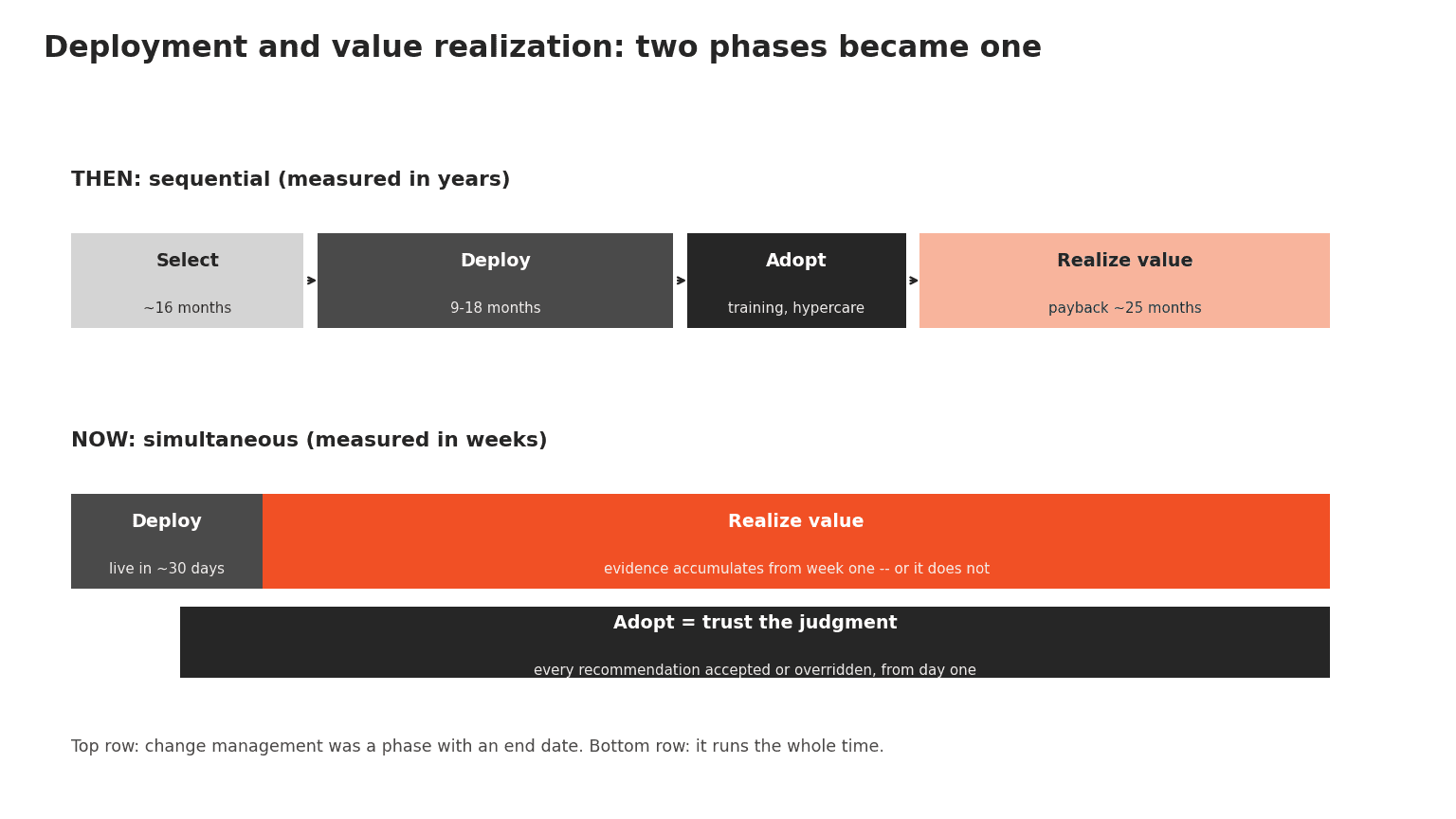
The old sequence had room in it. The new one does not. Diagram: LightSource.
McKinsey found that companies digitized 20 to 25 times faster than they believed possible during COVID, which is roughly what my 2020 project felt like from the inside. But we were compressing the old sequence, not changing its shape. The 2026 version is a different shape. At Deloitte we used to call an ERP transformation running concurrently with an S2P rollout "heart surgery," because live financial data, historical mappings, and change management across two systems at once multiplied every risk. It was the exception we planned around. Now it is simply the operating condition: there is no version of a deployment where the adjacent systems hold still, the org chart holds still, and the AI roadmap holds still while you implement. Every deployment happens on a patient that is already on the table for something else -- and the patient is awake, and working, and asking whether the surgery is producing value yet.
What I Do Differently Now: Manage Toward the Trust Curve
A year and a half of running deployments from the operator seat has changed my working definition of the job. I used to manage deployments toward a go-live date. I now manage them toward a trust curve, and the go-live date is just the point where the curve starts being measured with real stakes.
The difference is visible by day three. In my consultant era, day three of a deployment meant the project plan: confirming workstreams, gathering data templates, building the RAID log, aligning steering committee cadence. All of that still happens. But by day three now I also want to know which real decision the system will support first, on a sourcing event the buyer actually recognizes -- a named RFQ, not a sanitized demo. I want the baseline written down before go-live so nobody can hide behind a clean status report, and I want a guess, in writing, about which recommendation our most skeptical user will reject first and why. We keep a running value ledger from that day forward: the current cycle time, the spend baseline, the savings mechanism we expect, who owns it, and the date by which we will know whether it moved.
Concretely, that changes three habits. First, the win has to arrive in week one, not quarter two -- a normalized bid comparison the buyer could not have built by hand, a cost anomaly nobody had spotted, one spend analysis question answered in minutes that used to take a data pull. Not because week-one wins are large, but because they are when the trust account opens, and every user who watches the system be right about something specific becomes cheaper to convince about everything after. Second, skeptics get the system's judgment early and on purpose. The instinct is to pilot with enthusiasts; the enthusiasts were never the constraint. The buyer who has run the category for fifteen years and does not believe a model can price it is either your loudest reference or your silent veto, and which one is decided in the first month. Third, the metric I report is not "on time, on budget, live." It is how fast adoption is converting into measured value, read through the most honest signal an AI deployment produces: whether users accept, edit, or reject the system's recommendations. Accepts tell you what earned trust. Edits tell you what context the system was missing. Rejects tell you whether the problem is data, policy, category nuance, or simple unfamiliarity -- and each one is a change-management task with a name on it, not a line in a training deck.
My industrial engineering degree turns out to be more useful for this than most of what I learned about project management. A deployment is a flow system. Open sourcing events are work-in-process. A manager who sits on an AI-drafted award recommendation for four days is queue time. A buyer who rebuilds the supplier list in a spreadsheet is rework. A model that answers in seconds changes nothing about throughput if the decision still waits in a human trust bottleneck -- so the real job of a deployment team is finding that bottleneck while there is still time to respond to it.
At LightSource this is structural rather than aspirational: nearly half the company works on deployment strategy and implementation, most of us from the same consulting backgrounds, because when a platform goes live in 30 days the trust curve is the product. My colleague Mason Morgan has written about what the people side of the AI journey looks like when it is treated as the main event rather than a workstream, and my colleague Aparna Keswani's AI sourcing playbook walks the lifecycle in detail.
For procurement teams evaluating AI platforms this year, the practical translation is a change in what you ask vendors:
Ask | Weak answer | Strong answer |
|---|---|---|
Time to first measurable win? | "Value framework in QBR one" | A specific week-one artifact |
Who owns value realization? | A separate phase or team | The deployment team, continuously |
How is adoption measured? | Logins and training completion | Recommendations accepted vs. overridden |
What do skeptics see? | Demo environments | Their own categories, scored early |
What happens on override? | "Users can always override" | Overrides captured with reasons, fed back |
Proof at 90 days? | Usage statistics | Value converted per adopted workflow |
If a vendor describes value realization as something that happens after deployment, they are describing the world I worked in six years ago. It was a fine world -- it paid for a lot of consulting -- but the research on how it performed is unambiguous, and the AI economics do not leave room for it. We discussed a version of this on our podcast: AI is collapsing procurement's distance between decision and consequence everywhere, and deployment was never going to be exempt.
I still think about the Coupa Cabana party, mostly fondly. We earned it -- five months, three regions, a pandemic, a system that worked. But the thing we celebrated was getting the machine installed, and the thing that actually determined whether Molex got its money's worth started the following Monday, when a few hundred buyers decided how they felt about the new way of working. Nobody threw a party for that part. In 2026, that part is the whole job, it starts on day one, and the teams that understand this are the ones whose AI investments will not show up in next year's edition of the miss-rate statistics. Or so I keep telling my old clients, who now ask me why anyone would need five months.
Sources
IDC: AI is ready, enterprises are not -- $409B 2026 AI spend (+53%) and FutureScape projection that ~50% of AI use cases miss ROI targets
Forrester 2026 Predictions -- 25% of planned 2026 AI spend deferred to 2027; 15% report EBITDA lift
IBM CEO Study 2025 -- 25% of AI initiatives delivered expected ROI; 16% scaled enterprise-wide
Fortune on MIT Project NANDA -- 95% of enterprise GenAI pilots show no measurable P&L impact
Morgan Stanley AI adoption tracking (via The Corner) -- S&P 500 companies reporting measurable AI benefits rose from 14% to ~25%
Gartner: 40%+ of agentic AI projects canceled by 2027 -- cost, unclear value, risk controls; "agent washing"
McKinsey: From adoption to impact (July 2026) -- only 11% of organizations in the "reinvention" horizon
McKinsey: Why do most transformations fail? -- ~70% of transformations fail
McKinsey: Rewired for value -- companies capture 31% of expected revenue lift, 25% of expected cost savings
BCG: CEO's guide to maximizing value from AI -- the 10-20-70 rule
Prosci: change management and project success -- 88% vs. 13% success with excellent vs. poor change management
Panorama Consulting 2025 ERP Report (press release) -- average ERP timeline fell from 15.5 to 9 months
CFO.com: Why your ERP is underperforming -- 25-month average ERP payback; change management routinely omitted
Deloitte: ERP selection -- Gartner: 16.3-month average technology selection cycle
Supply Chain Research: S2P buyer's guide -- full enterprise S2P implementations commonly benchmarked at 9-18 months
Klarna: AI assistant handles two-thirds of customer service chats -- the 2024 claim, work of 700 agents
Bloomberg: Klarna seeks human customer service staff after AI push dents quality -- the 2025 reversal
Forbes: AI layoffs are backfiring -- 2026 retrospective on Klarna and similar reversals
Frequently Asked Questions
What is the difference between software deployment and value realization?
Deployment is getting a system live: configured, integrated, migrated, and adopted by users. Value realization is converting that live system into measurable business outcomes -- savings, speed, quality. Historically they were run as separate phases, often years apart and by different teams. AI systems collapse the two, because an AI platform starts producing judgments that users accept or reject from day one, so evidence of value (or its absence) accumulates immediately.
Why do most enterprise AI pilots fail to show ROI?
Rarely because of the models. IDC attributes 2026's projected ~50% ROI miss rate to unclear business gains, weak human-machine collaboration, and poor data foundations, and BCG's long-standing rule holds that 70% of AI deployment effort is people and process, not technology. Pilots typically fail where users decline to trust the system's judgment and workflows never change -- which is a change management failure, not a technical one.
How long does a source-to-pay (S2P) implementation take?
Traditional enterprise S2P implementations are commonly benchmarked at 9-18 months, with single modules in 3-6 months, and ERP research shows average implementations of 9-15.5 months with payback averaging around 25 months. AI-native procurement platforms deploy much faster -- LightSource customers are typically live in about 30 days -- which shifts the real question from time-to-go-live to how quickly adoption converts into measured value.
What should procurement teams ask AI vendors about time to value?
Ask for the first measurable win in week one, not a value framework at the first QBR: a specific artifact like a normalized bid comparison or a flagged cost anomaly. Ask who owns value realization after go-live (the strong answer is the deployment team, continuously -- not a separate phase), and ask how adoption is measured (recommendations accepted versus overridden beats logins and training completion).
How has change management changed for AI deployments?
It stopped being a phase. In traditional 12-plus-month implementations, change management had a start date, a training plan, and an end. Because AI systems exercise judgment from the first week, user trust is being won or lost continuously, so change management now runs the entire deployment and beyond. Research consistently shows this is where value is decided: projects with excellent change management are about seven times more likely to meet objectives than those with poor change management.
In February 2020 I was booked on a Delta flight to Dongguan, China, to run user acceptance testing for a procurement system. I was a Deloitte analyst two years out of an industrial engineering degree, and the project was the kind you hope for early in a consulting career: a global source-to-pay deployment for Molex, the Koch Industries electronics manufacturer, spanning the US, China, and the rest of APAC, on a five-month clock that most people in our practice considered somewhere between ambitious and unwise.
The flight never happened. On a prep call in late January, one of our China teammates mentioned quietly that "the US flu is getting really bad here." None of us understood yet what we were hearing. On January 31, Delta announced it was suspending all flying between the US and China, and my UAT trip turned into weeks of late-evening testing and training sessions run across three regions' time zones, whoever was awake carrying the session. We hit the go-live date anyway, mid-pandemic. At the time, we were told it was the fastest global Coupa deployment Deloitte had ever done. The firm celebrated it. There was a team party. It had a theme, and the theme was "Coupa Cabana."
Lufthansa aircraft parked on Frankfurt's closed Runway Northwest, March 27, 2020 -- the season the whole industry's calendar stopped, and ours somehow did not. Photo: Wikimedia Commons (CC0).
I have been thinking about that project a lot this summer, because a year and a half into running deployment at LightSource, the number that made us briefly famous inside a Big Four practice now reads as a failure mode. Five months from kickoff to a working system is the kind of timeline that gets a customer asking what went wrong. That inversion is worth taking apart, because the interesting part is not that software got faster to install. It is that two things I spent seven years treating as separate problems -- getting a system deployed and getting value out of it -- have collapsed into one.
Consulting Split the Job in Two: Deployment, Then Value
My consulting years split cleanly along that seam, which is part of why I notice it.
At Deloitte, the job was deployment and adoption. Get the system live, integrated, and used: data migrated, workflows configured, suppliers onboarded, training delivered, hypercare survived. The implicit contract was that value would follow from a well-adopted system, and the hard lesson -- the one every implementation consultant learns on some project or another -- was that an unadopted system is not an efficient one, just a faster way to fail. You can hit every milestone, exit hypercare on schedule, and hand the client a system their buyers quietly route around six months later.
At McKinsey, the engagements inverted. The system was usually already live -- sometimes for years -- and the question was why the value had not shown up. This is an enormous category of work, and the research explains why it exists: McKinsey's own studies found that roughly 70% of transformations fail to achieve their goals, and that large companies capture, on average, only 31% of the expected revenue lift and 25% of the expected cost savings from their digital transformations. Somebody has to go find the other 70%. For two years in Chicago, that was my job: standing in front of steering committees explaining that the software was fine, the process had moved on without it, and the value case everyone approved two years ago described an organization that no longer existed. The craft of that work was separating activity from outcome -- baselines, benefit trees, named savings owners, leakage tracking -- and asking of every promised dollar whether it had been identified, approved, implemented, or actually realized. A sourcing event completed in a tool is activity. An award that survives into pricing and compliance is value.
Both chapters were teaching the same fact. In neither of them was technology readiness the constraint. The Deloitte projects did not stall because the system could not go live; they stalled where people declined to change how they worked. The McKinsey engagements did not exist because the software was broken; they existed because live and valuable are different states, separated by trust and behavior. The industry had simply organized itself around treating those as two engagements, sold separately, often years apart.
The 2026 AI Value Gap Is Mostly an Adoption Problem
The reason I am writing this down now is that the entire enterprise software industry is re-learning that fact in public, at AI prices.
The 2026 numbers are a genre unto themselves. IDC projects enterprise AI spending will hit $409 billion this year, up 53%, while its own FutureScape research projects that nearly 50% of AI-driven use cases will miss their ROI targets. Forrester predicts enterprises will defer a quarter of their planned 2026 AI spend into 2027 as CFO rigor arrives, noting only 15% of AI decision-makers report any EBITDA lift. IBM's CEO study found just 25% of AI initiatives have delivered their expected ROI. MIT's Project NANDA report -- the one that briefly ruined every AI vendor's August in 2025 -- put it most bluntly: 95% of enterprise GenAI pilots were producing zero measurable P&L impact. Our CEO Spencer Penn later took the deployment version of that argument to the main stage at MEMA's Commercial Vehicle Outlook Conference. Gartner expects over 40% of agentic AI projects to be canceled by the end of 2027. There are greener readings -- Morgan Stanley counts the share of S&P 500 companies reporting measurable AI benefits rising from 14% to about 25% over the past year -- but even the optimistic curve says three-quarters of the largest companies on earth cannot yet point to a number.
Five studies, five denominators, one pattern. Chart: LightSource, from IDC, Gartner, McKinsey, IBM, and MIT Project NANDA.
Read those reports closely and almost none of them blame the models. The cited causes are unclear business gains, weak human-machine collaboration, poor data foundations, workflows that never changed. BCG has been publishing the same allocation rule for years, and it applies to AI more than anything that came before it: in a successful deployment, 10% of the effort is the algorithms, 20% is the technology and data, and 70% is the people and process. When a deployment fails, it fails in the 70%.
The most instructive failures are the ones where the technology worked. In early 2024 Klarna announced its AI assistant was handling two-thirds of customer service chats in its first month, doing the work of 700 agents. Barely a year later the company was moving humans back into customer service; CEO Sebastian Siemiatkowski's postmortem was that "we focused too much on efficiency and cost... the result was lower quality." Both press releases were true. The system worked as deployed, and the value case still collapsed on quality and trust -- exactly the kind of failure I used to get parachuted in to diagnose, except it played out in quarters instead of years, in public.
Deployment and Value Realization Now Happen at Once
Here is the structural change underneath all of this, and it is the thing my 2020 self would have found hardest to believe.
The old sequence had room in it. A full source-to-pay implementation is commonly benchmarked at 9 to 18 months; Panorama's ERP research put the average enterprise implementation at 15.5 months as recently as last year, falling to about 9 months as cloud systems simplified, with average payback around 25 months after that. Even the shopping took forever -- Deloitte cites Gartner research that enterprises spend 16.3 months just selecting a system before any of this starts. Inside that calendar, "change management" could genuinely be a phase: a workstream with a start date, some champions, a training plan, and an end. Value realization could be someone else's project, later. The whole consulting industry's org chart -- including both of my former employers' -- is a fossil record of that sequence.
AI systems deleted the gap, for one specific reason: they do not wait to be useful. A traditional system goes live as an empty process -- forms, workflows, approval chains -- and produces value only after months of transactions accumulate. An AI-native system starts exercising judgment on day one. It normalizes the first RFQ responses that arrive, flags the outlier bid, drafts the award recommendation, surfaces the supplier risk. Every one of those outputs lands in front of a buyer who either accepts it or quietly ignores it. Which means adoption stops being a training-completion metric and becomes something much starker: the accumulated record of whether users trust the system's judgment. And that record is your ROI evidence, or the absence of it, from week one. There is no separate phase where value gets realized later, because agentic systems produce their value at the moment of the decision or not at all.
The old sequence had room in it. The new one does not. Diagram: LightSource.
McKinsey found that companies digitized 20 to 25 times faster than they believed possible during COVID, which is roughly what my 2020 project felt like from the inside. But we were compressing the old sequence, not changing its shape. The 2026 version is a different shape. At Deloitte we used to call an ERP transformation running concurrently with an S2P rollout "heart surgery," because live financial data, historical mappings, and change management across two systems at once multiplied every risk. It was the exception we planned around. Now it is simply the operating condition: there is no version of a deployment where the adjacent systems hold still, the org chart holds still, and the AI roadmap holds still while you implement. Every deployment happens on a patient that is already on the table for something else -- and the patient is awake, and working, and asking whether the surgery is producing value yet.
What I Do Differently Now: Manage Toward the Trust Curve
A year and a half of running deployments from the operator seat has changed my working definition of the job. I used to manage deployments toward a go-live date. I now manage them toward a trust curve, and the go-live date is just the point where the curve starts being measured with real stakes.
The difference is visible by day three. In my consultant era, day three of a deployment meant the project plan: confirming workstreams, gathering data templates, building the RAID log, aligning steering committee cadence. All of that still happens. But by day three now I also want to know which real decision the system will support first, on a sourcing event the buyer actually recognizes -- a named RFQ, not a sanitized demo. I want the baseline written down before go-live so nobody can hide behind a clean status report, and I want a guess, in writing, about which recommendation our most skeptical user will reject first and why. We keep a running value ledger from that day forward: the current cycle time, the spend baseline, the savings mechanism we expect, who owns it, and the date by which we will know whether it moved.
Concretely, that changes three habits. First, the win has to arrive in week one, not quarter two -- a normalized bid comparison the buyer could not have built by hand, a cost anomaly nobody had spotted, one spend analysis question answered in minutes that used to take a data pull. Not because week-one wins are large, but because they are when the trust account opens, and every user who watches the system be right about something specific becomes cheaper to convince about everything after. Second, skeptics get the system's judgment early and on purpose. The instinct is to pilot with enthusiasts; the enthusiasts were never the constraint. The buyer who has run the category for fifteen years and does not believe a model can price it is either your loudest reference or your silent veto, and which one is decided in the first month. Third, the metric I report is not "on time, on budget, live." It is how fast adoption is converting into measured value, read through the most honest signal an AI deployment produces: whether users accept, edit, or reject the system's recommendations. Accepts tell you what earned trust. Edits tell you what context the system was missing. Rejects tell you whether the problem is data, policy, category nuance, or simple unfamiliarity -- and each one is a change-management task with a name on it, not a line in a training deck.
My industrial engineering degree turns out to be more useful for this than most of what I learned about project management. A deployment is a flow system. Open sourcing events are work-in-process. A manager who sits on an AI-drafted award recommendation for four days is queue time. A buyer who rebuilds the supplier list in a spreadsheet is rework. A model that answers in seconds changes nothing about throughput if the decision still waits in a human trust bottleneck -- so the real job of a deployment team is finding that bottleneck while there is still time to respond to it.
At LightSource this is structural rather than aspirational: nearly half the company works on deployment strategy and implementation, most of us from the same consulting backgrounds, because when a platform goes live in 30 days the trust curve is the product. My colleague Mason Morgan has written about what the people side of the AI journey looks like when it is treated as the main event rather than a workstream, and my colleague Aparna Keswani's AI sourcing playbook walks the lifecycle in detail.
For procurement teams evaluating AI platforms this year, the practical translation is a change in what you ask vendors:
Ask | Weak answer | Strong answer |
|---|---|---|
Time to first measurable win? | "Value framework in QBR one" | A specific week-one artifact |
Who owns value realization? | A separate phase or team | The deployment team, continuously |
How is adoption measured? | Logins and training completion | Recommendations accepted vs. overridden |
What do skeptics see? | Demo environments | Their own categories, scored early |
What happens on override? | "Users can always override" | Overrides captured with reasons, fed back |
Proof at 90 days? | Usage statistics | Value converted per adopted workflow |
If a vendor describes value realization as something that happens after deployment, they are describing the world I worked in six years ago. It was a fine world -- it paid for a lot of consulting -- but the research on how it performed is unambiguous, and the AI economics do not leave room for it. We discussed a version of this on our podcast: AI is collapsing procurement's distance between decision and consequence everywhere, and deployment was never going to be exempt.
I still think about the Coupa Cabana party, mostly fondly. We earned it -- five months, three regions, a pandemic, a system that worked. But the thing we celebrated was getting the machine installed, and the thing that actually determined whether Molex got its money's worth started the following Monday, when a few hundred buyers decided how they felt about the new way of working. Nobody threw a party for that part. In 2026, that part is the whole job, it starts on day one, and the teams that understand this are the ones whose AI investments will not show up in next year's edition of the miss-rate statistics. Or so I keep telling my old clients, who now ask me why anyone would need five months.
Sources
IDC: AI is ready, enterprises are not -- $409B 2026 AI spend (+53%) and FutureScape projection that ~50% of AI use cases miss ROI targets
Forrester 2026 Predictions -- 25% of planned 2026 AI spend deferred to 2027; 15% report EBITDA lift
IBM CEO Study 2025 -- 25% of AI initiatives delivered expected ROI; 16% scaled enterprise-wide
Fortune on MIT Project NANDA -- 95% of enterprise GenAI pilots show no measurable P&L impact
Morgan Stanley AI adoption tracking (via The Corner) -- S&P 500 companies reporting measurable AI benefits rose from 14% to ~25%
Gartner: 40%+ of agentic AI projects canceled by 2027 -- cost, unclear value, risk controls; "agent washing"
McKinsey: From adoption to impact (July 2026) -- only 11% of organizations in the "reinvention" horizon
McKinsey: Why do most transformations fail? -- ~70% of transformations fail
McKinsey: Rewired for value -- companies capture 31% of expected revenue lift, 25% of expected cost savings
BCG: CEO's guide to maximizing value from AI -- the 10-20-70 rule
Prosci: change management and project success -- 88% vs. 13% success with excellent vs. poor change management
Panorama Consulting 2025 ERP Report (press release) -- average ERP timeline fell from 15.5 to 9 months
CFO.com: Why your ERP is underperforming -- 25-month average ERP payback; change management routinely omitted
Deloitte: ERP selection -- Gartner: 16.3-month average technology selection cycle
Supply Chain Research: S2P buyer's guide -- full enterprise S2P implementations commonly benchmarked at 9-18 months
Klarna: AI assistant handles two-thirds of customer service chats -- the 2024 claim, work of 700 agents
Bloomberg: Klarna seeks human customer service staff after AI push dents quality -- the 2025 reversal
Forbes: AI layoffs are backfiring -- 2026 retrospective on Klarna and similar reversals
Frequently Asked Questions
What is the difference between software deployment and value realization?
Deployment is getting a system live: configured, integrated, migrated, and adopted by users. Value realization is converting that live system into measurable business outcomes -- savings, speed, quality. Historically they were run as separate phases, often years apart and by different teams. AI systems collapse the two, because an AI platform starts producing judgments that users accept or reject from day one, so evidence of value (or its absence) accumulates immediately.
Why do most enterprise AI pilots fail to show ROI?
Rarely because of the models. IDC attributes 2026's projected ~50% ROI miss rate to unclear business gains, weak human-machine collaboration, and poor data foundations, and BCG's long-standing rule holds that 70% of AI deployment effort is people and process, not technology. Pilots typically fail where users decline to trust the system's judgment and workflows never change -- which is a change management failure, not a technical one.
How long does a source-to-pay (S2P) implementation take?
Traditional enterprise S2P implementations are commonly benchmarked at 9-18 months, with single modules in 3-6 months, and ERP research shows average implementations of 9-15.5 months with payback averaging around 25 months. AI-native procurement platforms deploy much faster -- LightSource customers are typically live in about 30 days -- which shifts the real question from time-to-go-live to how quickly adoption converts into measured value.
What should procurement teams ask AI vendors about time to value?
Ask for the first measurable win in week one, not a value framework at the first QBR: a specific artifact like a normalized bid comparison or a flagged cost anomaly. Ask who owns value realization after go-live (the strong answer is the deployment team, continuously -- not a separate phase), and ask how adoption is measured (recommendations accepted versus overridden beats logins and training completion).
How has change management changed for AI deployments?
It stopped being a phase. In traditional 12-plus-month implementations, change management had a start date, a training plan, and an end. Because AI systems exercise judgment from the first week, user trust is being won or lost continuously, so change management now runs the entire deployment and beyond. Research consistently shows this is where value is decided: projects with excellent change management are about seven times more likely to meet objectives than those with poor change management.
In February 2020 I was booked on a Delta flight to Dongguan, China, to run user acceptance testing for a procurement system. I was a Deloitte analyst two years out of an industrial engineering degree, and the project was the kind you hope for early in a consulting career: a global source-to-pay deployment for Molex, the Koch Industries electronics manufacturer, spanning the US, China, and the rest of APAC, on a five-month clock that most people in our practice considered somewhere between ambitious and unwise.
The flight never happened. On a prep call in late January, one of our China teammates mentioned quietly that "the US flu is getting really bad here." None of us understood yet what we were hearing. On January 31, Delta announced it was suspending all flying between the US and China, and my UAT trip turned into weeks of late-evening testing and training sessions run across three regions' time zones, whoever was awake carrying the session. We hit the go-live date anyway, mid-pandemic. At the time, we were told it was the fastest global Coupa deployment Deloitte had ever done. The firm celebrated it. There was a team party. It had a theme, and the theme was "Coupa Cabana."
Lufthansa aircraft parked on Frankfurt's closed Runway Northwest, March 27, 2020 -- the season the whole industry's calendar stopped, and ours somehow did not. Photo: Wikimedia Commons (CC0).
I have been thinking about that project a lot this summer, because a year and a half into running deployment at LightSource, the number that made us briefly famous inside a Big Four practice now reads as a failure mode. Five months from kickoff to a working system is the kind of timeline that gets a customer asking what went wrong. That inversion is worth taking apart, because the interesting part is not that software got faster to install. It is that two things I spent seven years treating as separate problems -- getting a system deployed and getting value out of it -- have collapsed into one.
Consulting Split the Job in Two: Deployment, Then Value
My consulting years split cleanly along that seam, which is part of why I notice it.
At Deloitte, the job was deployment and adoption. Get the system live, integrated, and used: data migrated, workflows configured, suppliers onboarded, training delivered, hypercare survived. The implicit contract was that value would follow from a well-adopted system, and the hard lesson -- the one every implementation consultant learns on some project or another -- was that an unadopted system is not an efficient one, just a faster way to fail. You can hit every milestone, exit hypercare on schedule, and hand the client a system their buyers quietly route around six months later.
At McKinsey, the engagements inverted. The system was usually already live -- sometimes for years -- and the question was why the value had not shown up. This is an enormous category of work, and the research explains why it exists: McKinsey's own studies found that roughly 70% of transformations fail to achieve their goals, and that large companies capture, on average, only 31% of the expected revenue lift and 25% of the expected cost savings from their digital transformations. Somebody has to go find the other 70%. For two years in Chicago, that was my job: standing in front of steering committees explaining that the software was fine, the process had moved on without it, and the value case everyone approved two years ago described an organization that no longer existed. The craft of that work was separating activity from outcome -- baselines, benefit trees, named savings owners, leakage tracking -- and asking of every promised dollar whether it had been identified, approved, implemented, or actually realized. A sourcing event completed in a tool is activity. An award that survives into pricing and compliance is value.
Both chapters were teaching the same fact. In neither of them was technology readiness the constraint. The Deloitte projects did not stall because the system could not go live; they stalled where people declined to change how they worked. The McKinsey engagements did not exist because the software was broken; they existed because live and valuable are different states, separated by trust and behavior. The industry had simply organized itself around treating those as two engagements, sold separately, often years apart.
The 2026 AI Value Gap Is Mostly an Adoption Problem
The reason I am writing this down now is that the entire enterprise software industry is re-learning that fact in public, at AI prices.
The 2026 numbers are a genre unto themselves. IDC projects enterprise AI spending will hit $409 billion this year, up 53%, while its own FutureScape research projects that nearly 50% of AI-driven use cases will miss their ROI targets. Forrester predicts enterprises will defer a quarter of their planned 2026 AI spend into 2027 as CFO rigor arrives, noting only 15% of AI decision-makers report any EBITDA lift. IBM's CEO study found just 25% of AI initiatives have delivered their expected ROI. MIT's Project NANDA report -- the one that briefly ruined every AI vendor's August in 2025 -- put it most bluntly: 95% of enterprise GenAI pilots were producing zero measurable P&L impact. Our CEO Spencer Penn later took the deployment version of that argument to the main stage at MEMA's Commercial Vehicle Outlook Conference. Gartner expects over 40% of agentic AI projects to be canceled by the end of 2027. There are greener readings -- Morgan Stanley counts the share of S&P 500 companies reporting measurable AI benefits rising from 14% to about 25% over the past year -- but even the optimistic curve says three-quarters of the largest companies on earth cannot yet point to a number.
Five studies, five denominators, one pattern. Chart: LightSource, from IDC, Gartner, McKinsey, IBM, and MIT Project NANDA.
Read those reports closely and almost none of them blame the models. The cited causes are unclear business gains, weak human-machine collaboration, poor data foundations, workflows that never changed. BCG has been publishing the same allocation rule for years, and it applies to AI more than anything that came before it: in a successful deployment, 10% of the effort is the algorithms, 20% is the technology and data, and 70% is the people and process. When a deployment fails, it fails in the 70%.
The most instructive failures are the ones where the technology worked. In early 2024 Klarna announced its AI assistant was handling two-thirds of customer service chats in its first month, doing the work of 700 agents. Barely a year later the company was moving humans back into customer service; CEO Sebastian Siemiatkowski's postmortem was that "we focused too much on efficiency and cost... the result was lower quality." Both press releases were true. The system worked as deployed, and the value case still collapsed on quality and trust -- exactly the kind of failure I used to get parachuted in to diagnose, except it played out in quarters instead of years, in public.
Deployment and Value Realization Now Happen at Once
Here is the structural change underneath all of this, and it is the thing my 2020 self would have found hardest to believe.
The old sequence had room in it. A full source-to-pay implementation is commonly benchmarked at 9 to 18 months; Panorama's ERP research put the average enterprise implementation at 15.5 months as recently as last year, falling to about 9 months as cloud systems simplified, with average payback around 25 months after that. Even the shopping took forever -- Deloitte cites Gartner research that enterprises spend 16.3 months just selecting a system before any of this starts. Inside that calendar, "change management" could genuinely be a phase: a workstream with a start date, some champions, a training plan, and an end. Value realization could be someone else's project, later. The whole consulting industry's org chart -- including both of my former employers' -- is a fossil record of that sequence.
AI systems deleted the gap, for one specific reason: they do not wait to be useful. A traditional system goes live as an empty process -- forms, workflows, approval chains -- and produces value only after months of transactions accumulate. An AI-native system starts exercising judgment on day one. It normalizes the first RFQ responses that arrive, flags the outlier bid, drafts the award recommendation, surfaces the supplier risk. Every one of those outputs lands in front of a buyer who either accepts it or quietly ignores it. Which means adoption stops being a training-completion metric and becomes something much starker: the accumulated record of whether users trust the system's judgment. And that record is your ROI evidence, or the absence of it, from week one. There is no separate phase where value gets realized later, because agentic systems produce their value at the moment of the decision or not at all.
The old sequence had room in it. The new one does not. Diagram: LightSource.
McKinsey found that companies digitized 20 to 25 times faster than they believed possible during COVID, which is roughly what my 2020 project felt like from the inside. But we were compressing the old sequence, not changing its shape. The 2026 version is a different shape. At Deloitte we used to call an ERP transformation running concurrently with an S2P rollout "heart surgery," because live financial data, historical mappings, and change management across two systems at once multiplied every risk. It was the exception we planned around. Now it is simply the operating condition: there is no version of a deployment where the adjacent systems hold still, the org chart holds still, and the AI roadmap holds still while you implement. Every deployment happens on a patient that is already on the table for something else -- and the patient is awake, and working, and asking whether the surgery is producing value yet.
What I Do Differently Now: Manage Toward the Trust Curve
A year and a half of running deployments from the operator seat has changed my working definition of the job. I used to manage deployments toward a go-live date. I now manage them toward a trust curve, and the go-live date is just the point where the curve starts being measured with real stakes.
The difference is visible by day three. In my consultant era, day three of a deployment meant the project plan: confirming workstreams, gathering data templates, building the RAID log, aligning steering committee cadence. All of that still happens. But by day three now I also want to know which real decision the system will support first, on a sourcing event the buyer actually recognizes -- a named RFQ, not a sanitized demo. I want the baseline written down before go-live so nobody can hide behind a clean status report, and I want a guess, in writing, about which recommendation our most skeptical user will reject first and why. We keep a running value ledger from that day forward: the current cycle time, the spend baseline, the savings mechanism we expect, who owns it, and the date by which we will know whether it moved.
Concretely, that changes three habits. First, the win has to arrive in week one, not quarter two -- a normalized bid comparison the buyer could not have built by hand, a cost anomaly nobody had spotted, one spend analysis question answered in minutes that used to take a data pull. Not because week-one wins are large, but because they are when the trust account opens, and every user who watches the system be right about something specific becomes cheaper to convince about everything after. Second, skeptics get the system's judgment early and on purpose. The instinct is to pilot with enthusiasts; the enthusiasts were never the constraint. The buyer who has run the category for fifteen years and does not believe a model can price it is either your loudest reference or your silent veto, and which one is decided in the first month. Third, the metric I report is not "on time, on budget, live." It is how fast adoption is converting into measured value, read through the most honest signal an AI deployment produces: whether users accept, edit, or reject the system's recommendations. Accepts tell you what earned trust. Edits tell you what context the system was missing. Rejects tell you whether the problem is data, policy, category nuance, or simple unfamiliarity -- and each one is a change-management task with a name on it, not a line in a training deck.
My industrial engineering degree turns out to be more useful for this than most of what I learned about project management. A deployment is a flow system. Open sourcing events are work-in-process. A manager who sits on an AI-drafted award recommendation for four days is queue time. A buyer who rebuilds the supplier list in a spreadsheet is rework. A model that answers in seconds changes nothing about throughput if the decision still waits in a human trust bottleneck -- so the real job of a deployment team is finding that bottleneck while there is still time to respond to it.
At LightSource this is structural rather than aspirational: nearly half the company works on deployment strategy and implementation, most of us from the same consulting backgrounds, because when a platform goes live in 30 days the trust curve is the product. My colleague Mason Morgan has written about what the people side of the AI journey looks like when it is treated as the main event rather than a workstream, and my colleague Aparna Keswani's AI sourcing playbook walks the lifecycle in detail.
For procurement teams evaluating AI platforms this year, the practical translation is a change in what you ask vendors:
Ask | Weak answer | Strong answer |
|---|---|---|
Time to first measurable win? | "Value framework in QBR one" | A specific week-one artifact |
Who owns value realization? | A separate phase or team | The deployment team, continuously |
How is adoption measured? | Logins and training completion | Recommendations accepted vs. overridden |
What do skeptics see? | Demo environments | Their own categories, scored early |
What happens on override? | "Users can always override" | Overrides captured with reasons, fed back |
Proof at 90 days? | Usage statistics | Value converted per adopted workflow |
If a vendor describes value realization as something that happens after deployment, they are describing the world I worked in six years ago. It was a fine world -- it paid for a lot of consulting -- but the research on how it performed is unambiguous, and the AI economics do not leave room for it. We discussed a version of this on our podcast: AI is collapsing procurement's distance between decision and consequence everywhere, and deployment was never going to be exempt.
I still think about the Coupa Cabana party, mostly fondly. We earned it -- five months, three regions, a pandemic, a system that worked. But the thing we celebrated was getting the machine installed, and the thing that actually determined whether Molex got its money's worth started the following Monday, when a few hundred buyers decided how they felt about the new way of working. Nobody threw a party for that part. In 2026, that part is the whole job, it starts on day one, and the teams that understand this are the ones whose AI investments will not show up in next year's edition of the miss-rate statistics. Or so I keep telling my old clients, who now ask me why anyone would need five months.
Sources
IDC: AI is ready, enterprises are not -- $409B 2026 AI spend (+53%) and FutureScape projection that ~50% of AI use cases miss ROI targets
Forrester 2026 Predictions -- 25% of planned 2026 AI spend deferred to 2027; 15% report EBITDA lift
IBM CEO Study 2025 -- 25% of AI initiatives delivered expected ROI; 16% scaled enterprise-wide
Fortune on MIT Project NANDA -- 95% of enterprise GenAI pilots show no measurable P&L impact
Morgan Stanley AI adoption tracking (via The Corner) -- S&P 500 companies reporting measurable AI benefits rose from 14% to ~25%
Gartner: 40%+ of agentic AI projects canceled by 2027 -- cost, unclear value, risk controls; "agent washing"
McKinsey: From adoption to impact (July 2026) -- only 11% of organizations in the "reinvention" horizon
McKinsey: Why do most transformations fail? -- ~70% of transformations fail
McKinsey: Rewired for value -- companies capture 31% of expected revenue lift, 25% of expected cost savings
BCG: CEO's guide to maximizing value from AI -- the 10-20-70 rule
Prosci: change management and project success -- 88% vs. 13% success with excellent vs. poor change management
Panorama Consulting 2025 ERP Report (press release) -- average ERP timeline fell from 15.5 to 9 months
CFO.com: Why your ERP is underperforming -- 25-month average ERP payback; change management routinely omitted
Deloitte: ERP selection -- Gartner: 16.3-month average technology selection cycle
Supply Chain Research: S2P buyer's guide -- full enterprise S2P implementations commonly benchmarked at 9-18 months
Klarna: AI assistant handles two-thirds of customer service chats -- the 2024 claim, work of 700 agents
Bloomberg: Klarna seeks human customer service staff after AI push dents quality -- the 2025 reversal
Forbes: AI layoffs are backfiring -- 2026 retrospective on Klarna and similar reversals
Frequently Asked Questions
What is the difference between software deployment and value realization?
Deployment is getting a system live: configured, integrated, migrated, and adopted by users. Value realization is converting that live system into measurable business outcomes -- savings, speed, quality. Historically they were run as separate phases, often years apart and by different teams. AI systems collapse the two, because an AI platform starts producing judgments that users accept or reject from day one, so evidence of value (or its absence) accumulates immediately.
Why do most enterprise AI pilots fail to show ROI?
Rarely because of the models. IDC attributes 2026's projected ~50% ROI miss rate to unclear business gains, weak human-machine collaboration, and poor data foundations, and BCG's long-standing rule holds that 70% of AI deployment effort is people and process, not technology. Pilots typically fail where users decline to trust the system's judgment and workflows never change -- which is a change management failure, not a technical one.
How long does a source-to-pay (S2P) implementation take?
Traditional enterprise S2P implementations are commonly benchmarked at 9-18 months, with single modules in 3-6 months, and ERP research shows average implementations of 9-15.5 months with payback averaging around 25 months. AI-native procurement platforms deploy much faster -- LightSource customers are typically live in about 30 days -- which shifts the real question from time-to-go-live to how quickly adoption converts into measured value.
What should procurement teams ask AI vendors about time to value?
Ask for the first measurable win in week one, not a value framework at the first QBR: a specific artifact like a normalized bid comparison or a flagged cost anomaly. Ask who owns value realization after go-live (the strong answer is the deployment team, continuously -- not a separate phase), and ask how adoption is measured (recommendations accepted versus overridden beats logins and training completion).
How has change management changed for AI deployments?
It stopped being a phase. In traditional 12-plus-month implementations, change management had a start date, a training plan, and an end. Because AI systems exercise judgment from the first week, user trust is being won or lost continuously, so change management now runs the entire deployment and beyond. Research consistently shows this is where value is decided: projects with excellent change management are about seven times more likely to meet objectives than those with poor change management.
Read more


Read more
Read more
Faster sourcing. Lower cost. Less chaos.
See how LightSource connects engineering, procurement, and suppliers in one operating system to help you launch faster at lower cost.
SOC 2
Kearney #1 2024
Gartner Cool Vendor
Procuretech 100
G2 Top Rated
Faster sourcing. Lower cost. Less chaos.
See how LightSource connects engineering, procurement, and suppliers in one operating system to help you launch faster at lower cost.
SOC 2
Kearney #1 2024
Gartner Cool Vendor
Procuretech 100
G2 Top Rated
Faster sourcing. Lower cost. Less chaos.
See how LightSource connects engineering, procurement, and suppliers in one operating system to help you launch faster at lower cost.
SOC 2
Kearney #1 2024
Gartner Cool Vendor
Procuretech 100
G2 Top Rated
Trusted by:
Trusted by:
Trusted by: