

MEMA is one of the most important organizations in American manufacturing, and I'm a little embarrassed to say I didn't know it existed until about a year ago. The Vehicle Suppliers Association has been at it since 1904. It represents more than 1,000 companies that make the parts inside every car on the road and every truck moving freight across the country. By MEMA's count, vehicle suppliers directly employ over 930,000 Americans and support 4.8 million jobs in total, which makes them the largest manufacturing sector in the United States -- a larger employment footprint than the assembly plants with the famous logos out front, carried by an association most people outside the industry have never heard of.
On Wednesday I joined Collin Shaw, President of MEMA Original Equipment Suppliers, on the main stage at the Commercial Vehicle Outlook Conference in Livonia, Michigan, for a fireside on AI in supply chain management. The room was the people who build the trucking industry's hardware: systems engineers from Bosch and ZF, purchasing leaders from Volvo Group, trailer manufacturers, dealers, and a long tail of the Tier 1 and Tier 2 suppliers that make everything work. If I had to compress an hour of conversation into two sentences, it would be the two I opened with: velocity is the only way to win, and it is existential; and AI has to come out of the lab and into production.
Three takeaways survived the drive home.
The Speed Gap: China's New EV Makers Ship Vehicles in Half the Time
We put a McKinsey chart on screen that I have not stopped thinking about since it was published last August. In McKinsey's analysis of automotive product development, a new EV-focused OEM -- the profile of China's attackers -- takes a vehicle from styling to start of production in about 24 months. A mass-market legacy OEM takes 45 months. A premium OEM takes 53. That is the same product, subject to the same physics and the same regulators, delivered on half the clock.
The reporting behind that chart is worse than the averages. A Reuters investigation last July found that BYD, Chery, Zeekr, and Nio now develop all-new or redesigned models in as little as 18 months. My favorite detail from that piece: when Chery decided the Omoda 5 needed to be re-engineered for European roads -- steering, traction control, brakes, vibration dampers, tires -- the retuned vehicle was shipping six weeks later. Six weeks is roughly how long a legacy program spends getting the change request onto the right committee agenda.
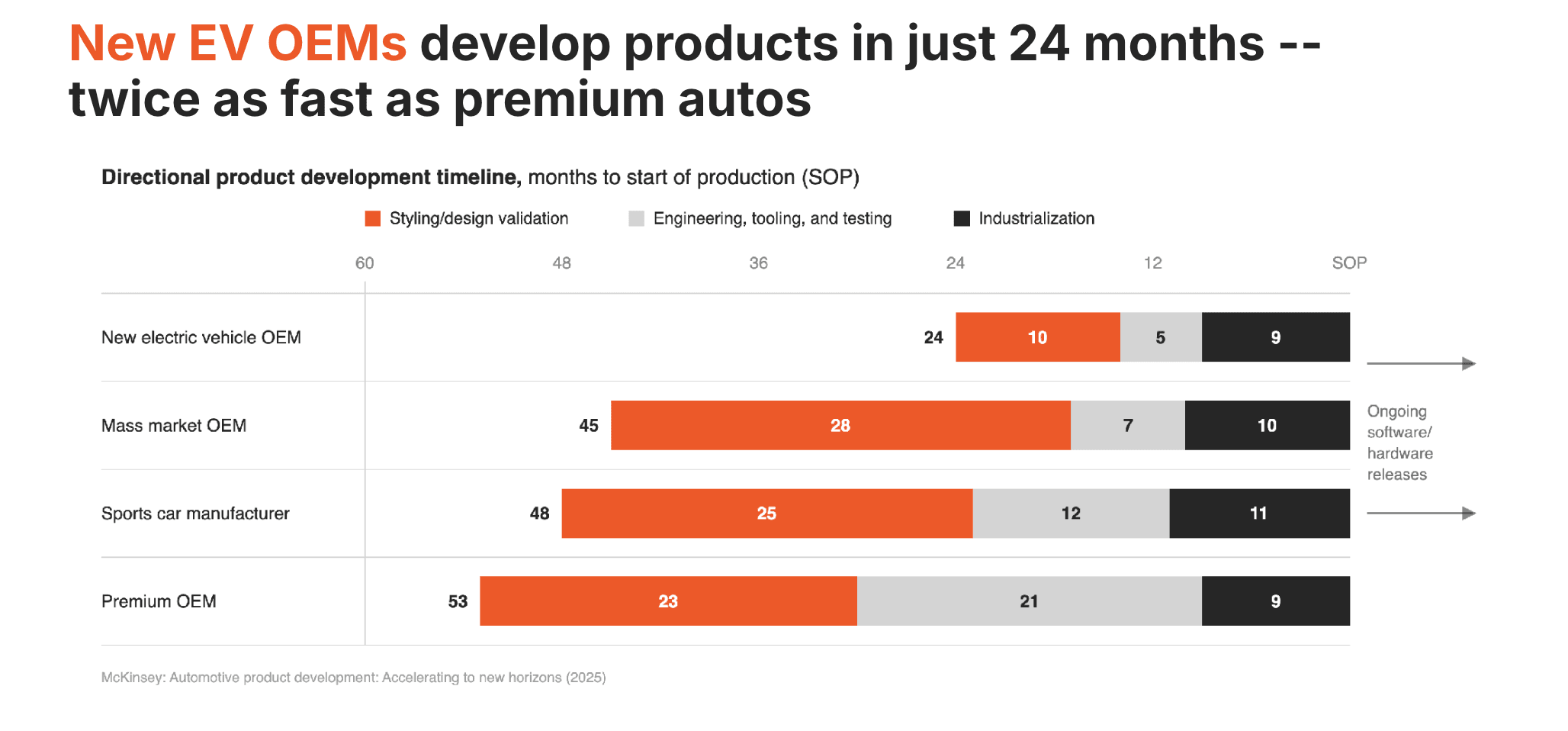
McKinsey's explanation for the gap is not heroics. Chinese EV programs run roughly 65 percent of their testing in simulation versus 40 to 50 percent elsewhere, keep software architectures centralized so features ship over the air, integrate vertically, pull suppliers in at the concept stage (worth up to four months of schedule on its own), and route decisions through small steering groups instead of committee layers. None of that is secret, and all of it is organizational, which is exactly why it is hard to copy. The more manufacturers I talk with, the more convinced I am that the real constraint is system latency: the waiting lives between functions, between companies, and between approval layers, not inside any one person's job. Years at Tesla and Waymo left me allergic to that kind of waiting, and none of this argues for skipping rigor. In a vehicle program, speed comes from shortening the distance between a question and the next useful answer.
The macro numbers say this is not a niche phenomenon. China produced 32 percent of global manufacturing value added in 2024; the United States produced 15 percent. China's vehicle exports passed 7 million units in 2025, up about 21 percent in a year, and the IEA counted China at more than 80 percent of global electric medium- and heavy-duty truck sales in 2024 -- the commercial vehicle industry's own segment. I wrote about what that clock feels like from inside a program in China Time, and the pattern has only compressed since.
Takeaway 1: Protectionism Slows the Decline but Does Not Reverse It
The conference opened with MEMA's Washington team walking the room through USMCA and emissions policy before anyone talked markets, which tells you what daily life looks like for a supplier in 2026. Since November 1, 2025, Section 232 tariffs have put 25 percent on imported medium- and heavy-duty trucks and their parts, with USMCA-qualifying vehicles taxed only on their non-US content. Layer that on top of the steel, aluminum, and passenger-vehicle programs, and the average supplier is managing more trade-policy surface area than at any point in decades -- while ACT Research and FTR describe a market in early recovery, with Class 8 backlogs at multi-year highs, 2026 build slots essentially sold out, and planning attention already shifting to EPA 2027. My colleague Renette Youssef wrote about why the IEEPA ruling didn't simplify any of this, and I've covered the mechanics of managing duty exposure at the BOM level.
I understand the impulse behind protection, and some of it is warranted -- there are national-security reasons to keep the ability to build heavy trucks onshore, a point I argued in The Front Line Is a Factory Floor. But the record on tariffs as a competitiveness strategy is sobering. The Peterson Institute's scoring of 50 years of US industrial policy found the 2018 steel tariffs raised steel employment by roughly 26,000 jobs while costing an estimated 433,000 jobs in the rest of the economy, at a consumer cost of about $650,000 per job saved per year. A study published in the American Economic Journal last November found that the local labor markets most exposed to the 2002 steel tariffs -- the towns full of factories that buy steel to make things -- saw steel-using manufacturers exit and never fully return, even after the tariffs were lifted. Trucks are downstream of steel, and suppliers are downstream of both.
It is worth being precise about what has actually declined, too. US manufacturing output is near its all-time high; the Federal Reserve's industrial production index sat at about 103 percent of its 2017 average this July. Employment tells the other story: 19.6 million manufacturing jobs at the 1979 peak, 12.6 million today. America has not forgotten how to make things; what shrinks every year is our share of a compounding global pie, and no tariff schedule changes a compounding rate.
So protection can buy time, at a real cost to the industries downstream of it. If the window gets spent preserving old operating rhythms, what we will have bought is a slower decline at higher input costs. The interesting question is what fills the window.
Takeaway 2: AI Value Comes From Redesigned Workflows, and Small Wins Buy the Permission
This was the heart of the fireside. Everyone in that ballroom has been told by their board to figure out AI. Almost none of them would say their company has done it, and the data backs their instinct. Roughly 40 percent of American workers now use generative AI at work, a diffusion rate faster than the PC or the internet at the same age. Meanwhile, as of last September, only about 10 percent of US firms used AI to actually produce goods and services -- up from 3.7 percent two years earlier, but a fraction of what the individual numbers would predict.
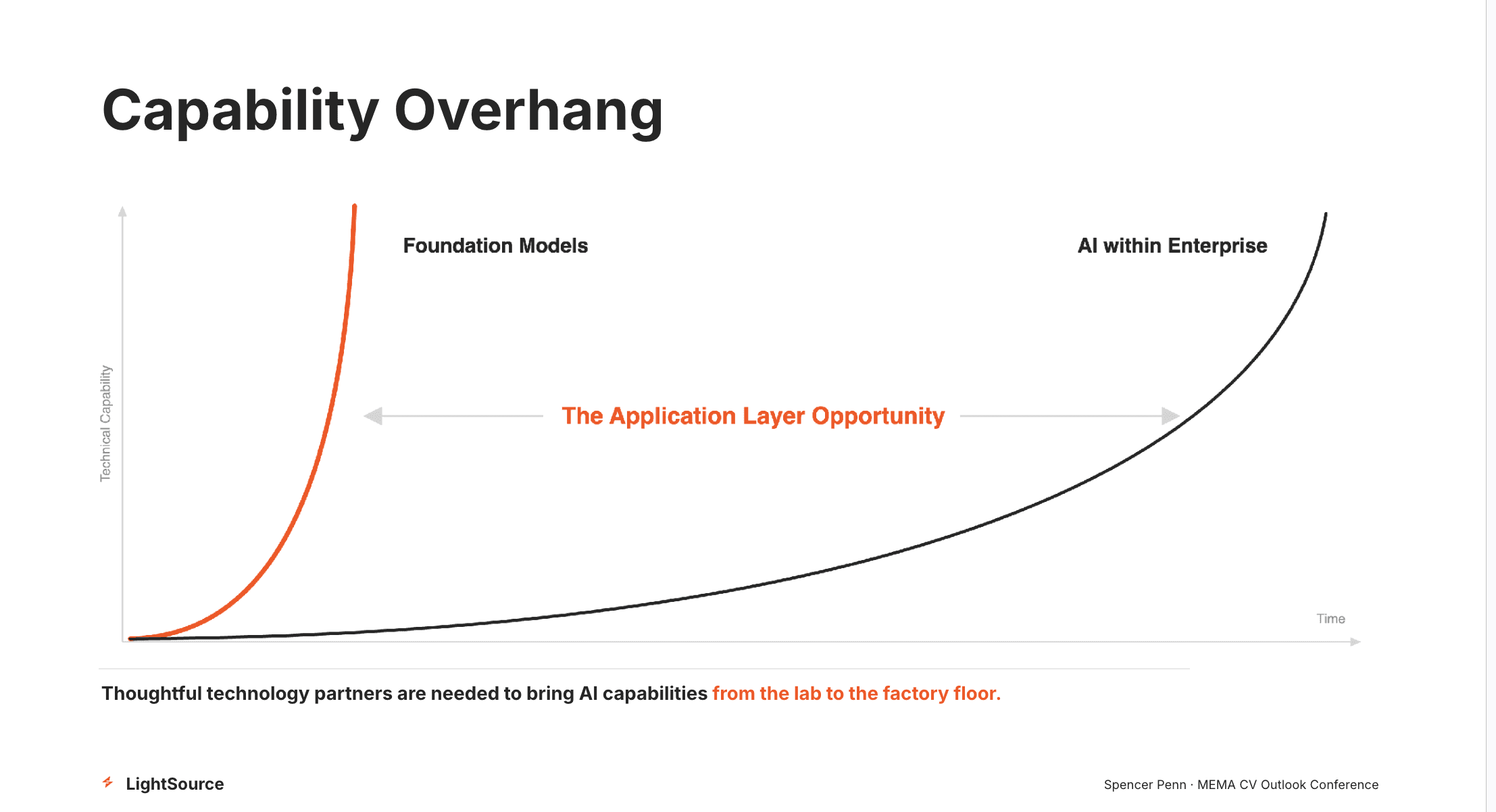
That distance is the slide I put up: the capability overhang. Foundation models are compounding on a research-lab clock. AI inside the enterprise is compounding on a budget-cycle clock. The space between the two curves is where the value sits, unclaimed, waiting for someone to carry frontier capability into a workflow that produces trucks, axles, and wire harnesses.
The skeptics in the room had read the MIT study finding that 95 percent of enterprise generative AI pilots showed no measurable P&L impact, and I didn't argue with the number -- I argued with the reading. That result indicts deployment models, not model capability. It describes copilot licenses bolted onto unchanged processes and pilots measured before any workflow moved. McKinsey's State of AI research finds 88 percent of organizations now use AI somewhere, yet only about 6 percent qualify as high performers -- and the high performers are nearly three times as likely to have fundamentally redesigned workflows rather than inserting AI into existing ones. Getting everyone a chatbot license is table stakes; fluency comes first, but fluency alone doesn't move a P&L. I've made the longer version of this argument in LLMs Are Playdough. Deployment Builds the House., and my colleague Renette Youssef made the operating-system version in Direct Materials Doesn't Have an AI Problem.
On stage I shared the example that made the room go quiet, then loud. A customer of ours, a large Tier 1 automotive supplier, averaged three to four weeks to respond to an RFQ. Running that cycle through LightSource, they brought it down to eight days. LightSource is the direct-materials operating system their sourcing team works in: supplier bids arrive normalized instead of as PDF attachments, engineering and procurement share one live spec, and a re-quote starts from structured data rather than an inbox search. Twenty people took out their phones to photograph that slide, and a dozen more started writing.
What went into those camera rolls was not a technology demo but a peer's cycle time, with a number attached, from their own industry. Everyone in that room knows where the latency hides: a slow quote delays sourcing decisions, engineering trade-offs, launch readiness, and the cost-down work that never pauses in this industry. That is what a small win is for -- not a pilot for the pilot's sake, but a proof point that arms the change-makers inside an organization to go redesign the next process, and the one after that. My colleague Ali Ruben wrote about what happens when those wins start compounding across a deployment. The caution is equally real: a small win that never graduates into the way the organization actually works is how companies end up in MIT's 95 percent. Speed to the first proof point matters precisely because urgency decays.
Takeaway 3: Industry Groups Carry the Fights Individual Companies Can't Win Alone
The takeaway that changed my own thinking most this year is about the trade associations themselves. I used to file them under conference organizers. Watching MEMA's team work corrected that: the same morning as our fireside, they were briefing a ballroom of suppliers on USMCA rules and emissions timelines -- the kind of work that never trends and quietly decides billions in duty exposure. When 1,000 companies speak through one organization, Washington listens in a way it never will to any single supplier.
That matters because the macro factors behind China's advantage are government-built, and the numbers are public. CSIS tallied $230.9 billion of Chinese government support for the EV industry from 2009 through 2023, and calls that estimate conservative because it excludes cheap land, subsidized utilities, and support to the battery supply chain. The same institution's Red Ink study put China's total industrial-policy spending at no less than 1.73 percent of GDP -- multiples of the US figure. China mines about 60 percent of the world's rare earths and processes roughly 90 percent -- the same chokepoint dynamics I dug into in the ASML piece -- and when Beijing restricted seven rare-earth elements in April 2025, automakers on three continents were scrambling for magnets within weeks. The market access runs on diplomacy with a long horizon: over half of China's automobile export value in the first half of 2026 went to Belt and Road countries. Add energy prices shaped by policy at every level of government and capital that arrives whenever the state wants an industry to exist, and you get a competitor whose advantages were assembled deliberately, over decades.
A Tier 1 supplier in Livonia can fix its RFQ cycle. It cannot negotiate magnet export quotas. The split that emerged over the day looks like this:
Layer | Companies | MEMA | Government |
|---|---|---|---|
Speed | Redesign workflows, put AI in production | Spread proof points across members | Fund workforce and capacity |
Trade | Map exposure, qualify alternates | Advocate workable rules | Negotiate and enforce |
Inputs | Second-source critical parts | Aggregate shortage evidence | Secure minerals and energy |
Capital | Prove the productivity case | Surface financing constraints | Shape credit and tax policy |
The Companies column is the part I can influence, and it is where LightSource lives. The Government column is the reason "we'll just out-engineer it" is not a complete strategy, and the MEMA column is what connects the two. Companies that treat policy as someone else's problem are betting their future on fights they never showed up for.
Driving out of Livonia, I kept returning to those 20 phones. The capability overhang curve stayed in pockets, and so did the McKinsey timeline; the slide people stood up to photograph was a peer's result. The suppliers in that room have survived multi-year downcycles, tariff whiplash, and an EPA 2027 planning puzzle, and they know how to build. What they need is evidence that the fast version of their own process exists. Velocity is existential because delay compounds: a three-week quote becomes a late sourcing decision, a late sourcing decision becomes a delayed launch, and a delayed launch hands the next program to a competitor whose whole system is built to learn faster. Every company that publishes a number like eight days makes the next company's urgency a little easier to justify. Whether the US supplier base closes the velocity gap inside the window the tariffs bought is genuinely open. I left Livonia more optimistic than the charts say I should be.
Sources
McKinsey: Automotive product development: Accelerating to new horizons (Aug 2025) -- new EV OEMs reach start of production in ~24 months vs. 45-53 for legacy OEMs; simulation, supplier collaboration, and governance drivers
McKinsey: Racing to EV production (Oct 2025) -- the stage-by-stage development timeline chart
Reuters: How China's new auto giants left GM, VW and Tesla in the dust (Jul 2025) -- 18-month development cycles; Chery's six-week Europe respec
UNIDO: International Yearbook of Industrial Statistics 2025 -- China 32.0% and US 15.0% of 2024 global manufacturing value added
AP: China's vehicle exports pass 7 million in 2025 -- export growth of about 21%
IEA: Global EV Outlook 2025 -- China above 80% of global electric medium/heavy truck sales in 2024
White House CEA: Artificial Intelligence and the Great Divergence (Jan 2026) -- ~40% of workers use generative AI; ~10% of firms use AI in production of goods and services
St. Louis Fed: The State of Generative AI Adoption in 2025 -- generative AI diffusing faster than prior general-purpose technologies
Fortune on MIT NANDA's The GenAI Divide (Aug 2025) -- 95% of enterprise genAI pilots showed no measurable P&L impact
McKinsey: The State of AI (2025/2026) -- 88% of organizations use AI; ~6% are high performers; high performers ~3x likelier to redesign workflows
CSIS: The Chinese EV Dilemma: Subsidized Yet Striking (Jun 2024) -- $230.9B in Chinese EV support, 2009-2023
CSIS: Red Ink: Estimating Chinese Industrial Policy Spending (May 2022) -- Chinese industrial policy at 1.73%+ of GDP
CSIS: Rare Earth Export Restrictions One Year Later (Apr 2026) -- the April 2025 export-control episode and its supply-chain effects
PIIE: Scoring 50 Years of US Industrial Policy -- steel tariffs added ~26,000 steel jobs, cost ~433,000 elsewhere
American Economic Journal: Local Labor Market Effects of the 2002 Bush Steel Tariffs (Nov 2025) -- persistent damage to steel-consuming local economies
Congressional Research Service: Presidential 2025 Tariff Actions -- Section 232: 25% on medium/heavy-duty trucks and parts from Nov 1, 2025
FreightWaves: Fleet demand stays strong despite July slowdown in Class 8 orders (Aug 2026) -- ACT and FTR on backlogs, sold-out 2026 build slots, and EPA 2027
MEMA: Vehicle supplier industry remains largest US manufacturing sector -- 4.8 million total jobs; 907,000+ direct (MEMA/IHS Markit)
BLS: Forty years of falling manufacturing employment -- manufacturing employment peaked at 19.6 million in June 1979
Frequently Asked Questions
What is MEMA, The Vehicle Suppliers Association?
MEMA is the leading North American trade association for vehicle suppliers, parts manufacturers, and remanufacturers, founded in 1904 and representing more than 1,000 member companies. By MEMA's estimate, vehicle suppliers directly employ over 930,000 Americans and support 4.8 million jobs in total, making them the largest manufacturing sector in the United States. Its MEMA Original Equipment Suppliers division, led by President Collin Shaw, serves suppliers to the light-vehicle and commercial-vehicle OE markets.
What is the MEMA Commercial Vehicle Outlook Conference?
It is MEMA's annual outlook event for the commercial-vehicle supplier industry, held August 26, 2026 in Livonia, Michigan. The 2026 program covered the Washington policy landscape (USMCA and emissions), FTR's market outlook, McKinsey's lessons from low-cost regions, a dealer perspective from American Truck Dealers, trailer market trends, Volvo Group's approach to cost optimization, and a fireside on AI in supply chain management.
How much faster do Chinese EV makers develop vehicles than legacy automakers?
McKinsey's 2025 product-development analysis found new EV-focused OEMs take about 24 months from styling to start of production, versus 45 months for mass-market legacy OEMs and 53 for premium OEMs. Reuters reported in July 2025 that BYD, Chery, Zeekr, and Nio develop all-new or redesigned models in as little as 18 months. The drivers are organizational: simulation-heavy testing, centralized software architectures, early supplier collaboration, and lean decision-making.
What is an AI capability overhang?
A capability overhang is the gap between what frontier AI models can already do and what organizations have actually deployed into daily workflows. Roughly 40 percent of US workers use generative AI individually, while only about 10 percent of firms use AI to produce goods and services, so most of the available capability sits unused. Closing that gap is an application-layer and process-redesign problem rather than a model-capability problem.
Do tariffs protect US manufacturing jobs?
The evidence says tariffs can hold a floor under a protected industry while raising costs for the industries downstream of it. The Peterson Institute found the 2018 Section 232 steel tariffs added roughly 26,000 steel jobs while costing about 433,000 jobs across the wider economy, and peer-reviewed research on the 2002 steel tariffs found lasting harm to steel-consuming local labor markets. The current Section 232 truck tariffs -- 25 percent on imported medium- and heavy-duty trucks and parts since November 1, 2025 -- can buy adjustment time, but the record says tariffs alone do not restore competitiveness.
How should a manufacturer start with AI if most pilots fail?
Start with one measurable workflow rather than a broad rollout: pick a process with a clear cycle-time or cost metric, redesign the workflow around AI rather than bolting a chatbot onto the old process, and publish the result internally. MIT's finding that 95 percent of generative AI pilots showed no P&L impact reflects pilots that never changed the underlying workflow. A concrete proof point -- like a Tier 1 supplier cutting RFQ response from three to four weeks down to eight days -- gives internal champions the evidence to expand.
MEMA is one of the most important organizations in American manufacturing, and I'm a little embarrassed to say I didn't know it existed until about a year ago. The Vehicle Suppliers Association has been at it since 1904. It represents more than 1,000 companies that make the parts inside every car on the road and every truck moving freight across the country. By MEMA's count, vehicle suppliers directly employ over 930,000 Americans and support 4.8 million jobs in total, which makes them the largest manufacturing sector in the United States -- a larger employment footprint than the assembly plants with the famous logos out front, carried by an association most people outside the industry have never heard of.
On Wednesday I joined Collin Shaw, President of MEMA Original Equipment Suppliers, on the main stage at the Commercial Vehicle Outlook Conference in Livonia, Michigan, for a fireside on AI in supply chain management. The room was the people who build the trucking industry's hardware: systems engineers from Bosch and ZF, purchasing leaders from Volvo Group, trailer manufacturers, dealers, and a long tail of the Tier 1 and Tier 2 suppliers that make everything work. If I had to compress an hour of conversation into two sentences, it would be the two I opened with: velocity is the only way to win, and it is existential; and AI has to come out of the lab and into production.
Three takeaways survived the drive home.
The Speed Gap: China's New EV Makers Ship Vehicles in Half the Time
We put a McKinsey chart on screen that I have not stopped thinking about since it was published last August. In McKinsey's analysis of automotive product development, a new EV-focused OEM -- the profile of China's attackers -- takes a vehicle from styling to start of production in about 24 months. A mass-market legacy OEM takes 45 months. A premium OEM takes 53. That is the same product, subject to the same physics and the same regulators, delivered on half the clock.
The reporting behind that chart is worse than the averages. A Reuters investigation last July found that BYD, Chery, Zeekr, and Nio now develop all-new or redesigned models in as little as 18 months. My favorite detail from that piece: when Chery decided the Omoda 5 needed to be re-engineered for European roads -- steering, traction control, brakes, vibration dampers, tires -- the retuned vehicle was shipping six weeks later. Six weeks is roughly how long a legacy program spends getting the change request onto the right committee agenda.
McKinsey's explanation for the gap is not heroics. Chinese EV programs run roughly 65 percent of their testing in simulation versus 40 to 50 percent elsewhere, keep software architectures centralized so features ship over the air, integrate vertically, pull suppliers in at the concept stage (worth up to four months of schedule on its own), and route decisions through small steering groups instead of committee layers. None of that is secret, and all of it is organizational, which is exactly why it is hard to copy. The more manufacturers I talk with, the more convinced I am that the real constraint is system latency: the waiting lives between functions, between companies, and between approval layers, not inside any one person's job. Years at Tesla and Waymo left me allergic to that kind of waiting, and none of this argues for skipping rigor. In a vehicle program, speed comes from shortening the distance between a question and the next useful answer.
The macro numbers say this is not a niche phenomenon. China produced 32 percent of global manufacturing value added in 2024; the United States produced 15 percent. China's vehicle exports passed 7 million units in 2025, up about 21 percent in a year, and the IEA counted China at more than 80 percent of global electric medium- and heavy-duty truck sales in 2024 -- the commercial vehicle industry's own segment. I wrote about what that clock feels like from inside a program in China Time, and the pattern has only compressed since.
Takeaway 1: Protectionism Slows the Decline but Does Not Reverse It
The conference opened with MEMA's Washington team walking the room through USMCA and emissions policy before anyone talked markets, which tells you what daily life looks like for a supplier in 2026. Since November 1, 2025, Section 232 tariffs have put 25 percent on imported medium- and heavy-duty trucks and their parts, with USMCA-qualifying vehicles taxed only on their non-US content. Layer that on top of the steel, aluminum, and passenger-vehicle programs, and the average supplier is managing more trade-policy surface area than at any point in decades -- while ACT Research and FTR describe a market in early recovery, with Class 8 backlogs at multi-year highs, 2026 build slots essentially sold out, and planning attention already shifting to EPA 2027. My colleague Renette Youssef wrote about why the IEEPA ruling didn't simplify any of this, and I've covered the mechanics of managing duty exposure at the BOM level.
I understand the impulse behind protection, and some of it is warranted -- there are national-security reasons to keep the ability to build heavy trucks onshore, a point I argued in The Front Line Is a Factory Floor. But the record on tariffs as a competitiveness strategy is sobering. The Peterson Institute's scoring of 50 years of US industrial policy found the 2018 steel tariffs raised steel employment by roughly 26,000 jobs while costing an estimated 433,000 jobs in the rest of the economy, at a consumer cost of about $650,000 per job saved per year. A study published in the American Economic Journal last November found that the local labor markets most exposed to the 2002 steel tariffs -- the towns full of factories that buy steel to make things -- saw steel-using manufacturers exit and never fully return, even after the tariffs were lifted. Trucks are downstream of steel, and suppliers are downstream of both.
It is worth being precise about what has actually declined, too. US manufacturing output is near its all-time high; the Federal Reserve's industrial production index sat at about 103 percent of its 2017 average this July. Employment tells the other story: 19.6 million manufacturing jobs at the 1979 peak, 12.6 million today. America has not forgotten how to make things; what shrinks every year is our share of a compounding global pie, and no tariff schedule changes a compounding rate.
So protection can buy time, at a real cost to the industries downstream of it. If the window gets spent preserving old operating rhythms, what we will have bought is a slower decline at higher input costs. The interesting question is what fills the window.
Takeaway 2: AI Value Comes From Redesigned Workflows, and Small Wins Buy the Permission
This was the heart of the fireside. Everyone in that ballroom has been told by their board to figure out AI. Almost none of them would say their company has done it, and the data backs their instinct. Roughly 40 percent of American workers now use generative AI at work, a diffusion rate faster than the PC or the internet at the same age. Meanwhile, as of last September, only about 10 percent of US firms used AI to actually produce goods and services -- up from 3.7 percent two years earlier, but a fraction of what the individual numbers would predict.
That distance is the slide I put up: the capability overhang. Foundation models are compounding on a research-lab clock. AI inside the enterprise is compounding on a budget-cycle clock. The space between the two curves is where the value sits, unclaimed, waiting for someone to carry frontier capability into a workflow that produces trucks, axles, and wire harnesses.
The skeptics in the room had read the MIT study finding that 95 percent of enterprise generative AI pilots showed no measurable P&L impact, and I didn't argue with the number -- I argued with the reading. That result indicts deployment models, not model capability. It describes copilot licenses bolted onto unchanged processes and pilots measured before any workflow moved. McKinsey's State of AI research finds 88 percent of organizations now use AI somewhere, yet only about 6 percent qualify as high performers -- and the high performers are nearly three times as likely to have fundamentally redesigned workflows rather than inserting AI into existing ones. Getting everyone a chatbot license is table stakes; fluency comes first, but fluency alone doesn't move a P&L. I've made the longer version of this argument in LLMs Are Playdough. Deployment Builds the House., and my colleague Renette Youssef made the operating-system version in Direct Materials Doesn't Have an AI Problem.
On stage I shared the example that made the room go quiet, then loud. A customer of ours, a large Tier 1 automotive supplier, averaged three to four weeks to respond to an RFQ. Running that cycle through LightSource, they brought it down to eight days. LightSource is the direct-materials operating system their sourcing team works in: supplier bids arrive normalized instead of as PDF attachments, engineering and procurement share one live spec, and a re-quote starts from structured data rather than an inbox search. Twenty people took out their phones to photograph that slide, and a dozen more started writing.
What went into those camera rolls was not a technology demo but a peer's cycle time, with a number attached, from their own industry. Everyone in that room knows where the latency hides: a slow quote delays sourcing decisions, engineering trade-offs, launch readiness, and the cost-down work that never pauses in this industry. That is what a small win is for -- not a pilot for the pilot's sake, but a proof point that arms the change-makers inside an organization to go redesign the next process, and the one after that. My colleague Ali Ruben wrote about what happens when those wins start compounding across a deployment. The caution is equally real: a small win that never graduates into the way the organization actually works is how companies end up in MIT's 95 percent. Speed to the first proof point matters precisely because urgency decays.
Takeaway 3: Industry Groups Carry the Fights Individual Companies Can't Win Alone
The takeaway that changed my own thinking most this year is about the trade associations themselves. I used to file them under conference organizers. Watching MEMA's team work corrected that: the same morning as our fireside, they were briefing a ballroom of suppliers on USMCA rules and emissions timelines -- the kind of work that never trends and quietly decides billions in duty exposure. When 1,000 companies speak through one organization, Washington listens in a way it never will to any single supplier.
That matters because the macro factors behind China's advantage are government-built, and the numbers are public. CSIS tallied $230.9 billion of Chinese government support for the EV industry from 2009 through 2023, and calls that estimate conservative because it excludes cheap land, subsidized utilities, and support to the battery supply chain. The same institution's Red Ink study put China's total industrial-policy spending at no less than 1.73 percent of GDP -- multiples of the US figure. China mines about 60 percent of the world's rare earths and processes roughly 90 percent -- the same chokepoint dynamics I dug into in the ASML piece -- and when Beijing restricted seven rare-earth elements in April 2025, automakers on three continents were scrambling for magnets within weeks. The market access runs on diplomacy with a long horizon: over half of China's automobile export value in the first half of 2026 went to Belt and Road countries. Add energy prices shaped by policy at every level of government and capital that arrives whenever the state wants an industry to exist, and you get a competitor whose advantages were assembled deliberately, over decades.
A Tier 1 supplier in Livonia can fix its RFQ cycle. It cannot negotiate magnet export quotas. The split that emerged over the day looks like this:
Layer | Companies | MEMA | Government |
|---|---|---|---|
Speed | Redesign workflows, put AI in production | Spread proof points across members | Fund workforce and capacity |
Trade | Map exposure, qualify alternates | Advocate workable rules | Negotiate and enforce |
Inputs | Second-source critical parts | Aggregate shortage evidence | Secure minerals and energy |
Capital | Prove the productivity case | Surface financing constraints | Shape credit and tax policy |
The Companies column is the part I can influence, and it is where LightSource lives. The Government column is the reason "we'll just out-engineer it" is not a complete strategy, and the MEMA column is what connects the two. Companies that treat policy as someone else's problem are betting their future on fights they never showed up for.
Driving out of Livonia, I kept returning to those 20 phones. The capability overhang curve stayed in pockets, and so did the McKinsey timeline; the slide people stood up to photograph was a peer's result. The suppliers in that room have survived multi-year downcycles, tariff whiplash, and an EPA 2027 planning puzzle, and they know how to build. What they need is evidence that the fast version of their own process exists. Velocity is existential because delay compounds: a three-week quote becomes a late sourcing decision, a late sourcing decision becomes a delayed launch, and a delayed launch hands the next program to a competitor whose whole system is built to learn faster. Every company that publishes a number like eight days makes the next company's urgency a little easier to justify. Whether the US supplier base closes the velocity gap inside the window the tariffs bought is genuinely open. I left Livonia more optimistic than the charts say I should be.
Sources
McKinsey: Automotive product development: Accelerating to new horizons (Aug 2025) -- new EV OEMs reach start of production in ~24 months vs. 45-53 for legacy OEMs; simulation, supplier collaboration, and governance drivers
McKinsey: Racing to EV production (Oct 2025) -- the stage-by-stage development timeline chart
Reuters: How China's new auto giants left GM, VW and Tesla in the dust (Jul 2025) -- 18-month development cycles; Chery's six-week Europe respec
UNIDO: International Yearbook of Industrial Statistics 2025 -- China 32.0% and US 15.0% of 2024 global manufacturing value added
AP: China's vehicle exports pass 7 million in 2025 -- export growth of about 21%
IEA: Global EV Outlook 2025 -- China above 80% of global electric medium/heavy truck sales in 2024
White House CEA: Artificial Intelligence and the Great Divergence (Jan 2026) -- ~40% of workers use generative AI; ~10% of firms use AI in production of goods and services
St. Louis Fed: The State of Generative AI Adoption in 2025 -- generative AI diffusing faster than prior general-purpose technologies
Fortune on MIT NANDA's The GenAI Divide (Aug 2025) -- 95% of enterprise genAI pilots showed no measurable P&L impact
McKinsey: The State of AI (2025/2026) -- 88% of organizations use AI; ~6% are high performers; high performers ~3x likelier to redesign workflows
CSIS: The Chinese EV Dilemma: Subsidized Yet Striking (Jun 2024) -- $230.9B in Chinese EV support, 2009-2023
CSIS: Red Ink: Estimating Chinese Industrial Policy Spending (May 2022) -- Chinese industrial policy at 1.73%+ of GDP
CSIS: Rare Earth Export Restrictions One Year Later (Apr 2026) -- the April 2025 export-control episode and its supply-chain effects
PIIE: Scoring 50 Years of US Industrial Policy -- steel tariffs added ~26,000 steel jobs, cost ~433,000 elsewhere
American Economic Journal: Local Labor Market Effects of the 2002 Bush Steel Tariffs (Nov 2025) -- persistent damage to steel-consuming local economies
Congressional Research Service: Presidential 2025 Tariff Actions -- Section 232: 25% on medium/heavy-duty trucks and parts from Nov 1, 2025
FreightWaves: Fleet demand stays strong despite July slowdown in Class 8 orders (Aug 2026) -- ACT and FTR on backlogs, sold-out 2026 build slots, and EPA 2027
MEMA: Vehicle supplier industry remains largest US manufacturing sector -- 4.8 million total jobs; 907,000+ direct (MEMA/IHS Markit)
BLS: Forty years of falling manufacturing employment -- manufacturing employment peaked at 19.6 million in June 1979
Frequently Asked Questions
What is MEMA, The Vehicle Suppliers Association?
MEMA is the leading North American trade association for vehicle suppliers, parts manufacturers, and remanufacturers, founded in 1904 and representing more than 1,000 member companies. By MEMA's estimate, vehicle suppliers directly employ over 930,000 Americans and support 4.8 million jobs in total, making them the largest manufacturing sector in the United States. Its MEMA Original Equipment Suppliers division, led by President Collin Shaw, serves suppliers to the light-vehicle and commercial-vehicle OE markets.
What is the MEMA Commercial Vehicle Outlook Conference?
It is MEMA's annual outlook event for the commercial-vehicle supplier industry, held August 26, 2026 in Livonia, Michigan. The 2026 program covered the Washington policy landscape (USMCA and emissions), FTR's market outlook, McKinsey's lessons from low-cost regions, a dealer perspective from American Truck Dealers, trailer market trends, Volvo Group's approach to cost optimization, and a fireside on AI in supply chain management.
How much faster do Chinese EV makers develop vehicles than legacy automakers?
McKinsey's 2025 product-development analysis found new EV-focused OEMs take about 24 months from styling to start of production, versus 45 months for mass-market legacy OEMs and 53 for premium OEMs. Reuters reported in July 2025 that BYD, Chery, Zeekr, and Nio develop all-new or redesigned models in as little as 18 months. The drivers are organizational: simulation-heavy testing, centralized software architectures, early supplier collaboration, and lean decision-making.
What is an AI capability overhang?
A capability overhang is the gap between what frontier AI models can already do and what organizations have actually deployed into daily workflows. Roughly 40 percent of US workers use generative AI individually, while only about 10 percent of firms use AI to produce goods and services, so most of the available capability sits unused. Closing that gap is an application-layer and process-redesign problem rather than a model-capability problem.
Do tariffs protect US manufacturing jobs?
The evidence says tariffs can hold a floor under a protected industry while raising costs for the industries downstream of it. The Peterson Institute found the 2018 Section 232 steel tariffs added roughly 26,000 steel jobs while costing about 433,000 jobs across the wider economy, and peer-reviewed research on the 2002 steel tariffs found lasting harm to steel-consuming local labor markets. The current Section 232 truck tariffs -- 25 percent on imported medium- and heavy-duty trucks and parts since November 1, 2025 -- can buy adjustment time, but the record says tariffs alone do not restore competitiveness.
How should a manufacturer start with AI if most pilots fail?
Start with one measurable workflow rather than a broad rollout: pick a process with a clear cycle-time or cost metric, redesign the workflow around AI rather than bolting a chatbot onto the old process, and publish the result internally. MIT's finding that 95 percent of generative AI pilots showed no P&L impact reflects pilots that never changed the underlying workflow. A concrete proof point -- like a Tier 1 supplier cutting RFQ response from three to four weeks down to eight days -- gives internal champions the evidence to expand.
MEMA is one of the most important organizations in American manufacturing, and I'm a little embarrassed to say I didn't know it existed until about a year ago. The Vehicle Suppliers Association has been at it since 1904. It represents more than 1,000 companies that make the parts inside every car on the road and every truck moving freight across the country. By MEMA's count, vehicle suppliers directly employ over 930,000 Americans and support 4.8 million jobs in total, which makes them the largest manufacturing sector in the United States -- a larger employment footprint than the assembly plants with the famous logos out front, carried by an association most people outside the industry have never heard of.
On Wednesday I joined Collin Shaw, President of MEMA Original Equipment Suppliers, on the main stage at the Commercial Vehicle Outlook Conference in Livonia, Michigan, for a fireside on AI in supply chain management. The room was the people who build the trucking industry's hardware: systems engineers from Bosch and ZF, purchasing leaders from Volvo Group, trailer manufacturers, dealers, and a long tail of the Tier 1 and Tier 2 suppliers that make everything work. If I had to compress an hour of conversation into two sentences, it would be the two I opened with: velocity is the only way to win, and it is existential; and AI has to come out of the lab and into production.
Three takeaways survived the drive home.
The Speed Gap: China's New EV Makers Ship Vehicles in Half the Time
We put a McKinsey chart on screen that I have not stopped thinking about since it was published last August. In McKinsey's analysis of automotive product development, a new EV-focused OEM -- the profile of China's attackers -- takes a vehicle from styling to start of production in about 24 months. A mass-market legacy OEM takes 45 months. A premium OEM takes 53. That is the same product, subject to the same physics and the same regulators, delivered on half the clock.
The reporting behind that chart is worse than the averages. A Reuters investigation last July found that BYD, Chery, Zeekr, and Nio now develop all-new or redesigned models in as little as 18 months. My favorite detail from that piece: when Chery decided the Omoda 5 needed to be re-engineered for European roads -- steering, traction control, brakes, vibration dampers, tires -- the retuned vehicle was shipping six weeks later. Six weeks is roughly how long a legacy program spends getting the change request onto the right committee agenda.
McKinsey's explanation for the gap is not heroics. Chinese EV programs run roughly 65 percent of their testing in simulation versus 40 to 50 percent elsewhere, keep software architectures centralized so features ship over the air, integrate vertically, pull suppliers in at the concept stage (worth up to four months of schedule on its own), and route decisions through small steering groups instead of committee layers. None of that is secret, and all of it is organizational, which is exactly why it is hard to copy. The more manufacturers I talk with, the more convinced I am that the real constraint is system latency: the waiting lives between functions, between companies, and between approval layers, not inside any one person's job. Years at Tesla and Waymo left me allergic to that kind of waiting, and none of this argues for skipping rigor. In a vehicle program, speed comes from shortening the distance between a question and the next useful answer.
The macro numbers say this is not a niche phenomenon. China produced 32 percent of global manufacturing value added in 2024; the United States produced 15 percent. China's vehicle exports passed 7 million units in 2025, up about 21 percent in a year, and the IEA counted China at more than 80 percent of global electric medium- and heavy-duty truck sales in 2024 -- the commercial vehicle industry's own segment. I wrote about what that clock feels like from inside a program in China Time, and the pattern has only compressed since.
Takeaway 1: Protectionism Slows the Decline but Does Not Reverse It
The conference opened with MEMA's Washington team walking the room through USMCA and emissions policy before anyone talked markets, which tells you what daily life looks like for a supplier in 2026. Since November 1, 2025, Section 232 tariffs have put 25 percent on imported medium- and heavy-duty trucks and their parts, with USMCA-qualifying vehicles taxed only on their non-US content. Layer that on top of the steel, aluminum, and passenger-vehicle programs, and the average supplier is managing more trade-policy surface area than at any point in decades -- while ACT Research and FTR describe a market in early recovery, with Class 8 backlogs at multi-year highs, 2026 build slots essentially sold out, and planning attention already shifting to EPA 2027. My colleague Renette Youssef wrote about why the IEEPA ruling didn't simplify any of this, and I've covered the mechanics of managing duty exposure at the BOM level.
I understand the impulse behind protection, and some of it is warranted -- there are national-security reasons to keep the ability to build heavy trucks onshore, a point I argued in The Front Line Is a Factory Floor. But the record on tariffs as a competitiveness strategy is sobering. The Peterson Institute's scoring of 50 years of US industrial policy found the 2018 steel tariffs raised steel employment by roughly 26,000 jobs while costing an estimated 433,000 jobs in the rest of the economy, at a consumer cost of about $650,000 per job saved per year. A study published in the American Economic Journal last November found that the local labor markets most exposed to the 2002 steel tariffs -- the towns full of factories that buy steel to make things -- saw steel-using manufacturers exit and never fully return, even after the tariffs were lifted. Trucks are downstream of steel, and suppliers are downstream of both.
It is worth being precise about what has actually declined, too. US manufacturing output is near its all-time high; the Federal Reserve's industrial production index sat at about 103 percent of its 2017 average this July. Employment tells the other story: 19.6 million manufacturing jobs at the 1979 peak, 12.6 million today. America has not forgotten how to make things; what shrinks every year is our share of a compounding global pie, and no tariff schedule changes a compounding rate.
So protection can buy time, at a real cost to the industries downstream of it. If the window gets spent preserving old operating rhythms, what we will have bought is a slower decline at higher input costs. The interesting question is what fills the window.
Takeaway 2: AI Value Comes From Redesigned Workflows, and Small Wins Buy the Permission
This was the heart of the fireside. Everyone in that ballroom has been told by their board to figure out AI. Almost none of them would say their company has done it, and the data backs their instinct. Roughly 40 percent of American workers now use generative AI at work, a diffusion rate faster than the PC or the internet at the same age. Meanwhile, as of last September, only about 10 percent of US firms used AI to actually produce goods and services -- up from 3.7 percent two years earlier, but a fraction of what the individual numbers would predict.
That distance is the slide I put up: the capability overhang. Foundation models are compounding on a research-lab clock. AI inside the enterprise is compounding on a budget-cycle clock. The space between the two curves is where the value sits, unclaimed, waiting for someone to carry frontier capability into a workflow that produces trucks, axles, and wire harnesses.
The skeptics in the room had read the MIT study finding that 95 percent of enterprise generative AI pilots showed no measurable P&L impact, and I didn't argue with the number -- I argued with the reading. That result indicts deployment models, not model capability. It describes copilot licenses bolted onto unchanged processes and pilots measured before any workflow moved. McKinsey's State of AI research finds 88 percent of organizations now use AI somewhere, yet only about 6 percent qualify as high performers -- and the high performers are nearly three times as likely to have fundamentally redesigned workflows rather than inserting AI into existing ones. Getting everyone a chatbot license is table stakes; fluency comes first, but fluency alone doesn't move a P&L. I've made the longer version of this argument in LLMs Are Playdough. Deployment Builds the House., and my colleague Renette Youssef made the operating-system version in Direct Materials Doesn't Have an AI Problem.
On stage I shared the example that made the room go quiet, then loud. A customer of ours, a large Tier 1 automotive supplier, averaged three to four weeks to respond to an RFQ. Running that cycle through LightSource, they brought it down to eight days. LightSource is the direct-materials operating system their sourcing team works in: supplier bids arrive normalized instead of as PDF attachments, engineering and procurement share one live spec, and a re-quote starts from structured data rather than an inbox search. Twenty people took out their phones to photograph that slide, and a dozen more started writing.
What went into those camera rolls was not a technology demo but a peer's cycle time, with a number attached, from their own industry. Everyone in that room knows where the latency hides: a slow quote delays sourcing decisions, engineering trade-offs, launch readiness, and the cost-down work that never pauses in this industry. That is what a small win is for -- not a pilot for the pilot's sake, but a proof point that arms the change-makers inside an organization to go redesign the next process, and the one after that. My colleague Ali Ruben wrote about what happens when those wins start compounding across a deployment. The caution is equally real: a small win that never graduates into the way the organization actually works is how companies end up in MIT's 95 percent. Speed to the first proof point matters precisely because urgency decays.
Takeaway 3: Industry Groups Carry the Fights Individual Companies Can't Win Alone
The takeaway that changed my own thinking most this year is about the trade associations themselves. I used to file them under conference organizers. Watching MEMA's team work corrected that: the same morning as our fireside, they were briefing a ballroom of suppliers on USMCA rules and emissions timelines -- the kind of work that never trends and quietly decides billions in duty exposure. When 1,000 companies speak through one organization, Washington listens in a way it never will to any single supplier.
That matters because the macro factors behind China's advantage are government-built, and the numbers are public. CSIS tallied $230.9 billion of Chinese government support for the EV industry from 2009 through 2023, and calls that estimate conservative because it excludes cheap land, subsidized utilities, and support to the battery supply chain. The same institution's Red Ink study put China's total industrial-policy spending at no less than 1.73 percent of GDP -- multiples of the US figure. China mines about 60 percent of the world's rare earths and processes roughly 90 percent -- the same chokepoint dynamics I dug into in the ASML piece -- and when Beijing restricted seven rare-earth elements in April 2025, automakers on three continents were scrambling for magnets within weeks. The market access runs on diplomacy with a long horizon: over half of China's automobile export value in the first half of 2026 went to Belt and Road countries. Add energy prices shaped by policy at every level of government and capital that arrives whenever the state wants an industry to exist, and you get a competitor whose advantages were assembled deliberately, over decades.
A Tier 1 supplier in Livonia can fix its RFQ cycle. It cannot negotiate magnet export quotas. The split that emerged over the day looks like this:
Layer | Companies | MEMA | Government |
|---|---|---|---|
Speed | Redesign workflows, put AI in production | Spread proof points across members | Fund workforce and capacity |
Trade | Map exposure, qualify alternates | Advocate workable rules | Negotiate and enforce |
Inputs | Second-source critical parts | Aggregate shortage evidence | Secure minerals and energy |
Capital | Prove the productivity case | Surface financing constraints | Shape credit and tax policy |
The Companies column is the part I can influence, and it is where LightSource lives. The Government column is the reason "we'll just out-engineer it" is not a complete strategy, and the MEMA column is what connects the two. Companies that treat policy as someone else's problem are betting their future on fights they never showed up for.
Driving out of Livonia, I kept returning to those 20 phones. The capability overhang curve stayed in pockets, and so did the McKinsey timeline; the slide people stood up to photograph was a peer's result. The suppliers in that room have survived multi-year downcycles, tariff whiplash, and an EPA 2027 planning puzzle, and they know how to build. What they need is evidence that the fast version of their own process exists. Velocity is existential because delay compounds: a three-week quote becomes a late sourcing decision, a late sourcing decision becomes a delayed launch, and a delayed launch hands the next program to a competitor whose whole system is built to learn faster. Every company that publishes a number like eight days makes the next company's urgency a little easier to justify. Whether the US supplier base closes the velocity gap inside the window the tariffs bought is genuinely open. I left Livonia more optimistic than the charts say I should be.
Sources
McKinsey: Automotive product development: Accelerating to new horizons (Aug 2025) -- new EV OEMs reach start of production in ~24 months vs. 45-53 for legacy OEMs; simulation, supplier collaboration, and governance drivers
McKinsey: Racing to EV production (Oct 2025) -- the stage-by-stage development timeline chart
Reuters: How China's new auto giants left GM, VW and Tesla in the dust (Jul 2025) -- 18-month development cycles; Chery's six-week Europe respec
UNIDO: International Yearbook of Industrial Statistics 2025 -- China 32.0% and US 15.0% of 2024 global manufacturing value added
AP: China's vehicle exports pass 7 million in 2025 -- export growth of about 21%
IEA: Global EV Outlook 2025 -- China above 80% of global electric medium/heavy truck sales in 2024
White House CEA: Artificial Intelligence and the Great Divergence (Jan 2026) -- ~40% of workers use generative AI; ~10% of firms use AI in production of goods and services
St. Louis Fed: The State of Generative AI Adoption in 2025 -- generative AI diffusing faster than prior general-purpose technologies
Fortune on MIT NANDA's The GenAI Divide (Aug 2025) -- 95% of enterprise genAI pilots showed no measurable P&L impact
McKinsey: The State of AI (2025/2026) -- 88% of organizations use AI; ~6% are high performers; high performers ~3x likelier to redesign workflows
CSIS: The Chinese EV Dilemma: Subsidized Yet Striking (Jun 2024) -- $230.9B in Chinese EV support, 2009-2023
CSIS: Red Ink: Estimating Chinese Industrial Policy Spending (May 2022) -- Chinese industrial policy at 1.73%+ of GDP
CSIS: Rare Earth Export Restrictions One Year Later (Apr 2026) -- the April 2025 export-control episode and its supply-chain effects
PIIE: Scoring 50 Years of US Industrial Policy -- steel tariffs added ~26,000 steel jobs, cost ~433,000 elsewhere
American Economic Journal: Local Labor Market Effects of the 2002 Bush Steel Tariffs (Nov 2025) -- persistent damage to steel-consuming local economies
Congressional Research Service: Presidential 2025 Tariff Actions -- Section 232: 25% on medium/heavy-duty trucks and parts from Nov 1, 2025
FreightWaves: Fleet demand stays strong despite July slowdown in Class 8 orders (Aug 2026) -- ACT and FTR on backlogs, sold-out 2026 build slots, and EPA 2027
MEMA: Vehicle supplier industry remains largest US manufacturing sector -- 4.8 million total jobs; 907,000+ direct (MEMA/IHS Markit)
BLS: Forty years of falling manufacturing employment -- manufacturing employment peaked at 19.6 million in June 1979
Frequently Asked Questions
What is MEMA, The Vehicle Suppliers Association?
MEMA is the leading North American trade association for vehicle suppliers, parts manufacturers, and remanufacturers, founded in 1904 and representing more than 1,000 member companies. By MEMA's estimate, vehicle suppliers directly employ over 930,000 Americans and support 4.8 million jobs in total, making them the largest manufacturing sector in the United States. Its MEMA Original Equipment Suppliers division, led by President Collin Shaw, serves suppliers to the light-vehicle and commercial-vehicle OE markets.
What is the MEMA Commercial Vehicle Outlook Conference?
It is MEMA's annual outlook event for the commercial-vehicle supplier industry, held August 26, 2026 in Livonia, Michigan. The 2026 program covered the Washington policy landscape (USMCA and emissions), FTR's market outlook, McKinsey's lessons from low-cost regions, a dealer perspective from American Truck Dealers, trailer market trends, Volvo Group's approach to cost optimization, and a fireside on AI in supply chain management.
How much faster do Chinese EV makers develop vehicles than legacy automakers?
McKinsey's 2025 product-development analysis found new EV-focused OEMs take about 24 months from styling to start of production, versus 45 months for mass-market legacy OEMs and 53 for premium OEMs. Reuters reported in July 2025 that BYD, Chery, Zeekr, and Nio develop all-new or redesigned models in as little as 18 months. The drivers are organizational: simulation-heavy testing, centralized software architectures, early supplier collaboration, and lean decision-making.
What is an AI capability overhang?
A capability overhang is the gap between what frontier AI models can already do and what organizations have actually deployed into daily workflows. Roughly 40 percent of US workers use generative AI individually, while only about 10 percent of firms use AI to produce goods and services, so most of the available capability sits unused. Closing that gap is an application-layer and process-redesign problem rather than a model-capability problem.
Do tariffs protect US manufacturing jobs?
The evidence says tariffs can hold a floor under a protected industry while raising costs for the industries downstream of it. The Peterson Institute found the 2018 Section 232 steel tariffs added roughly 26,000 steel jobs while costing about 433,000 jobs across the wider economy, and peer-reviewed research on the 2002 steel tariffs found lasting harm to steel-consuming local labor markets. The current Section 232 truck tariffs -- 25 percent on imported medium- and heavy-duty trucks and parts since November 1, 2025 -- can buy adjustment time, but the record says tariffs alone do not restore competitiveness.
How should a manufacturer start with AI if most pilots fail?
Start with one measurable workflow rather than a broad rollout: pick a process with a clear cycle-time or cost metric, redesign the workflow around AI rather than bolting a chatbot onto the old process, and publish the result internally. MIT's finding that 95 percent of generative AI pilots showed no P&L impact reflects pilots that never changed the underlying workflow. A concrete proof point -- like a Tier 1 supplier cutting RFQ response from three to four weeks down to eight days -- gives internal champions the evidence to expand.


Faster sourcing. Lower cost. Less chaos.
See how LightSource connects engineering, procurement, and suppliers in one operating system to help you launch faster at lower cost.
SOC 2
Kearney #1 2024
Gartner Cool Vendor
Procuretech 100
G2 Top Rated
Faster sourcing. Lower cost. Less chaos.
See how LightSource connects engineering, procurement, and suppliers in one operating system to help you launch faster at lower cost.
SOC 2
Kearney #1 2024
Gartner Cool Vendor
Procuretech 100
G2 Top Rated
Faster sourcing. Lower cost. Less chaos.
See how LightSource connects engineering, procurement, and suppliers in one operating system to help you launch faster at lower cost.
SOC 2
Kearney #1 2024
Gartner Cool Vendor
Procuretech 100
G2 Top Rated
Trusted by:
Trusted by:
Trusted by: