

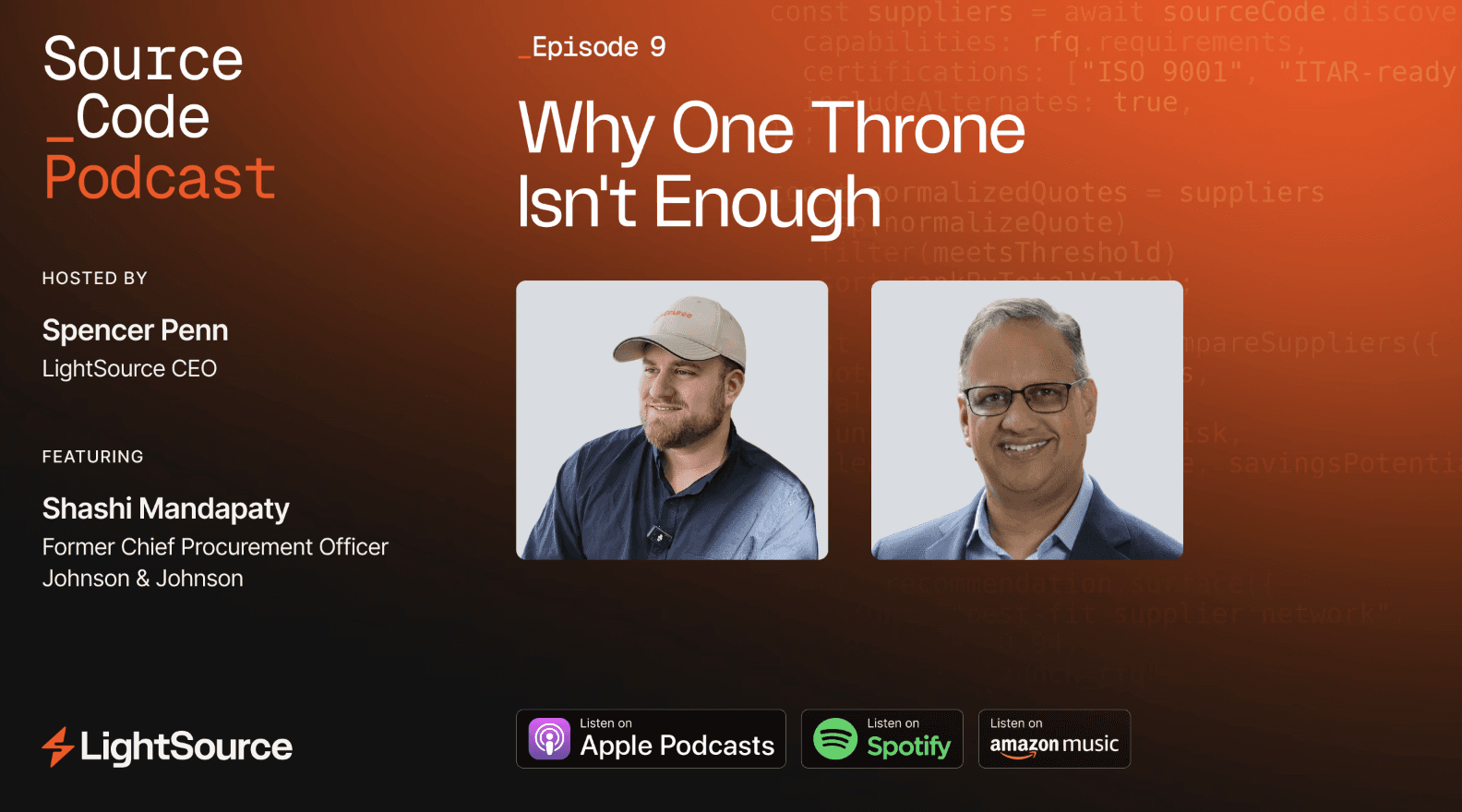
Guest: Shashi Mandapaty, Former Chief Procurement Officer, Johnson & Johnson; Advisor to the National Cancer Institute in India
Listen on Spotify | Listen on Apple Podcasts | Listen on Amazon Music
Most people who reach the top of a corporate function stay there until they retire. Shashi Mandapaty ran procurement at Johnson & Johnson, where he spent 12 years, and then chose a different shape for his career: half of his time now goes to building a cancer research division at the National Cancer Institute in India, and the other half to procurement advisory work. He is also a stage four cancer survivor, which is part of why the work found him. In this episode of Source Code, he and Spencer cover why cancer in India is a different disease from cancer in the United States, what a biorepository actually does, the career moves that took an electrical engineer to a CPO seat, how CPOs get measured, and why he calls what he does now a plural career.
India's Cancer Problem Is Different
Mandapaty had just returned from Nagpur, in central India, where he presented a research plan to the Chief Minister of Maharashtra. The institution behind it is the National Cancer Institute in India, a not-for-profit, 700-bed cancer hospital that opened in 2014. He has worked with it for about three and a half years, the last six months on the plan itself. "If everything goes well in the next five years, we will have the world's largest cancer biorepository," he says, along with a dedicated research division that would be the largest in the country.
The numbers he walks through come with his own caveats. By incidence, India is third in the world behind the United States and China. By deaths, it is second. Among the ten highest-incidence countries, India has the worst ratio of deaths to new cases: about 65 percent, against roughly 25 percent in the US. And India's cancer registry captures only around 10 percent of cases, mostly urban ones, so the real picture in rural India is probably worse.
The disease profile differs too. In the US, cancer is largely a disease of aging; prostate cancer alone is close to a third of male cases. In India, Mandapaty says, it is largely a disease of the young, and much of it is avoidable. "I am a stage four cancer survivor, and most of the cancer that happens in India is avoidable cancer." Tobacco, chewed and smoked, drives about a third of male cancers. Infection-linked cancers such as cervical cancer have vaccines. Breast cancer is the most common cancer among women in both countries, but in India it tends to appear about a decade earlier, in the late thirties and early forties. Why that is, he says, is exactly the kind of question India-specific research has to answer.
What a Biorepository Does
In the US, the National Cancer Institute designates hospitals as comprehensive cancer centers when they run patient care, education, and research at a high level under one roof, and Mandapaty cites US studies showing patient outcomes 35 to 70 percent better at those centers than elsewhere. NCI India already has the patient care and plans for the education leg. His job is research.
Most of the basic science will keep coming from institutions like Johns Hopkins. What India needs is translational research: taking that science to the problems above and turning bench insights into bedside action. The biorepository is the starting point. It stores physical tissue and blood samples, collected under the right protocols and ethical consents, and annotates each one with genomic and other multi-omic data plus the patient's medical record, which Mandapaty describes as "almost like a digital twin of the sample." Researchers today can wait two to four years to find enough samples matching a profile before they can even begin. India's patient volume, as unfortunate as it is, means the repository could become the largest source of annotated samples anywhere, and the data would be useful to researchers everywhere.
Making a Non-Profit Sustainable
Spencer brought up the Harvard Business School case on Narayana Health, the Bangalore heart hospital that performs complex surgeries at a fraction of Western costs with outcomes on par with the best. Mandapaty, who read the same case, draws the same lesson: understand what patients need and build the whole activity system to deliver it at a cost India can bear, without compromising quality. He sees two reasons the model holds. One is quantitative: a steady stream of diverse samples that no other institution can match, if they are collected, stored, and consented to global standards. The other is commitment: the trust that runs the hospital, its board, and the state government have been unwavering, and they know the first three to four years need investment before other revenue streams arrive.
Spencer offered introductions at Harvard and Penn Medicine, and Mandapaty was specific about what helps most: leading researchers for the research advisory board that sets the agenda, and people who open doors for the foundation board that raises money. "Knowledge and money, I think those are the two that go hand in hand."
Why He Doesn't Call It Giving Back
Mandapaty rejects the usual framing. "I don't think there's any giving back," he says, "because what I realize is that I do only those things where I get something out of it." The satisfaction of working on something close to his heart is the point. If someone took the project away from him tomorrow, he says, he would be the one who felt the loss.
From Boiler Burners to P&G
Mandapaty trained as an electrical engineer. His first job was at Thermax, which had a tie-up with the boiler maker Babcock & Wilcox, working on instrumentation for industrial boilers and thermic fluid heaters. The work kept narrowing: process boilers, then oil- and gas-fired boilers, then just the burners. Specializing is how engineers get good, he says, but he did not want to spend "30 years or 35 years of my career going deeper and deeper into instrumentation of the nozzle in a burner that fires naphtha."
So he went back to school for industrial management, at what is now the Indian Institute of Management Mumbai, and then joined Procter & Gamble buying raw and packaging materials for its businesses in Asia.
The Risks That Shaped the Career
Next came four years in marketing at P&G India, an up-or-out function, with no marketing training. "At that time I did not see it as a risk. I thought I would have fun, so I just did it." In 2004 he moved to Moscow to set up procurement for all of Eastern Europe, a territory stretching from Israel to Pakistan, in what P&G people called the CNN countries because they were always on the news for the wrong reasons. Getting a couple of currencies wrong could have wrecked the business; getting them right could crisis-proof it, so the team localized suppliers and, most importantly, talent. "If someone had offered a role like that to me now, I don't know if I would have the courage to accept it." Then came P&G's global headquarters in Cincinnati, and later Johnson & Johnson.
He never planned to be a CPO. At P&G, hosting the company's chief procurement officer in Mumbai or meeting them in Singapore felt like meeting someone from another league, and when he got the J&J job the question in his head was "Can I live up to those standards?" There was no plan, he says, only a habit of leaving the comfort zone and the luck of working with CPOs worth looking up to. Douglas Johnson, a guest on episode 11, told a similar story about a 34-year career that nobody could have mapped in advance.
The Skill That Gets You to CPO
"Number one is being very close to the business." Not supporting it, being part of it. In Eastern Europe, procurement could make or break the business. A buyer who understands both the industries they buy from and the business they sit inside can talk with marketing or finance in their own language and connect what is possible outside to what the business needs. "You become indispensable." Category knowledge still matters: "It's the combination of the two that truly creates magic."
He pushes back on the idea that this only works in direct materials. Media buying, an indirect category, is deeply embedded in the business. In pharma, R&D procurement manages the relationships with contract research organizations and CDMOs, which makes it one of the most critical categories there is. Even business services and travel add up to a surprising share of the P&L, and a buyer who keeps handing the business new levers becomes a value driver. The way in is to study the business like a student: read the agenda before the meeting, do the pre-work, and tie what is happening outside to the pipeline and the financials. Victoria Folbigg made a related argument on episode 10: the procurement teams that last are the ones that learn to profile their stakeholders like marketers.
How CPOs Get Measured
Three things are common everywhere, Mandapaty says: connecting with senior leadership and representing the function to them; building a strong organization that rallies behind the business; and, over the last 10 to 15 years, a digital-first mindset that modernizes the function. "Procurement needs to step out of this self-assumed role of being the cop, to being an enabler," he says, which means bringing in the best technology to drive speed and value rather than acting as the compliance desk.
What differs is the industry. In pharma, innovation comes first, which is why R&D is such a critical category, and resilience is close behind: a patient three cycles into chemotherapy cannot have the fourth disrupted by a supply problem somewhere upstream. In consumer goods, cost rules in a business of razor-thin margins. In banking and credit cards, risk is paramount, and every new supplier is vetted for the exposure it adds. Jim Nelles covered the finance side of that scorecard on episode 14.
The Plural Career
Half of Mandapaty's time now goes to the cancer institute. The other half is still procurement: advising companies and private equity firms, the world Chris Chandler described on episode 12. He did not want another CPO role, and he is not retiring. "I'm not retiring, but I would want to have a career where I tend to grow, not just from a financial perspective, but also grow from just new areas that I can learn." The portfolio gives him diversified income and diversified growth, and he is careful to say it is the right move for him at this point, not a prescription for everyone. Spencer's verdict at the end of the conversation: he is simply too young to retire.
Guest: Shashi Mandapaty, Former Chief Procurement Officer, Johnson & Johnson; Advisor to the National Cancer Institute in India
Listen on Spotify | Listen on Apple Podcasts | Listen on Amazon Music
Most people who reach the top of a corporate function stay there until they retire. Shashi Mandapaty ran procurement at Johnson & Johnson, where he spent 12 years, and then chose a different shape for his career: half of his time now goes to building a cancer research division at the National Cancer Institute in India, and the other half to procurement advisory work. He is also a stage four cancer survivor, which is part of why the work found him. In this episode of Source Code, he and Spencer cover why cancer in India is a different disease from cancer in the United States, what a biorepository actually does, the career moves that took an electrical engineer to a CPO seat, how CPOs get measured, and why he calls what he does now a plural career.
India's Cancer Problem Is Different
Mandapaty had just returned from Nagpur, in central India, where he presented a research plan to the Chief Minister of Maharashtra. The institution behind it is the National Cancer Institute in India, a not-for-profit, 700-bed cancer hospital that opened in 2014. He has worked with it for about three and a half years, the last six months on the plan itself. "If everything goes well in the next five years, we will have the world's largest cancer biorepository," he says, along with a dedicated research division that would be the largest in the country.
The numbers he walks through come with his own caveats. By incidence, India is third in the world behind the United States and China. By deaths, it is second. Among the ten highest-incidence countries, India has the worst ratio of deaths to new cases: about 65 percent, against roughly 25 percent in the US. And India's cancer registry captures only around 10 percent of cases, mostly urban ones, so the real picture in rural India is probably worse.
The disease profile differs too. In the US, cancer is largely a disease of aging; prostate cancer alone is close to a third of male cases. In India, Mandapaty says, it is largely a disease of the young, and much of it is avoidable. "I am a stage four cancer survivor, and most of the cancer that happens in India is avoidable cancer." Tobacco, chewed and smoked, drives about a third of male cancers. Infection-linked cancers such as cervical cancer have vaccines. Breast cancer is the most common cancer among women in both countries, but in India it tends to appear about a decade earlier, in the late thirties and early forties. Why that is, he says, is exactly the kind of question India-specific research has to answer.
What a Biorepository Does
In the US, the National Cancer Institute designates hospitals as comprehensive cancer centers when they run patient care, education, and research at a high level under one roof, and Mandapaty cites US studies showing patient outcomes 35 to 70 percent better at those centers than elsewhere. NCI India already has the patient care and plans for the education leg. His job is research.
Most of the basic science will keep coming from institutions like Johns Hopkins. What India needs is translational research: taking that science to the problems above and turning bench insights into bedside action. The biorepository is the starting point. It stores physical tissue and blood samples, collected under the right protocols and ethical consents, and annotates each one with genomic and other multi-omic data plus the patient's medical record, which Mandapaty describes as "almost like a digital twin of the sample." Researchers today can wait two to four years to find enough samples matching a profile before they can even begin. India's patient volume, as unfortunate as it is, means the repository could become the largest source of annotated samples anywhere, and the data would be useful to researchers everywhere.
Making a Non-Profit Sustainable
Spencer brought up the Harvard Business School case on Narayana Health, the Bangalore heart hospital that performs complex surgeries at a fraction of Western costs with outcomes on par with the best. Mandapaty, who read the same case, draws the same lesson: understand what patients need and build the whole activity system to deliver it at a cost India can bear, without compromising quality. He sees two reasons the model holds. One is quantitative: a steady stream of diverse samples that no other institution can match, if they are collected, stored, and consented to global standards. The other is commitment: the trust that runs the hospital, its board, and the state government have been unwavering, and they know the first three to four years need investment before other revenue streams arrive.
Spencer offered introductions at Harvard and Penn Medicine, and Mandapaty was specific about what helps most: leading researchers for the research advisory board that sets the agenda, and people who open doors for the foundation board that raises money. "Knowledge and money, I think those are the two that go hand in hand."
Why He Doesn't Call It Giving Back
Mandapaty rejects the usual framing. "I don't think there's any giving back," he says, "because what I realize is that I do only those things where I get something out of it." The satisfaction of working on something close to his heart is the point. If someone took the project away from him tomorrow, he says, he would be the one who felt the loss.
From Boiler Burners to P&G
Mandapaty trained as an electrical engineer. His first job was at Thermax, which had a tie-up with the boiler maker Babcock & Wilcox, working on instrumentation for industrial boilers and thermic fluid heaters. The work kept narrowing: process boilers, then oil- and gas-fired boilers, then just the burners. Specializing is how engineers get good, he says, but he did not want to spend "30 years or 35 years of my career going deeper and deeper into instrumentation of the nozzle in a burner that fires naphtha."
So he went back to school for industrial management, at what is now the Indian Institute of Management Mumbai, and then joined Procter & Gamble buying raw and packaging materials for its businesses in Asia.
The Risks That Shaped the Career
Next came four years in marketing at P&G India, an up-or-out function, with no marketing training. "At that time I did not see it as a risk. I thought I would have fun, so I just did it." In 2004 he moved to Moscow to set up procurement for all of Eastern Europe, a territory stretching from Israel to Pakistan, in what P&G people called the CNN countries because they were always on the news for the wrong reasons. Getting a couple of currencies wrong could have wrecked the business; getting them right could crisis-proof it, so the team localized suppliers and, most importantly, talent. "If someone had offered a role like that to me now, I don't know if I would have the courage to accept it." Then came P&G's global headquarters in Cincinnati, and later Johnson & Johnson.
He never planned to be a CPO. At P&G, hosting the company's chief procurement officer in Mumbai or meeting them in Singapore felt like meeting someone from another league, and when he got the J&J job the question in his head was "Can I live up to those standards?" There was no plan, he says, only a habit of leaving the comfort zone and the luck of working with CPOs worth looking up to. Douglas Johnson, a guest on episode 11, told a similar story about a 34-year career that nobody could have mapped in advance.
The Skill That Gets You to CPO
"Number one is being very close to the business." Not supporting it, being part of it. In Eastern Europe, procurement could make or break the business. A buyer who understands both the industries they buy from and the business they sit inside can talk with marketing or finance in their own language and connect what is possible outside to what the business needs. "You become indispensable." Category knowledge still matters: "It's the combination of the two that truly creates magic."
He pushes back on the idea that this only works in direct materials. Media buying, an indirect category, is deeply embedded in the business. In pharma, R&D procurement manages the relationships with contract research organizations and CDMOs, which makes it one of the most critical categories there is. Even business services and travel add up to a surprising share of the P&L, and a buyer who keeps handing the business new levers becomes a value driver. The way in is to study the business like a student: read the agenda before the meeting, do the pre-work, and tie what is happening outside to the pipeline and the financials. Victoria Folbigg made a related argument on episode 10: the procurement teams that last are the ones that learn to profile their stakeholders like marketers.
How CPOs Get Measured
Three things are common everywhere, Mandapaty says: connecting with senior leadership and representing the function to them; building a strong organization that rallies behind the business; and, over the last 10 to 15 years, a digital-first mindset that modernizes the function. "Procurement needs to step out of this self-assumed role of being the cop, to being an enabler," he says, which means bringing in the best technology to drive speed and value rather than acting as the compliance desk.
What differs is the industry. In pharma, innovation comes first, which is why R&D is such a critical category, and resilience is close behind: a patient three cycles into chemotherapy cannot have the fourth disrupted by a supply problem somewhere upstream. In consumer goods, cost rules in a business of razor-thin margins. In banking and credit cards, risk is paramount, and every new supplier is vetted for the exposure it adds. Jim Nelles covered the finance side of that scorecard on episode 14.
The Plural Career
Half of Mandapaty's time now goes to the cancer institute. The other half is still procurement: advising companies and private equity firms, the world Chris Chandler described on episode 12. He did not want another CPO role, and he is not retiring. "I'm not retiring, but I would want to have a career where I tend to grow, not just from a financial perspective, but also grow from just new areas that I can learn." The portfolio gives him diversified income and diversified growth, and he is careful to say it is the right move for him at this point, not a prescription for everyone. Spencer's verdict at the end of the conversation: he is simply too young to retire.
Guest: Shashi Mandapaty, Former Chief Procurement Officer, Johnson & Johnson; Advisor to the National Cancer Institute in India
Listen on Spotify | Listen on Apple Podcasts | Listen on Amazon Music
Most people who reach the top of a corporate function stay there until they retire. Shashi Mandapaty ran procurement at Johnson & Johnson, where he spent 12 years, and then chose a different shape for his career: half of his time now goes to building a cancer research division at the National Cancer Institute in India, and the other half to procurement advisory work. He is also a stage four cancer survivor, which is part of why the work found him. In this episode of Source Code, he and Spencer cover why cancer in India is a different disease from cancer in the United States, what a biorepository actually does, the career moves that took an electrical engineer to a CPO seat, how CPOs get measured, and why he calls what he does now a plural career.
India's Cancer Problem Is Different
Mandapaty had just returned from Nagpur, in central India, where he presented a research plan to the Chief Minister of Maharashtra. The institution behind it is the National Cancer Institute in India, a not-for-profit, 700-bed cancer hospital that opened in 2014. He has worked with it for about three and a half years, the last six months on the plan itself. "If everything goes well in the next five years, we will have the world's largest cancer biorepository," he says, along with a dedicated research division that would be the largest in the country.
The numbers he walks through come with his own caveats. By incidence, India is third in the world behind the United States and China. By deaths, it is second. Among the ten highest-incidence countries, India has the worst ratio of deaths to new cases: about 65 percent, against roughly 25 percent in the US. And India's cancer registry captures only around 10 percent of cases, mostly urban ones, so the real picture in rural India is probably worse.
The disease profile differs too. In the US, cancer is largely a disease of aging; prostate cancer alone is close to a third of male cases. In India, Mandapaty says, it is largely a disease of the young, and much of it is avoidable. "I am a stage four cancer survivor, and most of the cancer that happens in India is avoidable cancer." Tobacco, chewed and smoked, drives about a third of male cancers. Infection-linked cancers such as cervical cancer have vaccines. Breast cancer is the most common cancer among women in both countries, but in India it tends to appear about a decade earlier, in the late thirties and early forties. Why that is, he says, is exactly the kind of question India-specific research has to answer.
What a Biorepository Does
In the US, the National Cancer Institute designates hospitals as comprehensive cancer centers when they run patient care, education, and research at a high level under one roof, and Mandapaty cites US studies showing patient outcomes 35 to 70 percent better at those centers than elsewhere. NCI India already has the patient care and plans for the education leg. His job is research.
Most of the basic science will keep coming from institutions like Johns Hopkins. What India needs is translational research: taking that science to the problems above and turning bench insights into bedside action. The biorepository is the starting point. It stores physical tissue and blood samples, collected under the right protocols and ethical consents, and annotates each one with genomic and other multi-omic data plus the patient's medical record, which Mandapaty describes as "almost like a digital twin of the sample." Researchers today can wait two to four years to find enough samples matching a profile before they can even begin. India's patient volume, as unfortunate as it is, means the repository could become the largest source of annotated samples anywhere, and the data would be useful to researchers everywhere.
Making a Non-Profit Sustainable
Spencer brought up the Harvard Business School case on Narayana Health, the Bangalore heart hospital that performs complex surgeries at a fraction of Western costs with outcomes on par with the best. Mandapaty, who read the same case, draws the same lesson: understand what patients need and build the whole activity system to deliver it at a cost India can bear, without compromising quality. He sees two reasons the model holds. One is quantitative: a steady stream of diverse samples that no other institution can match, if they are collected, stored, and consented to global standards. The other is commitment: the trust that runs the hospital, its board, and the state government have been unwavering, and they know the first three to four years need investment before other revenue streams arrive.
Spencer offered introductions at Harvard and Penn Medicine, and Mandapaty was specific about what helps most: leading researchers for the research advisory board that sets the agenda, and people who open doors for the foundation board that raises money. "Knowledge and money, I think those are the two that go hand in hand."
Why He Doesn't Call It Giving Back
Mandapaty rejects the usual framing. "I don't think there's any giving back," he says, "because what I realize is that I do only those things where I get something out of it." The satisfaction of working on something close to his heart is the point. If someone took the project away from him tomorrow, he says, he would be the one who felt the loss.
From Boiler Burners to P&G
Mandapaty trained as an electrical engineer. His first job was at Thermax, which had a tie-up with the boiler maker Babcock & Wilcox, working on instrumentation for industrial boilers and thermic fluid heaters. The work kept narrowing: process boilers, then oil- and gas-fired boilers, then just the burners. Specializing is how engineers get good, he says, but he did not want to spend "30 years or 35 years of my career going deeper and deeper into instrumentation of the nozzle in a burner that fires naphtha."
So he went back to school for industrial management, at what is now the Indian Institute of Management Mumbai, and then joined Procter & Gamble buying raw and packaging materials for its businesses in Asia.
The Risks That Shaped the Career
Next came four years in marketing at P&G India, an up-or-out function, with no marketing training. "At that time I did not see it as a risk. I thought I would have fun, so I just did it." In 2004 he moved to Moscow to set up procurement for all of Eastern Europe, a territory stretching from Israel to Pakistan, in what P&G people called the CNN countries because they were always on the news for the wrong reasons. Getting a couple of currencies wrong could have wrecked the business; getting them right could crisis-proof it, so the team localized suppliers and, most importantly, talent. "If someone had offered a role like that to me now, I don't know if I would have the courage to accept it." Then came P&G's global headquarters in Cincinnati, and later Johnson & Johnson.
He never planned to be a CPO. At P&G, hosting the company's chief procurement officer in Mumbai or meeting them in Singapore felt like meeting someone from another league, and when he got the J&J job the question in his head was "Can I live up to those standards?" There was no plan, he says, only a habit of leaving the comfort zone and the luck of working with CPOs worth looking up to. Douglas Johnson, a guest on episode 11, told a similar story about a 34-year career that nobody could have mapped in advance.
The Skill That Gets You to CPO
"Number one is being very close to the business." Not supporting it, being part of it. In Eastern Europe, procurement could make or break the business. A buyer who understands both the industries they buy from and the business they sit inside can talk with marketing or finance in their own language and connect what is possible outside to what the business needs. "You become indispensable." Category knowledge still matters: "It's the combination of the two that truly creates magic."
He pushes back on the idea that this only works in direct materials. Media buying, an indirect category, is deeply embedded in the business. In pharma, R&D procurement manages the relationships with contract research organizations and CDMOs, which makes it one of the most critical categories there is. Even business services and travel add up to a surprising share of the P&L, and a buyer who keeps handing the business new levers becomes a value driver. The way in is to study the business like a student: read the agenda before the meeting, do the pre-work, and tie what is happening outside to the pipeline and the financials. Victoria Folbigg made a related argument on episode 10: the procurement teams that last are the ones that learn to profile their stakeholders like marketers.
How CPOs Get Measured
Three things are common everywhere, Mandapaty says: connecting with senior leadership and representing the function to them; building a strong organization that rallies behind the business; and, over the last 10 to 15 years, a digital-first mindset that modernizes the function. "Procurement needs to step out of this self-assumed role of being the cop, to being an enabler," he says, which means bringing in the best technology to drive speed and value rather than acting as the compliance desk.
What differs is the industry. In pharma, innovation comes first, which is why R&D is such a critical category, and resilience is close behind: a patient three cycles into chemotherapy cannot have the fourth disrupted by a supply problem somewhere upstream. In consumer goods, cost rules in a business of razor-thin margins. In banking and credit cards, risk is paramount, and every new supplier is vetted for the exposure it adds. Jim Nelles covered the finance side of that scorecard on episode 14.
The Plural Career
Half of Mandapaty's time now goes to the cancer institute. The other half is still procurement: advising companies and private equity firms, the world Chris Chandler described on episode 12. He did not want another CPO role, and he is not retiring. "I'm not retiring, but I would want to have a career where I tend to grow, not just from a financial perspective, but also grow from just new areas that I can learn." The portfolio gives him diversified income and diversified growth, and he is careful to say it is the right move for him at this point, not a prescription for everyone. Spencer's verdict at the end of the conversation: he is simply too young to retire.


Faster sourcing. Lower cost. Less chaos.
See how LightSource connects engineering, procurement, and suppliers in one operating system to help you launch faster at lower cost.
SOC 2
Kearney #1 2024
Gartner Cool Vendor
Procuretech 100
G2 Top Rated
Faster sourcing. Lower cost. Less chaos.
See how LightSource connects engineering, procurement, and suppliers in one operating system to help you launch faster at lower cost.
SOC 2
Kearney #1 2024
Gartner Cool Vendor
Procuretech 100
G2 Top Rated
Faster sourcing. Lower cost. Less chaos.
See how LightSource connects engineering, procurement, and suppliers in one operating system to help you launch faster at lower cost.
SOC 2
Kearney #1 2024
Gartner Cool Vendor
Procuretech 100
G2 Top Rated
Trusted by:
Trusted by:
Trusted by: